|
(11) | EP 0 224 059 B1 |

| (12) | EUROPEAN PATENT SPECIFICATION |
|
|
| (54) |
Azetidinone derivative and process for preparing the same Azetidinonderivat und Verfahren zu seiner Herstellung Dérivé d'azétidinone et son procédé de fabrication |
|
|
|||||||||||||||||||||||||||||||
|
||||||||||||||||||||||||||||||||
| Note: Within nine months from the publication of the mention of the grant of the European patent, any person may give notice to the European Patent Office of opposition to the European patent granted. Notice of opposition shall be filed in a written reasoned statement. It shall not be deemed to have been filed until the opposition fee has been paid. (Art. 99(1) European Patent Convention). |
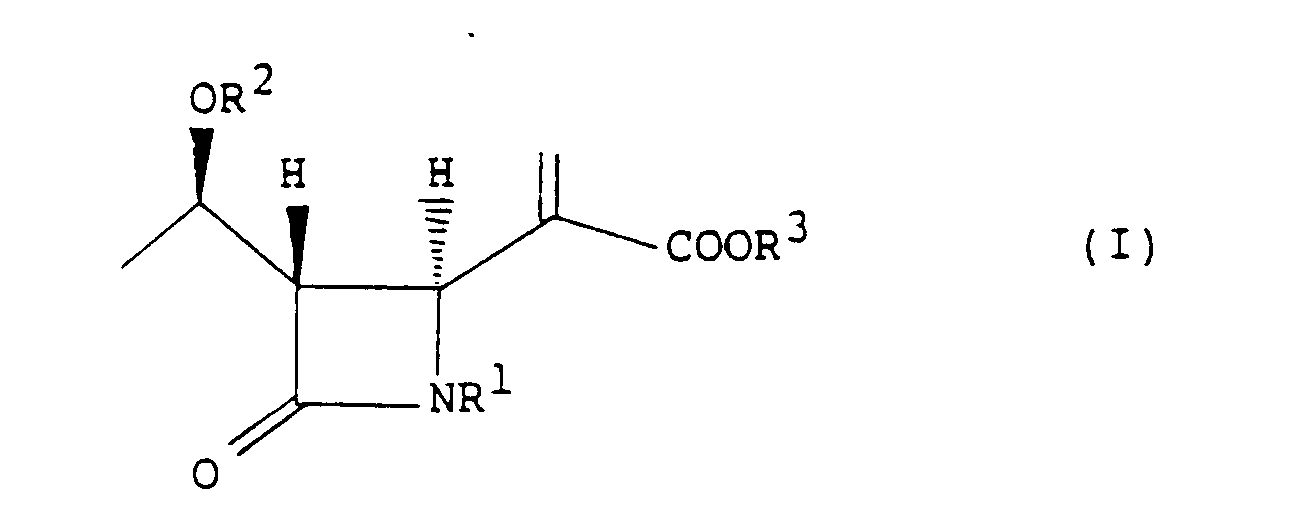
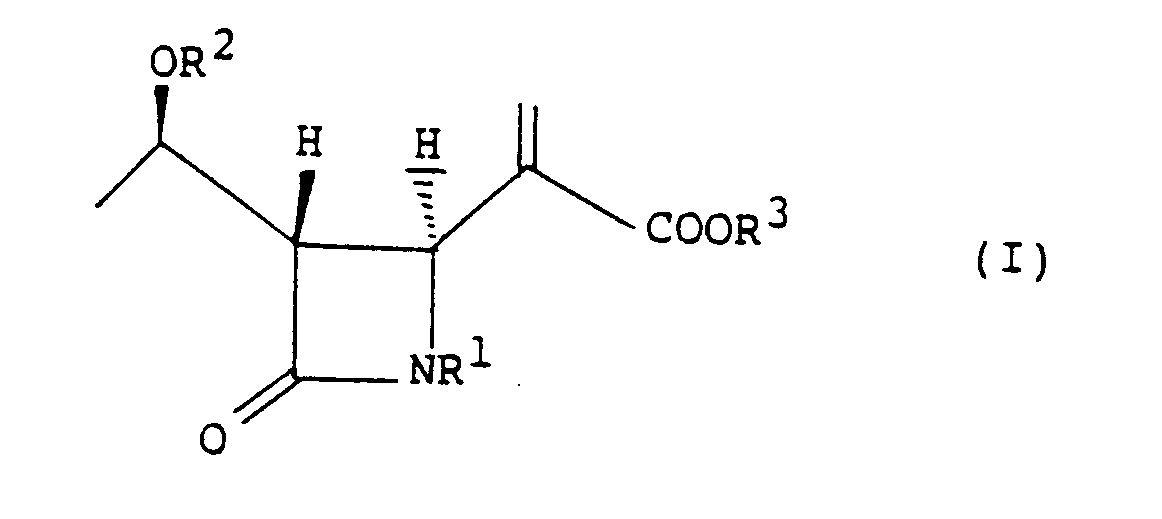
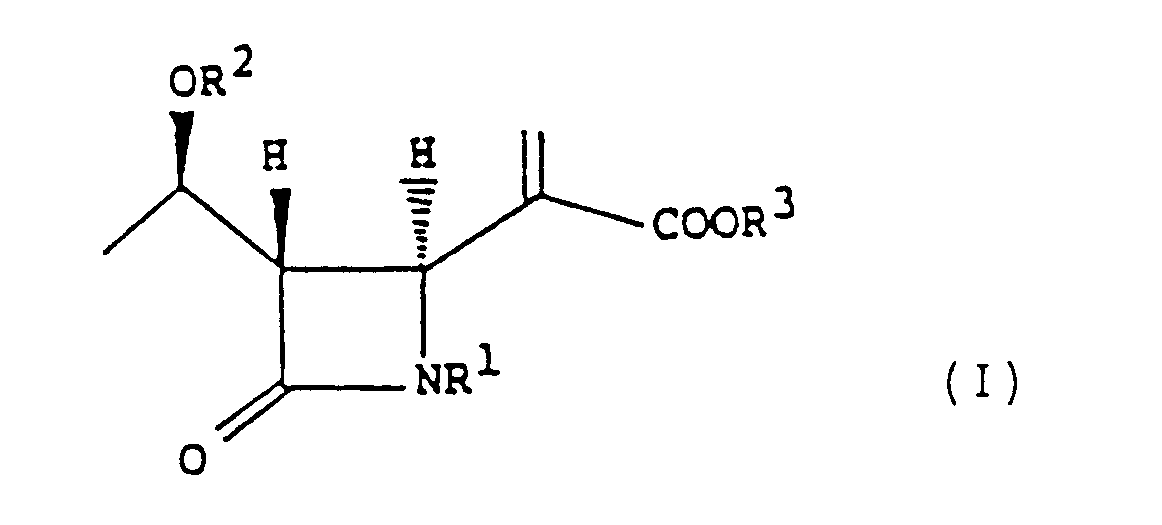
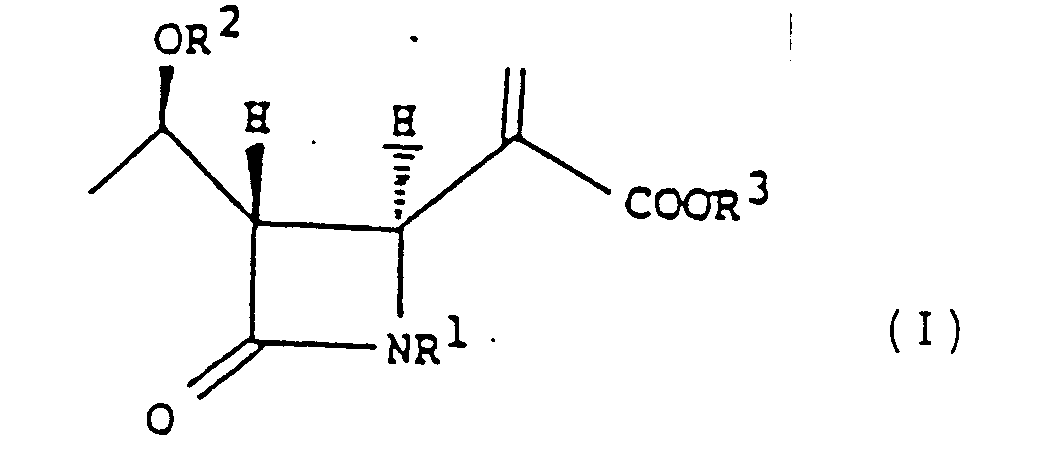
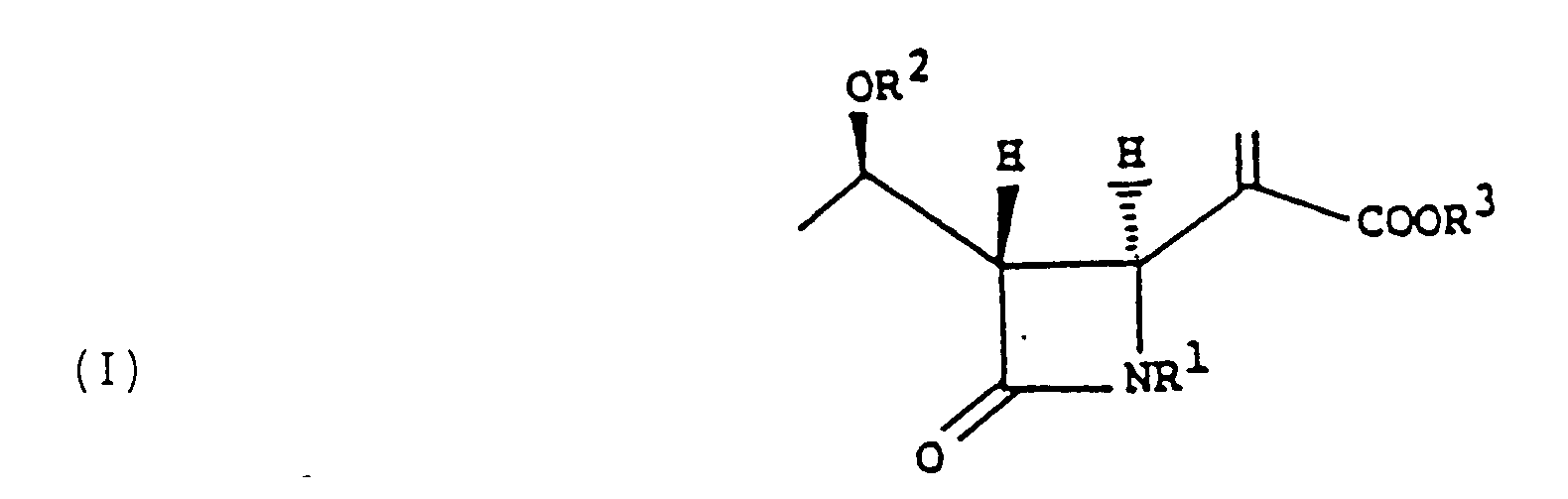
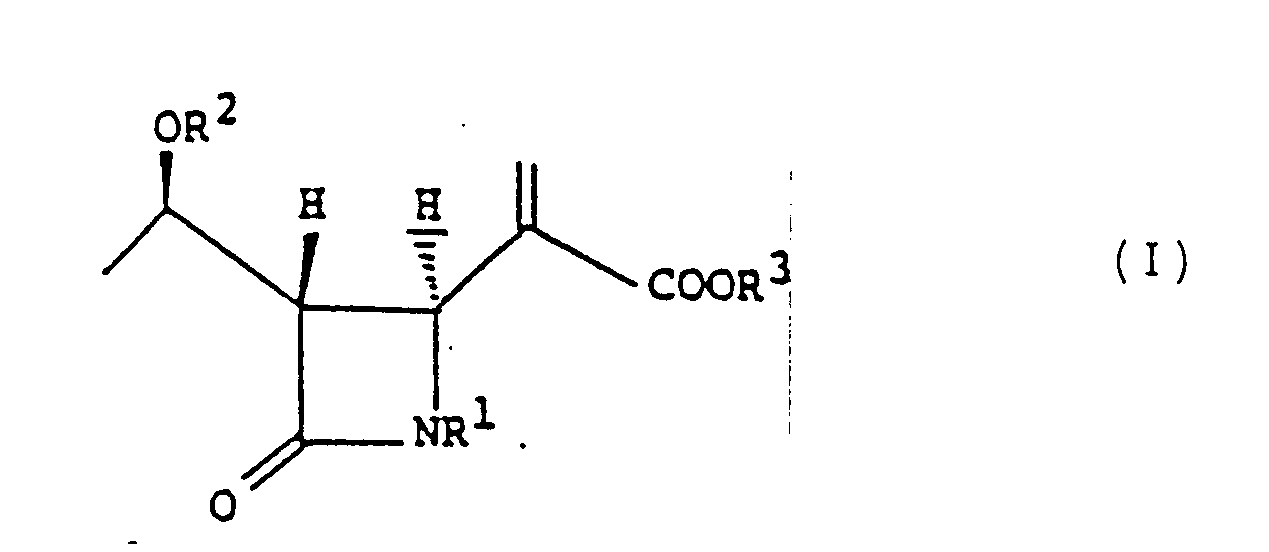
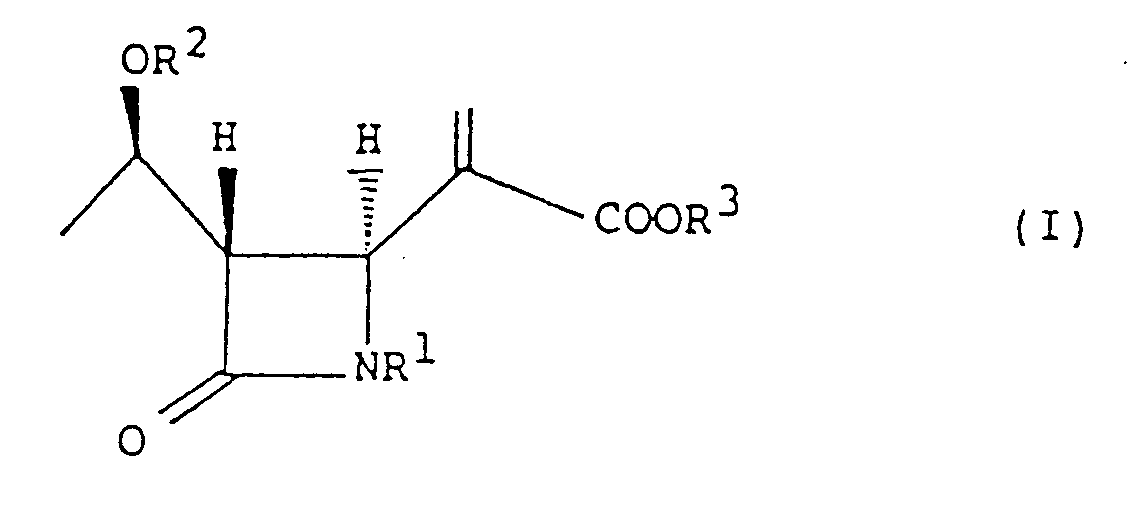
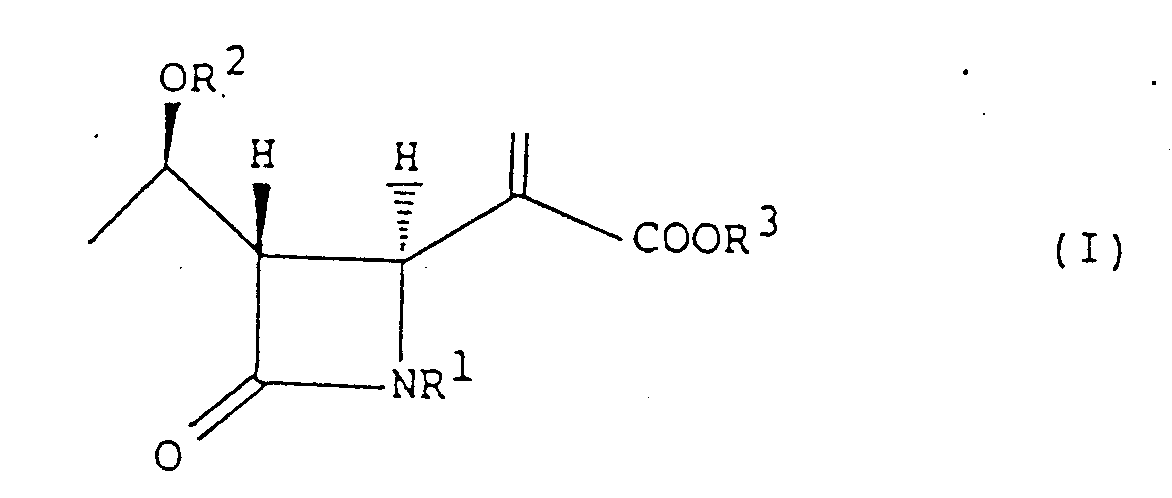
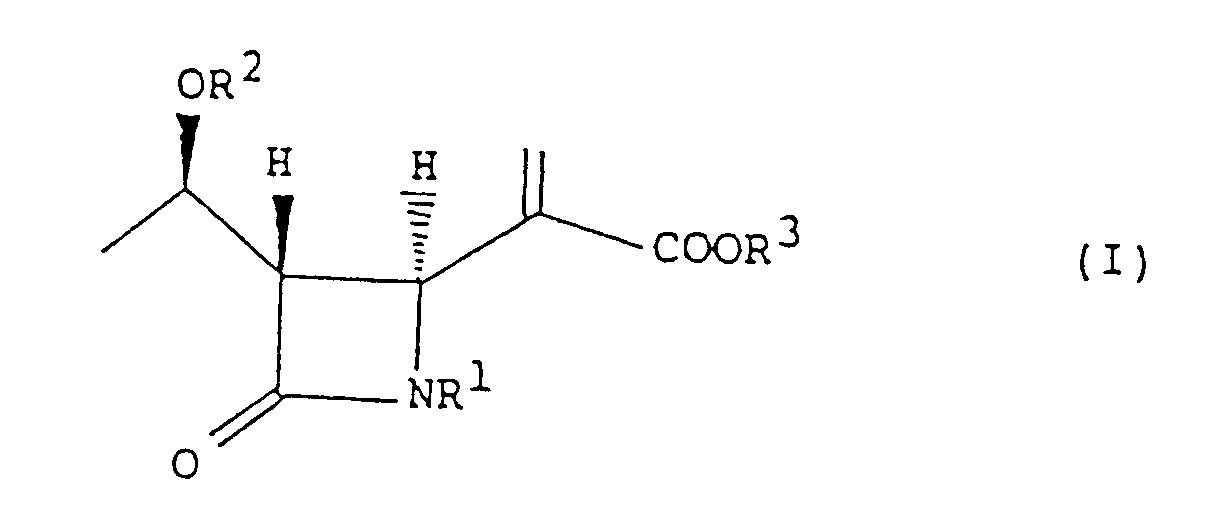
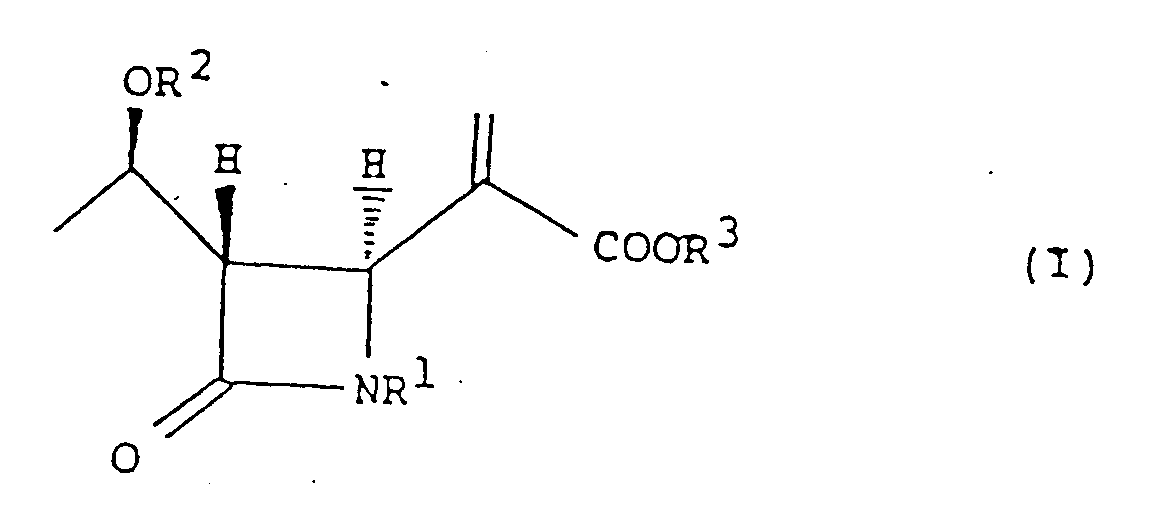
[0001] The present invention relates to an azetidinone derivative having the general formula (I):
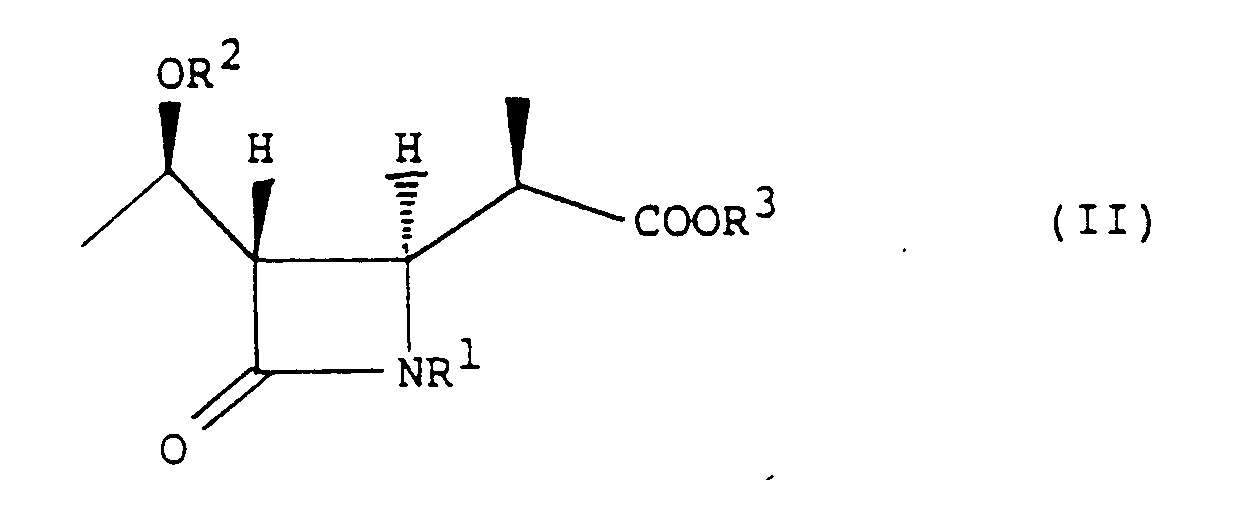
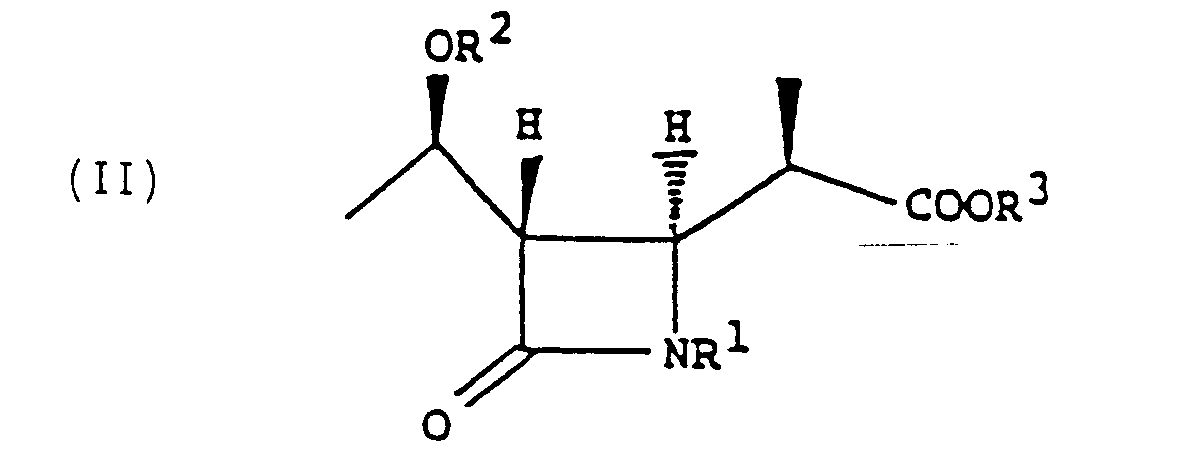
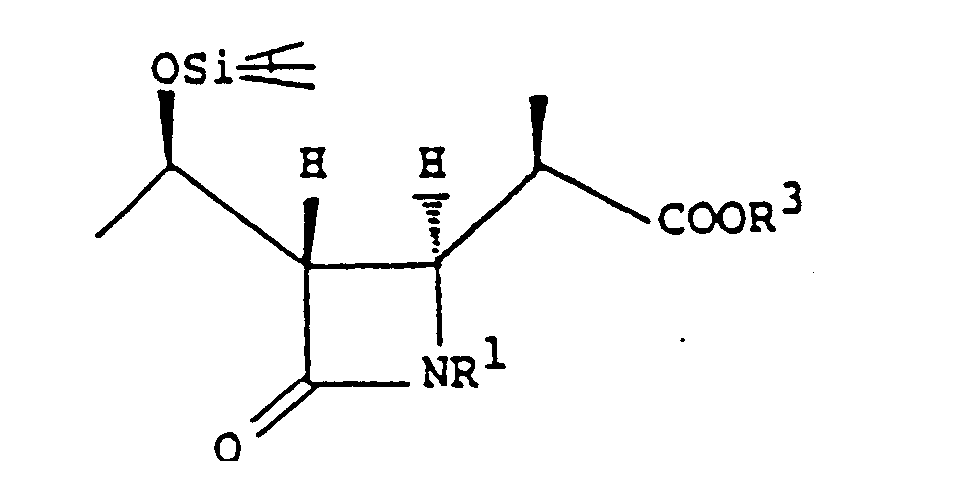
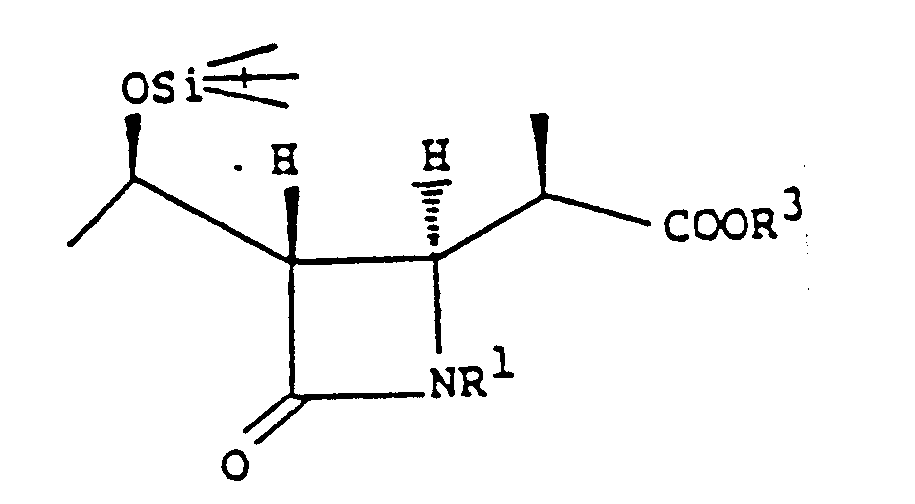
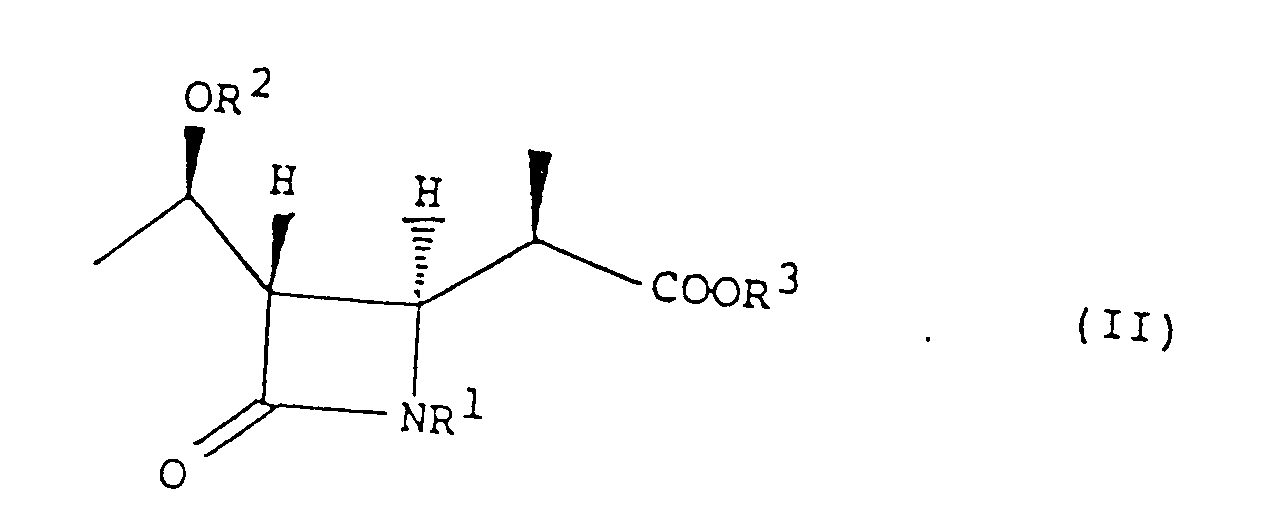
wherein R¹ is benzyl group, R² is hydrogen atom; and R³ is methyl group or ethyl group, a process for preparing the same, and a process for preparing an azetidinone derivative having the general formula (II):
wherein R¹, R² and R³ are as above.
[0002] The azetidinone derivative (I) of the present invention can be converted into an important intermediate of 1β-methylcarbapenem antibiotics by a selective reduction of the double bond (cf. the following Reference Examples). The 1β-methylcarbapenem antibiotics show an excellent antibacterial activity against almost all kinds of bacteria including Pseudomonas aeruginosa with much more powerful activity than that of known drugs and an excellent stability against β-lactamase. Moreover, the 1β-methylcarbapenem antibiotics also have a metabolic stability, which was not obtained in case of the carbapenem antibiotics, and thus are greatly expected to be the β-lactam antibiotics of the fourth generation.
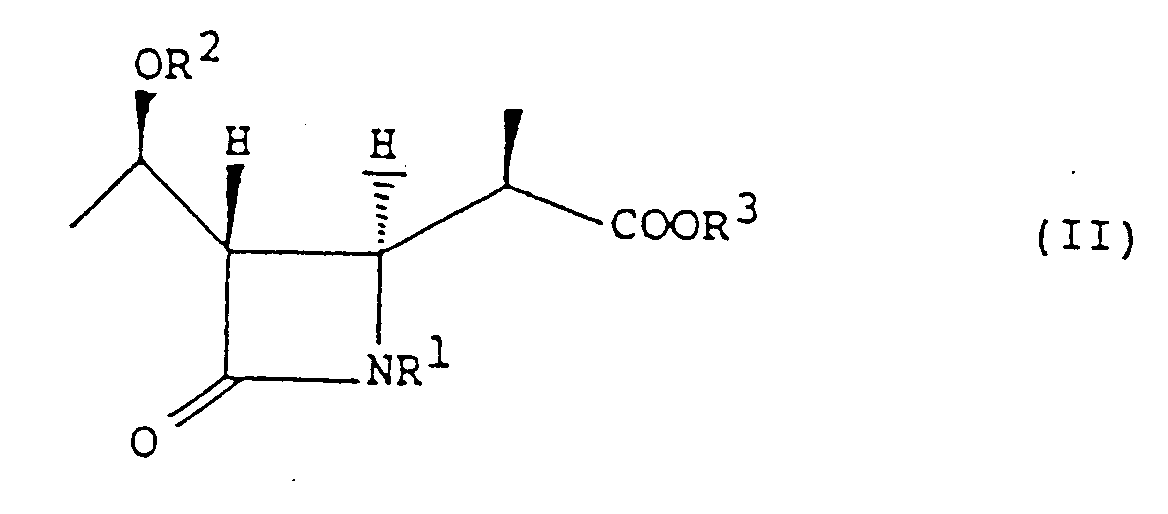
[0003] It is well known that β-lactam compound having the general formula (II):
wherein R¹, R² and R³ are as above, is a main intermediate for synthesizing 1β-methylcarbapenem antibiotics. The conventional methods, however, cannot synthesize 1β methyl group stereo-selectively and requires extremely troublesome procedures for separating stereoisomers (for example, D. H. Shih, F. Baker, L. Cama, and B. G. Christensen, Heterocycles, 21, 1 (1984); D. H. Shih, J. A. Fayter, L. D. Cama, B. G. Christensen, and J. Hirshfield, Tetrahedron Lett., 26, 583 (1985); D. H. Shir, L. Cama and B. G. Christensen, ibid., 26, 587 (1985); T. Shibata, K. Iino, T. Tanaka, T. Hashimoto, Y. Kameyama, and Y. Sugimura; ibid., 26, 4739 (1985)).
[0004] In an assay of Deok-Chan Ha, David J. Hart, and Teng-Koei Yang, published in J.Am.Chem.Soc. (1984), 106, pages 4819 to 4825 it is described that ester enolates and N-trimethylsilylimines react to afford N-protio-β-lactams. It is said that the stereochemical course of the reaction depends on the ester enolate geometry, which leads to that (E)-enolates give mainly cis β-lactams while (Z)-enolates give nearly equal mixtures of cis and trans β-lactams. Also the use of ethyl β-hydroxybutyrate as the ester component allows the preparation of β-lactams of potential use in carbapenem synthesis.
[0005] From JP-A-60 51171 the production of β-lactam compounds, for example (3S,4R)-1-[4-Methoxybenzyl]-4-phenylthioethynyl-3-[(1R)-1-hydroxyethy]-2-azetidinone, is known which are described to be useful as synthetic intermediate of a thienamycin compound (antibiotic substance).
[0006] From EPA-113 101 6-(1-Hydroxyethyl)-2-SR8-1-methyl-1-carbadethipen-2-em-3-carboxylic acid esters and a process for the preparation of such compounds are known which are used as active antibiotics.
[0007] From EPA-180 189 a β-lactam compound is known of the formula
wherein R₁ is a hydrogen atom, a lower alkyl group or a 1-hydroxy(lower)-alkyl group wherein the hydroxyl group is optionally protected, R₂ is a hydrogen atom or a protective group for the nitrogen atom and R₃ is a methyl group, a halomethyl group, a hydroxymethyl group, a protected hydroxymethyl group, a formyl group, a carboxyl group, a lower alkoxycarbonyl group or an ar(lower)alkoxycarbonyl group wherein the aryl group is optionally substituted, or R₂ and R₃ are combined together to form an oxaalkylene group and, when taken together with one nitrogen atom and two carbon atoms adjacent thereto, they represent a six-membered cyclic aminoacetal group, which is useful as a valuable intermediate in the stereospecific production of 1-methylcarbapenem compounds.
[0008] As a result of the present inventors' effort to solve the above-mentioned problem, it was found that the azetidinone derivative having the general formula (I) can be a very effective intermediate for synthesizing the above β-lactam compound having the general formula (II).
[0009] It may be said that the industrial synthesis of the 1β-methylcarbapenem antibiotics becomes easier by the present invention.
[0010] According to the present invention, there are provided an azetidinone derivative having the general formula (I):
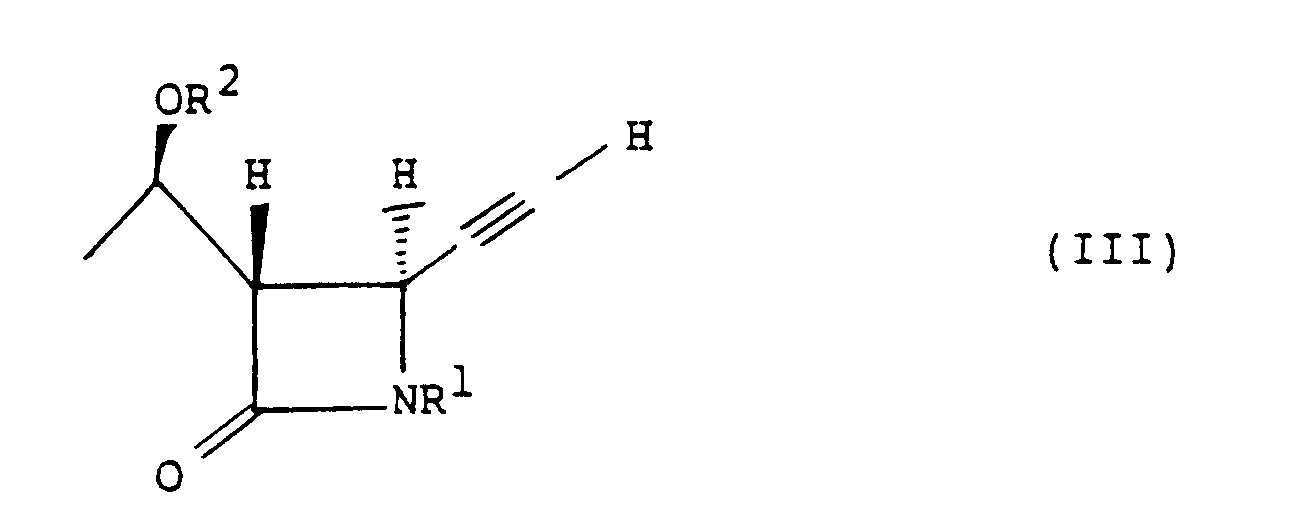
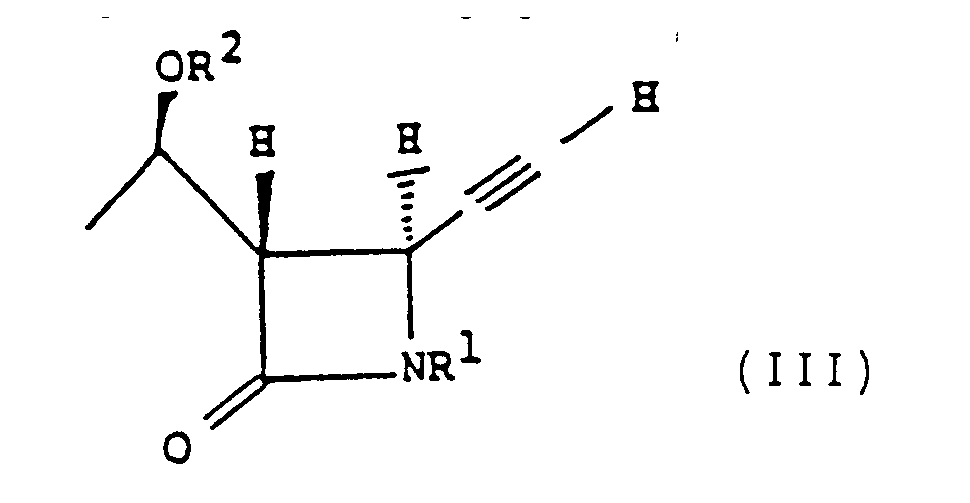
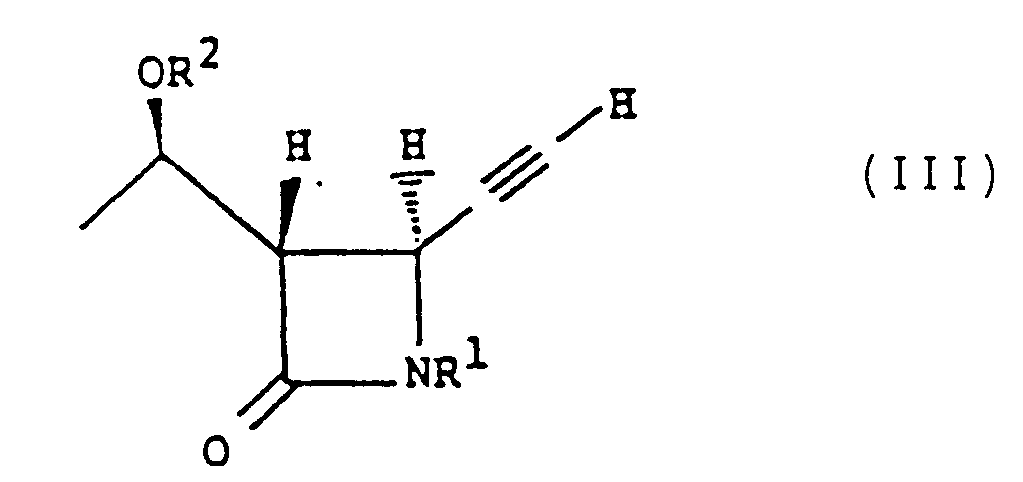
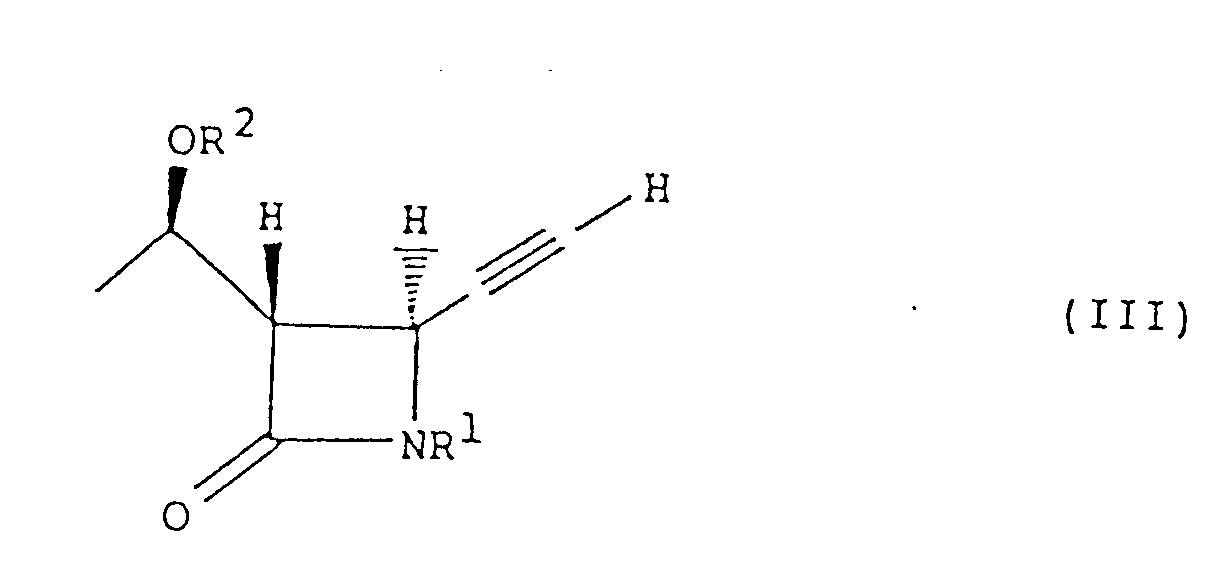
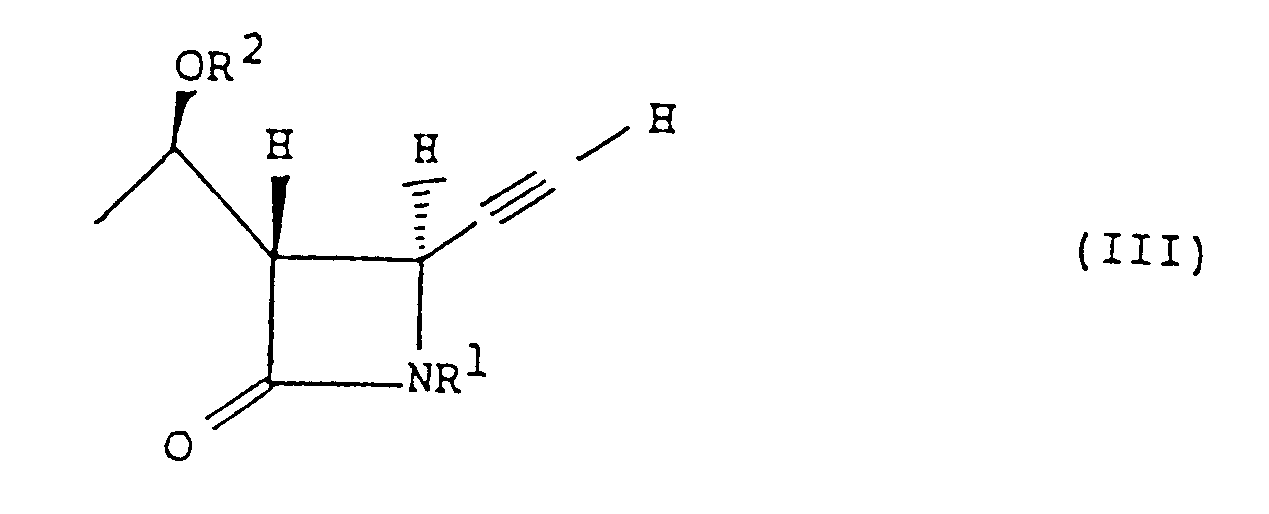
wherein R¹, R² and R³ are as above, a process for preparing the same, which comprises hydroalkoxycarbonylating an ethynylazetidinone having the general formula (III):
in the presence of group VIII metal or metal compound, alcohol and carbon monoxide, and then, if necessary, hydrolyzing the obtained product, a process for preparing an azetidinone derivative having the general formula (II):
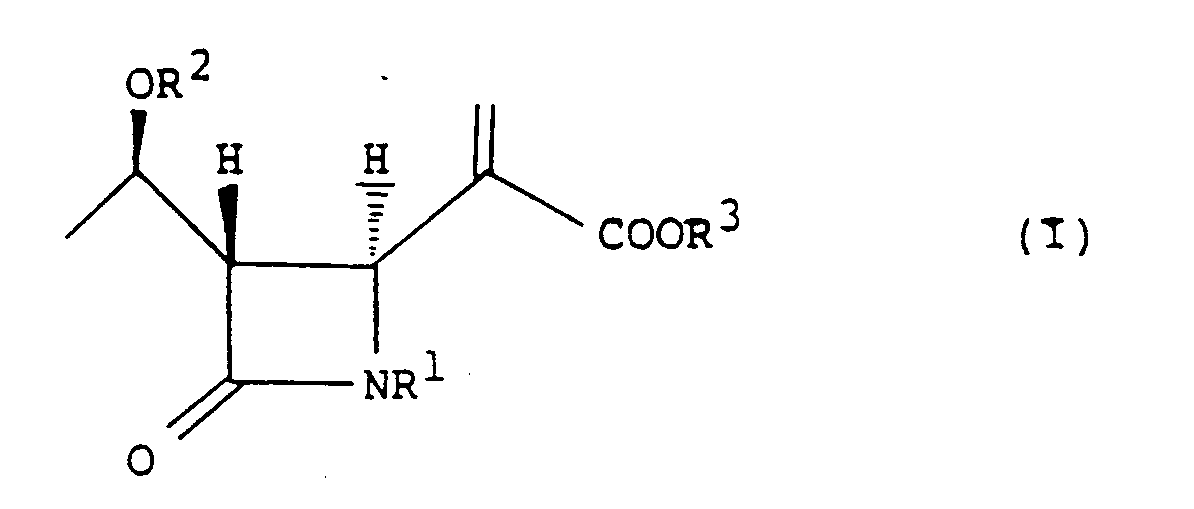
which comprises reducing an azetidinone derivative having the general formula (I) in the presence of L-selectride (Lithium tri-sec-butylborohydride) and sec-butanol, and a process for preparing an azetidinone derivative having the general formula (II), which comprises hydroalkoxycarbonylating an ethynylazetidinone having the general formula (III) in the presence of group VIII metal or metal compound, alcohol and carbon monoxide and, if necessary, hydrolyzing the obtained product to give an azetidinone derivative having the general formula (I), which is then reduced in the presence of lithium tri-sec-butylborohydride.
[0011] According to the present invention there is further provided a process for preparing an azetidinone derivative having the general formula:
wherein R¹ is benzyl group and R³ is methyl group or ethyl group,which comprises reducing an azetidinone derivative having the general formula (I):
wherein R¹ and R³ are as above, R² is hydrogen atom, in the presence of Lithium tri-sec-butylborohydride, and sec-butanol, and introducing tert-butyldimethylsilyl group into hydroxy group, and a process for preparing an azetidinone derivative having the general formula:
wherein R¹ is benzyl group and R³ is methyl group or ethyl group, which comprises hydroalkoxycarbonylating an ethynyl azetidinone having the general formula (III):
wherein R¹ is as above and R² is hydrogen atom, in the presence of group VIII metal or metal compound, alcohol and carbon monoxide and, if necessary, hydrolyzing the obtained product to give an azetidinone derivative having the general formula (I):
wherein R¹, R² and R³ are as above, reducing the compound of formula (I), in the presence of Lithium tri-sec-butylborohydride and introducing tert-butyldimethylsilyl group into hydroxy group.
[0012] The starting material of the present invention, the ethynylazetidinone having the general formula (III) can be prepared from β-hydroxybutyric acid thiol ester having the general formula (IV):
wherein R⁴ is an alkyl group or an aryl group, or according to the methods described in the literature (T. Chiba and T. Nakai, Chem. Lett., 651 (1985), D. C. Ha, D. J. Hart, and T. K. Yang, J. Am. Chem. Soc., 106, 4819 (1984)) highly efficiently (cf. the following Reference Examples).
[0013] In the general formula (III) of the starting compound of the present invention, R¹ is benzyl group, R² is hydrogen atom.
[0014] The essential condition of the process of the present invention is the hydroalkoxycarbonylation of the ethynylazetidinone having the general formula (III) in the presence of group VIII metal or metal compound, alcohol and carbon monoxide. Examples of the group VIII metal or metal compound are, for instance, palladium black, palladium charcoal, tetrakisphenylphosphine palladium, palladium chloride, or nickel carbonyl. Although an amount of the metal or metal compound may vary depending on the other reaction conditions, the reaction proceeds smoothly by employing 10⁻⁵ to 200 molar % of the metal or metal compound. A pressure of carbon monoxide used in the hydroalkoxycarbonylation may range from a normal pressure to 1471,0 kPa (150 atm), preferably from 10 to 490,3 kPa (50 atm) in viewpoint of the reaction efficiency and the operatability. Alcohol is generally used as a solvent. Examples of the alcohol which can be employed in the present invention are, for instance, methanol, ethanol, n-propanol, l-propanol, n-butanol, sec-butanol, or benzylalcohol. In addition to the alcohol, supplementary solvent can also be employed. Examples of such solvent are halogenated hydrocarbons such as methylene chloride, chloroform, carbon tetrachloride and dichloroethane, aromatic organic solvents such as benzene and toluene, ethereal organic solvent such as diethyl ether and tetrahydrofuran, aliphatic hydrocarbons such as pentane and hexane, esters such as ethyl acetate and methyl propionate, acetonitrile, hexamethyl-phosphoric triamide, dimethylsulfoxide, dimethylformamide, or water. Although the reaction temperature may vary depending on the other reaction conditions, the reaction usually proceeds at a temperature of from room temperature to 200°C. In some case, the addition of the mineral acid extremely increases the reaction efficiency. Examples of such mineral acid are, for instance, hydrochloric acid, hydrobromic acid, or hydroiodic acid. An amount of the mieral acid employed may range from 10 to 200 molar %.
[0015] The azetidinone derivative as prepared easily by the above method can be converted into the β-lactam compound having the general formula (II) with a high selectivity by means of a reducing agent such as L-selectride®.
[0016] Among the compounds having the general formula (I), the compound in the form of free acid can be easily obtained by hydrolyzing the corresponding ester according to the usual procedure.
[0017] The present invention is more particularly described and explained by the following Reference Examples and Examples.
Reference Example 1
[0019] 5.91 Grams (50 mmol) of methyl 3-hydroxybutyrate and 3.74 g (55 mmol) of imidazole were dissolved in 20 mℓ of DMF and thereto 8.29 g (55 mmol) of t-butyldimethylsilylchloride was added in several portions. After stirring the mixture at room temperature for 30 minutes, ice water was added and extraction with diethyl ether was conducted three times. The extract was washed with a saturated solution of NaCℓ, dried with anhydrous magnesium sulfate and concentrated under reduced pressure. The concentrate was distilled (62 to 68°C/0,67 kPa (5 mmHg)) to give 10.51 g of methyl (-)-3-t-butyldimethylsilyloxybutyrate (yield: 91 %).
TLC: 0.4 (hexane : diethyl ether 20 : 1)
IR: (neat) l735 cm⁻¹
MNR: δ 0.03, 0.06 (each 3H; s), 0.85 (9H; s), l.20 (3H; d J=5), 2.42 (2H; m), 3.75 (3H; s) and 4.25 (lH; m)
MS: ll5, l33, l59 [M-(Me+COOMe)], l75 [M-Bu] and 2l7 [M-Me]
[α]
-3l,75° (c=l.94, CHCℓ₃)
Reference Example 2
[0021] To a solution of 3.58 g (l5.4 mmol) of methyl (-)-3-t-butyldimethylsilyloxybutyrate dissolved in 30 mℓ of methanol, 30 mℓ of lN potassium hydroxide was added and the mixture was stirred for l5 hours. After almost all methanol was distilled away, the resultant was acidified with lN hydrochloric acid and extracted with diethyl ether. The extract was washed with a saturated solution of NaCℓ, dried with anhydrous magnesium sulfate and concentrated under reduced pressure to give 3.l8 g of (-)-3-t-butyldimethylsilyloxybutyric acid (yield: 95 %).
TLC: 0.2 (hexane : diethyl ether 20 : l)
IR: (neat) l7l0 cm⁻¹
NMR: δ 0.09 (6H; s), 0.88 (9H; s), l.20 (3H; d J=6), 2.46 (2H; d J=6) and 4.27 (lH; d t J=6.6)
MS: ll0, l37, l97 and 2l8 [M]
[α]
-l2.50° (c=0.96, chloroform)
Reference Example 3
[0023] To a solution of 3.18 g (19.2 mmol) of (-)-3-t-butyldimethylsilyloxybutyric acid and 2.26 mℓ (22 mmol) of thiophenol dissolved in 100 mℓ of methylene chloride, 4.53 g (22 mmol) of N,N'-dicyclohexylcarbodiimide was added. After stirring the mixture at room temperature for 2 hours, the resultant was filtered and the filtrate was concentrated and distilled (110 to 116°C/0,40 kPa (0.3 mmHg)) to give 5.00 g of (-)-3-t-butyldimethylsilyloxybutyric acid phenylthio ester (yield: 83 %).
TLC: 0.3 (hexane : diethyl ether 20 : 1)
IR: (neat) 1710 cm⁻¹
NMR: δ 0.07 (6H; s), 0.91 (9H; s), 1.22 (3H; d J=5), 2.61, 2.87 (each 1H; dd J=15, 7), 4.34 (1H; m) and 7.41 (5H; s)
MS: 115, 159 [M-(Me+COSPh)], 253 [M-Bu] and 295 [M-Me]
[α]
-65.91° (c=0.98, CHCℓ₃)
Reference Example 4
[0025] To 3.26 g (10.4 mmol) of (-)-3-t-butyldimethyl-silyloxybutyric acid phenylthio ester was added 50 mℓ of acetic acid: THF : water (3 : 1 : 1) and the mixture was stirred at 50°C for 24 hours. The resultant was concentrated and distilled (128 to 130°C/0,11 kPa (0.8 mmHg)) to give 1.91 g of (-)-3-hydroxybutyric acid phenylthio ester (yield: 94 %).
TLC: 0.35 (hexane : diethyl ether 1 : 1)
IR: (neat) 3440 and 1705 cm⁻¹
NMR: δ 1.20 (3H; d J=6), 2.82 (2H; d J=6), 3.0 (1H; br. s), 4.22 (1H; m) and 7.36 (5H; s)
MS: 110 [PhSH], 137 [COSPh] and 196 [M]
[α]
-42.25° (c=1.42, CHCℓ₃)
Reference Example 5
[0027] A mixture of 1.51 g (12.0 mmol) of 3-trimethylsilyl-2-propinal, 1.31 ml (12.0 mmol) of benzylamine and 10 ml of diethyl ether was stirred for 30 minutes and the solvent was distilled away under reduced pressure. The residue was distilled under reduced pressure (120 to 130°C of oil bath temperature/0,13 kPa (1 mmHg)) and the obtained imine was used as it is in the following reaction.
[0028] To a solution of 1.963 g (10.0 mmol) of (-)-3-hydroxybutyric acid phenylthio ester dissolved in 40 ml of methylene chloride, 4.00 ml (23.0 mmol) of diisopropylethylamine and 5.94 g (22.0 mmol) of 9-BBN trifurate were added at -78°C. After the mixture was heated to -25°C for 1 hour and stirred at -30° to -20°C for 1 hour, 40 ml of the methylene chloride solution of the previously prepared imine was added dropwise at the same temperature for about 20 minutes. The mixture was heated to room temperature for 1.5 hours and further stirred for 1 hour. After the reaction solution was cooled to -35° to -40°C, a mixture of 60 ml of phosphate buffer (pH 7.0), 60 ml of methanol and 30 ml of 31 % hydrogen peroxide was added for about 20 minutes. After the mixture was heated to 0°C for 30 minutes and stirred vigorously at room temperature for 1 hour, the resultant was extracted twice with methylene chloride. The extract was washed with a saturated solution of NaCℓ, dried with anhydrous magnesium sulfate and concentrated under reduced pressure. The concentrate was purified with silica-gel column (C-300; developer hexane : diethyl ether 3 : 2) to give 2.054 g of 3-benzylamino-2-(l-hydroxyethyl)-5-trimethylsilyl-4-pentynic acid phenylthio ester (yield: 50 %).
TLC: 0.4l (hexane : diethyl ether 3 : 2)
IR: (neat) 3400, 2l60 and l700 cm⁻¹
NMR: δ 0.23 (3H; s), l.25 (3H; d J=7), 2.92 (lH; t J=6), 3.6 to 3.8 (2H; m), 4.03 (lH; d J=l2), 4.3 (lH; m), 7.30 (5H; s) and 7.39 (5H; s)
MS: l5l, 2l6, 302 [M⁺-SPh] and 4l2 [M⁺+l]
Reference Example 6
[0030] To a solution of 2.054 g (5.0 mmol) of 3-benzylamino-2-(l-hydroxyethyl)-5-trimethylsilyl-4-pentinic acid phenylthio ester dissolved in 40 mℓ of THF was added 3 mℓ of 4N potassium hydroxide and the mixture was stirred at room temperature for 3 hours. The resultant was neutralised with 2N hydrochloric acid and extracted with ethyl acetate six times while conducting salting out. The extract was dried with anhydrous magnesium sulfate and concentrated. To the concentrate were added 250 mℓ of acetonitrile and then l.57 g (6.0 mmol) of triphenylphosphine and the mixture was vigorously stirred under reflux condition, to which a solution of l.32 g (6.0 mmol) of 2,2′-dipyridyldisulfide in 50 mℓ of acetonitrile was added dropwise for 40 minutes. After reflux for l hour, the reaction solution was concentrated and purified twice with 50 g of silica-gel chromatography (developer methylene chloride → diethyl ether) and then with 50 g of silica-gel chromatography (developer hexane : diethyl ether l : 4) to give 80l mg of trans-form and 62 mg of cis-form of l-benzyl-4-ethynyl-3-(l-hydroxyethyl)-2-azetidinone.
[0031] For analysis of the trans-form, sample obtained by recrystallization from diethyl ether was employed.
Trans-form
TLC: 0.75 (diethyl ether)
mp: l34°C
IR: (chloroform) 3450 and l745 cm⁻¹
NMR: δ l.24 (3H; d J=6), 2.42 (lH; d J=l), 2.7 (lH; br. s), 3.28 (lH; dd J=5, 2.5), 4.l (3H; m), 4.73 (lH; d J=l5) and 7.29 (5H; s)
MS: l32, l86, 2ll and 229 [M⁺]
Elemental Analysis: for C₁₄H₁₅O₂N
Calcd.(%): C 73.34, H 6.59, N 6.ll
Found (%): C 73.45, H 6.54, N 6.l0
[α]
-20.45° (c= l.00, chloroform)
Cis-form
TLC: 0.56 (diethyl ether)
IR: (chloroform) 3500 and l750 cm⁻¹
NMR: δ l.36 (3H; d J=6), 2.68 (lH; d J=2), 2.7 (lH; br. s), 3.27 (lH; dd J=5, 6), 4.2 (3H; m), 4.76 (lH; d J=l5) and 7.38 (5H; s)
MS: l50, l87, 205 and 229 [M⁺]
[α]
-58.82° (c=l.22, chloroform)
Reference Example 7
[0033] To a solution of 578 mg (2.74 mmol) of 3-(l-hydroxyethyl)-4-(2-trimethylsilylethynyl)-2-azetidinone, which was prepared according to T. Chiba and T. Nakai [Chem. Lett., 65l (l985)], in 5 mℓ of THF, 4 mℓ (4 mmol) of a lM solution of tetrabutylammonium fluoride in THF was added. After stirring at room temperature for 2 hours, l0 g of silica-gel was added, the solvent was distilled away and the resultant was eluted with diethyl ether. The eluent was concentrated and purified with l0 g of silica-gel column (diethyl ether) to give 347 mg of 4-ethynyl-3-(l-hydroxyethyl)-2-azetidinone (yield: 92 %).
TLC: 0.35 (diethyl ether)
IR: (neat) 3300 and l750 cm⁻¹
NMR: δ l.28 (3H; d J=6), 2.45 (lH; d J=2), 3.3 (2H; m), 4.2 (lH; m), 4.28 (lH; t J=2) and 6.8 (lH; m)
MS: l06, l2l (M⁺-H₂O) and l39 (M⁺)
Reference Example 8
[0035] To a solution of 63 mg (0.45 mmol) of 4-ethynyl-3-(l-hydroxyethyl)-2-azetidinone in 2 mℓ of DMF, 0.l7 mℓ (l.2 mmol) of triethylamine and l80 mg (l.2 mmol) of t-butyldimethylsilyl chloride were added and the mixture was stirred at room temperature for a night. Ice water was added to the reaction solution and the resultant was extracted three times with diethyl ether, washed with a saturated solution of NaCℓ, dried with anhydrous magnesium sulfate and purified with 5 g of silica-gel column (hexane : ether l0 : l) to give l43 mg of l-t-butyldimethylsilyl-3-(l-t-butyldimethylsilyloxyethyl)-4-ethynyl-2-azetidinone (yield: 87 %).
TLC: 0.3 (hexane : ether l0 : l)
IR: (chloroform) l740 cm⁻¹
NMR: δ 0.02, 0.04 (each 3H; s), 0.2l, 0.23 (each 3H; s), 0.82 (9H; s), 0.9l (9H; s), l.l8 (3H; d J=6), 2.38 (lH; d J=2), 3.23 (lH; t J=2.5) and 4.2 (2H; m)
MS: l48, l53, 3l0 (M⁺-Bu) and 352 (M⁺-Me)
Reference Example 9
[0037] To a solution of 36 mg (0.l6 mmol) of l-benzyl-4-ethynyl-3-(l-hydroxyethyl)-2-azetidinone in 2 mℓ of methylene chloride, 30 mg (0.25 mmol) of 4,4-dimethyl-aminopyridine and 0.04 mℓ (0.25 mmol) of benzyloxycarbonyl chloride were added at -l0°C and the mixture was stirred for a night. Ice water was added to the reaction solution and the resultant was extracted three times with methylene chloride. The extract was washed with a saturated solution of NaCℓ, dried with anhydrous magnesium sulfate, concentrated and purified with 5 g of silica-gel column (hexane : ether 2 : 3) to give 40 mg of 1-benzyl-3-(1-benzyloxycarbonyloxyethyl)-4-ethynyl-2-azetidinone (yield: 69 %).
TLC: 0.5 (hexane : ether 1 : 1)
IR: (chloroform) 1760 and 1265 cm⁻¹
NMR: δ 1.39 (3H; d J=6), 2.44 (1H; d J=2), 3.48 (1H; dd J=2, 6), 4.0 (2H; m), 4.79 (1H; d J=15), 5.1 (3H; m), 7.28 (5H; s) and 7.42 (5H; s)
MS: 108, 210, 228, 272 (M⁺-PhCH₂), 318, 335 and 363
Example 1
[0039] In autoclave were introduced 229 mg (1 mmol) of 1-benzyl-4-ethynyl-3-(1-hydroxyethyl)-2-azetidinone, 10 mg (0.1 mmol) of palladium black, 0.19 ml (0.5 mmol) of concentrated hydroiodic acid and 10 ml of methanol. The autoclave was charged with carbon monoxide at 196,1 kPa (20 atm) and the reaction was carried out at 65°C for 16 hours. To the reaction mixture was added 0.2 ml of triethylamine and the mixture was concentrated under reduced pressure. The concentrate was purified with 15 g of silica-gel column (benzene : ethyl acetate 3 : 2) to give 203 mg of 1-benzyl-3-(1-hydroxyethyl)-4-(1-methoxycarbonylethenyl)-2-azetidinone (yield: 70 %).
TLC: 0.3 (benzene : ethyl acetate 1 : 1)
IR: (chloroform) 3500 and 1745 cm⁻¹
NMR: δ 1.28 (3H; d J=6), 2.96 (1H; dd J=2, 6), 3.3 (1H; br. s), 3.74 (3H; s), 3.91 (1H; d J=15), 4.1 (2H; m), 4.79 (1H; d J=15), 5.85 (1H; s), 6.36 (1H; s) and 7.3 (5H; s)
MS: 156, 177, 216, 271 (M⁺-H₂O) and 290 (M⁺+1)
Example 2
[0041] In autoclave were introduced 46 mg (0.2 mmol) of 1-benzyl-4-ethynyl-3-(1-hydroxyethyl)-2-azetidinone, 5 mg (0.05 mmol) of palladium black, 0.02 ml (0.1 mmol) of concentrated hydroiodic acid and 5 ml of ethanol. The autoclave was charged with carbon monoxide at 196,1 kPa (20 atm) and the reaction was carried out at 65°C for 12 hours. To the reaction mixture was added 0.1 ml of triethylamine and the mixture was concentrated under reduced pressure. The concentrate was purified with 2 g of silica-gel column (benzene : ethyl acetate 3 : 2) to give 32 mg of 1-benzyl-3-(1-hydroxyethyl)-4-(1-methoxycarbonylethenyl)-2-azetidinone (yield: 53 %).
TLC: 0.3 (benzene : ethyl acetate 1 : 1)
IR: (chloroform) 3300 and 1745 cm⁻¹
NMR: δ 1.3 (5H; m), 2.91 (1H; dd J=2, 6), 3.2 (1H; br. s), 3.90 (1H; d J=15), 4 to 4.5 (4H; m), 4.78 (1H; d J=15), 5.86 (1H; s), 6.34 (1H; s) and 7.3 (5H; s)
MS: 96, 134, 158, 170, 172, 230, 275 and 285
Example 3
[0043] In autoclave were introduced 35 mg (0.1 mmol) of 1-benzyl-3-(1-benzyloxycarbonyloxyethyl)-4-ethynyl-2-azetidinone, 3 mg (0.03 mmol) of palladium black, 0.01 ml (0.05 mmol) of concentrated hydroiodic acid and 4 ml of methanol. The autoclave was charged with carbon monoxide at 196,1 kPa (20 atm) and the reaction was carried out at 65°C for 12 hours. To the reaction mixture was added 0.1 ml of triethylamine and the mixture was concentrated under reduced pressure. The concentrate was purified with 2 g of silica-gel column (ether : hexane 2 : 1) to give 31 mg of 1-benzyl-3-(1-benzyloxycarbonyloxyethyl)-4-(1-methoxycarbonylethenyl)-2-azetidinone (yield: 73 %).
TLC: 0.4 (ether : hexane 2 : 1)
IR: (chloroform) 1760 and 1265 cm⁻¹
NMR: δ 1.27 (3H; d J=6), 3.20 (1H; dd J=2, 6), 3.63 (3H; s), 3.84 (1H; d J=15), 4.32 (1H; d J=2), 4.76 (1H; d J=15), 5.1 (1H; m), 5.12 (2H; s), 5.72 (1H; s), 6.29 (1H; s), 7.2 (5H; s) and 7.4 (5H; s)
MS: 96, 180, 196, 216, 228, 270, 290, 332 (M⁺-PhCH₂) and 395
Example 4
[0045] The reaction was carried out as in Example 1 except that 144 mg (1.0 mmol) of 4-ethynyl-3-(1-hydroxyethyl)-2-azetidinone was employed. The obtained product was purified with 10 g of silica-gel column (benzene : acetone 1 : 1) to give 89 mg of 3-(1-hydroxyethyl)-4-(1-methoxycarbonylethenyl)-2-azetidinone (yield: 45 %).
TLC: 0.15 (ether)
IR: (chloroform) 1710 and 1760 cm⁻¹
NMR: δ 1.41 (3H; d J=6), 2.96 (1H; dd J=2, 6), 3.5 (1H; br. s), 3.81 (3H; s), 4.25 (1H; m), 4.47 (1H; m), 5.93 (1H; s), 6.31 (1H; s) and 7.0 (1H; br. s)
MS: 114, 124, 139, 149, 165 and 181 (M⁺-H₂O)
Example 5
[0047] In autoclave were introduced 184 mg (0.5 mmol) of 1-t-butyldimethylsilyl-3-(1-t-butyldimethylsilyloxyethyl)-4-ethynyl-2-azetidinone, 5 mg (0.05 mmol) of palladium black, 0.1 ml (0.25 mmol) of concentrated hydroiodic acid and 5 ml of methanol. The autoclave was charged with carbon monoxide at 196,1 kPa (20 atm) and the reaction was carried out at 65°C for 16 hours. To the reaction mixture was added 0.1 ml of triethylamine and the mixture was concentrated under reduced pressure. The concentrate was purified with 10 g of silica-gel column (benzene : acetone 1 : 1) to give 50 mg of 3-(1-hydroxyethyl)-4-(1-methoxycarbonylethenyl)-2-azetidinone (yield: 50 %). The spectrum data of the obtained product agreed completely with those of the product obtained in Example 4.
Example 6
[0049] In autoclave were introduced 46 mg (0.2 mmol) of 1-benzyl-4-ethynyl-3-(1-hydroxyethyl)-2-azetidinone, 30 mg of 10 % palladium charcoal, 0.02 ml (0.1 mmol) of concentrated hydroiodic acid and 5 ml of methanol. The autoclave was charged with carbon monoxide at 196,1 kPa (20 atm) the reaction was carried out at 65°C for 12 hours. To the reaction mixture was added 0.1 ml of triethylamine and the mixture was concentrated under reduced pressure. The concentrate was purified with 2 g of silica-gel column (benzene : ethyl acetate 3 : 2) to give 6 mg of 1-benzyl-3-(1-hydroxyethyl)-4-(1-methoxycarbonylethenyl)-2-azetidinone (yield: 10 %). The spectrum data of the obtained product agreed completely with those of the product obtained in Example 1.
Example 7
[0051] The procedure in Example 6 was repeated except that tetrakistriphenylphosphine was employed in place of 10 % palladium charcoal to give 7 mg of 1-benzyl-3-(1-hydroxyethyl)-4-(1-methoxycarbonylethenyl)-2-azetidinone (yield: 12 %). The spectrum data of the obtained product agreed completely with those of the product obtained in Example 1.
Example 8
[0053] To a solution of 30 mg (0.1 mmol) of 1-benzyl3-(1-hydroxyethyl)-4-(1-methoxycarbonylethenyl)-2-azetidinone dissolved in 1 ml of methanol, 1 ml (1 mmol) of 1N potassium hydroxide was added with ice bath. After the mixture was stirred at room temperature for 4 hours, 1 ml of 1N hydrochloric acid was added and the extraction with ethyl acetate was conducted three times. The extract was washed with a saturated solution of NaCl, dried with magnesium sulfate and concentrated to give 19 mg of 1-benzyl-4-(1-carboxyethenyl)-3-(1-hydroxyethyl)-2-azetidinone (yield: 68 %).
TLC: 0.2 (ethyl acetate)
IR: (neat) 3400 and 1735 cm⁻¹
NMR: δ 1.35 (3H; d J=6), 3.06 (1H; dd J=7, 2), 3.8 (1H; m), 4.3 (1H; m), 4.92 (1H; d J=15), 5.93 (1H; s), 6.4 (2H; br. s), 6.48 (1H; s) and 7.44 (5H; s)
MS: 73, 84, 86, 106, 107, 149, 167 and 205
Example 9
[0055] The procedure in Example 2 was repeated except that methanol/diethyl ether (1/1) was employed in place of ethanol to give 30 mg of 1-benzyl-3-(1-hydroxyethyl)-4-(1-methoxycarbonylethenyl)-2-azetidinone (yield: 50 %). The spectrum data of the obtained product agreed completely with those of product obtained in Example 1.
Reference Example 10
[0057] To a solution of 30 mg (0.1 mmol) of 1-benzyl-3-(1-hydroxyethyl)-4-(1-methoxycarbonylethenyl)-2-azetidinone dissolved in 0.5 ml of THF and 1 ml of sec-butanol, 0.5 ml (0.5 mmol) of a 1M solution of L-selectride® in THF was slowly added at -78°C. After stirring at the same temperature for 1 hour, 0.1 ml of acetic acid was added and the mixture was vigorously stirred for 10 minutes. sec-Butanol and acetic acid were removed under reduced pressure by the azeotropic distillation with toluene at room temperature. Ethyl acetate was added to the concentrated residue and the resultant was filtered with kieselguhr. The filtrate was concentrated and thereto 1 ml of DMF, 20 mg (0.3 mmol) of imidazole and 45 mg (0.3 mmol) of t-butyldimethylsilylchloride were added successively. After stirring at room temperature for a night, ice water was added and the extraction with ether was carried out. The organic layer was washed with a saturated solution of NaCl, dried with magnesium sulfate and purified with 2 g of silica-gel column (hexane : ether 1 : 1) to give 29 mg of 1-benzyl-4-(1-methoxycarbonylethyl)-3-(1-t-butyldimethylsilyloxy-ethyl)-2-azetidinone (yield: 72 %). NMR showed α : β = 1 : 8 (cf. the following Reference Examples 11 and 12).
TLC: 0.35 (ether : hexane 1 : 1)
IR: 1740 cm⁻¹
NMR: δ 0.02, 0.05 (each 3H; s), 0.84 (9H; s), 1.09 (3H; d J=7), 1.22 (3H; d J=6), 2.8 (1H; m), 3.06 (1H; dd J=2, 6), 3.61 (2.67 H; s corresponding to β-form of methyl ether), 3.65 (0.33 H; s corresponding to α-form of methyl ester), 3.82 (1H; m), 4.1 (2H; m), 4.68 (1H; d J=15) and 7.3 (5H; s)
MS: 91, 348 (M⁺-Bu) and 390 (M⁺-Me)
Reference Example 11
[0059] To a solution of 25 mg of 1-benzyl-4-(1-methoxycarbonylethyl)-3-(1-t-butyldimethylsilyloxyethyl)-2-azetidinone, which was obtained in Reference Example 10, dissolved in 1 ml of methanol, 1 ml (1 mmol) of 1N potassium hydroxide was added and the mixture was stirred at room temperature for 6 hours. To the reaction solution was added l mℓ of 2N hydrochloric acid with ice bath and the resultant was extracted with ethyl acetate. The extract was washed with a saturated solution of NaCℓ, dried with magnesium sulfate and concentrated. The concentrate was dissolved in l mℓ of ether and the solution was added at -78°C to a blue solution prepared from 20 mg of Na and about 2 mℓ of ammonia. After stirring at the same temperature for l hour, a saturated aqueous solution of ammonium chloride was added to the solution. The mixture was heated to around 0°C and extracted with ethyl acetate three times. The extract was washed with a saturated solution of NaCℓ, dried with magnesium sulfate, concentrated and purified with 2 g of silica-gel column (ethyl acetate) to give l4 mg of 3-(l-t-butyldimethylsilyloxyethyl)-4-(l-carboxyethyl)-2-azetidinone (yield: 62 %). The spectrum data of the sample obtained by reprecipitation from hexane-methylene chloride agreed completely with those described in the literature [D. H. Shih, F. Baker, L. Cama and B. G. Christensen, Heterocycles 2l, 29 (l984)].
Reference Example l2
[0061] 3-(l-t-Butyldimethylsilyloxyethyl)-4-(l-methoxycarbonylethyl)-2-azetidinone was obtained by treating 3-(l-t-butyldimethylsilyloxyethyl)-4-(l-carboxyethyl)-2-azetidinone, which was obtained in Reference Example ll, with diazomethane in ether and proved to be lβ-methyl form by the comparison with the NMR data described in the literature [D. H. Shih, F. Baker, L. Cama and B. G. Christensen, Heterocycles 2l, 29 (1984)].
Reference Example 13
[0063] To a solution of 60 mg (0.3 mmol) of 3-(1-hydroxyethyl)-4-(1-methoxycarbonylethenyl)-2-azetidinone dissolved in 2 ml of THF, 10 mg of 5 % palladium charcoal was added and the mixture was stirred under hydrogen atmosphere for a night. The reaction solution was filtered with kieselguhr and the filtrate was washed with ethyl acetate and concentrated. To the concentrate were added 1 ml of DMF, 40 mg (0.6 mmol) of imidazole and 90 mg (0.6 mmol) of t-butyldimethylsilylchloride and the mixture was stirred for a night. Ice water was added to the reaction solution and the resultant was extracted with ether, washed with a saturated solution of NaCl, dried with magnesium sulfate, concentrated and purified with 15 g of silica-gel column (ether : hexane 1 : 2 → 2 : 3) to give 12 mg of α-form, 16 mg of β-form and 35 mg of the mixture thereof of 3-(1-t-butyldimethylsilyloxyethyl)-4-(1-methoxycarbonylethyl)-2-azetidinone (yield: 67 %).
[0064] The spectrum data of the obtained compounds agreed completely with those described in the literature [D. H. Shih, F. Baker, L. Cama and B. G. Christensen, Heterocycles 21, 29 (1984)].
Reference Example 14
[0066] To a solution of 28 mg (0.07 mmol) of 1-benzyl-3-(1-benzyloxycarbonyloxyethyl)-4-(1-methoxycarbonylethenyl)-2-azetidinone dissolved in 2 ml of methanol, 5 mg of 5 % palladium charcoal was added and the mixture was stirred under hydrogen atmosphere for a night. The reaction solution was filtered with kieselguhr and the filtrate was washed with ethyl acetate and concentrated. To the concentrate were added 1 ml of DMF, 20 mg (0.3 mmol) of imidazole and 45 mg (0.3 mmol) of t-butyldimethylsilylchloride and the mixture was stirred for a night. Ice water was added to the reaction solution and the resultant was extracted with ether, washed with a saturated solution of NaCl, dried with magnesium sulfate, concentrated and purified with 2 g of silica-gel column (hexane : ether 1 : 1) to give 22 mg of 1-benzyl-4-(-1-methoxycarbonylethyl)-3-(1-t-butyldimethylsilyloxyethyl)-2-azetidinone (yield: 84 %). Comparison with the NMR data showed α : β = 1 : 1.
[0067] TLC, IR and MS were the same as in Reference Example 10.
NMR: δ 0.02, 005 (each 3H; s), 0.84 (9H; s), 1.09 (3H; d J=7), 1.22 (3H; d J=6), 2.4 to 2.9 (3.5H; m), 3.52 (1.5H; s), 3.61 (1.5H; s), 3.65 (0.5H; m), 3.82 (0.5H; s), 3.9 to 4.5 (2.5H; m), 4.68 (0.5H; d J=15) and 7.3 (5H; s)
Reference Example 15
[0069] To a solution of 38 mg (0.14 mmol) of 1-benzyl-4-(1-carboxyethenyl)-3-(1-hydroxyethyl)-2-azetidinone dissolved in l mℓ of methanol, 5 mg of 5 % palladium charcoal was added and the mixture was stirred under hydrogen atmosphere for a night. The reaction solution was filtered with kieselguhr, the filtrate was added with an ethereal solution of diazomethane and the resultant was concentrated. The concentrate was purified with 2 g of silica-gel column (benzene : ethyl acetate 1 : 1) to give 30 mg of 1-benzyl-4-(1-methoxycarbonylethyl)-3-(1-hydroxyethyl)-2-azetidinone (yield: 78 %).
TLC: 0.3 (benzene : ethyl acetate l : l)
IR: (chloroform) 3500 and l740 cm⁻¹
NMR: δ l.0 to l.3 (6H; d × 4 each J=ca.6), 2.4 to 3.0 (3H; m), 3.48, 3.5l (total 3H; each s), 3.5 to 4.l (3H; m), 4.35 (0.5H; m), 4.69 (0.5H; d J=l4) and 7.26 (5H; s)
MS: l26, l60, l76, 204, 2l4, 263 and 292 (M⁺+l)
Reference Example l6
[0071] To a solution of 25 mg (0.086 mmol) of l-benzyl-4-(l-methoxycarbonylethyl)-3-(l-hydroxyethyl)-2-azetidinone, which was obtained in Reference Example l5, dissolved in l mℓ of DMF, were added 20 mg (0.3 mmol) of imidazole and 45 mg (0.3 mmol) of t-butyldimethylsilylchloride and the mixture was stirred for a night. Ice water was added to the reaction solution and the resultant was extracted with ether. The extract was purified with silica-gel column as in Reference Example l4 to give 28 mg of l-benzyl-4-(l-methoxycarbonylethyl)-3-(l-t-butyldimethylsilyloxyethyl)-2-azetidinone (yield: 8l %).
1. An azetidinone derivative having the general formula (I):
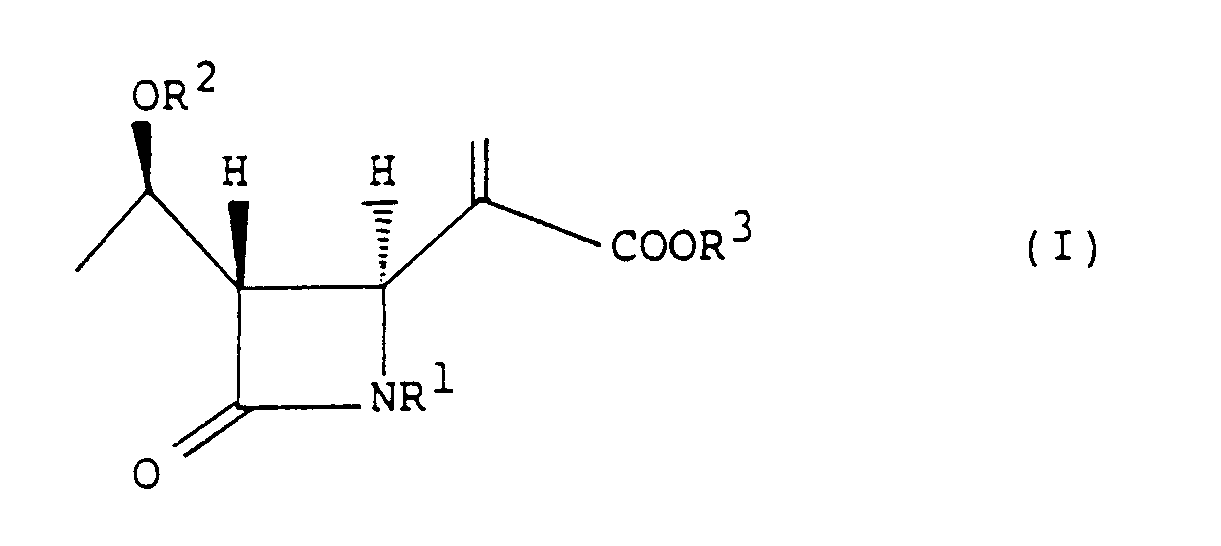
wherein R¹ is benzyl group, R² is hydrogen atom; and R³ is methyl group or ethyl group.
wherein R¹ is benzyl group, R² is hydrogen atom; and R³ is methyl group or ethyl group.
2. A process for preparing an azetidinone derivative having the general formula (I):
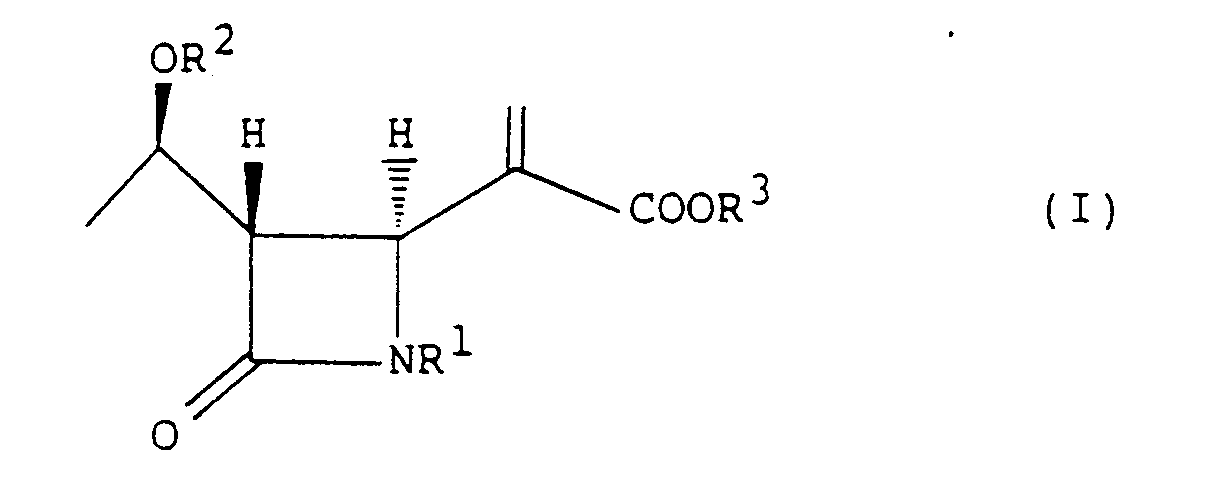
wherein R¹ is benzyl group, R² is hydrogen atom and R³ is methyl group or ethyl group, which comprises hydroalkoxycarbonylating an ethynylazetidinone having the general formula (III):
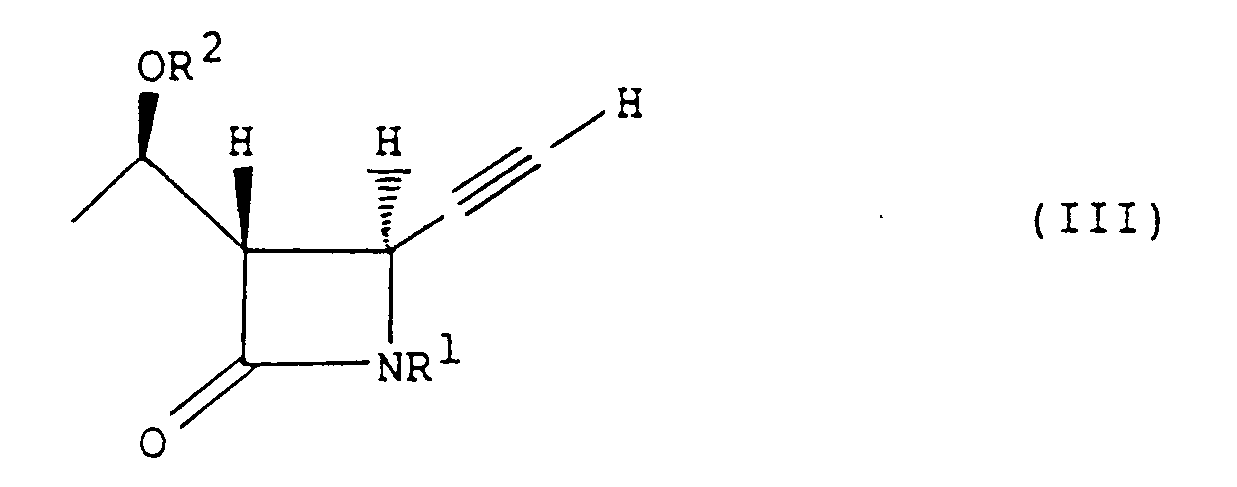
wherein R¹ and R² are as above, in the presence of group VIII metal or metal compound, alcohol and carbon monoxide, and then, if necessary, hydrolyzing the obtained product.
wherein R¹ is benzyl group, R² is hydrogen atom and R³ is methyl group or ethyl group, which comprises hydroalkoxycarbonylating an ethynylazetidinone having the general formula (III):
wherein R¹ and R² are as above, in the presence of group VIII metal or metal compound, alcohol and carbon monoxide, and then, if necessary, hydrolyzing the obtained product.
3. A process for preparing an azetidinone derivative having the general formula (II):
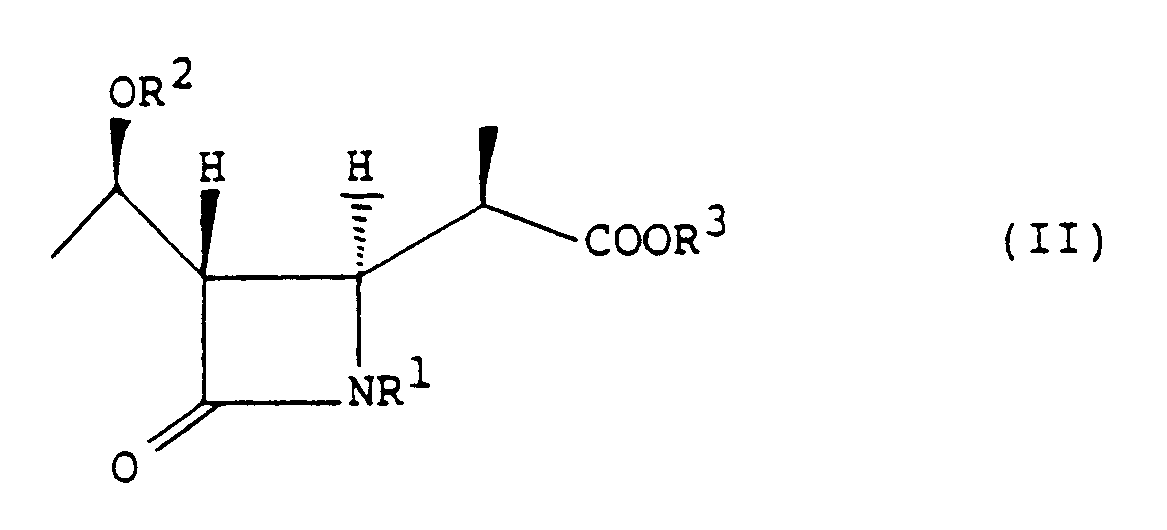
wherein R¹ is benzyl group, R² is hydrogen atom and R³ is methyl group or ethyl group which comprises reducing an azetidinone derivative having the general formual (I):
wherein R¹, R² and R³ are as above, in the presence of Lithium tri-sec-butylborohydride, and sec-butanol.
wherein R¹ is benzyl group, R² is hydrogen atom and R³ is methyl group or ethyl group which comprises reducing an azetidinone derivative having the general formual (I):
wherein R¹, R² and R³ are as above, in the presence of Lithium tri-sec-butylborohydride, and sec-butanol.
4. A process for preparing an azetidinone derivative having the general formula (II):
wherein R¹ is benzyl group, R² is hydrogen atom and R³ is methyl group or ethyl group, which comprises hydroalkoxycarbonylating an ethynyl azetidinone having the general formula (III):
wherein R¹ and R² are as above, in the presence of group VIII metal or metal compound, alcohol and carbon monoxide and, if necessary, hydrolyzing the obtained product to give an azetidinone derivative having the general formula (I):
wherein R¹, R² and R³ are as above, and reducing the compound of formula I in the presence of Lithium tri-sec-butylborohydride.
wherein R¹ is benzyl group, R² is hydrogen atom and R³ is methyl group or ethyl group, which comprises hydroalkoxycarbonylating an ethynyl azetidinone having the general formula (III):
wherein R¹ and R² are as above, in the presence of group VIII metal or metal compound, alcohol and carbon monoxide and, if necessary, hydrolyzing the obtained product to give an azetidinone derivative having the general formula (I):
wherein R¹, R² and R³ are as above, and reducing the compound of formula I in the presence of Lithium tri-sec-butylborohydride.
5. A process for preparing an azetidinone derivative having the general formula:
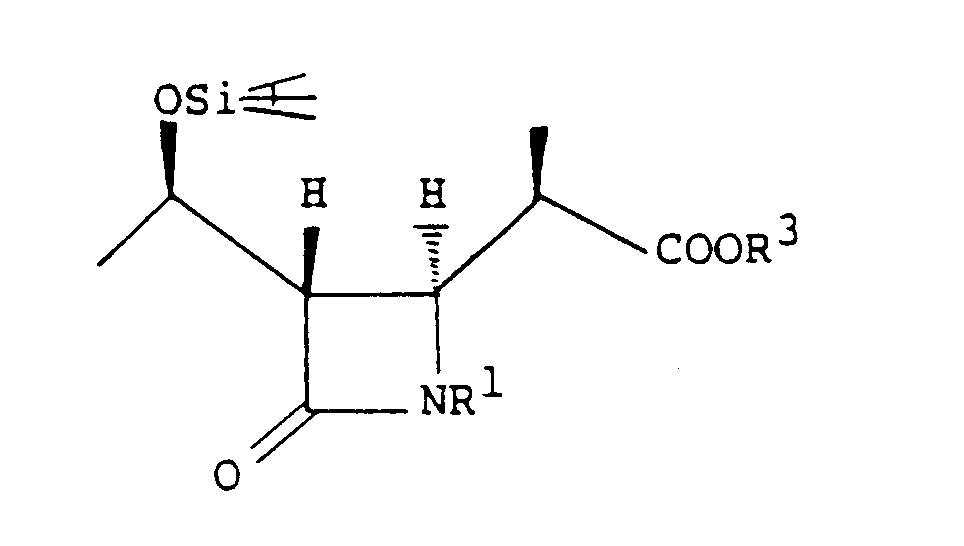
wherein R¹ is benzyl group and R³ is methyl group or ethyl group,which comprises reducing an azetidinone derivative having the general formula (I):
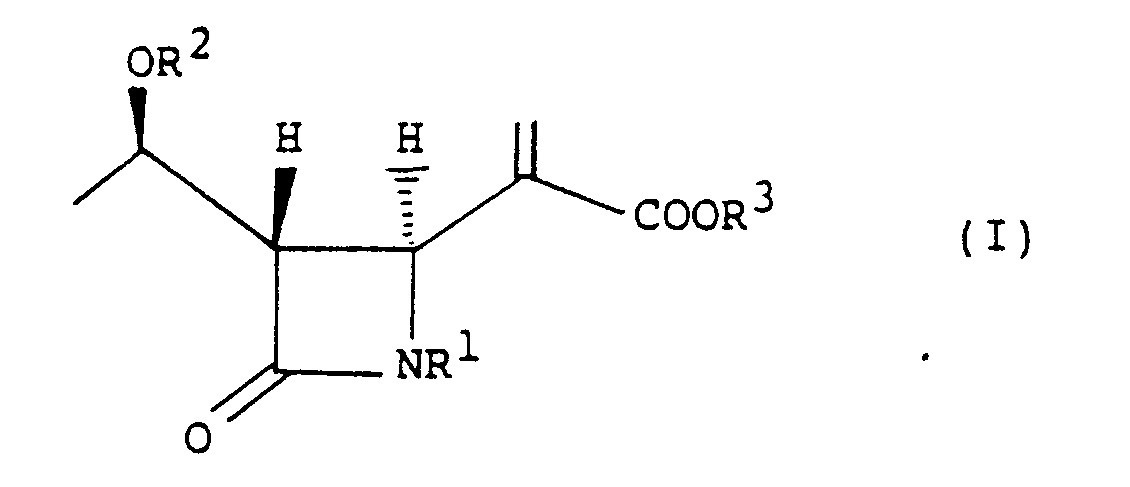
wherein R¹ and R³ are as above, R² is hydrogen atom, in the presence of Lithium tri-sec-butylborohydride, and sec-butanol, and introducing tert-butyldimethylsilyl group into hydroxy group.
wherein R¹ is benzyl group and R³ is methyl group or ethyl group,which comprises reducing an azetidinone derivative having the general formula (I):
wherein R¹ and R³ are as above, R² is hydrogen atom, in the presence of Lithium tri-sec-butylborohydride, and sec-butanol, and introducing tert-butyldimethylsilyl group into hydroxy group.
6. A process for preparing an azetidinone derivative having the general formula:
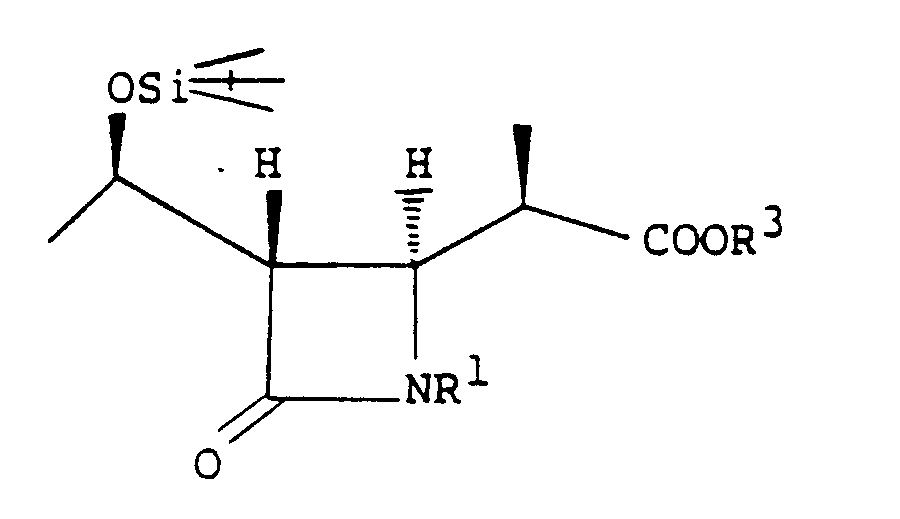
wherein R¹ is benzyl group and R³ is methyl group or ethyl group, which comprises hydroalkoxycarbonylating an ethynyl azetidinone having the general formula (III):
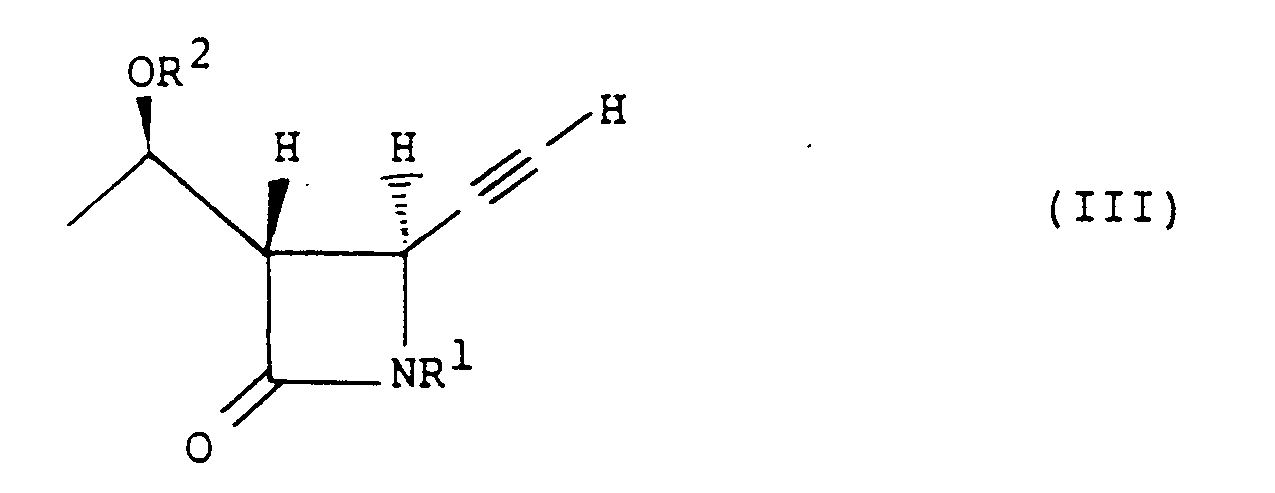
wherein R¹ is as above and R² is hydrogen atom, in the presence of group VIII metal or metal compound, alcohol and carbon monoxide and, if necessary, hydrolyzing the obtained product to give an azetidinone derivative having the general formula (I):
wherein R¹, R² and R³ are as above, reducing the compound of formula (I), in the presence of Lithium tri-sec-butylborohydride, and introducing tertbutyldimethylsilyl group into hydroxy group.
wherein R¹ is benzyl group and R³ is methyl group or ethyl group, which comprises hydroalkoxycarbonylating an ethynyl azetidinone having the general formula (III):
wherein R¹ is as above and R² is hydrogen atom, in the presence of group VIII metal or metal compound, alcohol and carbon monoxide and, if necessary, hydrolyzing the obtained product to give an azetidinone derivative having the general formula (I):
wherein R¹, R² and R³ are as above, reducing the compound of formula (I), in the presence of Lithium tri-sec-butylborohydride, and introducing tertbutyldimethylsilyl group into hydroxy group.
1. Dérivé d'azétidinone répondant à la formule générale I :
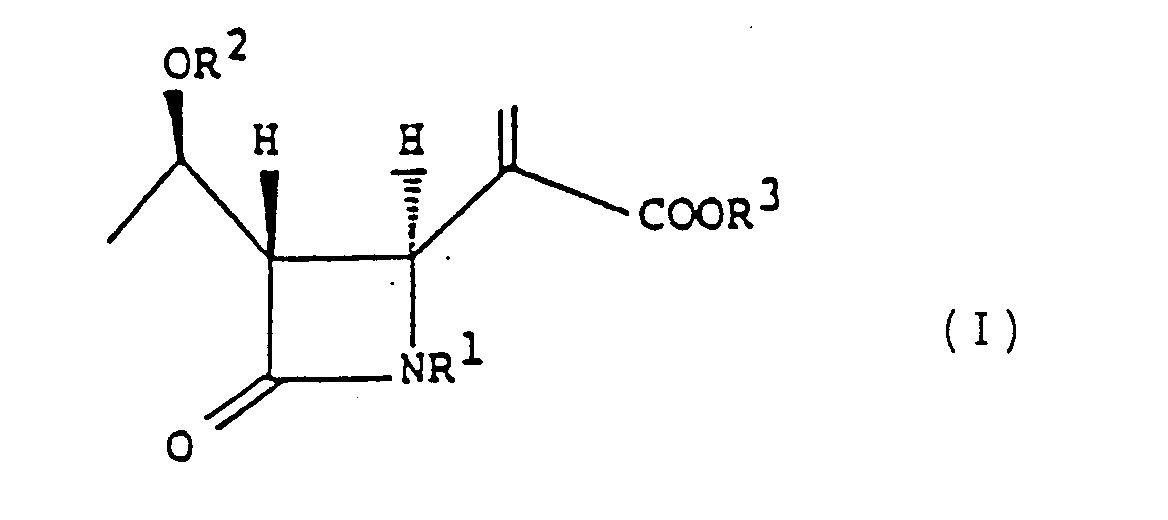
dans laquelle R¹ est un radical benzyle, R² est un atome d'hydrogène et R³ est un radical méthyle ou éthyle.
dans laquelle R¹ est un radical benzyle, R² est un atome d'hydrogène et R³ est un radical méthyle ou éthyle.
2. Procédé de préparation d'un dérivé d'azétidinone de formule générale I :
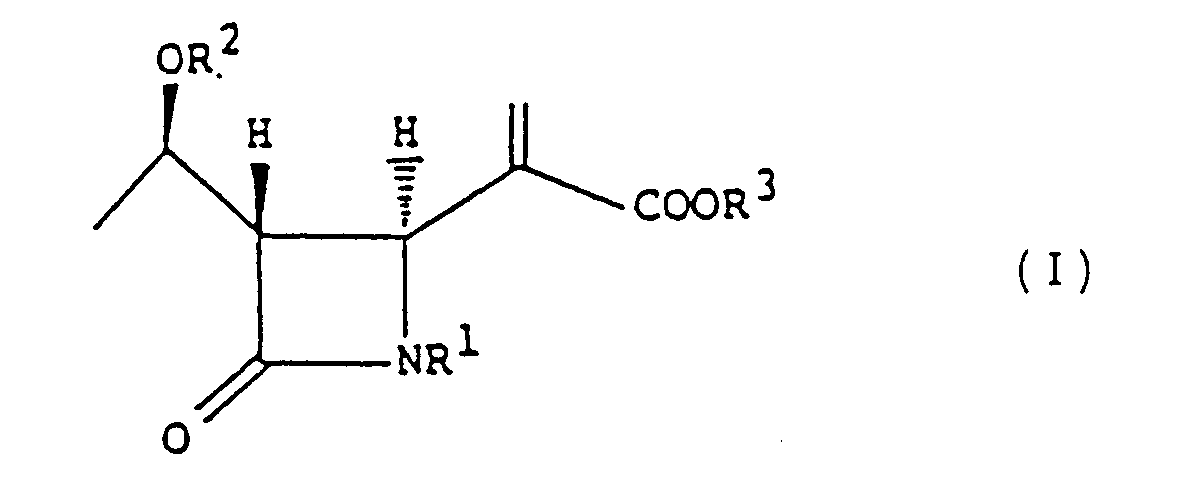
dans laquelle R¹ est un radical benzyle, R² est un atome d'hydrogène, R³ est un radical méthyle ou éthyle, qui consiste à hydroalcoxycarbonyler une éthynyl azétidone de formule générale III :
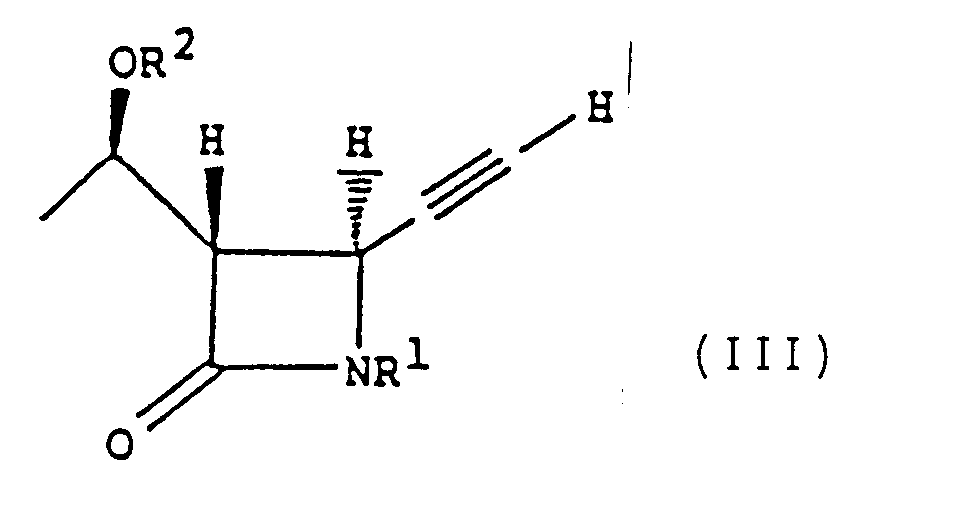
dans laquelle R¹ et R² sont comme ci-dessus, en présence d'un métal ou composé métallique du groupe VIII d'un alcool et d'oxyde de carbone et, ensuite, à hydrolyser éventuellement le produit obtenu.
dans laquelle R¹ est un radical benzyle, R² est un atome d'hydrogène, R³ est un radical méthyle ou éthyle, qui consiste à hydroalcoxycarbonyler une éthynyl azétidone de formule générale III :
dans laquelle R¹ et R² sont comme ci-dessus, en présence d'un métal ou composé métallique du groupe VIII d'un alcool et d'oxyde de carbone et, ensuite, à hydrolyser éventuellement le produit obtenu.
3. Procédé de préparation d'un dérivé d'azétidinone de formule générale II :
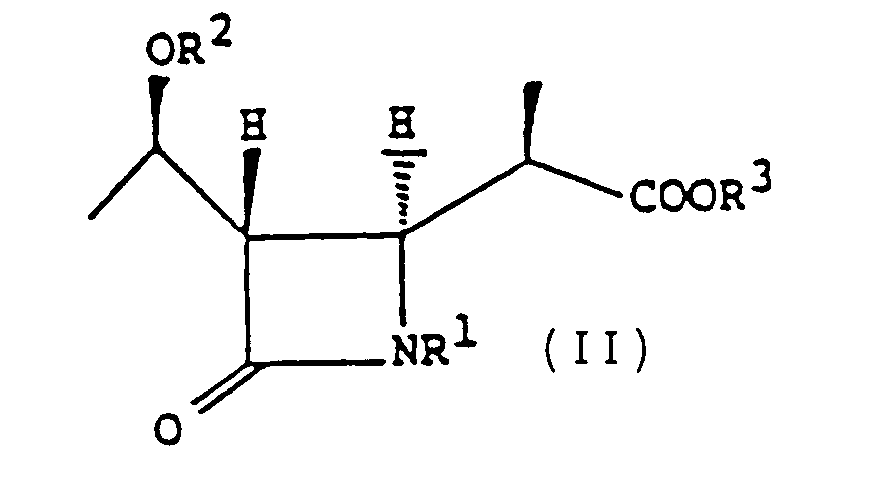
dans laquelle R¹ est un radical benzyle, R² est un atome d'hydrogène et R³ est un radical méthyle ou éthyle, qui consiste à réduire un dérivé d'azétidinone de formule générale I :
dans laquelle R¹, R² et R³ sont comme ci-dessus en présence de tri-s-butylborohydrure de lithium et de s-butanol.
dans laquelle R¹ est un radical benzyle, R² est un atome d'hydrogène et R³ est un radical méthyle ou éthyle, qui consiste à réduire un dérivé d'azétidinone de formule générale I :
dans laquelle R¹, R² et R³ sont comme ci-dessus en présence de tri-s-butylborohydrure de lithium et de s-butanol.
4. Procédé de préparation d'un dérivé d'azétidinone de formule générale II :
dans laquelle R¹ est un radical benzyle, R² est un atome d'hydrogène et R³ est un radical méthyle ou éthyle, qui consiste à hydroalcoxycarbonyler une éthynyl-azétidinone de formule générale III :
dans laquelle R¹ et R² sont tels que ci-dessus en présence d'un métal ou composé métallique du Groupe VIII, d'un alcool et d'un oxyde de carbone et, éventuellement, à hydrolyser le produit obtenu pour obtenir un dérivé d'azétidinone de formule générale I :
dans laquelle R¹, R² et R³ sont tels que ci-dessus et à réduire le composé de formule I en présence de tri-s-butylborohydrure de lithium.
dans laquelle R¹ est un radical benzyle, R² est un atome d'hydrogène et R³ est un radical méthyle ou éthyle, qui consiste à hydroalcoxycarbonyler une éthynyl-azétidinone de formule générale III :
dans laquelle R¹ et R² sont tels que ci-dessus en présence d'un métal ou composé métallique du Groupe VIII, d'un alcool et d'un oxyde de carbone et, éventuellement, à hydrolyser le produit obtenu pour obtenir un dérivé d'azétidinone de formule générale I :
dans laquelle R¹, R² et R³ sont tels que ci-dessus et à réduire le composé de formule I en présence de tri-s-butylborohydrure de lithium.
5. Procédé de préparation d'un dérivé d'azétidinone de formule générale :
dans laquelle R¹ est un radical benzyle et R³ est un radical méthyle ou éthyle, qui consiste à réduire le dérivé d'azétidinone de formule générale I :
dans laquelle R¹ et R³ sont tels que ci-dessus, R² est un atome d'hydrogène, en présence de tri-s-butylborohydrure de lithium et de s-butanol et introduire un groupe t-butyldiméthylsilyle dans le radical hydroxy.
dans laquelle R¹ est un radical benzyle et R³ est un radical méthyle ou éthyle, qui consiste à réduire le dérivé d'azétidinone de formule générale I :
dans laquelle R¹ et R³ sont tels que ci-dessus, R² est un atome d'hydrogène, en présence de tri-s-butylborohydrure de lithium et de s-butanol et introduire un groupe t-butyldiméthylsilyle dans le radical hydroxy.
6. Procédé de préparation d'un dérivé d'azétidinone de formule générale :
dans laquelle R¹ est un radical benzyle et R³ est un radical méthyle ou éthyle, qui consiste à hydroalcoxycarbonyler une éthynyl-azétidinone de formule générale III :
dans laquelle R¹ est tel que ci-dessus et R² est un atome d'hydrogène, en présence d'un métal ou composé métallique du Groupe VIII, d'un alcool et d'oxyde de carbone et éventuellement, à hydrolyser le produit obtenu pour obtenir un dérivé d'azétidinone de formule générale I :
dans laquelle R¹, R² et R³ sont tels que ci-dessus, à réduire le composé de formule I en présence de tris-s-butylborohydrure de lithium et à introduire un groupe t-butyldiméthylsilyle dans le radical hydroxy.
dans laquelle R¹ est un radical benzyle et R³ est un radical méthyle ou éthyle, qui consiste à hydroalcoxycarbonyler une éthynyl-azétidinone de formule générale III :
dans laquelle R¹ est tel que ci-dessus et R² est un atome d'hydrogène, en présence d'un métal ou composé métallique du Groupe VIII, d'un alcool et d'oxyde de carbone et éventuellement, à hydrolyser le produit obtenu pour obtenir un dérivé d'azétidinone de formule générale I :
dans laquelle R¹, R² et R³ sont tels que ci-dessus, à réduire le composé de formule I en présence de tris-s-butylborohydrure de lithium et à introduire un groupe t-butyldiméthylsilyle dans le radical hydroxy.
1. Azetidinon-Derivat der allgemeinen Formel (I):
worin R¹ eine Benzylgruppe, R² ein Wasserstoffatom und R³ eine Methylgruppe oder eine Ethylgruppe bedeuten.
worin R¹ eine Benzylgruppe, R² ein Wasserstoffatom und R³ eine Methylgruppe oder eine Ethylgruppe bedeuten.
2. Verfahren zur Herstellung eines Azetidinon-Derivats der allgemeinen Formel (I):
worin R¹ eine Benzylgruppe, R² ein Wasserstoffatom und R³ eine Methylgruppe oder eine Ethylgruppe bedeuten, das umfaßt
die Hydroxyalkoxycarbonylierung eines Ethinylazetidinons der allgemeinen Formel (III):
worin R¹ und R² wie oben definiert sind,
in Gegenwart eines Metalls oder einer Verbindung eines Metalls der Gruppe VIII des PSE, eines Alkohols und von Kohlenmonoxid und dann, falls erforderlich,
die Hydrolyse des erhaltenen Produkts.
worin R¹ eine Benzylgruppe, R² ein Wasserstoffatom und R³ eine Methylgruppe oder eine Ethylgruppe bedeuten, das umfaßt
die Hydroxyalkoxycarbonylierung eines Ethinylazetidinons der allgemeinen Formel (III):
worin R¹ und R² wie oben definiert sind,
in Gegenwart eines Metalls oder einer Verbindung eines Metalls der Gruppe VIII des PSE, eines Alkohols und von Kohlenmonoxid und dann, falls erforderlich,
die Hydrolyse des erhaltenen Produkts.
3. Verfahren zur Herstellung eines Azetidinon-Derivats der allgemeinen Formel (II):
worin R¹ eine Benzylgruppe, R² ein Wasserstoffatom und R³ eine Methylgruppe oder eine Ethylgruppe bedeuten, das umfaßt
die Reduktion eines Azetidinon-Derivats der allgemeinen Formel (I):
worin R¹, R² und R³ wie oben definiert sind,
in Gegenwart von Lithium-tri-sec-butylborhydrid und sec-Butanol.
worin R¹ eine Benzylgruppe, R² ein Wasserstoffatom und R³ eine Methylgruppe oder eine Ethylgruppe bedeuten, das umfaßt
die Reduktion eines Azetidinon-Derivats der allgemeinen Formel (I):
worin R¹, R² und R³ wie oben definiert sind,
in Gegenwart von Lithium-tri-sec-butylborhydrid und sec-Butanol.
4. Verfahren zur Herstellung eines Azetidinon-Derivats der allgemeinen Formel (II):
worin R¹ eine Benzylgruppe, R² ein Wasserstoffatom und R³ eine Methylgruppe oder eine Ethylgruppe bedeuten, das umfaßt
die Hydroxyalkoxycarbonylierung eines Ethinylazetidinons der allgemeinen Formel (III)
worin R¹ und R² wie oben definiert sind,
in Gegenwart eines Metalls oder einer Verbindung eines Metalls des PSE, eines Alkohols und von Kohlenmonoxid, und, falls erforderlich,
die Hydrolyse des erhaltenen Produkts zur Herstellung eines Azetidinon-Derivats der allgemeinen Formel (I):
worin R¹, R² und R³ wie oben angegeben sind, und
die Reduktion der Verbindung der Formel (I) in Gegenwart von Lithium-tri-sec-butylborhydrid.
worin R¹ eine Benzylgruppe, R² ein Wasserstoffatom und R³ eine Methylgruppe oder eine Ethylgruppe bedeuten, das umfaßt
die Hydroxyalkoxycarbonylierung eines Ethinylazetidinons der allgemeinen Formel (III)
worin R¹ und R² wie oben definiert sind,
in Gegenwart eines Metalls oder einer Verbindung eines Metalls des PSE, eines Alkohols und von Kohlenmonoxid, und, falls erforderlich,
die Hydrolyse des erhaltenen Produkts zur Herstellung eines Azetidinon-Derivats der allgemeinen Formel (I):
worin R¹, R² und R³ wie oben angegeben sind, und
die Reduktion der Verbindung der Formel (I) in Gegenwart von Lithium-tri-sec-butylborhydrid.
5. Verfahren zur Herstellung eines Azetidinon-Derivats der allgemeinen Formel
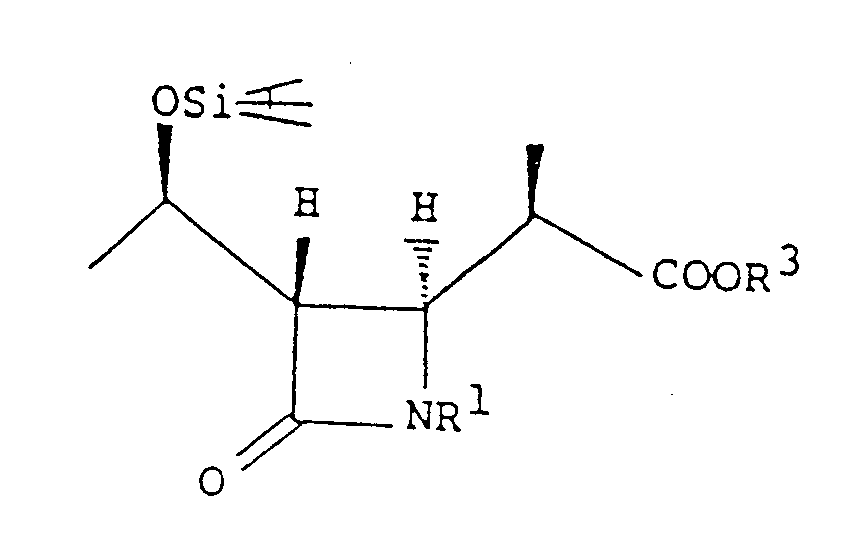
worin R¹ eine Benzylgruppe und R³ eine Methylgruppe oder eine Ethylgruppe bedeuten, das umfaßt
die Reduktion eines Azetidinon-Derivats der allgemeinen Formel (I):
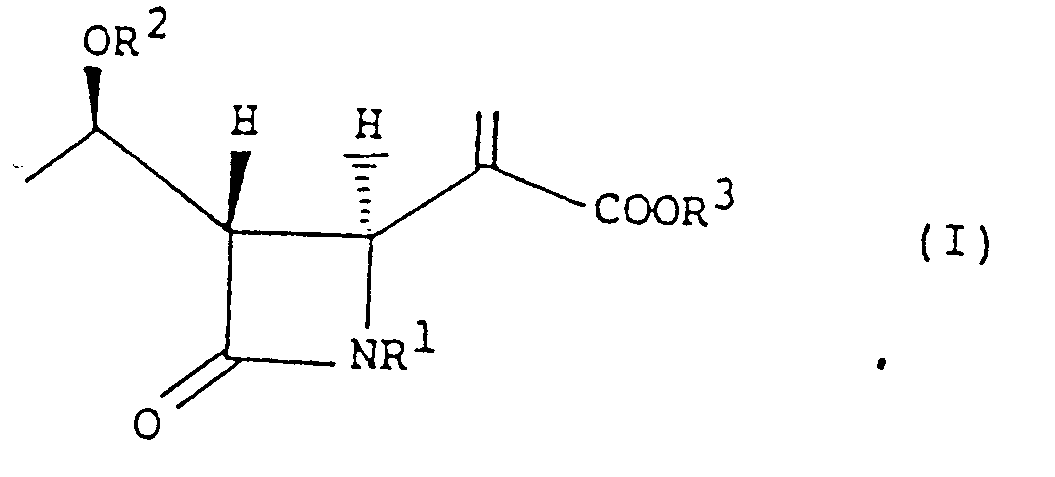
worin R¹ und R³ wie oben definiert sind und R² ein Wasserstoffatom bedeutet,
in Gegenwart von Lithium-tri-sec-butylborhydrid und sec-Buthanol und
die Einführung einer tert-Butyldimethylsilylgruppe in die Hydroxygruppe.
worin R¹ eine Benzylgruppe und R³ eine Methylgruppe oder eine Ethylgruppe bedeuten, das umfaßt
die Reduktion eines Azetidinon-Derivats der allgemeinen Formel (I):
worin R¹ und R³ wie oben definiert sind und R² ein Wasserstoffatom bedeutet,
in Gegenwart von Lithium-tri-sec-butylborhydrid und sec-Buthanol und
die Einführung einer tert-Butyldimethylsilylgruppe in die Hydroxygruppe.
6. Verfahren zur Herstellung eines Azetidinon-Derivats der allgemeinen Formel
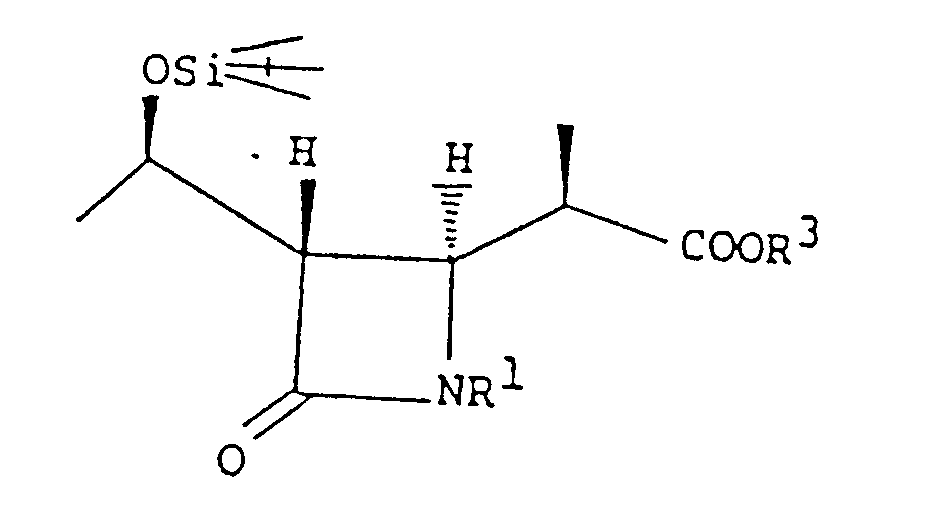
worin R¹ eine Benzylgruppe und R³ eine Methylgruppe oder eine Ethylgruppe bedeuten, das umfaßt
die Hydroxylalkoxycarbonylierung eines Ethinylazetidinons der allgemeinen Formel (III):
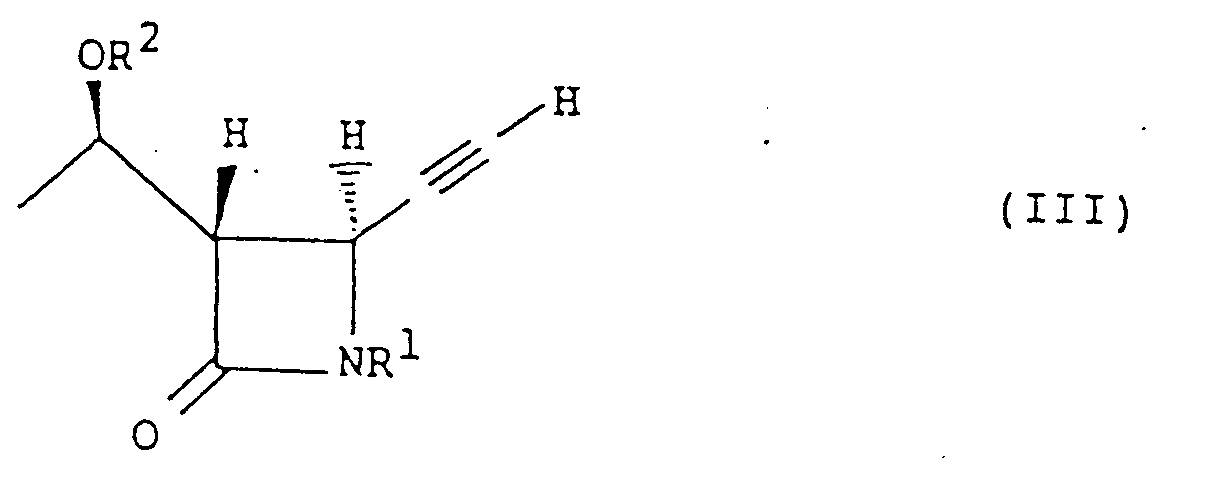
worin R¹ wie oben defineirt ist und R² ein Wasserstoffatom bedeutet,
in Gegenwart eines Metalls oder einer Verbindung eines Metalls der Gruppe VIII des PSE, eines Alkohols und von Kohlenmonoxid, und, falls erforderlich,
die Hydrolyse des erhaltenen Produkts zur Bildung eines Azetidinon-Derivats der allgemeinen Formel (I):
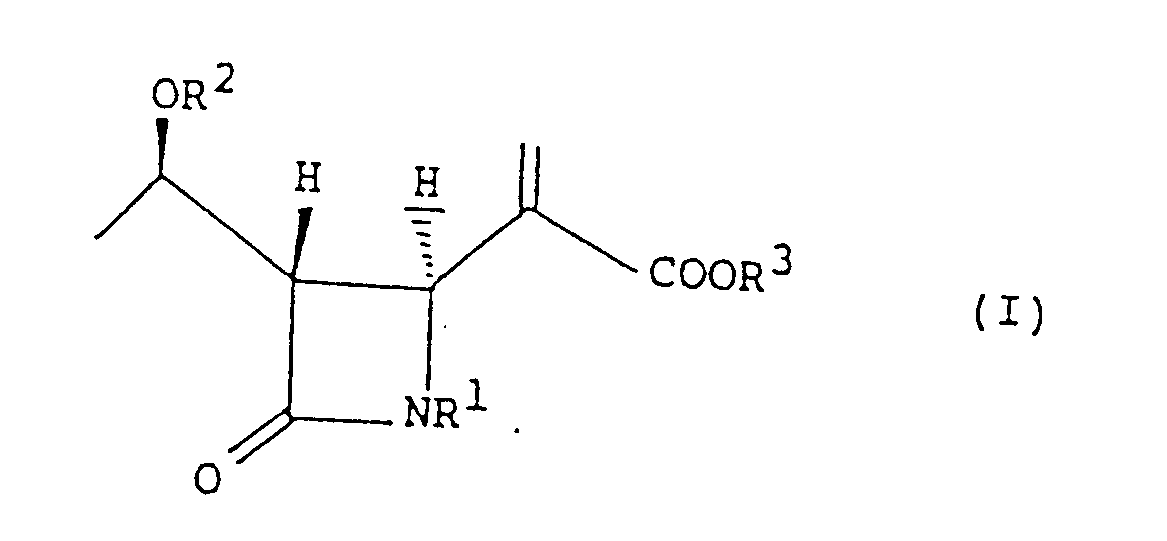
worin R¹, R² und R³ wie oben definiert sind,
die Reduktion der Verbindung der Formel (I) in Gegenwart von Lithium-tri-sec-butylborhydrid, und
die Einführung einer tert-Butyldimethylsilylgruppe in die Hydroxygruppe.
worin R¹ eine Benzylgruppe und R³ eine Methylgruppe oder eine Ethylgruppe bedeuten, das umfaßt
die Hydroxylalkoxycarbonylierung eines Ethinylazetidinons der allgemeinen Formel (III):
worin R¹ wie oben defineirt ist und R² ein Wasserstoffatom bedeutet,
in Gegenwart eines Metalls oder einer Verbindung eines Metalls der Gruppe VIII des PSE, eines Alkohols und von Kohlenmonoxid, und, falls erforderlich,
die Hydrolyse des erhaltenen Produkts zur Bildung eines Azetidinon-Derivats der allgemeinen Formel (I):
worin R¹, R² und R³ wie oben definiert sind,
die Reduktion der Verbindung der Formel (I) in Gegenwart von Lithium-tri-sec-butylborhydrid, und
die Einführung einer tert-Butyldimethylsilylgruppe in die Hydroxygruppe.