|
(11) | EP 0 277 333 A1 |

| (12) | EUROPEAN PATENT APPLICATION |
|
|
|
|
|||||||||||||||||||||||||||
| (54) | Imidazole derivatives having therapeutical activity, process for their preparation and pharmaceutical compositions containing them |
| (57) The econazole and miconazole sulfosalicylates show in vitro a relevant anti-fungine
activity with wide spectrum and, if locally applied, are well tolerated and more effective
than the corresponding nitrates for the control, in vivo and clinically, of the mycosis
as induced from dermatophytes and from Candida albicans. |
[0001] The present invention relates to novel imidazole derivatives, more specifically to two novel salts with sulphosalicylic acid of econazole, namely 1-(2-((4-chlorophenyl)-methoxy)-2-(2,4-dichlorophenyl)-ethyl)-1-H-imidazole, and of miconazole, namely 1-(2-((2,4-dichlorophenyl)-2-(2,4-dichlorophenyl)methoxy)-ethoxy)-1H-imidazole, having therapeutical activity, particularly anti-mycotic activity.
[0002] The novel derivatives of the present invention have following general formula:
wherein R represents H, C1.
[0003] The cutaneous mycosis are infections mainly induced from dermatophytes and from Candida Albicans. The dermatophytes are fungi found as parasites in the horny layer, in the hair and in the nails owing to the presence of keratolitic enzymes, capable of hydrolizing the long polypeptidic chains of keratin.
[0004] Three genuses (Trichophyton, Microsporum and Epidermophyton) are mainly responsible of the cutaneous pathologies. The infections induced from dermatophytes are generally defined as tinea. Depending on the part affected there are several clinical pictures: tinea capitis, tinea barbae, tinea corporis, tinea cruris, tinea pedis, tinea manuum, tinea faciei, tinea unguium.
[0005] The Candida albicans is an ubiquitary, non keratinophylic fungus , normally being saprophyte of cutis and of mucosae, which becomes pathogenic when its spronting and reproduction are promoted by a particularly suitable environment or by the weakening of the organic defences.
[0006] The clinical evidences induced from Candida albicans vary according to the part involved: intertriginis, vulvovaginities, oral candidiases ("thrush"), boccheruolo, paronichia.
[0007] Among the drugs useful for the topical treatment of surface mucosae the imidazole derivatives have acquired, in the last years, a relevant importance.
[0008] More particularly the active principles known as econazole (DCI) and miconazole (DCI), correspond to the above indicated chemical names, are anti-mycotic drugs with wide activity spectrum; they are endowed with a powerfull activity against dermatophytes and Candida albicans, as well as against some gram-positive germs. Their action takes place by selective inhibition of the purine and glutamine fixing onto the membrane of mycetes.
[0009] The miconazole and the econazole are used as nitrates in several pharmaceutical forms (cream, powder, ovuli, etc.).
[0010] The imidazole compounds according to the present invention are chemically defined in the following manner:
a) 1-(2-((4-chlorophenyl)-methoxy)-2-(2,4-dichlorophenyl)-ethyl)-1H-imidazole 5-sulfosalicylate (econazole SSA) corresponding to the formula C₂₅H₂₀Cl₄N₂O₇S.
Its molecular weight is 599.89.
Its centesimal elemental analysis is the following:
C 50.05 (found 50.25)
H 3.53 (found 3.47)
N 4.67 (found 4.81)
O 18.67 (found 18.54°
S 5.34 (found 5.49)
Cl 17.74 (found 17.44, by difference).
The substance is in form of a white fine powder, is soluble in methanol, ethanol and dimethylsulfoxide, poorly soluble in water, insoluble in the common organic solvents.
It crystallize from methyl or ethyl alcohol and melts at 176-178°C (at Kofler).
The saturated aqueous solution of the salt has a pH of 3.15, as measured with a glass electrode.
b) 1-(2-(2,4-dichlorophenyl)-2-((2,4-dichlorophenyl)-methoxy)ethyl)-1H-imidazole 5-sulfosalicylate (miconazole SSA) corresponding to the formula C₂₅H₂₀Cl₄N₂O₇S.
Its molecular weight is 634.3.
Its centesimal elemental analysis is the following:
C 47.34 (found 47.49)
H 3.18 (found 3.32)
N 4.42 (found 4.59)
O 17.66 (found 17.51)
S 5.05 (found 4.92)
Cl 22.35 (found 22.17, by difference)
The substance is in form of a white fine powder, is soluble in methanol, ethanol and DMSO, poorly soluble in water, insoluble in the common organic solvents. It crystallizes from ethyl or methyl alcohol and melts at 181-183°C. (Kofler). The saturated aqueous solution of the salt has a pH of 3.20 as measured with a glass electrode.
[0011] The compounds according to the present invention are produced by reacting in ethanol solution under boiling miconazole and respectively econazole with 5-sulphosalicylic acid in equimolar pro portions; the reaction mixture is concentrated up to dryness, and thereafter the residue is taken with ethyl ether and crystallized from ethyl alcohol. The process shall be better understood from the following examples, having purely illustrative and non limiting purposes.
EXAMPLE 1
[0012] 1.82 g of 5-sulfosalicylic acid (7.2 mmoles) are dissolved at room temperature in 40 ml of absolute ethyl alcohol. Then 3 g of miconazole base (7.2 mmoles), are added, it being likewise known as 1-(2-((2,4-dichlorophenyl)-2-(2-((2,4-dichlorophenyl)-methoxy)ethyl)-1H-imidazole, and the mixture is refluxed.
[0013] After complete solubilization of the miconazole, the solution is maintained under refluxing for 10 minutes, then it is charged in a rotating evaporator under vacuum, and it is concentrated up to dryness in the water bath of the apparatus. The residue is taken with ethyl ether, the mixture being cooled from outside with a refrigerating mixture, filtered under vacuum and crystallized with ethyl alcohol. In this way with a quantitative yield, the final product is obtained, it having appearance of a white powder having melting point 181-183°C (Kofler).
EXAMPLE 2
[0015] 1.98 g of 5-sulfosalicylic acid (7.8 mmoles) are dissolved at room temperature in about 40 ml of absolute ethyl alcohol. Then 3 g of econazole base (7.8 mmoles), also known as 1-(2-((4-chlorophenyl)-methoxy-2-(2,4-dichlorophenyl)-ethyl)-1H-imidazole, are added and the mixture is refluxed. After complete solubilization of the econazole, the solution is maintained at refluxing for 10 minutes; then it is placed into a rotating evaporator under vacuum and concentrated up to dryness in the water bath of the apparatus.
[0016] The residue is taken with ethyl ether by cooling it from outside with a refrigerating mixture, filtered under vacuum and crystallized from ethyl alcohol.
[0017] In this manner there is obtained, with quantitative yields, the final product having the appearance of a white fine powder and having melting point of 176-178°C (Kofler).
[0018] The UV and IR spectra and the differential thermal analysis have confirmed the foreseen structure (fig. 3-6).
[0019] The compounds of the present invention have been the subject of pharmacological investigation, both in vitro and in vivo, the results of which, for reporting clarity, shall be separately illustrated for each compound.
I- a In vitro antimycotic activity.
[0020] The antimycotic activty of miconazole SSA has been evaluated against Candida albicans 73/079 (YMA and SAB), Cryptococcus neoformans 451, Saccharomyces cerevisiae, Aspergillus niger, Trichophyton mentagrophyties 569A, Hendersonula toruloidea TH65 and Pacilomyces varioti.
[0021] The microorganisms have been incubated onto agar-glucose medium, (Sabourauds medium) at 30 or 37°C, depending on the species, in the presence of miconazole SSA.
[0022] The incubation was of 24 hours for Candida and Cryptococcus, of 48-72 hours for the other mycetes. The miconazole SSA has been solubilized in dimethylsulfoxide (DMSO) , and then diluted in phosphate buffer at pH 6.6 up to a concentration of 100 µg/ml.
[0024] Under these experimental conditions the results indicate a relevant anti-mycotic activity in vitro of miconazole SSA.
[0025] Since for some imidazole derivatives a discrepancy has been detected, sometimes of relevant magnitude , between the antimycotic activity in vitro and that in vivo (Richardson et al., Antimicrob Agents Chemother 27: 832, 1985), and since both the tests of antimycotic activity in vivo and the tests of therapeutical activity in the human being suffering from skin mycosis are considered as more reliable than those in vitro (Odds et al. J. Antimicrob. Chemoter. 18, 473, 1986), the antimycotic activity of miconazole SSA has been controlled both in the experimental animals and in the human being.
I-b Antimycotic activity in vivo.
[0026] The antimycotic activity of miconazole SSA has been investigated in vivo in an infection model induced from Candida albicans in comparison with miconazole nitrate.
[0027] The experiment has been carried out according to the model of Van Cutsem and Thienpoint (J. Van Cutsem and D. Thienpoint. Experimental cutaneous Candida Albicans infections in guinea pigs. Sabouraudia 9:17, 1971).
[0028] A group of 40 guinea pigs, previously treated with alloxan, has been inoculated with 3 x 10⁶ blastospores and C. Albicans in a shaved cutis area. The hair has been shaved at beginning of the experiment and, sub sequently, every seven days.
[0029] Immediately after the inoculation, the animals have been divided into four groups: the first group did not received any treatment and was used as the control; the second group has been treated with placebo; the third group has been treated with 2% miconazole nitrate cream; the fourth group has been treated with 2% miconazole SSA cream. All the treatments have been carried out with two cutaneous applications per day at 12 hours interval between them.
[0030] The lesion entity has been evaluated after 7, 15 and 25 days from the inoculation according to a rating score scale: 0) no lesions; 1) slight lesion; 2) moderate lesion; 3) marked lesion; 4) heavy lesion.
[0032] The placebo application (cream devoid of the active principle) had no influence on the lesion behaviour, as demonstrated from the possibility of superimposing the scores of the first group (no treatment) and of the second group of animals (placebo).
[0033] On the contrary, relevant slighter lesions and a quick recovery have been observed in animals treated in comparison with 2% miconazole nitrate cream, as demonstrated from the lower score recorded for the third group at each of the three observations times.
[0034] Lastly, for the animals treated with 2% miconazole SSA cream a relevantly faster recovery has been observed with respect to the animals treated with 2% miconazole nitrate cream, as demonstrated from difference of the scores recorded for the third and fourth groups of animals.
[0035] The results of the experiments demonstrated that miconazole SSA is endowed with an in vivo anti-mycotic activity higher than that of miconazole nitrate, thus leading to the recovery of the lesion induced from Candida albicans in shorter times and in a more efficacious way.
I-c Anti-mycotic activity in the human being.
[0036] The antimycotic activity of miconazole SSA in the human being has been evaluated in comparison with miconazole nitrate in the case of 20 patients suffering from vulvo vaginalis candidiasis, diagnostically assessed by means of cultural and microscopical examination.
[0037] The patients have been randomized and treated, 10 with miconazole nitrate and 10 with miconazole SSA, in form of vaginal ovuli, each containing the equivalent of 100 mg of miconazole base. The posology was of 2 ovuli per day for 14 days. The cultural and microscopic examinations have been repeated after 7 and 14 days from the beginning of the treatment and the results have been recorded and reported in the table 3.
[0038] From the results of clinical experiments a greater therapeutical effectiveness of the miconazole SSA with respect to the miconazole nitrate, is shown as evidenced from the percentages of positivity at the culture examination (10 vs 40% at the seventh day; 0 vs 10% at 14° day (p < 0.01) and at the microscopical examination for Candida albicans (10 vs 30% at 7° days; 0 vs 20% at 14° days) (p < 0.01).
II- a In vitro antimycotic activity.
[0039] The antimycotic activity of econazole SSA has been evaluated against Candida Albicans 73/079 (YMA and SAB), Cryptococcus neoformans 451, Saccharomyces cerevisiae, Aspergillus niger, Trichophyton mentagrophytes 569A, Hendersonula toruloidea TH65 and Pacilomyces varioti.
[0040] The microorganisms have been incubated onto agar-glucose medium, (Sabourauds medium) at 30 or 37°C, depending on the species, in the presence of econazole SSA.
[0041] The incubation was of 24 hours for Candida and Cryptococcus, of 48-72 hours for the other mycetes. The econazole SSA has been solubilized in dimethylsulfoxide (DMSO) , and then diluted in phosphate buffer at pH 6.6 up to a concentration of 100 µg/ml.
[0043] Under these experimental conditions the results indicate a relevant anti-mycotic activity in vitro of econazole SSA.
[0044] Since for some imidazole derivatives a discrepancy has been detected, sometimes of relevant magnitude , between the antimycotic activity in vitro and that in vivo (Richardson et al., Antimicrob Agents Chemother 27: 832, 1985), and since both the tests of antimycotic activity in vivo and the tests of therapeutical activity in the human beings suffering from skin mycosis, are considered as more reliable than those in vitro (Odds et al. J. Antimicrob. Chemoter. 18, 473, 1986) the antimycotic activity of econazole SSA has been controlled both in the experimental animals and in the human beings.
I-b Antimycotic activity in vivo.
[0045] The antimycotic activity of econazole SSA has been investigated in vivo in an infection model induced from Candida albicans in comparison with econazole nitrate.
[0046] The experiment has been carried out according to the model of Van Cutsem and Thienpoint (J. Van Cutsem and D. Thienpoint. Experimental cutaneous Candida Albicans infections in guinea pig. Sabouraudia 9:17, 1971).
[0047] A group of 40 guinea pigs, previously treated with alloxan, has been inoculated with 3 x 10⁶ boastospores and C. Albicans in a shaved cutis area. The hair has been shaved at beginning of the experiment and, subsequently, every seven days.
[0048] Immediately after the inoculation, the animals have been divided into four groups: the first group did not received any treatment and was used as the control; the second group has been treated with placebo; the third group has been treated with 2% econazole nitrate cream; the fourth group has been treated with 2% econazole SSA cream. All the treatments have been carried out with two cutaneous applications per day at 12 hours interval between them.
[0049] The lesion entity has been evaluated at 7, 15 and 25 days from the inoculation according to a rating scale: 0) no lesions; 1) slight lesion; 2) moderate lesion; 3) marked lesion; 4) heavy lesion.
[0051] The placebo application (cream devoid of the active principle) had no influence on the lesion behaviour, as demonstrated from the possibility of superimposing the scores of the first group (no treatment) and of the second group of animals (placebo).
[0052] On the contrary, relevant slighter lesions and a quick recovery have been observed in animals treated with 2% econazole nitrate cream, as demonstrated from the lower scores reduced for the third group at each of the three observations times.
[0053] Lastly, for the animals treated with 2% econazole SSA cream a relevantly faster recovery has been observed with respect to the animals treated with 2% econazole nitrate cream, as demonstrated from difference of the scores recorded for the third and fourth groups of animals.
[0054] The results of the experiments demonstrated that econazole SSA is endowed with an in vivo anti-mycotic activity higher than that of econazole nitrate, thus leading to the recovery of the lesion induced from Candida Albicans in shorter times and in a more efficacious way.
I-c Antimycotic activity in the human being.
[0055] The anti-mycotic activity of econazole SSA in the human being has been evaluated in comparison with econazole nitrate in the case of 20 patients suffering from vulvovaginalis candidiasis, assessed by means of cultural and microscopical examination.
[0056] The patients have been randomized and treated, 10 with econazole nitrate and 10 with econazole SSA, in form of vaginal ovuli, each containing the equivalent of 100 mg of econazole base. The posology was of 2 ovuli per day for 14 days. The cultural and microscopic examinations have been repeated after 7 and 14 days from the beginning of the treatment and the results have been recorded and reported in the table 6.
[0057] From the results of the clinical experiments a greater therapeutical effectiveness of the econazole SSA with respect to the econazole nitrate is shown as evidenced from percentages of positivity at the culture examination (10 vs 40% at the seventh day; 0 bis 10% at 14° day) (p <0.01) and at the microscopical examination for Candida albicans (10 vs 30% at 7° days; 0 vis 20% at 14° days) (p < 0.01).
[0058] The compounds of the present invention are used for the preparation of pharmaceutical forms suitable for the topical use and thus for the foreseen therapeutical application, such as creams, ointments, lotions gels, milk, tinctures, powders, ovuli, foams, vaginal capsules, vaginal washings, oral gels.
[0059] For their preparation the normal excipients, solvents, vehicles and additives are used, according to the standard pharmaceutical techniques. As regards the dosage of the active principle in the aforesaid pharmaceutical formulations and as regars the use posology, the dosage and posology already known and used for the corresponding nitrates still holds true.
1. Imidazole derivatives having the formula:
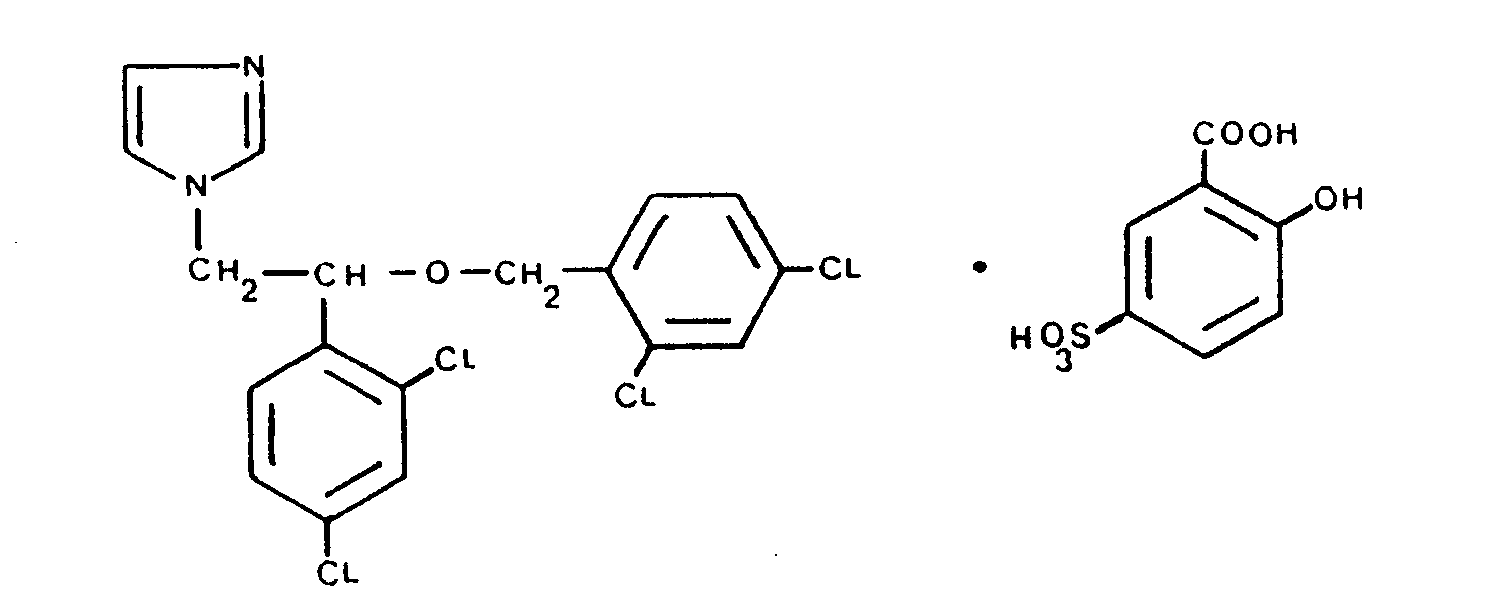
wherein R represents H, Cl.
wherein R represents H, Cl.
2. 1-(2-((4-chlorophenyl)-methoxy)-2-(2,4-dichlorophenyl)-ethyl)-1H-imi dazole 5-
sulfosalicylate according to claim 1.
3. 1-(2-((2,4-dichlorophenyl)-2-(2,4-dichlorophenyl)methoxy)-ethyl)-1H-imidazole
5-sulfosalicylate according to claim 1.
4. Pharmaceutical composition for topical use, characterized by containing, as the
active ingredient a compound according to claim 1, together with the normal excipients,
vehicles, solvents and diluents.
5. Pharmacuetical composition according to claim 1 in form of cream, ointment, lotions,
gels, milk, tincture, powder, ovuli, foam, vaginal capsules, vaginal washings.
6. Pharmaceutical composition according to claim 4 for the therapy of cutaneous mycosis.
7. A process for the preparation of the compounds of claim 1, characterized in that
equimolecular amounts of sulfosalicylic acid and of a compound selected respectively
among miconazole and econazole are reacted under hot conditions, as a solution in
alcoholic solvent.
8. A process according to claim 7, characterized in that said reaction is carried
out at the boiling point and in ethanolic solution.