|
(11) | EP 0 353 198 A1 |

| (12) | EUROPEAN PATENT APPLICATION |
|
|
|
|
|||||||||||||||||||||||||||
| (54) | Parabanic acid derivatives and pharmaceutical compositions containing them |
| (57) The present invention relates to parabanic acid derivatives and pharmaceutically
acceptable salts and metal complexes thereof having aldose reductase inhibitory activity.
The compounds have the formula
The compounds are useful as drugs for the treatment or prevention of diabetic conditions. |
[0001] The present invention relates to novel parabanic acid derivatives and pharmaceutically acceptable salts and metal complexes thereof and pharmaceutical compositions containing such derivatives, salts and complexes as an active ingredient.
[0002] Diabetic neuropathy, diabetic cataract and diabetic microangiopathy such as diabetic retinopathy, diabetic nephropathy or diabetic dermopathy are intractable chronic diseases associated with diabetes. One of the causes of these diabetic complications involves polyol metabolism. Under non-physiological hyperglycemic conditions in diabetes, glucose utilization via a polyol pathway increases many times as compared with normal conditions, so that the production of sorbitol is elevated by aldose reductase. Consequently, excessive accumulation of intracellular sorbitol occurs in tissues such as the peripheral nerve, retina, kidney, lens and artery. Under these conditions, cellular edema and functional disorders may be causes by abnormal intracellular osmotic pressure.
[0003] In the search for inhibitors against aldose reductase and hence the production of sorbitol and to develop new drugs for the treatment and prevention of the said diabetic complications, novel parabanic acid derivatives have been found having an excellent aldose reductase inhibitory activity.
[0004] It is an object of the present invention to provide novel parabanic acid derivatives as well as pharmaceutically acceptable salts and metal complexes thereof having an excellent aldose reductase inhibitory activity. Another object of the invention is to provide pharmaceutical compositions containing these parabanic acid derivatives or pharmaceutically acceptable salts or metal complexes thereof as an active ingredient to treat diabetic complications.
[0005] The parabanic acid derivatives of the present invention are represented by the following formula (I):
wherein R is hydrogen or a lower alkyl group, X is hydrogen, an alkyl group, a cycloalkyl group, a lower alkylcycloalkyl group, a phenyl group or a phenylalkyl group which may optionally be substituted by a lower alkyl group, a lower alkoxy group, a nitro group or halogen, and n represents an integer of from 1 to 4.
[0006] In the formula (I), R represents hydrogen or a straight or branched alkyl group having 1 to 4 carbon atoms, such as methyl, ethyl, propyl, isopropyl, butyl, isobutyl, sec-butyl or tert-butyl.
[0007] X represents hydrogen; a straight or branched alkyl group having 1 to 8 carbon atoms such as methyl, ethyl, propyl, isopropyl, butyl, isobutyl, sec-butyl, tert-butyl, pentyl, isopentyl, neopentyl, tert-pentyl, hexyl, heptyl or octyl; a cycloalkyl group having 3 to 8 carbon atoms such as cyclopropyl, cyclobutyl, cyclopentyl, cyclohexyl, cycloheptyl or cyclooctyl; a lower alkylcycloalkyl group such as a lower cycloalkyl group substituted by a straight or branched alkyl group having 1 to 3 carbon atoms such as methyl, ethyl, propyl or isopropyl; a phenyl group; or a phenylalkyl group, for example an alkyl group of 1 to 6 carbon atoms bonded to phenyl group, such as benzyl, phenylethyl, phenylpropyl, phenylbutyl, phenylpentyl or phenylhexyl, which may optionally be substituted by a straight or branched alkyl group having 1 to 3 carbon atoms such as methyl, ethyl, propyl or isopropyl, a straight or branched alkoxy group having 1 to 3 carbon atoms such as methoxy, ethoxy, propoxy or isopropoxy, a nitro group or a halogen atom such as fluorine, chlorine, bromine or iodine.
[0008] The parabanic acid derivatives of the present invention include pharmaceutically acceptable salts of the compounds of formula (I) given above, for example, salts such as acid addition salts with an acid such as hydrochloric acid, sulfuric acid, nitric acid, hydrobromic acid, phosphoric acid, perchloric acid, thiocyanic acid, boric acid, formic acid, acetic acid, haloacetic acid, propionic acid, glycolic acid, citric acid, tartaric acid, succinic acid, glyconic acid, lactic acid, malonic acid, fumaric acid, anthranilic acid, benzoic acid, cinnamic acid, p-toluenesulfonic acid, naphthalenesulfonic acid or sulfanilic acid, salts with an alkali metal such as sodium or potassium, salts with an alkaline-earth metal such as calcium, magnesium or barium, or salts with other metals such as aluminium.
[0009] The parabanic acid derivatives of the invention may also be used in the form of their pharmaceutically acceptable metal complexes such as for example, complexes with zinc, nickel, cobalt, copper, iron etc.
[0010] These pharmaceutically acceptable salts and metal complexes can be produced from free parabanic acid derivatives in a conventional manner or can be prepared by exchange reactions from each other.
[0011] When the compounds of the invention can exist in the form of optical isomers the present invention includes any of the d-, l- and dl-isomers.
[0012] The parabanic acid derivatives of the present invention may be prepared by any convenient method. They can, for example, be prepared as follows:
[0013] (i) In an appropriate solvent which does not inhibit the reaction, oxalyl chloride and an N-substituted urea having a substituent corresponding to X in the above formula (I) are stirred at low temperature under ice cooling or at room temperature, or oxalic diester and the said N-substituted urea are stirred at room temperature or at a suitable temperature above room temperature by heating in the presence of a base such as an amine or an alkali metal alkoxide.
[0014] Subsequently, in an appropriate solvent which does not inhibit the reaction, such as ethanol, the compound obtained by the above method and a halogenocarboxylic acid alkyl ester such methyl bromoacetate, ethyl bromoacetate, ethyl chloroacetate, or ethyl bromobutylate are refluxed, if desired with heating, in the presence of a base such as potassium hydroxide to give compounds of the present invention represented by the formula (I) wherein R is a lower alkyl group.
[0015] The resulting alkyl esters of this invention may be hydrolyzed with an acid, for example, by dissolving the compound in a mixture of acetic acid and concentrated hydrochloric acid and refluxing to give compounds of the present invention represented by the formula (I) wherein R is hydrogen. This compound having hydrogen as R can also be produced in a similar manner as mentioned above by using a halogenocarboxylic acid instead of a halogenocarboxylic acid alkyl ester, i.e. not via the said alkyl ester compound.
[0016] (ii) Oxalyl chloride and N,N′-disubstituted urea which are substituted with both groups corresponding to X and -(CH₂)n-COOR in the formula (I) are stirred at low temperature under cooling or at room temperature in an appropriate solvent which does not inhibit the reaction such as tetrahydrofuran, or the said N,N′-disubstituted urea and oxalic diester are stirred at room temperature or with heating in the presence of an amine or alkali metal alkoxide to give the compound of the present invention.
[0017] (iii) Subsequently, the so obtained compounds of the present invention represented by the formula (I) wherein X is hydrogen may be reacted with a halogenated compound of X such as a halogenated alkyl or halogenated benzyl to give the parabanic acid derivative of this invention where X is not hydrogen.
[0018] The resulting compounds of the present invention can be purified by conventional methods such a distillation, chromatography and recrystallization. Determination may be established by, inter alia, elemental analyses, melting point, IR, NMR, mass spectrum, etc.
[0019] The present invention also provides the use of parabanic acid derivatives of formula I as well as pharmaceutically acceptable salts and metal complexes thereof for inhibiting aldose reductase activity, as well as the use of said compounds for the treatment of diabetic disorders.
[0020] The present invention also provides a method for the treatment of mammals suffering from diabetes which comprises treating said mammals with parabanic acid derivatives of formula I as well as pharmaceutically acceptable salts and metal complexes thereof.
Example 1.
[0022] 2.7 g of potassium hydroxide was dissolved in 150 ml of ethanol. 5.1 g of 1-methylparabanic acid and 10 ml of ethyl bromoacetate were added thereto and the solution was heated under reflux for 6 hours. After cooling, the insoluble substance was filtered off and ethanol was distilled away. The residue was dissolved in ethyl acetate, washed with 5% sodium carbonate and brine, dried over anhydrous sodium sulfate, and passes through silica gel column. Ethyl acetate was distilled away and the residue was recrystallized from hexane to give 3.1 g of ethyl 1-methyl-2,4,5-trioxoimidazolidine-3-acetate (Compound 1).
m.p.: 97 - 98.5 °C
| Elementary Analysis: C₈H₁₀N₂O₅ | |||
| C % | H % | N % | |
| Calculated | 44.86 | 4.71 | 13.08 |
| Found | 44.87 | 4.82 | 12.96 |
IR (KBr): 2980, 2950, 1725, 1450, 1430, 1215, 1140
NMR (DMSO-d₆/TMS): δ=1.21(t,3H,J=7.1Hz), 3.03(s,3H), 4.17(q,2H,J=7.1Hz), 4.39(s,2H)
[0023] In the same manner, the following compounds were obtained.
Ethyl 1-butyl-2,4,5-trioxoimidazolidine-3-acetate (Compound 2)
m.p.: 66 - 67 °C
| Elementary Analysis: C₁₁H₁₆N₂O₅ | |||
| C % | H % | N % | |
| Calculated | 51.56 | 6.29 | 10.93 |
| Found | 51.29 | 6.51 | 10.65 |
IR (KBr): 2950, 2860, 1745, 1720, 1445, 1425, 1405, 1220, 1130
NMR (DMSO-d₆/TMS): δ=0.88(t,3H,J=7.1Hz), 1.22(t,3H,J=7.1Hz), 1.29(sex,2H,J=7.1Hz), 1.56(quin,2H,J=7.1Hz), 3.54(t,2H,J=7.1Hz), 4.17(q,2H,J=7.1Hz), 4.38(s,2H)
Ethyl 1-isobutyl-2,4,5-trioxoimidazolidine-3-acetate (Compound 3)
m.p.: 116 - 117 °C
| Elementary Analysis: C₁₁H₁₆N₂O₅ | |||
| C % | H % | N % | |
| Calculated | 51.56 | 6.29 | 10.93 |
| Found | 51.48 | 6.45 | 10.74 |
IR (KBr): 2960, 2870, 1745, 1720, 1445, 1430, 1410, 1220, 1135
NMR (DMSO-d₆/TMS): δ=0.88(t,6H,J=7.1Hz), 1.21(t,3H,J=7.1Hz), 1.95(m,1H), 3,36(d,2H,J=7.1Hz), 4.16(q,2H,J=7.1Hz), 4.40(s,2H)
Ethyl 1-hexyl-2,4,5-trioxoimidazolidine-3-acetate (Compound 4)
Ethyl 1-(4-methylcyclohexyl)-2,4,5-trioxoimidazolidine-3-acetate (Compound 5)
m.p.: 114 - 115 °C
| Elementary Analysis: C₁₄H₂₀N₂O₅ | |||
| C % | H % | N % | |
| Calculated | 56.75 | 6.80 | 9.45 |
| Found | 56.68 | 6.83 | 9.69 |
IR (KBr): 2950, 2920, 2860, 1750, 1720, 1440, 1125
NMR (DMSO-d₆/TMS): δ=0.88(d,3H,J=6.5Hz), 1.03(m,2H), 1.22(t,3H,J=7.2Hz), 1.36(m,1H), 1.73(m,4H), 1.97(m,2H), 3.88(m,1H), 4.17(q,2H,J=7.2Hz), 4.36(s,2H)
Ethyl 1-benzyl-2,4,5-trioxoimidazolidine-3-acetate (Compound 6)
m.p.: 150 - 151 °C
| Elementary Analysis: C₁₄H₁₄N₂O₅ | |||
| C % | H % | N % | |
| Calculated | 57.93 | 4.86 | 9.65 |
| Found | 58.23 | 4.94 | 9.64 |
IR (KBr): 2980, 1745, 1720, 1440, 1420, 1400, 1225, 1140
NMR (DMSO-d₆/TMS): δ=1.21(t,3H,J=7.1Hz), 4.17(q,2H,J=7.1Hz), 4.41(s,2H), 4.75(s,2H), 7.31-7.47(m,5H)
Ethyl 1-(2-methylbenzyl)-2,4,5-trioxoimidazolidine-3-acetate (Compound 7)
m.p.: 158 - 160 °C
| Elementary Analysis: C₁₅H₁₆N₂O₅ | |||
| C % | H % | N % | |
| Calculated | 59.21 | 5.30 | 9.21 |
| Found | 59.07 | 5.47 | 9.07 |
IR (KBr): 2980, 2950, 1720, 1445, 1425, 1400, 1220, 1140
NMR (DMSO-d₆/TMS): δ=1.20(t,3H,J=7.1Hz), 2.34(s,3H), 4.16(q,2H,J=7.1Hz), 4.42(s,2H), 4.72(s,2H), 7.14-7.25(m,5H)
Ethyl 1-(4-methylbenzyl)-2,4,5-trioxoimidazolidine-3-acetate (Compound 8)
m.p.: 117.5 - 118.5 °C
| Elementary Analysis: C₁₅H₁₆N₂O₅ | |||
| C % | H % | N % | |
| Calculated | 59.21 | 5.30 | 9.21 |
| Found | 59.04 | 5.39 | 9.15 |
IR (KBr): 2980, 2950, 1750, 1725, 1445, 1420, 1440, 1230, 1145
NMR (DMSO-d₆/TMS): δ=1.20(t,3H,J=7.1Hz), 2.28(s,3H), 4.16(q,2H,J=7.1Hz), 4.41(s,2H), 4.69(s,2H), 7.16 and 7.22(each d,4H,J=8.3Hz)
Ethyl 1-(2-methoxylbenzyl)-2,4,5-trioxoimidazolidine-3-acetate (Compound 9)
m.p.: 121 - 122 °C
| Elementary Analysis: C₁₅H₁₆N₂O₆ | |||
| C % | H % | N % | |
| Calculated | 56.25 | 5.03 | 8.75 |
| Found | 56.45 | 5.12 | 8.75 |
IR (KBr): 2980, 2945, 2830, 1720, 1445, 1405, 1220, 1140
NMR (DMSO-d₆/TMS): δ=1.20(t,3H,J=7.1Hz), 3.80(s,3H), 4.16(q,2H,J=7.1Hz), 4.42(s,2H), 4.70(s,2H), 6.89-7.31(m,4H)
Ethyl 1-(3-methoxylbenzyl)-2,4,5-trioxoimidazolidine-3-acetate (Compound 10)
m.p.: 116 - 117 °C
| Elementary Analysis: C₁₅H₁₆N₂O₆ | |||
| C % | H % | N % | |
| Calculated | 56.25 | 5.03 | 8.75 |
| Found | 56.30 | 5.14 | 8.70 |
IR (KBr): 3030, 2945, 2830, 1750, 1720, 1440, 1420, 1400, 1220, 1140
NMR (DMSO-d₆/TMS): δ=1.20(t,3H,J=7.1Hz), 3.74(s,3H), 4.16(q,2H,J=7.1Hz), 4.42(s,2H), 4.72(s,2H), 6.89-7.29(m,4H)
Ethyl 1-(3,4-dimethoxylbenzyl)-2,4,5-trioxoimidazolidine-3-acetate (Compound 11)
m.p.: 118 - 123 °C
| Elementary Analysis: C₁₆H₁₈N₂O₇ | |||
| C % | H % | N % | |
| Calculated | 54.86 | 5.18 | 8.00 |
| Found | 54.73 | 5.19 | 7.82 |
IR (KBr): 2980, 2950, 2840, 1750, 1725, 1445, 1420, 1220, 1140
NMR (DMSO-d₆/TMS): δ=1.20(t,3H,J=7.1Hz), 3.73(2×s,each 3H), 4.16(q,2H,J=7.1Hz), 4.41(s,2H), 4.67(s,2H), 6.85(dd,1H,J=8.3, 2.0Hz), 6.91(d,1H,J=8.3Hz), 6.92(d,1H,J=2.0Hz)
Ethyl 1-(2-chlorobenzyl)-2,4,5-trioxoimidazolidine-3-acetate (Compound 12)
m.p.: 142 - 143 °C
| Elementary Analysis: C₁₄H₁₃N₂O₅Cl | |||
| C % | H % | N % | |
| Calculated | 51.78 | 4.04 | 8.63 |
| Found | 51.91 | 4.12 | 8.48 |
IR (KBr): 2980, 2940, 2900, 1745, 1725, 1440, 1420, 1400, 1220, 1140
NMR (DMSO-d₆/TMS): δ=1.21(t,3H,J=7.1Hz), 4.17(q,2H,J=7.1Hz), 4.43(s,2H), 4.82(s,2H), 7.32-7.51(m,4H)
Ethyl 1-(3-chlorobenzyl)-2,4,5-trioxoimidazolidine-3-acetate (Compound 13)
m.p.: 136 - 137 °C
| Elementary Analysis: C₁₄H₁₃N₂O₅Cl | |||
| C % | H % | N % | |
| Calculated | 51.78 | 4.04 | 8.63 |
| Found | 51.89 | 4.07 | 8.58 |
IR (KBr): 2980, 2940, 1725, 1440, 1420, 1400, 1220, 1140
NMR (DMSO-d₆/TMS): δ=1.20(t,3H,J=7.1Hz), 4.17(q,2H,J=7.1Hz), 4.41(s,2H), 4.77(s,2H), 7.31-7.46(m,4H)
Ethyl 1-(4-clorobenzyl)-2,4,5-trioxoimidazolidine-3-acetate (Compound 14)
m.p.: 130 - 131 °C
| Elementary Analysis: C₁₄H₁₃N₂O₅Cl | |||
| C % | H % | N % | |
| Calculated | 51.78 | 4.04 | 8.62 |
| Found | 51.91 | 4.04 | 8.56 |
IR (KBr): 2980, 1740, 1720, 1440, 1420, 1225, 1140
NMR (DMSO-d₆/TMS): δ=1.20(t,3H,J=7.1Hz), 4.16(q,2H,J=7.1Hz), 4.41(s,2H), 4.77(s,2H), 7.38 and 7.42(each d,4H,J=8.3Hz)
Ethyl 1-(4-bromobenzyl)-2,4,5-trioxoimidazolidine-3-acetate (Compound 15)
m.p.: 143 - 144 °C
| Elementary Analysis: C₁₄H₁₃N₂O₅Br | |||
| C % | H % | N % | |
| Calculated | 45.55 | 3.55 | 7.59 |
| Found | 45.54 | 3.58 | 7.53 |
IR (KBr): 2980, 2950, 1745, 1720, 1440, 1420, 1400, 1230, 1145
NMR (DMSO-d₆/TMS): δ=1.20(t,3H,J=7.1Hz), 4.16(q,2H,J=7.1Hz), 4.41(s,2H), 4.72(s,2H), 7.31 and 7.56(each d,1H,J=8.4Hz)
Ethyl 1-(4-fluorobenzyl)-2,4,5-trioxoimidazolidine-3-acetate (Compound 16)
m.p.: 102 - 104 °C
| Elementary Analysis: C₁₄H₁₃N₂O₅F | |||
| C % | H % | N % | |
| Calculated | 54.55 | 4.25 | 9.09 |
| Found | 54.55 | 4.26 | 9.08 |
IR (KBr): 2980, 2950, 1740, 1720, 1440, 1420, 1400, 1235, 1220, 1140
NMR (DMSO-d₆/TMS): δ=1.20(t,3H,J=7.1Hz), 4.16(q,2H,J=7.1Hz), 4.40(s,2H), 4.74(s,2H), 7.17-7.42(m,5H)
Ethyl 1-(2,4-dichlorobenzyl)-2,4,5-trioxoimidazolidine-3-acetate (Compound 17)
m.p.: 170 - 171 °C
| Elementary Analysis: C₁₄H₁₂N₂O₅Cl₂ | |||
| C % | H % | N % | |
| Calculated | 46.82 | 3.37 | 7.80 |
| Found | 46.88 | 3.38 | 7.79 |
IR (KBr): 2980, 2945, 1750, 1725, 1445, 1420, 1400, 1225, 1145
NMR (DMSO-d₆/TMS): δ=1.21(t,3H,J=7.1Hz), 4.17(q,2H,J=7.1Hz), 4.43(s,2H), 4.80(s,2H), 7.44(dd,1H,J=8.3, 2.0Hz), 7.53(d,1H,J=8.3Hz), 7.66(d,1H,J=2.0Hz)
Ethyl 1-(3,4-dichlorobenzyl)-2,4,5-trioxoimidazolidine-3-acetate (Compound 18)
m.p.: 136 - 137 °C
| Elementary Analysis: C₁₄H₁₂N₂O₅Cl₂ | |||
| C % | H % | N % | |
| Calculated | 46.82 | 3.37 | 7.80 |
| Found | 46.94 | 3.32 | 7.81 |
IR (KBr): 2980, 2950, 1750, 1725, 1450, 1425, 1400, 1235, 1150
NMR (DMSO-d₆/TMS): δ=1.21(t,3H,J=7.1Hz), 4.17(q,2H,J=7.1Hz), 4.41(s,2H), 4.77(s,2H), 7.36(dd,1H,J=8.3, 2.0Hz), 7.63(d,1H,J=8.3Hz), 7.66(d,1H,J=2.0Hz)
Ethyl 1-(3-nitrobenzyl)-2,4,5-trioxoimidazolidine-3-acetate (Compound 19)
m.p.: 124.5 - 125.5 °C
| Elementary Analysis: C₁₄H₁₃N₃O₇ | |||
| C % | H % | N % | |
| Calculated | 50.15 | 3.91 | 12.53 |
| Found | 50.40 | 3.79 | 12.62 |
IR (KBr): 3070, 2980, 2950, 1740, 1720, 1525, 1350, 1220, 1145
NMR (DMSO-d₆/TMS): δ=1.21(t,3H,J=7.2Hz), 4.17(q,2H,J=7.2Hz), 4.41(s,2H), 4.91(s,2H), 7.64-8.26(m,4H)
Ethyl 1-(2-phenylethyl)-2,4,5-trioxoimidazolidine-3-acetate (Compound 20)
m.p.: 106 - 108 °C
| Elementary Analysis: C₁₅H₁₆N₂O₅ | |||
| C % | H % | N % | |
| Calculated | 59.21 | 5.30 | 9.21 |
| Found | 58.94 | 5.44 | 8.88 |
IR (KBr): 3030, 2960, 2930, 1720, 1440, 1430, 1410, 1230, 1135
NMR (DMSO-d₆/TMS): δ=1.21(t,3H,J=7.1Hz), 2.89(t,2H,J=7.4Hz), 3.77(t,2H,J=7.4Hz), 4.17(q,2H,J=7.1Hz), 4.39(s,2H), 7.20-7.31(m,5H)
Ethyl 1-(2-(4-methylphenyl)ethyl)-2,4,5-trioxoimidazolidine-3-acetate (Compound 21)
m.p.: 98 - 99 °C
| Elementary Analysis: C₁₆H₁₈N₂O₅ | |||
| C % | H % | N % | |
| Calculated | 60.37 | 5.70 | 8.80 |
| Found | 59.84 | 5.88 | 8.52 |
IR (KBr): 2950, 2920, 2850, 1750, 1720, 1450, 1410, 1230, 1130
NMR (DMSO-d₆/TMS): δ=1.21(t,3H,J=7.1Hz), 2.26(s,3H), 2.84(t,2H,J=7.4Hz), 3.73(t,2H,J=7.4Hz), 4.17(q,2H,J=7.1Hz), 4.39(s,2H), 7.10(s,5H)
Ethyl 1-(2-(3,4-dimethoxyphenyl)ethyl)-2,4,5-trioxoimidazolidine-3-acetate (Compound 22)
m.p.: 141 - 142 °C
| Elementary Analysis: C₁₇H₂₀N₂O₇ | |||
| C % | H % | N % | |
| Calculated | 56.04 | 5.53 | 7.69 |
| Found | 55.67 | 5.65 | 7.42 |
IR (KBr): 3000, 2950, 2840, 1745, 1720, 1440, 1430, 1405, 1215, 1145
NMR (DMSO-d₆/TMS): δ=1.21(t,3H,J=7.1Hz), 2.82(t,2H,J=7.2Hz), 3.71 and 3.73(each s,6H), 4.16(q,2H,J=7.1Hz), 4.39(s,2H), 6.71(dd,1H,J=8.3, 2.0Hz), 6.81(d,1H,J=2.0Hz), 6.84(d,1H,J=8.3Hz)
Ethyl 1-(2-(2-chlorophenyl)ethyl)-2,4,5-trioxoimidazolidine-3-acetate (Compound 23)
m.p.: 140 - 141 °C
| Elementary Analysis: C₁₅H₁₅N₂O₅Cl | |||
| C % | H % | N % | |
| Calculated | 53.19 | 4.46 | 8.27 |
| Found | 52.92 | 4.56 | 8.15 |
IR (KBr): 3000, 2950, 1720, 1445, 1430, 1410, 1230, 1140
NMR (DMSO-d₆/TMS): δ=1.21(t,3H,J=7.1Hz), 3.03(t,2H,J=7.2Hz), 3.80(t,2H,J=7.2Hz), 4.17(q,2H,J=7.1Hz), 4.39(s,2H), 7.25-7.44(m,5H)
Ethyl 1-(2-(4-bromophenyl)ethyl)-2,4,5-trioxoimidazolidine-3-acetate (Compound 24)
m.p.: 112.5 - 113.5 °C
| Elementary Analysis: C₁₅H₁₅N₂O₅Br | |||
| C % | H % | N % | |
| Calculated | 47.02 | 3.95 | 7.31 |
| Found | 47.19 | 4.05 | 7.21 |
IR (KBr): 2950, 1725, 1440, 1420, 1400, 1240, 1140
NMR (DMSO-d₆/TMS): δ=1.21(t,3H,J=7.2Hz), 2.88(t,2H,J=6.9Hz), 3.77(t,2H,J=6.9Hz), 4.17(q,2H,J=7.2Hz), 4.39(s,2H), 7.20, 7.47(each d,4H,J=8.3Hz)
Ethyl 1-(2-(3,4-dichlorophenyl)ethyl)-2,4,5-trioxoimidazolidine-3-acetate (Compound 25)
m.p.: 104 - 105 °C
| Elementary Analysis: C₁₅H₁₄N₂O₅Cl₂ | |||
| C % | H % | N % | |
| Calculated | 48.28 | 3.78 | 7.51 |
| Found | 48.19 | 3.82 | 7.50 |
IR (KBr): 2940, 1725, 1440, 1405, 1220, 1140
NMR (DMSO-d₆/TMS): δ=1.20(t,3H,J=7.2Hz), 2.91(t,2H,J=6.9Hz), 3.80(t,2H,J=6.9Hz), 4.16(q,2H,J=7.2Hz), 4.38(s,2H), 7.23(dd,1H,J=8.3, 2.0Hz), 7.53(d,1H,J=8.3Hz), 7.56(d,1H,J=2.0Hz)
Ethyl 1-(2-(3-nitrophenyl)ethyl)-2,4,5-trioxoimidazolidine-3-acetate (Compound 26)
m.p.: 102 - 104 °C
| Elementary Analysis: C₁₅H₁₅N₃O₇ | |||
| C % | H % | N % | |
| Calculated | 51.58 | 4.33 | 12.03 |
| Found | 51.83 | 4.35 | 12.20 |
IR (KBr): 3300, 2990, 2945, 1780, 1720, 1520, 1445, 1340, 1225, 1140
NMR (DMSO-d₆/TMS): δ=1.20(t,3H,J=7.2Hz), 3.07(t,2H,J=6.9Hz), 3.87(t,2H,J=6.9Hz), 4.15(q,2H,J=7.2Hz), 4.37(s,2H), 7.56-8.15(m,4H)
Ethyl 1-(3-phenylpropyl)-2,4,5-trioxoimidazolidine-3-acetate (Compound 27)
m.p.: 93 - 94 °C
| Elementary Analysis: C₁₆H₁₈N₂O₅ | |||
| C % | H % | N % | |
| Calculated | 60.37 | 5.70 | 8.80 |
| Found | 60.14 | 5.87 | 8.70 |
IR (KBr): 3000, 2950, 2930, 1720, 1450, 1430, 1410, 1230, 1140
NMR (DMSO-d₆/TMS): δ=1.21(t,3H,J=7.1Hz), 1.88(q,2H,J=7.4Hz), 2.61(t,2H,J=7.4Hz), 3.57(t,2H,J=7.4Hz), 4.17(q,2H,J=7.1Hz), 4.39(s,2H), 7.16-7.30(m,5H)
Ethyl 1-(4-phenylbutyl)-2,4,5-trioxoimidazolidine-3-acetate (Compound 28)
m.p.: 92.5 - 94 °C
MS (EI, 70eV): 332 (M⁺), 314, 130, 117, 104, 91, 65, 56, 29
IR (KBr): 2980, 2930, 2850, 1725, 1450, 1430, 1410, 1230, 1140
NMR (DMSO-d₆/TMS): δ=1.20(t,3H,J=7.1Hz), 1.58(m,4H), 2.59(m,2H), 3.56(m,2H), 4.15(q,2H,J=7.1), 4.38(s,2H), 7.14-7.29(m,5H)
Ethyl 1-(3,4-dichlorobenzyl)-2,4,5-trioxoimidazolidine-3-acetate (Compound 29)
Example 2.
[0024] 2.9 g of Compound 1 was added to a mixture of 8 ml of acetic acid and 4 ml of concentrated hydrochloric acid. After heating under reflux for 2 hours about half the solvent was distilled off. 4 ml of acetic acid and 2 ml of concentrated hydrochloric acid were further added thereto and the solution was heated under reflux for 2 hours. The residue obtained by distillation of the solvent was dissolved in ethyl acetate, washed with water and extracted with 10% sodium carbonate. After washing with ethyl acetate, the solution was acidified with concentrated hydrochloric acid. Precipitated crystals were extracted with ethyl acetate, washed with water and brine, dried over anhydrous sodium sulfate and concentrated to dryness. Ether was added to the residue, and the residue was collected by filtration and recrystallized from ethyl acetate/hexane to give 0.9 g of 3-carboxymethyl-1-methylparabanic acid (Compound 30).
m.p.: 191 - 193 °C
| Elementary Analysis: C₆H₆N₂O₅ | |||
| C % | H % | N % | |
| Calculated | 38.72 | 3.25 | 15.05 |
| Found | 38.73 | 3.26 | 14.93 |
IR (KBr): 3000-2400, 1780, 1730, 1710, 1460, 1425, 1390, 1260, 1145
NMR (DMSO-d₆/TMS): δ=3.03(s,3H), 4.28(s,2H), 13.33(bs,1H)
[0025] The following compounds were obtained in the same manner.
1-Butyl-3-carboxymethylparabanic acid (Compound 31)
m.p.: 123 - 124 °C
| Elementary Analysis: C₉H₁₂N₂O₅ | |||
| C % | H % | N % | |
| Calculated | 47.37 | 5.30 | 12.28 |
| Found | 47.42 | 5.56 | 12.15 |
IR (KBr): 3000-2400, 1770, 1730, 1720, 1450, 1430, 1405, 1250, 1135
NMR (DMSO-d₆/TMS): δ=0.88(t,3H,J=7.4Hz), 1.29(sex,2H,J=7.4Hz), 1.55(quin,2H,J=7.4Hz), 3.54(t,2H,J=7.4Hz), 4.28(s,2H), 13.40(bs,1H)
3-Carboxymethyl-1-isobutylparabanic acid (Compound 32)
m.p.: 162 - 163 °C
| Elementary Analysis: C₉H₁₂N₂O₅ | |||
| C % | H % | N % | |
| Calculated | 47.37 | 5.30 | 12.28 |
| Found | 47.42 | 5.59 | 12.07 |
IR (KBr): 3000-2500, 1770, 1720, 1440, 1405, 1225, 1140
NMR (DMSO-d₆/TMS): δ=0.88(d,6H,J=6.9Hz), 1.95(m,1H), 3.36(d,2H,J=6.9Hz), 4.28(s,2H), 13.41(bs,1H)
3-Carboxymethyl-1-hexylparabanic acid (Compound 33)
m.p.: 104 - 106 °C
| Elementary Analysis: C₁₁H₁₆N₂O₅ | |||
| C % | H % | N % | |
| Calculated | 51.56 | 6.29 | 10.93 |
| Found | 51.73 | 6.72 | 10.93 |
IR (KBr): 3000-2500, 2950, 2920, 2850, 1770, 1730, 1710, 1445, 1430, 1400, 1250, 1135
NMR (DMSO-d₆/TMS): δ=0.86(m,3H), 1.26(m,6H), 1.57(m,2H), 3.53(t,2H,J=7.1Hz), 4.27(s,2H), 13.41(bs,1H)
3-Carboxymethyl-1-(4-methylcyclohexyl)parabanic acid (Compound 34)
m.p.: 190.5 - 191.5 °C
| Elementary Analysis: C₁₂H₁₆N₂O₅ | |||
| C % | H % | N % | |
| Calculated | 53.73 | 6.01 | 10.44 |
| Found | 53.67 | 5.99 | 10.71 |
IR (KBr): 3000-2500, 2950, 2925, 2860, 1770, 1720, 1440, 1260, 1140
NMR (DMSO-d₆/TMS): δ=0.88(d,3H,J=6.5Hz), 1.02(m,2H), 1.37(m,1H), 1.73(m,4H), 1.97(m,2H), 3.88(m,1H), 4.31(s,2H), 13.17(bs,1H)
1-Benzyl-3-carboxymethylparabanic acid (Compound 35)
m.p.: 207.5 - 209.5 °C
| Elementary Analysis: C₁₂H₁₀N₂O₅ | |||
| C % | H % | N % | |
| Calculated | 54.97 | 3.84 | 10.68 |
| Found | 55.15 | 3.87 | 10.65 |
IR (KBr): 3000-2500, 1730, 1710, 1440, 1425, 1400, 1260, 1145
NMR (DMSO-d₆/TMS): δ=4.30(s,2H), 4.74(s,2H), 7.34(m,4H), 13.40(bs,1H)
3-Carboxymethyl-1-(2-methylbenzyl)parabanic acid (Compound 36)
m.p.: 198 - 199 °C
| Elementary Analysis: C₁₃H₁₂N₂O₅ | |||
| C % | H % | N % | |
| Calculated | 56.52 | 4.38 | 10.14 |
| Found | 56.88 | 4.48 | 10.15 |
IR (KBr): 3000-2400, 1770, 1725, 1710, 1440, 1425, 1400, 1240, 1145
NMR (DMSO-d₆/TMS): δ=2.35(s,3H), 4.31(s,2H), 4.73(s,2H), 7.13-7.26(m,4H), 13.43(bs,1H)
3-Carboxymethyl-1-(4-methylbenzyl)parabanic acid (Compound 37)
m.p.: 192 - 193.5 °C
| Elementary Analysis: C₁₃H₁₂N₂O₅ | |||
| C % | H % | N % | |
| Calculated | 56.52 | 4.38 | 10.14 |
| Found | 56.61 | 4.41 | 10.02 |
IR (KBr): 3000-2500, 1770, 1735, 1715, 1450, 1425, 1400, 1245, 1145
NMR (DMSO-d₆/TMS): δ=2.28(s,3H), 4.29(s,2H), 4.69(s,2H), 7.16 and 7.22(each d,4H,J=8.4Hz), 13.43(bs,1H)
3-Carboxymethyl-1-(2-methoxybenzyl)parabanic acid (Compound 38)
m.p.: 185 - 186 °C
| Elementary Analysis: C₁₃H₁₂N₂O₆ | |||
| C % | H % | N % | |
| Calculated | 53.43 | 4.14 | 9.59 |
| Found | 53.14 | 4.02 | 9.46 |
IR (KBr): 3000-2400, 1770, 1720, 1710, 1445, 1430, 1400, 1245, 1145
NMR (DMSO-d₆/TMS): δ=3.80(s,3H), 4.31(s,2H), 4.69(s,2H), 6.89-7.31(m,4H), 13.44(bs,1H)
3-Carboxymethyl-1-(3-methoxybenzyl)parabanic acid (Compound 39)
m.p.: 189 - 190 °C
| Elementary Analysis: C₁₃H₁₂N₂O₆ | |||
| C % | H % | N % | |
| Calculated | 53.43 | 4.14 | 9.59 |
| Found | 53.31 | 3.99 | 9.62 |
IR (KBr): 3000-2500, 1765, 1730, 1710, 1445, 1425, 1400, 1245, 1145
NMR (DMSO-d₆/TMS): δ=3.74(s,3H), 4.30(s,2H), 4.72(s,2H), 6.86-7.29(m,4H), 13.45(bs,1H)
3-Carboxymethyl-1-(3,4-dimethoxybenzyl)parabanic acid (Compound 40)
m.p.: 163 - 164 °C
| Elementary Analysis: C₁₄H₁₄N₂O₇ | |||
| C % | H % | N % | |
| Calculated | 52.18 | 4.38 | 8.69 |
| Found | 52.21 | 4.71 | 8.30 |
IR (KBr): 3350, 2930, 1760, 1720, 1450, 1405, 1255, 1145
NMR (DMSO-d₆/TMS): δ=3.73(s,6H), 4.30(s,2H), 4.67(s,2H), 6.86(dd,1H,J=8.4, 2.0Hz), 6.90(d,1H,J=2.0Hz), 6.92(d,1H,J=8.4Hz), 13.46(bs,1H)
3-Carboxymethyl-1-(2-chlorobenzyl)parabanic acid (Compound 41)
m.p.: 227 - 228 °C
| Elementary Analysis: C₁₂H₉N₂O₅Cl | |||
| C % | H % | N % | |
| Calculated | 48.58 | 3.06 | 9.44 |
| Found | 48.44 | 2.86 | 9.76 |
IR (KBr): 3000-2400, 1770, 1710, 1430, 1420, 1390, 1260, 1145
NMR (DMSO-d₆/TMS): δ=4.33(s,2H), 4.82(s,2H), 7.32-7.51(m,4H), 13.44(bs,1H)
3-Carboxymethyl-1-(3-chlorobenzyl)parabanic acid (Compound 42)
m.p.: 207 - 208 °C
| Elementary Analysis: C₁₂H₉N₂O₅Cl | |||
| C % | H % | N % | |
| Calculated | 48.58 | 3.06 | 9.44 |
| Found | 48.43 | 2.84 | 9.65 |
IR (KBr): 3000-2400, 1770, 1720, 1440, 1425, 1400, 1250, 1150
NMR (DMSO-d₆/TMS): δ=4.30(s,2H), 4.77(s,2H), 7.31-7.45(m,4H), 13.46(bs,1H)
3-Carboxymethyl-1-(4-chlorobenzyl)parabanic acid (Compound 43)
m.p.: 185 - 186 °C
| Elementary Analysis: C₁₂H₉N₂O₅Cl | |||
| C % | H % | N % | |
| Calculated | 48.58 | 3.06 | 9.44 |
| Found | 48.23 | 2.93 | 9.64 |
IR (KBr): 3000-2500, 1780, 1740, 1720, 1440, 1405, 1250, 1150
NMR (DMSO-d₆/TMS): δ=4.29(s,2H0, 4.74(s,2H), 7.37 and 7.43(each d,4H,J=8.4Hz), 13.46(bs,1H)
1-(4-Bromobenzyl)-3-carboxymethylparabanic acid (Compound 44)
m.p.: 200.5 - 201.5 °C
| Elementary Analysis: C₁₂H₉N₂O₅Br | |||
| C % | H % | N % | |
| Calculated | 42.25 | 2.66 | 8.21 |
| Found | 42.37 | 2.58 | 8.39 |
IR (KBr): 2950, 2400, 1770, 1730, 1700, 1435, 1420, 1400, 1240, 1140
NMR (DMSO-d₆/TMS): δ=4.30(s,2H), 4.72(s,2H), 7.31 and 7.56(each d,4H,J=8.4Hz), 13.41(bs,1H)
3-Carboxymethyl-1-(4-fluorobenzyl)parabanic acid (Compound 45)
m.p.: 173 - 174 °C
| Elementary Analysis: C₁₂H₉N₂O₅F | |||
| C % | H % | N % | |
| Calculated | 51.44 | 3.24 | 10.00 |
| Found | 51.65 | 3.19 | 9.99 |
IR (KBr): 3000-2400, 1770, 1730, 1710, 1440, 1420, 1400, 1255, 1140
NMR (DMSO-d₆/TMS): δ=4.30(s,2H), 4.74(s,2H), 7.17-7.42(m,4H), 13.43(bs,1H)
3-Carboxymethyl-1-(2,4-dichlorobenzyl)parabanic acid (Compound 46)
m.p.: 230.5 - 232 °C
| Elementary Analysis: C₁₂H₈N₂O₅Cl₂ | |||
| C % | H % | N % | |
| Calculated | 43.53 | 2.44 | 8.46 |
| Found | 43.47 | 2.28 | 8.64 |
IR (KBr): 3000-2500, 1780, 1735, 1720, 1450, 1430, 1390, 1255, 1150
NMR (DMSO-d₆/TMS): δ=4.31(s,2H), 4.80(s,2H), 7.44(dd,1H,J=8.4, 2.0Hz), 7.52(d,1H,J=8.4Hz), 7.67(d,1H,J=2.0Hz), 13.43(bs,1H)
3-Carboxymethyl-1-(3,4-dichlorobenzyl)parabanic acid (Compound 47)
m.p.: 196.5 - 197.5 °C
| Elementary Analysis: C₁₂H₈N₂O₅Cl₂ | |||
| C % | H % | N % | |
| Calculated | 43.53 | 2.44 | 8.46 |
| Found | 43.36 | 2.14 | 8.48 |
IR (KBr): 3000-2400, 1780, 1730, 1710, 1440, 1420, 1390, 1255, 1150
NMR (DMSO-d₆/TMS): δ=4.30(s,2H), 4.77(s,2H), 7.36(dd,1H,J=8.4, 2.0Hz), 7.63(d,1H,J=8.4Hz), 7.66(d,1H,J=2.0Hz), 13.44(bs,1H)
3-Carboxymethyl-1-(3-nitrobenzyl)parabanic acid (Compound 48)
m.p.: 192 - 194 °C
| Elementary Analysis: C₁₂H₉N₃O₇ | |||
| C % | H % | N % | |
| Calculated | 46.91 | 2.95 | 13.68 |
| Found | 47.15 | 2.88 | 13.98 |
IR (KBr): 3000-2400, 1725, 1705, 1525, 1440, 1420, 1400, 1340, 1250, 1145
NMR (DMSO-d₆/TMS): δ=4.30(s,2H), 4.91(s,2H), 7.65-8.25(m,4H), 13.42(bs,1H)
3-Carboxymethyl-1-(2-phenylethyl)parabanic acid (Compound 49)
m.p.: 154.5 - 155.5 °C
| Elementary Analysis: C₁₃H₁₂N₂O₅ | |||
| C % | H % | N % | |
| Calculated | 56.52 | 4.38 | 10.14 |
| Found | 56.59 | 4.44 | 10.06 |
IR (KBr): 3000-2500, 1775, 1720, 1710, 1440, 1425, 1400, 1240, 1140
NMR (DMSO-d₆/TMS): δ=2.89(t,2H,J=7.2Hz), 3.77(t,2H,J=7.2Hz), 4.28(s,2H), 7.19-7.31(m,5H), 13.43(bs,1H)
3-Carboxymethyl-1-(2-(4-methylphenyl)ethyl)parabanic acid (Compound 50)
m.p.: 158 - 159 °C
| Elementary Analysis: C₁₄H₁₄N₂O₅ | |||
| C % | H % | N % | |
| Calculated | 57.93 | 4.86 | 9.65 |
| Found | 57.95 | 5.05 | 9.55 |
IR (KBr): 3250, 2925, 1730, 1715, 1455, 1440, 1425, 1405, 1205, 1140
NMR (DMSO-d₆/TMS): δ=2.26(s,3H), 2.84(t,2H,J=7.4Hz), 3.73(t,2H,J=7.4Hz), 4.29(s,2H), 7.10(s,4H), 13.46(bs,1H)
3-Carboxymethyl-1-(2-(3,4-dimethoxyphenyl)ethyl)parabanic acid (Compound 51)
m.p.: 141 - 142 °C
| Elementary Analysis: C₁₅H₁₆N₂O₇ | |||
| C % | H % | N % | |
| Calculated | 53.57 | 4.80 | 8.33 |
| Found | 53.28 | 4.91 | 8.21 |
IR (KBr): 3250, 2930, 1725, 1440, 1425, 1405, 1260, 1140
NMR (DMSO-d₆/TMS): δ=2.82(t,2H,J=7.2Hz), 3.71(s,3H), 3.73(s,3H), 3.75(t,2H,J=7.2Hz), 4.28(s,2H), 6.72(dd,1H,J=8.4, 2.0Hz), 6.80(d,1H,J=2.0Hz), 6.85(d,1H,J=8.4Hz), 13.42(bs,1H)
3-Carboxymethyl-1-(2-(2-chlorophenyl)ethyl)parabanic acid (Compound 52)
m.p.: 148 - 149 °C
| Elementary Analysis: C₁₃H₁₁N₂O₅Cl | |||
| C % | H % | N % | |
| Calculated | 50.26 | 3.57 | 9.02 |
| Found | 50.28 | 3.56 | 9.02 |
IR (KBr): 3000-2500, 1770, 1725, 1710, 1440, 1425, 1405, 1250, 1140
NMR (DMSO-d₆/TMS): δ=3.02(t,2H,J=7.2Hz), 3.80(t,2H,J=7.2Hz), 4.28(s,2H), 7.24-7.45(m,4H), 13.42(bs,1H)
1-(2-(4-Bromophenyl)ethyl)-3-carboxymethylparabanic acid (Compound 53)
m.p.: 172 - 173 °C
| Elementary Analysis: C₁₃H₁₁N₂O₅Br | |||
| C % | H % | N % | |
| Calculated | 43.97 | 3.12 | 7.89 |
| Found | 44.18 | 3.11 | 7.92 |
IR (KBr): 3000-2500, 1770, 1720, 1435, 1400, 1250, 1140
NMR (DMSO-d₆/TMS): δ=2.88(t,2H,J=6.9Hz), 3.77(t,2H,J=6.9Hz), 4.29(s,2H), 7.20, 7.46(each d,4H,J=8.4Hz), 13.46(bs,1H)
3-Carboxymethyl-1-(2-(3,4-dichlorophenyl)ethyl)parabanic acid (Compound 54)
m.p.: 136 - 138 °C
| Elementary Analysis: C₁₃H₁₀N₂O₅Cl₂ | |||
| C % | H % | N % | |
| Calculated | 45.24 | 2.92 | 8.12 |
| Found | 45.33 | 2.96 | 8.12 |
IR (KBr): 3000-2500, 1770, 1730, 1710, 1445, 1430, 1405, 1210, 1140
NMR (DMSO-d₆/TMS): δ=2.91(t,2H,J=6.9Hz), 3.80(t,2H,J=6.9Hz), 4.28(s,2H), 7.23(dd,1H,J=8.4, 2.0Hz), 7.51(d,1H,J=8.4Hz), 7.56(d,1H,J=2.0Hz), 13.44(bs,1H)
3-Carboxymethyl-1-(2-(3-nitrophenyl)ethyl)parabanic acid (Compound 55)
m.p.: 139 - 142 °C
| Elementary Analysis: C₁₃H₁₁N₃O₇ | |||
| C % | H % | N % | |
| Calculated | 48.60 | 3.45 | 13.18 |
| Found | 48.47 | 3.56 | 13.30 |
IR (KBr): 3000-2500, 1725, 1520, 1440, 1420, 1400, 1250, 1140
NMR (DMSO-d₆/TMS): δ=3.06(t,2H,J=6.9Hz), 3.87(t,2H,J=6.9Hz), 4.26(s,2H), 7.55-8.15(m,4H), 13.43(bs,1H)
3-Carboxymethyl-1-(3-phenylpropyl)parabanic acid (Compound 56)
m.p.: 145.5 - 146.5 °C
| Elementary Analysis: C₁₄H₁₄N₂O₅ | |||
| C % | H % | N % | |
| Calculated | 57.93 | 4.86 | 9.65 |
| Found | 58.21 | 5.08 | 9.66 |
IR (KBr): 3000-2400, 1775, 1725, 1705, 1440, 1410, 1255, 1135
NMR (DMSO-d₆/TMS): δ=1.88(tt,2H,J=7.2, 7.2Hz), 2.61(t,2H,J=7.2Hz), 3.57(t,2H,J=7.2Hz), 4.28(s,2H), 7.16-7.30(m,5H), 13.44(bs,1H)
3-Carboxymethyl-1-(4-phenylbutyl)parabanic acid (Compound 57)
m.p.: 102 - 103 °C
| Elementary Analysis: C₁₅H₁₆N₂O₅ | |||
| C % | H % | N % | |
| Calculated | 59.21 | 5.30 | 9.21 |
| Found | 59.15 | 5.035 | 9.20 |
IR (KBr): 3360, 2980, 2940, 1840, 1765, 1750, 1705, 1450, 1420, 1400, 1135
NMR (DMSO-d₆/TMS): δ=1.58(m,4H), 2.58(m,2H), 3.56(m,2H), 4.27(s,2H), 7.14-7.28(m,5H), 13.43(bs,1H)
3-Carboxypropyl-1-(3,4-dichlorobenzyl)parabanic acid (Compound 58)
m.p.: 118.5 - 120 °C
| Elementary Analysis: C₁₄H₁₂N₂O₅Cl₂ | |||
| C % | H % | N % | |
| Calculated | 46.82 | 3.37 | 7.80 |
| Found | 46.51 | 3.38 | 7.54 |
IR (KBr): 3000-2500, 1730, 1700, 1440, 1410, 1400, 1245, 1130
NMR (DMSO-d₆/TMS): δ=1.79(quin,2H,J=6.9Hz), 2.32(t,2H,J=6.9Hz), 3.54(t,2H,J=6.9Hz), 4.69(s,2H), 7.39(dd,1H,J=8.4, 2.0Hz), 7.61(d,1H,J=8.4Hz), 7.69(d,1H,J=2.0Hz), 12.10(bs,1H)
Example 3.
[0026] 7.0 g of glycine ethyl ester hydrochloride was suspended in 100 ml of benzene, and 10 ml of phenylisocyanate and 8 ml of triethylamine were added thereto. The mixture was stirred for 5 hours and benzene was distilled away. Ethyl acetate was added to the residue, washed with water and brine, and dried over anhydrous sodium sulfate. Ethyl acetate was distilled away and 100 ml of 1N aqueous solution of sodium hydroxide was added to the resulting residue. The solution was stirred at 50°C for 2 hours. Insoluble substance was filtered off and the filtrate was acidified with concentrated hydrochloric acid. The precipitated crystals were collected by filtration and recrystallized from methanol/water to give 6.8 g of phenylcarbamoylglycine.
[0027] 3.9 g of phenylcarbamoylglycine was suspended in 50 ml of tetrahydrofuran. Under cooling, 2.0 ml of oxalyl chloride in small portions was added with stirring. After stirring for 3 hours at room temperature, tetrahydrofuran was distilled away under reduced pressure. The residue was dissolved in ethyl acetate, washed with water and brine, and dried over anhydrous sodium sulfate. Ethyl acetate was distilled away and the resulting residue was recrystallized from ethyl acetate/hexane to give 4.4 g of 3-carboxymethyl-1-phenylparabanic acid (Compound 59).
m.p.: 202 - 203 °C
| Elementary Analysis: C₁₁H₈N₂O₅ | |||
| C % | H % | N % | |
| Calculated | 53.23 | 3.25 | 11.29 |
| Found | 53.32 | 3.07 | 11.11 |
IR (KBr): 3000-2500, 1780, 1730, 1720, 1430, 1255, 1140
NMR (DMSO-d₆/TMS): δ=4.38(s,2H), 7.42-7.57(m,4H), 13.44(bs,1H)
Example 4.
[0028] 5.9 g of hydantoic acid was suspended in 100 ml of tetrahydrofuran, under cooling 5.1 ml of oxalyl chloride in small portions added with stirring. After stirring for 3 hours at room temperature, tetrahydrofuran was distilled away under reduced pressure. The residue was dissolved in ethyl acetate, washed with water and brine, and dried over anhydrous sodium sulfate. The solution was concentrated to dryness under reduced pressure and the resulting residue was recrystallized from ethyl acetate/hexane to give 3.1 g of 1-carboxymethylparabanic acid (Compound 60).
m.p.: 155 - 158 °C
| Elementary Analysis: C₅H₄N₂O₅ | |||
| C % | H % | N % | |
| Calculated | 34.90 | 2.34 | 16.28 |
| Found | 34.78 | 2.09 | 16.13 |
IR (KBr): 3000-2500, 1740, 1710, 1440, 1260, 1120
NMR (DMSO-d₆/TMS): δ=4.23(s,2H), 12.41(bs,1H), 13.36(bs,1H)
The invention will now be further illustrated with respect to the following pharmacological results.
1) Acute toxicity test
[0029] The test compounds of the present invention were orally administered to groups of 8 Wistar-strain male rats, and the LD₅₀ values were calculated based on the death rate after 7 days. Typical results are shown on Table 1.
Table 1
| Compound of the invention | LD₅₀ (mg/kg) |
| Compound 44 | > 5,000 |
| Compound 47 | > 2,000 |
| Compound 48 | > 5,000 |
(2) Aldose reductase inhibitory activity
[0030] The aldose reductase inhibitory activity of compounds of the present invention was evaluated by using aldose reductase prepared from rat lenses. The test compound was added to a reaction mixture consisting of phosphate buffer, NADPH and aldose reductase. After stability of absorbance was confirmed for a few minutes, glyceraldehyde was added to the reaction mixture and then the decrease in absorbance at 340 nm with the passage of time was measured to assay the inhibitory activity of the test compound against aldose reductase.
[0031] An example of the results is shown on Table 2: The inhibitory rate (%) against aldose reductase in the table is the value at 5 x 10⁻⁷ M for each test compound.
| Test compound | Inhibitory rate (%) | Test compound | Inhibitory rate (%) |
| Compound 19 | 31 | Compound 47 | 75 |
| Compound 33 | 35 | Compound 48 | 75 |
| Compound 34 | 49 | Compound 49 | 30 |
| Compound 36 | 41 | Compound 50 | 42 |
| Compound 37 | 30 | Compound 51 | 42 |
| Compound 39 | 44 | Compound 52 | 37 |
| Compound 41 | 32 | Compound 53 | 47 |
| Compound 42 | 31 | Compound 54 | 57 |
| Compound 43 | 56 | Compound 55 | 36 |
| Compound 44 | 65 | Compound 57 | 25 |
| Compound 46 | 61 | Compound 60 | 31 |
[0032] As shown by the above mentioned results, the parabanic acid derivatives of the present invention possess excellent aldose reductase inhibitory activity as well as low toxicity. Therefore, the compounds are very useful in the treatment and prevention of diabetic complications, for example, diabetic neuropathy, diabetic cataract and diabetic microangiopathy such as diabetic retinopathy, diabetic nephropathy or diabetic dermopathy, which are caused by excessive accumulation of intracellular sorbitol. Since the compounds of the invention possess low toxicity and advantageous safety, long-term continuous administration and oral use are possible, so that they can be advantageously used especially in the treatment of chronic diseases.
[0033] The compounds of the present invention can be made up into pharmaceutical compositions by combination with appropriate medicinal carriers or diluents, and can be formulated into preparations in solid, semisolid, liquid or gaseous form such as tablets, capsules, powders, granules, ointments, solutions, suppositories, injections, inhalants, aerosols and cataplasms in usual ways for oral or parenteral administration.
[0034] In pharmaceutical dosage forms, the compounds of the present invention can be used in the form of their pharmaceutically acceptable salts and metal complexes, and also can be used alone or in appropriate association, as well as in combination with other pharmaceutically active components.
[0035] In the case of oral preparations, the compounds can be used alone or combined with appropriate additives to make tablets, powders, granules, or capsules, e.g. with conventional additives such as lactose, mannitol, corn starch or potato starch; with binders such as crystalline cellulose, cellulose derivatives, acacia, corn starch or gelatins; with disintegrators such as corn starch, potato starch or sodium carboxymethylcellulose; with lubricants such as talc or magnesium stearate; and if desired, with diluents, buffering agents, moistening agents, preservatives and flavoring agents.
[0036] The compounds of the invention can be made up into suppositories by mixing with a variety of bases, e.g. fatty and oily bases such as cacao butter, emulsifying base or water-soluble base such as macrogol.
[0037] The compounds of the present invention can be formulated into preparations for injection by dissolving, suspending or emulsifying in aqueous or non-aqueous solvents, such as distilled water for injection, physiological saline solution, vegetable oil, synthetic aliphatic acid glycerides, esters of higher aliphatic acids or propylene glycol.
[0038] In the case of inhalations or aerosol preparations, the compounds of the invention in the form of a liquid or fine powders can be filled into an aerosol container with a gas or liquid spraying agent, and if desired, with conventional adjuvants such as humidifying agents or dispersing agents. They can also be used as pharmaceuticals for a non-pressurized preparation such as in a nebulizer or an atomizer.
[0039] In order to make the compounds or the present invention into collyriums, they can be prepared as a solution or suspension together with an aqueous solvent such as sterile, purified water and physiological saline solution, or a non-aqueous solvent for injection, if desired, with preserving agents, sterilizers, etc.
[0040] Furthermore, depending on the condition to be treated, the compounds of the invention can be formulated into other preparations suitable for treatment of the condition, such as ointments or cataplasms.
[0041] The desirable dose of the compounds of the present invention varies with the subject, form of the drug, method and period of administration. However, in order to obtain desirable effects, generally it is recommended to administer orally 10 to 4000 mg, preferably 20 to 2000 mg daily.
[0042] In the case of parenteral administration e.g. injection, doses of the compounds in the order of one tenth to one third of the above dose are preferable as daily doses.
[0043] Examples of pharmaceutical compositions containing the compound of the present invention as active ingredients are given below.
| Prescription example 1 (tablet) | |
| Component | Amount in a tablet (mg) |
| compound of this invention | 100 |
| lactose | 130 |
| corn starch | 40 |
| magnesium stearate | 10 |
| Total | 280 mg |
| Prescription example 2 (capsule) | |
| Component | Amount in a tablet (mg) |
| compound of this invention | 50 |
| lactose | 250 |
| Total | 300 mg |
| Prescription example 3 (injection) | |
| Component | Amount in a tablet (mg) |
| compound of this invention | 10 |
| sodium chloride | proper amount |
| distilled water for injection proper amount | |
| Total | 1 ml |
1. Parabanic acid derivatives having the formula (I):
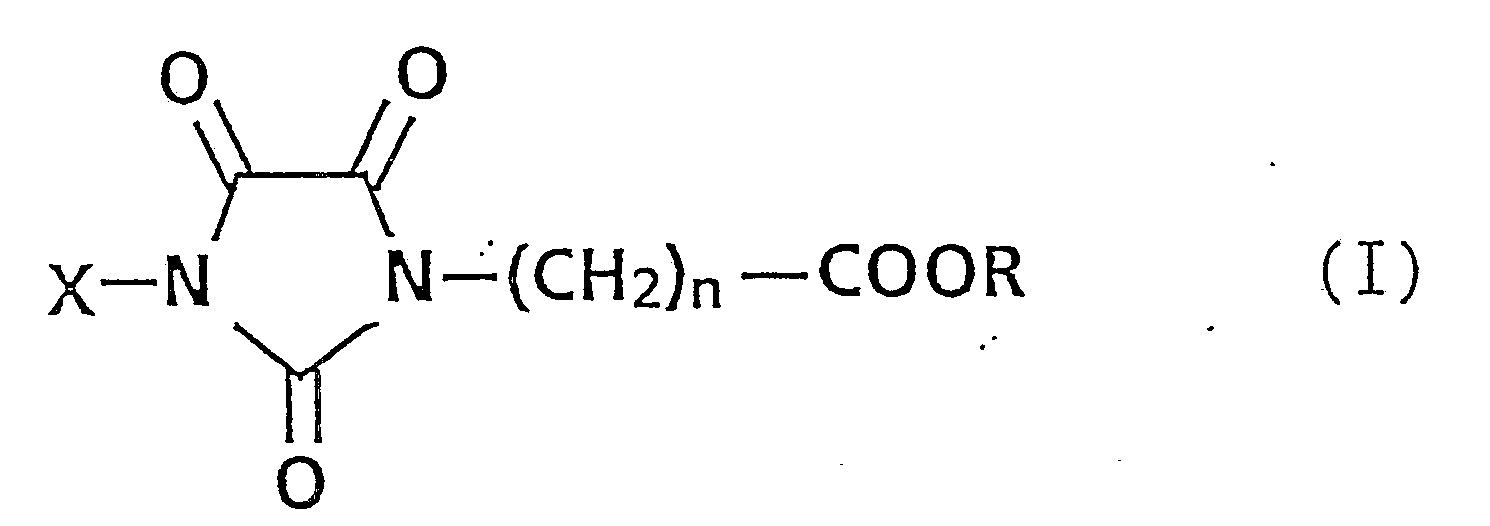
wherein R is hydrogen or a lower alkyl group, X is hydrogen, an alkyl group, a cycloalkyl group, a lower alkylcycloalkyl group, a phenyl group or a phenylalkyl group which may optionally be substituted by a lower alkoxy group, a nitro group or halogen, and n represents an integer of from 1 to 4;
and pharmaceutically acceptable salts and metal complexes thereof.
wherein R is hydrogen or a lower alkyl group, X is hydrogen, an alkyl group, a cycloalkyl group, a lower alkylcycloalkyl group, a phenyl group or a phenylalkyl group which may optionally be substituted by a lower alkoxy group, a nitro group or halogen, and n represents an integer of from 1 to 4;
and pharmaceutically acceptable salts and metal complexes thereof.
2. Parabanic acid derivatives and pharmaceutically acceptable salts and metal complexes
thereof according to claim 1 characterized in that R is hydrogen.
3. Parabanic acid derivatives and pharmaceutically acceptable salts and metal complexes
thereof according to claim 1 or claim 2 characterized in that n is an integer of 1.
4. Parabanic acid derivatives and pharmaceutically acceptable salts and metal complexes
thereof according to any one of claims 1 to 3 characterized in that X is a lower alkyl
group.
5. Parabanic acid derivatives and pharmaceutically acceptable salts and metal complexes
thereof according to any one of claims 1 to 3 characterized in that X is a lower alkyl
substituted phenylalkyl group.
6. Parabanic acid derivatives and pharmaceutically acceptable salts and metal complexes
thereof according to any one of claims 1 to 3 characterized in that X is a lower alkoxy
substituted phenylalkyl group.
7. Parabanic acid derivatives and pharmaceutically acceptable salts and metal complexes
thereof according to any one of claims 1 to 3 characterized in that X is a nitro substituted
phenylalkyl group.
8. Parabanic acid derivatives and pharmaceutically acceptable salts and metal complexes
thereof according to any one of claims 1 to 3 characterized in that X is a halo substituted
phenylalkyl group.
9. Parabanic acid derivatives and pharmaceutically acceptable salts and metal complexes
thereof according to any one of the preceding claims characterized in that the phenylalkyl
group is benzyl.
10. Parabanic acid derivatives and pharmaceutically acceptable salts and metal complexes
thereof according to any one of claims 1 to 9 characterized in that the phenylalkyl
group is phenylethyl.
11. A pharmaceutical composition comprising as an active ingredient an effective amount
of at least one parabanic acid derivative of the formula (I) or a pharmaceutically
acceptable salt or metal complex thereof as defined in any one of claims 1 to 10.
12. The use of a parabanic acid derivative of formula I or a pharmaceutically acceptable
salt or metal complex thereof as defined in any one of claims 1 to 10 for the manufacture
of a drug for the treatment of diabetic conditions.
13. The use of a parabanic acid derivative of formula I or a pharmaceutically acceptable
salt or metal complex thereof as defined in any one of claim 1 to 10 for the manufacture
of a drug for the inhibition of aldose reductase production in mammals.
14. A method for the treatment of mammals suffering from diabetes which comprises
treating said mammals with parabanic acid derivatives of formula I or a pharmaceutically
acceptable salt or metal complex thereof as defined in any one of claims 1 to 10.
15. A process for the preparation of a pharmaceutical formulation comprising bringing
a parabanic acid derivative of formula I or a pharmaceutically acceptable salt or
metal complex thereof as defined in any one of claims 1 to 10 for the manufacture
of a drug.
16. A process for the preparation of a pharmaceutical formulation comprising bringing
a parabanic acid derivative or a pharmaceutically acceptable salt or metal complex
thereof as defined in any one of claims 1 to 10 for the manufacture of a drug, which
comprises preparing said compounds using conventional chemical procedures.
17. A process for the preparation of a parabanic acid derivative or pharmaceutically
acceptable salt or metal complex thereof for the manufacture of a drug which comprises
(i) reacting oxalyl chloride with an N-substituted urea having a substituent corresponding
to X in formula I and subsequently reacting the so-obtained compound with a halogenocarboxylic
acid alkyl ester and if desired hydrolyzing the so-obtained alkyl ester product with
an acid,
(ii) reacting oxalyl chloride with an N,N′-disubstituted urea substituted with groups X and -(CH₂)n-COOR in formula I and if desired reacting a so-obtained compound of formula I wherein X represents hydrogen with a halogenated compound of X.
(ii) reacting oxalyl chloride with an N,N′-disubstituted urea substituted with groups X and -(CH₂)n-COOR in formula I and if desired reacting a so-obtained compound of formula I wherein X represents hydrogen with a halogenated compound of X.