|
(11) | EP 0 586 298 B1 |

| (12) | EUROPEAN PATENT SPECIFICATION |
|
|
| (54) |
Inhibitor of herpes simplex viral thymidine kinase Inhibitoren der Thymidinkinase von Herpes Simplex Virus Inhibiteur de thymidine kinase du virus herpes simplex |
|
|
|||||||||||||||||||||||||||||||
| Note: Within nine months from the publication of the mention of the grant of the European patent, any person may give notice to the European Patent Office of opposition to the European patent granted. Notice of opposition shall be filed in a written reasoned statement. It shall not be deemed to have been filed until the opposition fee has been paid. (Art. 99(1) European Patent Convention). |
[0002] Herpes simplex viruses type (HSV-1) and type 2 (HSV-2) induce unique virus-specified thymidine kinases (dThd kinase) in infected cells. While the activity of viral dThd kinase does not appear to be cirtical for virus replication in cell culutre systems, studies have suggested that it is important for virus pathogeneicity and reactiviation of latent virus from neural cells. Nutter et al., Demonstration of Viral Thymidine Kinase Inhibitor and Its Effect on Dexoynucleotide Metabolism in Cells Infected with Herpers Simplex Virus, Antimicrobial Agents and Chemotherapy, Vol 31, No. 3, pp d368-374 (1987). Thus it is the intention of this invention to provide novel thymidine kinase inhibitors for antiviral agents in mammals.
[0003] This invention relates to a compound of formula I
in which R is C₁₋₆ alkyl or Ar(CH₂)n-, wherein Ar represents phenyl optionally substituted with one to five same or different halogen, C₁₋₆ alkyl or C₁₋₆ alkyloxy ; n is one to six.
[0004] A further aspect of the present invention relates to the use of a compound of formula I in the manufacture of a composition for inhibiting viral thymidine kinases.
[0005] Yet another aspect of the invention relates to the use of a compound of formula I in the manufacture of a medicament for treating simplex viral infection in a mammal afflicted with such an infection.
[0006] Yet another aspect of the invention provides a pharmaceutical formulation comprising a compound of formula I and one or more pharmaceutically acceptable carriers, excipients or diluents.
[0007] As used herein, C₁₋₆ alkyl refers to straight and branched chain alkyl groups with one to six carbon atoms, and such groups include methyl, ethyl, n-propyl, isopropyl, n-butyl, t-butyl, n-pentyl, n-hexyl, 3-methylpentyl, or the like alkyl groups; C₁₋₆ alkyloxy (alkoxy) refers to straight or branched alkyloxy groups such as methoxy, ethoxy, n-propoxy, i-propoxy, n-butoxy, t-butoxy, n-pentyloxy, n-hexyloxy, or 3-methylpentyloxy, to name a few.
[0008] The specific examples which follow illustrate the synthesis of representative compounds of the instant invention and are not to be construed as limiting the invention. The methods may be adapted to variations in order to produce compounds embraced by this invention as claimed but not specifically disclosed. Further, variations of the methods to produce the same compounds in somewhat different fashion will also be evident to one skilled in the art.
[0009] The nuclear magnetic resonance (NMR) spectral characteristics refer to chemical shifts (δ) expressed in parts per million (ppm) versus tetramethylsilane (TMS) as reference standard. The nature of the shifts as to multiplicity is reported as broad singlet (bs), broad doublet (bd), broad triplet (bt), broad quartet (bq), singlet (s), multiplet (m), doublet (d), quartet (q), triplet (t), doublet of doublet (dd), doublet of triplet (dt), and doublet of quartet (dq).
Synthesis of (2R, 4S, 5S)-1-(Tetrahydro-4-hydroxy-5-methoxy-2-furanyl)thymine (2) and (2R, 4R, 5R)-1-(Tetrahydro-4-hydroxy-5-methoxy-2-furanyl thymine (3)
[0010]
To a solution of glycal 1 (1.94 g, 10 mmol) [prepared according to the literature procedures: J. Zemlicka, et al., J. Amer. Chem. Soc., 94 3213 (1972)] in MeOH (4 mL) and CH₂Cl₂ (5 mL) at 0°C was added dropwise a solution of 3-chloroperbenzoic acid (80-85%, ca. 11 mmol) in CH₂Cl₂ (2 mL) under nitrogen. After being stirred at room temperature for 1.5 h, the mixture was diluted with CH₂Cl₂ and aqueous NaHCO₃. The organic phase was washed with brine, dried over MgSO₄, and concentrated in vacuo. The residual oil was chromatographed on silica gel using 5% MeOH in CH₂Cl₂ as eluent to separate the mixture of 2 and 3. The isomer 3 was eluted first and obtained as amorphous solid (1.25 g, 55%). Continuing the column with 5% MeOH in CH₂Cl₂, the isomer 2 was isolated as a fine residue (yield: 350 mg, 15%). In a similar manner as described here, compounds 4 - 15 were prepared using the corresponding alcohols; their physical and spectroscopic data are summarized in Table 1.
THYMIDINE KINASE INHIBITORY ASSAY
[0012] The reaction (50 µl) was performed in: 50 mM Tris-HCl pH 7.5, 5 mM MgCl₂, 30 mM KCl, 2 mM dithiothreitol, 5 mM ATP, 1 µM [³H]thymidine, 0 - 20 µM potential inhibitor, 0.075 mg/ml bovine serum albumin, 0.1 unit/ml HSV-1 TK. Incubation was at 37°C for 1 hour. Samples (40 µl) were spotted on DE-81 filter disks, washed with 1 mM ammonium formate (pH 7), three times with water, twice with ethanol, and dried. Radioactivity was quantitated in a scintillation counter.
[0013] TK (thymidine kinase) was affinity purified from HSV-1 (KOS) infected cells by published procedures (Fyfe (1982) Mol. Pharmacol. 21:432-437 and Field et al. (1990) Antiviral Res. 13:41-52). One unit is defined as 1 nanomole thymidine phosphorylated per hour.
[0014] In Table 2, inhibition constants were determined from slope replots (1/slope vs [I]) of Lineweaver-Burk plots. "N" indicates the number of experiments, and each experiment was done in triplicate.
Table 2
| Compound | Ki, µM | |
| 2 | 3.2 ± 0.3 | (N=4) |
| 13 | 4.3 ± 1.8 | (N=3) |
| 16 | 10.1 ± 4.7 | (N=3) |
| 12 | 26 | (N=1) |
[0015] The foregoing test shows that compounds of formula I are useful for inhibiting viral thymidine kinsases. The compounds of formula I can also be administered for the control or prevention of viral infection, such as herpes simplex viral infections, to mammals in need of such treatment. The compounds of formula I can also be used as medicaments in the form of pharmaceutical preparations (formulations) which contain them in association with a compatible pharmaceutical carrier material. This can be an organic or inorganic carrier suitable for enteral, e.g., oral, or parenteral administration. Examples of such carriers are water, gelatine, gum arabic, lactose, starch, magnesium stearate, talc, vegetable oils, polyalkylene glycols and petroleum jelly. The pharmaceutical preparations can be made up in a solid form, e.g., as tablets, dragees, suppositories or capsules, or in a liquid form, e.g. as solutions, suspensions or emulsions; they may be subjected to standard pharmaceutical operations, e.g. sterilization and/or may contain adjuvants, e.g. preserving, stabilizing, wetting or emulsifying agents, salts for varying the osmotic pressure or buffers. They may also contain other therapeutically valuable substances.
[0016] The compounds of formula I can be administered to adult humans in a daily dosage of from about 1 to 1000 mg, preferably about 5 to 500 mg. The daily dosage may be administered as a single dose or in divided doses. The above dosage range is given by way of example only and can be varied upwards or downwards depending on factors such as the particular compound being administered, the route of administration, the severity of the indication being treated and the condition of the patient.
1. A compound of formula I
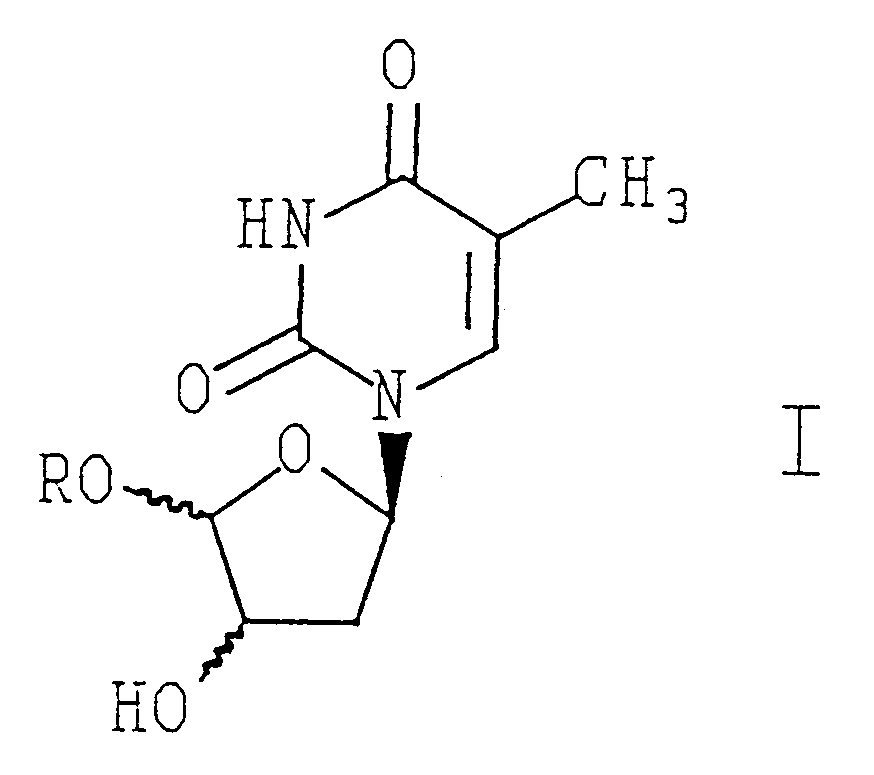
in which R is C₁₋₆alkyl or Ar(CH₂)n-, wherein Ar represents phenyl optionally substituted with one to five same or different halogen, C₁₋₆ alkyl or C₁₋₆ alkyloxy; and n equals one to six.
in which R is C₁₋₆alkyl or Ar(CH₂)n-, wherein Ar represents phenyl optionally substituted with one to five same or different halogen, C₁₋₆ alkyl or C₁₋₆ alkyloxy; and n equals one to six.
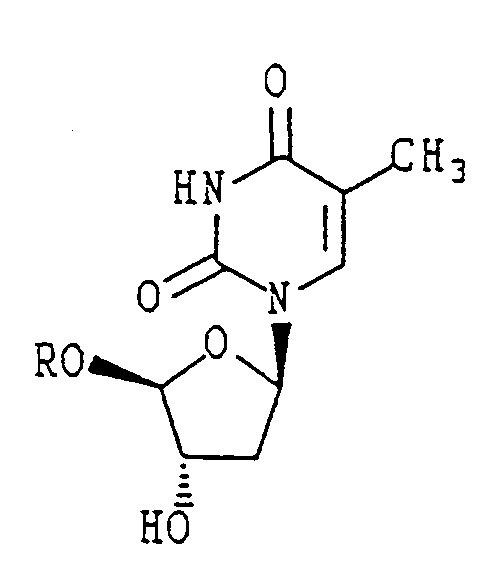
2. A compound of claim 1 in which the configurations at the 4- and 5-positions are represented
by the formula
3. The compound of claim 2 in which R is methyl.
4. The compound of claim 2 in which R is ethyl.
5. The compound of claim 2 in which R is n-propyl.
6. The compound of claim 2 in which R is t-butyl.
7. The compound of claim 2 in which R is phenylmethyl.
8. The compound of claim 2 in which R is 2-phenylethyl.
9. The compound of claim 2 in which R is 3-phenylproypyl.
10. The compound of claim 2 in which R is 4-bromophenylmethyl.
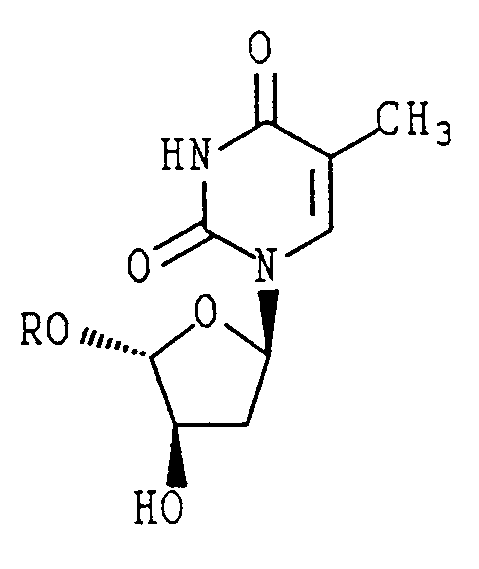
11. A compound of claim 1 in which the configurations at the 4- and 5-positions are represented
by the formula
12. The compound of claim 11 in which R is methyl.
13. The compound of claim 11 in which R is ethyl.
14. The compound of claim 11 in which R is n-propyl.
15. The compound of claim 11 in which R is t-butyl.
16. The compound of claim 11 in which R is phenylmethyl.
17. The compound of claim 11 in which R is 2-phenylethyl.
18. The compound of claim 11 in which R is 3-phenylpropyl.
19. The compound of claim 11 in which R is 4-bromophenylmethyl.
20. A pharmaceutical formulation which comprises as an active ingredient a compound as
claimed in any one of claims 1 to 19, or a pharmaceutically acceptable salt thereof,
associated with one or more pharmaceutically acceptable carriers, excipients or diluents
therefor.
21. Use of the compound as claimed in one of claims 1 to 19 in the manufacture of a medicament
for treating herpes simplex viral infection in a mammal afflicted with such infection.
22. Use of a compound as claimed in one of claims 1 to 19 in the manufacture of a composition
for inhibiting viral thymidine kinase.
1. Eine Verbindung noch der Formel I
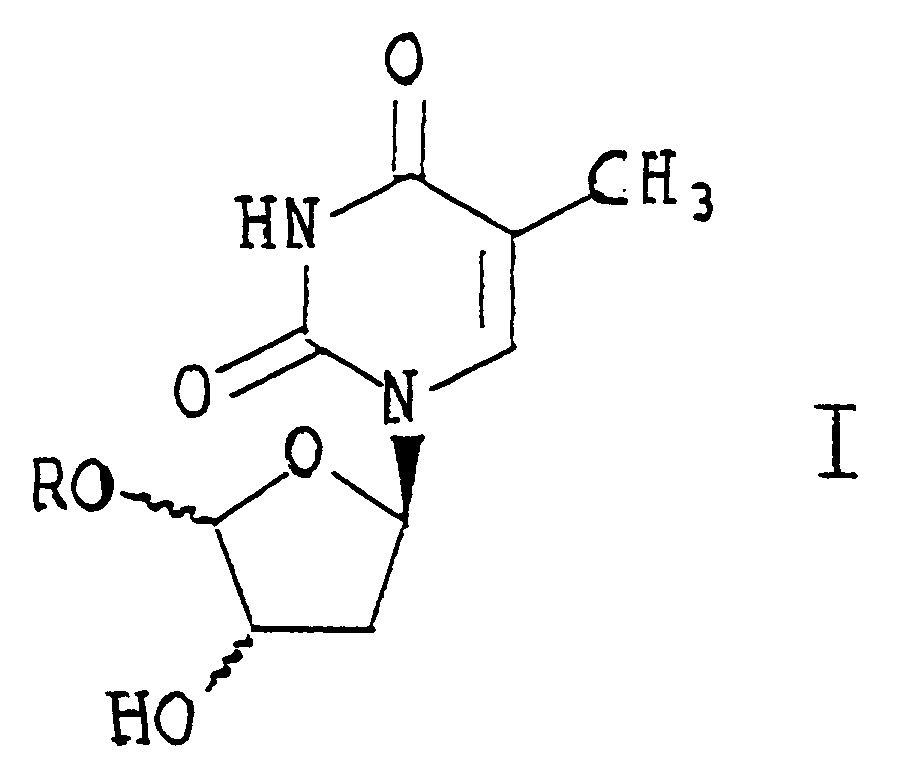
in welcher R C₁₋₆ Alkyl oder Ar(CH₂)n- ist, wobei Ar mit einem bis fünf Atomen desselben oder unterschiedlichen Halogen, C₁₋₆ Alkyl oder C₁₋₆ Alkyloxy beliebig substituirtes Phenyl darstellt; und n gleich eins bis sechs ist.
in welcher R C₁₋₆ Alkyl oder Ar(CH₂)n- ist, wobei Ar mit einem bis fünf Atomen desselben oder unterschiedlichen Halogen, C₁₋₆ Alkyl oder C₁₋₆ Alkyloxy beliebig substituirtes Phenyl darstellt; und n gleich eins bis sechs ist.
2. Eine Verbindung des Anspruches 1 in welcher die Konfigurationen an den Stellungen
4 und 5 durch die Formel
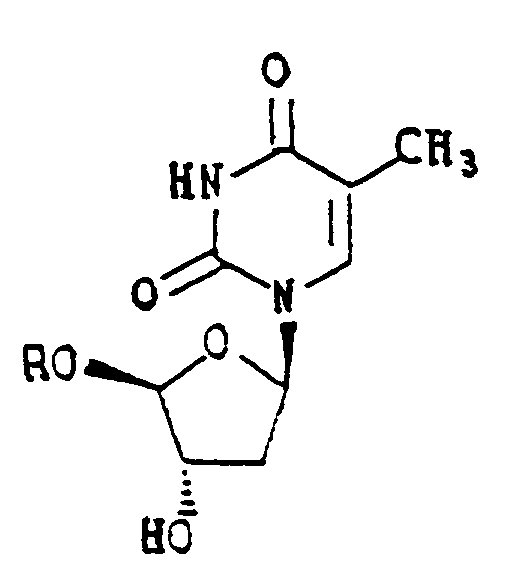
dargestellt sind.
dargestellt sind.
3. Die Verbindung des Anspruches 2 in welcher R Methyl ist.
4. Die Verbindung des Anspruches 2 in welcher R Äthyl ist.
5. Die Verbindung des Anspruches 2 in welcher R n-Propyl ist.
6. Die Verbindung des Anspruches 2 in welcher R t-Butyl ist.
7. Die Verbindung des Anspruches 2 in welcher R Phenylmethyl ist.
8. Die Verbindung des Anspruches 2 in welcher R 2-Phenyläthyl ist.
9. Die Verbindung des Anspruches 2 in welcher R 3-Phenylpropyl ist.
10. Die Verbindung des Anspruches 2 in welcher R 4-Bromophenylmethyl ist.
11. Eine Verbindung des Anspruches 1 in welcher die Konfigurationen an den Stellungen
4 und 5 durch die Formel
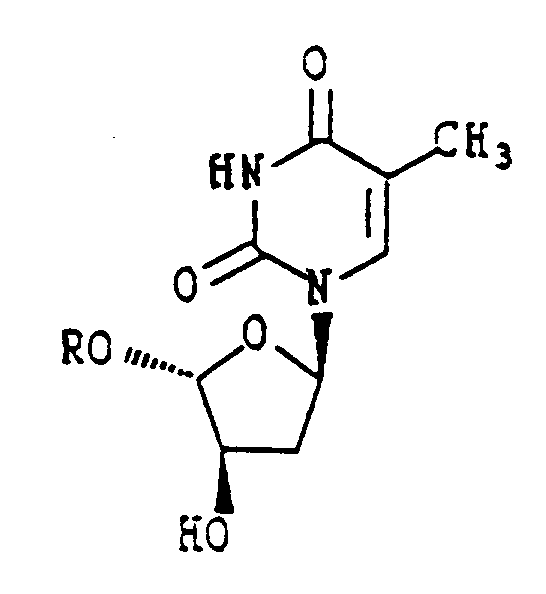
dargestellt sind.
dargestellt sind.
12. Die Verbindung des Anspruches 11 in welcher R Methyl ist.
13. Die Verbindung des Anspruches 11 in welcher R Äthyl ist.
14. Die Verbindung des Anspruches 11 in welcher R n-Propyl ist.
15. Die Verbindung des Anspruches 11 in welcher R t-Butyl ist.
16. Die Verbindung des Anspruches 11 in welcher R Phenylmethyl ist.
17. Die Verbindung des Anspruches 11 in welcher R 2-Phenyläthyl ist.
18. Die Verbindung des Anspruches 11 in welcher R 3-Phenylpropyl ist.
19. Die Verbindung des Anspruches 11 in welcher R 4-Bromophenylmethyl ist.
20. Eine pharmazeutische Formulierung, die als wirksamer Bestandteil eine wie in irgendeinem
der Ansprüche 1 bis 19 beanspruchte Verbindung oder ein pharmazeutisch annehmbares
Salz derselben ist, das einem oder mehreren pharmazeutisch annehmbaren Trägern, Bindemitteln
oder Verdünnungsmitteln für dieselbe zugeordnet ist.
21. Verwendung der wie in einem der Ansprüche 1 bis 19 beanspruchten Verbindung in der
Herstellung eines Arzneimittels zur Behandlung einer Virusinfektion durch Herpes Simplex
bei einem durch eine solche Infektion heimgesuchten Säugetier.
22. Verwendung einer wie in einem der Ansprüche 1 bis 19 beanspruchten Verbindung in der
Herstellung einer Verbindung zur Hemmung von Virusthymidinkinase.
1. Un composé de formule I
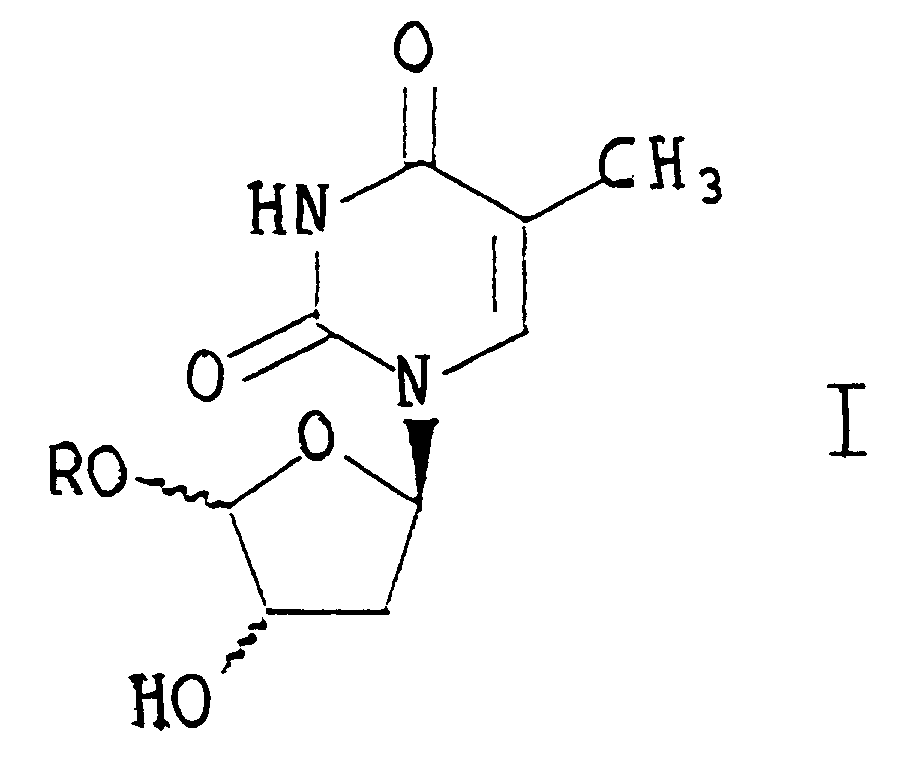
dans lequel R est C₁₋₆alkyle ou Ar(CH₂)n-, où Ar représente du phényle facultativement substitué avec un à cinq atomes d'un même halogène ou d'halogène différent, C₁₋₆ alkyle ou C₁₋₆ alkyloxy; et n égale un à six.
dans lequel R est C₁₋₆alkyle ou Ar(CH₂)n-, où Ar représente du phényle facultativement substitué avec un à cinq atomes d'un même halogène ou d'halogène différent, C₁₋₆ alkyle ou C₁₋₆ alkyloxy; et n égale un à six.
2. Un composé de la revendication 1 dans lequel les configurations aux positions 4 et
5 sont représentées par la formule
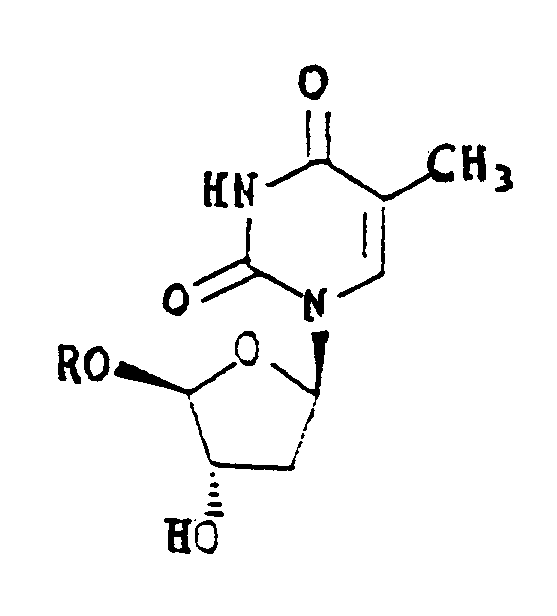
3. Le composé de la revendication 2 dans lequel R est du méthyle.
4. Le composé dans la revendication 2 dans lequel R est de l'éthyle.
5. Le composé de la revendication 2 dans lequel R est du n-propyle.
6. Le composé de la revendication 2 dans lequel R est du t-butyle.
7. Le composé de la revendication 2 dans lequel R est du phénylméthyle.
8. Le composé de la revendication 2 dans lequel R est du 2-phényléthyle.
9. Le composé de la revendication 2 dans lequel R est du 3-phénylpropyle.
10. Le composé de la revendication 2 dans lequel R est 4-bromophénylméthyle.
11. Un composé dans la revendication 1 dans lequel les configurations aux positions 4
et 5 sont représentées par la formule
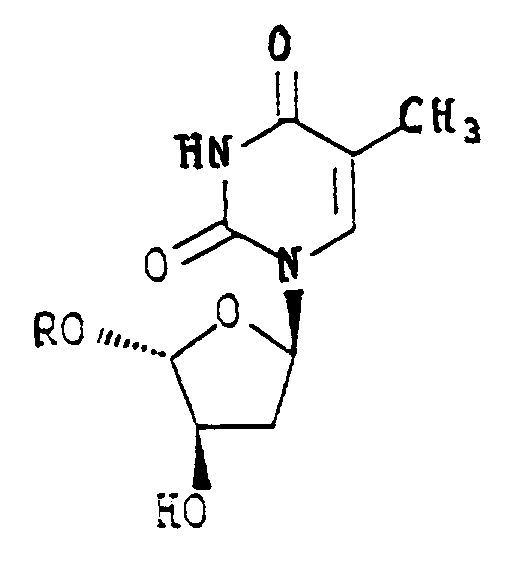
12. Le composé de la revendication 11 dans lequel R est du méthyle.
13. Le composé de la revendication 11 dans lequel R est de l'éthyle.
14. Le composé de la revendication 11 dans lequel R est du n-propyle.
15. Le composé de la revendication 11 dans lequel R est du t-butyle.
16. Le composé de la revendication 11, dans lequel R est du phénylméthyle.
17. Le composé de la revendication 11, dans lequel R est du 2-phényléthyle.
18. Le composé de la revendication 11, dans lequel R est du 3-phénylpropyle.
19. Le composé de la revendication 11 dans lequel R est du 4-bromophénylméthyle.
20. Une formulation pharmaceutique qui comprend, comme ingrédient actif, un composé tel
que revendiqué dans l'une quelconque des revendications 1 à 19 ou un seul pharmaceutiquement
acceptable de celui-ci, associé à un ou plusieurs supports, excipients ou diluants
pharmaceutiquement acceptables pour celui-ci.
21. Utilisation du composé tel que revendiqué dans l'une des revendications 1 à 19 dans
la fabrication d'un médicament pour traiter une infection virale d'herpès simplex
chez un mammifère affligé d'une telle infection.
22. Utilisation d'un composé tel que revendiqué dans l'une des revendications 1 à 19 dans
la fabrication d'une composition pour inhiber la thymidine kinase virale.