[0001] trans-2-Methoxycyclohexanol is a useful synthon; for instance, it can be converted to 2-methoxycyclohexanone
which is an intermediate for antibiotic compounds, and potentially as an auxiliary
for control of chirality in asymmetric synthesis. For such purposes, it is essential
that the
trans-2-methoxycyclo-hexanol is used in single-enantiomer form.
[0002] trans-2-Methoxycyclohexanol can be resolved by biocatalysis but in the case of a requirement
for the [1(
S),2(
S)]-enantiomer, our experience is that biocatalysis using a commercially-available
enzyme such as Amano PS lipase (from
Pseudomonas fluorescens) is a lengthy procedure requiring considerable amounts of enzyme.
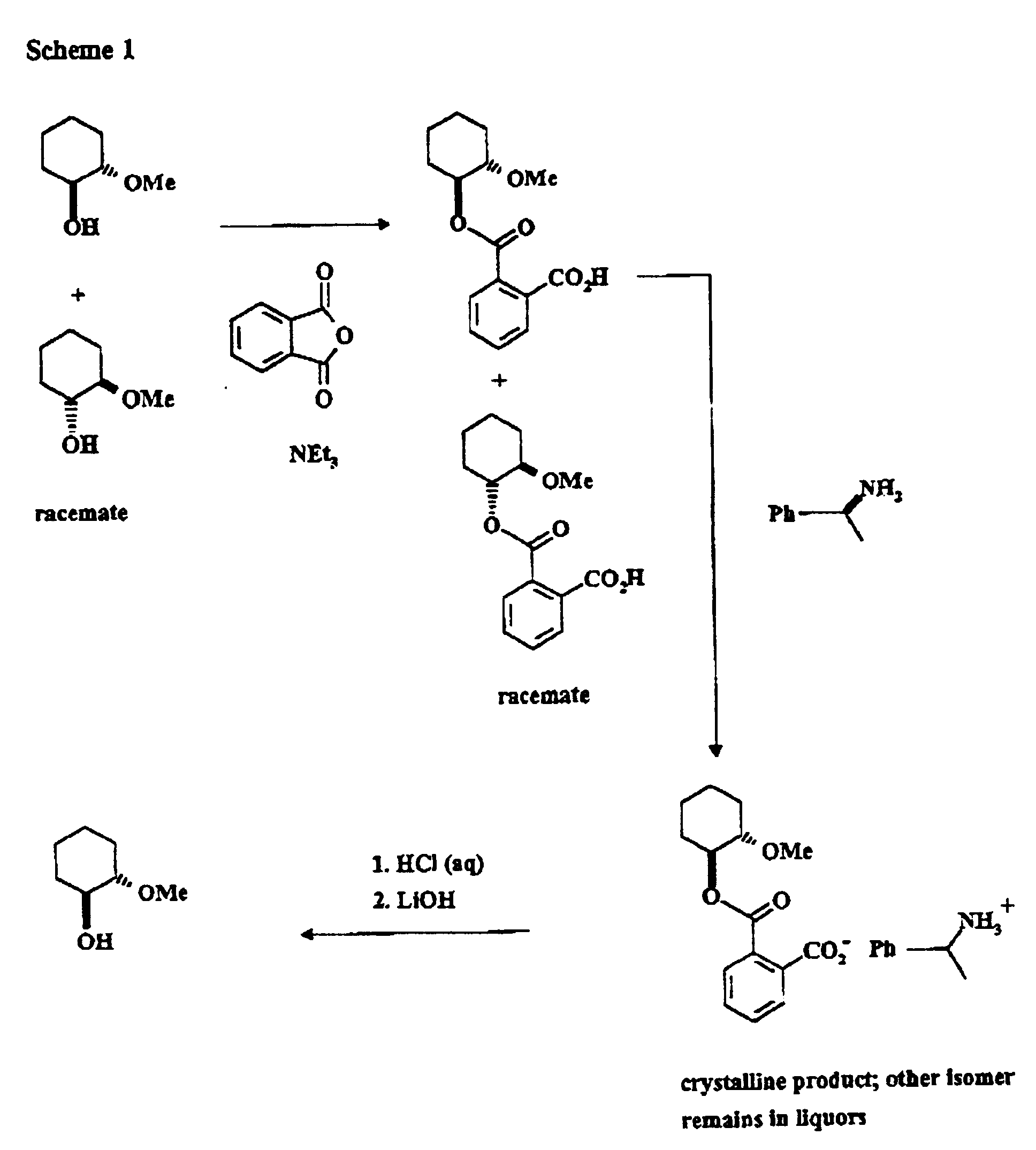
[0003] According to the present invention, an effective procedure has been discovered for
the production of enantiomers of 2-methoxycyclohexanol, by resolution of the hemiphthalate
ester with a chiral amine. Examples of the chiral amine are the (
S) and (
R) enantiomers of α-methylbenzylamine (1-phenylethylamine). A schematic representation
of the procedure is then as outlined in Scheme 1.
[0004] According to the Scheme, racemic
trans-methoxycyclohexanol, produced from acid-mediated addition of methanol with cyclohexene
oxide, is converted to the hemiphthalate with phthalic anhydride. The (
S)-enantiomer of α-methylbenzyl-amine gives crystals that yield the [(S),(S)] enantiomer
of 2-methoxycyclohexanol. Typically, the initial crystallisation gives 30% yield of
salt, in a diastereo-isomeric excess of 70%. Recrystallisation of the salt elevates
the enantiomeric excess. An appropriate solvent is used for the procedure, such as
a mixture of ethyl acetate or methyl
t-butyl ether with ethanol or 2-propanol.
[0005] As an alternative way of operating the process, the enantiomer of the chiral amine
can be used that provides the desired enantiomer of the methoxycyclohexanol initially
in the liquors. Thus, use of (
R)-α-methylbenzylamine may give liquors containing the methoxycyclohexanol component
in 70% yield and 30% ee for [(
S), (
S)] isomer. This enriched material can be broken down to the free hemiphthalate, and
then another chiral amine (e.g. (
S)-α-methylbenzylamine) used to elevate ee with the benefit of the initial enrichment.
[0006] A further feature of the invention is the use of more than one amine (as indicated
above), the first to give a partial resolution, and the second to elevate enantiomeric
excess. The second amine need not necessarily be chiral, provided that the salt increases
in ee on recrystallisation. A corollary of this is that ee elevation can be via a
salt of the hemiphthalate with a cationic component that is not an amine, such as
an inorganic ion.
[0007] The following Example illustrates the invention.
Example
[0008] Racemic 2-methoxycyclohexanyl hemiphthalate (10.0 g) in ethyl acetate (80 ml) was
treated with (
S)-α-methylbenzylamine (4.84 g) and methanol (3 ml). The mixture was heated until all
solid dissolved, then stirred for 24 h at ambient temperature, and lastly maintained
at 0°C for 30 min. The crystals were collected by filtration and washed with hexane.
This gave the salt in yield of 4.31 g (29%), de 75%.
[0009] Recrystallisation from a mixture of ethyl acetate (38 ml) and methanol (3 ml) gave
3.37 g of salt, de 90%.
[0010] From a different batch recrystallisation of 2.83 g, 92% de from ethyl acetate (9
ml) and isopropanol (11 ml) gave 2.07 g, de 97%.
1. trans-2-Methoxycyclohexanyl hemiphthalate as either single enantiomer, (R) or (S), or as a mixture of enantiomers in which either is in at least 50% ee.
2. A hemiphthalate according to claim 1, in which the ee is at least 75%.
3. A salt of an amine and a hemiphthalate according to either preceding claim.
4. A salt according to claim 3, in which the amine is optically-active.
5. A salt according to claim 4, which is the (S)-α-methylbenzylamine salt of [1(S), 2(S)]-2-methoxycyclohexanyl hemiphthalate.
6. A salt according to claim 4, which is the (R)-α-methylbenzylamine salt of [1(S) ,2(S)]-2-methoxycyclohexanyl hemiphthalate.
7. Use of a hemiphthalate or salt according to any preceding claim, for the preparation
of at least substantially optically-pure 2-methylcyclohexanone.
8. A process for preparing 2-methoxycyclohexanone or trans-2-methoxycyclohexanol as at least substantially a single enantiomer, which comprises
converting a mixture of enantiomers of trans-2-methoxycyclohexanol to the hemiphthalate ester; crystallising therefrom a salt
according to any of claims 3 to 6 and, if desired, recrystallising the or a different
such salt; removing the amine; and, if desired, before or after removing the amine,
oxidising the cyclohexanol to the cyclohexanone.
