|
(11) | EP 1 371 638 A1 |

| (12) | EUROPEAN PATENT APPLICATION |
|
|
|
|
|||||||||||||||||||||||
|
||||||||||||||||||||||||
| (54) | Pyridazinone derivatives as intermediates of herbicides |
| (57) This invention provides pyridazinone derivatives given in the general formula:
[wherein, R100 represents hydrogen, halogen or C1-C3 alkyl, R101 represents C1-C3 haloalkyl and R102 represents hydrogen or C1-C3 alkyl] which are intermediates in the production of compounds having excellent herbicidal activity. |
[0002] The object of the present invention is to provide pyridazinone derivatives useful as intermediates for preparing compounds having excellent herbicidal activity.
[0003] Pyridazinone derivatives of the formula
are disclosed in EP-A-947 509 of which the present application is a Divisional Application.
[0004] The present invention provides a pyridazinone derivative given in the formula (I)
[wherein, R100 represents hydrogen, halogen or C1-C3 alkyl, R101 represents C1-C3 haloalkyl, and R102 represents hydrogen or C1-C3 alkyl.]
that is an intermediate for the production of pyridazinone derivatives having excellent herbicidal activity.
[0005] In the present invention,
in the definition of R100,
halogen atom means fluorine, chlorine, bromine or iodine, and
C1-C3 alkyl includes methyl, ethyl, propyl, isopropyl;
in the definition of R101,
C1-C3 haloalkyl includes trichloromethyl, trifluoromethyl, difluoromethyl,
chlorodifluoromethyl, pentafluoroethyl, 1,1-difluoroethyl, etc.; and
in the definition of R102,
C1-C3 alkyl includes methyl, ethyl, propyl, isopropyl.
[0006] A production method of the pyridazinone derivatives of the present invention is given in the following scheme.
[wherein R100, R101 and R102 have the same definition as mentioned above, R30 represents C1-C6 alkyl such as methyl or ethyl, and R31
represents amino, C1-C6 alkyl such as methyl, ethyl and t-butyl, or C1-C6 alkoxy such as methoxy, ethoxy and t-butoxy.]
The reaction conditions for each step are given, for example, below.
1) A method to produce compound [A2] from compound [A1]
[0007] Compound [A2] may be produced by previously reacting the α-dihalo compound given as R101C(=O)CV2R102 [wherein, R101, R102 and V have the same definition as mentioned above] with water in the presence of a base to obtain the carbonyl derivative given as R101C(=O)C(=O)R102 [wherein, R101 and R102 have the same definition as mentioned above.] (reaction 1), and subsequently, reacting with compound [A1] (reaction 2). The carbonyl derivative given as R101C(=O)C(=O)R102 [wherein, R101 and R102 have the same definition as mentioned above] may also be reacted in water or alcohol, and as a hydrate or acetal derivative.
[0008] Reaction 1 is usually performed within a solvent. The limits to the reaction temperature are usually from 20 to 100° C, and the limits to the reaction time are usually from a moment to 24 hours. For the amounts of the agents used in the reaction, based on 1 mole of α -dihalo compound R101C(=O)CV2R102, a rate of 2 moles is the theoretical amount of each water and the base, but may be optionally altered to correspond to the condition of the reaction.
[0009] As the base that may be used, organic bases and inorganic bases both may be utilized, and for example, sodium acetate, potassium acetate and the like may be set forth.
[0010] As the solvent, aliphatic hydrocarbons such as hexane, heptane, ligroin, cyclohexane and petroleum ether; aromatic hydrocarbons such as benzene, toluene and xylene; halogenated hydrocarbons such as chlorobenzene and dichlorobenzene, ethers such as diethyl ethers, diisopropyl ether, dioxane, THF and ethylene glycol dimethyl ether; esters such as ethyl formate, ethyl acetate, butyl acetate and diethyl carbonate; nitro compounds such as nitromethane and nitrobenzene; nitriles such as acetonitrile and isobutylonitrile; acid amides such as DMF; tertiary amines such as pyridine, triethylamine, diisopropylethylamine, N,N-dimethylaniline, N,N-diethylaniline and N-methylmorpholine; sulfur compounds such as DMSO and sulfolane; alcohols such as methanol, ethanol, ethylene glycol, isopropanol and t-butanol; or a mixture thereof are set forth.
[0011] Reaction 2 is usually performed within a solvent. The limits to the reaction temperature are usually from -20 to 200° C, and the limits to the reaction time are usually from a moment to 72 hours. For the amount of the agents used in the reaction, based on 1 mole of α-dihalo compound utilized in reaction 1, a rate of 1 mole is the theoretical amount of compound [A1], but may be optionally altered to correspond to the condition of the reaction. Furthermore, the salt of compound [A1] (for example, hydrochloric acid salts or sulfuric acid salts) may utilized to correspond with the condition of the reaction.
[0012] As the solvent, aliphatic hydrocarbons such as hexane, heptane, ligroin, cyclohexane and petroleum ether; aromatic hydrocarbons such as benzene, toluene and xylene; halogenated hydrocarbons such as chloroform, carbon tetrachloride, dichloromethane, dichloroethane, chlorobenzene and dichlorobenzene; ethers such as diethyl ether, diisopropyl ether, dioxane, THF and ethylene glycol dimethyl ether; esters such as ethyl formate, ethyl acetate, butyl acetate and diethyl carbonate; nitro compounds such as nitromethane and nitrobenzene; nitriles such as acetonitrile and isobutylonitrile; acid amides such as formamide, DMF and acetamide; tertiary amines such as pyridine, triethylamine, diisopropylethylamine, N,N-dimethylaniline, N,N-diethylaniline and N-methylmorpholine; sulfur compounds such as DMSO and sulfolane; fatty acids such as formic acid, acetic acid and propionic acid; alcohols such as methanol, ethanol, ethylene glycol, isopropanol and t-butanol; water; or a mixture thereof are set forth.
[0013] After the completion of the reaction, the reaction mixture may be filtered to collect the precipitated crystals or may be subjected to the ordinary post-treatment such as extraction with an organic solvent and concentration, and if necessary, may be further purified by the procedure such as chromatography and recrystallization. Thus objective material can be isolated.
2) A method to produce compound [A3] from compound [A2]
[0014] Compound [A3] may be produced by reacting compound [A2] with the phosphorane compound given as Ar3P=C(R100)COOR30 [wherein, R100, R30 and Ar have the same definition as mentioned above].
[0015] The said reaction is usually performed within a solvent. The limits to the reaction temperature are usually from -20 to 150° C, preferably from 0 to 100° C, and the limits to the reaction time are usually from a moment to 72 hours. For the amounts of the agents used in the reaction, based on 1 mole of compound [A2], a rate of 1 mole is the theoretical amount of phosphorane, but may be optionally altered to correspond to the condition of the reaction.
[0016] As the solvents that may be utilized, aliphatic hydrocarbons such as hexane, heptane, ligroin, cyclohexane and petroleum ether; aromatic hydrocarbons such as benzene, toluene and xylene; ethers such as diethyl ether, diisopropyl ether, dioxane, THF and ethylene glycol dimethyl ether; nitro compounds such as nitromethane and nitrobenzene; acid amides such as formamide, DMF and acetamide; tertiary amines such as pyridine, triethylamine, diisopropylethylamine, N,N-dimethylaniline, N,N-diethylaniline and N-methylmorpholine; sulfur compounds such as DMSO and sulfolane; alcohols such as methanol, ethanol, ethylene glycol, isopropanol and t-butanol; water; or a mixture thereof are set forth.
[0017] After the completion of the reaction, the reaction mixture may be subjected to distillation to remove the reaction solvent and then the residue may be subjected to chromatography, or the reaction mixture may be subjected to the ordinary post-treatment such as extraction with an organic solvent and concentration. If necessary, further purification such as chromatography and recrystallization may be conducted. Thus the objective material can be isolated.
3) A method to produce compound [A4] from compound [A3]
[0018] Compound [A4] may be produced by performing a intramolecular cyclization reaction with compound [A3] in the presence of an acid. The said reaction is usually performed within a solvent. The limits to the reaction temperature are usually from 0 to 200° C, preferably from 50 to 150° C, and the limits to the reaction time are usually from a moment to 72 hours.
[0019] As the acid, inorganic acids such as hydrochloric acid and sulfuric acid, or organic acids such as trifluoroacetic acid and p-toluenesulfonic acid may be set forth. The amount of the acid used in the reaction is ratio of a catalytic amount to an excess amount based on 1 mole of compound [A3].
[0020] As the solvent, aliphatic hydrocarbons such as hexane, heptane, ligroin, cyclohexane and petroleum ether, aromatic hydrocarbons such as benzene, toluene and xylene; halogenated hydrocarbons such as chloroform, carbon tetrachloride, dichloromethane, dichloroethane, chlorobenzene and dichlorobenzene; ethers such as diethyl ether, diisopropyl ether, dioxane, THF and ethyleneglycol dimethyl ether; ketones such as acetone, methylethyl ketone, methylisobutyl ketone, isophorone and cyclohexanone; nitro compounds such as nitromethane and nitrobenzene; sulfur compounds such as DMSO and sulfolane; fatty acids such as formic acid, acetic acid and propionic acid; alcohols such as methanol, ethanol, ethylene glycol, isopropanol and t-butanol; water, or a mixture of thereof may be set forth.
[0021] After the completion of the reaction, the reaction mixture may be filtered to collect the precipitated crystals or may be subjected to the ordinary post-treatment such as extraction with an organic solvent and concentration, and if necessary, may be further purified by the procedure such as chromatography and recrystallization. Thus objective material can be isolated.
A further production method of certain pyridazinone derivatives of the present invention is given in the following scheme.
[wherein, R100 and R101 have the same definition as mentioned above, and R40 represents hydrogen, carbamoyl, formyl or C1-C6 alkylcarbonyl such as acetyl and propionyl.]
[0023] The reaction is usually performed within a solvent. The limits to the reaction temperature are usually from 0 to 120°C, and the limits to the reaction time are usually from a moment to 72 hours. For the amounts of the agents used in the reaction, based on 1 mole compound [VI], a rate of 1 mole is the theoretical amount of compound [A5], but may be optionally altered to correspond to the condition of the reaction.
[0025] After the completion of the reaction, the reaction mixture may be poured into water to correct the precipitated crystals or may be subjected to the ordinary post-treatment such as extraction with an organic solvent and concentration. If necessary, further purification procedure such as chromatography and recrystallization may be conducted. Thus the objective material may be isolated. potato (Solanum tuberosum). In these cases, the present invention compounds are usually formulated in the same manner as the case where they are used as the active ingredients of herbicides, and may be used alone or in admixture with other harvesting aids for foliar treatment before harvesting the crops.
Hereinafter, the present invention is explained more specifically by means of examples, but the said examples do not limit the present invention in any way.
Example 1
1) Method to produce compound [1b] from compound [1a]
[0027] In a solution of 2.2g of 1,1-dibromo-3,3,3-trifluoroacetone and 25mL of water, 4.9g of sodium acetate trihydrate was incorporated, and was heated for 1.5 hours at 80°C. After cooling the reaction mixture to room temperature, 0.40g of compound [1a] was incorporated. After stirring the mixture at room temperature for 1 hour, water was added, then extracted with diethyl ether. After drying the obtained organic layer with magnesium sulfate anhydride, the said organic layer was concentrated under reduced pressure to acquire 0.65g of compound [1b]
[1H-NMR(300MHz, CDCl3, TMS δ (ppm)); 2.38 (3H, s), 7.41 (1H, br), 10.30 (1H, br)]
2) Method to produce compound [1c] from compound [1b]
[0028] In a solution of 0.64g of compound [1b] and 10mL of tetrahydrofuran, 1.4g of Ph3P=CHCO2C2H5 [wherein Ph represents phenyl.] was added under ice cooling, and then stirred at room temperature for 2 hours. After the completion of the reaction, the obtained mixture had water added and was extracted with diethylether. After drying the organic layer by utilizing magnesium sulfate anhydride, the said organic layer was concentrated under reduced pressure and had the residue subjected to silica gel chromatography to acquuire 0.75g of compound [1c]. m.p. 76.5 °C
3) Method to produce compound [1d] from compound [1c]
[0029] Ten millimeters (10mL) of concentrated hydrochloric acid was added to 0.75g of compound [1c]. The mixture was stirred for 30 minutes at room temperature, and was subsequently stirred for 2 hours while heating under reflux. After then, water was added into the reaction mixture and the mixture obtained was extracted with diethylether. After drying the organic layer by utilizing magnesium sulfate anhydride, the said organic layer was concentrated under reduced pressure to acquire 0.31 g of compound [1d].
m.p. 98.2 °C
Example 2
1) Method to produce compound [1g] from compound [1b]
[0031] To a solution of 13g of compound [1b and 130mL of tetrahydrofuran, 39g of Ph3P=C(CH3)CO2C2H5 [wherein Ph represents phenyl.] was added, and the obtained mixture was then left overnight. After stirring at 40° C for 3 hours, the mixture had water added and was then extracted with ethyl acetate. Afterwards, the organic layer was washed by utilizing an aqueous solution saturated with sodium chloride, dried by utilizing magnesium sulfate anhydride, and then concentrated under reduced pressure. The resulting residue was subjected to silica gel column chromatography to acquire 6.0g of compound [1g]. m.p. 94.5°C
2) Method to produce compound [1h] from compound [1g]
[0032] Eighty milliliters (80mL) of concentrated hydrochloric acid was added to 5.5g of compound [1g], then the obtained mixture was stirred for 3 hour while being heated under reflux. Afterwards, water was added to the reaction mixture and the resultant was extracted with ethyl acetate. The organic layer was washed by utilizing an aqueous solution saturated with sodium chloride, dried by utilizing magnesium sulfate anhydride, and then concentrated under reduced pressure. The resulting residue was subjected to silica gel column chromatography to acquire 0.9g of compound [1h].
[1H-NMR(300MHz, CDCl3, TMS δ (ppm)); 2.39 (3H, q, J=1.8Hz), 7.96 (1H, s), 12.35 (1H, br)]
Example 3
1) Method to produce compound [3b] from compound [3a]
[0034] To the solution of 158g of 1,1-dibromo-3,3,3-trifluoroacetone and 1.5L of water, 318g of sodium acetate trihydrate was incorporated, and the obtained mixture was stirred while heating at 80° C for 1.5 hours. After cooling the mixture to the room temperature, 50g of compound [3a] was added, and then the obtained mixture was stirred at room temperature for 5.5 hours. The precipitated crystals were collected by filtration and dried under reduced pressure to obtain 74g of the crude compound [3b].
2) Method to produce compound [3c] from compound [3b]
[0035] To the solution of 7.0g of compound [3b] and 50ml of tetrahydrofuran, 13.3g of Ph3P=CHCO2C2H5 [wherein Ph represents phenyl.] was added, and the obtained mixture was stirred at room temperature for 3 hours and left overnight. After the completionof the reaction, the reaction mixture was concentrated. The obtained residue was dissolved in t-butyl methyl ether to remove insoluble matters and the obtained organic layer was dried with magnesium sulfate and then concentrated to obtain 5.7g of the compound [3c].
[1H-NMR(250MHz,CDCl3,TMS δ (ppm)) ; 1.33(3H,t,J=7.1Hz),4.27(2H,q,J=7.1 Hz),6.51(1H,s),8.67(1H,s),9.93(1H,br,)]
3) Method to compound [1d] from compound [3c]
[0036] To 57g of compound [3c], 200ml of concentrated hydrochloric acid was added, and the obtained mixture was stirred while heating under reflux for 4.5 hours. The reaction mixture was cooled to room temperature and the precipitated crystals were collected by filtration to obtain 21.5g of compound [1d].
1. The pyridazinone derivative given in the general formula:
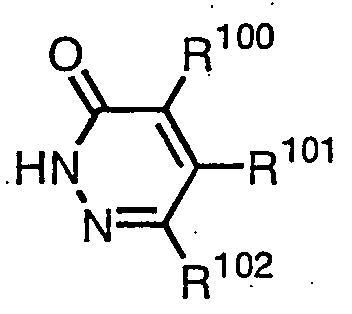
[wherein, R100 represents hydrogen, halogen or C1-C3 alkyl, R101 represents C1-C3 haloalkyl and R102 represents hydrogen or C1-C3 alkyl.]
[wherein, R100 represents hydrogen, halogen or C1-C3 alkyl, R101 represents C1-C3 haloalkyl and R102 represents hydrogen or C1-C3 alkyl.]
2. A compound selected from the following compounds:
5-trifluoromethyl-2,3-dihydro-pyridazin-3-one and
4-methyl-5-trifluoromethyl-2,3-dihydro-pyridazin-3-one.