|
(11) | EP 0 009 722 A1 |

| (12) | EUROPEAN PATENT APPLICATION |
|
|
|
|
|||||||||||||||||||||||||||
| (54) | Optically active complex, alanine.Ring-substituted mandelic acid, and the method for producing the same |
| (57) An optically active complex, alanine.ring-substituted mandelic acid, represented
by the following general formula:
wherein X is p-chloro, p-methoxy, p-methyl, or m-nitro, and n is 0 or 1/2, which is useful as an intermediate compound for obtaining optically active alanine or optically active ring-substituted mandelic acid, and a method for producing the complex is disclosed. |
[0001] The present invention relates to an optically active complex, alanine-ring-substituted mandelic acid, represented by the general formula:
wherein X is p-chloro, p-methoxy, p-methyl or m-nitro, and n is 0 or 1/2 and a method for producing thereof.
[0002] The object substance of the present invention is novel and is useful as an intermediate when optically active alanine and optically active ring-substituted mandelic acid is produced.
[0003] Hitherto, as a method of optical resolution of alanine there has been a method in which alanine is led to its N-benzoyl derivative and the derivative is in turn led to a slightly soluble salt by the reaction with an expensive alakaloid such as brucine and strychnine, and after removing the alkaloid which is formed by the decomposition of the salt, the thus obtained N-benzoyl derivative is hydrolyzed to obtain the optically active alanine. However, the above-mentioned method has unavoidable technical drawbacks.
[0004] Another method has been known in which acylated alanine is optically resolved by amino- acylase, however, since in this method it is necessary to acylize alanine to obtain an acyl- derivative, this method is unavoidably not advantageous.
[0005] On the other hand, as a method of optically resolving ring-substituted mandelic acid only one method has been known in which ephedrine is brought into reaction with p-chloromandelic acid and the reaction product is resolved, there are no other known methods for optically resolving other ring-substituted mandelic acid.
[0006] The inventors formerly have offered a method of optical resolution by the use of a complex of mandelic acid with alanine (German Offen. 2812041) and during the study of the combination of ring-substituted mandelic acid and alanine the inventors have newly found that a ring-substituted mandelic acid such as that mentioned above forms a complex with alanine and that owing to the difference of solubility between two complexes, when an optically active isomer of one of the pair comprising alanine and ring-substituted mandelic acid is used, racemic compound of the other of the above-mentioned pair is possibly resolved optically, for instance, by using L-alanine an optically active ring-substituted mandelic acid is obtained and conversely, by using optically active ring-substituted mandelic acid an optically active alanine is obtained.
[0007] The present invention has been completed on the above-mentioned findings obtained by the inventors' study.
[0008] In order to produce the object substance of the present invention, an optically active ring-substituted mandelic acid is brought into reaction in a solvent with DL-alanine, or optically active alanine is brought into reaction in a solvent with a racemic compound, DL- ring-substituted mandelic acid, to form a complex between the two reactants and then the slightly soluble complex is selectively crystallized out by cooling the- solution, by condensing the solution, if necessary, or by adding another solvent which reduce the solubility to effect the separation of the solid and the liquid. On crystallizing out of the complex, addition of so-called seeds is not necessarily indispensable, however, a small amount of the slightly soluble complex may be added in order to accelerate the crystallization.
[0009] The substance to be optically resolved may be a half-and-half mixture of L-isomer and D-isomer of a mixture in which one isomer is present more than a half amount of the mixture against its antipode.
[0010] The solvent used for the purpose of the invention is not especially limited, provided the slightly soluble complex and the easily soluble complex dissolves in the solvent at a temperature of between the room temperature and its boiling point, and the slightly soluble complex separates out by cooling or concentrating the solution or by adding another solvent into the solution, however, water, a hydrophilic organic solvent, for instance, methanol, ethanol, acetone, etc., or its aqueous solution is preferable.
[0011] The reaction is carried out at a temperature of higher than 0°C and lower than the boiling point of the solvent used in the reaction, however, it is preferable to carry out the reaction at a temperature between 50°C and the boiling point of the solvent used. The temperature at which the complex separates out is not especially limited provided it is lower than the boiling point of the solvent used, however, it is preferably a temperature of between 0°C and 50°C.
[0013] The mole ratio of alanine to a ring-substituted mandelic acid in reaction is 1.0 : 0.3 - 4.0, preferably 1.0 : 1.0 - 3.0. The concentration of alanine in the solvent is possibly selected from a wide range of 10 to 70% by weight.
[0014] In the case where the thus obtained nominal optically active complex is not yet optically pure, it is easily recrystallized to be the optically pure complex.
[0015] The composition of the complex of the present invention is: (alanine)1·(ring-substituted mandelic acid)0,9 - 1.15.
[0016] The actual composition, melting point, specific rotatory power and elementary analytical data are shown in Table 1.
[0017] The optically active alanine is obtainable by dissolving the complex obtained by the present invention into water, a hydrophilic organic solvent or its aqueous solution and after decomposition of the complex by a mineral acid into alanine and ring-substituted mandelic acid, separating the ring-substituted mandelic acid with the addition of an organic solvent such as ether, etc. or separating alanine from the ring-substituted mandelic acid using a strongly acidic ion-exchange resin.
[0018] D-alanine obtained by decomposing the object substance cf the presert invention is important as a raw material of antibiotics ,and also L-alanine is important as a component of solutions for amino acid infusion and as a food additive, and also the optically active ring-substituted mandelic acid is useful as an optical resolution agent and its D-isomer is useful as a raw material for antibiotics of beta-lactum type.
[0019] Optically active alanine or an optically active ring-substituted mandelic acid once used as an optical resolution agent is possibly repeatedly utilized as the optical resolution agent.
[0020] As has been described, the object substance of the present invention is useful as an intermediate in cases where an optically active compound is prepared from DL-alanine or a DL-ring-substituted mandelic acid, and the method of optical resolution via the intermediate has the following advantages as compared to the usual methods:
1. It is not necessary to convert alanine to be resolved to its derivative, and
2. Water is possibly used as the solvent in the process.
EXAMPLE 1:
[0022] DL-p-chloromandelic acid (16.43 g = 0.088 M) and L-alanine (5.23 g = 0.059 M) were mixed into 26.4 ml of water, and the mixture was heated to 70°C to have a solution. After cooling the solution to a room temperature and then stirring the cooled solution for one hour at the room temperature, the separated crystals were collected by filtration, washed with water and then dried. The thus obtained crystals, weighing 7.89 g, was a raw complex, D-p-chloromandelic acid·L-alanine, showing.a specific rotatory power
=-50.46° (c = 1, solvent: Water).
[0023] After mixing 7.5 g of the raw complex with 15 ml of water and heating the mixture to have a solution, the solution was cooled to a room temperature and then it was stirred for one hour. The crystals separated out from the solution. After collecting the crystals by filtration and washing with water, the crystals were dried to obtain 4.36 g of an optically pure compex, D-p-chloromandelic acid L-alanine, with a specific rotatory power of
= -83.17° (c = 1, water) .
EXAMPLES 2 - 4:
[0024] The following ring-substituted mandelic acids were optically resolved by the same procedures as in Example 1 by using optically active alanine. The results are shown in Table 2.
EXAMPLE 5:
[0025] DL-alanine (5.23 g) and D-p-chloromandelic acid (16.4 g) were mixed with 27 ml of water, and the mixture was heated to 70°C to dissolve the solids. After leaving the solution at a room temperature, the crystals which separated out were collected by filtration and washed with 2 ml of water. By drying the washed crystals, 9.08 g of a complex of L-alanine·D-p-chlaromandelic acid with a specific rotatory power of
=-46.3° (c = 1, water) were obtained. On recrystallization of 8.5 g of the thus obtained crystal from 18 ml of water, a purified crystal weighing 3.79 g was obtained. Its specific rotatory power was
-83.1° (c = 1, water).
EXAMPLES 6 and 7:
[0026] The results of optical resolution of DL-alanine using each of optically active ring-substituted mandelic acids as in Example 5 are shown in Table 3.
EXAMPLE 8:
[0027] DL-Alanine (7.5 g) and L-m-nitromandelic acid (12.5 g) were put into 35 ml of 33.3% aqueous methanolic solution and after dissolving the solids by heating the mixture, the solution was stirred for 2 hours at a room temperature. Then the separated crystals from the cooled solution were collected by filtration and washed with 3 ml of water. On drying the crystals, 9.56 g of a complex, L-alanine-L-m-nitrornandelic acid,- with a specific rotatory power of
=-63.2° (c = 1, water) was obtained.
[0028] On recrystallization of the thus obtained raw complex, 5.6 g of purified complex, L-alanine·L-m-nitromandelic acid was obtained.
REFERENTIAL EXAMPLE 1:
[0029] A complex , D-p-chloromandelic acid·L-alanine (5.0 g) obtained in Example 1 was dissolved in 30 ml of water and the thus prepared solution was infused into 30 ml of a strongly acidic ion-exchange resin, Dowex 50W(H+) ("Dowex" is a trademark of Dow Chemical Co., U.S.A.). On concentrating and drying to solid the effluent, 1.87 g of D-p-chloromandelic acid was obtained. Its specific rotatory power was
= -133.96 ° (c = 1, water).
REFERENTIAL EXAMPLE 2:
[0030] A complex, D-m-nitromandelic acid-D-alanine (5.0 g) obtained in Example 6 was dissolved into 30 ml of water and the thus prepared solution was infused into 20 ml of a weakly basic ion-exchange resin Diaion WA-20(OH-) ("Diaion" is a trademark of Mitsubishi Chemical Industries Ltd.). On concentrating and drying to dryness of effluent, 1.52 g of D-alanine was obtained. Its specific rotatory power was
= -14.7° (c = 1, 6N-HCL).
1. An optically active complex, alanine·ring-substituted mandelic acid, represented
by the general formula:

wherein X is p-chloro, p-methoxy, p-methyl or m-nitro, and n is 0 or 1/2.
wherein X is p-chloro, p-methoxy, p-methyl or m-nitro, and n is 0 or 1/2.
2. D-alanine·L-p-chloromandelic acid
3. D-alanine·D-p-chloromandelic acid
4. L-alanine-L-p-chloromandelic acid
5. L-alanine·D-p-chloromandelic acid
6. D-alanine·L-p-methoxymandelic acid
7. D-alanine·D-p-methoxymandelic acid
8. L-alanine·L-p-methoxymandelic acid
9. L-alanine·D-p-methoxymandelic acid
10. D-alanine·L-m-nitromandelic acid
11. D-alanine·D-m-nitromandelic acid
12. L-alanine·L-m-nitromandelic acid
13. L-alanine·D-m-nitromandelic acid
14. D-alanine·L-p-methylmandelic acid·½ H2O
15. D-alanine·D-p-methylmandelic acid
16. L-alanine·L-p-methylmandelic acid
17. L-alanine·D-p-methylmandelic acid·½ H20
18. A method for producing an optically active complex, alanine·ring-substituted mandelic
acid, characterized in that one of two optically active isomers of one of the pair
comprising one member of ring-substituted mandelic acid represented by the general
formula:
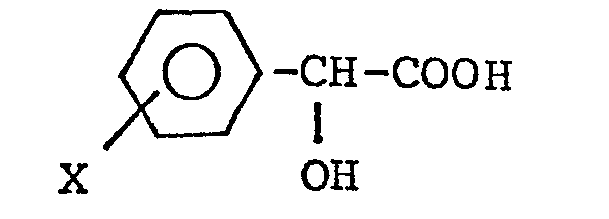
wherein X is p-chloro, p-methoxy, p-methyl or m-nitro, and alanine is brought into reaction with a racemic compound of the other of said pair in a solvent and the thus formed complexes are optically resolved utilizing the difference of solubility of said formed complexes.
wherein X is p-chloro, p-methoxy, p-methyl or m-nitro, and alanine is brought into reaction with a racemic compound of the other of said pair in a solvent and the thus formed complexes are optically resolved utilizing the difference of solubility of said formed complexes.