|
(11) | EP 0 045 918 A1 |

| (12) | EUROPEAN PATENT APPLICATION |
|
|
|
|
|||||||||||||||||||||||||||
| (54) | A process for the synthesis of vincamine and related indole alkaloids |
| (57) A process is taught for the synthesis of vincamine and related indole alkaloids,
according to which, through only two steps and through a novel synthesis intermediate,
namely the glycidic ester, having the formula
wherein R" represents -COOCH3 or -COOCH2CH3, 1-ethyl-1,2,3,4,5,6,7,12b-octahydroindole- [2,3-a] -quinolizine-1-carbaldehyde is reacted with a haloester in the presence of a base and the glycidic ester is converted to vincamine or apovincamine or like esters by reaction with a Lewis acid or a mineral acid, the reaction products being subsequently separated by chromatography. |
[0001] The present invention relates to a process for the preparation of the optical isomers and of the racemic forms of the vincamine and of the related indole alkaloids, as represented by the formula:
wherein: when R = OH, R' = H, and R" = -COO CH3, the compound (I) is vincamine and its optical isomers; when R = OH, R' = H and R" = -COOCH2CH3' the compound (I) is ethyl vincaminate and its optical isomers; when R + R' = double bond, and R" = -COOCH3, the compound (I) is apovincamine and its optical isomers; when R" = R' = H and R = OH, the compound (I) is vincanol and its optical isomers.
[0002] It is known that the vincamine and the indole alkaloids related thereto, which are concerned by the present invention, are. endowed with interesting therapeutical properties, at the cardiovascular level and generally for the circulatory system.
[0003] More particularly the vincamine and the apovincamine are substances already known and used in the therapy of the cerebral arteriosclerosis, owing to their efficacious vasodilating action at the cerebral level and also owing to their capability in activating the metabolism of the nervous cells.
[0004] The starting compound for the preparation of the compounds (I) is the 1-ethyl-1,2,3,4,5,6,7,12b-octahydro-indole- [2,3-a] -quinolizine-1-carbaldehyde, having the formula (II)
[0005] The method for the preparation of the sintone (II), both as the racemic mixture of the diastereoisomers, and in form of the single, optically pure isomers, has been described by W. Oppolzer et al., Helv. Chim. Acta, 60 (5), 1801 (1977). For the conversion of the aldehyde (II) to vincamine, the prior art (W. Oppolzer) discloses the following process:
[0006] According to the preceeding scheme, the aldehyde i) is converted to the corresponding ethylester acrylate, by treatment with triethylphosphonium acetate under the reaction conditions taught by Horner.
[0007] The ester ii) is firstly catalytically reduced and then condensed to give the homoeburnamonine iii), which with butylnitrite in the presence of bis-trimethylsilylamide in toluene gives the oxime iv) (X = -NOH).
[0008] The oxime is then hydrolized with HCl in the presence of formaldehyde, the homoeburnamonin-15-one iv) (X = O) being isolated from the reaction mixture.
[0009] By alkaline splitting of the diketone iv) (X = O) and acification of the resulting, reaction mixture, the vincamine v) is isolated.
[0010] It has been now found a novel process which permits the compounds represented by the formula (I) to be prepared starting from the compound (II) through only two steps according to the following scheme:
wherein R, R' and R" have the above indicated meanings.
[0011] In the step t) the aldehyde (II) is converted to the glycidic ester (III), this compound having never been described in the prior art, by treatment with a haloester of the type
wherein X = Cl, Br, I; R" = -COOCH , or -COO CH2CH3, in the presence of a base, such as sodium or potassium alcoholates, by using as the solvent anhydrous ethers or hydrocarbons, and carrying out the reaction at temperatures of between 0°C and 10°C. Subsequently, if the compound (III) is reacted (step w1) with a Lewis acid such as BF3 in toluene at 50°-100°C, it is possible to isolate by means of column chromatography from the reaction mixture, provided that the latter is processed in conventional way, the compounds (I), the groups R, R' and R" having the above stated meanings, except for the case of R = R' = H and R" = OH, whereas if the compound (III) is reacted with a diluted mineral acid at 50-80°C, by column chromatography of the reaction raw mixture it is possible to isolate, besides the other compounds, also the product (I) in which R = R' = H and R" = OH (step w2), The process of the invention can be thus represented in the following form:
[0013] present invention, is thus based on the intermediate (III), which as such is also a subject of the present invention, since it has never been previously described, both as a compound and as an intermediate for the production of the compounds (I)
EXAMPLE 1
[0014] Preparation of ethyl vincaminate (1: R = OH; R' = H, R" = COOC2H5), of ethyl apovincaminate (I: R + R' = double bond, R" = COOC2HS) and of vincanol (I:R=R'=H, R" = OH).
1.1 - Preparation of the qlycidic ester (III)
ethyl-1-ethyl-1,2,3,4,5,6,12b-octahydro-indole-[2,3-a]-quinolizine 1-(1' 2' oxy)-propionate
[0015]
In a suitable tank a solution is prepared comprising 2g of aldehyde (II), 1.3 g of ethyl chloroacetate and 100 mls of anhydrous ethyl ether. 0.52 g of sodium amide are subsequently added in small portions over 30 to 60 minutes, the mixture being maintained under an atmosphere of inert gas and at 0°C. At the end of the reaction, the mixture is brought to room temperature and poured in iced water.
[0016] The product is extracted with CH2Cl2, and the resulting organic phase is washed with water saturated with salt, dried over Na2S04, filtered and concentrated to a dry residue. There are obtained about 1.1 g of raw product which, without need of being isolated, is directly passed to the subsequent treatments.
1.2-a) Treatment with Lewis acid
[0017] 1.1 g of the residue resulting from the reaction 1.1 are dissolved in anhydrous toluene (30 mls).
[0018] The resulting solution is added with 10 mls of boron trifluoride etherate and the mixture is heated to 80°C under stirring. At the end of the reaction, the solution is cooled, filtered and concentrated under vacuum..
[0019] The residue is treated by column chromatography, by using as the eluant a mixture of acetone/methylene chloride/methanol in the ratios 5/4.9/0.1 and silica gel as the adsorbant.
[0020] From the eluate of the column, after concentration to dryness of the useful fractions and subsequent crystallization, the following products are serially recovered:
1) ethyl apovincaminate (I:R + R' = double bond, R" = COOC2H5).
2) ethyl vincaminate (I:R=OH, R'=H, R"-COOC2H5)
1.2-b) Treatment with mineral acids
[0021] The conversion is carried out as in the example 1.2-a), by using 20 mls of 10% HCl in alcohol, instead of the BF3 etherate.
[0022] At the end of the reaction, the mixture is made alkaline by adding sodium methoxide, filtered and concentrated under reduced pressure to a residue.
1.- A process for the preparation of single optical isomers and/or of racemic mixtures
of vincamine and related indole alkaloids, represented by the general formula (I):
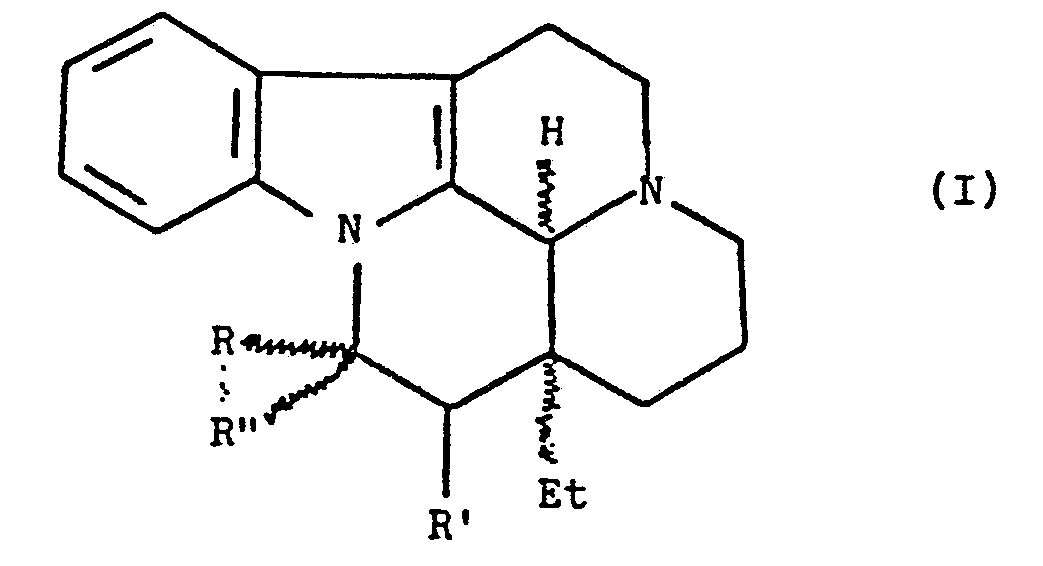
wherein R, R' and R" are defined as follows: R = -OH, R' = H, R" = -COOY (Y = -CH3 , -CH2CH3) ; R" = R' = H, R =-OH; R + R' = double bond, R" = -COOY; characterized in that a compound of the general formula (II)
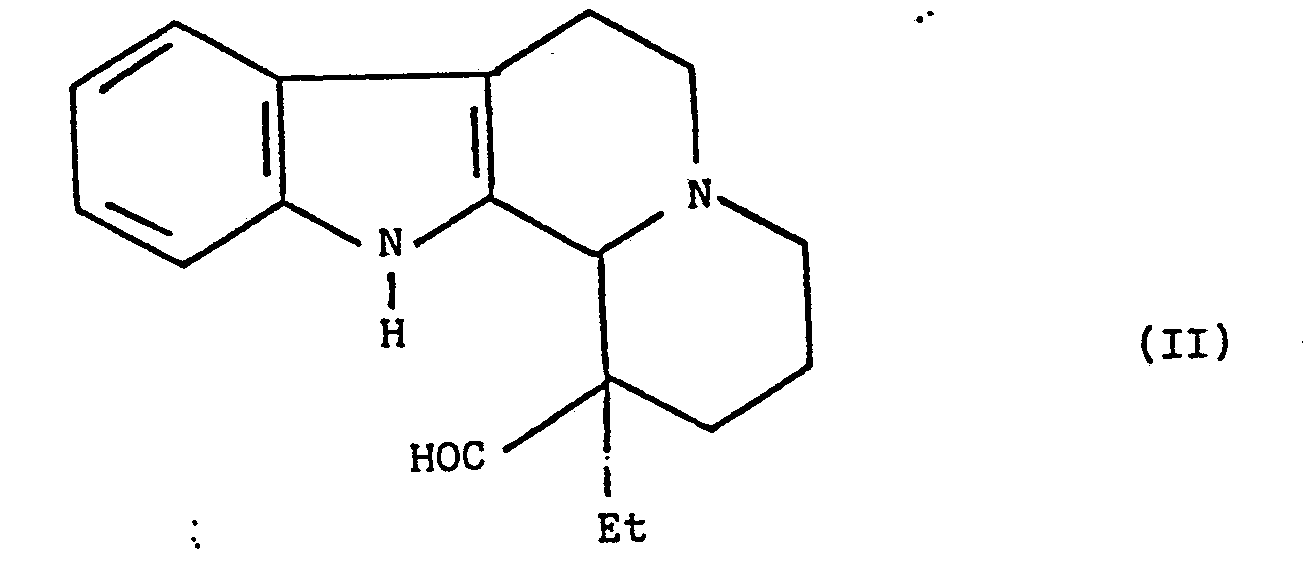
as single possible, optically pure isomer and/or as a mixture of the optical isomers is reacted with an alpha-haloester of the type XCH2-R'' (X = Cl, Br, J; R'' = -COOY) in the presence of a base selected from alkali alcoholates and sodium, potassium or lithium amide according to the Darzens reaction conditions to obtain the glycidic esters of the general formula (III)
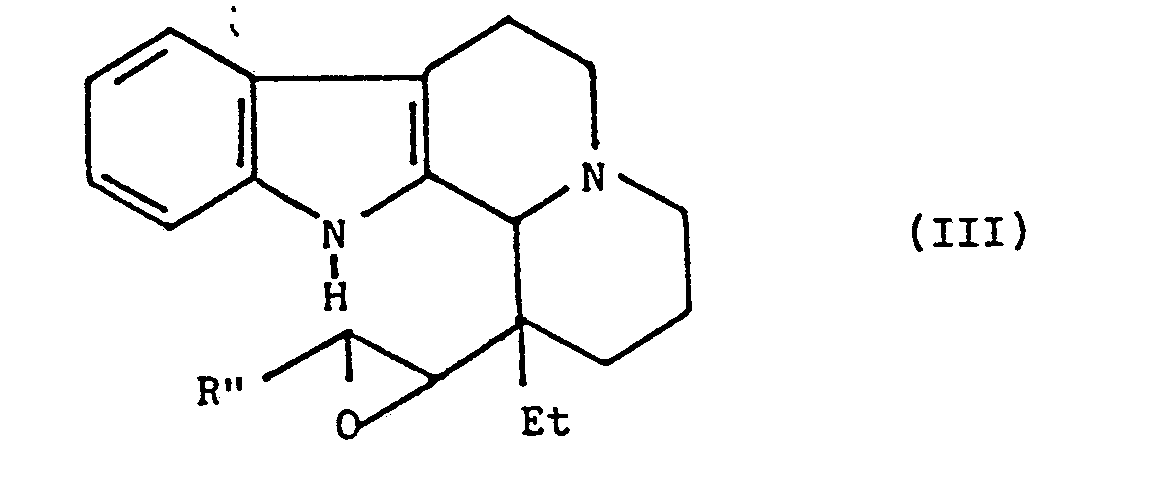
in which R" is defined as above which esters are then treated with a Lewis acid in an inert solvent and/or with a mineral acid in alcoholic solution to obtain the compounds of formula (I).
wherein R, R' and R" are defined as follows: R = -OH, R' = H, R" = -COOY (Y = -CH3 , -CH2CH3) ; R" = R' = H, R =-OH; R + R' = double bond, R" = -COOY; characterized in that a compound of the general formula (II)
as single possible, optically pure isomer and/or as a mixture of the optical isomers is reacted with an alpha-haloester of the type XCH2-R'' (X = Cl, Br, J; R'' = -COOY) in the presence of a base selected from alkali alcoholates and sodium, potassium or lithium amide according to the Darzens reaction conditions to obtain the glycidic esters of the general formula (III)
in which R" is defined as above which esters are then treated with a Lewis acid in an inert solvent and/or with a mineral acid in alcoholic solution to obtain the compounds of formula (I).
2.- Process according to claim 1, characterized in that for the isolation of the reaction
products the raw reaction mixture is treated by column chromatography.
3.- Process according to claim 1 or 2, characterized in that the Darzens reaction
is carried out in an inert solvent selected from anhydrous ethers and hydrocarbons
at a temperature of between 0° and 10°C.
4.- Process according to any one of the preceding claims, characterized in that the
treatment of the glycidic esters (III) to obtain the desired compounds (I) is carried
out with a Lewis acid, such as boron trifluoride etherate, the reaction being effected
in a solvent, like toluene, at a temperature of between 50 and 100°C.
5.- Process according to any one of claims 1 to 3, charactei- ized in that the treatment
of the glycidic esters (III) to obtain the desired compounds (I) is carried out with
mineral acids in alcoholic solution at a temperature of between 40 and 90°C.
6.- Glycidic esters of the general formula (III)
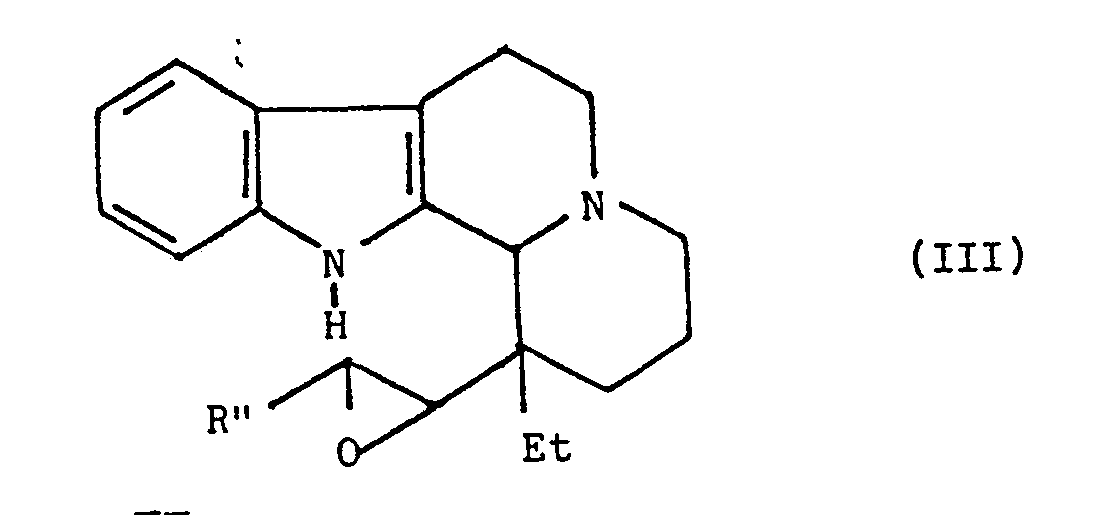
wherein R" is defined as above namely the methyl or ethyl esters of 1-ethyl-1,2,3,4,5,6,7, 12b-octahydro-indole-[2,3-a]-quinolizine-1-(1',2'-oxy)-propionic acid in the form of every possible optical isomer and in the form of a single pure compound and of mixtures thereof as new compounds and as intermediates for obtaining the compounds (I).
wherein R" is defined as above namely the methyl or ethyl esters of 1-ethyl-1,2,3,4,5,6,7, 12b-octahydro-indole-[2,3-a]-quinolizine-1-(1',2'-oxy)-propionic acid in the form of every possible optical isomer and in the form of a single pure compound and of mixtures thereof as new compounds and as intermediates for obtaining the compounds (I).