|
(11) | EP 0 058 906 A1 |

| (12) | EUROPEAN PATENT APPLICATION |
|
|
|
|
|||||||||||||||||||||||||||
| (54) | 5-Methyl-2-(2'-oxo-3'-butyl) phenol and perfume compositions comprising same |
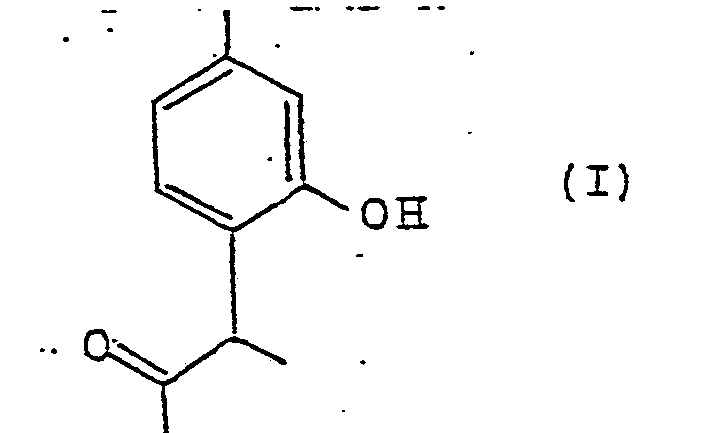
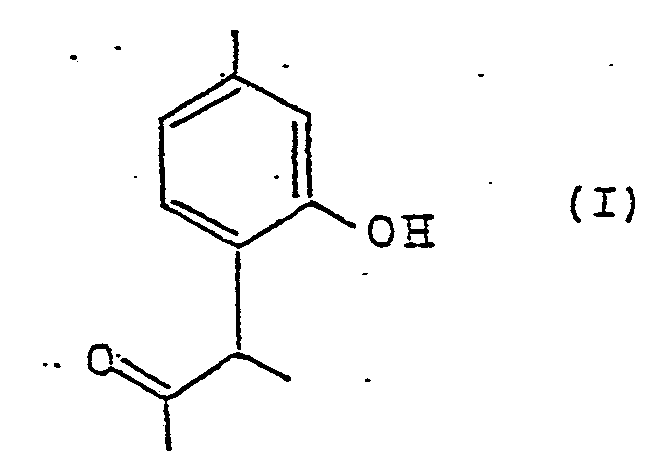
| (57) The novel compound of 5-methyl-2-(2'-oxo-3'-butyl)-phenol represented by the formula
This compound emits a characteristic sweet fragrance and a perfume composition comprising this compound is also provided. |
BACKGROUND OF THE INVENTION
Field of the Invention:
[0001] This invention relates to a novel m-cresol derivative emitting specific sweet fragrance and also to perfume compositions comprising the same.
[0002] We have made a study on vairous cresol derivatives and found that a novel compound of 5-methyl-2-(2'-oxo-3'-butyl)phenol represented by the following formula
has excellent properties as a perfume substance. This novel compound can be synthesized with ease from starting m-cresol through a series of-steps.
SUMMARY OF THE INVENTION
[0003] Accordingly, it is an object of the invention to provide a novel cresol derivative which is useful as an ingredient for perfume.
[0004] It is another object of the invention to provide a perfume composition comprising the cresol derivative of the just-mentioned type.
[0005] The above objects can be achieved, according to one aspect of the invention, by a compound of 5-methyl-2-(2'-oxo-3'-butyl)phenol represented by the formula
[0007] According to another aspect of the invention, there is provided a perfume composition which comprises an effective amount of the compound of the formula defined above.
BRIEF DESCRIPTION OF THE DRAWING
DETAILED DESCRIPTION AND A PREFERRED
EMBODIMENT OF THE INVENTION
[0009] The compound of the formula defined above can be produced by a process which comprises reacting starting m-cresol with 1-chloro-2-butene (crotylchloride) or with l-bromo-2-butene (crotylbromide) to form crotyl-3-methyl phenyl ether, subjecting the ether to the process if J. Borgulya et at described in Helv. Chim. Acta, 46, 2444 (1963), that is, the so-called Claisen rearrangement, thereby obtaining 2-(1'-buten-3'-yl)-5-methylphenol, isomerizing the same by the process of G. Ohloff et al described in Helv, Chim. Acta, 48, 1665 (1965) to form 2,(2'-buten-2'-yl)-5-methylphenol, and finally reacting it with an organic peracid such as peracetic acid or methachloroperbenzoic acid.
[0010] In practice, the above process is carried out, for example, as follows. At first, m-cresol and l-chloro-2-butene (crotyl-chloride) or 1-bromo-2-butene (crotylbromide) are dissolved in anhydrous acetone, to which anhydrous potassium carbonate is added, and they are heated to 60°C for reflux over three hours while stirring. After the completion of the stirring, water is added, followed by extraction with ether or the like. The ether phase, after being washed with an aqueous 10% solution of sodium hydroxide, is dried and then the ether removed through distillation. The concentrate is dissolved in diethyl-aniline, heated to 180°C and continuously agitated for about 16 hours. After the end of the reaction, the product is washed with 10% hydrochloric acid and further with water. Distillation under reduced pressure gives a fraction boiling at 77 - 89°C/2mmHg. The fraction is added dropwise to the reaction product of ethylenediamine and metallic lithium at 110 - 125°C. After the end of the addition, the reaction product is poured into ice water and extracted with ether or the like. The ether phase is washed with 10% hydrochloric acid, further washed with water and then dried. After distilling off the ether, the residue is distilled under a reduced pressure to obtain a fraction boiling at 70 - 80°C/2mmHg. The fraction is dissolved in a solvent such as dichloromethane or carbon tetrachloride. Further, sodium carbonate is added and peracetic acid is added dropwise while cooling to 0 - 5°C. After the end of the addition, the reaction is continued as it is for 30 minutes. After the end of the reaction, the product is treated in a conventional manner, distilled under a reduced pressure and purified to obtain 5-methyl-2-(2'-oxo-3'-butyl)phenol.
[0011] The compound obtained by the process referred to above is a white crystalline substance at room temperature, has a characteristic sweet perfume like that of fruit or molass and can be added for formulation into various perfume compositions. For instance, it can be formulated in about 0.1% upon preparation of synthetic essential oils such as peppermint, spearmint, lemon, orange or lime, so that it significantly contributes to the increase of the natural perfume and taste of these formulated products, thus exhibiting excellent effects. Furthermore, the present compound can be synthesized industrially with ease from those starting materials that can be available easily, and is thus very useful as the perfume ingredient. In a preferred aspect, the novel compound is added to any arbitrary perfume compositions in an amount of 1 to 2000 PPM.
Example 1
[0013] Into a 2 liters reaction flask equipped with a stirrer, a cooling tube and a thermometer, are charged 259 g (2.4 mol) of m-cresol, 229 g (2.53 mol) of 1-chloro-2-butene and 500 mt of anhydrous acetone, and they are heated while stirring, followed by addition of 349 g of anhydrous potassium carbonate and refluxing at 65°C over 3 hours. After the completion of the reaction, 500 mt of water are added and then extracted with 500 mℓ of ethyl ether. The ethyl ether phase, after being washed with an aqueous 10% solution of sodium hydroxide, is dried over sodium sulfate. The ethyl ether is distilled off under a reduced pressure to obtain 350 g of crotyl-3-methyl phenyl ether (90% of the theoretical yield based on the m-cresol). Then, the crotyl 3-methyl phenyl ether is charged into a one liter reaction flask and, with addition of 500 mℓ of diethylaniline, heated to 180 - 185°C and stirred for 16 hours. After the completion of the stirring, the product is cooled to room temperature, washed with 500 mℓ of 10% hydrochloric acid and washed twice with 500 mℓ of water. The reaction product is found to contain 2-(1'-buten-3'-yl)-5-methylphenol (1) and 2-(1'-buten-3'-yl)-3-methylphenol (2):
in 2:1 ratio as the result of instrumental analysis. The mixture is distilled under a reduced pressure to obtain 162 g of 2-(l'-buten-3'-yl)-5-methylphenol boiling at 77 - 89°C/2mmHg (41.6% of the theoretical yield based on the crotyl-3-methylphenyl ether). Then, 162 g of 2-(1'-buten-3'-yl)-5-methylphenol are added dropwise to 187.5 g of ethylenediamine and 8.4 g of metallic lithium, which have previously been reacted under stirring, while keeping the reaction temperature to 110 - 125°C for about one hour. After the completion of the addition, the reaction product is poured into 500 mt of ice water and extracted with 500 mℓ of ethyl ether. The ether phase is washed with 300 mℓ of 10% hydrochloric acid, further washed twice with 300 mℓ of water and dried over sodium sulfate. Thereafter, the ether is distilled off to obtain a concentrated product. The concentrate is distilled under a reduced pressure to obtain 160 g of 2-(2'-buten-2'-yl)-5-methylphenol boiling at 70 - 80°C/ 2mmHg (41.1% of the theoretical yield based on the crotyl-3-methylphenyl ether). 160 g of 2-(2'-buten-2'-yl)-5-methylphenol are dissolved in 320 mℓ of dichloromethane and, with further addition of 73.6 g of sodium carbonate, 226 g of 40% peracetic acid are dropped under stirring for 2 hours while keeping the temperature at 0 - 5°C. After the end of the addition, stirring is continued for 30 minutes. After the end of the stirring, they are washed three times with 300 mℓ of an aqueous 20% sodium thiosulfate solution; washed twice with 300 mℓ water and dried over sodium sulfate, and the dichloromethane is removed through distillation. The concentrate thus obtained is distilled under a reduced pressure to obtain 115 g of 5-methyl-2-(2'-oxo-3'-butyl)phenol, 26.9% of the theoretical yield based on the crotyl-3-methyl phenyl ether) boiling at 110 - 120°C/2mmHg. The present compound is obtained as white crystals after distillation and has the following properties.
[0017] N M R (δppm) : 1.35 (d, 3H), 2.1 0 ( s , 3H), 2.26 ( s, 3 H), 3.95 (q, 1H), 6.6 5 (d, 1 H), 6.6 8(s, 1H), 6.9 4 (d, 1 H )
Example 2
[0019] A formulated perfume composition having peppermint- like flavour was prepared according to the following formulation:
[0020] To 100 g of the formulated perfume, were added 0.001 g (corresponding to 10 ppm) of the compound (1) obtained in Example 1. As the result of the evaluation determined by 10 expert panels, all of the panels recognized that natural flavour was significantly improved for the product with addition of the compound (1) as compared with the product with no such addition.
Example 3
[0021] A formulated perfume having orange-like flavour was prepared according to the following formulation:
[0022] To 100 g of the formulated perfume, were added 0.001 g (corresponding to 10 ppm) of the compound (1) obtained in Example 1. As the result of the estimation determined by 10 expert panels, all of the panels recognized that natural flavour was significantly improved for the product with addition of the compound (1) as compared with the product with no such addition.
1. 5-methyl-2-(2'-oxo-3'-butyl)phenol represented by the formula
2. A perfume composition comprising an effective amount of 5-metyl-2-(2'-oxo-3'-butyl)phenol
represented by the formula
3. A perfume composition according to Claim 2, wherein the phenol compound is used
in an amount of 1 to 2000 PPM.