|
(11) | EP 0 070 155 A1 |

| (12) | EUROPEAN PATENT APPLICATION |
|
|
|
|
|||||||||||||||||||||||||||
| (54) | Process of preparing a ketazine from a ketone |
| (57) A ketazine is prepared by reacting a ketone with ammonia and hydrogen peroxide in
the presented of an arsenic compound:
where R' and R2 are alkyl, cycloalkyl or aryl or together complete a ring. For preparing a ketazine to be hydrolyzed to make hydrazine, an alkylketone, e.g. acetone or methyl ethyl ketone, is preferred. Inorganic catalysts include oxides, oxyacids, and salts thereof, halide, oxyhalides and sulfides of As. Organic catalysts include tri and pentavalent compounds, including of the general formulae or or where the Rs are C1-12 alkyl, C7-12 aralkyl or C6-12 aryl, and X and Y are each as defined for R and may also be OH or C1-12 alkoxy. The reaction is preferably conducted in an inert organic solvent, e.g. an aliphatic alcohol or diol, with gaseous ammonia under atmospheric or increased pressure, with 0.5 to 10 moles of ketone and 0.5 to 20 moles ammonia per mole of H202. The ketazine is obtained with high selectivity and high yield. |
[0001] This invention relates to a process of preparing a ketazine and, more particularly, to a process for preparing a ketazine by reacting an aliphatic or aromatic ketone with ammonia and hydrogen peroxide in the presence of a catalyst compound.
[0002] Ketazines are useful as intermediates for the synthesis of hydrazine, and various methods are known for preparing ketazines. Recently, extensive studies have been made of the process for preparing ketazines using a ketone, ammonia and hydrogen peroxide as starting materials, and such processes are disclosed, for example, in West German OLS Nos. 2127229, 2314038, 2143516, 2504924 and 2639009. These published processes comprise reacting the above starting materials in the presence of a nitrile or an amide as a co-reactant as an essential component of the reaction system; however, the nitrile or amide is converted into an amide or an ammonium salt of a carboxylic acid, respectively, as the reaction proceeds, and complicated procedures are required for separation and recovery of the amide or the ammonium salt from the reaction mixture, and also for the recovery of the nitrile and the amide from these by-products.
[0003] Also, processes for preparing ketazines using various catalysts without a nitrile or amide have been proposed; the use of a selenium catalyst is proposed in German 018 2403810, a cobalt salt in Japanese published Patent Application (OPI) No. 125629/79, palladium in Japanese Patent Application (OPI) Nos. 135719/79 and of silica gel catalyst in Belgian Patent No. 875594. However, none of these conventional processes using a catalyst has sufficient reaction rate and selectivity to the desired ketazine and, therefore, these processes are still unsatisfactory in practice on an industrial scale.
[0004] As a result of extensive studies on a process for preparing ketazines efficiently and in high yield, we have found that such objects can be achieved by using a specific arsenic compound as a catalyst.
[0005] The process of the present invention for preparing a ketazine comprises reacting an aliphatic or aromatic ketone with ammonia and hydrogen peroxide in the presence of an arsenic compound catalyst, to provide a corresponding ketazine.
[0006] The ketone used in the process of this invention can be any ketone compound which is known to form a corresponding ketazine. Examples of ketone compounds are represented by the general formula
wherein R1 and R2, which may be the same or different, each represents a straight or branched chain alkyl group having not more than 12 carbon atoms, a cycloalkyl group having 3 to 12 carbon atoms or an aryl group having 6 to 12 carbon atoms, or R1 and R2 may, together with the carbon atom of the carbonyl group to which they are attached, complete a ring having 4 to 11 carbon atoms. Such ketone compound can form, upon reaction, a ketazine represented by the general formula
wherein R1 and R2 are as defined above.
[0007] Illustrative examples of ketones which can be used include acetone, methyl ethyl ketone, 2-pentanone, 3-methyl-2-butanone, 3-methyl-2-pentanone, methyl cyclohexyl ketone, benzophenone, cyclopentanone, cyclohexanone, cycloheptanone, cyclooctanone, cyclodecanone and cyclododecanone. When the ketazine is prepared for the purpose of producing hydrazine by hydrolyzing the resulting ketazine with water, an alkyl ketone, particularly acetone or methyl ethyl ketone, is preferred as ketone compound from the economic standpoint since it is easily handled and easily available.
[0008] In the process of this invention, the reaction tends to proceed rapidly and the selectivity tends to increase as the water content in the reaction system decreases. Thus, the concentration of hydrogen peroxide used in the form of its aqueous solution for the reaction is preferably as high as possible. Generally, it is advantageous to use an aqueous solution of hydrogen peroxide having a hydrogen peroxide concentration of 30 to 90% by weight, preferably more than 60% by weight. Of course, an aqueous solution having a lower concentration of hydrogen peroxide may be used so long as the water content in the reaction system is maintained at a low level during the reaction while removing water from the reaction system by azeotropic distillation with a solvent which forms an azetropic mixture with water or while removing water with an entraining gas such as ammonia gas. Alternatively, the water content can be reduced, for example, by adding a dehydrating agent to the reaction system. In another embodiment, a ketone can be previously combined with hydrogen peroxide by the well known procedure to form a ketoperoxide, and the resulting peroxide can be used in the reaction in place of the ketone and hydrogen peroxide reactants.
[0009] The catalyst used in the process of this invention can be an inorganic arsenic compound, an organoarsenic compound or a mixture thereof, preferably an organoarsenic compound.
[0010] Examples of inorganic arsenic compounds are arsenic oxides, arsenic oxyacids, salts or esters of arsenic oxyacids, arsenic halides, arsenic oxyhalides and arsenic sulfides.
[0011] Examples of organoarsenic compounds wherein the valency of arsenic is trivalent (+3) include compounds represented by the formula RAsXY, arsenoso compounds [(RAsO)n], primary arsenic oxides (RAsO], heterocyclic derivatives of arsenic such as arsorane
and arseno derivatives [(RAs =)2], wherein R represents an alkyl group having 1 to 12 carbon atoms, an aralkyl group having 7 to 12 carbon atoms, an aryl group having 6 to 12 carbon atoms, a halogen atom, a hydroxyl group, an alkoxy group having 1 to 12 carbon atoms, an acyloxy group having 1 to 12 carbon atoms. -AsR'R", -OAsR!R", a nitrogen-containing group, for example -NR'R", a phosphorus-containing group, for example -PO(OR')2, a silicon-containing group, for example -OSiRt3 or a sulfur-containing group (wherein R' and R", which may be the same or different, each represents an alkyl group having 1 to 12 carbon atoms, an aralkyl group having 7 to 12 carbon atoms or an aryl group having 6 to 12 carbon atoms), n is an integer representing the number of recurring unit in the polymeric structure, and X and Y, which may be the same or different, each represents an alkyl group having 1 to 12 carbon atoms, an aralkyl group having 7 to 12 carbon atoms, an aryl group having 6 to 12 carbon atoms, a halogen atom, a hydroxyl group or an alkoxy group having 1 to 12 carbon atoms.
[0012] Examples of organoarsenic compounds wherein the valency of arsenic is pentavalent (+5) are compounds represented by the formulae R'R"R'"AsXY, R'R"Ar(=O)X and R'"As(=O)XY wherein, R', R", X and Y are as defined above, and R'" represents an alkyl group having 1 to 12 carbon atoms, an aralkyl group having 7 to 12 carbon atoms or an aryl group having 6 to 12 carbon atoms which may be the same as or different from R' and R".
[0013] Preferred organoarsenic compounds are those represented by the formulae R'R"As(=0)X and R'"As(=O)XY, and particularly preferred compounds are organoarsenic acids of the formula R'R"As(=O)OH, and organoarsenic acids of the formula R'"As(=O)(QH)2 wherein R', R" and R'" are as defined above. Examples of such acids are methylarsonic acid, ethylarsonic acid, phenylarsonic acid, o-, m- and p-methylphenylarsonic acids, o-, m- and p-methoxyphenylarsonic acids, o-, m- and p-carboxyphenylarsonic acid, o-, m- and p-nitrophenylarsonic acids, o-, m- and p-chlorophenylarsonic acids, o-, m- and p-nitrophenylarsonic acids, cacodylic acid (dimethylarsenic acid), diethylarsenic acid and diphenylarsenic acid.
[0014] Generally, the higher the catalyst concentration in the reaction system, the higher the reaction rate, but the optimum concentration of the catalyst can be determined depending upon the reaction conditions used and from the economic standpoint. The catalyst is usually used in an amount of 0.01 to 5 moles, preferably 0.1 to 1 mole, per mole of hydrogen peroxide.
[0015] In the process of this invention, the reaction between ketone, ammonia and hydrogen peroxide proceeds in the presence of the catalyst without using a solvent, but the reaction may be conducted in the presence of an inert organic solvent in order to ensure a uniform reaction system and to reduce the water concentration in the reaction system. Any inert organic solvent can be used in the reaction provided that it is not decomposed under the reaction conditions used and it does not take part in the reaction with the reactants and reaction products and does not decompose or otherwise adversely affect the reactants and reaction products. Preferred examples of such solvents are alcohols, esters, ethers, hydrocarbons, halogenated hydrocarbons and sulfones. In practice, the solvent is selected by consideration of such factors as high solubility of reactants, easy separation from the reaction product and low cost, and in general preferrred solvents include aliphatic C1-4- alcohols and diols or mixtures of C2-5 diols and aliphatic C1-4 alcohols. Particularly preferred solvents are diols having 3 to 5 carbon atoms, for example, propylene glycol, 1,3-propanediol, 1,3-butanediol, 1,4-butanediol and 1,5-pentanediol..
[0016] Ammonia used in the process of the invention can be introduced in the reaction system in the form of aqueous ammonia or ammonia gas. However, in order to reduce the water content in the reaction system ammonia is preferably introduced in the form of ammonia gas.
[0017] The starting materials, a ketone, ammonia and hydrogen peroxide; can be used in any proportions, but from the standpoints of yield of the desired ketazine and economy, the ketone is preferably used in an amount of from 0.5 to 10 moles, most preferably 1.5 to 5 moles, and ammonia is preferably used in an amount of from 0.5 to 20 moles, most preferably 2 to 10 moles, per mole of hydrogen peroxide.
[0018] However, the maximum amount of ammonia which can be used is spontaneously limited due to its saturation in the reaction system. Therefore, an increased concentration of ammonia in the reaction system obtained by using pressurized reaction conditions or by adding an ammonium carboxylate such as ammonium acetate, ammonium formate or ammonium propionate to the reaction system is generally very effective to increase the reaction rate.
[0019] The reaction can be conducted in a liquid phase at a temperature of 0° to 120°C, preferably 30° to 100°C, under atmospheric pressure or pressurized conditions.
[0020] The hydrogen peroxide reactant is relatively unstable and is liable to be decomposed during the reaction by contamination with a foreign material such as a heavy metal, thereby decreasing the yield of the desired ketazine. It is therefore highly desirable to add a stabilizer such as a chelating agent, such as ethylenediaminetetraacetic acid, diethylenetriaminepentaacetic acid, cyclohexanediaminetetraacetic acid, aminotrimethylenephosphonic acid, 1-hydroxyethylidene-1, 1-diphosphonic acid or ethylenediaminetetramethylene- phosphonic acid to the reaction system to stabilize the hydrogen peroxide reactant.
[0021] By the process of this invention, the desired ketazine can be produced with high selectivity and in high yield and thus the process is very useful for practicing on an industrial scale.
[0022] The present invention is illustrated by the following Examples, wherein the percentages are by weight.
Example 1
[0023] 2 g of cacodylic acid was placed in a 100 cc capacity four-necked flask equipped with a refluxing condenser and then 5 ml of propylene glycol, 20 ml of t-butanol and 20 ml of methyl ethyl ketone were charged into the flask. Ammonia gas was then blown into the resulting mixture to saturation while warming the mixture at 60°C and stirring. Thereafter, the rate of blowing the ammonia gas was adjusted to 40 cc/minute (S.T.P.) and 20 ml of a t-butanol solution containing 0.056 mole of 60% hydrogen peroxide was added dropwise to the mixture over a period of 5 minutes. After allowing the mixture to react for 1 hour at 60°C, methyl ethyl ketone azine formed in the reaction mixture was quantitatively determined by gas chromatography and the yield of the product was found to be 6.7 g (0.048 mole) which corresponded to 86% yield based on the hydrogen peroxide used. The reaction mixture was then distilled under reduced pressure so as to leave unreacted cacodylic acid and propylene glycol as a residue in the still, whereby 95% of the ketazine contained in the reaction mixture was obtained as a distillate.
[0024] The above reaction was repeated using the residue in the distillator to obtain methyl ethyl ketone azine in a yield of 85%.
Examule 2
[0025] 2 g of phenylarsonic acid was placed in a 100 cc capacity flask equipped with a refluxing condenser and then 10 ml of ethylene glycol, 20 ml of t-butanol and 20 ml of methyl ethyl ketone were charged into the flask. Ammonia gas was then blown into the resulting mixture to saturation while warming the mixture at 60°C and stirring. Thereafter, the blowing rate of ammonia gas was adjusted to 40 cc/minute (S.T.P.) and 20 ml of a t-butanol solution containing 0.056 mole of 90% hydrogen peroxide was added dropwise to the mixture over a period of 5 minutes. After allowing the mixture to react for 2 hours at 50°C, methyl ethyl ketone azine formed in the reaction mixture was quantitatively determined by gas chromatography and yield of the product was found to be 6.8 g (0.049 mole) which corresponded to 88% yield based on the hydrogen peroxide used.
Examples 3 to 10
[0027] ..The reaction was repeated using the same reaction conditions and procedures as described in Example 2 but using the solvent system shown in Table 1 below in place of the solvent system of ethylene glycol and t-butanol. The results obtained are shown in Table 1 below.
Examples 11 to 13
[0028] These examples were conducted using different ketone reactants. The reaction was repeated using the same reaction conditions and procedures as described in Example 2 but using the ketone reactant shown in Table 2 below in place of the methyl ethyl ketone. The results obtained are shown in Table 2 below.
Examples 14 to 15
[0029] These examples were conducted using different reaction temperatures. The reaction was repeated using the same reaction conditions and procedures as descrined in Example 2 but using the reaction temperatures shown in Table 3 below. The results obtained are shown in Table 3 below.
Examples 16 to 19
[0030] These examples were conducted using different catalysts. The reaction was repeated using the same reaction conditions and procedures as described in Example 2 but using the catalyst shown in Table 4 in place of phenylarsonic acid. The results obtained are shown in Table 4 below.
Example 20
[0031] The reaction was repeated using the same reaction conditions and procedures as described in Example 2 but using 0.5 g of phenylarsonic acid and additionally 5 g of ammonium acetate. The yield of ketazine was found to be 68%.
Example 21
[0032] 4 g of cacodylic acid and 0.1 g of cyclohexanediaminetetraacetic acid as a stabilizer were placed in a 100 cc capacity four-necked flask equipped with a refluxing condenser and then48g of 1,3-butanediol was charged into the flask. Ammonia gas was then blown into the resulting mixture to saturation while warming the mixture at 60°C and stirring. Thereafter, 0.24 mole of methyl ethyl ketone and 0.10 mole of hydrogen peroxide were added over a period of 20 minutes with vigorous stirring. During the addition, ammonia gas was absorbed vigorously and additional ammonia gas was supplied to the reaction system continuously to compensate for the consumption during the reaction. After completion of the addition of methyl ethyl ketone and hydrogen peroxide, the reaction mixture was stirred at 60°C for 3 hours in an ammonia gas stream. After completion of the reaction, methyl ethyl ketone azine was quantitatively determined by gas chromatography and the yield of the product was found to be 12.2 g (0.087 mole) which corresponded to 87% yield based on the hydrogen peroxide used.
1. A process of preparing a ketazine, which comprises reacting a ketone and hydrogen
peroxide or the reaction product thereof with ammonia in the presence of a catalyst,
characterised in that the catalyst is an inorganic and/or organic arsenic compound.
2. A process according to Claim 1, wherein said arsenic compound is used -in an amount
of 0.01 to 5 moles per mole of said hydrogen peroxide.
3. A process according to Claim 1 or 2, wherein said arsenic compound is an organoarsenic
compound.
4. A process according to Claim 3, wherein said organoarsenic compound is represented
by the general formula

or

wherein, R', R" and R'" each represents an alkyl group having 1 to 12 carbon atoms, an aralkyl group having 7 to 12 carbon atoms or an aryl group having 6 to 12 carbon atoms, and X and Y each represents an alkyl group having 1 to 12 carbon atoms, an aralkyl group having 7 to 12 carbon atoms, an aryl group having 6 to 12 carbon atoms, a halogen atom, a hydroxyl group or an alkoxy group having 1 to 12 carbon atoms.
or
wherein, R', R" and R'" each represents an alkyl group having 1 to 12 carbon atoms, an aralkyl group having 7 to 12 carbon atoms or an aryl group having 6 to 12 carbon atoms, and X and Y each represents an alkyl group having 1 to 12 carbon atoms, an aralkyl group having 7 to 12 carbon atoms, an aryl group having 6 to 12 carbon atoms, a halogen atom, a hydroxyl group or an alkoxy group having 1 to 12 carbon atoms.
5. A process according to Claim 3, wherein said organoarsenic compound is represented
by the general formula
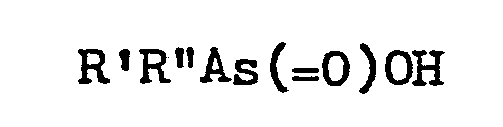
or
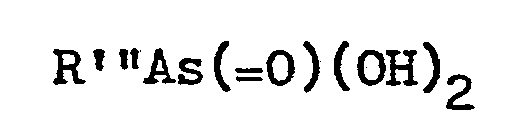
wherein R', R" and Rt", which may be the same or different, each represents an alkyl group having 1 to 12 carbon atoms, an aralkyl group having 7 to 12 carbon atoms or an aryl group having 6 to 12 carbon atoms.
or
wherein R', R" and Rt", which may be the same or different, each represents an alkyl group having 1 to 12 carbon atoms, an aralkyl group having 7 to 12 carbon atoms or an aryl group having 6 to 12 carbon atoms.
6. A process according to Claim 3, wherein said organoarsenic compound is methylarsonic
acid, ethylarsonic acid, phenylarsonic acid, o-, m- or p-methylphenylarsonic acid,
o-, m- or p-methoxyarsonic acid, o-, m- or p-nitrophenylarsonic acid, cacodylic acid,
diethylarsenic acid or diphenylarsenic acid.
7. A process according to any preceding claim, wherein the ketone is used in an amount
of 0.5 to 10 moles per mole of said hydrogen peroxide.
8. A process according to any preceding claim, wherein the ammonia is used in an amount
of 0.5 to 20 moles per mole of said hydrogen peroxide.
9. A process according to any preceding claim, wherein said reaction is conducted
in a solvent selected from alcohols, esters, ethers, hydrocarbons, halogenated hydrocarbons
and sulfones.
10. A process according to Claim 9, wherein said solvent is an alcohol.
11. A process according to Claim 10, wherein said alcohol is a diol having 3 to 5
carbon atoms.
12. A process according to Claim 10, wherein said alcohol is a mixture of at least
one aliphatic alcohol having 1 to 4 carbon atoms and at least one diol having 2 to
5 carbon atoms.