|
(11) | EP 0 120 665 A2 |

| (12) | EUROPEAN PATENT APPLICATION |
|
|
|
|
|||||||||||||||||||||||||||
| (54) | Soluble oil cutting fluid |
| (57) A soluble-oil, suitable when diluted with water, for use as a cutting fluid comprises
an alkali or alkaline-earth metal alkyl benzene sulphonate, a fatty acid diethanolamide,
a mixed alkanolamine borate, a polyisobutenesuccinimide and a major proportion of
mineral oil. The soluble-oil is relatively stable without the need for a conventional
coupling agent and some soluble-oil emulsions are bio-static even though conventional
biocides are not included. |
[0001] This invention relates to a soluble-oil and to an oil-in-water emulsion containing the soluble-oil, which emulsion is suitable for use as a cutting fluid.
[0002] Soluble-oil emulsions are well known as cutting fluids. The term "soluble-oil" although used throughout the industry is, in fact, a misnomer because the constituents are not soluble in water. The soluble-oils are basically mineral oils blended with emulsifiers and other additives which, when added to water and stirred, form an oil-in-water emulsion. The emulsion allows the good cooling properties of water to be utilised in the metal working process whilst the oil and additives provide lubrication and corrosion inhibiting properties.
[0003] The one or more emulsifiers included in the soluble-oil may not readily form a stable blend with the mineral oil and so a coupling agent is commonly required to bind the emulsifier to the oil. Conventional coupling agents include, for example, volatile alcohols such as sec. butanol, butyl oxitol or cyclohexanol. The volatility of these coupling agents means that over a period of time coupling agent is lost from the soluble-oil by vaporisation. This loss of coupling agent reduces the stability of the soluble-oil and is often associated with an objectionable smell. Further, the coupling agents have relatively low flash points which means that great care must be taken when they are blended or otherwise handled.
[0004] The present invention relates to a soluble-oil which is relatively stable without the need for a conventional coupling agent.
[0005] Thus according to the present invention a soluble-oil suitable, when diluted with water, for use as a cutting fluid comprises an alkali or alkaline-earth metal alkyl benzene sulphonate, a fatty acid diethanolamide, a mixed alkanolamine borate, a polyisobutenesuccinimide and a major proportion of mineral oil.
[0006] Soluble-oil emulsions may become contaminated by bacteria, yeasts and moulds. The growth of these micro-organisms may cause problems such as emulsion breakdown, the production of slimes and fungal mats and the evolution of foul odours. Biocides are often therefore included in soluble-oil formulations to control microbial growth: It has surprisingly been found that at least some of the soluble-oils according to the present invention are bio-static even though conventional biocides are not included in the formulation.
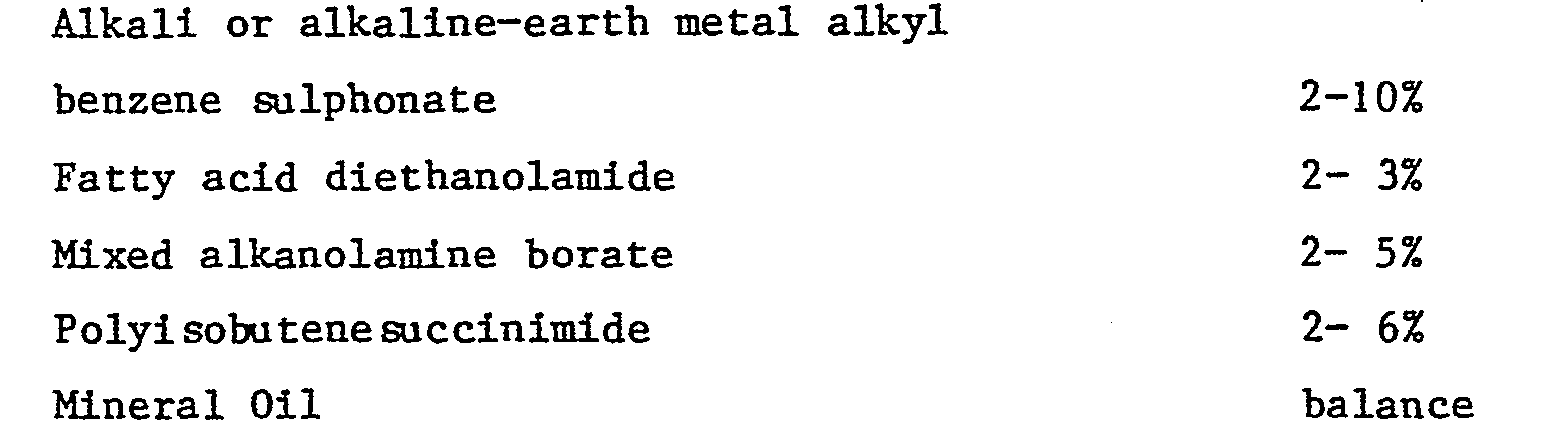
[0007] Suitably, the soluble-oil according to the present invention comprises the following amounts of the components;
[0008] The alkali metal or alkaline-earth metal of the alkyl benzene sulphonate is preferably potassium or calcium or more preferably sodium. The alkyl group is preferably derived from polypropylene. The alkali or alkaline-earth metal alkyl benzene sulphonate may be produced by known methods from synthetic sulphonic acids. Preferably the molecular weight of the compound is from 400 to 520. A high molecular weight improves the corrosion inhibiting properties of the soluble oil whereas a low molecular weight improves emulsion stability and so the choice of molecular weight involves a compromise. Mixtures of alkyl benzene sulphonates may be used.
[0009] The fatty acid diethanolamides are preferably formed by the reaction of diethanolamine with naturally occurring fatty acids having from 12 to 20 carbon atoms. The fatty acids may be saturated or unsaturated but are preferably unsaturated.
[0010] The mixed alkanolamine borate comprises the reaction products of more than one alkanolamine with boric acid. The alkanolamines may be selected from monoethanolamine, diethanolamine, triethanolamine, N,N dimethyl ethanolamine. A preferred combination of alkanolamines is mono- and di-ethanolamine.
[0011] The polyisobutenesuccinimide is preferably overbased with excess amine and preferably has a molecular weight of from 1000 to 3000.
[0012] The soluble-oil formulation also preferably contains a small amount of distilled water e.g. from 0 to 2% by weight of the total weight of the soluble-oil. The distilled water improves the stability of the blend.
[0013] A defoaming agent such as a Friedel Krafts wax may also be included in the soluble oil. A suitable wax is SASOL wax SH 105 supplied by Weber. The amount of defoaming agent is preferably in the range 0-0.05% by weight of the total weight of the soluble-oil.
[0014] The soluble-oils according to the present invention may also contain other conventional additives for soluble-oils such as for example corrosion inhibiting additives. A suitable commercially available corrosion inhibitor comprises a solution of benzene sulphonamido hexyl carboxylic acid in water and N,N-dimethyl amino propyl amine. This commercially available corrosion inhibitor is particularly effective when supplemented with triethanolamine. Alternatively, a mixture of triethanolamine and other carboxylic acids such as, for example, caprylic acid or capric acid may be used to inhibit corrosion. Typically, the corrosion inhibitor is used up to an amount of 2% by weight of the total weight of the soluble-oil. If the corrosion inhibitor comprises a mixture of triethanolamine and a carboxylic acid then the two compounds may be present in equal weights up to a combined weight of 2% of the total weight of the soluble-oil.
[0015] If a biocidal soluble-oil is required, a conventional biocide may be included in the formulation.
[0016] It is to be understood that the optional components of the soluble-oil are included in the composition in place of some of the mineral oil.
[0017] Although a wide range of mineral oils may be used in the soluble-oil formulations according to the present invention, base oils designated 100 to 500 solvent neutral have been found to be particularly suitable, i.e. paraffinic oils typically having kinematic viscosities at 40°C in the range 12 to 100 cSt.
[0018] The soluble-oil according to the present invention is relatively stable and when mixed with water readily forms an emulsion which may be used in a number of metal working operations e.g. cutting, drilling and grinding. Preferably, the emulsion has a water to soluble-oil ratio of from 10:1 to 40:1 although higher and lower dilutions may be useful in certain applications.
Example 1
[0021] The sodium alkyl benzene sulphonate had an average molecular weight of 440 and was used as a 60% by weight solution in a paraffinic mineral oil. The fatty acid diethanolamine was oleic acid diethanolamide and was approximately 25% overbased with excess diethanolamine. The mixed alkanolamine borate was a mixture of boric acid, monoethanolamine and diethanolamine in the approximate weight ratio 30:33:35. The polyisobutene succinimide was formed by the reaction between a polyisobutene having a molecular weight of approximately 1000,succinic acid anhydride and diethanolamine and was overbased with a small excess of N,N dimethyl ethanolamine.
[0022] The thermal stability of each formulation was tested after . 14 days at temperatures in the range -5°C to 50°C using a method based on the Institute of Petroleum test method IP 311, Thermal Stability of Emulsifiable Cutting Oil. Both formulations were very viscous at temperatures of 0°C and below but were stable on warming. Formulation B was also stable at temperatures up to 50°C. Formulation A became unstable at temperatures above 40°C. However, in the presence of 0.5% wt of water, Formulation A was also stable up to 50°C.
[0023] Samples of the two formulations were mixed with mains tap water at ratios of water to oil of from 10:1 to 25:1. The oil readily emulsified in the water at each dilution and each emulsion was subjected to the Institute of Petroleum standard test method IP 125 Aqueous Cutting Fluid Corrosion of Cast Iron. There was no visible staining or pitting at the lower dilutions and the corrosion at the highest dilutions was hardly perceptible.
[0024] The propensity to foam of Formulation B was less than that of Formulation A as determined by the Institute of Petroleum standard test method IP 312, Frothing Characteristics of Emulsifiable Cutting Oil. This is presumably due to the inclusion in Formulation B of Sasol wax, a known defoaming agent.
[0025] A test rig was used to evaluate the microbial degradation of the soluble-oil emulsions in a simulated workshop operation. The rig comprised a reservoir for the cutting fluid and an air lift pump to transfer the fluid from the reservoir to a funnel containing metal cuttings, the funnel being mounted over the reservoir so that the fluid drained back into the reservoir. Duplicate samples of Formulation A diluted with mains tap water in the ratio of water to oil of 20:1 were tested in the test rig. An inoculum prepared from a mixed culture of fungi and bacteria originating from a spoiled cutting oil emulsion was added to the test samples so that an initial total viable count of approximately 106 micro-organisms per millilitre of emulsion was obtained. Air was passed through the rig to circulate and aerate the fluid during normal working hours from Monday to Friday each week. Each Monday morning, viable counts of aerobic bacteria, yeasts and moulds were prepared and the presence of sulphide producing bacteria, evolution of H2S, pH and emulsion stability were determined.
[0026] Up to the end of 14 weeks, the emulsion had not evolved H2S or encouraged yeast, mould or fungal growth. The total viable bacteria count remained at approximately 106 organisms per millilitre of emulsion throughout the test. The strength of the emulsion was relatively constant throughout the test and the pH which was initially 9.5 fell to around 8.5 after 12 days and then remained at this value for the remainder of the test period.
[0027] The results show that Formulation A, which contains no conventional biocide or coupling agent, forms a stable emulsion which has biostatic properties and does not evolve H2S.
Example 2
[0030] Formulation D is similar to Formulation C except that it contains a corrosion inhibiting mixture comprising triethanolamine and Hostacor H. Hostacor H is a commercially available corrosion inhibitor comprising a solution of benzene sulphonamido hexyl carboxylic acid in water and N,N-dimethyl amino propyl amine.
[0031] The thermal stability of each formualtion was tested after 14 days at temperatures in the range 0 to 60°C using a method based on the Institute of Petroleum test method IP311, Thermal Stability of Emulsifiable Cutting Oil. Both formulations were stable throughout the temperature range.
[0032] Each of the formulations were mixed with mains tap water at ratios of water to soluble-oil of from 10:1 to 40:1. The soluble-oils readily emulsified in the water at each dilution. Each of the emulsions was subjected to the Institute of petroleum standard test method IP125, Aqueous Cutting Fluid Corrosion of Cast Iron. Formulation C showed no pitting or staining up to dilutions of 20:1 and Formulation D showed no pitting or staining up to dilutions of 40:1.
1. A soluble-oil suitable, when diluted with water, for use as a cutting fluid comprises
an alkali or alkaline-earth metal alkyl benzene sulphonate, a fatty acid diethanolamide,
a mixed alkanolamine borate, a polysiobutenesuccinimide and a major proportion of
mineral oil.
2. A soluble-oil as claimed in claim 1 comprising the following proportion of the
components as percentages of the total weight of the soluble oil:-
3. A soluble-oil as claimed in either claim 1 or claim 2 in which the alkali or alkaline-earth
metal alkyl benzene sulphonate has a molecular weight of from 400 to 520, the alkali
metal or alkaline-earth metal is selected from the group comprising sodium, potassium
and calcium and the alkyl group is derived from polypropylene.
4. A soluble-oil as claimed in any of claims 1 to 3 in which the fatty acid diethanolamide
is the reaction product of diethanolamine with a naturally occurring fatty acid having
from 12 to 20 carbon atoms.
5. A soluble-oil as claimed in any of claims 1 to 4 in which the mixed alkanolamine
borate is the reaction product of boric acid and at least two alkanolamines selected
from the group comprising monoethanolamine, diethanolamine, triethanolamine and N,N
dimethyl ethanolamine.
6. A soluble-oil as claimed in claim 5 in which the alkanolamines are mono- and di-ethanolamine.
7. A soluble-oil as claimed in any of claims 1 to 6 in which the polyisobutenesuccinimide
is overbased with excess amine and has a molecular weight of from 1000 to 3000.
8. A soluble-oil as claimed in any of claims 1 to 7 which contains up to 2% of distilled
water by weight of the total weight of the soluble-oil.
9. A soluble-oil as claimed in any of claims 1 to 8 which contains up to 0.05% of
a defoaming agent by weight of the total weight of the soluble oil.
10. An emulsion, suitable for use as a cutting fluid comprising water and a soluble-oil
as claimed in any of the preceding claims in a volumetric ratio of 10:1 to 40:1.