|
(11) | EP 0 061 720 B1 |

| (12) | EUROPEAN PATENT SPECIFICATION |
|
|
| (54) |
Process for the selective aliphatic chlorination of alkylbenzenes Verfahren zur selektiven aliphatischen Chlorierung von Alkylbenzolen Procédé de chlorination aliphatique sélective d'alcoylbenzènes |
|
|
|||||||||||||||||||||||||||||||
| Note: Within nine months from the publication of the mention of the grant of the European patent, any person may give notice to the European Patent Office of opposition to the European patent granted. Notice of opposition shall be filed in a written reasoned statement. It shall not be deemed to have been filed until the opposition fee has been paid. (Art. 99(1) European Patent Convention). |
[0001] This invention provides a process for the preparation of an a-chloro cumene derivative. The process comprises adding chlorine to a cumene derivative in the presence of a free radical initiator to preferentially chlorinate the a-position of the alkyl substituent. This preferential chlorination is surprising in that it occurs only at the a-position of essentially all of the alkyl moieties of the cumene derivative, while essentially none of the ring carbons or fi-positions of the alkyl substituent are chlorinated. Of particular interest in the practice of this invention is the use of an inert aromatic organic solvent which allows the chlorination to be taken to substantially 100 percent conversion without product solidification, thereby obviating the need for starting material recycle streams or the costly separation of unreacted starting material from the product. Surprisingly, when the process is conducted at a temperature between 4 and 15°C in the presence of an inert aromatic solvent, essentially complete conversion of the cumene derivative to its chlorinated analogs is obtained without a substantial reduction in selectivity of a-chlorination. The a-chlorinated cumene product is useful as an intermediate in the manufacture of herbicides and other biologically active chemicals.
[0002] The cumene derivatives employed are represented by Formula I
wherein X is a halogen, or any electron-withdrawing group which does not react with chlorine, such as -CF3, -CCI3 or -N02; and n is an integer from 1 to 5. Preferably, X is chlorine and n is 2. The most preferred cumene derivative is 3,5-dichlorocumene.
[0003] A suitable halogen or any agent that is capable of generating a chlorine atom, such as a suitable chlorine-containing solid or liquid, can be used as the chlorinating agent. Chlorine is the most preferred chlorinating agent. Chlorine atoms are preferably supplied at a ratio of from 0.5 to 1.1 moles of chlorine atoms per mole of cumene derivative. While excess chlorinating agent can be employed, too large an excess, for example, greater than 1.5 moles of chlorine atoms per mole of cumene derivative, may lead to some chlorination of the /3 carbon(s), as discussed hereinbefore.
[0004] Suitable free radical initiators include ultraviolet light and catalysts, such as peroxides. In the case of a peroxide, a sufficient quantity is used to cause halogenation of the a carbon. If a peroxide such as benzoyl peroxide is used, it is conveniently added to the reactants along with the solvent as hereinafter described. If employed, the peroxide is used in an amount between 0.005 and 0.05 mole of peroxide per mole of cumene derivative.
[0005] The process of this invention is preferably conducted in a chlorinated aromatic solvent especially the dichlorobenzenes, most preferably, it is conducted in m-dichlorobenzene, although other aromatic solvents such as, for example, benzene or monochlorobenzene may be used, if desired. For the purposes of this invention, an inert solvent is a solvent which does not interfere with the selective a-chlorination of the cumene derivative being used. The solvent is used in amounts such that the resultant product does not precipitate from solution, preferably from 0.25 to 0.8 mole of solvent per mole of cumene derivative.
[0006] The selective, aliphatic chlorination step is conducted in the liquid phase at a temperature of between 4° and 15°C. The chlorination step is preferably conducted in the presence of mold agitation sufficient to maintain an essentially homogeneous mixture of the reactants.
[0007] In conducting the chlorination step, neither the rate of chlorine addition nor the order of addition of the reactants is critical provided that at any time during the reaction, no more than 0.05 mole of chlorinating agent is present per mole of cumene derivative. A typical chlorination step generally requires from 1 to 2 hours.
[0008] The selective, aliphatic chlorination of a cumene derivative can be taken to essentially complete conversion when conducted in the appropriate solvent to yield the a-chlorinated cumene derivative. This obviates the need to separate the product from the initial reactants. The product is separable from the aromatic solvent by known crystallization techniques.
[0009] The instant reaction method requires no more time than similar prior methods. Generally speaking, however, the rate of conversion for a reaction of this type decreases as reaction temperature decreases. Therefore, it is surprising that the instant method is not more time consuming yet proceeds at a lower temperature than prior methods (cf. Houben-Weyl, Methoden der organischen Chemie, Band V/3, 1962, p. 743).
[0010] For the purposes of this invention, conversion refers to the elimination of the cumene derivative from the reaction mixture. For example, in the practice of this invention, 3,5-dichlorocumene is essentially completely converted to the compounds listed in the example. At essentially complete conversion of the reactant in the practice of this invention, the reaction is considered to be selective if at least 80 mole percent of the cumene derivative is converted to the a-chloro cumene derivative and/or its dehydrohalogenated analogue, preferably at least 90 mole percent, most preferably at least 92 mole percent.
[0011] The following examples further illustrate the invention. All percentages in the examples are by weight unless otherwise indicated.
Example
[0012] In a 300-milliliter vessel equipped with a dip tube, a stirring means and a cooling means, a mixture is formed by adding to the vessel with stirring 73 g of 3,5-dichlorocumene and 32 g of m-dichlorobenzene. The mixture is cooled to 5°C and is then stirred while simultaneously being sparged with gaseous nitrogen for 15 minutes. A 275 watt mercury vapor/incande- scent lamp is placed about 2,54 cm (1 inch) from the vessel. Gaseous chlorine is then introduced at approximately one gram per minute through the dip tube.
[0013] The mixture is analyzed periodically using gas chromatography, and chlorine addition is stopped when 3,5-dichloroc,umene no longer can be detected. At this point 28 minutes have elapsed since chlorine addition started. Yields are determined by dehydrochlorination of the a-chloro-3,5-dichlorocumene followed by comparison with authentic 3;5-dichloro-a-methylstyrene. The yield of a-chloro-3,5-dichlorocumene is about 92 mole percent, including that which is present as 3,5-dichloro-ce-methylstyrene, and no solids are observed. This indicates high correlation between conversion to the a-chloro product and selectivity, because conversion is approximately 100 percent and selectivity is 92 percent from 3,5-dichlorocumene to a-chloro-3,5-dichlorocumene, including that present as 3,5-dichloro-a-methylstyrene. The final reaction mixture contains 3,5-dichloro-a-methylstyrene, a-chloro-3,5-dichlorocumene, β-chloro-3,5-dichlorocumene and α,β-dichloro-3,5-dichlorocamene:
Comparative Experiment 1 (Not an example of this invention)
[0014] The procedure of the first example is followed except that no m-dichlorobenzene (solvent) is employed, and the mass of 3,5-dichlorocumene is increased to 277 g. The 3,5-dichlorocumene is added to the vessel first. Gaseous chlorine is then introduced at approximately one gram per minute. The temperature of the vessel is maintained at 6°C. The vessel contents solidify when 100 g of chlorine has been added. No further chlorine is added. The vessel contains about 77.5 percent a-chloro-3,5-dichlorocumene, about 11 percent 3,5-dichlorocumene, about 2 percent 3,5-dichloro-α-methylstyrene, and about 5.5 percent β- and α,β-chlorinated-3,5-dichlorocumene.
[0015] The lack of a solvent causes the 3,5-dichlorocumene reaction mixture to solidify before complete conversion is attained. However, as noted, selectivity was high.
Comparative Experiment 2 (Not an example of this invention)
[0016] Following the procedure of the first example and using the apparatus described therein, 55 g of 3,5-dichlorocumene and 100 ml of 1,2-dichlorotetrafluoroethane are added to the vessel. Analysis by gas chromatography shows that no 3,5-dichlorocumene is present 23 minutes after chlorine is first added. Further, the analysis shows the yield of a-chloro-3,5-dichlorocumene to be 71.6 mole percent, indicating a lack of selectivity to the a position.
1. A process for the preparation of a-chlorinated cumene derivatives by contacting
a cumene derivative represented by formula I
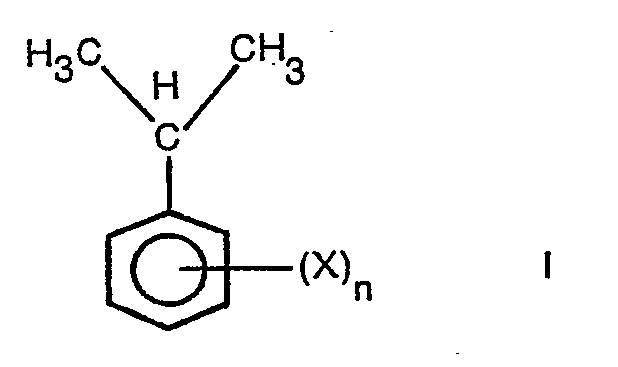
wherein n is a whole number from 1 to 5, and X is a halogen or an electron-withdrawing group which does not react with chlorine, in the presence of a free radical initiator, with chlorine, characterized in that the process is carried out in an inert aromatic solvent and at a temperature between 4 and 15°C.
wherein n is a whole number from 1 to 5, and X is a halogen or an electron-withdrawing group which does not react with chlorine, in the presence of a free radical initiator, with chlorine, characterized in that the process is carried out in an inert aromatic solvent and at a temperature between 4 and 15°C.
2. The process of Claim 1 characterized in that the free radical initiator is ultraviolet
light.
3. The process of Claim 1 or 2 characterized in that the ratio of moles of chlorine
atoms to moles of cumene derivative is from 0.5 to 1.1, with the proviso that no more
than 0.05 mole of chlorine is present at any point in time per mole of cumene derivative.
4. The process of any of the preceding Claims characterized in that the aromatic solvent
is m-dichlorobenzene.
5. The process of any of the preceding Claims characterized in that X is chlorine
and n is 2.
6. The process of any of the preceding Claims characterized in that the cumene derivative
is 3,5-dichlorocumene and the resultant product is a-chloro-3,5-dichlorocumene.
1. Verfahren zur Herstellung a-chlorierter Cumolderivate durch Inkontaktbringen eines
Cumolderivats der Formel I
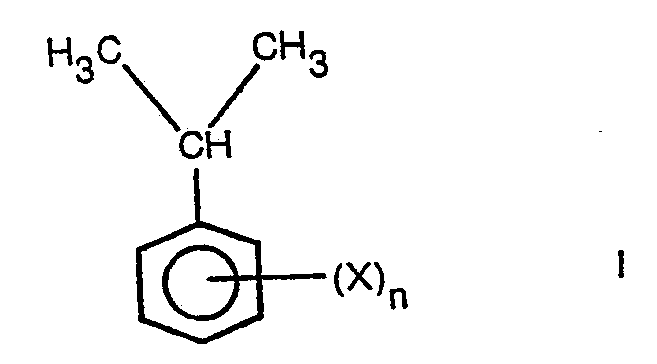
worin n eine ganze Zahl von 1 bis 5 ist, und X Halogen oder eine Elektronen anziehende Gruppe ist, die nicht mit Chlor reagiert, mit Chlor in Gegenwart eines Initiators für freie Radikale, dadurch gekennzeichnet, daß das Verfahren in einem inerten aromatischen Lösungsmittel und bei einer Temperatur zwischen 4 und 15°C durchgeführt wird.
worin n eine ganze Zahl von 1 bis 5 ist, und X Halogen oder eine Elektronen anziehende Gruppe ist, die nicht mit Chlor reagiert, mit Chlor in Gegenwart eines Initiators für freie Radikale, dadurch gekennzeichnet, daß das Verfahren in einem inerten aromatischen Lösungsmittel und bei einer Temperatur zwischen 4 und 15°C durchgeführt wird.
2. Verfahren nach Anspruch 1, dadurch gekennzeichnet, daß der Initiator für freie
Radikale ultraviolettes Licht ist.
3. Verfahren nach Anspruch 1 oder 2, dadurch gekennzeichnet, daß das Verhältnis der
Mol Chloratome zu Mol Cumolderivat 0,5 bis 1,1 beträgt, mit der Maßgabe, daß nicht
mehr als 0,05 Mol Chlor pro Mol Cumolderivat zu irgendeinem Zeitpunkt vorhanden sind.
4. Verfahren nach einem der vorhergehenden Ansprüche, dadurch gekennzeichnet, daß
das aromatische Lösungsmittel m-Dichlorbenzol ist.
5. Verfahren nach einem der vorhergehenden Ansprüche, dadurch gekennzeichnet, daß
X Chlor ist und n=2.
6. Verfahren nach einem der vorhergehenden Ansprüche, dadurch gekennzeichnet, daß
das Cumolderivat 3,5-Dichlorcumol ist und das entstehende Produkt a-Chlor-3,5-di-chlor-
cumol ist.
1. Procédé de préparation de dérivés de cumène a-chlorés par contact d'un dérivé de
cumène répondant à la formule I:
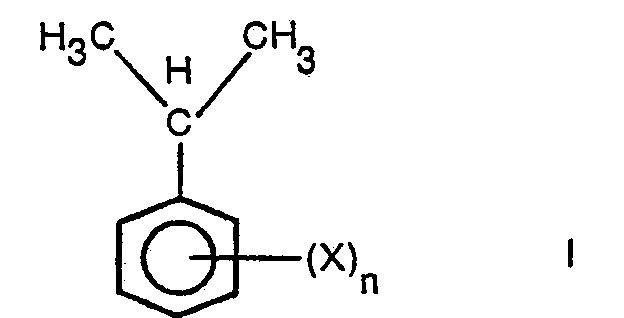
dans laquelle n est un nombre entier de 1 à 5, et X est un atome d'halogène ou un groupe attirant les électrons qui ne réagit pas avec le chlore, en présence d'un initiateur de radicaux libres, avec le chlore, caractérisé en ce qu'on effectue le procédé dans un solvant aromatique inerte et à une température comprise entre 4 et 15°C.
dans laquelle n est un nombre entier de 1 à 5, et X est un atome d'halogène ou un groupe attirant les électrons qui ne réagit pas avec le chlore, en présence d'un initiateur de radicaux libres, avec le chlore, caractérisé en ce qu'on effectue le procédé dans un solvant aromatique inerte et à une température comprise entre 4 et 15°C.
2. Procédé selon la revendication 1, caractérisé en ce que l'initiateur de radicaux
libres est la lumière ultra-violette.
3. Procédé selon la revendication 1 ou 2, caractérisé en ce que le rapport des moles
d'atomes de chlore aux moles du dérivé de cumène est de 0,5 à 1,1, à la condition
qu'il n'y ait pas plus de 0,05 mole de chlore à un moment quelconque par mole du dérivé
de cumène.
4. Procédé selon l'une quelconque des revendications précédentes, caractérisé en ce
que le solvant aromatique est le m-dichloro- benzène.
5. Procédé selon l'une quelconque des revendications précédentes, caractérisé en ce
que X est le chlore et n est 2.
6. Procédé selon l'une quelconque des revendications précédentes, caractérisé en ce
que le dérivé de cumène est le 3,5-dichloro- cumène et que le produit résultant est
l'a-chloro-3,5-dichlorocumène.