|
(11) | EP 0 084 092 B1 |

| (12) | EUROPEAN PATENT SPECIFICATION |
|
|
| (54) |
Valproic acid conjugates Conjugate von Valproinesäure Conjugés d'acide valproique |
|
|
|||||||||||||||||||||||||||||||||||
| Note: Within nine months from the publication of the mention of the grant of the European patent, any person may give notice to the European Patent Office of opposition to the European patent granted. Notice of opposition shall be filed in a written reasoned statement. It shall not be deemed to have been filed until the opposition fee has been paid. (Art. 99(1) European Patent Convention). |
BACKGROUND OF THE INVENTION
1. Field of the invention
[0001] This invention relates to novel valproic acid derivatives pertaining to binding assays, especially immunoassays, for determining valproic acid and its salt forms in liquid media such as serum. The novel derivatives are labeled valproic acid conjugates which may be directly used in performing such assays.
[0002] Valproic acid (2-n-propylpentanoic acid) and its various salt forms, particularly its sodium salt, are anticonvulsant drugs useful in the management of epilepsy. The structural formula for the acid is as follows:
cf. The Merck Index, 9th. ed., No. 9574 (1976).
[0003] Due to its rapid elimination, blood levels of valproic acid fluctuate considerably. There is only a poor correlation between daily dose and blood concentration, possibly due to interindividual differences in absorption or total body clearance. Therefore, the proper management of epilepsy with the drug cannot be achieved by the simple choice of a medication regimen based on body weight, surface area, or age of the patient. Frequent administration and determination of individual blood concentrations at accurately fixed times appear to be the only reliable monitoring method. No clear therapeutic blood levels have been firmly established. However, some physicians accept 50 to 100 yglml of valproic acid as the range of therapeutic blood levels since most patients with blood levels in this range seem adequately controlled (Pinder et al, Drug 13:94 (1977)).
2. Description of the prior art
[0004] At present valproic acid is usually analyzed by gas-liquid chromatography (Libeer et al, J. Chromatogr. 160:285 (1978), with high-pressure liquid chromatography also being used (Sutheimer et al, Chromtogr. Newsletter 7:1 (1979)). There is presently no commercially available immunoassay for valproic acid. An abstract has been published regarding a homogeneous enzyme immunoassay for valproic acid (Clin. Chem. 25:1093 (1979)). No details were given concerning any of the reagents which might be used in such an assay.
[0005] Nonradioisotopic specific binding assays employing an enzyme-cleavable label are described in German Offenlegungsschriften Nos. 2,618,419 and 2,618,511.
[0006] The assays avoid the use of radioisotopic labels and can be performed in homogeneous or heterogeneous formats. In the heterogeneous format, the bound- and free-species of the labeled conjugate are physically separated and the label measured in one of the separated species, whereas in the homogeneous format, the label expresses a different activity in the bound-species compared to the free-species, permitting performance of the assay without a separation step. In the aforementioned assays, the labeled conjugate serves as a substrate for a cleaving enzyme, with cleavage of the conjugate producing a distinguishable indicator product, usually a fluorescent product. The fluorescers umbelliferone or fluorescein are coupled to the ligand under assay through an ester bond which upon cleavage by an esterase releases the free fluorescent products, umbelliferone and fluorescein, respectively.
SUMMARY OF THE INVENTION
[0007] The present invention provides α-galactosyl-um-belliferone-valproic acid conjugates of the formula:
wherein n is an integer from 3 to 8, preferably 4, and the radicals R which may be the same or different respresent hydrogen, lower alkyl, e.g. methyl, ethyl and butyl; halogen, e.g. chloro or bromo; nitro; carboxyl; lower alkoxycarbonyl, e.g., methoxycarbonyl and ethoxycarbonyl; amino; mono- and di-lower alkylamino, e.g. methylamino, dimethylamino and methylethylamino; carbomoyl; hydroxyl; or lower alkoxy, e.g. methoxy and ethoxy. Preferably R represents hydrogen.
[0008] As described in more detail in the examples below, the labeled conjugates (I) are generally prepared by reaction of carboxyl-activated 7-β-galactosylcoumarin-3-carboxylic acid with appropriate w-amino-2-n-propylalkanoic acids of the formula:
wherein n is the same as described above. The reaction proceeds in an aqueous, neutral pH, solvent at between 0 and 25°C for between 1 and 3 hours. The w-amino-2-n-propylalkanoic acids (II) are prepared according to the malonic ester synthesis of carboxylic acids (Preparative Organic Chemistry, ed. Hilgetag and Martini, John Wiley & Sons (New York 1972), p. 912).
[0009] The conjugates according to the invention are useful as fluorogenic reagents in immunoassays for determining valproic acid. In such assay, the conjugates of the instant invention are used together with antibodies against valproic acid. Antibodies of this type and methods for their preparation are described in detail in the parent case (EP-A-0 028 795).
[0010] The present invention will now be illustrated, but is not intended to be limited, by the following examples.
Preparation of β-Galactosyl-umbelliferone-labeled valproic acid conjugates.
6-Amino-2-n-propylhexanoic Acid (II), n = 4.
[0011] To a stirred suspension of 6.24 grams (g) (0.13 mol) of sodium hydride (50% mineral oil dispersion) in 100 milliliters (ml) of dry dimethylformamide was slowly added 25.3 g (0.13 mol) of diethyl n-propyl- malonate (Pfaltz & Bauer, Inc., Stamford, Connecticut USA). After one hour, hydrogen evolution ceased. To this was slowly added a solution of 36.7 g (0.13 mol) of N-(4-bromobutyl)phthalimide (Aldrich Chemical Co., Milwaukee, Wisconsin USA) in 50 ml of dry dimethylformamide. The reaction mixture was stirred at room temperature for 3 hours, then heated at 60°C for 12 hours. It was cooled, quenched with 25 ml of 1:1 (volume:volume) (v:v) acetic acid:water, and the solvent removed under reduced pressure. The residue was partitioned between ethyl acetate and water. The organic phase was separated, dried, and evaporated to give 54.8 g of the crude diester. This was not characterized but instead was heated for 20 hours in 500 ml of dry ethanol containing 73 g (0.65 mol) of potassium tert-butoxide. After this, 150 ml of water was added and heating continued for an additional 3 hours. The reaction was cooled and most of the ethanol removed under reduced pressure. The concentrate was diluted with water, washed with ether, and acidified with hydrochloric acid. It was extracted with three 250 mi portions of ethyl acetate. The extracts were combined, dried, and evaporated to give a solid residue. Hydrolysis was completed by refluxing this residue in 500 ml of 1:1 (v:v) dioxane: 20% hydrochloric acid.
[0012] Evaporation of the dioxane-acid solution gave a residue that was chromatographed on 500 g of silica gel eluting with a solvent prepared by equilibrating equal volumes of chloroform, methanol, and concentrated aqueous ammonium hydroxide solution and discarding the upper phase. Fractions of 20 ml volume were collected. Fractions 122 and 149 were pooled, evaporated, and the residue recrystallized from ethanol to give 4 g (18% yield) of 6-amino-2-n-propylhexanoic acid as white crystals, mp (melting point) 209-210°C.
Infrared Spectrum (KCI): 1635 cm-1 (carbonyl).
N-(5-Carboxyoctyl)-7-a-galactosylcoumarin-3-carboxamide (I), n = 4, R = H.
[0013] A mixture of 24 g of potassium hydroxide, 80 ml of water, and 240 ml of methanol was stirred at 5°C while 20 g (0.035 mol) of ethyl 7-¡3-galactosylcoumarin-3-carboxylate (Burd. et al, Clin. Chem 23:1402(1977)) was added in one portion. After 5 minutes the reaction was heated for 15 hours at 50°C. When cool, the methanol was removed under reduced pressure and the remaining aqueous solution acidified to pH 2 with concentrated hydrochloric acid. The white precipitate was collected, washed with cold water, and recrystallized from hot water. The crystals were washed with acetone and dried at 80°C for 1 hour. This gave 12 g of 7-(3-galactosylcoumarin-3-carboxylic acid as white crystals, mp 250―255°C.
[0014] A solution of 734 milligrams (mg) (2 millimol (mmol)) of 7-¡3-galactosylcoumarin-3-carboxylic acid and 210 mg (2 mmol) of N-hydroxysuccinimide in 20 ml of dimethylformamide was cooled to -10°C while stirring under an inert atmosphere. To this was added 412 mg (2 mmol) of dicyclohexyl carbodiimide. After 15 minutes at -10°C, a clear solution was obtained. The reaction was allowed to warm to room temperature and stirred for 2 hours. It was again cooled to -10°C and the precipitate of dicyclohexyl urea removed by filtration under vacuum.
[0015] The filtrate, now containing the activated ester, was placed in a dropping funnel and added dropwise over a 15 minute period to a 0°C solution consisting of 346 mg (2 mmol) of 6-amino-2-n-propylhexanoic acid and 0.5 ml of triethylamine in 20 ml of water. After 1 hour at 0°C, the reaction mixture was allowed to warm to room temperature and stirred for 2 hours. Ten grams of silicic acid was added and the solvent removed on the rotary evaporator under high vacuum. The impregnated silicic acid was placed atop a column of 120 g of silicic acid packed in 3:2 (v:v) ethyl acetate:ethanol. The column was eluted with this solvent and 15 ml fractions were collected. Fractions 28 to 40 were combined, evaporated and the residue recrystallized from ethanol to give 365 mg (35% yield) of the labeled conjugate as cream coloured crystals, mg 162°C.
Infrared Spectrum (KCI): 1710 cm-1 (carbonyl).
[0016] The above-described synthesis of the labeled conjugate (I) n = 4, can be modified to yield β-galactosyl-umbelliferone-labeled valproic acid conjugates wherein n = 3-8 by replacing the starting material N-(4-bromobutyl)phthalimide in the described synthesis with the appropriate N-(w-bromoalkyl)phthalimide as follows:
1. A a-galactosyl-umbelliferone-valproic acid conjugate of the formula:
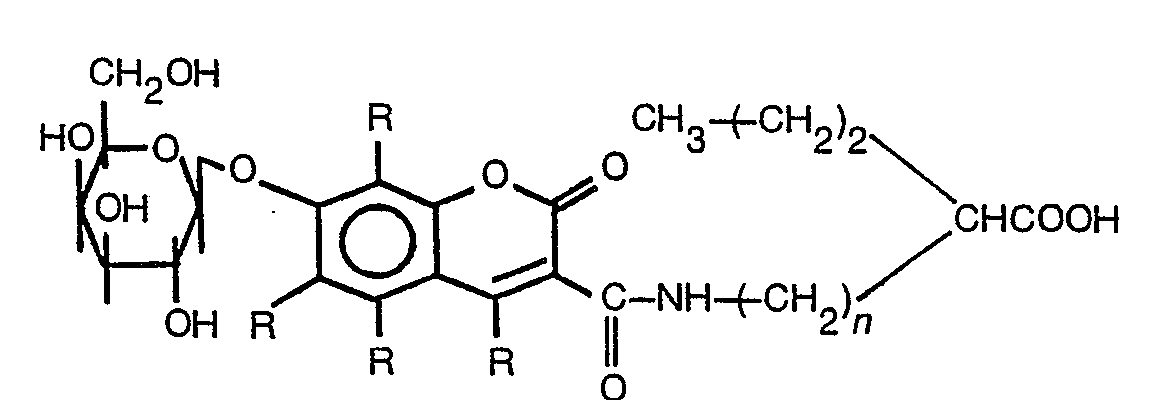
wherein n is an integer from 3 to 8 and the radicals R which may be the same or different represent hydrogen; lower alkyl; nitro; carboxyl; lower alkoxycarbonyl; amino; mono- and di-lower alkylamino; carbamoyl; hydroxyl or lower alkoxy.
wherein n is an integer from 3 to 8 and the radicals R which may be the same or different represent hydrogen; lower alkyl; nitro; carboxyl; lower alkoxycarbonyl; amino; mono- and di-lower alkylamino; carbamoyl; hydroxyl or lower alkoxy.
2. A conjugate according to claim 1 wherein all radicals R represent hydrogen.
3. A conjugate according to claim 1 or 2 wherein n = 4.
1. Conjugué de β-galactosyl-umbelliférone et d'acide valproïque, de formule:
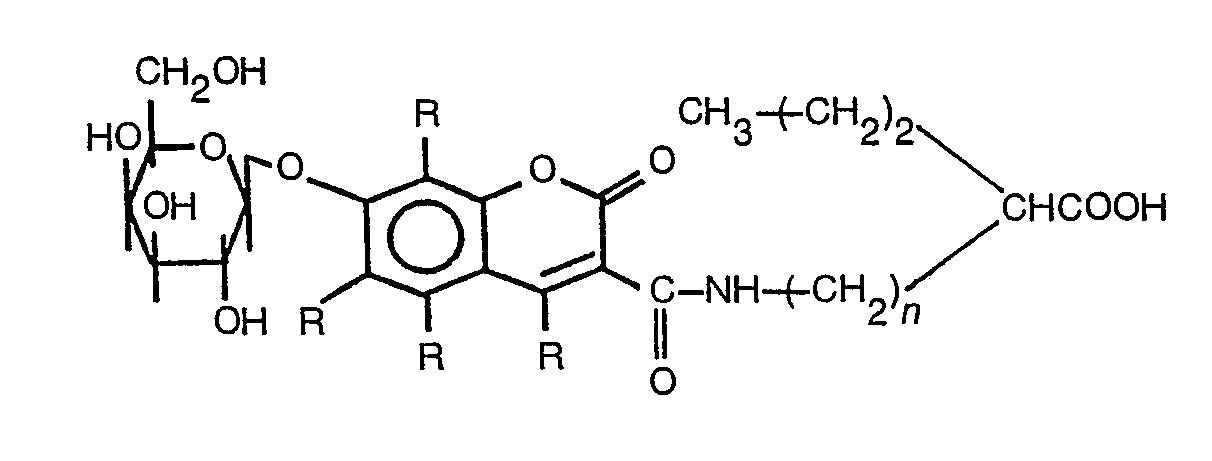
dans laquelle n est un nombre entier de 3 à 8 et les radicaux R, qui peuvent être égaux ou différents, représentent l'hydrogène; un radical alkyle inférieur; nitro; carboxyle; alkoxycarbonyle inférieur; amino; mono-et di-(alkyle inférieur)-amino; carbamoyle; hydroxyle ou alkoxy inférieur.
dans laquelle n est un nombre entier de 3 à 8 et les radicaux R, qui peuvent être égaux ou différents, représentent l'hydrogène; un radical alkyle inférieur; nitro; carboxyle; alkoxycarbonyle inférieur; amino; mono-et di-(alkyle inférieur)-amino; carbamoyle; hydroxyle ou alkoxy inférieur.
2. Conjugué suivant la revendication 1, dans lequel tous les radicaux R représentent
l'hydrogène.
3. Conjugué suivant la revendication 1 ou 2, dans lequel n a la valeur 4.
1. Ein β-Galactosyl-umbelliferon-valpronsäure-Konjugat der Formel
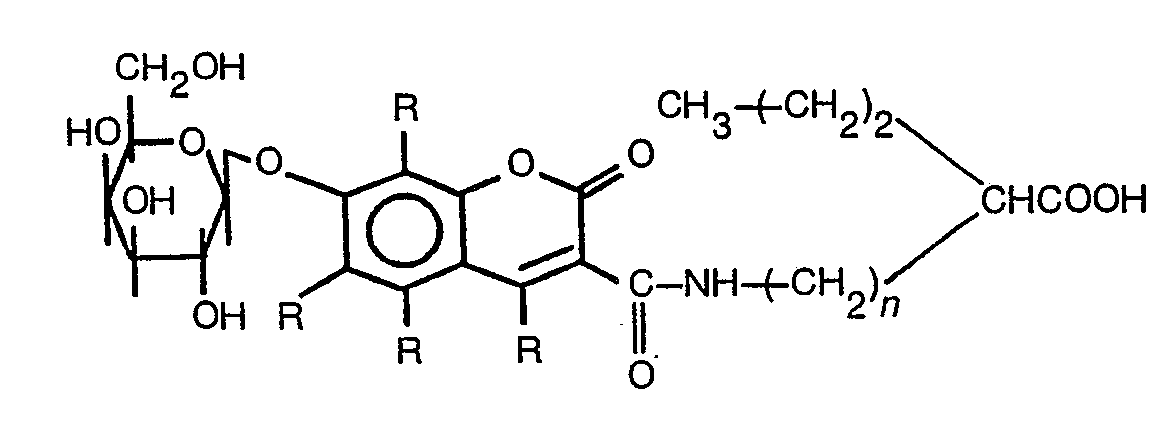
worin n eine ganze Zahl von 3 bis 8 und die Reste R, die gleich oder verschieden sein können, Wasserstoff, Niedrigalkyl, Nitro, Carboxyl, Niedrigalkoxycarbonyl, Amino, Mono- und Diniedrigalkylamino, Carbamoyl, Hydroxyl oder Niedrigalkoxy bedeuten.
worin n eine ganze Zahl von 3 bis 8 und die Reste R, die gleich oder verschieden sein können, Wasserstoff, Niedrigalkyl, Nitro, Carboxyl, Niedrigalkoxycarbonyl, Amino, Mono- und Diniedrigalkylamino, Carbamoyl, Hydroxyl oder Niedrigalkoxy bedeuten.
2. Konjugat gemäss Anspruch 1, worin alle Reste R Wasserstoff bedeuten.
3. Konjugat gemäss Ansprüchen 1 oder 2, worin n = 4 ist.