|
(11) | EP 0 171 216 A1 |

| (12) | EUROPEAN PATENT APPLICATION |
|
|
|
|
|||||||||||||||||||||||||||
|
||||||||||||||||||||||||||||
| (54) | A method for the production of tiglic aldehyde |
| (57) Ethylacrolein is isomerized in the presence of a hydrogenation catalyst, e.g. a group
VIII metal, e.g. Pt, Pd, Rh or Ru at a temperature of below 300°C, or Si, Al or Si-Al
at 200-400°C, optionally in the presence of hydrogen gas. In the liquid phase a solvent is present, e.g. an aromatic hydrocarbon; or in the gaseous phase any inert gas is present, with a fixed or fluidized bed. Both methods give good yields of up to 75% of tiglic aldehyde. The catalyst is separated and reused. The ethylacrolein is prepared by condensing n-butylaldehyde and aqueous formaldehyde solution. |
[0001] This invention relates to a novel method for the production of tiglic aldehyde [2-methyl-2-butene-l-al,
[0002] Tiglic aldehyde is an important raw material for the synthesis of isoterpenes. Tiglic acid
] which is obtained by oxidation of tiglic aldehyde is useful as a raw material for the synthesis of driers for perfumes, varnishes, inks, and the like. Further, a chloride of tiglic aldehyde [4-chloro-2-methyl-2-butene-l-al,
] is a useful compound to extend an isoterpene chain by one unit.
[0003] Hitherto, as a method for the production of tiglic aldehyde, a so-called Cross's aldol condensation method wherein acetaldehyde and propionaldehyde are condensed in a strong basic condition is known. However, this method has a drawback that the yield of said aldehyde is poor with a large quantity of various by-products being formed (see M.B. Green, W.T. Hickinbottom, Journal of Chemical Society, page 3262 (1975)).
[0004] An object of this invention is to provide a method for producing tiglic aldehyde which is an important raw material for the synthesis of isoterpenes.
[0005] Another object of this invention is to provide such method which provides a good yield from materials which are available at a low price.
[0006] This invention provides a method for the production of tiglic aldehyde, which comprises isomerizing ethylacrolein.
[0007] Ethylacrolein which is used as a starting material for the synthesis of tiglic aldehyde in this invention can be almost all quantitatively prepared by condensing usual industrial materials, n-butylaldehyde and a formalin aqueous solution (see U.S. Patent 4,346,239)0 The isomerization of ethylacrolein this invention can be carried out by either a liquid phase reaction or a gas phase reaction.
[0008] When the liquid phase reaction is employed for the production of tiglic aldehyde, ethylacrolein is heated in the copresence of a solvent and a catalyst. Examples of the solvent which can be used in this reaction include aromatic hydrocarbons, alcohols and aliphatic hydrocarbons. Illustrative of such solvents are toluene, ethylbenzene, xylene, n-butanol and n-octane.
[0009] Examples of the catalyst which can be used in this reaction include metals belonging to the Group_UIII of the periodic table, such as platinum, palladium, rhodium and ruthenium. These metals are generally supported on a carrier such as an activated carbon or alumina for use. These supported catalysts are generally used as a hydrogenation catalyst and commercially available, for example, 5% palladium-on-carbon and 0.5% palladium-on-alumina made by Nippon Engel Hard Co., Ltd.
[0010] When the catalyst is poisoned by, for example, sodium dithionite, sulfonic acid, thiophene, thiourea, or 1,1,3,3-tetramethylthiourea, its reactivity is reduced but the selectivity of the isomerization increases.
[0011] When hydrogen is copresent in the reaction system, though a saturated aldehyde, 2-methylbutanal
is formed as a by-product, the isomerization becomes extremely active, leading to an increase in yield.
[0012] The reaction temperature may be 50°C or higher but when the reaction temperature is too low, the rate of reaction is low,'whereas when the reaction temperature is too high, a loss which may be caused by the polymerization occurs. Accordingly, preferable results can be obtained in the range of from 80°C to 150°C.
[0013] The catalyst which was used can be repeatedly used ten times by mere filtration without any other treatment, and there was not found any change in reactivity.
[0014] On the other hand, the gas phase reaction can be conducted either a fixed bed . or a fluidized bed manner That is, tiglic aldehyde can be prepared by passing vaporized ethylacrolein with a carrier gas through a catalyst layer under heating. In this case, as the carrier gas which can be used, any inert gas can be used, and examples thereof include nitrogen gas, argon gas and a process-waste gas.
[0015] As the catalyst which can be used in this reaction, silica, alumina and silica-alumina can also be used in addition to the metals belonging to the of the periodic table (such as palladium, platinum, rhodium and ruthenium). Illustrative of catalysts which are commercially available are 0.5% palladium-on-allumina (made by Nippon Engel Hard Co., Ltd.) and silica-alumina N-631L (made by JGC Corporation).
[0016] When platinum-group metal-supported catalysts are used, the reaction temperature is relatively low e.g. about 300°C or lower, preferably from 50° to 150°C. When silica-alumina catalysts are used, the reaction temperature is relatively high, e.g. 200°C to 400°C, preferably from 250°C to 350°C. In both cases, a high yield can be attained.
[0017] In this case, a preferable space velocity is from 100 to 5000 hr-1, most preferably from 500 to 2000 hr-l.
[0018] A suitable molar ratio of the carrier gas to ethylacrolein is in the range of from 1/1 to 100/1, preferably from 10/1 to 50/1. When hydrogen is used as an activator, a suitable molar ratio of hydrogen to ethylacrolein is in the range from 0/1 to 1/1, preferably from 0/1 to 0.2/1, whereby a high yield can be attained.
[0019] By the method of the invention of isomerization of ethylacrolein to tiglic aldehyde, tiglic aldehyde can be prepared in a good yield by using n-butylaldehyde and a formalin aqueous solution which are readily commercially available raw materials.
[0020] The following examples are illustrative of this invention. The catalysts and other specific ingredients and processing parameters are presented as being typical, but modifications can be made therefrom within the scope of the invention.
PREPARATION OF CATALYSTS
Catalyst 1
[0021] 0.052 g of sodium dithionite (Na2S204) was dissolved in 100 ml of water, and 20.0 g of a 5% palladium-on-carbon powder (Nippon Engel Hard Co., Ltd.) was added thereto. The mixture was then stirred for 30 minutes. The mixture was heated on a sand bath to evaporate off water, and the residue was kept in a vacuum drying oven at 120°C for 24 hours.
Catalsyt 2
[0022] 0.5 g of thiourea was dissolved in 300 ml of acetone, and 20 g of a 5% palladium-on-carbon powder (Nippon Engel Hard Co., Ltd.) was added thereto. The mixture was then stirred for 30 minutes. The acetone was evaporated off by a rotary evaporator, and the residue was kept in a vacuum drying oven at 120°C for 12 hours.
Catalyst 3
[0023] 0.4 g of thiophene was dissolved in 300 ml of acetone, and 20 g of a 5% palladium-on-carbon powder was added thereto. The mixture was then stirred at room temperature for 30 minutes. The acetone was evaporated off by a rotary evaporator, and the residue was kept in a vacuum drying oven at 120°C for 12 hours.
Example 1
[0024] In a stainless steel reactor having a capacity of 100 ml were placed 8.4 g of ethylacrolein (0.1 mol), 25 ml of ethylbenzene, and 0.3 g of catalyst 1. The reactor was purged with nitrogen, and 500 ml of hydrogen gas at standard condition was then introduced in the reactor. The mixture was heated at 100°C for 6 hours.
[0025] After cooling the reactor, the reaction solution was analyzed by gas chromatography. The results of the reaction showed that the conversion of ethylacrolein was 97%, the yield of tiglic aldehyde was 74% and the yield of saturated aldehyde (2-methylbutane-l-al) was 22%.
Examples 2 to 6
[0027] Using catalyst 1 or 2, the same procedures as in Example 1 were followed except for changing the kind of the solvent (but not changing the amount (weight) of the solvent). The results are shown in Table 1.
Example 7
[0028] The catalyst used in Example 1 was filtered and then reused. The reaction was carried out at 100°C for 6 hours using 4.2 g of ethylacrolein, 12.5 ml of ethylbenzene, 0.15 g of recovered catalyst 1, and, 250 ml of hydrogen gas. The results are shown in Table 2.
Example 8
[0029] In a glass reactor equipped with a reflux condenser were placed 25 ml of toluene and 8.4 g of ethylacrolein, the reactor was purged with nitrogen, and 0.3 g of catalyst 3 was then added thereto. The mixture was refluxed under heating for about 6 hours while supplying a 5% hydrogen gas (the balance being nitrogen) into the reactor at a flow rate of 30 ml/min. The results are shown in Table 3.
Example 9
[0030] In a glass reactor was packed 2 g of a 5% palladium-on-alumina catalyst and ethylacrolein, hydrogen and nitrogen were introduced thereinto at a ratio of 1/0.037/3.4 in the gas phase. The yield of tiglic aldehyde was 35% at a space velocity (SV) of 700 hr-1 and at 100°C.
Examcle 10
[0031] The procedure of Example of was repeated but without the introduction of the hydrogen and at a temperature of 150°C. The tiglic aldehyde a yield was 36%.
Example 11
1. A process for producing tiglic aldehyde of the formula:
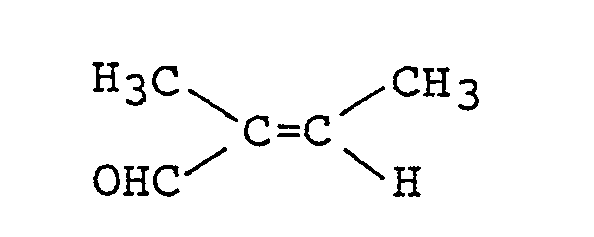
which comprises isomerizing ethylacrolein in the presence of a hydrogenation catalyst.
which comprises isomerizing ethylacrolein in the presence of a hydrogenation catalyst.
2. A process in accordance with Claim 1, wherein the reaction is carried out in the
presence of hydrogen gas.
3. A process in accordance with Claim 1, wherein the reaction is carried out in a
liquid phase.
4. A process in accordance with Claim 1, wherein the reaction is carried out in a
gas phase.
5. A process in accordance with claim 3, wherein the catalyst is palladium, platinum,
rhodium or ruthenium.
6. A process in accordance with Claim 4, wherein the catalyst is silica, alumina,
silica-alumina, platinum, palladium, rhodium or ruthenium. Dear Sirs, European Patent
Application No.85305146.4 Sumitomo Chemical Company Limited We wish to correct the
following clerical error. Page 11, line 22, amend "Example of" to "Example 9". Yours
faithfully BRAine B C Diamond