|
(11) | EP 0 119 558 B1 |

| (12) | EUROPEAN PATENT SPECIFICATION |
|
|
| (54) |
Stereoselective reduction of 2- or 3-substituted 4-piperidones with sodium borohydride Stereoselektive Reduktion von in Stellungen 2- oder 3-substituierten 4-Piperidonen mit Hilfe von Sodium-Boro-Hydrid Réduction stéréosélective de 4-pipéridones substituées en positions 2- ou 3-, à l'aide de borohydrure de sodium |
|
|
|||||||||||||||||||||||||||||||
| Note: Within nine months from the publication of the mention of the grant of the European patent, any person may give notice to the European Patent Office of opposition to the European patent granted. Notice of opposition shall be filed in a written reasoned statement. It shall not be deemed to have been filed until the opposition fee has been paid. (Art. 99(1) European Patent Convention). |
[0001] This invention relates to a stereoselective reduction of 2- or 3-substituted 4-piperidones of the formula I, II or III,
wherein R1 is hydrogen, loweralkyl or benzyl and R2 is methyl or ethyl, to the di-equatorial isomers of the corresponding 4-piperidinols of the formulae IV, V or VI. Said reduction is conducted by use of sodium borohydride in a protic solvent medium at a temperature lower than 0°C in the presence of an effective amount of an inorganic acid. Under favorable reaction conditions, the stereo-selectivity of the reduction is so high that simple crystallization of the reaction product affords the pure isomer in a commercially acceptable and advantageous process.
[0002] The di-equatorial isomers of the compounds IV, V and VI obtained by this invention are dipicted by the formula IVa, Va, and VIa, respectively. As can be seen from the formula, the di-equatorial isomers of the 3,4- substituted compounds, namely, compounds IVa and Va, are trans isomers with respect to the 3- and the 4- substituents, whereas the di-equatorial isomers of the 2,4-substituted compounds, namely, compounds Via, are cis isomers with respect to the 2- and the 4-substituents.
[0003] . The compounds IV are useful for synthesizing compounds of the formula VII by reacting them with substituted flurobenzenes. This reaction is not accompanied by any appreciable scrambling of the stereo orientation of the 3- or 4-substituent. The compounds of the formula VII, are useful as antidepressants and analgesic agents as described in U.S. Patents 4,216,218, 4,302,590 and 4,312,876.
[0004] The compounds V and VI can be reacted to afford compounds of formula VIII and IX, respectively, where Ar is a phenyl or substituted phenyl group.
[0005] The compounds VIII and IX, in general, possess analgetic activities. For instance, an article entitled "Aromatic Esters of Nonquaternary Carbon-4 Piperidinols as Analgesics" by James A. Waters, Journal of Medicinal Chemistry, Vol. 21, No. 7 (1978), pp. 628―633, describes the preparation and the analgesic activities of various aromatic carboxylic esters of 1-methyl-4-piperidinol compounds having a general formula VIII; where Ar is phenyl or substituted phenyl, the substituent being loweralkyl, loweralkoxy or fluorine; R4 is hydrogen, methyl or carboethoxy; and Rs is methyl or β-phenylethyl. It is particularly interesting to note that the cis and trans forms of the compound of the formula VIII are stated to have quite different analgetic activities.
[0006] Since two stereo isomers of a given 4-piperidinol compound of the formula IV, V or VI often give rise to different pharmaceutical activities of end products derived therefrom such as compounds of the formula VII, VIII or IX and since the end products derived from the di-equatorial isomers often have better pharmaceutical activities, it is important to develop a process for a stereoselective reduction of the 4-piperidone compounds of the formula I, II or III to the di-equatorial isomers of the corresponding piperidinol compounds of the formula IV, V or VI.
[0007] It is already known from EP-A2-0034647 that 3-phenyl-4-piperidones can be reduced to form a mixture of the cis- and trans-isomers of 3-phenyl-4-piperidinol, using any conventional techniques, for example by using reducing agents comprising sodium borohydride and lithium tri- sec. butyl-borohydride at a temperature of from 0 to 25°C.
[0008] It has now been discovered that when reduction of the compound I, II or III is conducted by use of sodium borohydride in a protic solvent at a temperature substantially lower than ambient temperature in the presence of an inorganic acid, the stereoselectivity of the reduction to the di-equatorial isomer product is very high so that frequently a simple crystallization of the reaction product conducted in commercially acceptable and advantageous manner affords the di-equatorial isomer in a substantially pure form. The stereoselectivity obtained by this invention is higher than those obtained by other methods such as dissolving metal reduction (e.g. Na in NH3), reduction with B2Hs, reduction with aluminum isopropoxide, or catalytic reduction using, for instance, a platinum, palladium or rhodium catalyst, or reduction with NaBHJROH.
[0009] The method of this invention has a further advantage that when the starting 4-piperidone compound is a 3-phenyl-4-piperidone (namely, compound I), the reduction of the carbonyl group to the hydroxyl group is not accompanied by undesirable reduction of the phenyl group to any appreciable extent, wich is in contrast to dissolving metal reduction methods such side reaction often occurs to a substantial extent.
[0010] In depicting the stereo orientations of 2-, 3- or 4-substituent of the piperidine ring, heavy solid lines (-) indicate the substituent is above the average plane of the piperidine ring and broken lines (----) indicate the substituent is belowthe average plane of the piperidine ring. A light solid line (-) indicates the substituent may be above or below the average plane of the piperidine ring.
[0011] The stereoselective reduction of this invention is conducted in a protic solvent medium. Preferably, the protic solvent medium comprises an alcohol, water or a mixture thereof. A preferred example of the alcohol is methanol. The choice of the composition of the solvent medium depends upon, among other things, the solubility of the reactant and the product in the solvent medium and the reaction temperature selected. For instance, where a reaction temperature of below 0°C is desired, pure water medium may be unsuitable and hence some other reaction medium such as a mixture of water and methanol, pure methanol or a mixture of tetrahydrofuran and water can be used. It has been found that generally speaking, polar solvents are preferred. Examples of preferred solvent medium include mixtures of water and methanol, for instance, in a volume ratio of 10:3 or 7:3, and mixtures of tetrahydrofuran and water, for instance, in a volume ratio of 9:1.
[0012] It has been discovered that the presence of an inorganic acid in the reaction medium further enhances the stereoselectivity of the reduction. Examples of inorganic acids suitable for this invention include hydrochloric acid, hydrobromic acid, sufuric acid, boric acid, phosphoric acid and mixtures and acid salts thereof. Generally speaking, the stereoselectivity increases with the concentration of the inorganic acid. Thus, it is preferable that the molar amount of the inorganic acid be at least one-half the molar amount of the starting 4-piperidone compound. It is more preferable to have at least a molar equivalent of the inorganic acid. The term "molar amount of the inorganic acid" as used in the specification and the appended claims shall mean the molar amount of acidic hydrogen of the acid molecule, rather than the molar amount of the acid molecule itself. As the concentration of the inorganic acid in the reaction system becomes substantially higher than the equi-molar concentration with respect to the ketone, the consumption of sodium borohydride through hydrolysis reaction tends to become more appreciable.
[0013] It has been found that in order to achieve a high stereoselectivity of the reduction it is preferable to conduct the reduction at a temperature substantially lower than the ambient temperature. Thus, the reduction is conducted at a temperature lower than 0°C. It has been observed that the stereoselectivity increases with the decrease of the reaction temperature. Thus it is preferable to conduct the reaction at low temperatures, for instance, in the range of from -30°C to about -10°C. The consumption of sodium borohydride through hydrolysis increases with the reaction temperature. It has been observed that very little hydrolysis of sodium borohydride occurs when the temperature is below -10°C.
[0014] When the reaction condition is judiciously chosen by adjusting the reaction temperature, composition of the solvent medium and the concentration of the inorganic acid relative to that of the starting 4-piperidone compound, the stereoselectivity of the reduction is often so high that simple crystallization of the reaction product affords the isomer in a substantially pure form. Quite often this is a significant commercial advantage. For example, when N-methyl-3-phenyl-4-piperidine is reduced with sodium borohydride at -15°C in 7:3 mixture of water and methanol in the presence of a molar equivalent of HCI with respect to the ketone, about 96% yield of the trans (diequatorial) isomer of the corresponding 4-piperidinol can be obtained.
[0015] The starting 3-phenyl-4-piperidone compounds (I) can be obtained according to the method disclosed in the afore-mentioned U.S. Patents. The piperidone compounds II and III can be prepared by methods known in the art, for instance, by making use of the method described by Howton, J. Org. Chem. Vol. 10, 277 (1945).
[0016] The following examples summarize the stereoselectivities of reductions conducted under various conditions.
Example I
[0017] N-methyl-3-phenyl-4-piperidone was reduced with sodium borohydride under various reaction conditions. The results are summarized in Table 1.
Example II
[0018] N-methyl-3-phenyl-4-piperidone was reduced (1) by dissolving metal method using Li, Na, and K and (2) by using aluminum isopropoxide and lithium isopropoxide. The results are summarized in Table 2. The results of Table 1 should be compared with those of Table 2 as an indication of the improved stereo- selectivity of the instant invention.
Example III
[0019] N-methyl-3-phenyl-4-piperidone was reduced by a catalytic hydrogenation method using platinum, palladium and rhodium. The results are summarized in Table 3. The results of Table 1 should be compared with those of Table 3 as an indication of the improved stereoselectivity of the instant invention.
Example IV
[0020] N-methyl-3-methyl-4-piperidone was reduced with sodium borohydride. For the sake of comparison, it was also catalytically hydrogenated using platinum oxide catalyst. The results are summarized in Table 4. They illustrate the stereoselectivity of the instant process.
Example V
1. A process for a stereoselective reduction of a piperidone compound of the formulae
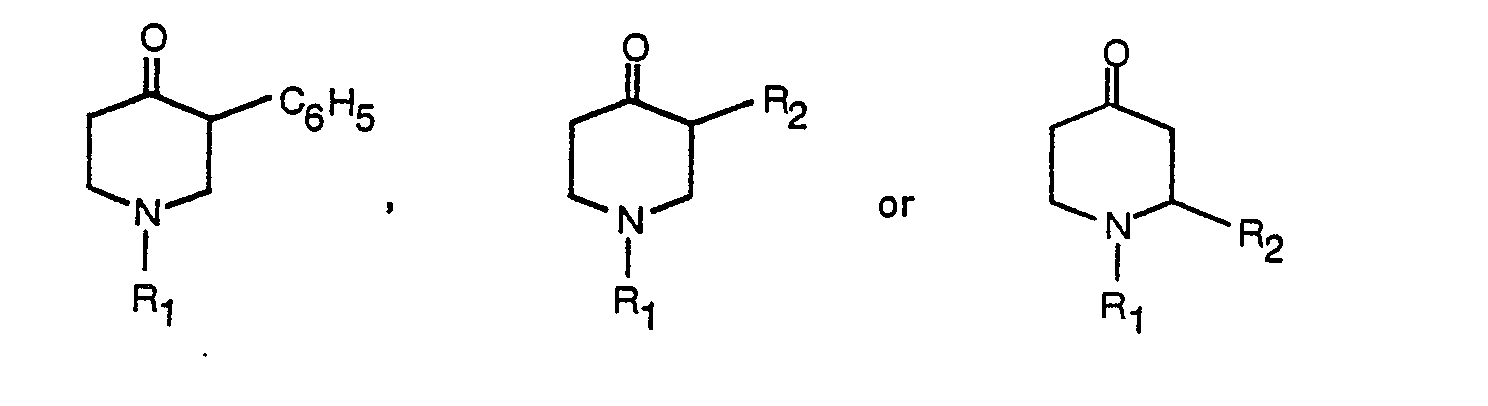
where R1 is hydrogen, loweralkyl or benzyl and R2 is methyl or ethyl, by use of sodium borohydride to the diequatorial isomers of the corresponding 4-piperidinols of the formulae
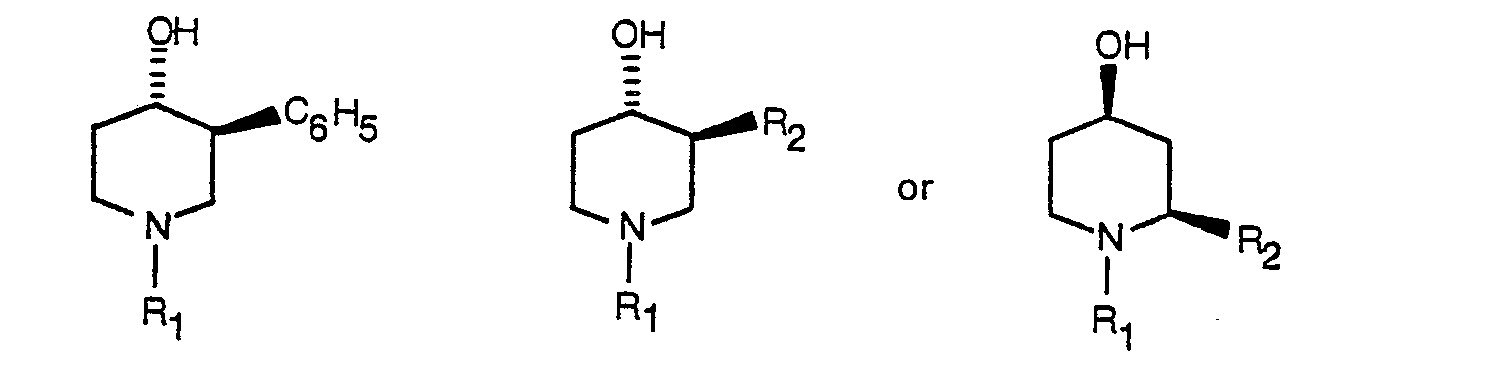
which comprises conducting the reduction at a temperature lower than 0°C in a protic solvent medium in the presence of an inorganic acid or acidic salt thereof.
where R1 is hydrogen, loweralkyl or benzyl and R2 is methyl or ethyl, by use of sodium borohydride to the diequatorial isomers of the corresponding 4-piperidinols of the formulae
which comprises conducting the reduction at a temperature lower than 0°C in a protic solvent medium in the presence of an inorganic acid or acidic salt thereof.
2. The process as defined in Claim 1 wherein the protic solvent medium comprises an
alcohol, water or a mixture thereof.
3. The process as defined in Claim 2 wherein the protic solvent medium comprises methanol,
water or a mixture thereof.
4. The process as defined in any one of Claims 1 to 3 wherein the reduction is conducted
at a temperature of from -30° to -10°C.
5. The process as defined in any one of Claims 1 to 4 wherein the molar amount of
the inorganic acid in the reaction mixture is at least one half the molar amount of
the 4-piperidone.
6. The process as defined in any one of Claims 1 to 5 wherein the inorganic acid is
hydrochloric acid, hydrobromic acid, sulfuric acid, boric acid, phosphoric acid or
a mixture thereof.
7. The process as defined in Claim 1 wherein R1 is methyl.
1. Ein Verfahren zur stereoselektiven Reduktion einer Piperidonverbindung der Formeln
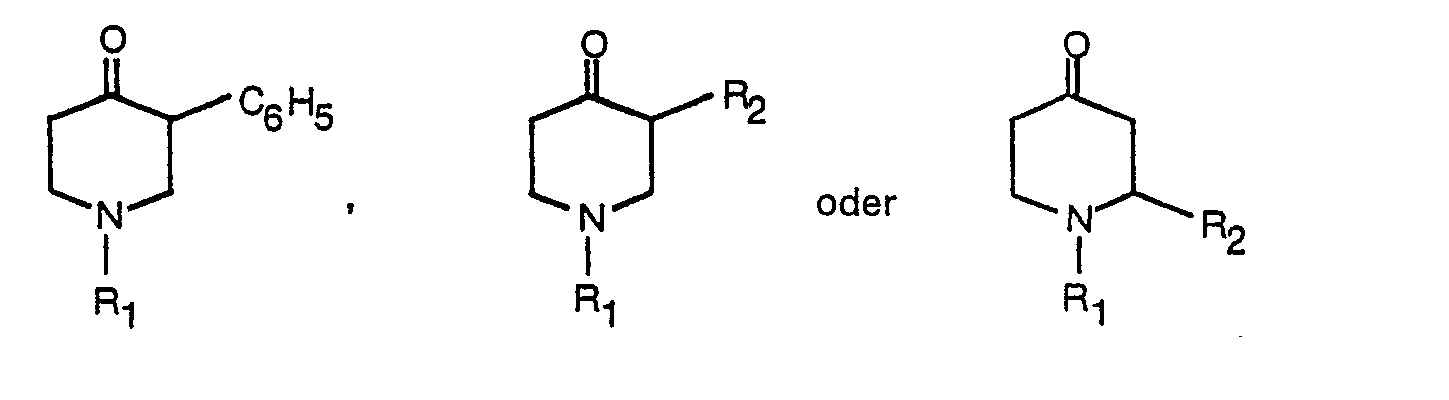
5 worin R, Wasserstoff, niederes Alkyl oder Benzyl und R, Methyl oder Äthyl bedeutet, unter Verwendung von Natriumborhydrid, zu den diäquatorialen Isomeren der entsprechenden 4-Piperidinole der Formeln
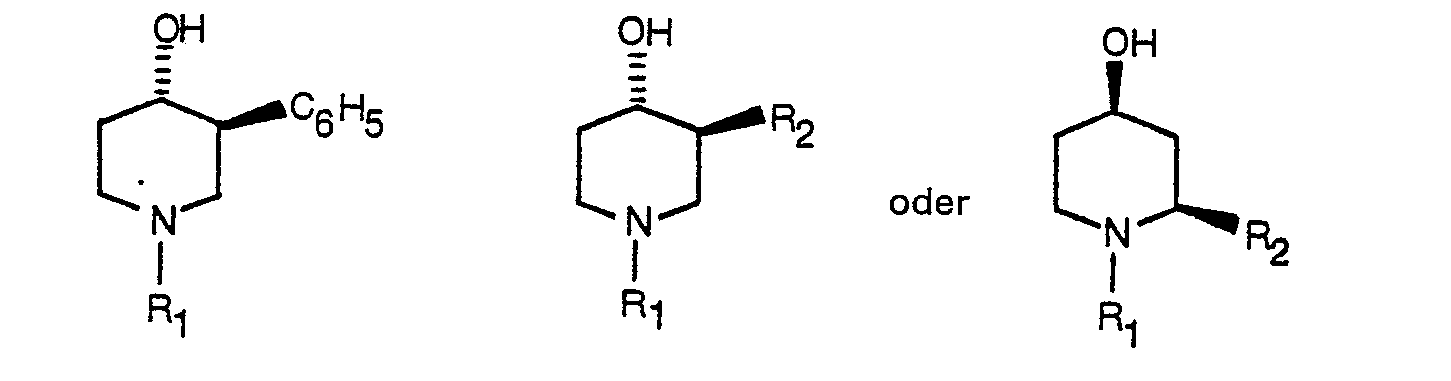
dadurch gekennzeichnet, daß man die Reduktion bei einer Temperatur unterhalb von 0°C in einem protischen Lösungsmittelsystem in Gegenwart einer anorganischen Säure der eines Säureadditionssalzes derselben durchführt.
5 worin R, Wasserstoff, niederes Alkyl oder Benzyl und R, Methyl oder Äthyl bedeutet, unter Verwendung von Natriumborhydrid, zu den diäquatorialen Isomeren der entsprechenden 4-Piperidinole der Formeln
dadurch gekennzeichnet, daß man die Reduktion bei einer Temperatur unterhalb von 0°C in einem protischen Lösungsmittelsystem in Gegenwart einer anorganischen Säure der eines Säureadditionssalzes derselben durchführt.
2. Das Verfahren gemäß Anspruch 1, worin das protische Lösungsmittelsystem ein Alkohol,
Wasser oder ein Gemisch davon ist.
3. Das Verfahren gemäß Anspruch 2, worin das protische Lösungsmittelsystem Methanol,
Wasser oder ein Gemisch davon ist.
4. Das Verfahren gemäß einem der Ansprüche 1 bis 3, worin die Reduktion bei einer
Temperatur von -30° bis -10°C durchgeführt wird.
5. Das Verfahren gemäß einem der Ansprüche 1 bis 4, worin die molare Menge der anorganischen
Säure im Reaktionsgemisch wenigstens die Hälfe der molaren Menge des 4-Piperidons
beträgt.
6. Das Verfahren gemäß einem der Ansprüche 1 bis 5, worin die anorganische Säure Salzsäure,
Bromwasserstoffsäure, Schwefelsäure, Borsäure, Phosphorsäure oder eine Mischung davon
ist.
7. Das Verfahren gemäß Anspruch 1, worin R1 Methyl ist.
1. Procédé de réduction stéréosélective d'un composé de pipéridone de formule:
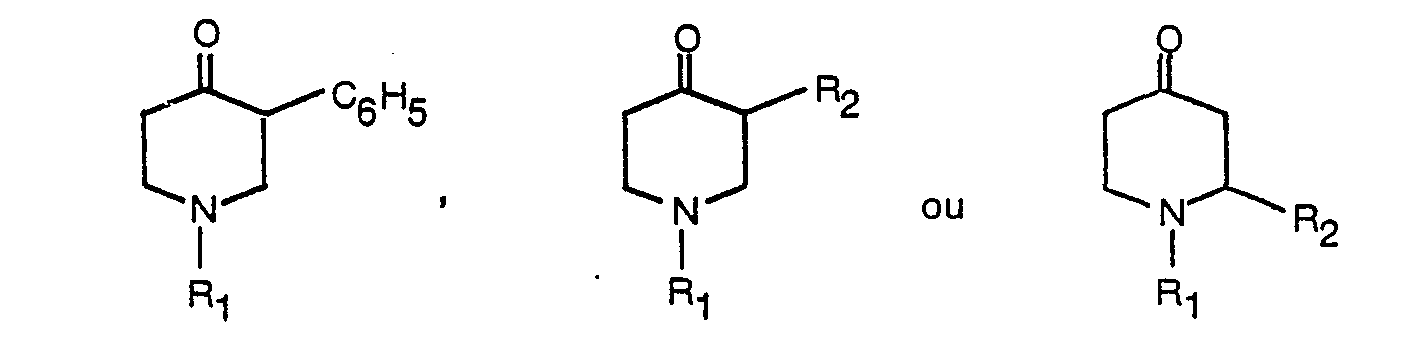
dans lesquelles R1 est un atome d'hydrogène, un groupe alkyle inférieur ou benzyle et R2 est un groupe méthyle ou éthyle, par emploi de borohydrure de sodium, en les isomères diéquatoriaux des 4-pipéridinols correspondants de formule:
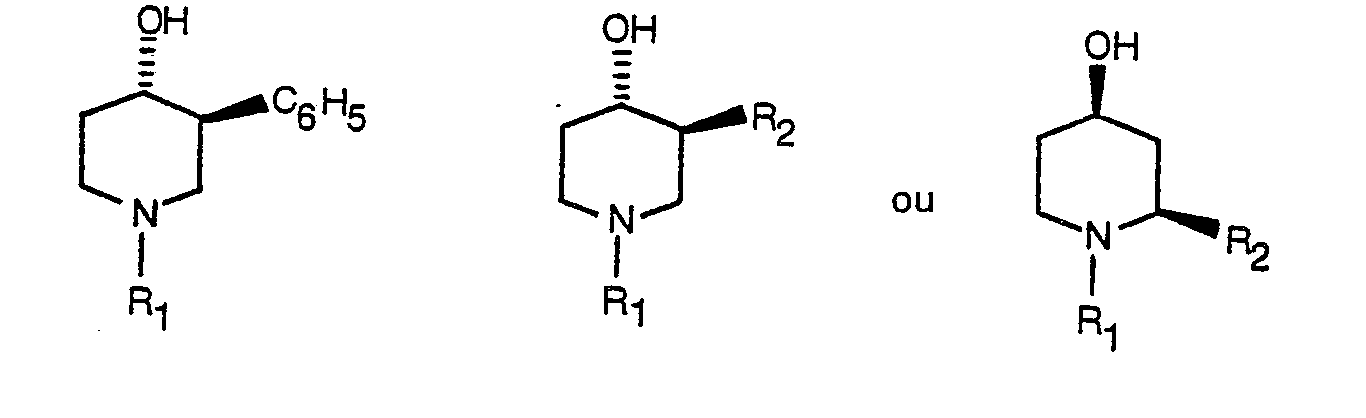
qui comprend la réalisation de la réduction à une température inférieure à 0°C dans un milieu solvant protique en présence d'un acide minéral ou d'un sel acide de celui-ci.
dans lesquelles R1 est un atome d'hydrogène, un groupe alkyle inférieur ou benzyle et R2 est un groupe méthyle ou éthyle, par emploi de borohydrure de sodium, en les isomères diéquatoriaux des 4-pipéridinols correspondants de formule:
qui comprend la réalisation de la réduction à une température inférieure à 0°C dans un milieu solvant protique en présence d'un acide minéral ou d'un sel acide de celui-ci.
2. Procédé selon la revendication 1, dans lequel le milieu solvant protique comprend
un alcool, de l'eau ou un mélange de ceux-ci.
3. Procédé selon la revendication 2, dans lequel le milieu solvant protique comprend
le méthanol, l'eau ou un mélange de ceux-ci.
4. Procédé selon l`une quelconque des revendications 1 à 3, dans lequel la réduction
est réalisée à une température allant de -30 à -10°C.
5. Procédé selon l'une quelconque des revendications 1 à 4, dans lequel la quantité
molaire d'acide inorganique dans le mélange de réaction est égale à au moins la moitié
de la quantité molaire de 4-pipéridone.
6. Procédé selon l'une quelconque des revendications'1 à 5, dans lequel l'acide minéral et l'acide chlorhydrique, l'acide bromhydrique,
l'acide sulfurique, l'acide borique, l'acide phosphorique ou un mélange de ceux-ci.
7. Procédé selon la revendication 1, dans lequel R1 est un groupe méthyle.