|
(11) | EP 0 152 138 B1 |

| (12) | EUROPEAN PATENT SPECIFICATION |
|
|
| (54) |
Method of preparing 9beta,10alpha-5,7-diene-steroids Verfahren zur Herstellung von 9-beta,10-alpha-5,7-dien-Steroiden Méthode de préparation de stéroides 9-bêta,10-alpha-5,7-diène |
|
|
|||||||||||||||||||||||||||||||
| Note: Within nine months from the publication of the mention of the grant of the European patent, any person may give notice to the European Patent Office of opposition to the European patent granted. Notice of opposition shall be filed in a written reasoned statement. It shall not be deemed to have been filed until the opposition fee has been paid. (Art. 99(1) European Patent Convention). |
[0001] The invention relates to a method of preparing 9β,10α-5,7-diene steroids by irradiating the corresponding 9α,10β-steroids or 9,10-seco steroids with filtered ultraviolet light.
[0002] 9β,10α-5,7-diene steroids generally are intermediates in the synthesis of pharmacologically interesting compounds which can fulfil a useful function in the human body. The hormone-(analogue 6-dehydro-9p,10a-progesterone (9p,10a-pregna-4,6-diene-3,20-dione) or dydrogesterone is an orally active progestative hormone and is generally used to correct deficiencies of progesterone in the body.
[0003] Therefore, a good possibility for synthesizing this substance and other 9β,10α-steroids from available or readily available raw materials is of great importance. Various 9α,10β-steroids, for example, ergosterol, pregnenolone and 7-dehydrocholesterol, are available as raw materials for the preparation of 9β,10α-5,7- diene steroids. The preparation of dydrogesterone from pregnenolone is described by Rappoldt et al. in Recueil trav. chim. 80, 43 (1961) and 90, 27 (1971). Important intermediates in the synthesis of dydrogesterone are lumisterol2, 3-(ethylenedioxy)-9β,10α-pregna-5,7-diene-20-one and 3,20- bis(ethylenedioxy)-913,10a-pregna-5,7-diene. These intermediates can be prepared by irradiating the corresponding 9a,10p-isomers, namely ergosterol, 3-(ethylenedioxy)-9α,10β-pregna-5,7-diene-20-one and 3,20-bis(ethyienedioxy)-9a,10p-pregna-5,7-diene, respectively, with ultraviolet light. This irradiation is preferably carried out with filtered ultraviolet light. A high-pressure mercury lamp has so far been used for this purpose. In the above-mentioned publications, the desired 9β,10α-5,7-diene steroids were formed during this photochemical isomerisation in yields of only 20% calculated on converted 9a,10p-isomer. When the UV-irradiation was carried out in two steps, namely first by means of short-wave and then by means of long-wave UV-radiation as described in Netherlands Patent Specification 112,521, the desired 9β,10α-5,7-diene steroid could also be isolated only in a yield of not yet 20% calculated on converted starting material. Obviously, a considerable part of the expensive starting material is lost in this photochemical isomerisation probably due to the formation of undesired side products. It therefore stands to reason that an improvement of the yield in this photochemical conversion is of great importance.
[0004] One has recently succeeded to considerably improve the conversion of ergosterol into pre- ergocalciferol or previtamin D by means of laser photolysis. Dauben and Phillips (J. Am. Chem. Soc. 104, 355 and 5780, 1982) state that, by means of laser irradiation at higher wavelengths, more lumisterol3 is formed from 7-dehydrocholesterol at the expense of previtamin D3, i.e. that at higher wavelengths the formation of the 9(3,1 Oa-isomer is favoured. According to these authors, for example, it is possible to obtain 25% lumisterol3 and 50% previtamin D3 (in addition to 10% tachysterol) by using laser light of 305 nm, and even equally large quantities of these isomers, namely approximately 45%, by using laser light of 355 nm. A yield of 9β,10α-steroid, for example, lumisterol3, of approximately 45%, however, is generally considered insufficient for industrial production. In addition, the results of Dauben and Phillips do not correspond to those of Malatesta et al. (J. Am. Chem. Soc. 703, 6781,1981). Although in this article a proviso is made as regards the completeness of the photo-equilibration, the results just indicate a dramatic decline of the yield of lumisterol when irradiated with laser light of higher wavelength, namely a reduction in yield to below 10% at 337 and 353 nm. Nor does United States Patent Specification 4,388,242 in the name of Malatesta et al. comprise any indication that luminsterol could be formed in a yield attractive for practice when irradiated with laser light. Moreover, for a practical industrial production the use of lasers is not very attractive in connection with the high costs of acquisition and the high energy consumption. Irradiation with a lamp is therefore to be preferred by far to laser irradiation for producing a given photochemical conversion.
[0005] It was surprisingly found that the photochemical conversion of 9α,10β-steroids into the corresponding 9β,10α-isomers occurs with a considerably higher yield when an antimony lamp is used as a light source instead of a laser or the conventional high pressure mercury lamp. Depending on the structure of the starting material, a considerable improvement of the yield can be obtained thereby, even an improvement by over 200% compared with the irradiation with light of a high-pressure mercury lamp. An additional advantage is that the improvement of the yield is associated with the formation of a smaller quantity of byproducts, as a result of which the purification of the desired product is facilitated. The irradiation may be carried out entirely with an antimony lamp or - which provides equally good results - first with a conventional light source producing UV-radiation, for example a high-pressure mercury lamp, after which the chemical conversion is completed by irradiation with an antimony lamp.
[0006] An antimony lamp is a gas discharge lamp in which the antimony present produces an emission spectrum during the discharge. Antimony lamps are also recommended for sterilization purposes.
[0007] In principal, all 9a,10p-5,7-diene-steroids may be used as starting materials for the photochemical conversion, provided preferably photosensitive substituents in the molecule are protected. For example, it is usually desired to ketalize ketone functions optionally present in the starting material, before subjecting the material to a photochemical conversion according to the invention.
[0008] However, the method according to the invention relates in particular to the preparation of 9β,10α-5,7- diene steroids from starting steroids of the general formula
wherein R, is a hydrogen atom; an etherified, non-etherified, esterified, or non-esterified hydroxy group; or a ketalized or non-ketalized oxo group; and R2 is a branched or non-branched saturated or unsaturated hydrocarbon chain having at most 10 carbon atoms which, if desired, is substituted with one or more fluorine atoms, etherified, non-etherified, esterified or non-esterified hydroxy groups, and/or ketalized or non-ketalized oxo groups.
[0009] Examples of suitable starting steroids which play a part as an intermediate in the preparation of dydrogesterone are ergosterol and 9a,1013-3,20-bis(ethylenedioxy)-5,7-pregnadiene. As will become apparent from the examples, these compounds can be converted into the desired 9β,10α-isomers, namely lumisterol2 and 9β,10α-3,20-bis(ethylenedioxy)-5,7-pregnadiene, respectively, in so far unprecedentedly high yields. Other suitable starting materials are previtamins and tachysterols. For example, by using the method according to the present invention, previtamin D3 can be converted into lumisterol3 in a high yield.
[0010] The invention will now be described in greater detail with reference to the ensuing specific examples.
Example I
Preparation of 9β,10α-3,20-bis(ethylenedioxy)-5,7-pregnadiene.
[0011] 20.0 g of 9α,10β-3,20-bis(ethylenedioxy)-5,7-pregnadiene were dissolved in 2 litres of tetrahydrofuran to which 2 drops of collidine had been added. The resulting solution was then irradiated with a Q2017 antimony lamp (brand Heraeus) while cooling and in a nitrogen atmosphere. As filters were used: a filter which absorbs all the light below 260 nm for 2.5 hours succeeded by a filter which absorbs all the light below 300 nm for 3.5 hours. Finally a solution was obtained, the dissolved substance of which according to HPLC-analysis is composed as follows: 54.2% (= 10.84 g) of starting material, 5.5% (= 1.10 g) of 6Z-9,10- seco-3,20-bis(ethylenedioxy)-5(10),6,8-pregnatriene and 34.6% (= 6.92 g) of 913,10a-3,20-bis(ethylene- dioxy)-5,7-pregnadiene. Yield 75.5% calculated on converted starting material. The solution was worked up by evaporation of tetrahydrofuran, taking up the residue in 300 ml of methyl acetate, and cooling to -25°C. A crystallisate was obtained consisting of 9.08 g of starting material and 0.68 of 9β,10α-3,20-bis(ethylene- dioxy)-5,7-pregnadiene. After evaporating the mother liquor and adding methanol, a second crystallisate was obtained consisting of 1.12 g of starting material and 5.10 g of 9(3,10a-3,20-bis(ethylenedioxy)-5,7- pregnadiene, so that totally 5.78 g of desired product were obtained. Total yield of crystalline material 63.1 % with respect to converted starting material.
Example II
Preparation of lumisterol2
[0012] According to the conditions described in Example I, 19.9 g of ergosterol in tetrahydrofuran were irradiated with a Q2017 antimony lamp. An irradiation time of 3 hours with the use of the first filter was used, succeeded by 5 hours with the use of the second filter. Finally a solution was obtained, the dissolved substance of which according to HPLC-analysis has the following composition: 53.1% (= 10.57 g) of ergosterol, 1.8% (= 0.36 g) of previtamin D2, and 37.3% (= 7.42 g) of lumisterol2. Yield 79.5% calculated on converted starting material. The solution was worked up by removing tetrahydrofuran via evaporation and dissolving the residue in boiling ethanol. After cooling, 8.08 g of ergosterol were recovered.
[0013] 2.28 g of ergosterol and 6.33 g of lumisterol2 were obtained from the mother-liquor by means of liquid chromatography.
Example III
Preparation of lumisterol3
[0015] According to the conditions described in Example I, 19.20 g of 7-dehydrocholesterol in tetrahydrofuran were irradiated with a Q2017 antimony lamp. A radiation time of 2 hours with the use of the first filter was used, succeeded by 4 hours with the use of the second filter. Finally a solution was obtained, the dissolved substance of which according to HPLC-analysis has the following composition: 47.0% (= 9.02 g) of 7- dehydrocholesterol, 2.5% (= 0.48 g) of previtamin D3, and 48.0% (= 9.22 g) of lumisterol3. Yield 91% calculated on converted starting material.
Example IV
Preparation of 9β,10α-3,20-bis(ethylenedioxy)-5,7-pregnadiene.
[0016] 23.0 g of 6Z-9,10-seco-3,20-bis(ethylenedioxy)-5(10),6,8-pregnatriene (previtamin D analogon) were dissolved in 3.5 litres of methyl acetate. The solution was then irradiated with a Q2017 antimony lamp for 8.5 hours while cooling and in a nitrogen atmosphere. The light below 303 nm was absorbed by a filter. Finally a solution was obtained, the dissolved substance of which according to HPLC-analysis has the following composition: 4.5% (= 1.04 g) of starting material 29.2% (= 6.72 g) of 9α,10β-3,20-bis-(ethylenedioxy)-5,7-pregnadiene, and 48.9% (= 11.25 g) of 9β,10α-3,20-bis(ethylenedioxy)-5,7- pregnadiene. The solution was worked up by evaporation down to 350 ml and cooling to -25°C. A crystallisate consisting of 3.30 g of 9β,10α-3,20-bis(ethylenedioxy)-5,7-pregnadiene and 4.74 g of 9α,10β-3,20-bis(ethylenedioxy)-5,7-pregnadiene was obtained. After evaporating the mother liquor and adding methanol, a second crystallisate was obtained consisting of 0.97 g of 9a,10(3-3,20-bis(ethylenedioxy)-5,7- pregnadiene and 7.11 g of 913,10a-3,20-bis(ethylenedioxy)-5,7-pregnadiene. 16.12 g (70.1%) of crystalline ring-closed product (5,7-diene) were obtained, 65% of which has the 9β,10α- and 35% has the 9α,10β-configuration.
Example V
Preparation of lumisterol3.
[0017] According to the conditions described in Example IV, 25.1 g of previtamin D3 in tetrahydrofuran were irradiated with a Q2017 antimony lamp. Finally a solution was obtained, the dissolved substance of which. according to HPLC-analysis has the following composition: 4.5% (= 1.13 g) of previtamin D3, 19.4% (= 4.87 g) of 7-dehydrocholesterol, and 76.5% (= 19.2 g) of lumisterol3.
Example VI
Preparation of lumisterol3.
[0018] According to the conditions described in Example IV, 7.09 g of tachysterol3 in tetrahydrofuran were irradiated with a Q2017 antimony lamp.
[0019] Finally a solution was obtained, comprising according to HPLC-analysis: 21.6% (=1.51 g) of 7- dehydrocholesterol and 75.0% (= 5.25 g) of lumisterol3. Previtamin D3 and tachysterol3 could not be detected.
Example VII
Preparation of 9(3,10a-3,20-bis(ethylenedioxy)-5,7-pregnadiene.
[0020] 40.0 g of 9α,10β-3,20-bis(ethylenedioxy)-5,7-pregnadiene were dissolved in 4 litres of methyl acetate. The resulting solution was then irradiated with a 1500 W medium pressure mercury lamp (Philips HOV, reg. trademark) while cooling and in a nitrogen atmosphere. A filter was used which absorbs all the light below a wavelength of 280 nm.
[0021] After two hours a solution was obtained, the dissolved substance of which according to HPLC analysis was composed as follows: 66% (= 26.6 g) of starting material, 22.9% (9.2 g) of 6Z-9,10-seco-3,20- bis(ethylenedioxy)-5(10),6,8-pregnatriene and 9.9% (= 4.0 g) of 9β,10α-3,20-bis(ethylenedioxy)-5,7- pregnadiene.
[0022] Then the mercury lamp was replaced by an antimony lamp (Heraeus Q2017, reg. trademark) and a filter solution was applied which absorbs all the light below a wavelength of 300 nm.
[0023] The solution was irradiated for 5 hours and again analysed by HPLC, which gave the following composition of the dissolved substance: 69.6% (27.8 g) of starting material, 3.0% (= 1.2 g) of6Z-9,10-seco-3,20-bis(ethylenedioxy)-5(10),6,8-pregnatriene and 22.6% (= 9.0 g) of 9β,10α-3,20-bis(ethylenedioxy)-5,7- pregnadiene.
1. A method of preparing 9β,10α-5,7-diene steroids by irradiating the corresponding
9a,10(3-steroids or 9,10-seco steroids with filtered ultraviolet light, characterized
in that the irradiation is carried out with an antimony lamp.
2. A method as claimed in Claim 1, characterized in that prior to the irradiation
with light of an antimony lamp, the starting steroid is irradiated with a conventional
light source producing UV-radiation.
3. A method as claimed in Claim 1 or 2, characterized in that the starting steroid
is a compound of the general formula
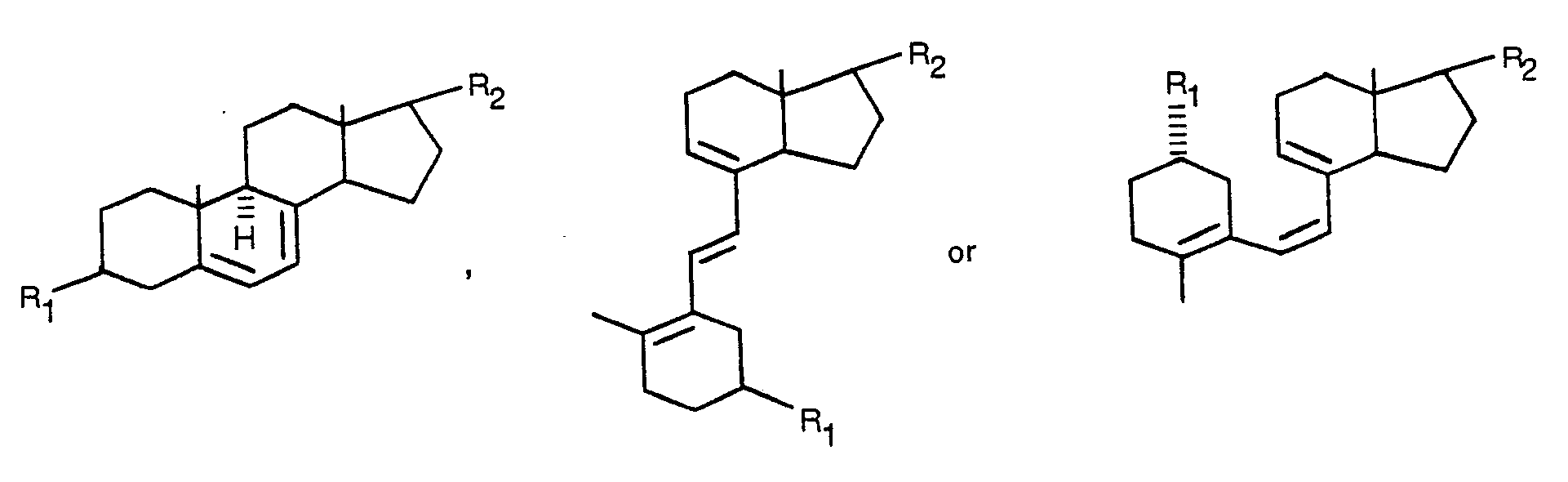
wherein R, is a hydrogen atom; an etherified, non-etherified, esterified or non-esterified hydroxy group; or a ketalized or non-ketalized oxo group; and R2 is a branched or non-branched, saturated or unsaturated hydrocarbon chain having at most 10 carbon atoms which, if desired, is substituted with one or more fluorine atoms, etherified, non-etherified, esterified or non-esterified hydroxy groups, and/or ketalized or non-ketalized oxo groups.
wherein R, is a hydrogen atom; an etherified, non-etherified, esterified or non-esterified hydroxy group; or a ketalized or non-ketalized oxo group; and R2 is a branched or non-branched, saturated or unsaturated hydrocarbon chain having at most 10 carbon atoms which, if desired, is substituted with one or more fluorine atoms, etherified, non-etherified, esterified or non-esterified hydroxy groups, and/or ketalized or non-ketalized oxo groups.
4. A method as claimed in Claim 3, characterized in that the starting steroid is ergosterol,
9α,10β-3,20- bis(ethylenedioxy)-5,7-pregnadiene or 7-dehydrocholesterol.
5. A method as claimed in Claim 3, characterized in that the starting steroid is previtamin
D3 or 6Z-9,10- seco-3,20-bis(ethylenedioxy)-5(10),6,8-pregnatriene.
6. A method as claimed in Claim 3, characterized in that the starting steroid is tachysterol3 or 6E-9,10- seco-3,20-bis(ethylenedioxy)-5(10),6,8-pregnatriene.
1. Verfahren zum Herstellen von 9ß,10a-5,7-Diensteroiden durch Bestrahlen der entsprechenden
9a,10ß-Steroide oder 9,10-Secosteroide mit gefiltertem UV-Licht, dadurch gekennzeichnet,
daß die Bestrahlung mit einer Antimonlampe durchgeführt wird.
2. Verfahren wie in Anspruch 1 beansprucht, dadurch gekennzeichnet, daß vor dem Bestrahlen
mit dem Licht einer Antimonlampe das Ausgangssteroid mit einer herkömmlichen UV-Strahlung
erzeugenden Lichtquelle bestrahlt wird.
3. Verfahren wie in Anspruch 1 oder 2 beansprucht, dadurch gekennzeichnet, daß das
Ausgangssteroid eine Verbindung der allgemeinen Formel
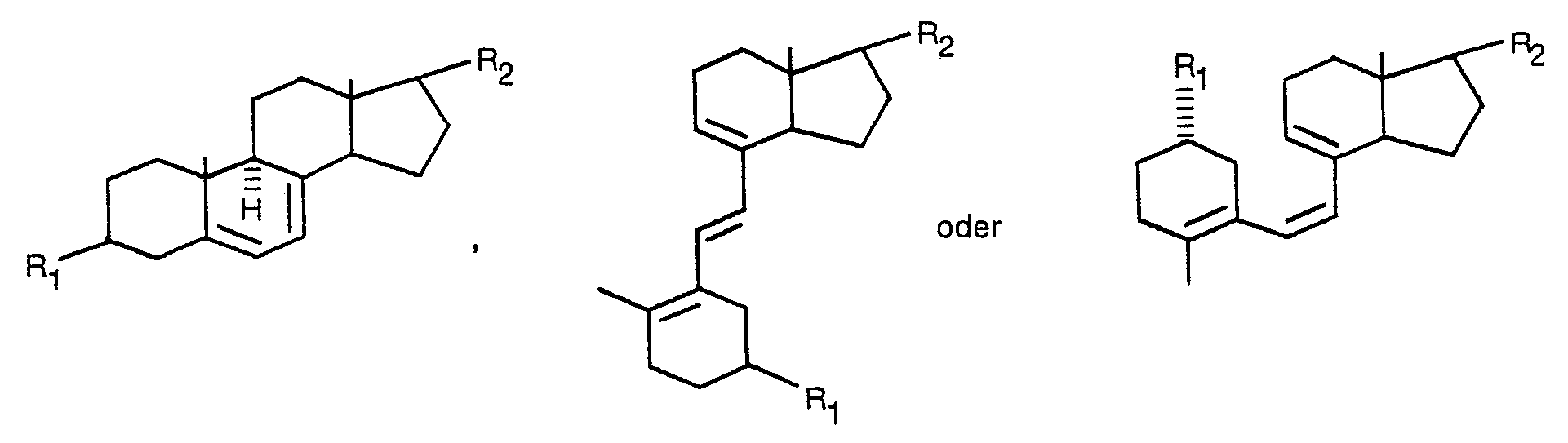
ist, worin R, ein Wasserstoffatom; eine verätherte, nicht-verätherte, veresterte oder nicht-veresterte Hydroxygruppe oder eine ketalisierte oder nicht-ketalisierte Oxogruppe bedeutet und R2 eine verzweigte oder unverzweigte, gesättigte oder ungesättigte Kohlenwasserstoffkette mit höchstens 10 C-Atomen ist, die, wenn gewünscht, mit einem oder mehreren Fluoratomen, verätherten, nicht-verätherten, veresterten oder nicht-veresterten Hydroxygruppen und/oder ketalisierten oder nicht-ketalisierten Oxogruppen substituiert ist.
ist, worin R, ein Wasserstoffatom; eine verätherte, nicht-verätherte, veresterte oder nicht-veresterte Hydroxygruppe oder eine ketalisierte oder nicht-ketalisierte Oxogruppe bedeutet und R2 eine verzweigte oder unverzweigte, gesättigte oder ungesättigte Kohlenwasserstoffkette mit höchstens 10 C-Atomen ist, die, wenn gewünscht, mit einem oder mehreren Fluoratomen, verätherten, nicht-verätherten, veresterten oder nicht-veresterten Hydroxygruppen und/oder ketalisierten oder nicht-ketalisierten Oxogruppen substituiert ist.
4. Verfahren wie in Anspruch 3 beansprucht, dadurch gekennzeichnet, daß das Ausgangssteroid
Ergosterin, 9α,10β-3,20-Bis(äthylendioxy)-5,7-pregnadien oder 7-Dehydrocholesterin
ist.
5. Verfahren wie in Anspruch 3 beansprucht, dadurch gekennzeichnet, daß das Ausgangssteroid
Prävitamin D3 oder 6Z-9,10-Seco-3,20-bis(äthylendioxy)-5(10),6,8-pregnatrien ist.
6. Verfahren wie in Anspruch 3 beansprucht, dadurch gekennzeichnet, daß das Ausgangssteroid
Tachysterol3 oder 6E-9,10-Seco-3,20-bis(äthylendioxy)-5(10),6,8-pregnatrien ist.
1. Procédé de préparation de stéroïdes 9-beta,10-alpha-5,7-diéniques, par irradiation
des 9-alpha,10- beta-stéroïdes ou des 9,10-secostéroïdes correspondants par de la
lumière ultra-violette filtrée, caractérisé en ce que l'irradiation est réalisée à
l'aide d'une lampe à antimoine.
2. Procédé tel que revendiqué à la revendication 1, caractérisé en ce qu'avant l'irradiation
par la lumière d'une lampe à antimoine, le stéroide de départ est irradié par une
source de lumière classique produisant un rayonnement ultra-violet.
3. Procédé tel que revendiqué à la revendication 1 ou 2, caractérisé en ce que le
stéroïde de départ est un composé de formule générale:
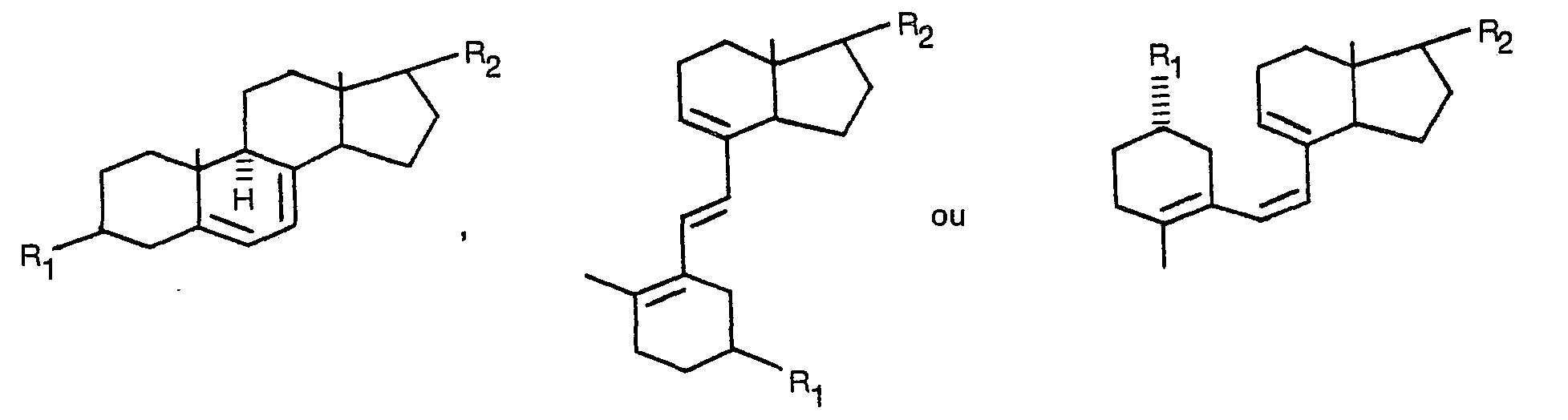
dans laquelle R1 est un atome d'hydrogène; un groupe hydroxy éthérifié, non éthérifié, estérifié ou non estérifié; ou un groupe carbonyle cétalisé ou non cétalisé; et R2 est une chaine hydrocarbonée ramifiée ou non ramifiée, saturée ou insaturée ayant au maximum 10 atomes de carbone et qui, si on le désire, est substituée par un ou plusieurs atomes de fluor, groupes hydroxy éthérifiés, non éthérifiés, estérifiés ou non estérifiés et/ou groupes carbonyle cétalisés ou non cétalisé.
dans laquelle R1 est un atome d'hydrogène; un groupe hydroxy éthérifié, non éthérifié, estérifié ou non estérifié; ou un groupe carbonyle cétalisé ou non cétalisé; et R2 est une chaine hydrocarbonée ramifiée ou non ramifiée, saturée ou insaturée ayant au maximum 10 atomes de carbone et qui, si on le désire, est substituée par un ou plusieurs atomes de fluor, groupes hydroxy éthérifiés, non éthérifiés, estérifiés ou non estérifiés et/ou groupes carbonyle cétalisés ou non cétalisé.
4. Procédé tel que revendiqué à la revendication 3, caractérisé en ce que le stéroïde
de départ est l'ergostérol, le 9-alpha,10-beta,3,20-bis(éthylènedioxy)-5,7-prégnadiène
ou le 7-déhydrocholestérol.
5. Procédé tel que revendiqué à la revendication 3, caractérisé en ce que le stéroïde
de départ est la prévitamine D3 ou le 6Z-9,10-seco-3,20-bis(éthylènedioxy)-5(10),6,8-prégnatriène.
6. Procédé tel que revendiqué à la revendication 3, caractérisé en ce que le stéroide
de départ est le tachystérol3 ou le 6E-9,10-seco-3,20-bis(éthylènedioxy-5(10),6,8-prégnatriène.