|
(11) | EP 0 258 021 A1 |

| (12) | EUROPEAN PATENT APPLICATION |
|
|
|
|
|||||||||||||||||||||||||||
| (54) | Method of inhibiting the corrosion of copper in aqueous systems |
| (57) A method of providing a durable, corrosion inhibiting film on the surface of copper
or copper-containing metal in contact with a dynamic, aggressive aqueous system having
a pH substantially neutral to alkaline which comprises adding in a non-continuous
manner a sufficient amount for the purpose of an alkyl benzotriazole having the formula:
wherein R is a C₃ to C₆ linear alkyl, and permitting contact of the benzotriazole for a time sufficient to provide the film and thereafter discontinuing the feed of the benzotriazole and permitting any residual benzotriazole in the aqueous system to deplete. |
[0001] The present application relates to the production of a corrosion inhibiting film on the surface of copper or copper-containing parts in contact with a dynamic, aggressive aqueous system.
[0002] In many industrial processes, undesirable excess heat is removed by the use of heat exchangers in which water is used as the heat exchange fluid. Copper and copper-bearing alloys are often used in the fabrication of such heat exchangers, as well as in other parts in contact with the cooling water, such as, for example, pump impellers, stators, and valve parts. The cooling fluid is often corrosive towards these metal parts by virtue of the cooling fluid containing aggressive ions and by the intentional introduction of oxidizing systances for biological control. The consequences of such corrosion are the loss of metal from the equipment, leading to failure or requiring expensive maintenance; creation of insoluble corrosion product films on the heat exchange surfaces, leading to decreased heat transfer and subsequent loss of productivity; and discharge of copper ions which can then "plate out" on less noble metal surfaces and cause severe galvanic corrosion, a particularly insidious form of corrosion. Also, since copper is a toxic substance, its discharge to the environment is undesirable. Prevention or at least minimization of such discharge is a great problem in view of increasingly stringent public attitudes and legislation relating to pollution of the environment.
[0003] It is common practice to introduce corrosion inhibitors into the cooling water. These materials interact with the metal to directly produce a film which is resistant to corrosion, or to indirectly promote formation of protective films by activating the metal surface so as to form stable oxides or other insoluble salts. However, such films are not completely stable, but rather are constantly degrading under the influence of the aggressive conditions in the cooling water. Because of this effect, a constant supply of corrosion inhibiting substances, sufficient to the purpose, must be maintained in the cooling water. But because many cooling systems are open, a constant depletion of these corrosion inhibiting substances occurs, requiring a continuous addition of fresh corrosion inhibiting substances so as to maintain, within defined limits, a concentration of such corrosion inhibiting substances sufficient for the purpose of maintaining good corrosion inhibition. The need to constantly replace the corrosion inhibiting substances leads to increased costs of operation, and often requires expensive equipment to monitor and regulate the addition of these substances.
[0004] Another undesirable feature of the continuous feed requirements of these inhibitors is the continuous discharge of these inhibitor materials into the environment. Since many of these corrosion inhibiting substances have measurable toxicities for various aquatic species, their continuous discharge presents an additional and indeed chronic hazard to the environment. The benzotriazoles are indeed a problem in this regard.
[0005] In the treatment of copper-bearing metallurgical materials an additional complication does, however, arise. Unlike the corrosion products of ferrous metals, which quickly form insoluble oxides which will not react further, the corrosion products of copper-bearing metallurgical materials, namely cupric and cuprous ions, remain soluble and are reactive towards the inhibitors specific for such metals. As a result, the copper-specific inhibitors are further depleted by deactivation. Under certain circumstances, such as, for example, acid spills, process leaks, overfeeds of oxidizing biocides, or inadvertent loss of inhibitor feed, the corrosion rate of the copper-bearing metallurgical materials can increase to such an extent that all the remaining inhibitor is depleted by deactivation. Unless this condition is recognized and specific recovery procedures are instituted, it is clear that no useful effect of additional maintenance dosages of the inhibitor will be obtained since the inhibitor will be deactivated at a rate equal to its addition rate.
[0006] The use of substituted benzotriazoles as corrosion inhibitors is known. US-A- 4 060 491 describes the use of 5-alkylbenzotriazoles in lubricants for the reduction of wear of steel surfaces. In US-A- 4 519 928, it is disclosed that N-t-alkylated benzotriazoles are useful for imparting oxidation and corrosion resistance to oleaginous lubricant compositions. GB-A- 1 065 995 teaches that 5-alkyl substituted benzotriazoles are effective in reducing corrosion or tarnish of copper items specifically in glycolic solvents or in lubricants, or to resist tarnishing in the presence of atmospheric sulphides. The use of substituted benzotriazoles as metal inactivators in detergent compositions is described in US-A- 2 618 606. Another ferrous metal corrosion inhibitor is disclosed in US-A- 3 895 170, which particularly describes 1-hydroxy-4(5) substituted benzotriazoles.
[0007] In US-A- 4 406 811, there is described the combination of benzotriazoles or tolyltriazole with other components to form a multimetal corrosion inhibitor for aqueous systems.
[0008] JP- A- 56-142873 relates specifically to improving the dissolution rate of benzotriazoles and discloses for such purpose a reaction product of alkylbenzotriazoles and phosphonic acids for use in aqueous systems in concentrations of 10-5000 ppm. JP- A - 57-152476 relates to the combination of benzotriazoles and cyclic amines for inhibiting metallic corrosion in engine cooling systems, industrial heat exchangers, brake fluids, cutting oils, and glycolic oils.
[0009] However, the above described prior art which can be considered to relate to the inhibition of corrosion of copper-bearing metals in aqueous systems, all require the constant or continuing presence of the inhibitor in the aqueous medium. It is clear from the examples provided that the inhibitor must be continuously present in the aqueous phase in order to maintain adequate protection. All of the examples cited fail to address the method of inhibiting corrosion by the formation of a stable and durable inhibiting film which does not require a maintenance level of inhibitor in the aqueous medium which, as will be more particularly indicated hereinbelow, is a solution of a problem achieved by the present invention. Furthermore the prior art does not address itself to the application of such a method of inhibiting corrosion in a dynamic, aggressive aqueous system.
[0010] Thus, by means of the present invention, it is possible to provide a means of protecting copper-bearing metallurgical materials in dynamic, aggressive aqueous systems, particularly open aqueous water cooling systems for example open recirculating water systems, from corrosion so as to overcome the deficiencies or problems of the existing technology, namely: the need for expensive and complicated feed and monitoring equipment, the susceptibility of systems so treated to upset conditions, and the discharge of toxic copper and corrosion inhibiting substances into the environment.
[0011] According to the present invention there is provided a method of providing a durable, corrosion inhibiting film on the surface of copper or copper-containing metal in contact with a dynamic, aggressive aqueous system having a pH substantially neutral to alkaline which comprises adding in a non-continuous manner a sufficient amount for the purpose of an alkyl benzotriazole having the formula:
wherein R is a C₃ to C₆ linear alkyl, and permitting contact of the benzotriazole for a time sufficient to provide the film and thereafter discontinuing the feed of the benzotriazole and permitting any residual benzotriazole in the aqueous system to deplete.
[0012] It has been found that when copper-bearing metals are treated with compounds of the formula:
where R is a C₃ to C₆ and preferably C₃ or C₄, and especially C₄, linear alkyl, the rate of copper corrosion can decrease as much as 10 to 100-fold over the decrease of copper corrosion obtained when R is H, CH₃, C₂H₅ or CnH2n+1, where n is an integer greater than six or obtained when R is branched hydrocarbon, when applied on an equal weight basis. This achievement is an unexpected and novel finding, since the increase in molecular weight upon increasing the hydrocarbon chain length will result in a lower overall concentration of the inhibitor when applied on an equal weight basis.
[0013] Also, it has been found that the resistance to breakdown of inhibitive films formed from molecules of the compounds having formula I under dynamic conditions of circulation, heat, pH fluctuations and introduction of oxidizing biocides is enhanced. Thus the present invention provides durable, long lasting chemical resistant, pH tolerant, corrosion inhibiting films. The aqueous system being treated is usually substantially free of glycols.
[0014] The present invention provides a means for overcoming the objectionable deficiencies of commonly employed corrosion inhibitors for copper and copper-bearing alloys in service in aqueous, open cooling systems. It will be appreciated that to be able to provide treatment intermittently and be assured that protection is certain even in the absence of treatment for an extended period of time is the goal of all water treatment chemists. The use of the particular alkyl benzotriazoles used in the present invention, unlike other alkyl benzotriazoles commonly used in cooling water, effectively provides a film on the copper surface which is durable and resistant to many attacking mechanisms generally encountered in cooling water systems. In accordance with the present invention it is not necessary to have a residuum of the (previously used) benzotriazoles present in the medium to ensure any fractured film is repaired.
[0015] Because of the long-lasting and durable nature of the protective film thus formed, the application of the compounds used in the present invention need only be carried out on an intermittent basis. The frequency of these additions will be dictated by operating conditions and economy of usage. Thus, the alkylbenzotriazole can be added intermittently, and preferably the time frames of the intermittent feed are predicated upon the durability of the film formed.
[0016] In accordance with one embodiment, the present invention provides a method of treating copper-bearing metal components of the system, preferably an aqueous open cooling system, for the inhibition of corrosion by adding to the cooling water the particular alkyl benzotriazoles in an amount of from 0.1 to 100 parts by weight for every 1,000,000 parts by weight of water depending on the degree of corrosiveness of the water (parts per million). Preferably, an amount of from 1 to 50 parts per million, and especially 3 to 5 parts per million, may be added.
[0017] The addition of the benzotriazoles in the method of the present invention, which differs from the constant or continuing presence of the inhibitor in the aqueous medium according to the prior art, may be described as being on an "intermittent basis" or being "shot" feeding of the particular benzotriazoles. This shot feeding in conjunction with the restrictive selection of the benzotriazoles to those particular compounds in which the R group is linear and has 3 to 6 carbon atoms is of great importance, since it is the combination of both features which provides the solution to the problems of the prior art by means of the present invention.
[0018] In the interval between additions, no detectable levels of the inhibitive substance are present in the circulating cooling fluid, having been removed by blowdown. The inhibitive film thus formed has been shown to be present and fully effective for a period exceeding 30 days after the removal of the inhibitor from the circulating water. In addition, subjecting the system to pH depression and overfeeds of oxidizing biocides does not lead to film disruption or loss of inhibitory power. By contrast, inhibitive films formed by benzotriazole itself and by tolyltriazole (R = H or CH₃) are completely removed within 50 to 100 hours after treatment, and even more rapid loss of inhibitory power is observed if pH depressions or oxidizing biocide overfeeds are experienced.
[0019] Whereas alkylbenzotriazoles have been known to provide corrosion inhibition when provided in a continuing manner in an aqueous medium having copper-containing items therein, there has been the problem (as referred to hereinabove) of the inhibitor in the medium and it leading to environmental difficulties. The selection of the particular alkylbenzotriazoles in accordance with the present invention leads to unexpected advantages. This selection in conjunction with the shot feeding provides corrosion inhibiting films of unpredictable unusual film longevity properties and overcomes substantially the environmental difficulties.
[0020] It has been found that alkylbenzotriazoles in which the R (alkyl) group is branches and/or has a number of carbon atoms outside the selected range of 3 to 6 do not provide the advantages of the present invention. At the lower end of the range, if R is hydrogen (benzotriazole itself), methyl (tolyltriazole) or ethyl (ethyl benzotriazole) it is not possible to use such compounds in a shot feeding mode and achieve corrosion inhibition coupled with solution of the environmental problem of continuing presence of the inhibitor. It has been particularly found that use of n-butylbenzotriazole (R is 4 carbons) is superior to tolyltriazole (R is 1 carbon) in achieving a longer-lasting corrosion inhibiting film together, of course, with reduction of the environmental problem arising from addition to the medium of the benzotriazole to maintain corrosion inhibition (and its consequential transfer to the environment). However, tests with ethyl benzotriazole, by instantaneous electro-chemical corrosion rate measurements and the existence of patches of corroded metal on the heat transfer surfaces of a test specimen, under dynamic conditions, show that a satisfactory and stable film is not achieved.
[0021] Similar differences are found at the upper end of the range for example if one attempts to use the known octylbenzotriazole. Indeed it has been surprisingly found that although 5-octylbenzotriazole appears to work better than 5-n-propylbenzotriazole in a situation where the benzotriazole is continuously added to the aqeuous system, the reverse is true when operating in the shot feeding, environment-enhancing, dynamic manner of the present invention, that is the 5-n-propyl compound is superior to the 5-octyl compound. It would appear that the 5-octyl compound probably cannot form a corrosion inhibiting film as well as the 5-propyl compound in the conditions associated with a dynamic aqueous cooling system.
[0022] In particular it has been found that a 5 ppm active simple dose of 5-n-propylbenzotriazole provided complete and continuous corrosion inhibition of copper alloys in recirculator tests for the 14 day duration of the test whilst 5-octylbenzotriazole failed to provide significant protection under the same conditions. In contrast, in static tests where a constant 3 ppm level of inhibitor was present, 5-octylbenzotriazole was found to be slightly superior to 5-n-propylbenzotriazole. Therefore, the inability of 5-octylbenzotriazole to perform adequately in dynamic (recirculator) conditions cannot be due to lack of copper inhibition, so that the behaviour of 5-n-propylbenzotriazole as compared with 5-octylbenzotriazole would be unobvious in view of the static tests.
[0023] There is clearly no predictability of the action of alkyl benzotriazoles in water treatment. When the alkyl group contains 1 carbon atom (tolylbenzotriazole) there is no rapid formation of a stable film as in the present invention. It has also been found that such lack of suitable film formation arises when the alkyl group contains 2 carbon atoms (ethylbenzotriazole) so that it does not have any advantage over tolyltriazole. However, when the alkyl group contains 3 carbon atoms (n-propyltriazole) totally unexpected satisfactory results have been found. In contrast thereto, octyltriazole (alkyl of 8 carbon atoms) has been found not to perform satisfactorily under dynamic or water flow conditions.
[0024] It has been found that n-propylbenzotriazole provided similar satisfactory results to those achieved when the alkyl group is a linear group containing 4 carbon atoms (n-butylbenzotriazole). However, and illustrating unpredictability, it has been found that even when the alkyl group contains 4 carbon atoms but is branched, particularly t-butylbenzotriazole, vastly inferior results compared with n-butylbenzotriazole were achieved and indeed t-butylbenzotriazole is unsatisfactory for use in the method of the present invention.
[0025] It is also of importance that the method of the present invention is performed at a pH of substantially neutral to alkaline. It has been found that the benzotriazoles behave totally differently in such a pH range than they do in acidic conditions. However, whilst a pH depression can upset the corrosion inhibition of benzotriazoles as employed in the prior art, it has been found that the benzotriazoles used in the present invention continue to perform adequately after being subjected to such upset conditions.
[0026] The present invention will now be more particularly described with reference to, but is in no manner limited to, the following Examples and the accompanying drawings.
Example 1
[0027] A test water shown in Table A was circulated at 213 cm/sec (7 feet per second) through a test loop in which test coupons of admiralty brass (ADM) and 90/10 copper nickel (90/10 or Cu/Ni) were installed. Additionally, electrochemical corrosion rate probes of admiralty brass and 90/10 copper nickel were placed in the test loop. A heat transfer tube of 90/10 copper nickel was also present. That tube was subjected to a heat load of 25240W m-2 (8000 BTU/ft²-hr).
[0028] To the sump of the test unit was added a quantity of inhibitor. A fresh supply of the uninhibited test water was fed to the system, with continuous overflow, so as to replace one system volume every 24 hours. After three days, no detectable level of inhibitor was found in the recirculating water. The results of this testing are shown in Table I.
[0029] As is evident from the data, the protection afforded by tolyltriazole completely degraded within three days of the depletion of the inhibitor. By contrast, the protection afforded by the n-butylbenzotriazole inhibitor in accordance with the present invention was not diminished after 20 days.
Example 2
[0030] The test procedure of Example 1 was repeated, except that, commencing 24 hours after the addition of the inhibitor, sodium hypochlorite was added to the system so as to produce a free residuum of 1 ppm of chlorine. The chlorine dosage was repeated every 24 hours.
[0031] From the results shown in Table II, it is seen that the product of this invention has a significant resistance to chlorination, whereas the comparison example has none.
[0032] Thus, tolyltriazole failed between 41 and 65 hours whereas n-butylbenzotriazole was effective for a significantly longer period of time.
Example 3
[0033] In order to examine the resistance to low pH conditions, a test electrochemical cell was used. A copper electrode pretreated in 100 ppm of inhibitor was then placed in uninhibited test solution consisting of 0.1M Na₂SO₄, adjusted to pH 7. The electrode was then subjected to a triangular potential sweep waveform through the anodic and cathodic regions of the Cu⁰/Cu+2 reaction of the electrode. The pH was progressively lowered, and the sweep was repeated at each value of pH. Table III tabulates the cathodic peak currents, which are proportional to the degree of anodic dissolution of the test electrode.
[0034] Thus tolylbenzotriazole is considerably less effective than n-butylbenzotriazole under low pH conditions.
[0035] The following Examples 4 to 7 make reference to test results which are shown in Figs. 1 to 5 constituting the accompanying drawings.
Example 4
[0036] Tests were conducted on an industrial cooling system. The characteristics of the system are shown in Table B and the analysis of the cooling water in Table C.
[0037] A first test was conducted with a continuous feed of 3 ppm of tolyltriazole. The corrosion rate changed from 7.62x10⁻⁴ to 2.54x10⁻³ mm/year (0.03 to 0.1 mpy-mils per year). The feed of tolyltriazole was suspended and the residual amount of it allowed to deplete. The corrosion rate immediately began to increase to about 7.62x10⁻³ mm/y (0.3 mpy). Copper levels in the water remained fairly level at about 120 ppb (parts per billion).
[0038] A second test was conducted with single or shot feed of 3 ppm of tolyltriazole. The results are shown in Figures 1 and 2 wherein:-
Fig. 1 is a graph of the corrosion rate (on the vertical axis) versus the time (in the horizontal axis), and
Fig. 2 is a graph of the copper ion measured at the system discharge with the copper concentration on the vertical axis and the time on the horizontal axis.
[0039] With reference to the vertical axis in Fig. 1 (and also in Figs. 3, 5 and 6 referred to hereinbelow), the corrosion rate numbers on the vertical axis are in mils per year and their metric equivalents are:-
[0040] In this second test enough tolyltriazole was fed to the system to provide 3ppm. The corrosion rate fell to 3.81x10⁻³ mm/y (0.15 mpy) and remained there for about 30 hours. From that point, the corrosion rate rose steadily over the next 90 hours to a level of 1.02x10⁻² mm/y (0.4 mpy). At that point, another 3 ppm dose of tolyltriazole was added. The corrosion rate fell to 3.81x10⁻³ mm/y (0.15 mpy) and remained there for about 20 hours. Over the next 80 hours the corrosion rate rose steadily to about 1.02x10⁻² mm/y (about 0.4 mpy). This behaviour demonstrated the reproductibility of the data, and also showed that the protection afforded by tolyltriazole begins to break down as soon as the concentration depletes to near zero.
[0041] Referring to Figure 1, it will be seen that after the feed of tolyltriazole the corrosion rate remains fairly steady for a period of 24 hours. This period is the amount of time it takes to fully deplete - by blowdown of the system. After that time, the corrosion rate steadily increases due to the progressive failure of the protective film. This result clearly demonstrates the tolyltriazole requires a reservoir of the inhibitor in the recirculating water in order to provide continuing protection. The continuing substantial presence of copper (as measured in the system discharge) is shown in Fig.2.
[0042] A third test was conducted with single or shot feed of n-butylbenzotriazole. The results are shown in Figures 3 and 4 wherein:-
Fig.3 is a graph of corrosion rate (vertical axis) versus time (horizontal axis), and
Fig.4 is a graph of copper concentration (vertical axis) measured at the system discharge versus time (horizontal axis).
[0043] In this third test enough n-butylbenzotriazole was fed to the system to provide 5 ppm. The corrosion rate fell from 1.37 x 10⁻² mm/y (0.54 mpy) at the time of feed to 2.54 x 10⁻⁴ mm/y (0.01 mpy). The corrosion rate remained at that level for the next 500 hours, showing a slight increase to only about 1.27 x 10⁻³ mm/y (about 0.05 mpy) during that period. Even after a total elapsed time from the point of feed of 1078 hours, the corrosion rate was still below 3.30 x 10⁻³ (0.13 mpy). During that period, the copper concentration fell from 230 ppb just prior to feed of butylbenzotriazole, to 30 ppb, and remained there for the next 550 hours. After a total elapsed time of 1078 hours the copper concentration was still below 80 ppb. This level was lower than that achieved during continuous feed of tolyltriazole.
[0044] It will be noted that in these tests, 5ppm of butylbenzotriazole vs 3ppm of tolyltriazole was used. Such amounts were dictated by the lower solubility of butylbenzotriazole in water to yield a lower level of active ingredients. This necessity was shown in laboratory studies where the effect of tolyltriazole plateaued at 3ppm, while that of butylbenzotriazole plateaued at 5ppm.
[0045] With reference to Figures 1 and 3 it should be noted that they represent tests performed on a dynamic industrial cooling system. Any "blips" in the graphs arise from the operation of the testing apparatus and the production of results therefrom on a continuous basis. With respect to continuity of testing, the left-hand portion of the graph in Figure 3 (up to the point at which it is indicated the product - n-butylbenzotriazole - is fed) represent a continuation of the testing particularly illustrated in Figure 1.
[0046] Referring to Figure 3, it will be seen that after the addition of butylbenzotriazole the corrosion rate decreases sharply due to the establishment of a protective film. The treatment depletes by blowdown so that after about 24 hours, there is no inhibitor left in the recirculating water. The corrosion rates remain low and constant for the next 300 hours, showing the durable nature of the protective film. Thereafter, although the corrosion rates begin to increase, due to the progressive failure of the film under the dynamic conditions, the rate of increase is substantially lower than that for tolyltriazole. Referring to Figure 1, the corrosion rate increased from 3.81 x 10⁻³ mm/y (0.15 mpy) at the point of onset of film failure to 1.02 x 10⁻² mm/y (0.4 mpy) within 75 hours, for a rate of increase in the corrosion rate of 7.62 x 10⁻⁵ mm/year/hour (0.003 mpy per hour). For butylbenzotriazole (Figure 3), the onset of film failure is at about 300 hours total elapsed time. The corrosion rate increases from 5.08 x 10⁻⁴ mm/y to 2.79 x 10⁻³ mm/y (0.02 mpy to 0.11 mpy) over a period of 250 more hours. Thus the rate of increase in the corrosion rate is 1.02 x 10⁻⁵ mm/year/hour (0.004 mpy per hour), n-butylbenzotriazole achieves an improvement over the behaviour of tolyltriazole of the order of 7 to 10-fold. However, the most important feature is the fact that unlike tolyltriazole, butylbenzotriazole functions even in the absence of a reservoir of inhibitor in the recirculating water.
[0047] These tests show that the inhibitive film produced by tolyltriazole is not resistant to breakdown under dynamic conditions. Positive protection is therefore dependent upon maintaining a continuous residual of tolyltriazole in solution, as is shown by the continuous feed results. By contrast, after more than 1000 hours after the complete depletion of the butylbenzotriazole residuum, the protection afforded is still better than or equal to that provided by the continuous feed of tolyltriazole.
[0048] During the test period for butylbenzotriazole a pH depression occurred due to a stuck valve on the acid feed line to the cooling tower basin. The pH was depressed to below 4 for a period of about 30 hours before control could be restored. This upset occurred at 780 hours elapsed time. The corrosion rate of 90/10 cupronickel remained at 2.03 x 10⁻³ mm/y (0.08 mpy) before and after the upset. This demonstrates the chemical resistance of the film to low pH conditions, and confirms the laboratory studies set forth in Example 3 hereinabove.
Example 5
[0049] Further tests were conducted on an industrial cooling system. The characteristics of the system are shown in Table D and the analysis of the cooling water in Table E.
[0050] A fourth test was conducted with a continuous feed of 2 ppm of tolyltriazole. The corrosion rate averaged 7.62 x 10⁻³ to 1.02 x 10⁻² mm/y (0.3 to 0.4 mpy), with copper levels in the water of 300 to 400 ppb. The system was chlorinated once every other day to a free residuum of 0.5 to 1 ppm.
[0051] A fifth test was conducted with a single or shot feed of 5 ppm of butylbenzotriazole. In this fifth test, enough n-butylbenzotriazole was fed to the system to provide 5ppm of active inhibitor. This amount was allowed to deplete by blowdown. The corrosion rate fell to 7.62 x 10⁻⁴ mm/y (0.03 mpy), and remained there for the next 5 weeks. Copper in the recirculating water was measured to be 50 ppb or below during that period.
[0052] A second application of butylbenzotriazole was fed when the corrosion rate was observed to reach 7.62 x 10⁻³ (0.3 mpy). This dose was sufficient to provide 4 ppm of active inhibitor. Corrosion rates fell to 5.08 x 10⁻⁴ mm/y (0.02 mpy). After 34 days the corrosion rate had risen to 3.30 x 10⁻³ mm/y (0.13 mpy), less than half of that realized from the continuous feed of 2 ppm of tolyltriazole. Copper levels were measured to be 150 ppb, about half of that measured during the tolyltriazole treatment period. After 45 days the corrosion rate was still only 5.08 x 10⁻³ mm/y (0.2 mpy).
[0053] These tests show that the improvement in corrosion inhibition provided by butylbenzotriazole over tolyltriazole observed in the first trial described in Example 4 were duplicated or exceeded in the trial described in this Example 5, where the corrosivity of the recirculating water was greater, as measured by the differences in corrosion rate when the systems were being treated continuously with tolyltriazole. Also, the trial described in this Example 5 involved a more stringent chlorination program, demonstrating the chemical resistance of the butylbenzotriazole film.
Example 6
[0054] Further tests were conducted on an industrial cooling system. The characteristics of the system are shown in Table F and the analysis of the cooling water in Table G.
[0055] A sixth test was conducted with a continuous feed of tolyltriazole. However, in this test tolyltriazole was fed semi-continuously. The daily dosage of 4 ppm was divided into 4 doses of 1 ppm each, which were fed every 6 hours within a 1/2 hour period. The system was chlorinated every 12 hours to free residual of 1 to 2 ppm for one hour. The chlorinations were begun 1/2 hour after the completion of every other tolyltriazole addition. The corrosion rates averaged 2.03 x 10⁻³ mm/y (0.08 mpy), with spikes to 2.54 x 10⁻³ mm/y (1 mpy) during the chlorinations. Following termination of the feed of tolyltriazole the corrosion rate was observed to increase almost immediately. The corrosion rate was allowed to reach 5.08 x 10⁻³ mm/y (0.2 mpy) which occurred within 24 hours from termination of the feed. After two chlorination cycles the corrosion rate peaked above 0.05 mm/y (2 mpy) and stayed there. The actual level is not known since the range of the corrosion rate meter was exceeded.
[0056] A seventh test was conducted with a single or shot feed of 5 ppm of tolyltriazole. In this seventh test a single dose of 5 ppm active tolyltriazole was fed to the system and confirmed by analysis. The corrosion rates fell to 2.03 x 10⁻³ mm/y (0.08 mpy) and remained there for the next 30 or 40 hours. At that point they began to rise steadily, with spikes during chlorination, to a steady value of 0.015 mm/y (about 0.6 mpy), which appeared to be the freely corroding level for copper in this system. Copper levels in the water decreased to substantially 0 ppm after the feed of tolyltriazole, but climbed to over 100 ppb within 28 hours, peaking at about 140 ppb after 144 hours.
[0057] An eighth test was conducted with a single or shot feed of 5 ppm of butylbenzotriazole. In this seventh test, the corrosion rate fell from 0.15 mm/y to 1.27 x 10⁻³ mm/y, (0.6 mpy to 0.05 mpy) after the addition of 5 ppm of butylbenzotriazole. The corrosion rate remained at that level for the next 180 hours, when it began to increase steadily to a maximum of 0.015 to 0.20 mm/y (0.6 to 0.8 mpy) after about 300 hours total elapsed time. Copper levels in the water fell to 0 ppm, and remained there for the next 200 hours. The copper levels then rose steadily to maximum of 125 ppb after 260 hours total elapsed time.
[0058] These tests show the improved resistance to high levels of chlorination exhibited by butylbenzotriazole, and further confirm the fact that the tolyltriazole film does not persist after the depletion of the inhibitor in the recirculating water, and that by contrast, the film of butylbenzotriazole retains its effectiveness long after the depletion of the inhibitor in the recirculating water.
[0059] The comparison of all the tests in Examples 4 to 6 shows that butylbenzotriazole protects a wide range of copper alloys under a wide range of water conditions. The protection afforded by tolyltriazole is dependent upon the maintenance of a reservoir of inhibitor in the water phase to repair film breaks which occur rapidly due to the transitory nature of the film thus formed. Butylbenzotriazole is shown to provide long lasting protection in the absence of a reservoir of inhibitor in the recirculating water.
Example 7
[0060] The test procedure of Example 1 was repeated, utilizing, separately, ethylbenzotriazole, t-butylbenzotriazole and n-butylbenzotriazole. Utilizing such dynamic testing, the corrosion rate was plotted against time for each of the compounds and the results are shown in accompanying Figure 5.
[0061] The results show not only the continuing low corrosion rate achieved by using the straight 4 carbon atoms alkyl chain benzotriazole namely n-butylbenzotriazole but the much better results obtained not only in comparison with a benzotriazole having only 2 carbon atoms in the alkyl chain namely ethylbenzotriazole but also in comparison with the branched alkyl chain benzotriazole also of 4 carbon atoms namely t-benzotriazole.
Example 8
[0062] The test procedure of Example 1 was repeated, utilizing n-hexylbenzotriazole for both 90/10 cupronickel and admiralty brass. Utilizing such dynamic testing, the corrosion rate was plotted against time and the results are shown in Figure 6.
[0063] The upper trace represents the results for 90/10 cupronickel and the lower trace represents the results for admiralty brass during the period up to about 200 to 240 hours. However, about that time a cross-over occurs so that the results for 90/10 cupronickel then becomes the lower trace and the results for admiralty brass become the upper trace.
1. A method of providing a durable, corrosion inhibiting film on the surface of copper
or copper-containing metal in contact with a dynamic, aggressive aqueous system having
a pH substantially neutral to alkaline which comprises adding in a non-continuous
manner a sufficient amount for the purpose of an alkyl benzotriazole having the formula:
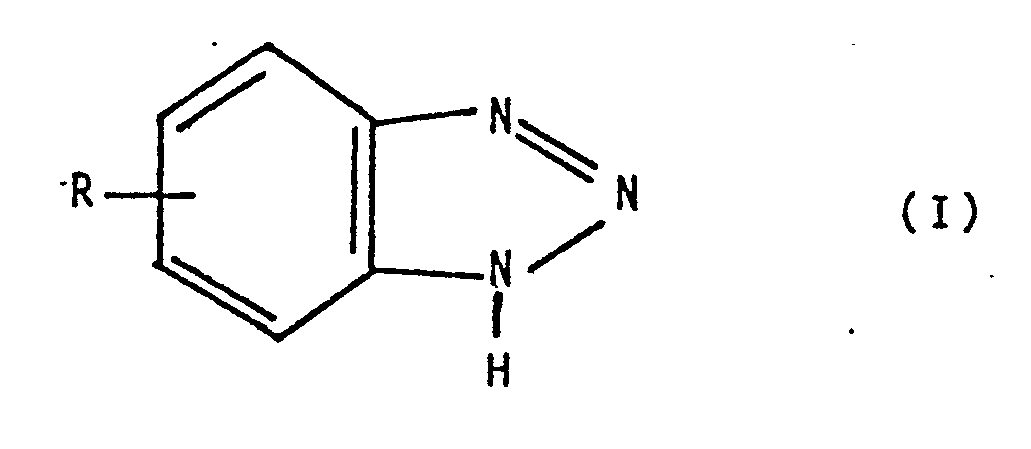
wherein R is a C₃ to C₆ linear alkyl, and permitting contact of the benzotriazole for a time sufficient to provide the film and thereafter discontinuing the feed of the benzotriazole and permitting any residual benzotriazole in the aqueous system to deplete.
wherein R is a C₃ to C₆ linear alkyl, and permitting contact of the benzotriazole for a time sufficient to provide the film and thereafter discontinuing the feed of the benzotriazole and permitting any residual benzotriazole in the aqueous system to deplete.
2. A method according to claim 1, wherein R is a C₃ or C₄ linear alkyl.
3. A method according to claim 1 or 2, in which R is n-butyl.
4. A method according to any of claims 1 to 3, wherein the alkyl benzotriazole is
employed in an amount of 0.1 to 100 ppm based on the weight of the water.
5. A method according to claim 4 wherein the alkylbenzotriazole is employed in an
amount of 1 to 50 ppm based on the weight of the water.
6. A method according to any of claims 1 to 5, wherein the alkylbenzotriazole is added
intermittently.
7. A method according to claim 6, wherein the time frames of the intermittent feed
are predicated upon the durability of the film formed.
8. A method according to any of claims 1 to 7, wherein the aqueous system is an aqueous
open cooling system.
9. A method according to claim 8, wherein the cooling water system is an open recirculating
water system.