|
(11) | EP 0 196 016 B1 |

| (12) | EUROPEAN PATENT SPECIFICATION |
|
|
| (54) |
3-nitropyridine-derivatives, process for their preparation and pharmaceutical composition containing them 3-Nitropyridinderivate, Verfahren zu deren Herstellung und diese enthaltende Arzneimittel Dérivés de nitro-3-pyridines, leur procédé de préparation et composition pharmaceutique les contenant |
|
|
|||||||||||||||||||||||||||||||
| Note: Within nine months from the publication of the mention of the grant of the European patent, any person may give notice to the European Patent Office of opposition to the European patent granted. Notice of opposition shall be filed in a written reasoned statement. It shall not be deemed to have been filed until the opposition fee has been paid. (Art. 99(1) European Patent Convention). |
Background of the Invention
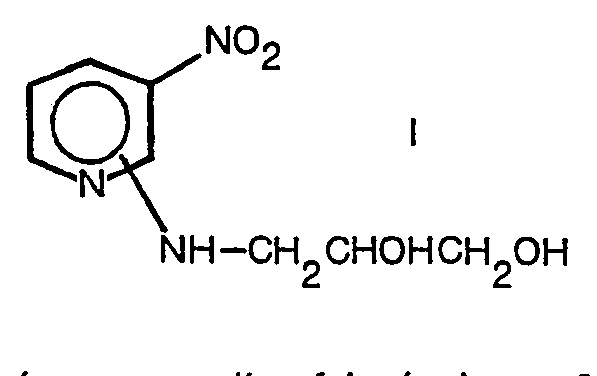
[0001] The present invention relates to two new substances which are 3-nitropyridine compounds having a 2,3-dihydroxy-1-propylamino substituent attached at the position 4 or 6 and salts of said compounds.
[0002] Said new compounds as well as a related compound which is already described as intermediate product in the prior art have the ability to enhance the therapeutic effect of radiation.
[0003] At the present time, certain other unrelated compounds are in experimental clinical use as radiation sensitizers. However, these compounds - for example, metronidazole and misonidazole - suffer from the drawback that they also cause neurotoxicity which limits their usefulness.
Description of the Prior Art
[0004] In the Journal of Medicinal Chemistry, vol. 16, no. 5, pages 520-524, 1973, there are described pyrido[3,2-g]pteridines. Said compounds, accordingly, have a ring system of three condensed rings, one of which is a pyridine ring and they are stated to have an antitumor activity. According to the reaction scheme outlined on page 521 of said publication the pyrido[3,2-g]pteridines are prepared by using as starting material the 2-chloro-3-nitropyridine which is reacted with an amine of formula
to yield the corresponding 2-amino-3-nitro-pyridine, which is thereafter reduced yielding a corresponding 2,3-diamino-pyridine which is submitted to further reactions in order to produce the desired final products. In table I there is mentioned the corresponding 2-amino-3-nitropyridine intermediate product in which the radical R of the amino group has the structure
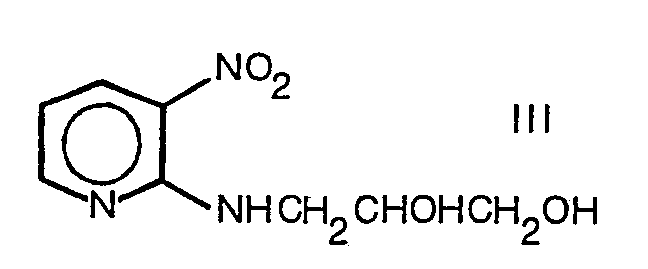
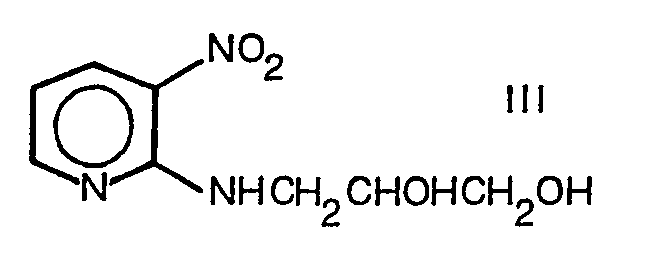
Said intermediate product, accordingly, corresponds to formula III
[0005] It was now unexpectedly found out that said prior art compound of formula III, as well as corresponding new compounds in which the stated amino substituent is not in the position 2, but attached at the position 4 or 6 of the pyridine nucleus have the activity of enhancing the therapeutic effect of radiation. Description of the Invention
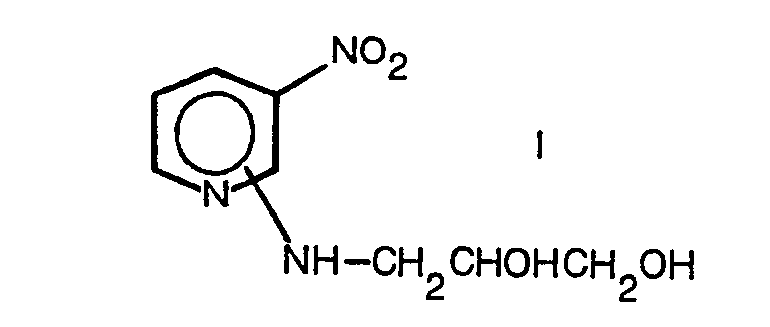
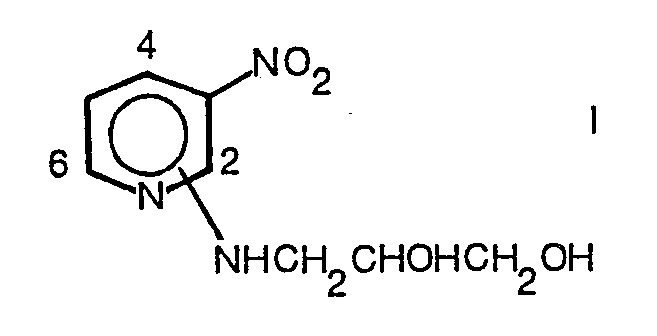
[0006] One subject of the present invention are new 3-nitropyridine compounds of formula I
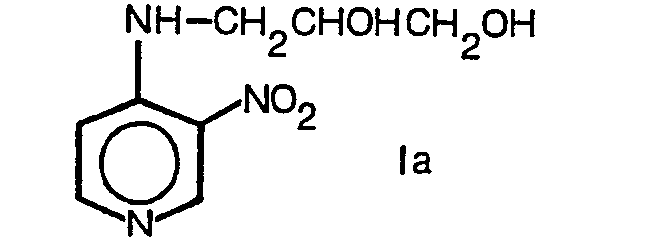
in which the -NHCH2CHOHCH20H group is attached at position 4 or 6 of the pyridine ring or salts of said compounds. One of the claimed compounds of formula I is the 4-(2,3-dihydroxy-1-propylamino)-3-nitro- pyridine which has the following formula la
[0007] A further object of the present invention is a process for the preparation of the 3-nitropyridine compounds of formula I
and said process is characterized in that a 3-nitropyridine, having in the position 4 or the position 6 a leaving group, is reacted with an amine of formula II
and the resulting product of formula I is isolated in the free form or as salt thereof.
[0008] According to a preferred embodiment of said process in the used starting material the leaving group is a halo atom, preferably a chlorine atom. The starting material, accordingly, is the corresponding chloro-3-nitropyridine of formula
wherein the chloro substituent is in the position 4 or 6. The reaction is preferably performed in a suitable solvent such as a lower aliphatic alcohol, or a polar aprotic solvent such as dimethyl-formamide, dimethylsulfoxide, or others such as tetrahydrofuran, glyme, diglyme, tetramethylurea, chloroform, or methylene chloride.
[0009] The treatment of the starting material with the amine of formula II is preferably performed in sufficient base to neutralize the hydrogen chloride formed. The reaction temperature is not critical and may vary from 0-100°C, preferably from about 0-25°C for a period of from 1-24 hours.
[0010] Suitable bases employed to neutralize the hydrogen chloride formed are tertiary amines such as triethylamine and pyridine. If desired, the neutralizing base may be supplied by using excess amine reactant. Inorganic bases such as alkali metal bicarbonates, carbonates and hydroxides may also be employed.
[0011] The product is recovered in substantially pure form by removal of solvent by evaporation under reduced pressure and the residue containing the product is chromatographed and crystallized from suitable solvents.
[0012] A further object of the present invention is a pharmaceutical composition for enhancing the therapeutic effect of radiation and said composition is characterized in that it contains as pharmaceutically effective ingredient an inventive compound of formula I or a pharmaceutically acceptable salt thereof.
[0013] It was furthermore found out that the corresponding prior art compound of formula III, in which the amino substituent of the stated formula is in the position 2 and not in the position 4 or 6, has as well the pharmaceutical activity of enhancing the therapeutic effect of radiation.
[0014] A further object of the present invention is therefore the use of the 2-(2,3-dihydroxy-1-propylamino)-3-nitropyridine of formula III or of a pharmaceutical salt thereof for the preparation of a pharmaceutical composition for enhancing the therapeutic effect of radiation.
[0015] Pharmaceutical compositions which contain as active ingredient the inventive compounds of formula I or the prior art compound of formula III or pharmaceutically acceptable salts of the compounds of formula I or III, can be used to treat human patients or domestic animals which are submitted to a radiation treatment of malignant diseases. Corresponding pharmaceutical compositions can be administered orally or intravenously.
[0016] The dosage in which said pharmaceutical compositions are employed depends on the radiation protocol for each individual patient. In protocols where the radiation dose is divided into a large number of fractions, the drug can be administered at intervals in the schedule and not necessarily with each radiation treatment. It should be noted that the compounds of the present invention are not intended for chronic administration. In general, the drug is administered from 10 minutes to 5 hours prior to the radiation treatment in a dosage amount of between 0.25 to about 4.0 grams per square meter of body surface.
[0017] The dosage range given is the effective dosage range and the decision as to the exact dosage used must be made by the administering physician based on his judgement of the patient's general physical condition. In determining the dose for the individual patient, the physician may begin with an initial dose of 0.25 g/square meter of body surface to determine how well the drug is tolerated and increase the dosage with each succeeding radiation treatment, observing the patient carefully for any drug side effect. The competition to be administered is an effective amount of the active compound and a pharmaceutical carrier for said active compound.
Example 1
4-(2,3-Dihydroxy-I-propylamino)-3-nitropyridine
[0018] A solution of 4-chloro-3-nitropyridine (1.1 g, 6.94 mmol) and 3-amino-1,2-propanediol (1.22 g, 13.4 mmol) in isopropanol (50 ml) was stirred at 20-25°C for 20 hours and then concentrated under reduced pressure. Flash chromatography of the residue over silica gel and elution with 10% MeOH-90% CHCI3 gave pure 4-(2,3-dihydroxy-1-propylamino)-3-nitropyridine (500 mg, 33.8%). An analytically pure sample, m.p. 131-35°C, was obtained upon recrystallization from MeOH-EtOAc-hexane.
Example 2
6-(2,3-Dihydroxy-1-propylamino)-3-nitropyridine
[0019] A solution of 6-chloro-3-nitropyridine (3.22 g, 20.3 mmol), 3-amino-1,2-propanediol (1.85 g, 20.3 mmol) and triethylamine (2.05 g, 20.3 mmol) in isopropanol (80 ml) was stirred at 20-25°C for 18 hours and then at reflux for 6 hours. After concentrating under reduced pressure, the residue was flash chromatographed over silica gel. Elution with 5% MeOH-95% CHCI3 and recrystallization from EtOAc-hexane afforded the analytically pure product named in the title.
Example 3
1. 3-nitropyridine compounds of the formula I
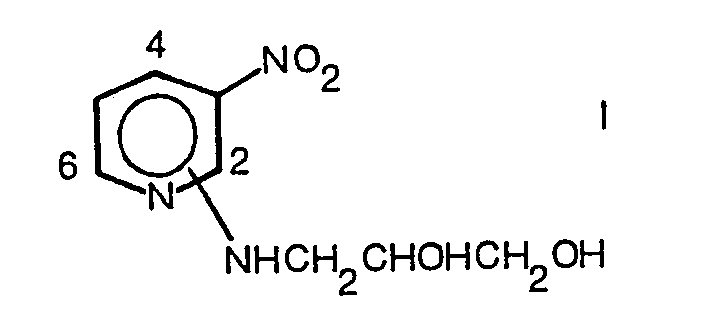
wherein the ―NHCH2CHOHCH2OH substituent is attached at position 4 or 6, or salts of the compounds of formula I.
wherein the ―NHCH2CHOHCH2OH substituent is attached at position 4 or 6, or salts of the compounds of formula I.
2. A compound according to claim 1 which is4-(2,3-dihydroxy-1-propy)amino)-3-nitropyridine
having the following formula la
3. Process for the preparation of the 3-nitropyridine compounds of formula I
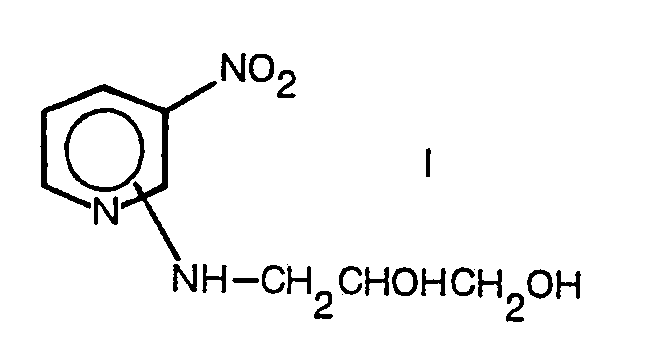
according to claim 1, characterized in that a 3-nitro-pyridine, having in the position 4 or the position 6 a leaving group is reacted with an amine of formula II

and the resulting product of formula I is isolated in the free form or as salt thereof.
according to claim 1, characterized in that a 3-nitro-pyridine, having in the position 4 or the position 6 a leaving group is reacted with an amine of formula II
and the resulting product of formula I is isolated in the free form or as salt thereof.
4. Process according to claim 3, characterized in that in the starting material the
leaving group is a haloatom, preferably chloride, and that the reaction is performed
in the presence of a base.
5. Pharmaceutical composition for enhancing the therapeutic effect of radiation, characterized
in that it contains as pharmaceutically effective ingredient a compound of formula
I according to claim 1 or a pharmaceutically acceptable salt thereof.
6. Pharmaceutical composition according to claim 5, characterized in that it furthermore
contains a pharmaceutically acceptable carrier.
7. Pharmaceutical composition according to claim 5 or 6, characterized in that it
contains as pharmaceutically effective ingredient a compound of formula la according
to claim 2.
8. Use of the 2-(2,3-dihydroxy-1-propylamino)-3-nitropyridine of formula III
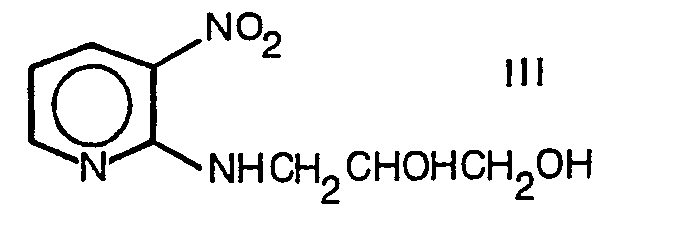
or of a pharmaceutically acceptable salt of said compound of formula III for the preparation of a pharmaceutical composition for enhancing the therapeutic effect of radiation.
or of a pharmaceutically acceptable salt of said compound of formula III for the preparation of a pharmaceutical composition for enhancing the therapeutic effect of radiation.
1. 3-Nitropyridinverbindungen der Formel I
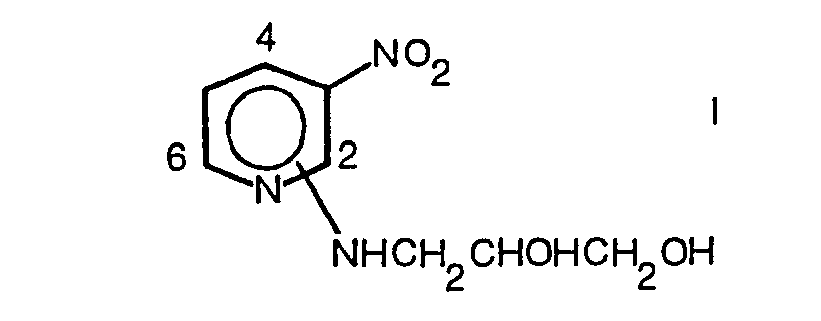
worin der -NHCH2CHOHCH20H-Substituent in der 4- oder 6-Stellung gebunden ist, oder Salze der Verbindungen der Verbindungen der Formel 1.
worin der -NHCH2CHOHCH20H-Substituent in der 4- oder 6-Stellung gebunden ist, oder Salze der Verbindungen der Verbindungen der Formel 1.
2. Verbindung nach Anspruch 1, welche 4-(2,3-Dihydroxy-1-propylamino)-3-nitropyridin
der folgenden Formel la ist
3. Verfahren zur Herstellung der 3-Nitropyridinverbindungen der Formel I
nach Anspruch 1, dadurch gekennzeichnet, dass ein 3-Nitropyridin mit einer austretenden Gruppe in der 4-Stellung oder der 6-Stellung mit einem Amin der Formel II umgesetzt wird

und das resultierende Produkt der Formel I in freier Form oder als ihr Salz isoliert wird.
nach Anspruch 1, dadurch gekennzeichnet, dass ein 3-Nitropyridin mit einer austretenden Gruppe in der 4-Stellung oder der 6-Stellung mit einem Amin der Formel II umgesetzt wird
und das resultierende Produkt der Formel I in freier Form oder als ihr Salz isoliert wird.
4. Verfahren nach Anspruch 3, dadurch gekennzeichnet, dass im Austauschmaterial die
austretende Gruppe ein Halogenatom, vorzugsweise Chlorid, ist und dass die Reaktion
in Gegenwart einer Base durchgeführt wird.
5. Pharmazeutische Zusammensetzung zur Stärkung des therapeutischen Effekts von Strahlung,
dadurch gekennzeichnet, dass sie als pharmazeutisch wirksamen Bestandteil eine Verbindung
der Formel 1 nach Anspruch 1 oder ein pharmazeutisch annehmbares Salz davon enthält.
6. Pharmazeutische Zusammensetzung nach Anspruch 5, dadurch gekennzeichnet, dass sie
weiterhin einen pharmazeutisch annehmbaren Träger enthält.
7. Pharmazeutische Zusammensetzung nach Anspruch 5 oder 6, dadurch gekennzeichnet,
dass sie als pharmazeutisch wirksamen Bestandteil eine Verbindung der Formel la nach
Anspruch 2 enthält.
8. Verwendung von 2-(2,3-Dihydroxy-1-propylamino)-3-nitropyridin der Formel III
oder eines pharmazeutisch annehmbaren Salzes der Verbindung der Formel III zur Herstellung einer pharmazeutischen Zusammensetzung zur Verstärkung des therapeutischen Effekts von Strahlung.
oder eines pharmazeutisch annehmbaren Salzes der Verbindung der Formel III zur Herstellung einer pharmazeutischen Zusammensetzung zur Verstärkung des therapeutischen Effekts von Strahlung.
1. Dérivés de 3-nitropyridine de formule 1
dans laquelle le substituant ―NHCH2CHOHCH2OH est fixé sur la position 4 ou 6 ou les sels des composés de formule I.
dans laquelle le substituant ―NHCH2CHOHCH2OH est fixé sur la position 4 ou 6 ou les sels des composés de formule I.
2. Composé selon la revendication 1 qui est la 4-(2,3-dihydroxy-1-propylamino)-3-nitropyridine
répondant à la formule la suivante
3. Procédé pour la préparation des dérivés de 3-nitropyridine de formule 1
selon la revendication 1, caractérisé en ce que l'on fait réagir une 3-nitropyridine ayant un groupe labile dans la position 4 ou la position 6 avec une amine de formule Il

et on isole le produit obtenu de formule I sous la forme libre ou sous forme d'un sel.
selon la revendication 1, caractérisé en ce que l'on fait réagir une 3-nitropyridine ayant un groupe labile dans la position 4 ou la position 6 avec une amine de formule Il
et on isole le produit obtenu de formule I sous la forme libre ou sous forme d'un sel.
4. Procédé selon la revendication 3, caractérisé en ce que, dans la matière de départ,
le groupe labile est un atome d'halogène, de préférence de chlore, et la réaction
est effectuée en présence d'une base.
5. Composition pharmaceutique pour accroître l'effet thérapeutique des rayonnements,
caractérisée en ce qu'elle contient comme ingrédient pharmaceutiquement efficace un
composé de formule I selon la revendication 1 ou un sel pharmaceutiquement acceptable
de celui-ci.
6. Composition pharmaceutique selon la revendication 5, caractérisé en ce qu'elle
contient de plus un véhicule pharmaceutiquement acceptable.
7. Composition pharmaceutiquement selon la revendication 5 ou 6, caractérisée en ce
qu'elle contient comme ingrédient pharmaceutiquement efficace un composé de formule
la selon la revendication 2.
8. Utilisation de la 2-(2,3-dihydroxy-1-propylamino)-3-nitropyridine de formule III
ou d'un sel pharmaceutiquement acceptable dudit composé de formule III pour la préparation d'une composition pharmaceutique pour accroître l'effet thérapeutique des rayonnements.
ou d'un sel pharmaceutiquement acceptable dudit composé de formule III pour la préparation d'une composition pharmaceutique pour accroître l'effet thérapeutique des rayonnements.