|
(11) | EP 0 422 885 B1 |

| (12) | EUROPEAN PATENT SPECIFICATION |
|
|
| (54) |
Phenylindane-containing polyimide gas separation membranes Gastrennungsmembranen auf der Basis von Phenylindan enthaltenden Polyimiden Membranes de séparation de gaz à base de polyimides renfermant un motif phénylindane |
|
|
|||||||||||||||||||||||||||||||
|
||||||||||||||||||||||||||||||||
| Note: Within nine months from the publication of the mention of the grant of the European patent, any person may give notice to the European Patent Office of opposition to the European patent granted. Notice of opposition shall be filed in a written reasoned statement. It shall not be deemed to have been filed until the opposition fee has been paid. (Art. 99(1) European Patent Convention). |
FIELD OF THE INVENTION
[0001] The present invention relates to asymmetric separation membranes particularly useful for separating gases and their use. The membranes of this invention are made from polyimides compositionally containing phenylindane functions. Membranes formed from this class of polyimides have improved environmental stability and superior gas productivity.
BACKGROUND
[0002] Polyimides have long been used as gas separation membranes. Generally, however, this class of polymers exhibits an inverse relationship between the gas permeation rate (flux) and the selectivity of one gas over other gases in a multi-component gas mixture. Because of this, prior art polyimide gas separation membranes tend to exhibit either high flux at the sacrifice of gas selectivities or high gas selectivities at the sacrifice of flux.
[0003] For example, US-A-4,705,540 and US-A-4,717,394 teach that certain alkyl-substituted polyimide material membranes have ultrahigh flux but suffer from only moderate gas selectivities.
[0004] The polyetherimide gas separation membranes taught in US-A-4,156,597, exhibit productivities of about 191 centiBarrers when separating oxygen from air and oxygen/nitrogen selectivity of 5.3.
[0005] Polyimide gas separation membranes taught in US-A-4,378,400, have, at an oxygen/nitrogen selectivity of 7.3, a productivity of only 46 centiBarrers.
[0006] The polyimide membranes taught in U.S. Re 30,351, US-A-3,822,202, and US-A-3,899,309 also suffer from moderate gas selectivities.
[0007] US-A-4,746,474 teaches a process for making free-standing, pinhole-free, ultrathin polyimide films, including those incorporating phenylindane residues in a polyimide backbone chain, by casting the polymer on water. The reference alludes to use of the films in gas separation and in end uses where controlled release of drugs is needed.
[0008] It would be highly desirable for polyimide gas separation materials to exhibit high gas selectivities while maintaining high fluxes.
SUMMARY OF INVENTION
[0009] The present invention relates to the discovery that, by incorporating phenylindane residues in a polyimide backbone chain, gas separation membranes made from the resulting polyimide material exhibit exceptionally high selectivity while maintaining good gas permeation rates.
[0010] While not wishing to be limited by this hypothesis, the high gas productivity of these membranes is believed to be due to the optimization of the molecular free volume in the polymer structure resulting from the incorporation of said phenylindane residues in the polyimide chain.
[0011] The polyimide membranes disclosed herein have found use in gas separations. The present invention is particularly useful in the enrichment of oxygen and nitrogen from air for increased combustion or inerting systems, respectively; in recovery of hydrogen in refinery and ammonia plants; separation of carbon monoxide from hydrogen in syngas systems; and separation of carbon dioxide or hydrogen sulfide from hydrocarbons.
DETAILED DESCRIPTION OF INVENTION
[0012] The present invention relates to an asymmetric gas separation membrane made from a polyimide having sufficient phenylindane residues of the following form incorporated into the polyimide backbone chain:
wherein R, R¹ and R² are independently -H or lower alkyls having from 1 to 6 carbon atoms.
[0013] The polymer should have sufficient molecular weight to allow it to be formed into a thin film.
[0014] The phenylindane may be incorporated within the diamine function, the dianhydride function, or both. Preferably, the diamine is 100 percent in the phenylindane form and the dianhydride can be any dianhydride used in the art.
[0016] Examples of preferred dianhydrides which incorporate said phenylindane residues include:
Such phenylindane-containing diamines and dianhydrides have been disclosed in the prior art, see for example, US-A-3,856,752 and US-A-4,734,482. These diamines and dianhydrides containing phenylindane residues are examples only in that any diamine or dianhydride containing phenylindane residues may be included in the present invention.
[0017] Polyimide materials useful in the present invention can be prepared by typical prior art methodology such as in US-A-3,856,752 and US-A-4,734,482, which are incorporated herein by reference. Suitable polyimide compositions may be prepared by the polycondensation of the above-described phenylindane-containing diamines and/or dianhydrides either alone or in combination with suitable aromatic diamines, such as;
or mixtures thereof, wherein the aromatic nucleus may be substituted with lower alkyl, halogen, or acid residues, and/or with suitable aromatic dianhydrides, such as
or mixtures thereof, where --R³-- is
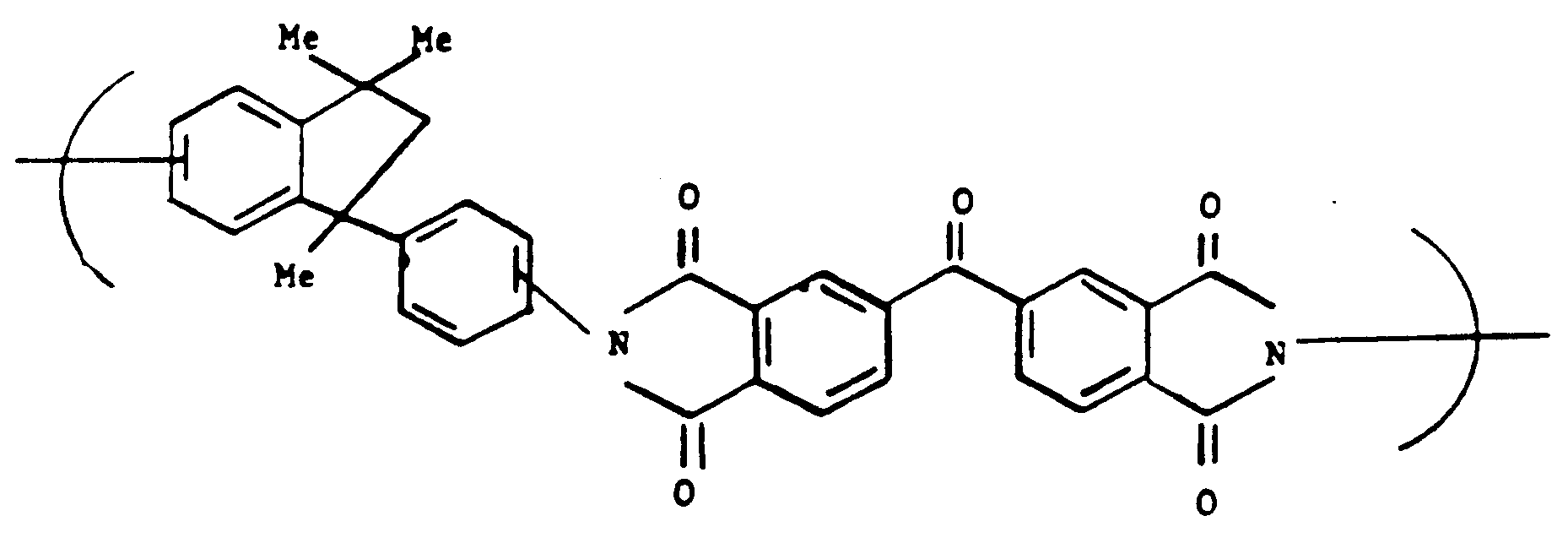
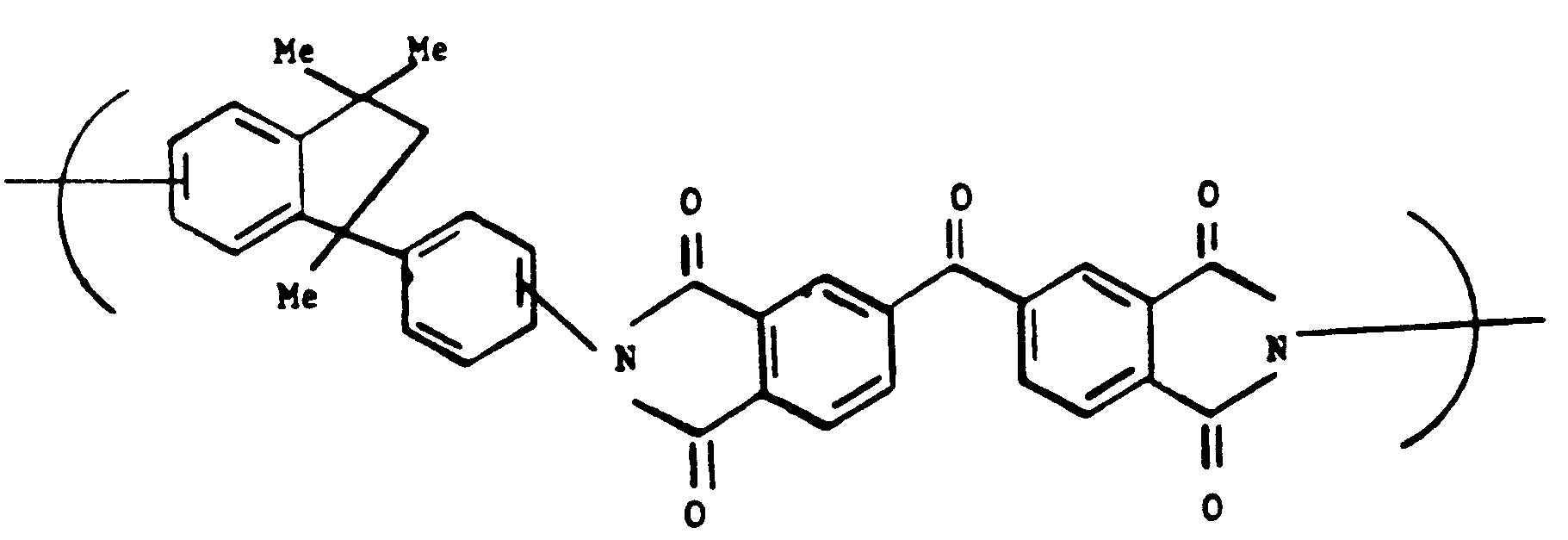
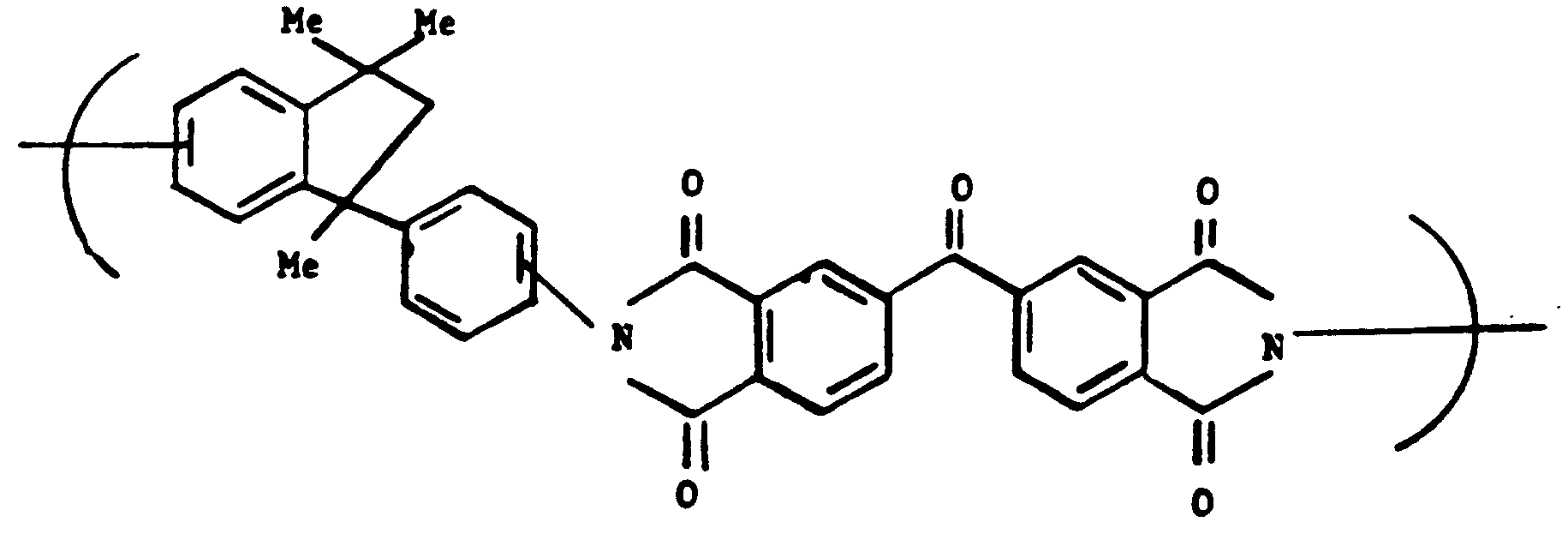
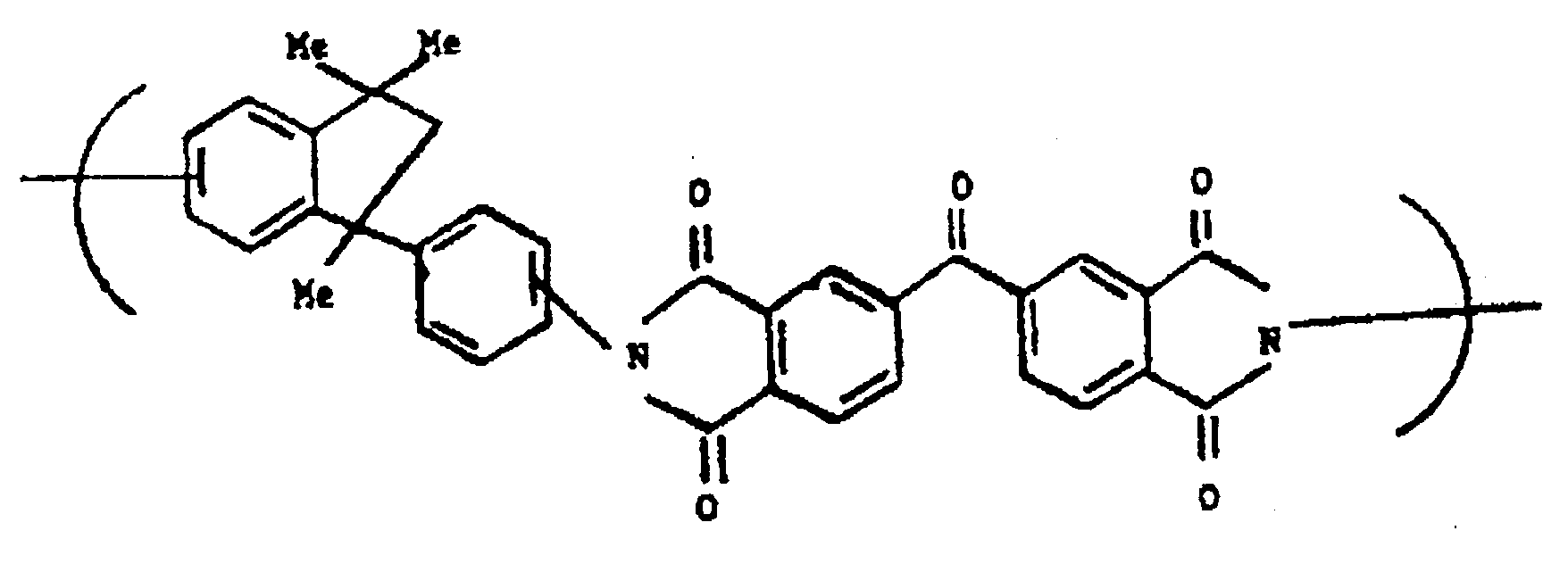
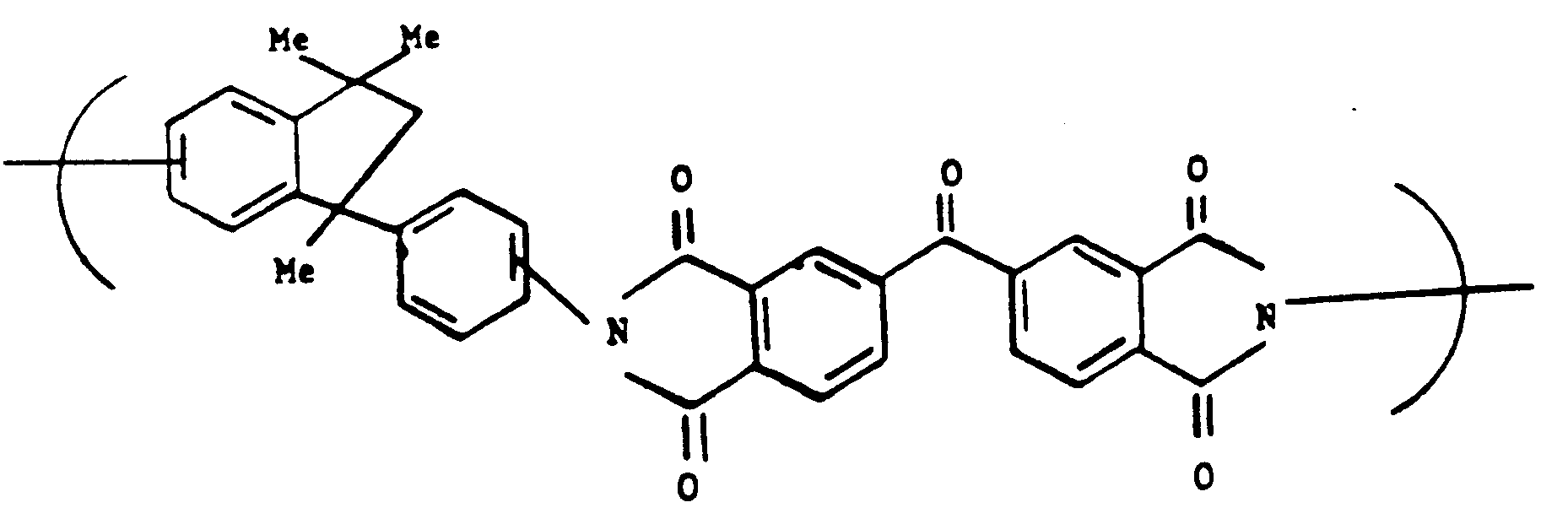
While essentially any polyimide incorporating phenylindane, preferably 50% or more in its repeating unit would be useful in the present invention, the most preferred phenylindane-containing polyimide composition is "MATRIMID 5218" polyimide resin. "MATRIMID 5218" is a commercially-available polyimide resin from the Ciba-Geigy Corporation and is based on the phenylindane diamine; 5(6)-amino-1-(4′-aminophenyl)-1,3-trimethylindane. The polymer repeating unit is believed to consist of:
This polyimide composition can be prepared by the methods taught in US-A-3,856,752.
[0018] As a further benefit, the preferred phenylindane-containing polyimide compositions of the present invention are soluble in a wide range of ordinary organic solvents. This is a great advantage for the ease of fabrication of industrially useful gas separation membranes. They can be solution cast as asymmetric membranes.
[0019] The process of this invention for separating one or more gases from a mixture employs gas separation asymmetric membranes having a thin skin at least one surface thereof. The asymmetric membranes of this invention preferably have a thin skin having a thickness of less than 10,000 Angstroms 1Å ≙ 0.1 nm on one of the surfaces thereof. More preferably, asymmetric membranes have a thin skin having a thickness of less than 2,000 Angstroms 1Å ≙ 0.1 nm on one side of the surfaces thereof.
[0020] The process of this invention possess an excellent balance of gas permeation rates and selectivities of one gas over other gases in a multi-component gas mixture. The phenylindane-containing polyimide materials of the present invention have been found to surprisingly exhibit significantly higher selectivities than taught or suggested in the art while retaining essentially equal or greater permeability.
[0021] It is believed that the incorporation of the phenylindane residue into the backbone of the polyimide membrane materials of the invention allows for the optimization of the molecular free volume within membranes of the present invention. This optimization is responsible for the surprisingly high gas selectivity observed for the present materials while maintaining good gas permeation rates.
[0022] The polyimides described in this invention have high inherent thermal stabilities. They are generally stable up to 400°C in air or inert atmospheres (US-A-3,856,752). The glass transition temperatures of these polyimides are generally above 300°C (US-A-3,856,752). The high temperature characteristics of these polyimides can help to prevent the membrane compaction problems observed in other polymers at even moderate temperatures.
EXAMPLES
EXAMPLE 1
[0023] A polymer solution containing 15 weight percent (wt.%) "MATRIMID 5218" polyimide in N-methylpyrrolidone was prepared through dissolution. Films of this solution were cast onto a glass plate treated with Du Pont TEFLON® dry lubricant at 100°C ± 2°C with a 15 mil (38.4 x 10⁻⁵ meter) knife gap. After drying on the plate at 100°C ± 2°C for 0.5 hours, the films were further dried in a vacuum oven (20 inches mercury -67.7 kPa) at room temperature overnight. The films were stripped off the plate and dried in a vacuum oven (20 inches mercury -67.7 kPa) at 120°C for 4 hours.
[0024] Du Pont TEFLON® dry lubricant contains a fluorocarbon telomer which reduces the adhesion of the membrane to the glass plate.
[0025] A 1.56 mils (39.6 µm) thick film, prepared as above, was tested for mixed gas oxygen/nitrogen (21/79 mole ratio) permeabilities at 478.8 pounds per square inch gauge (psig) (3401 kPa) and 25.2°C. The results were:
| O₂ Productivity: | 132 centiBarrers |
| O₂/N₂ Selectivity: | 7.2 |
[0026] A centiBarrer is the number of cubic centimeters of gas passed by the membrane at standard temperature and pressure times the thickness of the membrane in centimeters times 10⁻¹² divided by the permeating area of the membrane in square centimeters times the time in seconds times the partial pressure difference across the membrane in cm Hg, i.e.,
A 1.6 mils (40.6 µm) thick film, prepared as above, was tested for mixed gas oxygen/nitrogen (21/79 mole ratio) permeabilities at 478.0 psig (3395 kPa) and 25.2°C. The results were:
| O₂ Productivity: | 141 centiBarrers |
| O₂/N₂ Selectivity: | 7.1 |
[0027] A 1.6 mils (40.6 µm) thick film, prepared as above, was tested for mixed gas oxygen/nitrogen (21/79 mole ratio) permeabilities at 489.3 psig (3473 kPa) and 24.4°C. The results were:
| O₂ Productivity: | 135 centiBarrers |
| O₂/N₂ Selectivity: | 7.1 |
EXAMPLE 2
[0028] A 1.63 mils (41.4 µm) thick film, prepared as in Example 1, was tested for pure gas nitrogen permeability at 305.1 psig (2203 kPa) and 25.0°C. The N₂ Productivity was 20 centiBarrers.
[0029] The same film was tested for pure gas helium permeability at 82.8 psig (670 kPa) and 25.9°C. The He Productivity was 2250 centiBarrers.
[0030] The same film was tested for pure gas carbon dioxide permeability at 263.7 psig (1917 kPa) and 23.3°C. The result after a 24-hour permeation test was a CO₂ Productivity of 702 centiBarrers.
[0031] The same film was tested for pure gas carbon dioxide permeability at 274.6 psig (1993 kPa) and 23.8°C. The result after a 48-hour permeation test was a CO₂ Productivity of 717 centiBarrers.
[0032] Based on the above gas permeation rates, gas selectivities were calculated to be as follows:
| He/N₂ Selectivity: | 113 |
| CO₂/N₂ Selectivity: | 35 to 36 |
EXAMPLE 3
[0033] A 1.56 mils (39.6 µm) thick film, prepared as in Example 1, was tested for pure gas nitrogen permeability at 305.5 psig (2206 kPa) and 25.0°C. The N₂ Productivity was 19 centiBarrers.
[0034] The same film was tested for pure gas helium (He) permeability at 83.6 psig (676 kPa) and 26.0°C. The He Productivity was 2073 centiBarrers.
[0035] The same film was tested for pure gas carbon dioxide permeability at 268.4 psig (2019 kPa) and 23.4°C. The result after a 24-hour permeation test was a CO₂ Productivity of 718 centiBarrers.
[0036] The same film was tested for pure gas carbon dioxide permeability at 275.4 psig (1998 kPa) and 23.7°C. The result after a 48-hour permeation test was a CO₂ Productivity of 741 centiBarrers.
[0037] Based on the above gas permeation rates, gas selectivities were calculated to be:
| He/N₂ Selectivity: | 109 |
| CO₂/N₂ Selectivity: | 38 to 39 |
EXAMPLES 4 AND 5
[0038] Asymmetric membranes were prepared from "MATRIMID 5218" polyimide. A 22 wt.% "MATRIMID 5218" polyimide solution in N-methyl-pyrrolidone was cast onto a glass plate with a 15 mil (384 µm) knife gap at 100°C. After drying on the plate for the time noted in Table 1 at 100°C so as to achieve different thicknesses of dense layers on the surface of the membrane, the films were coagulated in a water bath at 18.0°C. The resulting membranes were washed in water overnight at room temperature, then in methanol for 2 hours at room temperature, and finally in "FREON" 113 for 2 hours at room temperature. The membranes were dried in a vacuum oven (20 inches mercury -67.7 kPa) at room temperature overnight followed by drying at 100°C for 4 hours.
[0039] Membranes made by the above method were treated to seal defects protruding through the dense gas separating layer of the membranes as taught in US-A-4,230,463. The membranes were dipped into a 5 wt.% "SYLGARD 184" ( a commercial product of the Dow Corning Corporation) solution in cyclohexane for 5 minutes at room temperature. The membrane was removed from the solution and allowed to drain for 0.5 hour at room temperature. The membrane was dried at 60°C for one hour and then further dried in a vacuum oven (20 inches mercury 67.7 kPa) at 60°C overnight.
[0040] Both the treated and untreated membranes were tested for pure gas nitrogen and helium permeabilities at 100 psig (789 kPa) and 25°C. The results are reported in Table 1.
Table 1
| Example | Dry Time (min) | Untreated | Treated | ||
| PHe(GPU) | PHe/PN₂ | PHe(GPU) | PHe/PN₂ | ||
| 4 | 0.5 | 530 | 7.1 | 170 | 61 |
| 5 | 1.0 | 555 | 5.4 | 245 | 71 |
[0041] A Gas Permeation Unit (GPU) is the cubic centimeters of gas passed by the membrane at standard temperature and pressure times 10⁻⁶ divided by the area of the membrane in square centimeters times the time in seconds times the pressure on the side of the membrane in cm Hg 1 mmHg ≙ 0.75 mbar, i.e.,
EXAMPLE 6
[0042] The treated membrane of Example 5 was tested for mixed gas oxygen/nitrogen (21/79 mole ratio) permeabilities at 100 psig (789 kPa) and 23°C. The results were:
| O₂ Productivity: | 18 GPU |
| O₂/N₂ Selectivity: | 5.2 |
EXAMPLE 7
[0043] This example describes the preparation and processes therein of asymmetric hollow fiber membranes from "Matrimid 5218" polyimide. The hollow fiber membranes are spun from a hollow fiber spinnerette into a water coagulant as has been taught in the prior art. For example, they may be of the type described in US-A-4,230,463 or of Cabasso et al. in Research and Development of NS-1 and Related Polysulfone Hollow Fibers for Reverse Osmosis Desalination of Seawater (NTIS PB-248666, 7/1975).
[0044] A polymer solution was prepared with 27 wt. % solids content of "Matrimid 5218" and 20 wt. % (based on polymer) of "Thermogard-230", available commercially from M&T Chemicals Co., in N-methyl pyrrolidone.
[0045] The above polymer solution was extruded through a hollow fiber spinnerette with fiber channel dimensions of outer diameter (OD) equal to 21 mils (533 µm microns) and inner diameter (ID) equal to 10 mils (254 µm microns) at the rate of 130 ml per hour at 100°C. A solution of 85 volume % N-methylpyrrolidone in water was injected into the fiber bore at a rate of 60 ml per hour. The spun fiber passed through an air gap of 10.0 cm at room temperature into a water coagulant bath maintained at 22°C. The fiber was wound up on a drum at the rate of 100 meters per minute.
[0046] The water-wet fiber was dehydrated as taught in US-A-4,080,743; US-A-4,080,744; US-A-4,120,098; and EP-A-O 219,878. This specifically involved the sequential replacement of water with methanol, the replacement of methanol with "Freon 113" (1,1,2-trichloro-1,2,2-trifluoroethane), and air-drying. The dry fibers were cut into lengths of approximately 20 inches (0.51 m) long and the open ends of the fibers were potted in an epoxy resin within a 1/4-inch (0.00635 m) diameter stainless steel tube to provide loops approximately 9 inches (0.23 m) long. From 10 to 24 fibers were so potted for the individual tests.
[0047] An asymmetric hollow fiber, prepared as described above, was tested for mixed gas oxygen/nitrogen permeabilities at 100 psig (789 kPa), room temperature. Results are reported below:
| O₂ Productivity: | 25 GPU |
| O₂/N₂ Selectivity: | 6.2 |
1. An asymmetric gas separation membrane formed of a polyimide polymer having incorporated
into the repeating polymer unit a phenylindane residue of the form:
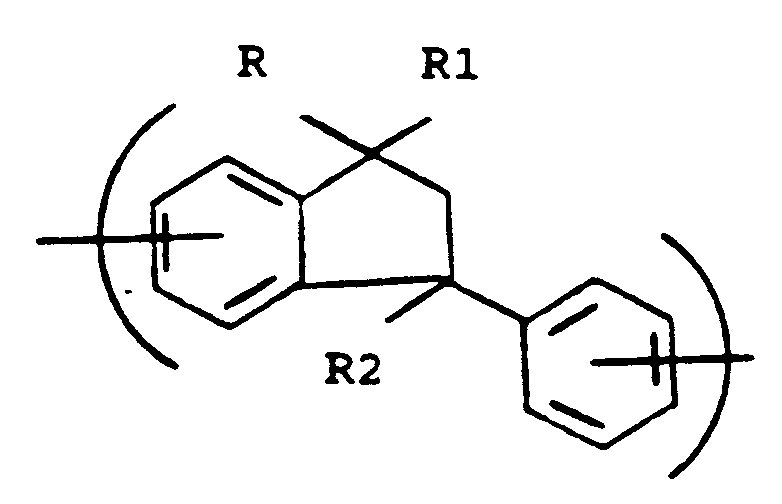
wherein R, R¹ and R² are independently -H or lower alkyl having from 1 to 6 carbon atoms.
wherein R, R¹ and R² are independently -H or lower alkyl having from 1 to 6 carbon atoms.
2. The membrane of claim 1 wherein the phenylindane is at least 50% of the repeating
polymer unit.
3. The membrane of claim 2 wherein the polyimide repeating unit comprises a diamine function
which is 100% of the phenylindane.
4. The membrane of claim 3 wherein the phenylindane-containing polyimide is
5. The membrane of any one of claims 1 to 4 wherein the membrane is an asymmetric hollow
fiber membrane.
6. A process of separating two or more gases comprising the step of bringing a mixture
of two or more gases into contact with one side of a permselective asymmetric gas
separation membrane which is formed from a polyimide polymer having incorporated into
the repeating polymer unit a phenylindane residue of the form:
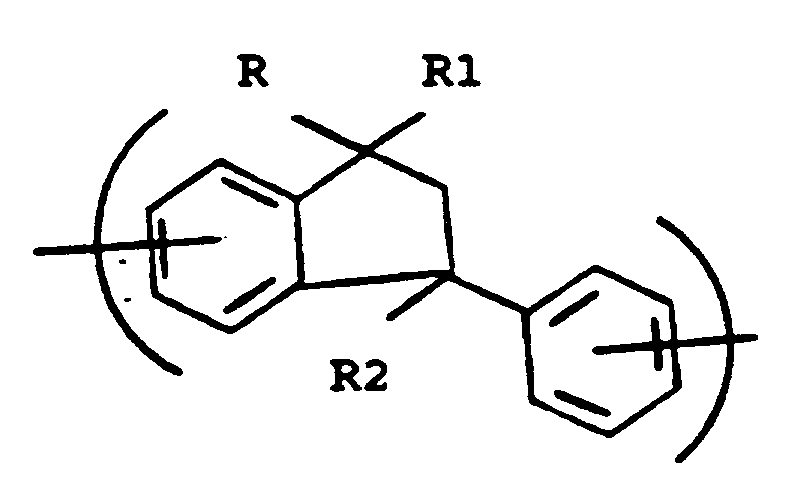
wherein R, R1 and R2 are independently -H or lower alkyl having from 1 to 6 carbon atoms.
wherein R, R1 and R2 are independently -H or lower alkyl having from 1 to 6 carbon atoms.
7. The process of claim 6 wherein the phenylindane is at least 50% of the repeating polymer
unit.
8. The process of claim 7 wherein the polyimide repeating unit comprises a diamine function
which is 100% of the phenylindane.
9. The process of claim 8 wherein the phenylindane-containing polyimide is
1. Asymmetrische Gastrennmembran, gebildet aus einem Polyimidpolymeren mit einem in die
polymere Repetiereinheit eingearbeiteten Phenylindanrest der Form:
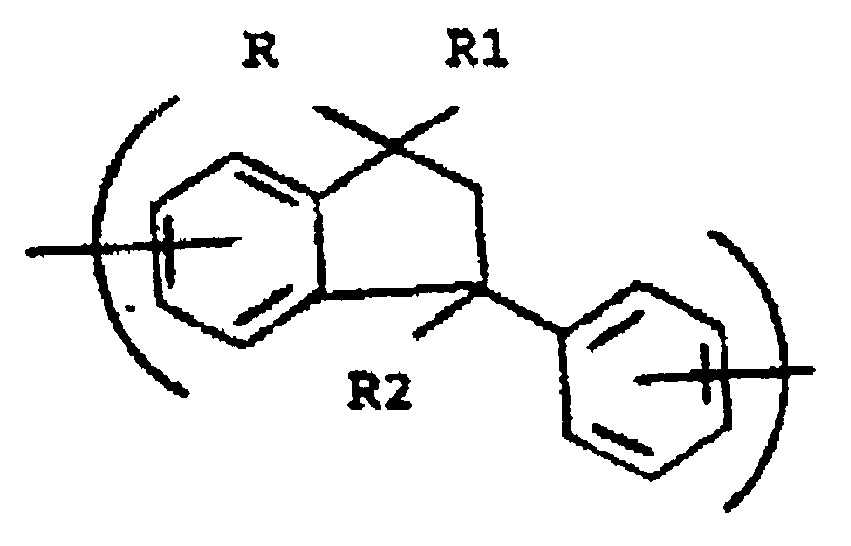
worin R, R¹ und R² unabhängig für -H oder Niedrigalkyl mit 1 bis 6 Kohlenstoffatomen stehen.
worin R, R¹ und R² unabhängig für -H oder Niedrigalkyl mit 1 bis 6 Kohlenstoffatomen stehen.
2. Membran nach Anspruch 1, worin das Phenylindan wenigstens 50 % der polymeren Repetiereinheit
ausmacht.
3. Membran nach Anspruch 2, worin die Polyimid-Repetiereinheit eine Diaminfunktion umfaßt,
die 100 % des Phenylindans entspricht.
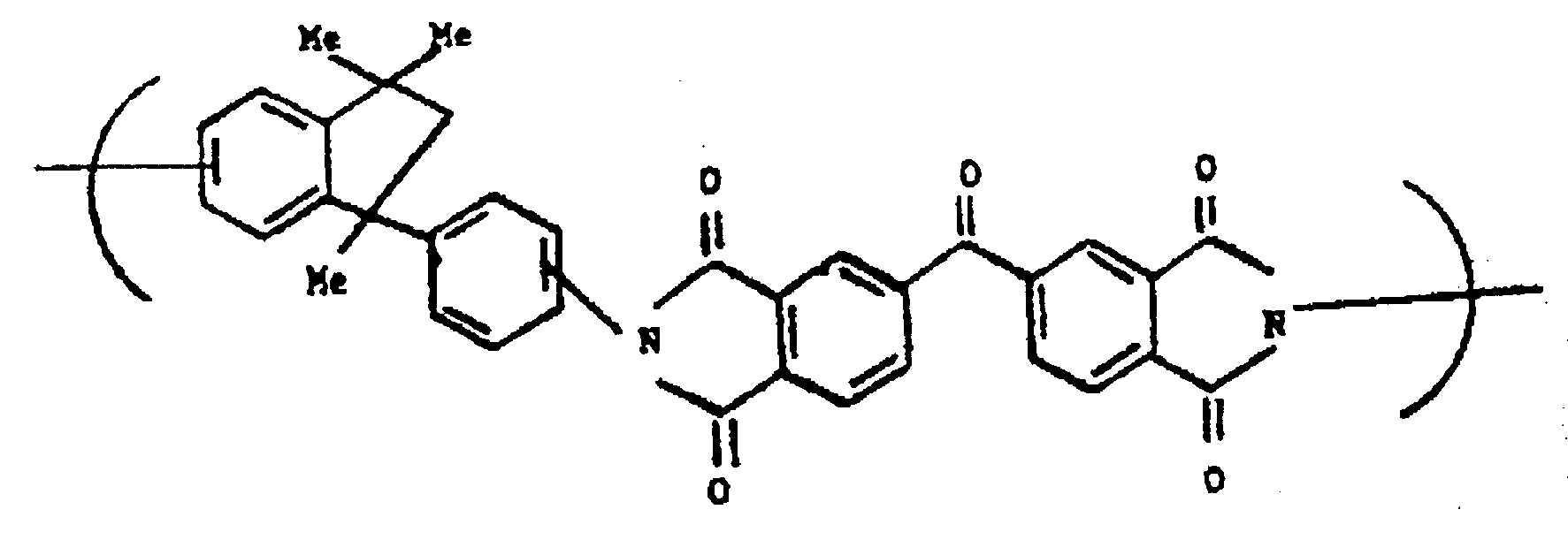
4. Membran nach Anspruch 3, worin das phenylindanhaltige Polyimid folgendes ist:
5. Membran nach einem der Ansprüche 1 bis 4, worin die Membran eine asymmetrische Hohlfasermembran
ist.
6. Verfahren zur Trennung von zwei oder mehreren Gasen, das die Stufe umfaßt, bei der
ein Gemisch von zwei oder mehreren Gasen mit einer Seite einer permiselektiven asymmetrischen
Gastrennmembran in Kontakt gebracht wird, die aus einem Polyimidpolymeren gebildet
ist, in dessen polymere Repetiereinheit ein Phenylindanrest der Form:
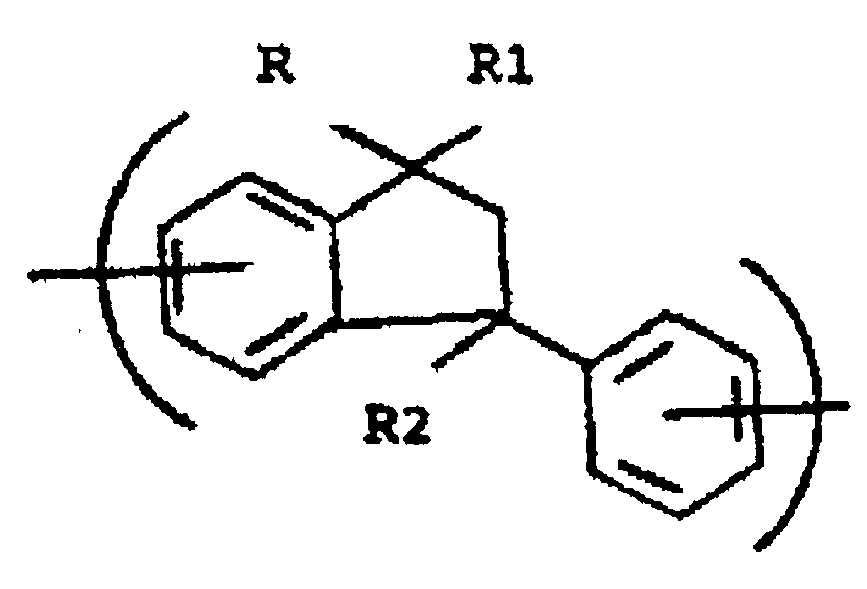
eingearbeitet ist, worin R, R¹ und R² unabhängig für -H oder Niedrigalkyl mit 1 bis 6 Kohlenstoffatomen stehen.
eingearbeitet ist, worin R, R¹ und R² unabhängig für -H oder Niedrigalkyl mit 1 bis 6 Kohlenstoffatomen stehen.
7. Verfahren nach Anspruch 6, bei dem das Phenylindan wenigstens 50 % der polymeren Repetiereinheit
ausmacht.
8. Verfahren nach Anspruch 7, bei dem die Polyimid-Repetiereinheit eine Diaminfunktion
umfaßt, die 100 % des Phenylindans entspricht.
9. Verfahren nach Anspruch 8, bei dem das phenylindanhaltige Polyimid folgendes ist:
1. Membrane asymétrique de séparation de gaz formée d'un polymère polyimide ayant, incorporé
dans l'unité polymère se répétant, un résidu phénylindane de la forme :
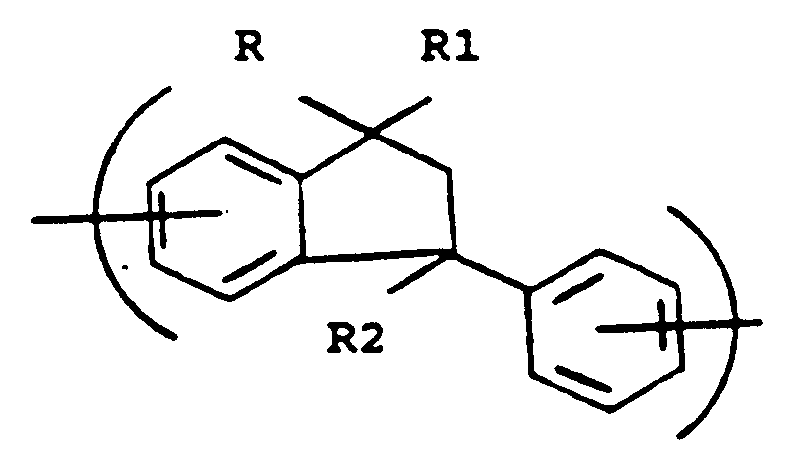
où R, R¹ et R² sont indépendamment -H ou un groupe alkyle inférieur ayant de 1 à 6 atomes de carbone.
où R, R¹ et R² sont indépendamment -H ou un groupe alkyle inférieur ayant de 1 à 6 atomes de carbone.
2. Membrane selon la revendication 1, dans laquelle le phénylindane constitue au moins
50 % de l'unité polymère se répétant.
3. Membrane selon la revendication 2, dans laquelle l'unité polyimide se répétant comprend
une fonction diamine qui est 100 % du phénylindane.
4. Membrane selon la revendication 3, dans laquelle le polyimide contenant du phénylindane
est
5. Membrane selon l'une quelconque des revendications 1 à 4, dans laquelle la membrane
est une membrane asymétrique en forme de fibres creuses.
6. Procédé de séparation de deux gaz ou plus, comprenant l'étape de mise en contact d'un
mélange de deux gaz ou plus avec un côté d'une membrane asymétrique de séparation
de gaz à perméation sélective qui est formée d'un polymère polyimide ayant, incorporé
dans l'unité polymère se répétant, un résidu phénylindane de la forme :
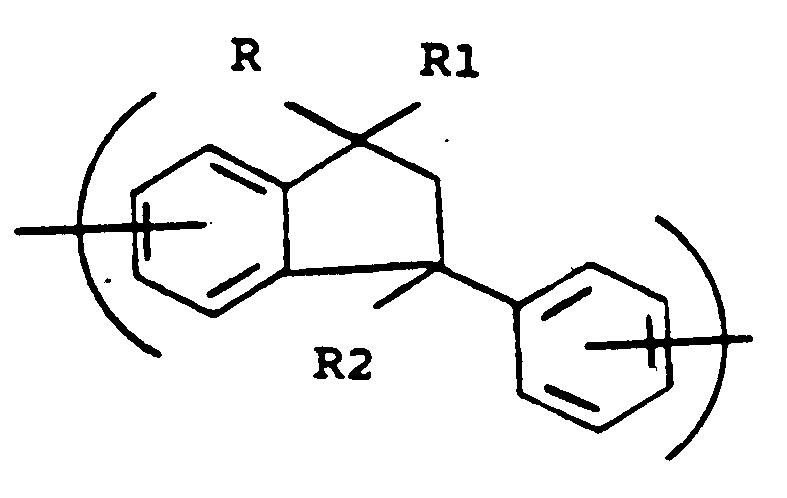
où R, R¹ et R² sont indépendamment -H ou un groupe alkyle inférieur ayant de 1 à 6 atomes de carbone.
où R, R¹ et R² sont indépendamment -H ou un groupe alkyle inférieur ayant de 1 à 6 atomes de carbone.
7. Membrane selon la revendication 6, dans laquelle le phénylindane constitue au moins
50 % de l'unité polymère se répétant.
8. Membrane selon la revendication 7, dans laquelle l'unité polyimide se répétant comprend
une fonction diamine qui est 100 % du phénylindane.
9. Membrane selon la revendication 8, dans laquelle le polyimide contenant du phénylindane
est