|
(11) | EP 0 875 508 A1 |

| (12) | EUROPEAN PATENT APPLICATION |
|
|
|
|
||||||||||||||||||||
| (54) | Method for the preparation of baccatin III and derivatives thereof from 10-deacetylbaccatin III |
| (57) 10-Deacetylbaccatin III is selectively acylated to baccatin III and derivatives thereof
in high yield with anhydrides (e.g. acetic anhydride), catalysed by Lewis acids. Extremely
effective catalysts in this reaction are compounds of the formula MLx wherein M is a rare earth metal and L is a anion, preferably a strong electron withdrawing
counterion such as triflate. |
[0001] This invention relates to the preparation of baccatin III and derivatives thereof from 10-deacetylbacctin III, a very useful precursor in the semisynthesis of the antitumour compound paclitaxel. More precisely, the invention relates to the selective introduction of an acyl group, such as an acetyl group, at the C10-hydroxyl position of 10-deacetylbaccatin III using a Lewis acid catalysed acylation reaction. The resulting baccatin III (if an acetyl group is introduced) or a derivative thereof can be protected or functionalised at the C7-position in high yield and with any desired (protecting)group.
Background of the invention
[0002] The limited availability of the potent antitumour compound paclitaxel (1), isolated from the bark of the Pacific yew tree (Taxus Brevifolia), has initiated scientists to develop an alternative paclitaxel source (Farina (ed.), The Chemistry and pharmacology of Taxol® and its derivatives, Elsevier Science Amsterdam, 1995, p 7-53). An attractive alternative is the semisynthesis from a paclitaxel precursor isolated from a renewable source. Through many precursors have been isolated and converted into paclitaxel and analogues, these semisyntheses are either too complex, (for example taxine B (Wiegerinck et al., J. Org. Chem., 1996, 61, 7092)), or the amount of isolated precursor is too low (like baccatin III (2) (Halsall et al., J. Chem. Soc., Chem. Commun., 1970, 216)) to be economically feasible. A useful precursor was discovered by Potier et al (C. R. Acad. Sc., 1981, 293, série II, 501), who isolated 10-deacetylbaccatin III (3) from the leaves of the European yew (Taxus Baccata). Meanwhile it has been demonstrated that this precursor can be isolated relatively easy and in significant amounts (Pilard et al., PCT Application, WO 94/07882).
[0003] In the first reported semisynthesis by Greene et al (J. Am. Chem. Soc., 1988, 110, 5917), 10-deacetylbaccatin III is converted into paclitaxel in four steps (scheme 1). Under what are claimed to be carefully optimised conditions, 10-deacetylbaccatin III (3) is protected at the C7-position using 20 equivalents of triethylsilyl chloride in pyridin at 0°C (c.y. 78%). Acylation with 10 equivalents of acetylchloride for 48 hours at 0°C results in 7-triethylsilyl-baccatin III in 86% yield. Treatment with excess protected side chain in the presence of di-2-pyridyl carbonate (DPC) and 4-dimethylamino pyridine (DMAP) at 73°C for 100 hours gave protected paclitaxel in 80% yield at 50% conversion. Deprotection of the C7- and C2'-position in 89% yield gave paclitaxel (1) in an overall yield of 24% starting from 10-deacetylbaccatin III (3) (48% when based on 50% conversion in step three).
[0004] The attachment of the side chain, the weakest point in the synthesis described above, has been improved through the years. For example, Holton et al. developed a process involving the use of β-lactam (4) to couple to 7-triethylsilylbaccatin III in 92% yield to obtain paclitaxel in an overall yield of 61% from 10-deacetylbaccatin III (Holton et al., Eur. Patent Application, 0,400,971). A second improved introduction of the side chain in 100% yield at 77% conversion involves an oxazinone (5). The overall yield from 10-deacetylbaccatin III is 66% (Holton et al., Eur. Patent Application 0,428,376). A third example of a high-yield side chain attachment to 7-triethylsilylbaccatin III uses oxazolidine (6) (94% yield), resulting in an overall yield of 64% (Greene et al., J. Chem. Soc., Chem. Commun., 1994, 2591).
[0005] The examples above illustrate that the weak point in the paclitaxel semisynthesis is no longer the attachment of the protected side chain but the conversion of 10-deacetylbaccatin III into C7-O-protected baccatin III.
Object of the invention
[0006] The object of this invention is to provide a method for an efficient single step conversion of 10-deacetylbaccatin III into baccatin III, which is an superior starting material for an improved semisynthesis of paclitaxel or paclitaxel analogues.
[0007] Another object of this invention is the provision of a method for an efficient conversion of 10-deacetylbaccatin III into baccatin III derivatives.
Detailed description of the invention
[0008] This invention relates to a new strategy in the semisynthesis of paclitaxel by selective acetylation of 10-deacetylbaccatin III to baccatin III. Classic acetylation methods with acetic anhydride and pyridine, for example, result in a mixture of baccatin III and 7-acetyl-10-deacetylbaccatin III in the ratio of approximately 1:1 (Potier et al., Tetrahedron, 1986, 42, 4460) or acetylation occurs selectively at the C7-hydroxyl (Kingston et al., J. Org. Chem., 1986, 51, 3239). Various Lewis acids are known to catalyse the acylation of alcohols with acid anhydrides (Yamamoto et al., J. Am. Chem. Soc., 1995, 117, 4413 and references cited therein). We have investigated whether Lewis acids could influence selectivety in the acetylation of the secondary OH-functions of 10-deacetylbaccatin III. We found that the use of Lewis acids in the reaction of 10-deacetylbaccatin III with acetic anhydride caused selective acetylation of the C10-hydroxyl group. This method can also be applied for improving the acetylation of 7-protected-10-deacetylbaccatin III (scheme 2).
[0009] It must be recognised that acetylation is also possible with other acetyl donors, for example a mixed anhydride of p-nitrobenzoic acid and acetic acid or acetyl chloride. The method is generally applicable to the acylation with anhydrides or mixed anhydrides of any carboxylic acid or acyl halides to prepare any C10-O-acyl derivatives of 10-deacetylbaccatin III.
[0010] Extremely effective catalysts in this reaction are the rare earth metal Lewis acid catalysts MLx, where M = La, Ce, Pr, Nd, Pm, Sm, Eu, Gd, Tb, Dy, Ho, Tb, Er, Tm, Yb or Lu and L = any counter ion, preferably a strong electron withdrawing counter ion like OTf-, ClO4- or NTf2-, which leads to stronger Lewis acidity. The obtained yields are excellent and the reaction is completed within a few hours at room temperature. No large excess of acylating reagent is necessary and after an easy workup the product is sufficiently pure to proceed with in the next reaction steps. The rare earth metal salts themselves are cheap, non-toxic materials that can be recovered and reused after the reaction. Lewis acids like TiCl4, ZnCl2, Sc(OTf)3, AlCl3 are also able to convert 10-deacetylbacctin III selectively into baccatin III; compared to rare earth metal catalysts, the reaction proceeds slower, with lower conversion and usually 10 mol% of catalyst is required. With respect to the use of solvents, conversion rates seem to depend on the solubility of 10-deacetylbaccatin III (see table 1, example 3).
The method described above allows us to use baccatin III as a key reagent in the synthesis of paclitaxel by protecting the C7-hydroxyl with any protecting group, followed by attachment of the side chain and deprotection. By this method, paclitaxel can be prepared more easily, with simpler reagents, in shorter reaction times, with less purification steps and in higher yields than the method described by Greene et al. (Eur. Patent Application 0,336,840).
[0011] Furthermore, it is possible to introduce a (protected) water soluble group or any other enzymatically cleavable group at the C-7 hydroxyl of baccatin III. After coupling of the side chain and deprotection this results in a semi-synthetic paclitaxel prodrug. By this method it is also possible to easily prepare C10-O-acyl paclitaxel derivatives, which are known to have the same biological activity as paclitaxel (Rao et al., J.Med.Chem 1995, 38, 3411)
Example 1
Preparation of baccatin III (2) using 1 mol% of ytterbium trifluoromethanesulfonate.
[0012] To a stirred solution of 300 mg (0.553 mmol) of 10-deacetylbaccatin III (3) in 20 mL of freshly distilled tetrahydrofuran 78 µL (1.5 eq.) of acetic anhydride was added, followed by 50 µL of a solution of 35 mg of commercial ytterbium trifluoromethanesulfonate hydrate in 2.0 mL of tetrahydrofuran. After two hours no starting material could be detected by means of TLC (Silica 60, CH2Cl2 / MeOH 9:1). The reaction mixture was diluted with 20 mL of ethylacetate and 20 mL of a saturated aqueous sodium hydrogencarbonate solution. The aqueous layer was extracted three times with 15 mL portions of ethylacetate. The combined organic layers were washed with brine, dried over anhydrous sodiumsulfate, filtrated and concentrated in vacuo to afford the crude product, which was >95% pure. Further purification was done by flash column chromatography (Silica 60H, CH2Cl2 / MeOH 99:1) to yield 310 mg of baccatin III (2) (96 %), m.p. 243-245 °C (lit: 236-238 °C).C31H38O11 calculated C 63.47% H 6.53% measured C 63.16% H 6.62%. FAB-MS m/z 587 [M + H]+, 609 [M + Na]+. 1H-NMR (300 MHz, CDCl3) δ (ppm) = 1.07 (s, 3H), 1.07 (s, 3H), 1.65 (s, 3H), 1.94 (s, 3H), 2.17 (s, 3H), 2.21 (s, 3H), 2.30 (m, 3H), 2.58 (m, 1H), 3.87 (d, 1H, J = 7.0), 4.15 (d, 1H, J = 8.3), 4.28 (d, 1H, J = 8.3), 4.46 (dd, 1H, J = 6.7, 10.8), 4.87 (t, 1H, J = 7.7), 4.97 (d, 1H, J = 7.8), 5.60 (d, 1H, J = 7.0), 6.31 (s, 1H), 7.47 (t, 2H, J = 7.6), 7.59 (t, 1H, J = 7.6), 8.09 (d, 2H, J = 7.6).
Example 2
Preparation of baccatin III (2) using 10 mol% of scandium trifluoromethanesulfonate.
[0013] To a solution of 50 mg (91.9 µmol) of 10-deacetylbaccatin III and 13 µL (1.5 eq.) of acetic anhydride in 2.0 mL of freshly distilled tetrahydrofuran 100 µL of a solution of 4.5 mg of commercial scandium trifluoromethanesulfonate in 1.0 mL of tetrahydrofuran was added. The reaction mixture was stirred at room temperature for 48 hours. Usual workup and isolation of the product by means of preparative TLC (Silica 60, CH2Cl2 / MeOH 10:1) afforded 9 mg of unreacted 10-deacetylbaccatin III (18 %) along with 31 mg of baccatin III (58 %). 1H-NMR and Rf-value (TLC) were in accordance with the product from example 1.
Example 3
Preparation of baccatin III with various Lewis acid catalysts.
[0014] To a solution of 50 mg (91.9 µmol) of 10-deacetylbaccatin III and 13 µL (1.5 eq.) of acetic anhydride in 2.0 mL of solvent 10-100 µL of a solution of 1.0 eq. of catalyst in 1.0 mL of the solvent was added. An overview of the various catalysts, the amount of catalyst, the solvents, the reaction times and the results are presented in table 1.
Table 1
| Lewis acid catalysed acetylation of 10-deacetylbaccatin III | ||||
| catalyst | mol% | solvent | reaction time | yield% |
| TiCl4 | 10 | THF | 48 hours | 20a |
| ZnCl2 | 10 | THF | 48 hours | 50b |
| AlCl3 | 10 | THF | 48 hours | 60a |
| CeCl3 | 1 | THF | 24 hours | >95b |
| Yb(OTf)3 | 1 | CH2Cl2 | 24 hours | >95b |
| Yb(OTf)3 | 1 | EtOAc | 3 hours | >95a |
| Yb(NO3)3 | 1 | CH2Cl2 | 24 hours | >95b |
| La(OTf)3 | 1 | THF | 2 hours | 97c |
| Lu(OTf)3 | 1 | THF | 3 hours | 80a |
| a) along with unreacted 10-deacetylbaccatin III, according to TLC. | ||||
| b) according to 300 MHz 1H-NMR. | ||||
| C) isolated yield |
Example 4
Preparation of 7-(2,2,2-trichloroethoxycarbonyl)-baccatin III.
[0015] Baccatin III used in this example (prepared as described in example 1) was used without chromatographic purification. A solution of 103 mg (0.176 mmol) of baccatin III (2), 50 µL of pyridin and 2.8 mg of 4-(dimetylamino)pyridin in 2.0 mL of dichloromethane was stirred at room temperature under an argon atmosphere. To the mixture 50 µL (2.0 eq) of 2,2,2-trichloroethyl chloroformate was added. After 45 minutes an additional 30 µL of 2,2,2-trichloroethyl chloroformate was added and stirring was continued for another 10 minutes. TLC (Silica 60, CH2Cl2 / MeOH 9:1) showed that no starting material was present in the reaction mixture. The reaction mixture was diluted with 30 mL of dichloromethane and successively washed with 15 mL portions of aqueous 0.5 N potassium bisulfate, demineralised water, aqueous saturated sodium bicarbonate and brine. The organic layer was dried over anhydrous sodium sulfate and evaporated. The resulting white residue was sonicated in diethylether and filtrated. Recrystallisation in methanol afforded 7-(2,2,2-trichloroethoxycarbonyl)-baccatin III, yield 129 mg (96 %) M.p. 208-211 °C. C34H39Cl3O13 calculated C 53.59 % H 5.16 % measured C 53.79% H 5.00%. FAB-MS m/z 785 [M + Na]+, 1H-NMR (300 MHz, CDCl3) δ (ppm) = 1.08 (s, 3H), 1.12 (s, 3H), 1.82 (s, 3H), 2.00 (m, 1H), 2.11 (s, 3H), 2.15 (s, 3H), 2.29 (s, 3H), 2.30 (m, 2H), 2.60 (m, 1H), 4.01 (d, 1H, J = 7.0), 4.15 (d, 1H, J = 8.5), 4.32 (d, 1H, J = 8.5), 4.64 (d, 1H, J = 12.0), 4.81 (t, 1H, J = 7.0), 4.98 (d, 1H, J = 8.0), 5.03 (d, 1H, J = 12.0), 5.62 (dd, 1H, J = 7.0, 11.0), 5.63 (d, 1H, J = 7.0), 6.39 (s, 1H), 7.48 (t, 2H, J = 7.6), 7.61 (t, 1H, J = 7.5), 8.10 (d, 2H, J = 7.6).
Example 5
Preparation of 10-benzoyl-10-deacetylbaccatin III
[0016] To a solution of 50 mg (91.9 µmol) of 10-deacetylbaccatin III and 13 µL (1.5 eq.) of benzoic anhydride in 2.0 mL of freshly distilled tetrahydrofuran 100 µL of a solution of 5.8 mg of commercial ytterbium trifluoromethanesulfonate hydrate in 1.0 mL of tetrahydrofuran was added. The reaction mixture was stirred at room temperature for 48 hours. Usual workup and isolation of the product by means of preparative TLC (Silica 60, CH2Cl2 / MeOH 10:1) afforded 11 mg unreacted 10-deacetylbaccatin III (22 %) along with 29 mg of 10-benzoyl-10deacetylbaccatin III (62 %), m.p. 154-156 °C. C36H40O11 calculated C 66.66 % H 6.22 % measured C 66.50 % H 6.23 %. 1H-NMR (300 MHz, CDCl3) δ (ppm) = 1.18 (s, 3H), 1.25 (s, 3H), 1.69 (s, 3H), 1.80-1.93 (m, 1H), 2.09 (s, 3H), 2.16-2.23 (m, 2H), 2.29 (s, 3H), 2.53-2.61 (m, 1H), 3.95 (d, 1H, J = 6.9), 4.17 (d, 1H, J = 8.3), 4.32 (d, 1H, J = 8.3), 4.55 (dd, 1H, J = 6.6, 10.6), 4.91 (br t, 1H, J = 7.9), 5.00 (d, 1H, J = 9.2), 5.67 (d, 1H, J = 6.9), 6.59 (s, 1H), 7.40-7.52 (m, 4H), 7.54-7.61 (m, 2H), 8.04-8.14 (m, 4H).
Example 6
Preparation of 7-triethylsilylbaccatin III via baccatin III
[0017] A solution of 50 mg (85.3 µmol) of baccatin III and 59.5 µL (5.0 eq.) of triethylamine in 2.0 mL of dichloromethane was stirred at 0°C under an argon atmosphere. To the mixture 71.6 µL (5.0 eq) of chlorotriethylsilane was added and the ice bath was removed. When no more starting material could be detected by means of TLC (Silica 60, CH2Cl2 / MeOH 10:1) the reaction mixture was diluted with 20 mL of dichloromethane and successively washed with 15 mL portions of aqueous 0.5 N potassium bisulfate, demineralised water, aqueous saturated sodium bicarbonate and brine. The organic layer was dried over anhydrous sodium sulfate and evaporated. Isolation of the product by means of preparative TLC (Silica 60, CH2Cl2 / MeOH 10:1) yields 47 mg (79 %) of the title compound. M.p. 252-254 °C. [a]D23 = 84.1° (c = 0.36 ; methanol) (lit.: 48.6°). 1H-NMR (300 MHz, CDCl3) δ (ppm) = 0.53-0.59 (m, 6H), 0.92 (t, 9H, J = 7.8), 1.03 (s, 3H), 1.19 (s, 3H), 1.68 (s, 3H), 1.83-1.92 (m, 1H), 2.14 (s, 3H), 2.17 (s, 3H), 2.22-2.31 (m, 2H), 2.26 (s, 3H), 2.47-2.58 (m, 1H), 3.80 (d, 1H, J = 7.0), 4.14 (d, 1H, J = 8.3), 4.30 (d, 1H, J = 8.3), 4.48 (dd, 1H, J = 6.6, 10.4), 4.84 (br t, 1H, J = 8.0), 4.97 (d, 1H, J = 8.1), 5.63 (d, 1H, J = 7.1), 6.42 (s, 1H), 7.45-7.50 (m, 2H), 7.58-7.60 (m, 1H), 8.09-8.12 (m, 2H).
1. A method for the preparation of baccatin III directely from 10-deacetylbaccatin III,
characterized by using an acetylation reaction with acetic anhydride, a mixed anhydride
of acetic acid and any other carboxylic acid or an acetyl halide, catalysed by a Lewis
acid.
2. A method according to claim 1, characterized by using a rare earth metal compound
MLx as a catalyst, wherein M = La, Ce, Pr, Nd, Pm, Sm, Eu, Gd, Tb, Dy, Ho, Er, Tm, Yb
or Lu and L = a counter ion.
3. A method according to claim 2, characterized in that L = a strong electron withdrawing
counter ion.
4. A method according to claim 3, wherein L = triflate (trifluoromethanesulfonate).
5. A method for the preparation of paclitaxel (taxol) via baccatin III, characterized
in that the method according to claims 1-4 is employed.
6. A method for the selective C10-O-acylation of 10-deacetylbaccatin III to introduce
an acyl group having at least 3 carbon atoms, employing an acylation reaction using
an anhydride, a mixed anhydride or an acyl halide, catalysed by a Lewis acid.
7. A method for acetylating 10-deacetylbaccatin III derivatives of the general formula
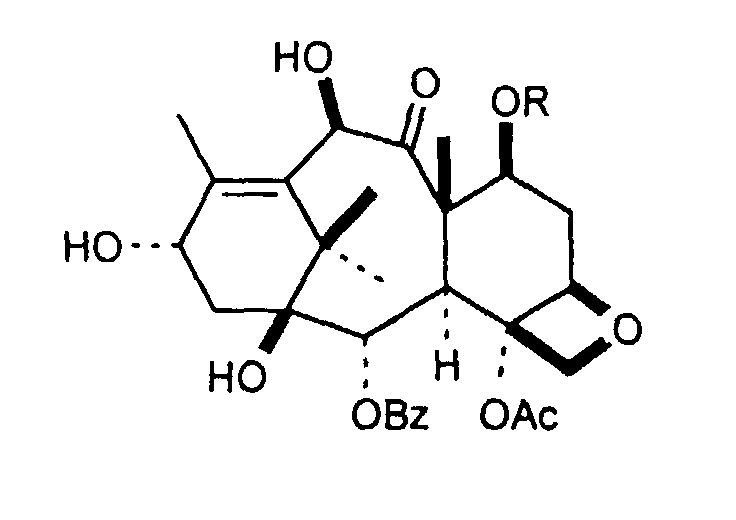
wherin R is a lower alkylsilyl group, characterized by employing the acetylating method of claims 1-4.
wherin R is a lower alkylsilyl group, characterized by employing the acetylating method of claims 1-4.
8. A method for the preparation of 7,10-difunctionalized 10-deacetylbaccatin III of the
general formula
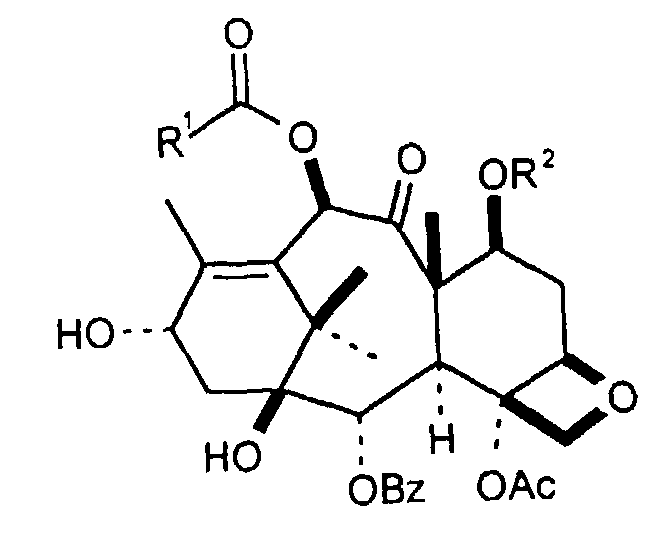
wherein R1 is an alkyl or aryl group and R2 is an OH-protecting group, a (protected) water soluble group or a (protected) prodrug moiety, comprising using the method of any of claims 1-4 and 6.
wherein R1 is an alkyl or aryl group and R2 is an OH-protecting group, a (protected) water soluble group or a (protected) prodrug moiety, comprising using the method of any of claims 1-4 and 6.
9. A pharmaceutical composition containing paclitaxel, wherein said paclitaxel is obtained
from baccatin III prepared according to clam 5.