|
(11) | EP 1 177 165 B1 |

| (12) | EUROPEAN PATENT SPECIFICATION |
|
|
| (54) |
PROCESSES FOR PREPARING PESTICIDAL INTERMEDIATES VERFAHREN ZUR HERSTELLUNG VON ZWISCHENPRODUKTEN FÜR PESTIZIDE PROCEDES DE PREPARATION D'INTERMEDIAIRES PESTICIDES |
|
|
|||||||||||||||||||||||||||||||
| Note: Within nine months from the publication of the mention of the grant of the European patent, any person may give notice to the European Patent Office of opposition to the European patent granted. Notice of opposition shall be filed in a written reasoned statement. It shall not be deemed to have been filed until the opposition fee has been paid. (Art. 99(1) European Patent Convention). |
[0001] This invention relates to a novel process for preparing intermediates (particularly certain aniline compounds starting from phenylhydrazine derivatives) useful in the preparation of pesticides.
[0002] 3,5-dihaloanilines and particularly 3,5-dichloroaniline are important synthetic intermediates for a number of valuable compounds including agrochemical fungicides for example as described in US patent publication numbers 3755350 and 3903090, or German patent publication number 2906574.
[0003] Various methods for preparing these compounds (particularly 3,5-dichloroaniline) are known, for example as described in Japanese patent publication numbers 05194330 and 60048500, and US patent publication number 4508922. However these procedures are generally inefficient, slow and suffer from poor selectivity and low yields. Furthermore they generally require the use of ammonia at high temperatures and/or pressures. There remains a need to develop new methods for obtaining these compounds particularly to find procedures which are safe to operate, efficient and can be performed at moderate temperatures and pressures.
[0004] The present applicants have surprisingly discovered a novel processes for the preparation of certain substituted anilines which do not suffer from these disadvantages, thus providing a new method for preparing valuable synthetic intermediates.
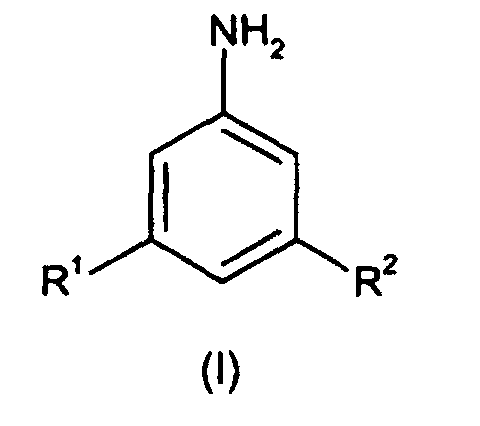
[0005] The present invention accordingly provides a process for the preparation of a substituted aniline of formula (I):
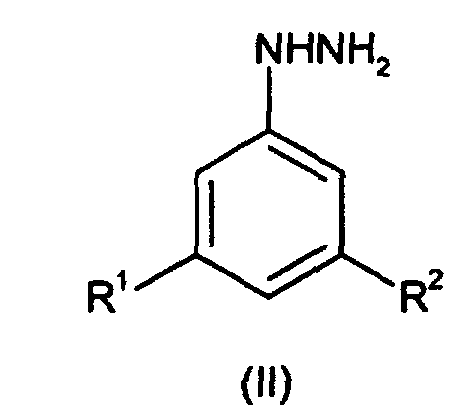
wherein R1 and R2 each independently represent a halogen atom; or an acid addition salt thereof; which process comprises the hydrogenolysis of a substituted phenylhydrazine of formula (II):
wherein R1 and R2 are as herein-before defined, or an acid addition salt thereof, in the presence of a metal or metal compound (for example a metal salt) under reducing conditions.
[0006] Unless otherwise specified in the present specification halogen atoms are selected from fluorine, chlorine, bromine and iodine.
[0007] The acid addition salts referred to in the invention are preferably the salts formed from strong acids such as mineral acids, for example sulphuric acid or hydrochloric acid.
[0008] The starting substituted phenylhydrazine derivatives of formula (II) are known compounds. Methods for their preparation can be found in the literature, for example in Methoden der Organishen Chemie (Houben-Weyl), Band E16a, 1990 (pages 648-653). One other method for the preparation of compounds of formula (II) is to react a corresponding trihalogenated derivative with hydrazine as described in European patent application number 1177165.
[0009] The hydrogenolysis may be performed using a metal or metal salt selected from Raney nickel (a nickel-aluminium alloy) optionally in the presence of iron, manganese, cobalt, copper, zinc or chromium; stannous chloride; zinc in the presence of acetic acid; and a molybdenum (III) salt. The reaction may also be carried out using Raney nickel, platinum or palladium (which may be supported on charcoal or other inert material) in the presence of hydrogen gas. When the reaction is performed with hydrogen gas a pressure of 2 to 20 bars (preferably 5 to 10 bars) is generally used. The hydrogenolysis is preferably performed using Raney nickel.
[0010] The reaction may be performed in the absence or presence of a solvent, but is generally conducted in a solvent which may be selected from alcohols such as methanol, ethanol, propanol, isopropanol, butanol, isobutanol or tertiary butanol; ethers; aromatic hydrocarbons and water (or mixtures thereof). Methanol and ethanol are preferred solvents.
[0011] The reaction temperature is generally from 20°C to 150°C, preferably from 20°C to 90°C. The amount of catalyst employed is generally from 0.01 to 3 molar equivalents (preferably from 0.05 to 2 molar equivalents), although when the reaction is carried out under an atmosphere of hydrogen, a smaller amount generally gives satisfactory results.
[0012] The process according to the invention seeks to enable substituted aniline compounds of formula (I) and their acid addition salts thereof to be obtained in high yield from readily available starting materials. Furthermore the reaction can be very simple and economical to perform, and product isolation can be straightforward. Another advantage of this method is that these compounds of formula (I) may be prepared at moderate temperatures and pressures, whereas prior art methods require high temperatures and pressures.
[0013] Particularly preferred compounds are those wherein R1 and R2 in formula (I) each represent a chlorine atom.
[0014] The substituted aniline compounds of formula (I) or an acid addition salt thereof prepared according to the process of the present invention can further be converted into an agriculturally fungicidal compound.
[0015] The following non-limiting examples illustrate the invention. Each product was shown to be identical to a known reference sample of the compound.
Example 1: Preparation of 3,5-dichloroaniline from 3,5-dichlorophonylhydrazine
[0016] Raney nickel (2g of a slurry in water) was added to a solution of 3,5-dichlorophenylhydrazine (1g) in methanol (5ml) and heated at 60°C for 2 hours. The cooled mixture was filtered and evaporated to give the title compound in 100% yield.
Example 2: Preparation 3,5-dichloroanillne from 3,5-dichlorophenylhydrazine
1. A process for the preparation of a substituted aniline of formula (I):
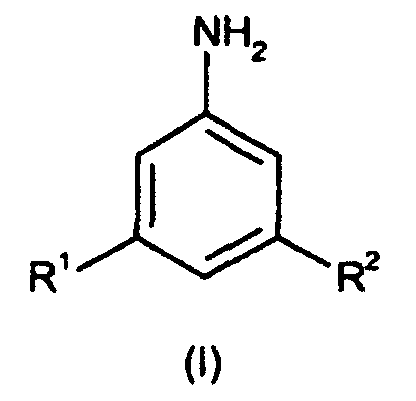
wherein R1 and R2 each independently represent a halogen atom; or an acid addition salt thereof; which process comprises the hydrogenolysis of a substituted phenylhydrazine of formula (II):
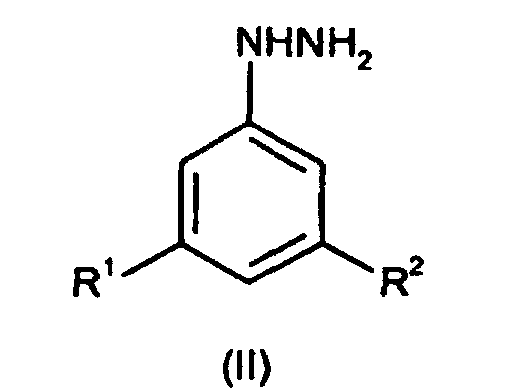
wherein R1 and R2 are as defined above, or an acid addition salt thereof, in the presence of a metal or metal compound under reducing conditions.
wherein R1 and R2 each independently represent a halogen atom; or an acid addition salt thereof; which process comprises the hydrogenolysis of a substituted phenylhydrazine of formula (II):
wherein R1 and R2 are as defined above, or an acid addition salt thereof, in the presence of a metal or metal compound under reducing conditions.
2. A process according to claim 1 in which the hydrogenolysis is performed using Raney
nickel.
3. A process according to any one of claims 1 or 2 wherein R1 and R2 represent chlorine.
4. A process according to claim 1, 2 or 3 wherein compound of formula (II) is 3,5-dichlorophenylhydrazine.
1. Verfahren zur Herstellung eines substituierten Anilins der Formel (I):
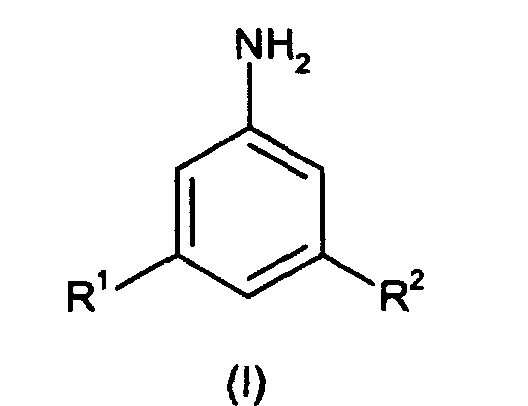
worin R1 und R2 jeweils unabhängig voneinander für Halogen stehen, oder eines Säureadditionssalzes davon; bei dem man ein substituiertes Phenylhydrazin der Formel (II):
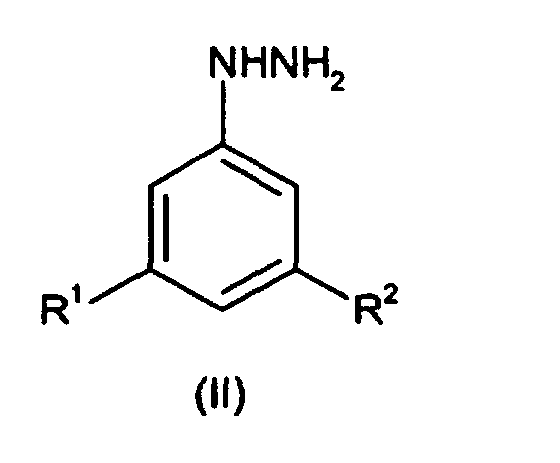
worin R1 und R2 wie oben definiert sind, oder ein Säureadditionssalz davon, in Gegenwert eines Metalls oder einer Metallverbindung unter reduzierenden Bedingungen hydrogenolysiert.
worin R1 und R2 jeweils unabhängig voneinander für Halogen stehen, oder eines Säureadditionssalzes davon; bei dem man ein substituiertes Phenylhydrazin der Formel (II):
worin R1 und R2 wie oben definiert sind, oder ein Säureadditionssalz davon, in Gegenwert eines Metalls oder einer Metallverbindung unter reduzierenden Bedingungen hydrogenolysiert.
2. Verfahren nach Anspruch 1, bei dem man die Hydrogenolyse unter Verwendung von Raney-Nickel
durchführt.
3. Verfahren nach einem der vorhergehenden Ansprüche, bei dem R1 und R2 für Chlor stehen.
4. Verfahren nach einem der vorhergehenden Ansprüche, bei dem die Verbindung der Formel
(II) für 3,5-Dichforophenylhydrazine steht.
1. Procédé de préparation d'aniline substituée de formule (I)
dans la quelle R1 et R2 représentent indépendamment l'un de l'autre un atome d'halogène, ou un de ses sels d'adition acides, par hydrogénolyse d'une phenylhydrazine substituée de formule (II) :
dans laquelle R1 et R2 sont tels que définis ci-dessus, ou un de ses sels d'adition acides, en présence d'un métal ou d'un dérivé métallique, dans des conditions réductrices.
dans la quelle R1 et R2 représentent indépendamment l'un de l'autre un atome d'halogène, ou un de ses sels d'adition acides, par hydrogénolyse d'une phenylhydrazine substituée de formule (II) :
dans laquelle R1 et R2 sont tels que définis ci-dessus, ou un de ses sels d'adition acides, en présence d'un métal ou d'un dérivé métallique, dans des conditions réductrices.
2. Procédé selon la revendication 1 pour lequel l'hydrogénolyse est conduite en présence
de nickel de Raney.
3. Procédé selon l'une des revendications 1 ou 2 pour lequel R1 and R2 représentent un atome de chlore.
4. Procédé selon l'une des revendications 1, 2 ou 3 pour lequel le composé de formule
(II) est la 3,5-dichlorophenylhydrazine.