| (19) |
 |
|
(11) |
EP 1 307 027 B1 |
| (12) |
EUROPEAN PATENT SPECIFICATION |
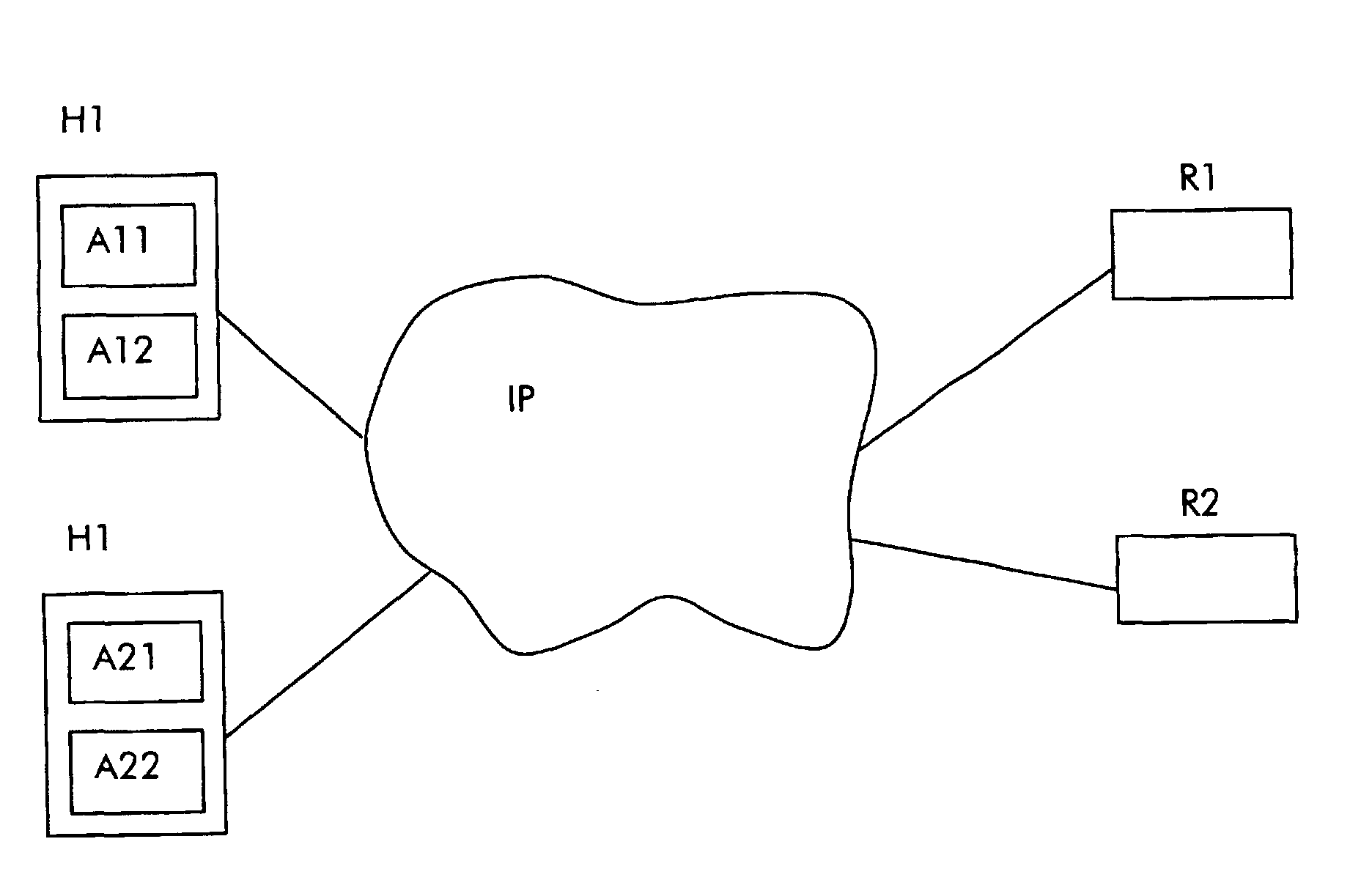
| (45) |
Mention of the grant of the patent: |
|
29.09.2004 Bulletin 2004/40 |
| (22) |
Date of filing: 25.10.2001 |
|
| (51) |
International Patent Classification (IPC)7: H04L 29/12 |
|
| (54) |
Method for setting up a communication between a device and a host application over
an IP network, host application and DSL router, and software programs realizing said
method
Verfahren zum Aufbau einer Kommunikation zwischen einem Gerät und einer Hostanwendung
über ein IP-Netz, Hostanwendung und DSL-Router, und Softwareprogramm zur Durchführung
dieses Verfahrens
Procédé d'établissement de communication entre un dispositif et une application hôte
dans un réseau IP, application hôte et routeur DSL, et programme de logiciel permettant
de mettre en oeuvre ce procédé
|
| (84) |
Designated Contracting States: |
|
AT BE CH CY DE DK ES FI FR GB GR IE IT LI LU MC NL PT SE TR |
| (43) |
Date of publication of application: |
|
02.05.2003 Bulletin 2003/18 |
| (73) |
Proprietor: ALCATEL |
|
75008 Paris (FR) |
|
| (72) |
Inventors: |
|
- Deleu, Johan Ghislain
2627 Schelle (BE)
- De Bruyker, Dirk
9120 Beveren-waas (BE)
- Cosemans, Peter Jozef Jeanne
2547 Lint (BE)
|
| (74) |
Representative: Narmon, Gisèle Marie Thérèse et al |
|
Alcatel Bell N.V.,
Francis Wellesplein 1
2018 Antwerpen
2018 Antwerpen (BE) |
| (56) |
References cited: :
EP-A- 1 139 635
US-A- 6 115 385
|
WO-A-01/31847
|
|
| |
|
|
|
|
| |
|
| Note: Within nine months from the publication of the mention of the grant of the European
patent, any person may give notice to the European Patent Office of opposition to
the European patent
granted. Notice of opposition shall be filed in a written reasoned statement. It shall
not be deemed to
have been filed until the opposition fee has been paid. (Art. 99(1) European Patent
Convention).
|
[0001] The present invention relates to a method for setting up a communication between
a device and a host application over an IP network, where said device has no externally
known IP address.
[0002] In order to be able to operate a device over an IP network, there's a need for the
device to have a unique IP address. Currently a few solutions exist to assign these
IP addresses: an IP address may be manually configured by the network administrator
before bringing the device on-line. This is however only possible to maintain in stable
networks and it is error-prone. For larger networks a frequently used technique is
to have a single node act as network address server. This server then automatically
assigns unique IP addresses to the other hosts in the network. Finally in small office
and home networks, IP addresses for local network communication can be generated automatically.
[0003] When the device has no unique IP address it can not be reached directly.
[0004] Closest prior art, EP-A-1 139634, discloses a method of using multicast messages
to dynamically allocate a temporary home address.
[0005] The objective of this invention is to enable communication with devices having no
externally known IP address, without the need to assign such an address. This is realized
by the method as described in claim 1, and by the host and device of claims 3 and
5 and the software programs of claims 7 and 8 for realizing this method. Indeed by
sending a discovery request to a specific multicast address and specific port, both
known by the device, the device can be reached. However, all devices knowing and listening
to this specific multicast address and specific port are also reached in this way
and will respond to this discovery request. The subsequently sent discovery responses
contain an identification parameter which makes it possible for the host application
to thereafter reach a specific device by including the identification parameter, whilst
the other devices having another identification will ignore the subsequent messages.
The discovery response and all subsequent messages sent by the device include the
host IP address and application port number where the discovery request originated
from to allow the device to communicate with a specific host application.
[0006] A characteristic feature of the present invention is that this method can be used
to configure devices on a local network, e.g. DSL routers not having a known IP address,
by sending in the subsequent messages information enabling the device to configure
itself. This is described in the claims 2, 4 and 6.
[0007] The above and other objects and features of the invention will become more apparent
and the invention itself will be best understood by referring to the following description
of an embodiment taken in conjunction with the accompanying drawings wherein a schematic
is shown of an IP network to which a host modules H1 (with running applications A11
and A12) and H2 (with running applications A21 and A22) and DSL routers R1 and R2
are connected.
[0008] The address of the DSL routers is not known. In order to be able to reach a DSL router,
e.g. R1, an a host application, e.g. A11 sends a multicast message over the IP network,
in this embodiment called a discovery request, to a specific multicast address and
a specific port as registered with an official organism such as IANA and known by
R1 and R2. Upon receipt of this message the DSL routers R1 and R2 send a discovery
response to the same specific multicast address and specific port, and include in
this message an identifier unique for each of these particular DSL routers and the
host IP address and application port number to specify the host application addressed,
i.e. A11. This unique device identifier can be a MAC address, a serial number or any
other parameter that is not shared with any other device. The discovery response is
accepted only by A11, based on the included host IP address and application port number.
[0009] Once the unique identifier is known to the host application A11, this identifier
is included by the host application in all subsequent messages sent to the specific
multicast address and port. Only the DSL router that matches to the identifier, i.e.
in this case R1, interpretes the message as being intended for it and accepts and
interpretes the messages. These messages can for instance contain information for
configuring the router. All other devices, e.g. R2 receiving the messages via the
specific multicast address and specific port just ignore these messages.
[0010] Vice versa, the DSL router R1 includes the host IP address and application port number
identifying the host application in all subsequent messages to specify the host application
addressed, i.e. A11. All other host applications, e.g. A22, receiving the messages
via the specific multicast address and specific port just ignore these messages.
[0011] While the principles of the invention have been described above in connection with
specific apparatus, it is to be clearly understood that this description is made only
by way of example and not as a limitation on the scope of the invention, as defined
in the appended claims.
1. Method for setting up a communication between a device (R1;R2) and a host application
(A11; A12; A21; A22) over an IP network, where said device has no externally known
IP address, said method including the steps of :
a) sending out a multicast discovery request by said host application to a specific
multicast address and a specific port known by said device;
b) said device responding to said discovery request with a multicast discovery response
sent to said specific multicast address and specific port said discovery response
including a unique identification parameter proper to said device and host IP address
and application port number as identified from said discovery request;
c) said host application accepting said discovery response based on said host IP address
and application port number and sending subsequent multicast messages to said specific
multicast address and specific port and including said identification parameter;
d) said device accepting said subsequent multicast messages based on said identification
parameter and sending subsequent multicast messages to said specific multicast address
and specific port and including said identification parameter and said host IP address
and application port number.
2. Method according to claim 1 characterised in that said subsequent messages include information enabling said device, e.g. a DSL router
to configure itself.
3. Host application for being connected to an IP network to which also at least one device
can be connected, said device having an IP address that is not externally known, said
host application including generation means realised to generate a discovery request,
transmission means realized to multicast said discovery request to a specific multicast
address and specific port known by said device, reception means realized to receive
a discovery response multicast by said device in response to said discovery request,
to said specific multicast address and specific port, and including an identification
parameter identifying said device, and generation and transmission means realized
to generate subsequent multicast messages including said identification parameter
and to multicast said subsequent multicast messages to said specific multicast address
and specific port.
4. Host application according to claim 3, characterized in that said generation and transmission means are realized to include in said subsequent
multicast messages information enabling said device, e.g. a DSL router to configure
itself.
5. Device for being connected to an IP network to which also at least one host application
can be connected, said device having an address that is not externally known, said
device including reception means able to receive a discovery request multicast by
said host application to a specific multicast address and specific port known by said
device, transmission means realized to multicast a discovery response to said specific
multicast address and specific port and including an identification parameter identifying
said device and said host IP address and application port number, said reception means
also being realized to accept subsequent multicast messages sent by said host to said
specific multicast address and specific port and including said identification parameter.
6. Device according to claim 5, characterized in that said reception means are in addition realized to recognise in said subsequent messages
information enabling configuration of said device, e;g. a DSL router, and operation
means realized to configure said device based on said information.
7. Software program for running on a host connected to an IP network to which also at
least one device is connected, said device having an address that is not externally
known, said software program when running realizing the steps a and c of the method
according to claim 1.
8. Software program for running on a device connected to an IP network to which also
at least one host is connected, said device having an address that is not externally
known, said software program when running realizing the steps b and d of the method
according to claim 1 .
1. Verfahren zum Aufbau einer Kommunikation zwischen einem Gerät (R1;R2) und einer Hostanwendung
(A11;A12;A21;A22) über ein IP-Netz, wobei das Gerät keine extern bekannte IP-Adresse
hat, und wobei das Verfahren folgende Schritte umfasst:
a) Aussenden einer Multicast-Feststellungs-Anfrage durch die Hostanwendung an eine
spezielle Multicast-Adresse und einen speziellen Anschluss, die dem Gerät bekannt
sind;
b) Antwort des Gerätes auf die Feststellungs-Anfrage mit einer Multicast-Feststellungs-Antwort,
die an die spezielle Multicast-Adresse und den speziellen Anschluss gesendet wird,
und wobei die Feststellungs-Antwort einen eindeutigen Identifizierungs-Parameter enthält,
der dem Gerät eigen ist, sowie die Host-IP-Adresse und die Anwendungs-Anschluss-Nummer
enthält, wie sie aus der Feststellungs-Anfrage erkannt wurde;
c) Akzeptieren der Feststellungs-Antwort durch die Hostanwendung, was auf der Host-IP-Adresse
und der Anwendungs-Anschluss-Nummer beruht, und Senden der nachfolgenden Multicast-Nachrichten
an die spezielle Multicast-Adresse und den speziellen Anschluss und Einbeziehung des
Identifizierungs-Parameters;
d) Akzeptieren der nachfolgenden Multicast-Nachrichten durch das Gerät, was auf dem
Identifizierungs-Parameter beruht, und Senden nachfolgender Multicast-Nachrichten
an die spezielle Multicast-Adresse und den speziellen Anschluss und Einbeziehung des
Identifizierungs-Parameters und der Host-IP-Adresse und der Anwendungs-Anschluss-Nummer.
2. Verfahren gemäß Anspruch 1, dadurch gekennzeichnet, dass die nachfolgenden Nachrichten Informationen enthalten, die das Gerät, z.B. einen
DSL-Router, in die Lage versetzen, sich selbst zu konfigurieren.
3. Hostanwendung für den Anschluss an ein IP-Netz, an das auch mindestens ein Gerät angeschlossen
werden kann, wobei das Gerät eine IP-Adresse hat, die nicht extern bekannt ist, wobei
die Hostanwendung Erzeugungs-Mittel enthält, die so realisiert sind, dass sie eine
Feststellungs-Anfrage erzeugen, Sende-Mittel, die so realisiert sind, dass sie die
Feststellungs-Anfrage an eine spezielle Multicast-Adresse und einen speziellen Anschluss
senden, der dem Gerät bekannt sind, Empfangs-Mittel, die so realisiert sind, dass
sie eine Feststellungs-Antwort empfangen, die von dem Gerät im Multicast als Antwort
auf die Feststellungs-Anfrage an die spezielle Multicast-Adresse und den speziellen
Anschluss gesendet wurde, und die einen Identifizierungs-Parameter enthalten, der
das Gerät identifiziert, und Erzeugungs- und Sende-Mittel, die so realisiert sind,
dass sie nachfolgende Multicast-Nachrichten erzeugen, die den Identifizierungs-Parameter
enthalten und welche die nachfolgenden Multicast-Nachrichten an die spezielle Multicast-Adresse
und den speziellen Anschluss im Multicast senden.
4. Hostanwendung gemäß Anspruch 3, dadurch gekennzeichnet, dass die Erzeugungs- und Sende-Mittel so realisiert sind, dass sie in die nachfolgenden
Multicast-Nachrichten Informationen aufnehmen, die das Gerät, z.B. einen DSL-Router,
in die Lage versetzen, sich selbst zu konfigurieren.
5. Gerät für den Anschluss an ein IP-Netz, an das auch mindestens eine Hostanwendung
angeschlossen werden kann, wobei das Gerät eine Adresse hat, die nicht extern bekannt
ist, wobei das Gerät Empfangs-Mittel enthält, die in der Lage sind, eine Feststellungs-Anfrage
zu empfangen, die von der Hostanwendung im Multicast an eine spezielle Multicast-Adresse
und einen speziellen Anschluss gesendet wurde, die dem Gerät bekannt sind, Sende-Mittel,
die so realisiert sind, dass sie eine Feststellungs-Antwort an die spezielle Multicast-Adresse
und den speziellen Anschluss senden und einen Identifizierungs-Parameter, der das
Gerät identifiziert, und die Host-IP-Adresse und die Anwendungs-Anschluss-Nummer aufnehmen,
wobei die Empfangs-Mittel auch so realisiert sind, dass sie nachfolgende Multicast-Nachrichten
akzeptieren, die von dem Host an die spezielle Multicast-Adresse und den speziellen
Anschluss gesendet werden und den Identifizierungs-Parameter enthalten.
6. Gerät gemäß Anspruch 5, dadurch gekennzeichnet, dass die Empfangs-Mittel zusätzlich realisiert sind, um in den nachfolgenden Nachrichten
Informationen zu erkennen, welche die Konfiguration des Gerätes, z.B. eines DSL-Routers,
ermöglichen, und dass Betriebs-Mittel realisiert sind, um das Gerät auf der Grundlage
der Informationen zu konfigurieren.
7. Softwareprogramm zur Ausführung auf einem Host-Rechner, der an ein IP-Netz angeschlossen
ist, an das auch mindestens ein Gerät angeschlossen ist, wobei das Gerät eine Adresse
hat, die extern nicht bekannt ist, wobei das Softwareprogramm im Betrieb die Schritte
a und c des Verfahrens gemäß Anspruch 1 realisiert.
8. Softwareprogramm zur Ausführung auf einem Gerät, das an ein IP-Netz angeschlossen
ist, an das auch mindestens ein Host angeschlossen ist, wobei das Gerät eine Adresse
hat, die extern nicht bekannt ist, wobei das Softwareprogramm im Betrieb die Schritte
b und d des Verfahrens gemäß Anspruch 1 realisiert.
1. Procédé permettant d'établir une communication entre un dispositif (R1 ; R2) et une
application hôte (A11 ; A12 ; A21 ; A22) sur un réseau IP, dans lequel ledit dispositif
n'a pas d'adresse IP connue à l'extérieur, ledit procédé comprenant les étapes consistant
à :
a) émettre une requête de découverte de multidiffusion par ladite application hôte
à une adresse spécifique de multidiffusion et un port spécifique connus dudit dispositif
;
b) ledit dispositif répond à ladite requête de découverte par une réponse de multidiffusion
envoyée à ladite adresse spécifique de multidiffusion et au port spécifique, ladite
réponse de découverte comprenant un paramètre d'identification unique, propre audit
dispositif, et une adresse IP de l'hôte et un numéro de port de l'application comme
identifiés à partir de ladite requête de découverte ;
c) ladite application hôte accepte ladite réponse de découverte sur la base de ladite
adresse IP de l'hôte et du numéro de port de l'application et envoie des messages
ultérieurs de multidiffusion à ladite adresse spécifique de multidiffusion et au port
spécifique et inclut ledit paramètre d'identification ;
d) ledit dispositif accepte lesdits messages ultérieurs de multidiffusion sur la base
dudit paramètre d'identification et envoie des messages ultérieurs de multidiffusion
à ladite adresse spécifique de multidiffusion et au port spécifique et inclut ledit
paramètre d'identification et ladite adresse IP de l'hôte et ledit numéro de port
de l'application.
2. Procédé selon la revendication 1, caractérisé en ce que lesdits messages ultérieurs comprennent des informations permettant audit dispositif,
par exemple un routeur DSL, de se configurer.
3. Application hôte à relier à un réseau IP auquel il est également possible de relier
au moins un dispositif, ledit dispositif ayant une adresse IP qui n'est pas connue
à l'extérieur, ladite application hôte comprenant des moyens de génération réalisés
pour générer une requête de découverte, des moyens de transmission réalisés pour multidiffuser
de ladite requête de découverte à une adresse spécifique de multidiffusion et un port
spécifique connus dudit dispositif, des moyens de réception réalisés pour recevoir
une réponse de découverte multidiffusée par ledit dispositif en réponse à ladite requête
de découverte, à ladite adresse spécifique de multidiffusion et audit port spécifique
et comprenant un paramètre d'identification identifiant ledit dispositif, et des moyens
de génération et de transmission réalisés pour générer des messages ultérieurs de
multidiffusion comprenant ledit paramètre d'identification et pour multidiffuser lesdits
messages ultérieurs de multidiffusion à ladite adresse spécifique de multidiffusion
et audit port spécifique.
4. Application hôte selon la revendication 3, caractérisée en ce que lesdits moyens de génération et de transmission sont réalisés pour inclure dans lesdits
messages ultérieurs de multidiffusion des informations permettant audit dispositif,
par exemple un routeur DSL, de se configurer.
5. Dispositif à relier à un réseau IP auquel il est également possible de relier au moins
une application hôte, ledit dispositif ayant une adresse IP qui n'est pas connue à
l'extérieur, ledit dispositif comprenant des moyens de réception capables de recevoir
une requête de découverte multidiffusée par ladite application hôte à une adresse
spécifique de multidiffusion et un port spécifique connus dudit dispositif, des moyens
de transmission réalisés pour multidiffuser une réponse de découverte à ladite adresse
spécifique de multidiffusion et audit port spécifique et comprenant un paramètre d'identification
identifiant ledit dispositif et ladite adresse IP de l'hôte et ledit numéro de port
de l'application, lesdits moyens de réception étant également réalisés pour accepter
des messages ultérieurs de multidiffusion envoyés par ledit hôte à ladite adresse
spécifique de multidiffusion et audit port spécifique et comprenant ledit paramètre
d'identification.
6. Dispositif selon la revendication 5, caractérisé en ce que lesdits moyens de réception sont de plus réalisés pour reconnaître dans lesdits messages
ultérieurs des informations permettant la configuration dudit dispositif, par exemple
un routeur DSL, et des moyens d'exploitation réalisés pour configurer ledit dispositif
sur la base desdites informations.
7. Logiciel destiné à s'exécuter sur un hôte relié à un réseau IP auquel est relié également
au moins un dispositif, ledit dispositif ayant une adresse qui n'est pas connue à
l'extérieur, ledit logiciel en cours d'exécution réalisant les étapes a et c du procédé
selon la revendication 1.
8. Logiciel destiné à s'exécuter sur un dispositif relié à un réseau IP auquel est relié
également au moins un hôte, ledit dispositif ayant une adresse qui n'est pas connue
à l'extérieur, ledit logiciel en cours d'exécution réalisant les étapes b et d du
procédé selon la revendication 1.