|
(11) | EP 1 250 310 B1 |

| (12) | EUROPEAN PATENT SPECIFICATION |
|
|
| (54) |
METHOD FOR SYNTHESIZING HYDRAZODICARBONAMIDE VERFAHREN ZUR HERSTELLUNG VON HYDRAZODICARBONAMID PROCEDE DE SYNTHESE D'HYDRAZODICARBONAMIDE |
|
|
|||||||||||||||||||||||||||||||
| Note: Within nine months from the publication of the mention of the grant of the European patent, any person may give notice to the European Patent Office of opposition to the European patent granted. Notice of opposition shall be filed in a written reasoned statement. It shall not be deemed to have been filed until the opposition fee has been paid. (Art. 99(1) European Patent Convention). |
Technical Field
[0001] The present invention relates to a method of synthesizing hydrazodicarbonamide, and more particularly, to a method for synthesizing hydrazodicarbonamide in high yield at low cost.
Background Art
[0002] Hydrazodicarbonamide has been used as a source material for azodicarbonamide which is a widely used azo series foaming agent. The following reaction 1 shows that azodicarbonamide (2) can be synthesized by oxidizing hydrazodicarbonamide (1) with an appropriate oxidizing agent.
[0003] Hydrazodicarbonamide (1) is derived from a reaction of hydrazine (3) and urea (4), which is shown in the following reaction 2.
[0004] The synthesis of hydrazine, which is one of the reactants, is very expensive and complicate, while urea can be relatively easily obtained at low cost.
[0005] Typically, hydrazine is synthesized by the Raschig Process or a method using ketazine. However, hydrazine synthesized by these methods should be subjected to additional condensation or hydrolysis, and wastes huge energy and requires complicate equipment, thus increasing the manufacturing cost.
[0006] Another synthesis method of hydrazine is the urea process. According to the urea process, hydrazine is obtained by a reaction between urea and sodium hypochlorite, which is expressed as the following reaction 3.
[0007] However, such a urea process consumes excess sodium hydroxide and produces sodium carbonate as a byproduct, which must be eliminated. Due to the cost and energy required for the elimination of sodium carbonate, the production cost of hydrazine is inevitably increased, adversely affecting in an environmental aspect.
[0008] Synthesis of hydrazodicarbonamide by the urea process is expressed as the following reaction 4.
[0009] Reaction 4 shows that excess reactants, including 3 moles of urea, 4 moles of sodium hydroxide and 1 mole of chlorine (Cl2), are consumed for producing 1 mole of hydrazodicarbonamide.
[0010] As previously described, using hydrazine for the synthesis of hydrazodicarbonamide is an expensive and complicated process, and is undesirable in an environmental aspect.
[0011] Another approach for the synthesis of hydrazodicarbonamide is to use semicarbazide instead of the expensive hydrazine. The following reaction 5 illustrates the synthesis of semicarbazide. Urea and sodium hypochlorite are reacted to obtain monochlorourea sodium salt as an intermediate and then reacted with excess ammonia in the presence of a catalyst to give semicarbazide.
[0012] However, the problem with this reaction is the need for excess ammonia. The amount of ammonia required is about 500 times the intermediate, monochlorourea sodium salt. Alternatively, an expensive catalyst should be used instead of reducing the amount of ammonia added for the reaction, thus raising the cost.
[0013] In addition, on more additional reaction for conversion of the obtained semicarbazide to hydrazodicarbonamide is required, which is expressed as the following reaction 6.
Disclosure of the Invention
[0014] An object of the present invention is to provide a method of synthesizing a great yield of hydrazodicarbonamide in a simple and inexpensive manner.
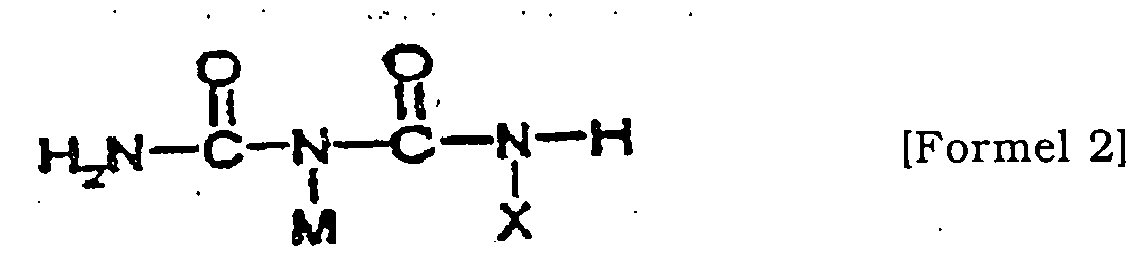
[0015] The above object of the present invention is achieved by a method for synthesizing hydrazodicarbonamide by a reaction of monohalobiuret metal salt having the formula 1 or 2, and ammonia in a solvent
where M is a metal and X is a halogen.
[0016] The above object and advantages of the present invention will become more apparent by describing in detail preferred embodiments thereof.
Best mode for carrying out the Invention
[0017] An example of the synthesis of hydrazodicarbonamide (HDCA) according to the present invention is expressed as the following reaction 7.
where M is a metal and X is a halogen.
[0018] In Reaction 7, monohalobiuret metal salt as a reactant may be derived by reacting the biuret having the formula 3 below with a metal hypohalogen compound, or by reacting the biuret with a halogen element and a base.
[0019] The synthesis reaction for HDCA according to the present invention may be carried out at a temperature of 30 to 150°C.
[0020] For Reaction 7 ammonia may be liquid ammonia, gaseous ammonia or ammonia water, but liquid ammonia is preferred. If ammonia water is selected as a source of ammonia, the concentration of ammonia water may be in the range of 10 to 50%.
[0021] The amount of ammonia used may be 1 to 1000 moles, but preferably 2 to 500 moles, with respect to 1 mole of monohalobiuret metal salt.
[0022] The solvent for Reaction 7 may be water or a solvent mixture containing water and an organic solvent, but water is preferred. If the solvent mixture is selected, the organic solvent may be at least one selected from the group consisting an aprotic polar solvent and a protic polar solvent having a dielectric constant of 50 or less. For example, the organic solvent includes methanol, ethanol, propanol, isopropanol, dimethylformamide, tetrahydrofuran and acetonitrile.
[0023] Preferably, the amount of organic solvent is 0.1 to 50 times by weight, but preferably 0.2 to 3.0 times by weight based on the amount of water.
[0024] A catalyst may be further added for reduction of reaction time and reaction efficiency. The catalyst may be sulfates, chlorides, carbonates and hydroxides of transition metal or alkali metal, and heavy metal salts of carboxylic acids. The amount of catalyst added may be 0.001 to 1 moles, but preferably 0.01 to 0.5 moles, with respect to 1 mole of monohalobiuret metal salt.
[0025] Alternatively, an inorganic acid such as hydrochloric acid, sulfuric acid and nitric acid may be used as a catalyst. Preferably, the amount of inorganic catalyst is 0.5 to 3.0 moles with respect to 1 mole of monohalobiuret metal salt.
[0026] In the reactions of the present invention, preferably the metal designated M is sodium, potassium or calcium, and the halogen element designated X is fluorine, chlorine, bromine or iodine.
[0028] Monohalobiuret metal salt having the formula 1 or 2 hereinabove, as a reactant for the synthesis of HDCA, are prepared by a variety of methods.
[0029] One of these methods is to directly react biuret with a metal hypohalogen compound, which is expressed as the following reaction 8.
where M is a metal and X is a halogen.
[0030] For example, chlorobiuret sodium salt is directly derived from biuret and sodium hypochlorite as expressed in the following reaction 9
[0031] Since Reaction 9 is a kind of exothermic reaction, it is preferable to keep the temperature of the reaction system at low temperatures. Due to thermal stability of chlorobiuret sodium salt produced, the above reaction may be carried out at room temperature, but preferably, within the range of -5 to 35°C.
[0032] As for the amount of reactants, preferably, 0.1 to 2 moles of sodium hypochlorite is added with respect to 1 mole of biuret in terms of the reaction efficiency and ease of handling. The produced chlorobiuret sodium salt may be readily used or may be reserved for use in a subsequent reaction.
[0033] As another method of preparing monohalobiuret metal salt, biuret is reacted with a halogen element (X2) such as chlorine (Cl2) or a halogen compound to obtain monohalobiuret (5), and a base, but preferably a metal hydroxide such as sodium hydroxide, potassium hydroxide or calcium hydroxide is then added to give monohalobiuret metal salt as a reactant for the synthesis of HDCA according to the present invention, which is expressed as the following reaction 10
where M is a metal and X is a halogen.
[0034] Since the halogenation of biuret for monohalobiuret 5 is also a kind of exothermic reaction, it is preferable to keep the reaction temperature at low temperatures, but more preferably, within the range of -5 to 30°C in terms of the stability of the reaction.
[0035] As a modification of Reaction 10, biuret is mixed with a metal hydroxide and then reacted with halogen to give monohalobiuret metal salt. Since this reaction is also an exothermic reaction, it is preferable to keep the reaction temperature at low temperatures, but more preferably, within the range of -5 to 30°C.
[0036] Monohalobiuret metal salt produced is in the form of 3-monohalobiuret metal salt or 1-monohalobiuret metal salt. Here, 3-monohalobiuret metal salt is the major form.
[0037] Referring to the following reaction 11, as biuret is reacted with a halogen compound, halogenation occurs at the position of Nitrogen 1 or Nitrogen 3. Due to higher acidity of hydrogen at the position of Nitrogen 3, hydrogen at the position of Nitrogen 3 is substituted by chlorine, resulting in 3-monohalobiuret (6) as the major product. Then, 3-monohalobiuret (6) is subjected to deprotonation to give 3-monohalobiuret metal salt.
[0038] Although the possibility of reaction is low, 1-monohafobiuret (7) may be produced by substitution of hydrogen at the position of Nitrogen 1 by chlorine, and deprotonated to produce 1-monohalobiuret metal salt.
[0039] Next, HDCA is synthesized by a reaction of ammonia and monohalobiuret metal salt which is prepared by the previously described method. This synthesis pathway is similar to the Favorskii reaction expressed as the following reaction 12
[0040] In Reaction 12, the metal halide is cleaved from monohalobiuret metal salt (8) by a reaction of negatively charged nitrogen atoms within its molecule and a N-N bond is formed, resulting in unstable diaziridinone derivative (9). Diaziridinone derivative (9) is immediately reacted with highly reactive ammonia to give HDCA.
[0041] In the above-mentioned synthesis reaction for HDCA according to the present invention, a preferred reaction temperature ranges from 30 to 150°C in terms of higher reaction rate and efficiency.
[0042] In addition, ammonia used in the above reaction 12 may be gaseous ammonia, liquid ammonia or ammonia water, but liquid ammonia is preferred in terms of the concentration of reactants and the reaction rate. If ammonia water is selected as a source for ammonia, the concentration of ammonia water may be in the range of 10 to 50%. Preferably, the amount of ammonia added is 1 to 1000 moles, but more preferably, 2 to 500 moles, with respect to 1 mole of monohalobiuret metal salt.
[0043] If the synthesis reaction for HDCA is carried out at high temperatures with excess ammonia, the synthesis reaction may be performed under pressure, but more preferably, in the range of 1 to 100 kgf/cm2, which avoids evaporation of ammonia and in turn increases the reaction rate and efficiency.
[0044] An advantage of the present invention is a higher yield in the absence of catalyst. However, the reaction time can be reduced with improved reaction efficiency by using a catalyst. The catalyst may be at least one selected from the group consisting of sulfates, chlorides, carbonates and hydroxides of transitioin metal or alkali metal, and heavy metal salts of carboxylic acids. Preferably, the amount of these catalysts is 0.001 to 1 moles, but more preferably 0.01 to 0.5 moles with respect to 1 mole of monohalobiuret metal salt having Formula 1 hereinabove. Alternatively, an inorganic acid such as sulfuric acid, hydrochloric acid or nitric acid may be used as a catalyst in an amount of 0.5 to 3.0 moles with respect to 1 mole of monohalobiuret metal salt.
[0045] Meanwhile, a solvent for biuret or the reaction system according to the present invention may be water. In either case, alcohol such as methanol, ethanol, propanol or isopropanol, dimethylformamide, tetrahydrofuran, or acetonitrile may be used as an organic solvent along with water. The amount of organic solvent is not limited, but preferably, the organic solvent is added in an amount of 0.2 to 3.0 times by weight based on water.
[0046] The organic solvent may be added at the beginning of the reaction as a solvent for biuret, or after a biuret solution is mixed with a sodium hypochlorite solution.
[0047] As previously described, considering that biuret is derived from 2 moles of urea and 1 mole of metal hypohalogen compound is derived from 2 moles of metal hydroxide and 1 mole of halogen compound, 2 moles of urea, 2 moles of metal hydroxide and 1 mole of halogen compound are consumed for obtaining 1 mole of HDCA according to the present invention (refer to Reaction 13 below).
where M is a metal and X is a halogen.
[0048] The amount of reactants used for HDCA according to the present invention is less than in a conventional technique, thus reducing the manufacturing cost. Also, as opposed to the case of using semicarbazide for the synthesis of HDCA, no additional process is required to give HDCA.
[0049] The present invention will now be described in greater detail with reference to the following examples. The following examples are illustrative and not intended to limit the scope of the invention.
EXAMPLES
<Preparation of chlorobiuret sodium salt>
Preparation 1
[0050] 229.6 g (0.287 moles) of 12.9% biuret slurry solution was placed in a 2-liter glass reactor and cooled to 5°C while stirring. To the reactor was added 170 g (0.287 moles) of 12% sodium hypochlorite solution and the temperature of the reaction system was controlled to be 5°C or less. After completion of adding sodium hypochlorite solution, the reaction product was analyzed by iodine titration method and liquid chromatography. The available chlorine of the reaction solution was 5.0% and the yield was 98%.
Preparation 2
[0051] 229.6 g (0.287 moles) of 12.9% biuret slurry solution was placed in a 2-liter glass reactor and cooled to 5°C while stirring. To the reactor was added 223 g (0.575 moles) of 10.3% sodium hydroxide solution. 20.3 g (0.287 moles) of chlorine gas was further added while keeping the temperature of the reaction system at 10°C or less. After completion of adding chlorine gas, the reaction product was analyzed by iodine titration method and liquid chromatography. The available chlorine of the reaction solution was 4.2% and the yield was 98%.
Preparation 3
[0052] 229.6 g (0.287 moles) of 12.9% biuret slurry solution was placed in a 2-liter glass reactor and cooled to 5°C while stirring. To the reactor was added 20.3 g (0.287 moles) of chlorine gas while keeping the temperature of the reaction solution at 10°C or less. After the addition of chlorine gas, 223 g (0.575 moles) of 10.3% sodium hydroxide solution was further added and vigorously stirred while keeping the temperature of the reaction system at 5°C or less. Then, the reaction product was analyzed by iodine titration method and liquid chromatography. The available chlorine of the reaction solution was 4.2% and the yield was 98%.
<Synthesis of HDCA>
Example 1
[0053] 399.6 g of the chlorobiuret sodium salt solution prepared in accordance with Preparation 1 was placed in a 2-liter glass reactor and cooled to 10°C while stirring. To the reactor was added 600 g (8.8 moles) of 25% ammonia water while keeping the temperature of the reaction solution at 10°C or less. The temperature of the reactor was raised to 100°C while vigorously stirring and maintained at the same temperature for 30 minutes.
[0054] After the reaction was completed, unreacted ammonia was removed and the reaction solution was filtered to give 30.5 g of water-insoluble HDCA in a yield of 90%.
Example 2
[0055] The process of Example 1 was followed except that 1.95 g (0.014 moles) of ZnCl2 was further added as a catalyst to the reaction system. 31.5 g of HDCA was obtained in a yield of 93%.
Example 3
[0056] The process of Example 1 was followed except that 25.4 mℓ (0.287 moles) of 35% HCl was further added as a catalyst to the reaction system. 31.2 g of HDCA was obtained in a yield of 92%.
Example 4
[0057] The process of Example 1 was followed except that 3.57 g (0.014 moles) of Ni(CH3CO2)2·4H2O was further added as a catalyst to the reaction system. 31.2 g of HDCA was obtained in a yield of 92%.
Example 5
[0058] 229.6 g (0.287 moles) of 12.9% biuret slurry solution was placed in a 2-liter glass reactor and cooled to 5°C while stirring. To the reactor was added 170 g (0.287 moles) of 12% sodium hypochlorite solution and the temperature of the reaction system was controlled to be 10°C or less The temperature of the resultant solution was raised to 100°C while adding 150 g (8.8 moles) of liquid ammonia to the reaction solution, and maintained at the same temperature for 30 minutes.
[0059] After the reaction was completed, unreacted ammonia was removed and the reaction solution was filtered to give 32.2 g of water-insoluble HDCA in a yield of 95%.
Example 6
[0060] The process of Example 5 was followed except that 1.95 g (0.014 moles) of ZnCl2 was further added as a catalyst to the reaction system. 32.5 g of HDCA was obtained in a yield of 96%.
Example 7
[0061] A biuret slurry solution obtained by suspending 29.6 g (0.287 moles) of biuret in 200 g of ethanol was placed in a 2-liter pressure reactor and cooled to 5°C while stirring. To the reactor was added 170 g (0.287 moles) of 12% sodium hypochlorite solution and the temperature of the reaction system was controlled to be 10°C or less. The temperature of the resultant solution was raised to 100°C while adding 150 g (8.8 moles) of liquid ammonia to the reaction solution, and maintained at the same temperature for 30 minutes.
[0062] After the reaction was completed, unreacted ammonia was removed and the reaction solution was filtered to give 28.8 g of water-insoluble HDCA in a yield of 85%.
Example 8
[0063] The process of Example 1 was followed except that the temperature of the reaction solution at the time of adding the sodium hypochlorite solution to the biuret slurry solution was maintained at 20°C, resulting in 31.5 g of HDCA in a yield of 93%.
Example 9
[0064] The process of Example 1 was followed except that 25% ammonia water was added in an amount of 200 g (2.93 moles), resulting in 29.5 g of HDCA in a yield of 87%.
Example 10
[0065] 472.9 g of the chlorobiuret sodium salt solution prepared in accordance with Preparation 2 was placed in a 2-liter glass reactor and cooled to 10°C while stirring. While adding 150 g (8.8 moles) of liquid ammonia to the reaction solution, the temperature of the resultant solution was raised to 100°C and maintained at the same temperature for 30 minutes.
[0066] After the reaction was completed, unreacted ammonia was removed and the reaction solution was filtered to give 32.2 g of water-insoluble HDCA in a yield of 95%.
Example 11
1. A method for synthesizing hydrazodicarbonamide by a reaction of monohalobiuret metal
salt having the formula 1 or 2, and ammonia in a solvent


where M is a metal selected from the group consisting of sodium, potassium and calcium, and X is a halogen selected from the group consisting of fluorine, chloride, bromine and iodine.
where M is a metal selected from the group consisting of sodium, potassium and calcium, and X is a halogen selected from the group consisting of fluorine, chloride, bromine and iodine.
2. The method of claim 1, wherein the monohalobiuret metal salt is derived by a reaction
between biuret having the following formula 3 and a metal hypohalogen compound

3. The method of claim 2, wherein the biuret and the metal hypohalogen compound are reacted
in a molar ratio of 0.5:1 to 10:1.
4. The method of claim 1, wherein for preparation of monohalobiuret metal salt, biuret
having the following formula 3 is mixed with a metal hydroxide and then reacted with
a halogen gas, or the biuret is reacted with a halogen gas and a base is then added
to the reaction mixture

5. The method of claim 2, wherein the reaction is carried out at 35°C or less.
6. The method of claim 3, wherein the reaction is carried out at 35°C or less.
7. The method of claim 4, wherein the reaction is carried out at 35°C or less.
8. The method of claim 1, wherein the ammonia is liquid ammonia, gaseous ammonia or ammonia
water.
9. The method of claim 1, wherein the monohalobiuret metal salt and ammonia are reacted
in a molar ratio of 1:1 to 1:1000.
10. The method of claim 1, wherein the reaction was carried out at a temperature of 30
to 150°C.
11. The method of claim 1, wherein the solvent is water.
12. The method of claim 1, wherein the solvent is a solvent mixture containing water and
an organic solvent, and the amount of organic solvent added is 0.1 to 50 times by
weight based on the amount of water.
13. The method of claim 12, wherein the organic solvent is at least one selected from
the group consisting an aprotic polar solvent and a protic polar solvent having a
dielectric constant of 50 or less.
14. The method of claim 1, wherein at least one catalyst selected from the group consisting
of sulfates, chlorides, carbonates and hydroxides of transition metal or alkali metal,
and heavy metal salts of carboxylic acids, and the amount of catalyst added is 0.001
to 1 moles with respect to 1 mole of monohalobiuret metal salt having the formula
1.
15. The method of claim 1, wherein at least one inorganic catalyst selected from the group
consisting of hydrochloric acid, sulfuric acid and nitric acid is further added, and
the amount of inorganic catalyst is 0.5 to 3.0 moles with respect to 1 mole of monohalobiuret
metal salt having the formula 1.
1. Verfahren zur Herstellung von Hydrazodicarbonamid durch eine Umsetzung von Monohalogenbiuret-Metallsalz
der Formel 1 oder 2 und Ammoniak in einem Lösungsmittel
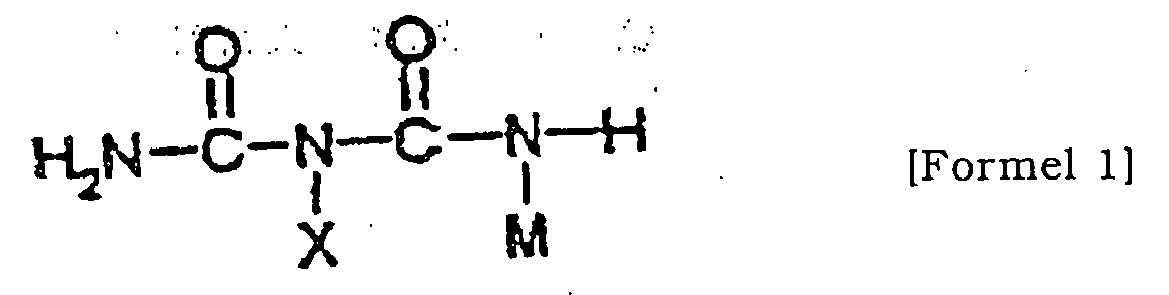
worin M ein Metall ist, gewählt aus der Gruppe, bestehend aus Natrium, Kalium und Calcium, und X ein Halogen ist, gewählt aus der Gruppe, bestehend aus Fluor, Chlor, Brom und Iod.
worin M ein Metall ist, gewählt aus der Gruppe, bestehend aus Natrium, Kalium und Calcium, und X ein Halogen ist, gewählt aus der Gruppe, bestehend aus Fluor, Chlor, Brom und Iod.
2. Verfahren nach Anspruch 1, wobei das Monohalogenbiuret-Metallsalz abgeleitet ist von
einer Umsetzung zwischen Biuret der folgenden Formel 3 und einer Metallhypohalogenverbindung
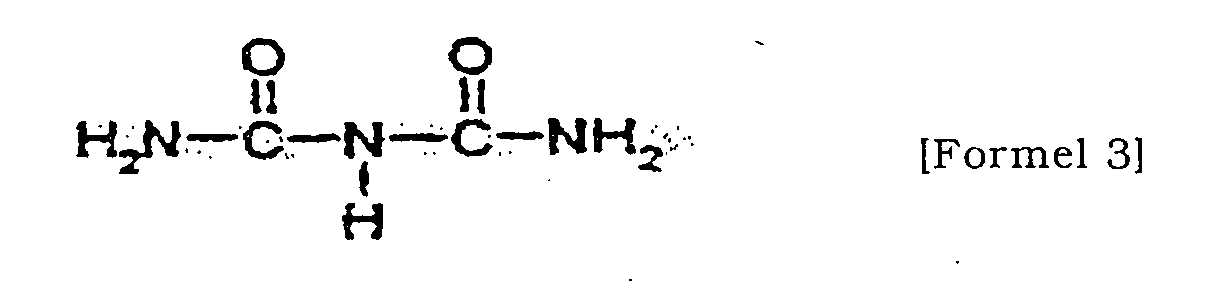
3. Verfahren nach Anspruch 2, wobei das Biuret und die Metallhypohalogenverbindung in
einem Molverhältnis von 0,5:1 bis 10:1 umgesetzt werden.
4. Verfahren nach Anspruch 1, wobei zur Herstellung des Monohalogenbiuret-Metallsalzes
Biuret der folgenden Formel 3 mit einem Metallhydroxid gemischt und dann mit einem
Halogengas umgesetzt wird, oder das Biuret mit einem Halogengas umgesetzt und eine
Base dann zu der Reaktionsmischung zugegeben wird
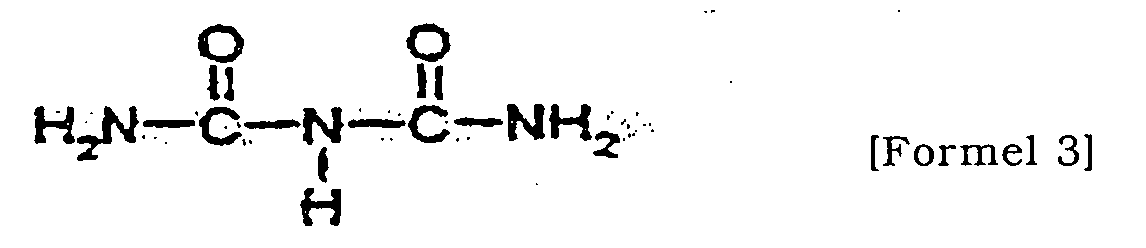
5. Verfahren nach Anspruch 2, wobei die Umsetzung bei 35°C oder weniger durchgeführt
wird.
6. Verfahren nach Anspruch 3, wobei die Umsetzung bei 35°C oder weniger durchgeführt
wird.
7. Vefahren nach Anspruch 4, wobei die Umsetzung bei 35°C oder weniger durchgeführt wird.
8. Verfahren nach Anspruch 1, wobei das Ammoniak flüssiges Ammoniak, gasförmiges Ammoniak
oder Ammoniakwasser ist.
9. Verfahren nach Anspruch 1, wobei das Monohalogenbiuret-Metallsalz und Ammoniak in
einem Molverhältnis von 1:1 1 bis 1:1.000 umgesetzt werden.
10. Verfahren nach Anspruch 1, wobei die Umsetzung bei einer Temperatur von 30 bis 150°C
durchgeführt wird.
11. Verfahren nach Anspruch 1, wobei das Lösungsmittel Wasser ist.
12. Verfahren nach Anspruch 1, wobei das Lösungsmittel eine Wasser und ein organisches
Lösungsmittel enthaltende Lösungsmittelmischung ist und die Menge des zugesetzten
organischen Lösungsmittels das 0,1- bis 50-fache des Gewichts, bezogen auf die Menge
an Wasser, beträgt.
13. Verfahren nach Anspruch 12, wobei das organische Lösungsmittel mindestens eines ist,
gewählt aus der Gruppe, bestehend aus einem aprotischen polaren Lösungsmittel und
einem protischen polaren Lösungsmittel mit einer Dielektrizitätskonstante von 50 oder
weniger.
14. Verfahren nach Anspruch 1, wobei mindestens ein Katalysator zugesetzt wird, gewählt
aus der Gruppe, bestehend aus Sulfaten, Chloriden, Carbonaten und Hydroxiden eines
Übergangsmetalls oder Alkalimetalls und Schwermetallsalzen von Carbonsäuren, und die
Menge des zugesetzten Katalysators 0,001 bis 1 Mol, bezogen auf 1 Mol an Monohalogenbiuret-Metallsalz
der Formel 1, beträgt.
15. Verfahren nach Anspruch 1, wobei weiterhin mindestens ein anorganischer Katalysator,
gewählt aus der Gruppe, bestehend aus Chlorwasserstoffsäure, Schwefelsäure und Salpetersäure,
zugegeben wird und die Menge des anorganischen Katalysators 0,5 bis 3,0 Mol, bezogen
auf 1 Mol des Monohalogenbiuret-Metallsalzes der Formel 1, beträgt.
1. Une méthode pour la synthèse d' hydrazodicarbonamide par une réaction d'un sel métallique
de monohalobiuret ayant la formule 1 ou 2, et de l'amoniaque dans un solvant.


dans lesquelles M est un métal choisi dans le groupe constitué par le sodium, le potassium et le calcium, et X est un halogène choisi dans le groupe constitué par le fluor, le chlore, le brome, et l'iode.
dans lesquelles M est un métal choisi dans le groupe constitué par le sodium, le potassium et le calcium, et X est un halogène choisi dans le groupe constitué par le fluor, le chlore, le brome, et l'iode.
2. La méthode de la revendication 1, dans laquelle le sel métallique de monohalobiuret
est obtenu par une réaction entre le biuret ayant la formule 3 ci-après et un composé
d'hypohalogénure de métal

3. La méthode de la revendication 2, dans laquelle le biuret et le composé d'hypohalogénure
de métal sont mis en réaction dans un rapport molaire de 0, 5 :1 à 10 :1.
4. La méthode de la revendication 1, dans laquelle pour la préparation du sel métallique
de monohalobiuret, le biuret ayant la formule 3 suivante est mélangé avec un hydroxyde
de métal puis est mis en réaction avec un halogène gazeux, ou le biuret est mis en
réaction avec un halogène gazeux et une base et est ajouté au mélange réactionnel

5. La méthode de la revendication 2, dans laquelle la réaction est effectuée à 35° C
ou moins.
6. La méthode de la revendication 3, dans laquelle la réaction est effectuée à 35° C
ou moins.
7. La méthode de la revendication 4, dans laquelle la réaction est effectuée à 35° C
ou moins.
8. La méthode de la revendication 1, dans laquelle l'amoniaque est de l'amoniaque liquide,
de l'amoniac gazeux ou de l'eau amoniaquée.
9. La méthode de la revendication 1, dans laquelle le sel métallique de monohalobiuret
et l'amoniac sont mis en réaction dans un rapport molaire de 1 : 1 à 1 : 1000.
10. La méthode de la revendication 1, dans laquelle la réaction a été effectuée à une
température de 30 à 150°C.
11. La méthode de la revendication 1, dans laquelle le solvant est l'eau.
12. La méthode de la revendication 1, dans laquelle le solvant est un mélange contenant
de l'eau et un solvant organique et la quantité de solvant organique ajouté est de
0, 1 à 50 fois en poids par rapport à la quantité d'eau.
13. La méthode de la revendication 12, dans laquelle le solvant organique est au moins
un solvant choisi dans le groupe constitué par un solvant aprotique polaire et un
solvant protique polaire ayant une constante diélectrique de 50 ou moins.
14. La méthode de la revendication 1, dans laquelle au moins un catalyseur choisi dans
le groupe constitué par des sulfates, des chlorures, des carbonates et des hydroxydes
de métal de transition ou de métal alcalin, et des sels de métal lourd d'acide carboxylique
et la quantité de catalyseur ajouté est de 0, 001 à 1 mole par rapport à une mole
de sel métallique de monohalobiuret ayant la formule 1.
15. La méthode de la revendication 1, dans laquelle au moins un catalyseur inorganique
choisi dans le groupe constitué par l'acide chlorhydrique, l'acide sulfurique et l'acide
nitrique est ajouté en outre et la quantité de catalyseur inorganique est de 0, 5
à 3, 0 moles par rapport à 1 mole de sel métallique de monohalobiuret ayant la formule
1.