|
(11) | EP 1 456 168 B1 |

| (12) | EUROPEAN PATENT SPECIFICATION |
|
|
| (54) |
PROCESS FOR THE CONTINUOUS QUATERNISATION OF TERTIARY AMINES WITH AN ALKYL HALIDE VERFAHREN ZUR KONTINUIERLICHEN QUATERNISIERUNG TERTIÄRER AMINE MIT EINEM ALKYLHALOGENID PROCEDE DE QUATERNARISATION CONTINUE D'AMINES TERTIAIRES AVEC UN HALOGENURE D'ALKYLE |
|
|
|||||||||||||||||||||||||||||||
| Note: Within nine months from the publication of the mention of the grant of the European patent, any person may give notice to the European Patent Office of opposition to the European patent granted. Notice of opposition shall be filed in a written reasoned statement. It shall not be deemed to have been filed until the opposition fee has been paid. (Art. 99(1) European Patent Convention). |
[0001] The present invention relates to a continuous process for the quaternisation of tertiary amines with an alkyl halide that is dissolved in the reaction mixture.
[0002] Several methods for quaternisation of amines with alkyl halides have been disclosed. The quaternisation processes are performed within a variety of pressure and temperature ranges, and at different molar ratios between the amine and the quaternising agent. There are included embodiments both of batch-wise as well as continuous processes.
[0003] In EP 0 869 114 a quaternisation process is described where an alkoxylated ester-amine is reacted with a quaternising agent at a pressure of 1-50 bars. The process is batch-wise, and in the working examples the process is performed in a low-pressure autoclave with 1.025 mole methyl chloride per mole ester-amine during 24 hours or more.
[0004] In US 3 813 441 a continuous process for the manufacture of quaternary ammonium chlorides is described, where a primary or a secondary amine is reacted with methyl chloride at a temperature of 50-80°C and at a pressure of 3 to 10 atm. The reaction is performed in the presence of an aqueous solution of an alkali metal hydroxide and a lower alcohol. Since a primary or secondary amine is the starting material, sodium chloride is formed during the reaction and has to be removed continuously.
[0005] US 5 491 240 discloses in the working examples a batch process for the manufacture of a quaternary ammonium compound by reacting a tertiary amine stepwise with a quaternising agent, e.g. methyl chloride, at a pressure of maximum 62 psig (about 5.3 bar) during reaction times of about 10 hours. Solvent is added intermittently if the viscosity gets too high, to maintain the reaction mixture in the liquid state during the reaction.
[0006] EP 0 288 857 describes a quaternisation reaction between a tertiary amine and an alkyl halide present in a molar ratio ranging from 1:3 to 1:8 at a temperature between 50-150°C at an over-pressure (18 and 27.5 bar in the examples). The reaction is performed batch-wise in the absence of solvents, and the quaternary ammonium compound is obtained in powdered form. The reaction time stated in the examples was about 2 hours. EP 0 012 296 and US 4 275 235 describe a similar process using the same molar ratio range.
[0007] In US 5 041 664 a continuous quaternisation process is disclosed where a long chain tertiary amine and an alkyl chloride are reacted in the presence of a heterogeneous catalyst in the presence of an alcohol solvent. The mole ratio between the amine and the chloride is suitably 1:1.2 to 1.2:1, preferably 1:1, and the pressure may be from about 1 to 210 bar. In the working example 70 bar is used.
[0008] WO 00/433348 relates to a process for making an aqueous solution of unsaturated quaternary ammonium salts ba racting, in the presence of water, N,N-dimethylaminoethyl acrylate with a quaternising agent such as methyl chloride. The process is carried out continuously in a tubular reactor, where the quaternising agent is introduced at the reactor base and N,N-dimethylaminoethyl acrylate and water at the top of the reactor. The reaction is carried out at a temperature between 35 to 60°C, at a pressure of 10 to 20 bars, and using preferably a molar ratio between methyl chloride and N,N-dimethylaminoethyl acrylate between 1:1 and 1.5:1.
[0009] The aim of the present invention is to create a continuous process for the manufacture of quaternary ammonium compounds from tertiary amines and alkyl halides, which is performed at moderate pressures and temperatures, and with short reaction times and no need for solvents, nor for catalysts. The process should also give high product yields and low amounts of by-products.
[0010] It has surprisingly been found that these objects can be fulfilled by a continuous process for manufacturing a quaternary ammonium compound by reacting, at a temperature between 50°C and 140°C, preferably from 70°C to 130°C and most preferably from 80°C to 125°C, a tertiary amine and an alkyl halide in a tubular reactor at a pressure sufficient to keep the alkyl halide dissolved in the reaction mixture, preferably at 12-65 bar, more preferably at 15-55 bar and most preferably at 18-50 bar, the molar ratio between the tertiary amine and the alkyl halide being from 1:1.3 to 1:2.9, preferably from 1:1.4 to 1:2.7 and most preferably from 1:1.5 to 1:2.6. The process could be performed either with or without a solvent present, preferably without a solvent.
[0012] Firstly, by using a pressure between 12 and 65 bar within the given temperature interval, the alkyl halide will be present in a solution together with the tertiary amine reactant, the quaternary ammonium product formed during the reaction and optionally a solvent. Thereby the viscosity of the reaction mixture will be reduced. The reaction may even be performed without any solvent, which will lead to less byproduct formation. To use a pressure above 65 bar will not give any additional advantages during the present conditions. No significant increase in the reaction rate will be achieved, and such a high pressure will require more expensive equipment. The optimal pressure depends for example on the temperature and the type of alkyl halide chosen, but is normally from 18 to 30 bar for a reaction performed in a solvent, and normally from 30 to 50 bar for a solvent-free process. When a solvent, such as an alcohol, is present during the quaternisation process, by-products, such as ethers, may be formed from the solvent and the alkyl halide. When recycling the unreacted alkyl halide, there will normally be a build-up of these by-products that may cause severe problems in the commercial production process, as well as for the quality of the desired quaternary ammonium products.
[0013] Secondly, by using a molar ratio of tertiary amine to alkyl halide between 1:1.3 and 1:2.9, there will be a smaller volume of the reactor occupied by the alkyl halide and a smaller amount of alkyl halide to recycle as compared to the process described in the working examples in EP 0 288 857, where the ratio is 1:3.4.
[0014] Thirdly, a continuous process according to the invention, which results in a short residence time and makes optimal use of the available reactor space, will give rise to a higher space time yield and a better quality of the product, such as low colour.
[0015] Preferably the reaction mixture is blended with the aid of internals in the tubular reactor. The presence of internals promotes plug-flow behaviour of the reaction mixture, and will further increase the reaction rate and the production capacity of the tubular reactor. Suitable internals are for example an inert packing, such as glass raschig rings.
[0016] The temperature according to the invention varies within the range of 50 to 140°C. At temperatures below 50°C the reaction rate is not sufficient, and above 140°C there is too much decomposition of the quaternary ammonium salt and formation of by-products. The temperature range is normally between 80 and 125°C.
[0017] The quaternary ammonium compounds that may be manufactured by the process of the present invention could have the formula
R1R2R3R4N+ X- (I)
where R1 is a hydrocarbyl group containing 1-22 carbon atoms, preferably 1-4 carbon atoms; R2 and R3 are the same or different hydrocarbyl groups containing 1-22 carbon atoms, preferably 8-22 carbon atoms, which could be saturated or unsaturated, linear or branched, or a group (AO) yH where AO is an alkyleneoxy group with 2 or 3 carbon atoms, preferably 2 carbon atoms, and y is a number between 1-50; R4 is an alkyl group containing 1-4 carbon atoms, preferably 1-2 carbon atoms; X- is a halide anion, preferably Cl-, Br- or I- and most preferably Cl-. These quaternary compounds are obtainable by the process of the present invention by reacting a tertiary amine of the formula R1R2R3N with an alkyl halide of the formula R4X, where X is halogen and R1, R2, R3 and R4 have the same meaning as in formula I. Suitable examples of the tertiary amines are di(tallow alkyl)methylamine, (tallow alkyl)dimethylamine, di(hydrogenated tallow alkyl)methylamine, (hydrogenated tallow alkyl)dimethylamine, di(rape seed alkyl)methylamine, (rape seed alkyl)dimethylamine, di(soya alkyl)methylamine, (soya alkyl)dimethylamine, di(coco alkyl)methylamine, (coco alkyl)dimethylamine, distearylmethylamine, stearyldimethylamine, dilaurylmethylamine, lauryldimethylamine, polyethoxylated primary amines, such as polyethoxylated cocoamine, polyethoxylated (tallow alkyl)amine and polyethoxylated (hydrogenated tallow alkyl)amine and polyethoxylated secondary amines, such as polyethoxylated dicocoamine, polyethoxylated di(tallow alkyl)amine and polyethoxylated di(hydrogenated tallow alkyl)amine.
[0018] Other quaternary ammonium compounds that may be formed by the process of the present invention have the formula
R5R6R7N+(CpH2p) (OA)zQ-R8 X- (II)
where R5 and R6 independently is an alkyl group containing 1-6 carbon atoms, preferably 1-4 carbon atoms and most preferably 1-2 carbon atoms; R7 is - (CpH2p) (OA) zQ-R8 or a hydrocarbyl group with 1-22 carbon atoms, preferably 1-6 carbon atoms, more preferably 1-4 carbon atoms and most preferably 1-2 carbon atoms; R8 is a hydrocarbyl group with 1-22 carbon atoms, preferably 8-22 carbon atoms; Q is
p is a number from 1 to 6, preferably 2-3, OA is an oxyalkylene group with 2 or 3 carbon atoms, preferably 2 carbon atoms, z is a number between 0 and 50; R9 is H or a hydrocarbyl group with 1-22 carbon atoms and X- has the same meaning as in formula I. R8 and R9 could be saturated or unsaturated, linear or branched. The products of formula II include the so-called esterquats. These are obtainable by the process of the present invention by reacting a tertiary amine of formula R6R7N(CpH2p) (OA) zQ-R8 with an alkyl halide of the formula R5X, where Q is -C(=O)-O or -O-C(=O), X is halogen and R5, R6, R7, R8, p, OA and z have the same meaning as above. Suitable examples of these tertiary amines are the diesters of stearic acid, coco fatty acid, tallow fatty acid, rape seed fatty acid, soya fatty acid, oleic acid, palmitic acid or lauric acid and methyldiethanolamine. Also included are the amidoquats, which are obtained in an analogous manner from a tertiary amine according to the above formula where Q is -N (R9) -C (=O) or -C (=O) -N (R9) . Suitable examples of these tertiary amines are the amidoamines obtained from N,N-dimethylpropylenediamine and a fatty acid such as stearic acid, coco fatty acid, tallow fatty acid, rape seed fatty acid, soya fatty acid, oleic acid, palmitic acid or lauric acid.
[0019] Still another group of quaternary ammonium compounds that may be obtained by the process of the present invention has the formula
where each Y independently is H or -C(=O)-R8, Σa+b+c is 3-50 and R5, R8 and X- have the same meaning as above. These quaternary ammonium compounds are esterquats that are obtainable by the process of the present invention from fatty acid esters of triethanolamine or ethoxylated triethanolamine and an alkyl halide R5X, where X is halogen and R5 has the same meaning as in formula III. Suitable examples are the esters obtained from triethanolamine or ethoxylated triethanolamine and an acid selected from the group stearic acid, coco fatty acid, tallow fatty acid, rape seed fatty acid, soya fatty acid, oleic acid, palmitic acid and lauric acid.
[0020] The compounds that may be quaternised by the process of the present invention are not limited to the types mentioned above. For example, also tertiary amines selected from the group consisting of di- and polyamines, alkoxylated di- and polyamines, 3-alkyloxypropylamines, alkoxylated 3-alkyloxypropylamines, N-(3-alkoxypropyl)-1,3-propanediamines, alkoxylated N-(3-alkoxypropyl)-1,3-propanediamines, amidoamines and amino acids may be quaternised. The only requirement is that the compound to be quaternised should contain a tertiary amino group and no primary or secondary amino groups.
[0021] The alkyl halide used as the quaternising agent is preferably methyl chloride, methyl bromide, ethyl chloride or ethyl bromide, and most preferably methyl chloride.
[0022] The following examples are illustrative of the invention, and should not be construed as limiting thereof.
Example 1
[0023] A 0.4 1 tubular reactor with an internal diameter of 0.01 m, filled with an inert packing consisting of glass raschig rings, was used for the continuous reaction of 68 g/hour di(hydrogenated tallow alkyl)methylamine/isopropanol mixture with methyl chloride. The reactant tertiary amine/methyl chloride molar ratio was 1:1.6 (MW amine = 523) and the isopropanol content was 15% counted on tertiary amine. During the quaternisation the reactor temperature was kept at 100°C and the reactor pressure was 20 bar. The resulting product was depressurized and collected in a heated glass round bottom flask equipped with a condenser. The excess amount of methyl chloride was removed by nitrogen purging. At a residence time of 3 hours the tertiary amine conversion to the quaternary ammonium chloride was 97.5%. The desired product was obtained in the form of a yellow clear liquid solution above 70°C.
Example 2
[0024] The same equipment as described in example 1 was used for a continuous reaction of 102g/hour diester of stearic acid and methyldiethanolamine/ethanol mixture with methyl chloride at 100°C and 20 bar. The reactant tertiary amine/methyl chloride molar ratio was 1:1.6 (MW amine = 598) and the ethanol content was 15% counted on tertiary amine. At a residence time of 2 hours the tertiary amine conversion to the quaternary ammonium chloride was 97%. The desired product was obtained in the form of a slightly yellow clear liquid solution above 70°C.
Example 3
[0025] The same equipment as described in example 1 was used for a continuous reaction of 68g/hour diester of stearic acid and methyldiethanolamine with methyl chloride at 100°C and 35 bar. The reactant tertiary amine/methyl chloride molar ratio was 1:2.5 (MW amine = 598). At a residence time of 3 hours the tertiary amine conversion to the quaternary ammonium chloride was 96%. After depressurization sufficient ethanol was added to the product in order to obtain the desired activity, whereafter the remaining excess amount of methyl chloride was removed by nitrogen purging. The desired product was obtained in the form of a slightly yellow clear liquid solution above 70°C.
Example 4
[0026] The same equipment as described in example 1 was used for a continuous reaction of 106g/hour di(coco alkyl)methyl amine with methyl chloride at 100°C and 30 bar. The reactant tertiary amine/methyl chloride molar ratio was 1:2.35 (MW amine = 397). At a residence time of 2 hours the tertiary amine conversion to the quaternary ammonium chloride was 98%. After depressurization ethanol was added to the product in order to obtain a solution, whereafter the remaining excess amount of methyl chloride was removed by nitrogen purging. The desired product was obtained in the form of a slightly yellow clear liquid solution above 70°C.
Comparison 1
[0027] The same equipment as described in example 1 was used for a continuous reaction of 68g/hour diester of stearic acid and methyldiethanolamine/isopropanol mixture with methyl chloride at 100°C and 20 bar. The reactant tertiary amine/methyl chloride molar ratio was 1:1.2 (MW amine = 598) and the isopropanol content was 15% counted on tertiary amine. At a residence time of 3 hours the tertiary amine conversion to the quaternary ammonium chloride was 89%.
Comparison 2
[0028] The same equipment as described in example 1 was used for a continuous reaction.of 68g/hour diester of stearic acid and methyldiethanolamine/isopropanol mixture with methyl chloride at 100°C and 7 bar. The reactant tertiary amine/methyl chloride molar ratio was 1:1.6 (MW amine = 602) and the ethanol content was 15% counted on tertiary amine. At a residence time of 3 hours the tertiary amine conversion to the quaternary ammonium chloride was 88%.
Comparison 3
[0029] The same equipment as described in example 1 was used for a continuous reaction of 68g/hour diester of stearic and methyldiethanolamine with methyl chloride at 100°C and 20 bar. The reactant tertiary amine/methyl chloride molar ratio was 1:4 (MW amine = 598). At a residence time of three hours the tertiary amine conversion to the quaternary ammonium chloride was 89%. In Example 3 a conversion of 96% was achieved with a molar ratio of only 1:2.5.
1. A continuous process for manufacturing a quaternary ammonium compound by reacting,
at a temperature of from 50°C to 140°C, a tertiary amine and an alkyl halide characterised in that the reaction is performed in a tubular reactor containing internals that are promoting
plug-flow behaviour at a pressure from 12 to 65 bar and sufficient to keep the alkyl
halide dissolved in the reaction mixture, the molar ratio between the tertiary amine
and the alkyl halide being from 1:1.3 to 1:2.9.
2. A process according to claim 1 characterised in that the pressure is from 15 to 55 bar and the molar ratio between the tertiary amine
and the alkyl halide is 1:1.4 to 1:2.7.
3. A process according to claim 1-2 characterised in that the reaction mixture is, except for the alkyl halide, free from solvents.
4. A process according to claim 3 charactarised in that the pressure is 30-50 bar.
5. A process according to claim 1-4 characterized in that the alkyl halide is methyl chloride, methyl bromide or ethyl chloride.
6. A process according to claim 1-5 characterise in that the quaternary ammonium compound has the formula
R1R2R3R4N+ X- (I)
where R1 is a hydrocarbyl group containing 1-22 carbon atoms; R2 and R3 are the same or different hydrocarbyl groups containing 1-22 carbon atoms or a group (AO)yH, where AO is an alkyleneoxy group with 2 or 3 carbon atoms and y is a number between 1-50; R4 is an alkyl group containing 1-4 carbon atoms and X- is a halide amnion.
R1R2R3R4N+ X- (I)
where R1 is a hydrocarbyl group containing 1-22 carbon atoms; R2 and R3 are the same or different hydrocarbyl groups containing 1-22 carbon atoms or a group (AO)yH, where AO is an alkyleneoxy group with 2 or 3 carbon atoms and y is a number between 1-50; R4 is an alkyl group containing 1-4 carbon atoms and X- is a halide amnion.
7. A process recording to claim 1-5 characterises in that the quaternary ammonium compound has the formula
R5R6R7N+(CpH2p) (OA) zQ-R8 X- (II)
where R5 and R6 independently is an alkyl group containing 1-6 carbon atoms; R7 is - (CpH2p) (OA) zQ-R8 or a hydrocarbyl group with 1-22 carbon atoms; R8 is a hydrocarbyl group with 1-22 carbon atoms; Q is

p is a number from 1 to 6, OA is an oxyalkylene group with 2 or 3 carbone atoms, z is a number between 0 and 50; R9 is H or a hydrocarbyl group with 1-22 carbon atoms, and X- has the same meaning as in formula I in claim 6.
R5R6R7N+(CpH2p) (OA) zQ-R8 X- (II)
where R5 and R6 independently is an alkyl group containing 1-6 carbon atoms; R7 is - (CpH2p) (OA) zQ-R8 or a hydrocarbyl group with 1-22 carbon atoms; R8 is a hydrocarbyl group with 1-22 carbon atoms; Q is
p is a number from 1 to 6, OA is an oxyalkylene group with 2 or 3 carbone atoms, z is a number between 0 and 50; R9 is H or a hydrocarbyl group with 1-22 carbon atoms, and X- has the same meaning as in formula I in claim 6.
8. A process according to claim 1-5 characterised in that the quaternary ammonium compound has the formula
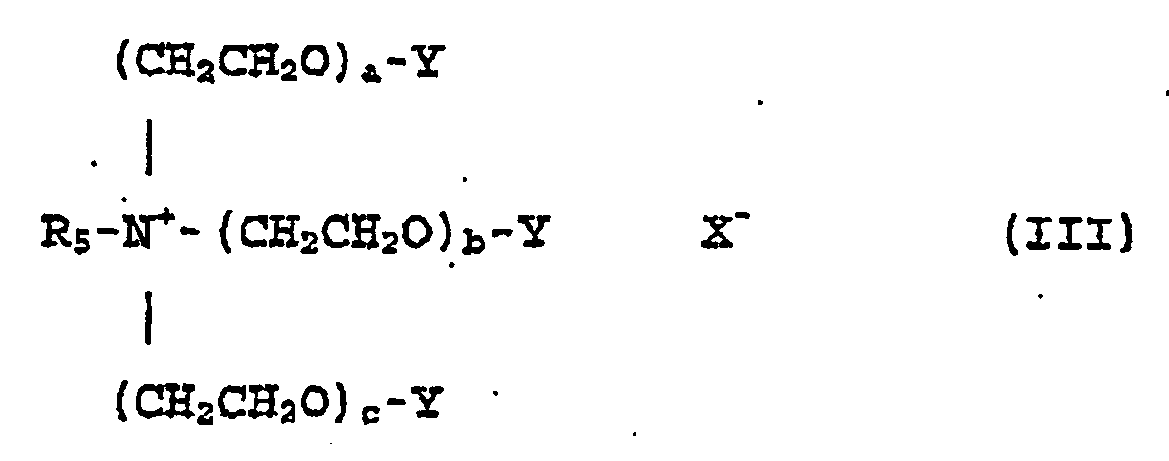
where each Y independently is H or -C (=O)-R8, Σa+b+c is 3-50 and R5, R8 and X- have the same meaning as in formula II in claim 7.
where each Y independently is H or -C (=O)-R8, Σa+b+c is 3-50 and R5, R8 and X- have the same meaning as in formula II in claim 7.
1. Kontinuierliches Verfahren zur Herstellung einer quaternären Ammoniumverbindung durch
Umsetzen eines tertiären Amins und eines Alkylhalogenids bei einer Temperatur von
50 °C bis 140 °C, dadurch gekennzeichnet, dass die Reaktion in einem Rohrreaktor, der Einbauten enthält, die eine Pfropfenströmung
fördern, bei einem Druck von 12 bis 65 bar, der ausreicht, um das Alkylhalogenid im
Reaktionsgemisch gelöst zu halten, durchgeführt wird, wobei das Stoffmengenverhältnis
zwischen dem tertiären Amin und dem Alkylhalogenid 1:1,3 bis 1:2,9 beträgt.
2. Verfahren gemäß Anspruch 1, dadurch gekennzeichnet, dass der Druck 15 bis 55 bar beträgt und das Stoffmengenverhältnis zwischen dem tertiären
Amin und dem Alkylhalogenid 1:1,4 bis 1:2,7 beträgt.
3. Verfahren gemäß Anspruch 1 bis 2, dadurch gekennzeichnet, dass das Reaktionsgemisch abgesehen von dem Alkylhalogenid frei von Lösungsmitteln ist.
4. Verfahren gemäß Anspruch 3, dadurch gekennzeichnet, dass der Druck 30 bis 50 bar beträgt.
5. Verfahren gemäß Anspruch 1 bis 4, dadurch gekennzeichnet, dass es sich bei dem Alkylhalogenid um Methylchlorid, Methylbromid oder Ethylchlorid handelt.
6. Verfahren gemäß Anspruch 1 bis 5, dadurch gekennzeichnet, dass die quaternäre Ammoniumverbindung die Formel
R1R2R3R4N+ X- (I)
hat, wobei R1 eine Kohlenwasserstoffgruppe ist, die 1 bis 22 Kohlenstoffatome enthält;
R2 und R3 gleiche oder verschiedene Kohlenwasserstoffgruppen, die 1 bis 22 Kohlenstoffatome enthalten, oder eine Gruppe (AO)yH sind, wobei AO eine Alkylenoxygruppe mit 2 oder 3 Kohlenstoffatomen ist und y eine Zahl von 1 bis 50 ist;
R4 eine Alkylgruppe ist, die 1 bis 4 Kohlenstoffatome enthält; und
X- ein Halogenid-Anion ist.
R1R2R3R4N+ X- (I)
hat, wobei R1 eine Kohlenwasserstoffgruppe ist, die 1 bis 22 Kohlenstoffatome enthält;
R2 und R3 gleiche oder verschiedene Kohlenwasserstoffgruppen, die 1 bis 22 Kohlenstoffatome enthalten, oder eine Gruppe (AO)yH sind, wobei AO eine Alkylenoxygruppe mit 2 oder 3 Kohlenstoffatomen ist und y eine Zahl von 1 bis 50 ist;
R4 eine Alkylgruppe ist, die 1 bis 4 Kohlenstoffatome enthält; und
X- ein Halogenid-Anion ist.
7. Verfahren gemäß Anspruch 1 bis 5, dadurch gekennzeichnet, dass die quaternäre Ammoniumverbindung die Formel
R5R6R7N+(CpH2p)(OA)zQ-R8 X- (II)
hat, wobei R5 und R6 unabhängig eine Alkylgruppe sind, die 1 bis 6 Kohlenstoffatome enthält;
R7 = -(CpH2p)(OA)zQ-R8 oder eine Kohlenwasserstoffgruppe mit 1 bis 22 Kohlenstoffatomen ist;
R8 eine Kohlenwasserstoffgruppe mit 1 bis 22 Kohlenstoffatomen ist;
Q

ist;
p eine Zahl von 1 bis 6 ist, OA eine Oxyalkylengruppe mit 2 oder 3 Kohlenstoffatomen ist, z eine Zahl von 0 bis 50 ist;
R9 = H oder eine Kohlenwasserstoffgruppe mit 1 bis 22 Kohlenstoffatomen ist; und
X- dasselbe wie in Formel I in Anspruch 6 bedeutet.
R5R6R7N+(CpH2p)(OA)zQ-R8 X- (II)
hat, wobei R5 und R6 unabhängig eine Alkylgruppe sind, die 1 bis 6 Kohlenstoffatome enthält;
R7 = -(CpH2p)(OA)zQ-R8 oder eine Kohlenwasserstoffgruppe mit 1 bis 22 Kohlenstoffatomen ist;
R8 eine Kohlenwasserstoffgruppe mit 1 bis 22 Kohlenstoffatomen ist;
Q
ist;
p eine Zahl von 1 bis 6 ist, OA eine Oxyalkylengruppe mit 2 oder 3 Kohlenstoffatomen ist, z eine Zahl von 0 bis 50 ist;
R9 = H oder eine Kohlenwasserstoffgruppe mit 1 bis 22 Kohlenstoffatomen ist; und
X- dasselbe wie in Formel I in Anspruch 6 bedeutet.
8. Verfahren gemäß Anspruch 1 bis 5, dadurch gekennzeichnet, dass die quaternäre Ammoniumverbindung die Formel
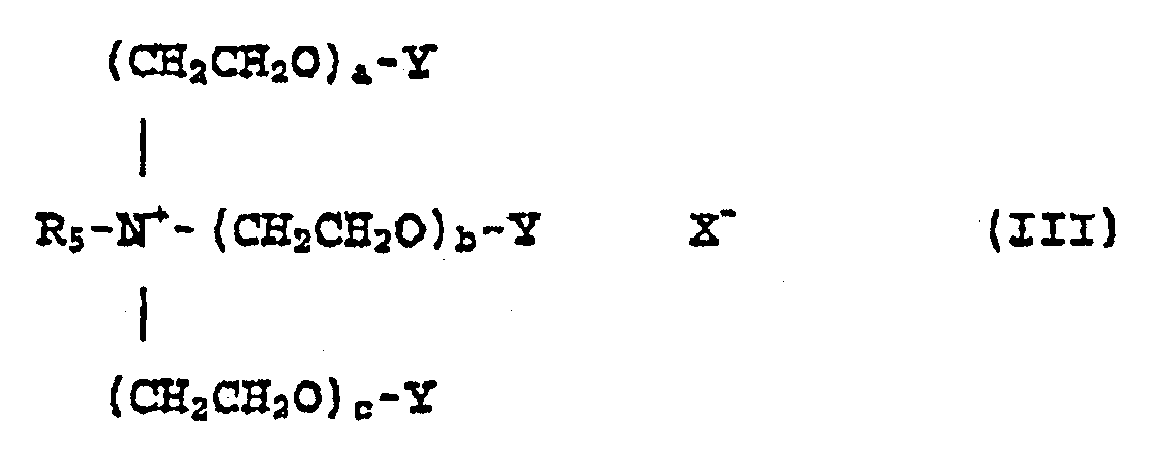
hat, wobei Y jeweils unabhängig H oder -C(=O)-R8 ist, die Summe a + b + c = 3 bis 50 ist und R5, R8 und X- dasselbe wie in Formel II in Anspruch 7 bedeuten.
hat, wobei Y jeweils unabhängig H oder -C(=O)-R8 ist, die Summe a + b + c = 3 bis 50 ist und R5, R8 und X- dasselbe wie in Formel II in Anspruch 7 bedeuten.
1. Procédé continu pour la préparation d'un composé d'ammonium quaternaire par réaction,
à une température de 50 à 140°C, d'une amine tertiaire et d'un halogénure d'alkyle,
caractérisé en ce que la réaction est mise en oeuvre dans un réacteur tubulaire contenant des chicanes
internes qui favorisent un comportement d'écoulement piston à une pression de 12 à
65 bars et suffisante pour maintenir l'halogénure d'alkyle à l'état dissous dans le
mélange réactionnel, le rapport molaire entre l'amine tertiaire et l'halogénure d'alkyle
étant de 1:1,3 à 1:2,9.
2. Procédé selon la revendication 1, caractérisé en ce que la pression est de 15 à 55 bars et en ce que le rapport molaire entre l'amine tertiaire et l'halogénure d'alkyle est de 1:1,4
à 1:2,7.
3. Procédé selon les revendications 1 et 2, caractérisé en ce que le mélange réactionnel est, hormis pour l'halogénure d'alkyle, dépourvu de solvants.
4. Procédé selon la revendication 3, caractérisé en ce que la pression est de 30 à 50 bars.
5. Procédé selon les revendications 1 à 4, caractérisé en ce que l'halogénure d'alkyle est le chlorure de méthyle, le bromure de méthyle ou le chlorure
d'éthyle.
6. Procédé selon les revendications 1 à 5, caractérisé en ce que le composé d'ammonium quaternaire répond à la formule :
R1R2R3R4N+ X- (I)
où R1 est un groupe hydrocarbyle contenant de 1 à 22 atomes de carbone ; R2 et R3 sont des groupes hydrocarbyle identiques ou différents contenant de 1 à 22 atomes de carbone ou un groupe (AO) yH, où AO est un groupe alkylèneoxy ayant 2 ou 3 atomes de carbone et y est un nombre compris entre 1 et 50, R4 est un groupe alkyle contenant de 1 à 4 atomes de carbone et X- est un anion halogénure.
R1R2R3R4N+ X- (I)
où R1 est un groupe hydrocarbyle contenant de 1 à 22 atomes de carbone ; R2 et R3 sont des groupes hydrocarbyle identiques ou différents contenant de 1 à 22 atomes de carbone ou un groupe (AO) yH, où AO est un groupe alkylèneoxy ayant 2 ou 3 atomes de carbone et y est un nombre compris entre 1 et 50, R4 est un groupe alkyle contenant de 1 à 4 atomes de carbone et X- est un anion halogénure.
7. Procédé selon les revendications 1 à 5, caractérisé en ce que le composé d'ammonium quaternaire répond à la formule
R5R6R7N+(CpH2p) (OA)zQ-R8 X- (II)
où R5 et R6 sont indépendamment un groupe alkyle contenant de 1 à 6 atomes de carbone ; R7 est - (CpH2p) (OA) zQ-R8 ou un groupe hydrocarbyle ayant de 1 à 22 atomes ; R8 est un groupe hydrocarbyle ayant de 1 à 22 atomes de carbone ; Q est

p est un nombre de 1 à 6, OA est un groupe oxyalkylène ayant 2 ou 3 atomes de carbone, z est un nombre compris entre 0 et 50 ; R9 est H ou un groupe hydrocarbyle ayant de 1 à 22 atomes de carbone, et X- a la même signification que dans la formule I de la revendication 6.
R5R6R7N+(CpH2p) (OA)zQ-R8 X- (II)
où R5 et R6 sont indépendamment un groupe alkyle contenant de 1 à 6 atomes de carbone ; R7 est - (CpH2p) (OA) zQ-R8 ou un groupe hydrocarbyle ayant de 1 à 22 atomes ; R8 est un groupe hydrocarbyle ayant de 1 à 22 atomes de carbone ; Q est
p est un nombre de 1 à 6, OA est un groupe oxyalkylène ayant 2 ou 3 atomes de carbone, z est un nombre compris entre 0 et 50 ; R9 est H ou un groupe hydrocarbyle ayant de 1 à 22 atomes de carbone, et X- a la même signification que dans la formule I de la revendication 6.
8. Procédé selon les revendications 1 à 5, caractérisé en ce que le composé d'ammonium quaternaire répond à la formule :
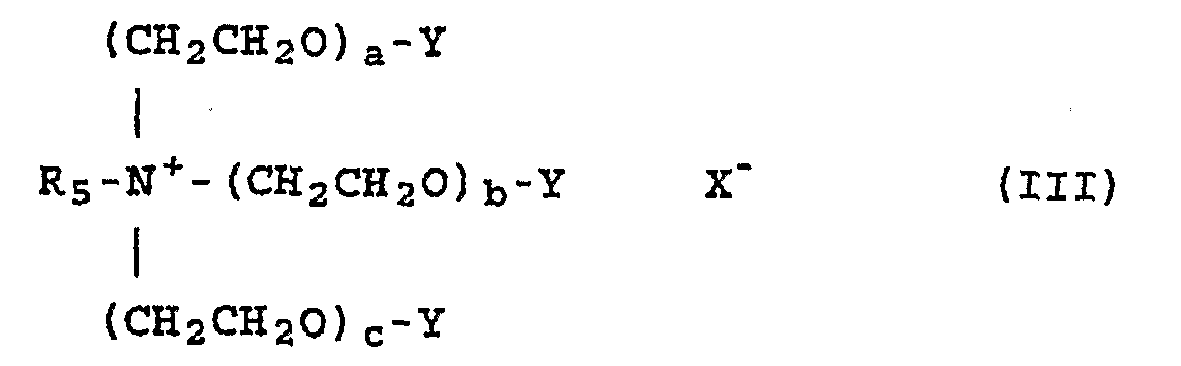
où chaque Y est indépendamment H ou -C(=O)-R8, Σa+b+c est de 3 à 50 et R5, R8 et X- ont la même signification que dans la formule II de la revendication 7.
où chaque Y est indépendamment H ou -C(=O)-R8, Σa+b+c est de 3 à 50 et R5, R8 et X- ont la même signification que dans la formule II de la revendication 7.
REFERENCES CITED IN THE DESCRIPTION
This list of references cited by the applicant is for the reader's convenience only. It does not form part of the European patent document. Even though great care has been taken in compiling the references, errors or omissions cannot be excluded and the EPO disclaims all liability in this regard.
Patent documents cited in the description
- EP0869114A [0003]
- US3813441A [0004]
- US5491240A [0005]
- EP0288857A [0006] [0013]
- EP0012296A [0006]
- US4275235A [0006]
- US5041664A [0007]
- WO00433348A [0008]