|
(11) | EP 2 949 712 B1 |

| (12) | EUROPEAN PATENT SPECIFICATION |
|
|
| (54) |
INK COMPOSITION TINTENZUSAMMENSETZUNG COMPOSITION D'ENCRE |
|
|
|||||||||||||||||||||||||||||||
| Note: Within nine months from the publication of the mention of the grant of the European patent, any person may give notice to the European Patent Office of opposition to the European patent granted. Notice of opposition shall be filed in a written reasoned statement. It shall not be deemed to have been filed until the opposition fee has been paid. (Art. 99(1) European Patent Convention). |
TECHNICAL FIELD
[0001] This invention relates to an ink composition comprising a plurality of polyether-modified silicones. More particularly, it relates to an ink composition which is combined with a water/water-soluble organic solvent mixture to formulate an inkjet ink which is fully wetting and penetrable and thus amenable to high-speed printing and high-speed application.
BACKGROUND
[0002] In the current printing industry, transition to aqueous ink systems (or water/low-volatile water-soluble organic solvent mixture-based ink systems) is in progress due to environmental concerns and other considerations. Since aqueous systems are slow drying, their production speed is lower than solvent systems. The aqueous system must be tailored so as to comply with high-speed operation targeting productivity improvements. It is required to improve the performance of ink so as to be compliant with high-speed printing and high-speed application.
[0003] Under such circumstances, in the ink and aqueous coating industries, there is a need for surfactants having a surface tension reducing ability and imparting a low contact angle so that the ink or coating composition may be improved in substrate wetting, substrate penetration and dispersion. For a choice of surfactant, the static surface tension is important when the system is stationary, whereas the index of dynamic surface tension is important during high-speed operation to meet a need for printing speed-up for the productivity improvement purpose.
[0004] Typical of known silicone-based surfactants are modified polysiloxane compounds. Among these, polyether-modified silicones have heretofore been regarded as useful wetting and dispersing agents for ink and coating compositions, as described in Patent Documents 1 to 4. Patent Document 5 and 6 disclose ink compositions comprising dual-ended polyether-modified silicones. However, when added to ink compositions, not all polyether-modified silicones having excellent wettability and penetrability are effective for preventing color bleeding and providing good color development and printed image uniformity. It is difficult to identify the structure of polyether-modified silicones and select a proper one.
[0005] Patent Document 7 discloses an ink composition comprising different polyether-modified silicones. When this ink composition is printed onto relatively poorly absorptive papers such as coated paper, problems such as uneven printing, blur and bleeding arise. For the effect derived from such a combination of polyether-modified silicones, there is still left room to improve.
Citation List
[0006]
- Patent Document 1:
- JP-A 2003-253166 (EP 1234859, USP 7201795)
- Patent Document 2:
- JP-A 2007-154021
- Patent Document 3:
- JP-A 2011-046035
- Patent Document 4:
- JP-A 2013-203910 (USP 8646891)
- Patent Document 5:
- JP-A 2008-208292
- Patent Document 6:
- JP-A 2012-167161
- Patent Document 7:
- JP-A 2005-120181
THE INVENTION
[0007] An object herein is to provide new and useful ink compositions which are wettable and penetrable even when printed onto relatively poorly-absorptive media such as glossy paper, and which can form printed images with good color development and uniformity and with little or no color bleeding, while lending themselves to high-speed printing and high-speed application.
[0008] The inventors have found that an ink composition comprising a plurality of specific polyether-modified silicones has sufficient wettability and penetrability to form printed images with good color development and uniformity and without color bleeding and lends itself to high-speed printing and high-speed application.
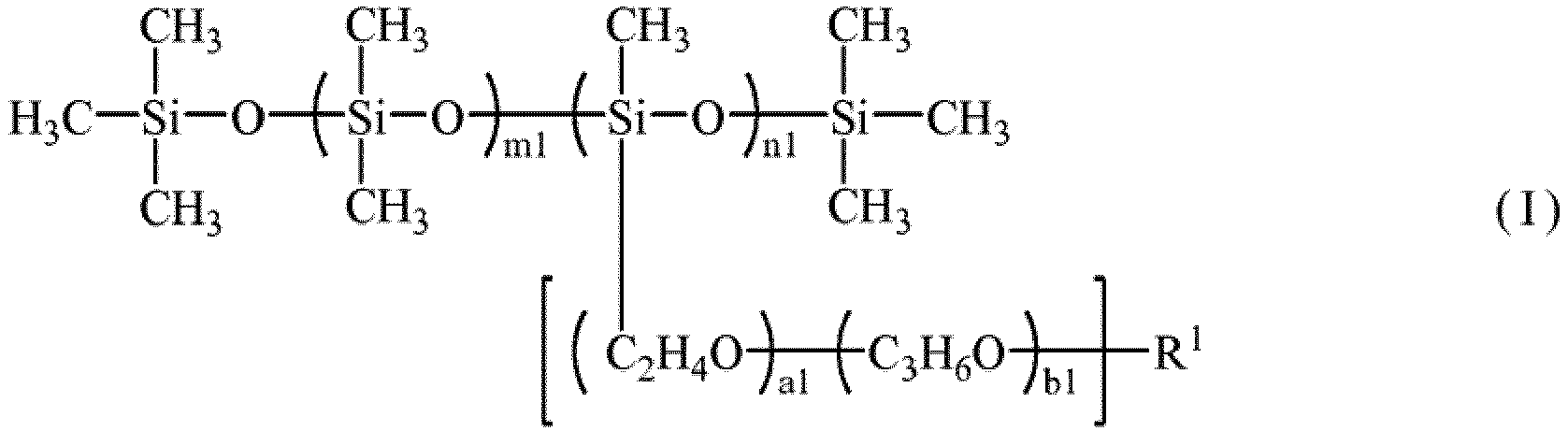
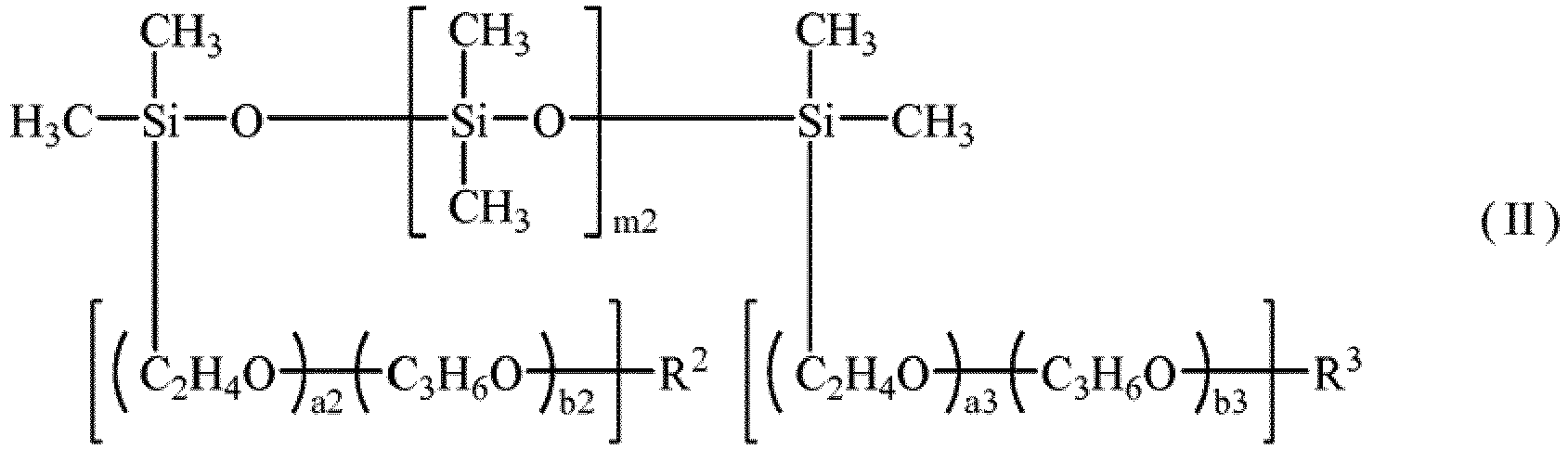
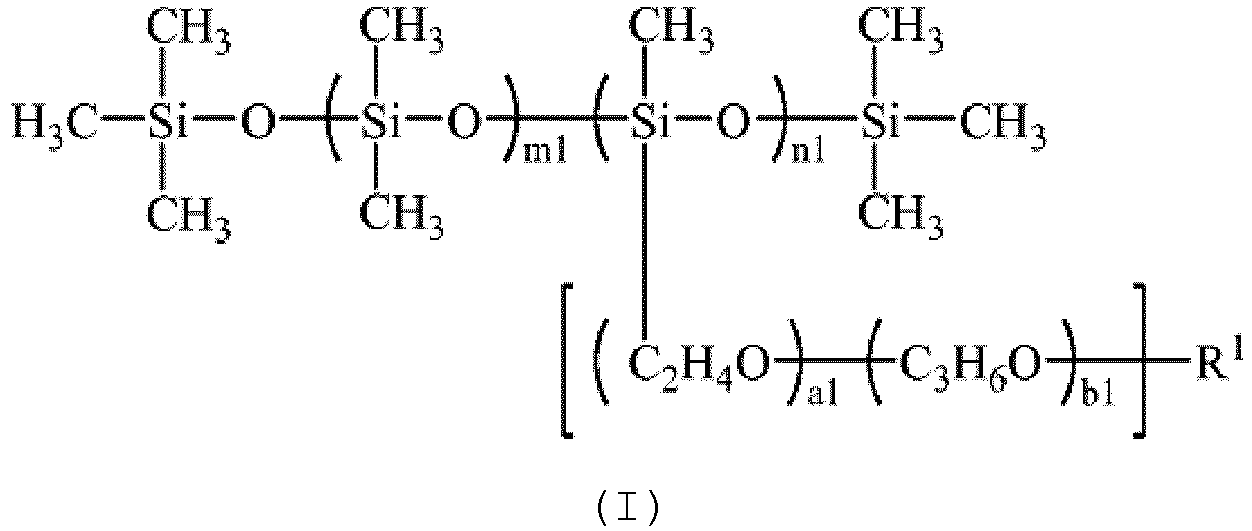
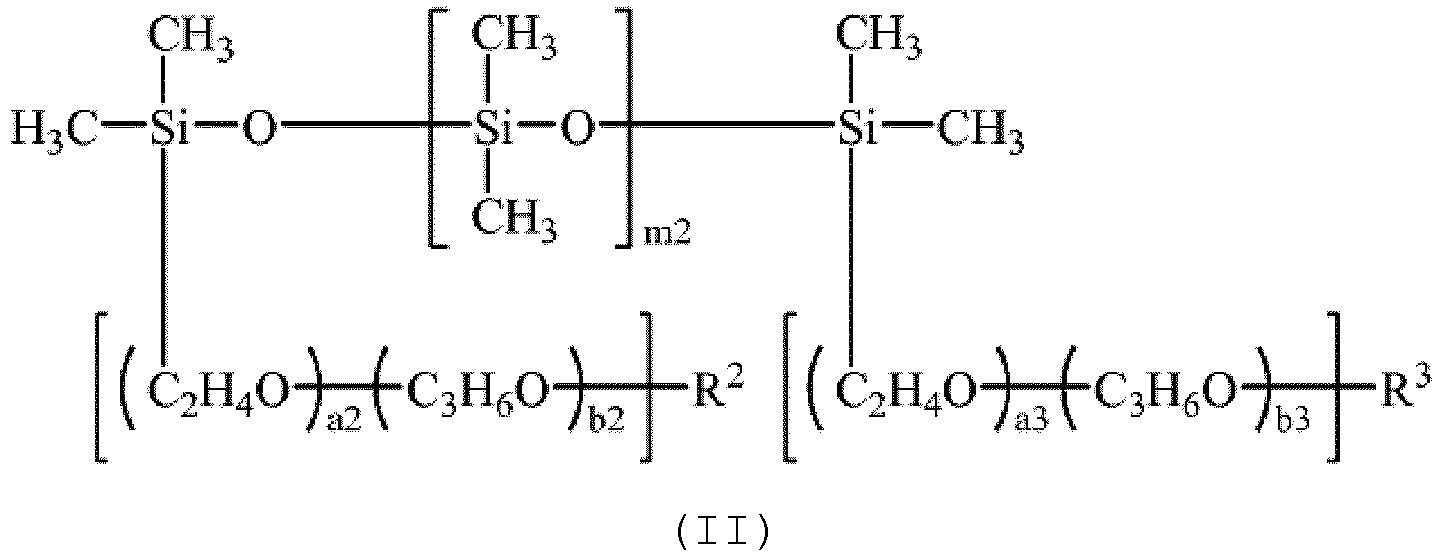
[0009] The invention provides an ink composition comprising (A) 0.01 to 5% by weight of a polyether-modified silicone having the average compositional formula (I), (B) 0.01 to 5% by weight of a polyether-modified silicone having the average compositional formula (II), water, a water-soluble organic solvent, and a colorant. The polyether-modified silicone (A) has the average compositional formula (I):
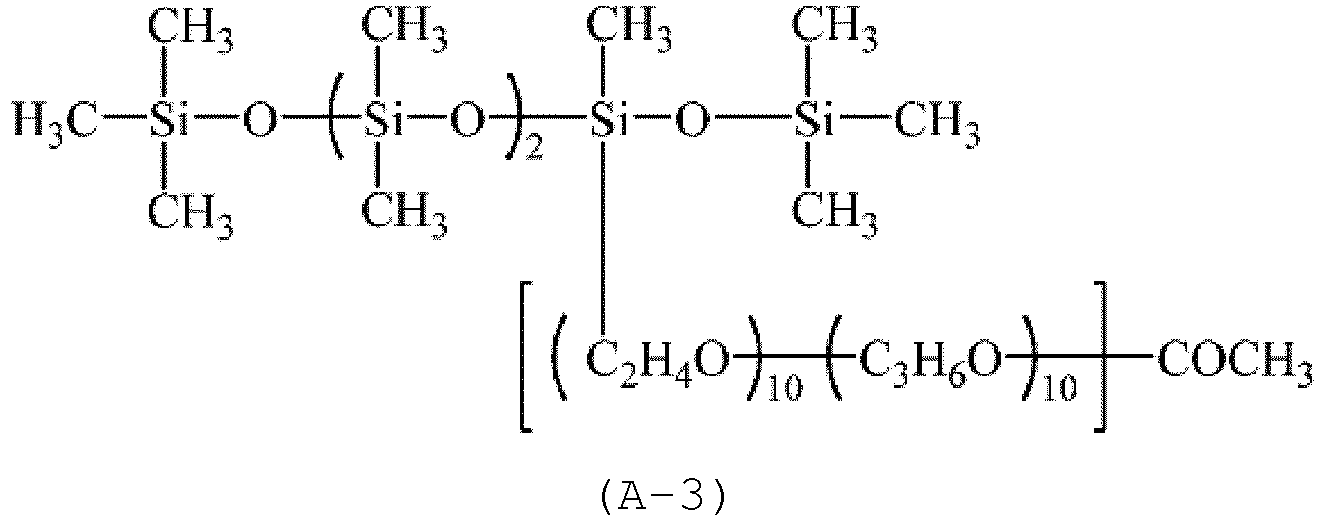
wherein R1 is hydrogen, an alkyl group of 1 to 4 carbon atoms or acetyl group, m1 is an integer of at least 0, n1 is an integer of at least 1, m1+n1 is an integer of 1 to 6, a1×n1 is an integer of 2 to 20, b1×n1 is an integer of 0 to 100, and units (a1) and (b1) may be arranged randomly or blockwise. The polyether-modified silicone (B) has the average compositional formula (II):
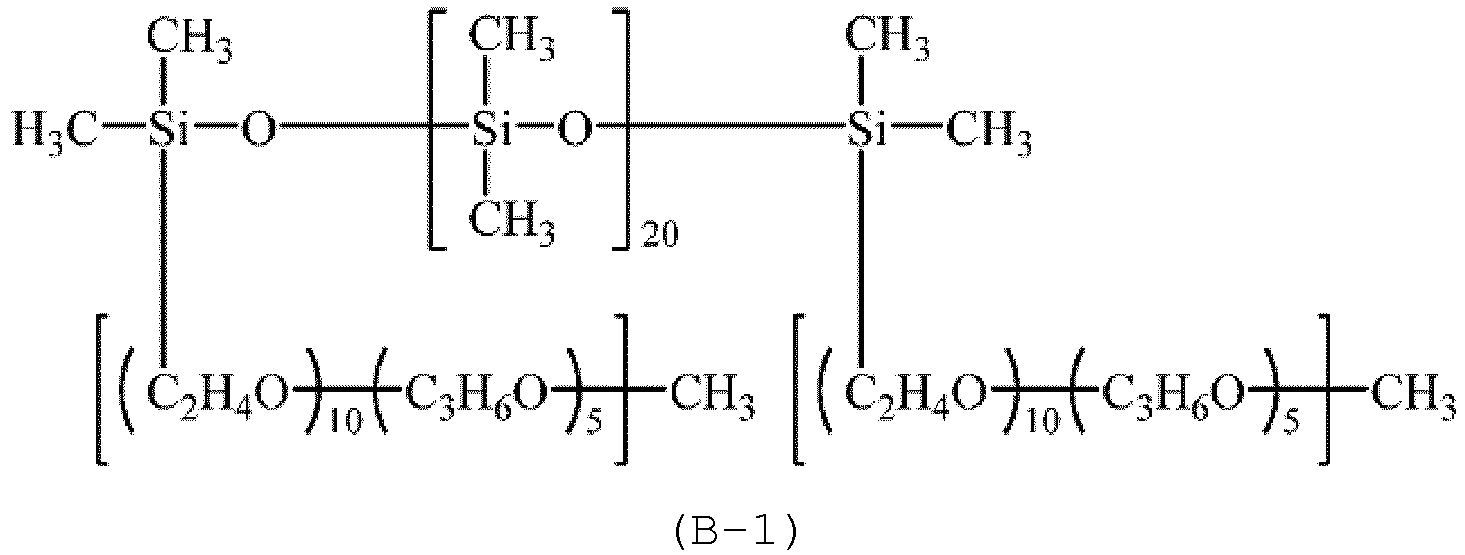
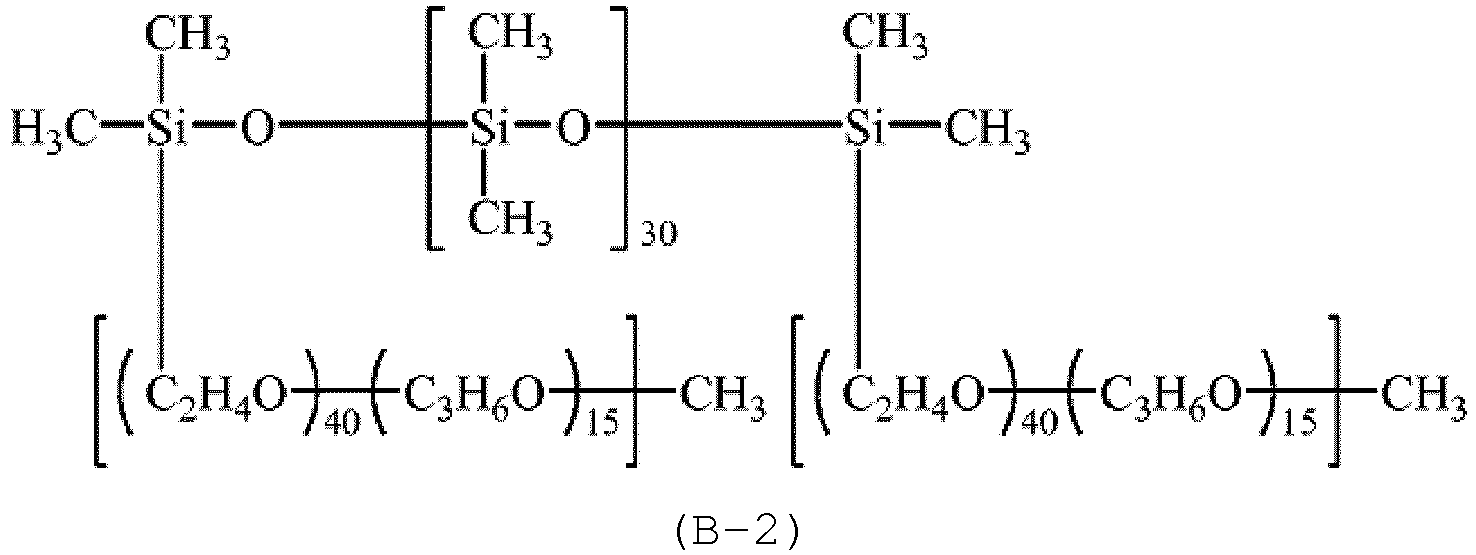
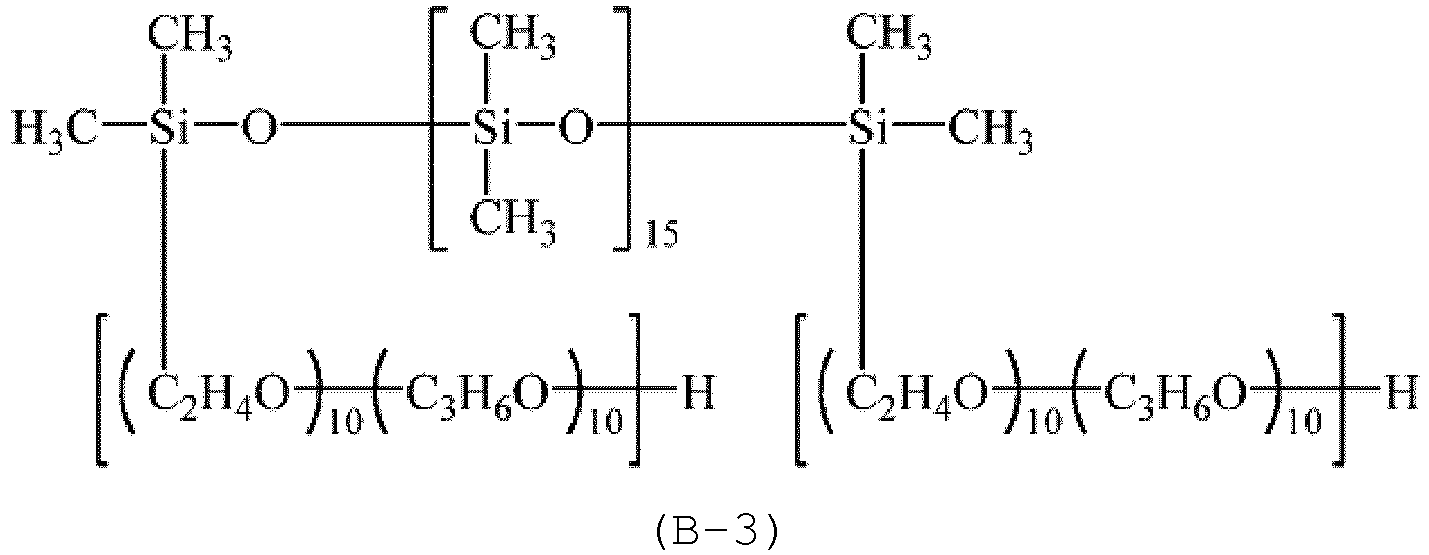
wherein R2 and R3 are independently hydrogen, an alkyl group of 1 to 4 carbon atoms or acetyl group, m2 is an integer of 10 to 40, a2+a3 is an integer of 5 to 100, b2+b3 is an integer of 0 to 100, units (a2) and (b2) may be arranged randomly or blockwise, and so may units (a3) and (b3).
[0010] The invention also provides an inkjet ink comprising any ink composition defined herein, and in another aspect the use of an ink composition as proposed herein as or in an inkjet ink.
ADVANTAGEOUS EFFECTS
[0011] We find that because of excellent wettability and penetrability, the ink compositions proposed herein form printed images with good color development and uniformity and without color bleeding, and are amenable to high-speed printing and high-speed application. By virtue of these advantages, the ink compositions are practically very useful as water/water-soluble organic solvent mixture-based inkjet ink.
FURTHER EXPLANATIONS; OPTIONS AND PREFERENCES
[0012] The ink composition of the invention comprises two types of specific polyether-modified silicones (A) and (B), water, a water-soluble organic solvent, and a colorant.
[0014] In formula (I), R1 is hydrogen, an alkyl group of 1 to 4 carbon atoms or acetyl group, preferably hydrogen, methyl or acetyl. The subscript m1 is an integer of at least 0, n1 is an integer of at least 1, and m1+n1 is an integer of 1 to 6, preferably an integer of 1 to 3. If m1+n1 is greater than 6, wettability may not be exerted immediately after application to substrates such as paper.
[0015] The value of a1×n1 is an integer of 2 to 20, preferably an integer of 5 to 15. Preferably a1 is an integer of 5 to 10. If a1×n1 is less than 2, component (A) may not dissolve in water, leaving insoluble matter in the ink composition. If a1×n1 exceeds 20, wettability may not be exerted immediately after application.
[0016] The value of b1×n1 is an integer of 0 to 100, preferably an integer of 0 to 50. Preferably b1 is an integer of 0 (or greater than 0) to 10. If b1×n1 is greater than 100, component (A) may not dissolve in water, leaving insoluble matter in the ink composition. The units (a1) and (b1), i.e. C2H4O and C3H6O units may be arranged randomly or blockwise, with the arrangement sequence of units being not limited.
[0017] The amount of component (A) used to prepare the ink composition is preferably 0.01 to 5% by weight, more preferably 0.05 to 3% by weight, based on 100% by weight of the ink composition. If the amount of component (A) is less than 0.01% by weight, the ink composition may foam, causing blur or bleeding on printing. If the amount of component (A) is greater than 5% by weight, water solubility may be adversely affected, causing blur or bleeding on printing.
[0018] Component (B) is a polyether-modified silicone having the average compositional formula (II).
[0019] In formula (II), R2 and R3 are independently hydrogen, an alkyl group of 1 to 4 carbon atoms or acetyl group, preferably hydrogen, methyl or acetyl. The subscript m2 is an integer of 10 to 40, preferably an integer of 10 to 30. If m2 is less than 10, wettability may not be exerted immediately before drying. If m2 is greater than 40, the ink composition may become repellent to substrates such as paper.
[0020] The value of a2+a3 is an integer of 5 to 100, preferably an integer of 10 to 80. If a2+a3 is less than 5, component (B) may not dissolve in water, leaving insoluble matter in the ink composition. If a2+a3 exceeds 100, the ink composition may not fully exert wettability immediately before drying. With respect to the value of a2 and a3, each of a2 and a3 is preferably greater than 0, preferably an integer of 2 to 50, more preferably 5 to 40.
[0021] The value of b2+b3 is an integer of 0 to 100, preferably an integer of 0 (or greater than 0) to 30. If b2+b3 is more than 100, component (B) may not dissolve in water, leaving insoluble matter in the ink composition. With respect to the value of b2 and b3, each of b2 and b3 is preferably an integer of 0 (or greater than 0) to 50, more preferably 0 (or greater than 0) to 15. The units (a2) and (b2) and units (a3) and (b3), i.e. C2H4O and C3H6O units may be arranged randomly or blockwise, with the arrangement sequence of units being not limited. Often for obvious reasons a2=a3 and b2=b3. Usually a2 and b2 (or a3 and b3, equivalently) are not both zero.
[0022] The amount of component (B) used to prepare the ink composition is preferably 0.01 to 5% by weight, more preferably 0.05 to 3% by weight, based on 100% by weight of the ink composition. If the amount of component (B) is less than 0.01% by weight, the ink composition may become short in penetration, causing blur or bleeding on printing. If the amount of component (B) is greater than 5% by weight, water solubility may be adversely affected, causing blur or bleeding on printing.
[0023] The ink composition further comprises water and a water-soluble (water-miscible) organic solvent. Water is preferably used in an amount of 5 to 95% by weight, more preferably 50 to 90% by weight based on 100% by weight of the ink composition. Examples of the water-soluble organic solvent include glycols such as ethylene glycol, diethylene glycol, triethylene glycol, propylene glycol, dipropylene glycol, tripropylene glycol, polyethylene glycol having a molecular weight of up to 2,000, 1,3-propylene glycol, isopropylene glycol, isobutylene glycol, 1,4-butanediol, 1,3-butanediol, 1,5-pentanediol, 1,6-hexanediol, glycerol, mesoerythritol, pentaerythritol, thioglycol, and hexylene glycol, alkyl alcohols of 1 to 4 carbon atoms, glycol ethers, formamide, acetamide, dimethyl sulfoxide, sorbitol, sorbitan, acetin, diacetin, triacetin, sulfolane, polyols such as 1,2,6-hexanetriol and trimethylolpropane, urea, 2-pyrrolidone, N-methyl-2-pyrrolidone, diethylene glycol monomethyl ether, diethylene glycol monoethyl ether, diethylene glycol monopropyl ether, diethylene glycol monobutyl ether, ethylene glycol monomethyl ether, ethylene glycol monoethyl ether, ethylene glycol monopropyl ether, and ethylene glycol monobutyl ether, which may be used alone or in admixture of two or more. The water-soluble organic solvent may be used in an amount of preferably 1 to 60% by weight, more preferably 1 to 50% by weight based on 100% by weight of the ink composition.
[0024] The colorant in the ink composition may be selected from dyes, organic pigments and inorganic pigments. Examples of the dye include colorants classified as acid dyes, direct dyes, reactive dyes, vat dyes, sulfur dyes and food colors as well as those classified as oil colors and basic dyes in the Colour Index. Suitable pigments for black ink include carbon blacks (C.I. Pigment black 7) such as furnace black (color black), lamp black, acetylene black and channel black. Specific examples include Raven 7000, Raven 5750, Raven 5250, Raven 5000, Raven 3500, Raven 2000, Raven 1500, Raven 1250, Raven 1200, Raven 1190 ULTRA-II, Raven 1170, Raven 1255 (available from Columbian Chemicals Company), Black Pearls L, Regal 400R, Regal 330R, Regal 660R, Mogul L, Monarch 700, Monarch 800, Monarch 880, Monarch 900, Monarch 1000, Monarch 1100, Monarch 1300, Monarch 1400, Vulcan XC-72R (available from Cabot Corporation), Color Black FW1, Color Black FW2, Color Black FW2V, Color Black FW18, Color Black FW200, Color Black S150, Color Black S160, Color Black S170, Printex 35, Printex U, Printex V, Printex 140U, Printex 140V, Special Black 6, Special Black 5, Special Black 4A, Special Black 4 (available from Degussa), No. 25, No. 33, No. 40, No. 47, No. 52, No. 900, No. 2300, MCF-88, MA600, MA7, MA8 and MA100 (available from Mitsubishi Chemical Corporation); metals such as copper oxide, iron oxide (C.I. Pigment Black 11) and titanium oxide; and organic pigments such as aniline black (C.I. Pigment Black 1). Suitable pigments for color ink include C.I. Pigment Yellow 1 (Fast Yellow G), 3, 12 (Disazo Yellow AAA), 13, 14, 17, 24, 34, 35, 37, 42 (Yellow Iron Oxide), 53, 55, 74, 81, 83 (Disazo Yellow HR), 93, 94, 95, 97, 98, 100, 101, 104, 108, 109, 110, 117, 120, 128, 138, 153, 180, C.I. Pigment Red 1, 2, 3, 5, 17, 22 (Brilliant Fast Scarlet), 23, 31, 38, 48:2 (Permanent Red 2B (Ba)), 48:2 (Permanent Red 2B (Ca)), 48:3 (Permanent Red 2B (Sr)), 48:4 (Permanent Red 2B (Mn)), 49:1, 52:2, 53:1, 57:1 (Brilliant Carmine 6B), 60:1, 63:1, 63:2, 64:1, 81 (Rhodamine 6G Rake), 83, 88, 101 (Red Iron Oxide), 104, 105, 106, 108 (Cadmium Red), 112, 114, 122 (Quinacridone Magenta), 123, 146, 149, 166, 168, 170, 172, 177, 178, 179, 185, 190, 193, 202, 206, 209, 219, C.I. Pigment Violet 19, 23, C.I. Pigment Orange 36, C.I. Pigment Blue 1, 2, 15 (Phthalocyanine Blue R), 15:1, 15:2, 15:3 (Phthalocyanine Blue G), 15:4, 15:6 (Phthalocyanine Blue E), 16, 17:1, 56, 60, 63, C.I. Pigment Green 1, 4, 7, 8, 10, 17, 18, 36, etc. The colorant is preferably used in an amount of 0.1 to 15% by weight, more preferably 2 to 10% by weight based on 100% by weight of the ink composition.
[0025] The ink composition may be prepared, for example, by mixing the above components on any well-known mixers such as a propeller agitator. If necessary, those components which are solid at room temperature are heated prior to mixing.
[0026] If desired, a resin and other additives may be added to the above components when an ink is prepared from the ink composition.
[0027] Suitable resins are polymers derived from a substance having at least one hydrophobic group selected from alkyl, cycloalkyl, and aryl groups. The preferred substance further has a hydrophilic group selected from carboxyl, sulfonate, hydroxyl, amino and amide groups, and salts thereof. Examples of the substances to form dispersing polymers include monomers having a double bond-bearing group such as acryloyl, methacryloyl, vinyl or aryl, and oligomers thereof. Examples include styrene, tetrahydrofurfuryl acrylate, butyl methacrylate, (α, 2, 3 or 4)-alkylstyrenes, (α, 2, 3 or 4)-alkoxystyrenes, 3,4-dimethylstyrene, α-phenylstyrene, divinylbenzene, vinyl naphthalene, dimethylamino (meth)acrylate, dimethylaminoethyl (meth)acrylate, dimethylaminopropylacrylamide, N,N-dimethylaminoethyl acrylate, acryloylmorpholine, N,N-dimethylacrylamide, N-isopropylacrylamide, N,N-diethylacrylamide, methyl (meth)acrylate, ethyl (meth)acrylate, propyl (meth)acrylate, ethylhexyl (meth)acrylate, other alkyl (meth)acrylates, methoxydiethylene glycol (meth)acrylate, ethoxy, propoxy, or butoxy-bearing diethylene glycol or polyethylene glycol (meth)acrylate, cyclohexyl (meth)acrylate, benzyl (meth)acrylate, phenoxyethyl (meth)acrylate, isobornyl (meth)acrylate, hydroxyalkyl (meth)acrylates, fluorine, chlorine or silicon-bearing (meth)acrylates, (meth)acrylamides, and maleic acid amides. Where it is desired to introduce a crosslinking structure into (meth)acrylic acid or the like in addition to its mono-functionality, compounds having an acrylic or methacrylic group may be used, for example, (mono, di, tri, tetra or poly)ethylene glycol di(meth)acrylates, (meth)acrylates of diols such as 1,4-butanediol, 1,5-pentanediol, 1,6-hexanediol, 1,8-octanediol and 1,10-decanediol, trimethylolpropane tri(meth)acrylate, glycerol (di or tri)-(meth)acrylates, di(meth)acrylates of bisphenol A or F ethylene oxide adducts, neopentyl glycol di(meth)acrylate, pentaerythritol tetra(meth)acrylate, and dipentaerythritol hexa(meth)acrylate.
[0028] The amount of the resin used to prepare the ink composition is not particularly limited. An appropriate amount of the resin is 0 to 30% by weight, more preferably 0 to 20% by weight based on 100% by weight of the ink composition as defined above. When used, the resin is preferably added in an amount of at least 1% by weight.
[0029] Suitable additives which can be added herein include UV absorbers, antioxidants, pH control agents, preservatives, and viscosity modifiers. In addition to the above components, the ink composition may contain these additives as the balance to make 100% by weight.
[0030] The ink composition is typically adjusted to a viscosity of from more than 0 to 4 mPa·s at 23°C to provide better printing performance.
[0031] Ink can be applied by an inkjet recording method, a recoding method with writing utensils such as a pen, and various other printing methods. Especially, the ink composition is suited for use in the inkjet recording method.
[0032] The substrate to which ink is applied may be selected from a wide range of substrates including absorptive recording media, low absorptive recording media, and non-absorptive recording media.
[0033] Suitable absorptive recording media include, but are not limited to, plain papers with high ink penetrability such as electrophotography paper; inkjet printing papers (special inkjet printing papers having an ink absorptive layer composed of silica or alumina particles or an ink absorptive layer composed of a hydrophilic polymer, typically polyvinyl alcohol (PVA) or polyvinyl pyrrolidone (PVP)); and coated papers with relatively low ink penetrability such as art papers and cast-coated papers for use in general offset printing.
[0034] Suitable low absorptive recording media include, but are not limited to, coated papers having on their surface a coating layer receptive to oil-base ink. Typical coated papers are printing papers including art paper, coated paper and mat paper.
[0035] Suitable non-absorptive recording media include, but are not limited to, plastic films free of an ink absorptive layer, and paper and other substrates having a plastic layer coated thereon or a plastic film bonded thereto. Examples of the plastic material used herein include polyvinyl chloride (PVC), polyethylene terephthalate (PET), polycarbonate, polystyrene, polyurethane, polyethylene, and polypropylene.
[0036] As used herein, "low absorptive recording media" and "non-absorptive recording media" refer to those recording media having a water absorption volume of 10 ml/m2 or less from the start of contact to 30 msec1/2 as measured by the Bristow method. The Bristow method is widely used as the method for measuring a fluid absorption volume in a short time: reference may be made to "Japan TAPPI paper and pulp test method 2000", Standard No. 51 "Paper and paper board - fluid absorption test method - Bristow method". The substrate to which the ink is applied is preferably selected from absorptive recording media having relatively low ink penetrability such as art paper, coated paper and cast-coated paper as demonstrated by a water absorption volume of 15 ml/m2 or less from the start of contact to 30 msec1/2 as measured by the Bristow method; low absorptive recording media such as art paper, coated paper and cast-coated paper; and non-absorptive recording media such as PET and PVC.
[0037] Preferably the ink is applied to the substrate at a coating weight of 0.6 to 20 g/m2, more preferably 1 to 15 g/m2.
EXAMPLES
[0038] Examples are given below by way of illustration and not by way of limitation. All parts and % are by weight.
Example 1
[0039] With stirring by a propeller agitator, 5 parts of Color Black S170 (available from Degussa) as black pigment was gradually added to 70 parts of ion exchanged water. Then 0.5 part of polyether-modified silicone (A), 0.5 part of polyether-modified silicone (B), 10 parts of polyethylene glycol (molecular weight 200) and 15 parts of glycerol were added. Further stirring for one hour yielded a black ink composition.
[0040] Similarly, magenta (M), cyan (C) and yellow (Y) ink compositions were prepared using magenta pigment (C.I. Pigment Red 122), cyan pigment (C.I. Pigment Blue 15:3) and yellow pigment (C.I. Pigment Yellow 74) instead of the black pigment, respectively.
Examples 2 to 10 and Comparative Examples 1 to 15
[0041] As in Example 1, ink compositions were prepared in accordance with the formulation shown in Tables 1 to 4.
[0042] The substrate to which ink was to be applied was OK topcoated paper (Oji Paper Co., Ltd.) in Examples 2 to 7 and Comparative Examples 1 to 11, and offset printing coated paper having a water absorption volume of 10 ml/m2 at 30 ms1/2 in Examples 8 to 10 and Comparative Examples 12 to 15.
(A) Polyether-modified silicones
[0043]
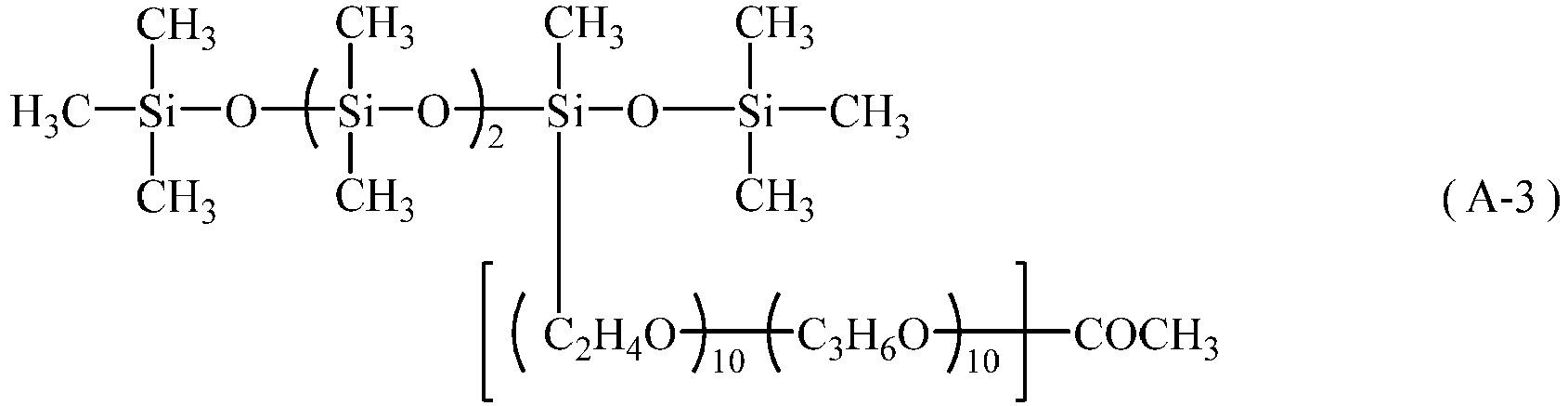
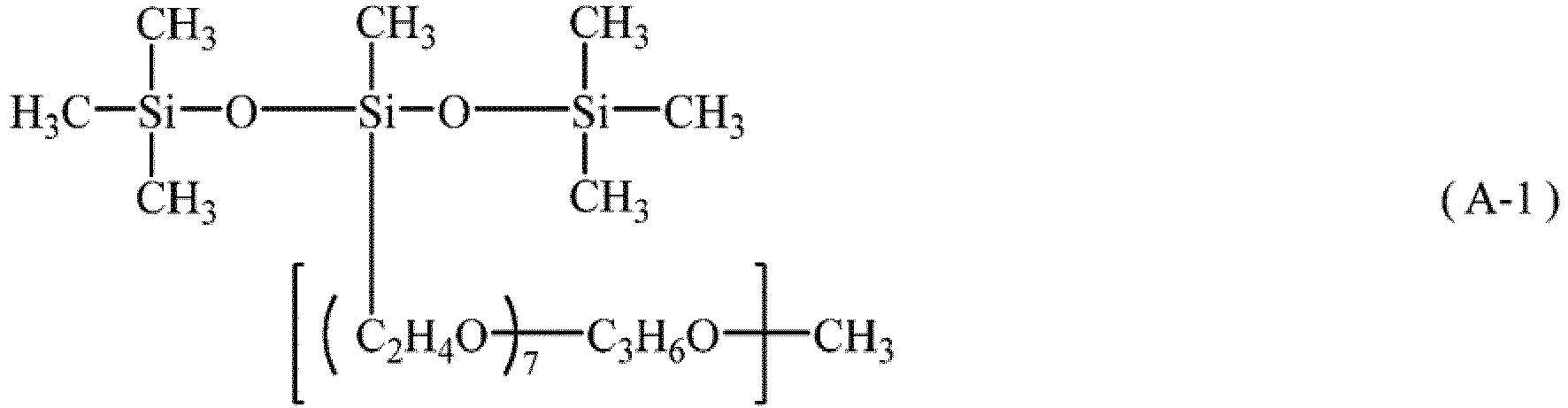
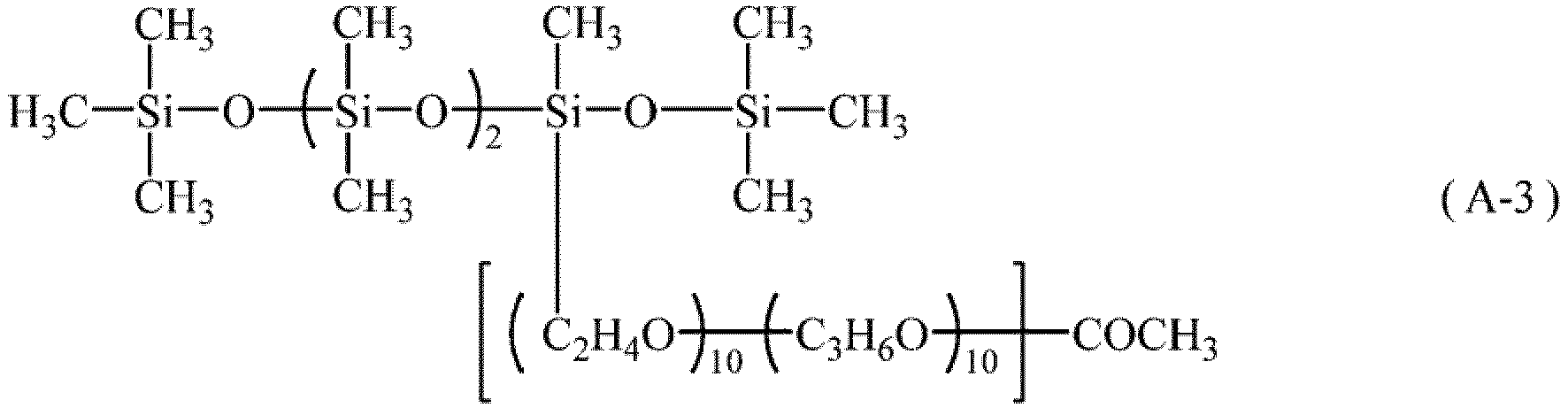
m1+n1=1, a1×n1=7, b1×n1=1
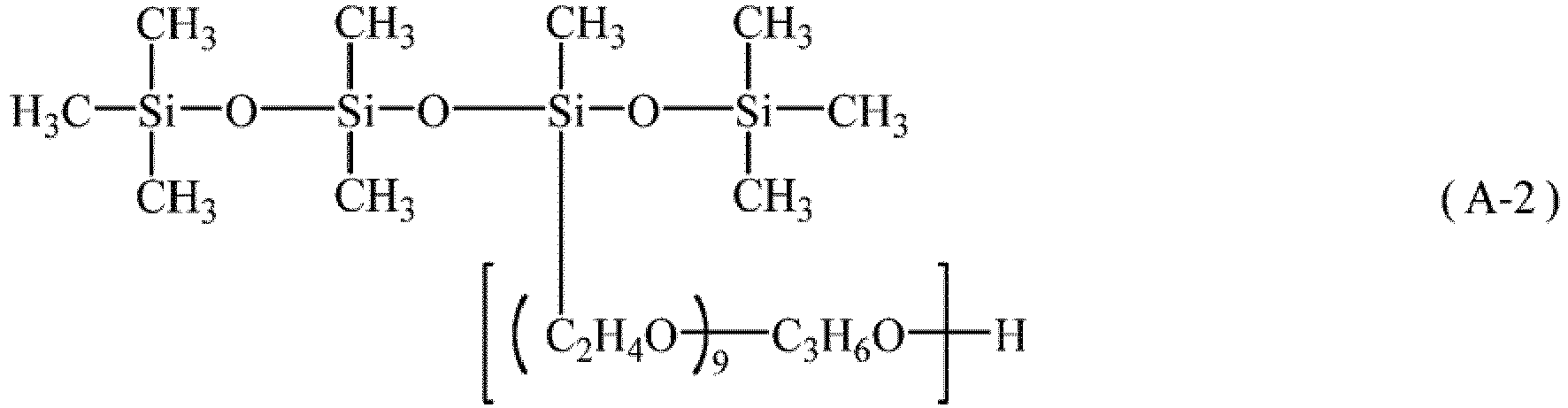
m1+n1=2, a1×n1=9, b1×n1=1
m1+n1=3, a1×n1=10, b1×n1=10
m1+n1=1, a1×n1=1, b1×n1=0
m1+n1=2, a1×n1=30, b1×n1=1
m1+n1=7, a1×n1=40, b1×n1=4
(B) Polyether-modified silicones
[0044]
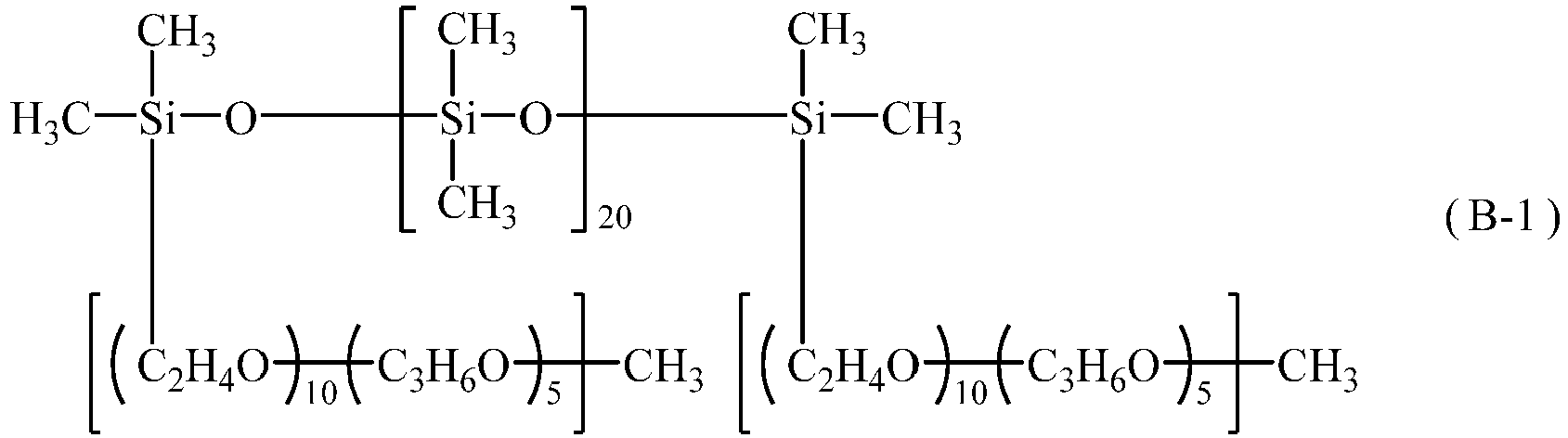
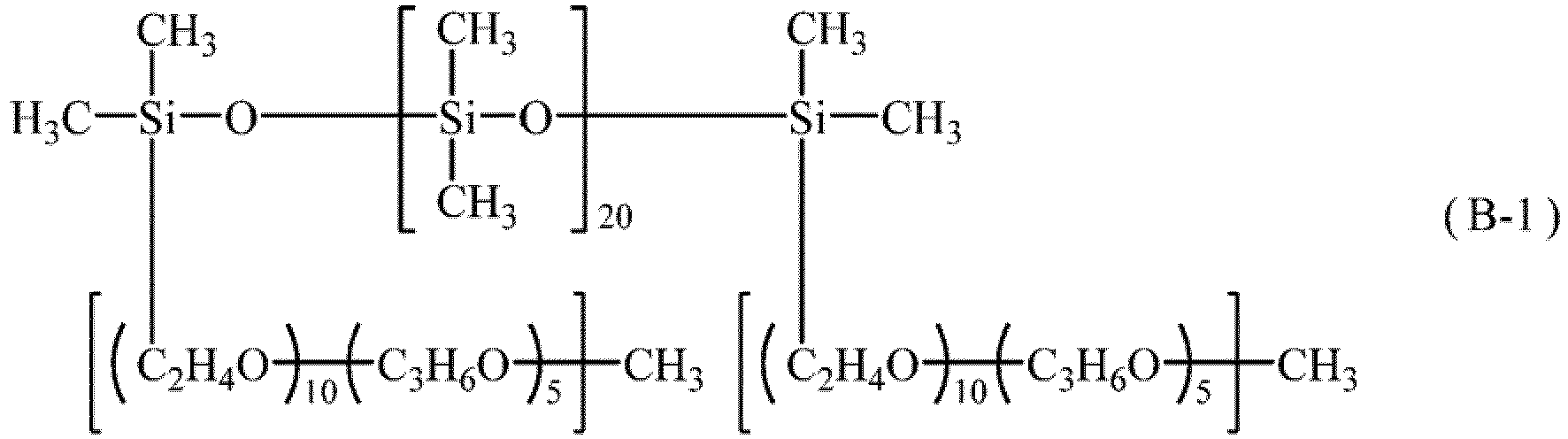
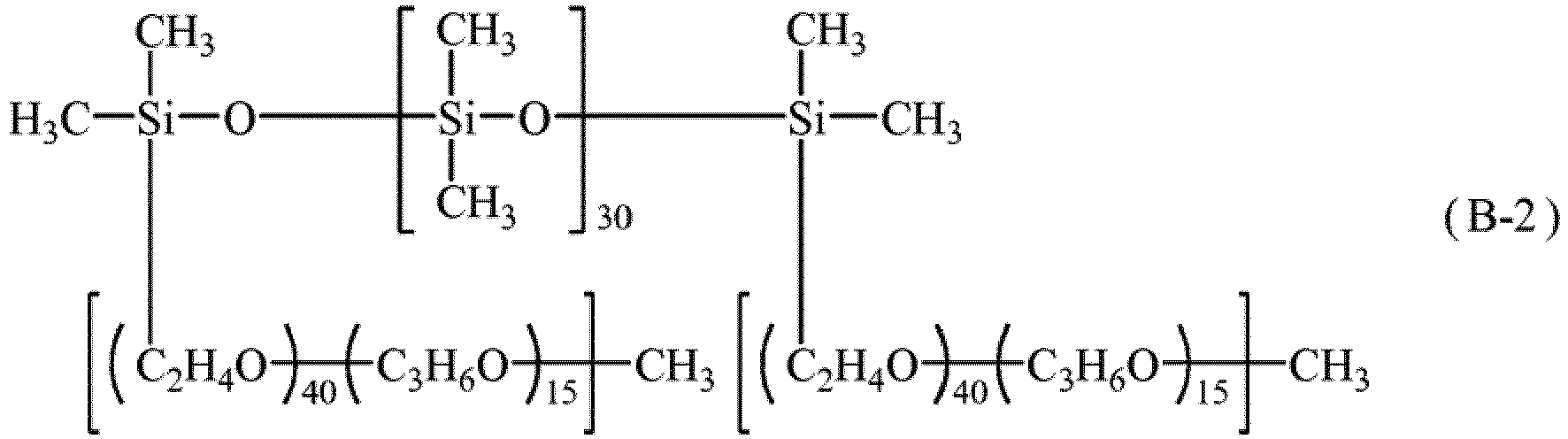
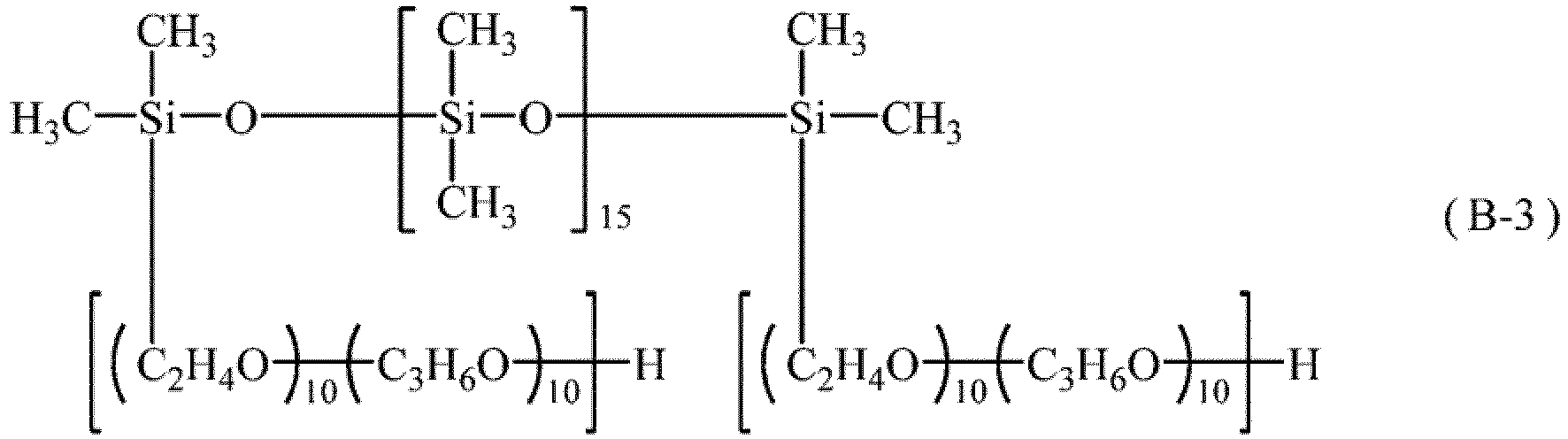
a2+a3=20, b2+b3=10
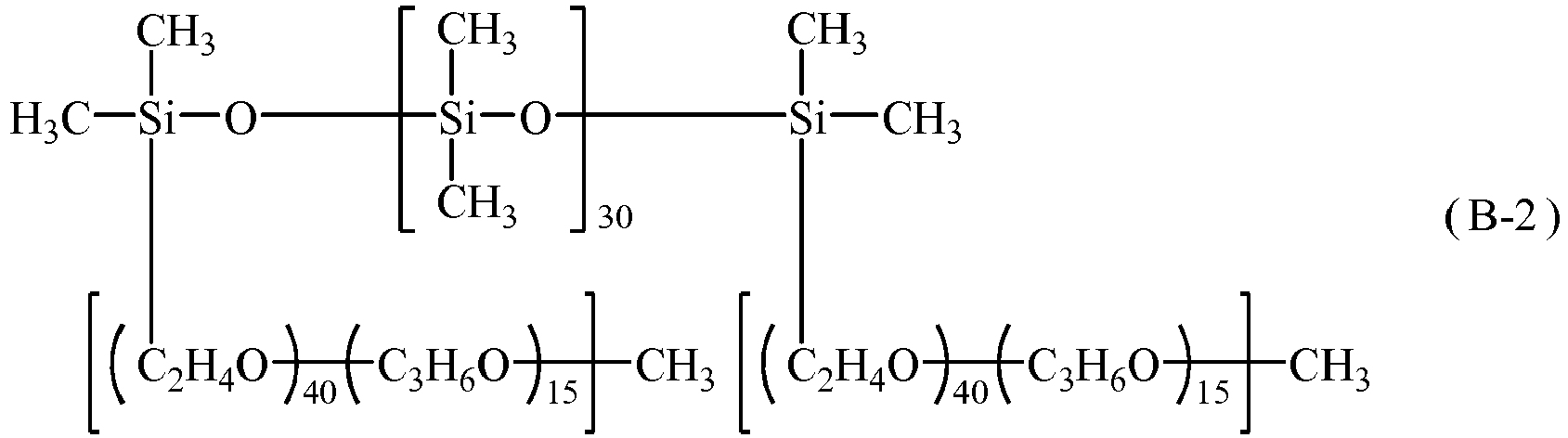
a2+a3=80, b2+b3=30
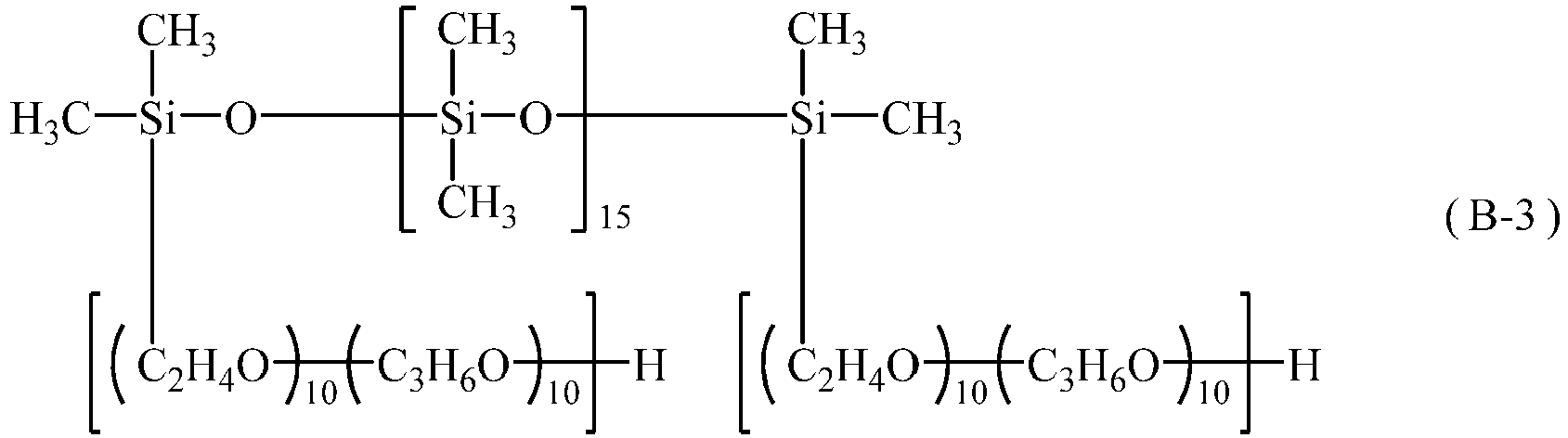
a2+a3=20, b2+b3=20
a2+a3=20, b2+b3=10
a2+a3=20, b2+b3=10
a2+a3=2, b2+b3=10
a2+a3=20, b2+b3=120
[0045] The performance of each ink composition was evaluated by the following tests. The results are shown in Tables 1 to 4.
Evaluation of Ink
(1) Print Density
[0046] Using a printer PX-045A (Seiko-Epson Co., Ltd.), a dot image was printed with the black ink on OK topcoated paper or offset printing coated paper. The print density of dots was measured by a microdensitometer Sakura PDM-5 (Sakura Seiki Co., Ltd.). The print density is preferably 0.99 to 1.10, more preferably 1.01 to 1.10.
(2) Dot Diameter
[0047] Using the printer PX-045A, a dot image was printed with the black ink on OK topcoated paper or offset printing coated paper. The dot image was observed under an electron microscope with a magnifying power of 100 to measure the diameter of dots. The dot diameter is preferably 200 to 250 µm, more preferably 220 to 240 µm.
(3) Color Density of Printed Image
[0048] Using the printer PX-045A, each of black (B), magenta (M), cyan (C) and yellow (Y) inks was solid printed on OK topcoated paper or offset printing coated paper. The color density was measured by a Macbeth densitometer (RD-918, manufactured by Macbeth). The color density is preferably 1.35 to 2.00, more preferably 1.40 to 2.00.
(4) Uniformity of Printed Image
[0049] Using the printer PX-045A, each of black, magenta, cyan and yellow inks was printed on OK topcoated paper or offset printing coated paper. The printed image was observed under an electron microscope with a magnifying power of 100 and evaluated for leveling ability. The leveling ability or density difference was rated according to the following criteria.
○: substantially no difference in density
Δ: slight difference
×: crescent mottles within dot
(5) Shape Factor of Dots
[0050] Using the printer PX-045A, each of black, magenta, cyan and yellow inks was printed on OK topcoated paper or offset printing coated paper. From the printed image, the shape factor of a dot was computed as (peripheral length)2/(4π*area). The shape factor is a value for quantitatively evaluating the degree of bleeding or blur. The peripheral length and area are determined from image analysis by a dot analyser. A dot of least irregular shape has a shape factor of nearly 1.
(6) Gloss
[0051] Using the printer PX-045A, each of black, magenta, cyan and yellow inks was printed on OK topcoated paper (gloss 6) or offset printing coated paper. Gloss, Gs(θ) was measured at an angle of 20° by a glossmeter (handy type PG-IM by Nippon Denshoku Industries Co., Ltd.). A higher value of gloss indicates better gloss.
Table 1
| Component (wt%) | Example | ||||||||
| 1 | 2 | 3 | 4 | 5 | 6 | 7 | |||
| Pigment (B/M/C/Y) | 5 | 5 | 5 | 5 | 5 | 5 | 5 | ||
| A | A-1 | 0.5 | 0.2 | 0.1 | 2.5 | ||||
| A-2 | 0.5 | 0.2 | |||||||
| A-3 | 0.5 | ||||||||
| A'-1 | |||||||||
| A'-2 | |||||||||
| A'-3 | |||||||||
| B | B-1 | 0.5 | 0.2 | 0.2 | 0.1 | 2.5 | |||
| B-2 | 0.5 | ||||||||
| B-3 | 0.5 | ||||||||
| B'-1 | |||||||||
| B'-2 | |||||||||
| B'-3 | |||||||||
| B'-4 | |||||||||
| Ethylene glycol | 0.2 | ||||||||
| Diethylene glycol | 0.2 | ||||||||
| Propylene glycol | |||||||||
| Polyethylene glycol | 10 | 10 | 10 | 10 | 10 | 10 | 10 | ||
| Glycerol | 15 | 15 | 15 | 15 | 15 | 15 | 15 | ||
| Water | 69 | 69 | 69 | 69.4 | 69.4 | 69.8 | 65 | ||
| Print Density | 1.05 | 1.03 | 1.02 | 1.04 | 1.04 | 1.02 | 1.05 | ||
| Dot Diameter | 2.34 | 236 | 230 | 233 | 237 | 232 | 238 | ||
| Color Density of Printed Image | B | 1.32 | 1.46 | 1.42 | 1.31 | 1.43 | 1.32 | 1.35 | |
| M | 1.47 | 1.45 | 1.51 | 1.46 | 1.45 | 1.43 | 1.47 | ||
| C | 1.82 | 1.87 | 1.8 | 1.81 | 1.86 | 1.80 | 1.82 | ||
| Y | 1.46 | 1.48 | 1.52 | 1. 47 | 1.47 | 1.45 | 1.45 | ||
| Uniformity of Printed Image | B | ○ | ○ | ○ | ○ | ○ | ○ | ○ | |
| M | ○ | ○ | ○ | ○ | ○ | ○ | ○ | ||
| C | ○ | ○ | ○ | ○ | ○ | ○ | ○ | ||
| Y | ○ | ○ | ○ | ○ | ○ | ○ | ○ | ||
| Shape Factor of Dot | B | 1.1 | 1.2 | 1.3 | 1.2 | 1.5 | 1.4 | 1.5 | |
| M | 1.4 | 1.5 | 1.4 | 1.2 | 1.6 | 1.3 | 1.5 | ||
| C | 1.3 | 1.4 | 1.6 | 1.3 | 1.6 | 1.6 | 1.4 | ||
| Y | 1.2 | 1.5 | 1.5 | 1.4 | 1.5 | 1.3 | 1.3 | ||
| Gloss | B | 6 | 6 | 5 | 5 | 5 | 5 | 6 | |
| M | 6 | 6 | 5 | 5 | 5 | 6 | 6 | ||
| C | 6 | 7 | 6 | 5 | 5 | 6 | 6 | ||
| Y | 7 | 7 | 6 | 6 | 6 | 6 | 7 | ||
Table 2
| Component (wt%) | Comparative Example | ||||||||||||
| 1 | 2 | 3 | 4 | 5 | 6 | 7 | 8 | 9 | 10 | 11 | |||
| Pigment (B/M/C/Y) | 5 | 5 | 5 | 5 | 5 | 5 | 5 | 5 | 5 | 5 | 5 | ||
| A | A-1 | 0.4 | 0.005 | 7 | 1 | ||||||||
| A-2 | 0.4 | ||||||||||||
| A-3 | 0.4 | 0.4 | |||||||||||
| A'-1 | 0.5 | ||||||||||||
| A'-2 | 0.5 | ||||||||||||
| A'-3 | 0.5 | ||||||||||||
| B | B-1 | 0.5 | 0.5 | 0.5 | 0.005 | 7 | 1 | ||||||
| B-2 | |||||||||||||
| B-3 | |||||||||||||
| B'-1 | 0.4 | ||||||||||||
| B'-2 | 0.4 | ||||||||||||
| B'-3 | 0.4 | ||||||||||||
| B'-4 | 0.4 | 0.4 | |||||||||||
| Ethylene glycol | 0.2 | 0.2 | |||||||||||
| Diethylene glycol | 0.2 | ||||||||||||
| Propylene glycol | 0.2 | ||||||||||||
| Polyethylene glycol | 10 | 10 | 10 | 10 | 10 | 10 | 10 | 10 | 10 | 10 | 10 | ||
| Glycerol | 15 | 15 | 15 | 15 | 15 | 15 | 15 | 15 | 15 | 15 | 15 | ||
| Water | 69 | 69 | 69 | 69.2 | 69 | 69 | 69 | 69.99 | 56 | 69 | 69 | ||
| Print Density | 0.97 | 0.97 | 0.98 | 0.96 | 0.9 | 0.9 | 0.89 | 0.99 | 0.99 | 0.98 | 0.93 | ||
| Dot Diameter | 199 | 197 | 189 | 198 | 193 | 192 | 190 | 191 | 200 | 197 | 195 | ||
| Color Density of Printed Image | B | 1.1 | 1.11 | 1.13 | 1.13 | 1.1 | 1.09 | 1.07 | 1.08 | 1.18 | 1.12 | 1.11 | |
| M | 1.24 | 1.24 | 1.26 | 1.26 | 1.23 | 1.2 | 1.19 | 1.2 | 1.25 | 1.24 | 1.21 | ||
| C | 1.36 | 1.36 | 1.37 | 1.38 | 1.33 | 1.34 | 1.3 | 1.3 | 1.42 | 1.35 | 1.32 | ||
| Y | 1.25 | 1.25 | 1.25 | 1.22 | 1.21 | 1.2 | 1.2 | 1.19 | 1.3 | 1.26 | 1.22 | ||
| Uniformity of Printed Image | B | × | × | × | × | × | × | × | × | × | × | × | |
| M | × | × | × | × | × | × | × | × | × | × | × | ||
| C | × | × | × | × | × | × | × | × | × | × | × | ||
| Y | × | × | × | × | × | × | × | × | × | × | × | ||
| Shape Factor of Dot | B | 2.7 | 2.6 | 2.5 | 2.7 | 2.6 | 2.6 | 2.7 | 2.7 | 2.8 | 2.7 | 2.8 | |
| M | 2.8 | 2.7 | 2.8 | 2.8 | 2.8 | 2.8 | 3.1 | 3.0 | 3.0 | 2.9 | 2.9 | ||
| C | 2.8 | 2.8 | 2.8 | 2.8 | 2.7 | 2.9 | 2.9 | 2.8 | 2.8 | 2.7 | 3.1 | ||
| Y | 2.9 | 2.7 | 2.7 | 2.7 | 2.8 | 2.7 | 3.0 | 2.9 | 2.9 | 2.8 | 3.0 | ||
| Gloss | B | 1 | 2 | 1 | 1 | 1 | 1 | 1 | 1 | 1 | 1 | 1 | |
| M | 3 | 2 | 1 | 2 | 1 | 1 | 1 | 2 | 2 | 2 | 2 | ||
| C | 2 | 2 | 2 | 2 | 2 | 2 | 1 | 2 | 2 | 2 | 2 | ||
| Y | 3 | 2 | 2 | 2 | 2 | 2 | 2 | 2 | 2 | 2 | 2 | ||
Table 3
| Component (wt%) | Example | ||||
| 8 | 9 | 10 | |||
| Pigment (B/M/C/Y) | 5 | 5 | 5 | ||
| A | A-1 | 0.5 | |||
| A-2 | 0.5 | ||||
| A-3 | 0.5 | ||||
| A'-1 | |||||
| B | B-1 | 0.5 | |||
| B-2 | 0.5 | ||||
| B-3 | 0.5 | ||||
| B'-1 | |||||
| Polyethylene glycol | 10 | 10 | 10 | ||
| Glycerol | 15 | 15 | 15 | ||
| Water | 69 | 69 | 69 | ||
| Print Density | 1.05 | 1.04 | 1.02 | ||
| Dot Diameter | 235 | 236 | 230 | ||
| Color Density of Printed Image | B | 1.33 | 1.46 | 1.42 | |
| M | 1.48 | 1.45 | 1.51 | ||
| C | 1.83 | 1.88 | 1.9 | ||
| Y | 1.47 | 1.48 | 1.52 | ||
| Uniformity of Printed Image | B | ○ | ○ | ○ | |
| M | ○ | ○ | ○ | ||
| C | ○ | ○ | ○ | ||
| Y | ○ | ○ | ○ | ||
| Shape Factor of Dot | B | 1.1 | 1.2 | 1.3 | |
| M | 1.4 | 1.6 | 1.5 | ||
| C | 1.3 | 1.4 | 1.6 | ||
| Y | 1.3 | 1.5 | 1.6 | ||
| Gloss | B | 6 | 6 | 5 | |
| M | 6 | 6 | 6 | ||
| C | 6 | 7 | 6 | ||
| Y | 7 | 7 | 6 | ||
Table 4
| Component (wt%) | Comparative Example | |||||
| 12 | 13 | 14 | 15 | |||
| Pigment (B/M/C/Y) | 5 | 5 | 5 | 5 | ||
| A | A-1 | 0.4 | 1 | |||
| A-2 | ||||||
| A-3 | ||||||
| A'-1 | 0.5 | |||||
| B | B-1 | 0.5 | 1 | |||
| B-2 | ||||||
| B-3 | ||||||
| B'-1 | 0.4 | |||||
| Polyethylene glycol | 10 | 10 | 10 | 10 | ||
| Glycerol | 15 | 15 | 15 | 15 | ||
| Water | 69 | 69.2 | 69 | 69 | ||
| Print Density | 0.97 | 0.97 | 0.98 | 0.93 | ||
| Dot Diameter | 199 | 198 | 197 | 195 | ||
| Color Density of Printed Image | B | 1.11 | 1.14 | 1.13 | 1.11 | |
| M | 1.25 | 1.26 | 1.24 | 1.21 | ||
| C | 1.37 | 1.38 | 1.36 | 1.32 | ||
| Y | 1.26 | 1.23 | 1.26 | 1.22 | ||
| Uniformity of Printed Image | B | × | × | × | × | |
| M | × | × | × | × | ||
| C | × | × | × | × | ||
| Y | × | × | × | × | ||
| Shape Factor of Dot | B | 2.7 | 2.8 | 2.7 | 2.8 | |
| M | 2.8 | 2.8 | 2.9 | 2.9 | ||
| C | 2.9 | 2.8 | 2.8 | 3.2 | ||
| Y | 2.9 | 2.7 | 2.8 | 3.0 | ||
| Gloss | B | 2 | 2 | 2 | 1 | |
| M | 3 | 2 | 2 | 2 | ||
| C | 2 | 2 | 2 | 1 | ||
| Y | 3 | 2 | 2 | 2 | ||
Notes
[0052] In respect of numerical ranges disclosed in the present description it will of course be understood that in the normal way the technical criterion for the upper limit is different from the technical criterion for the lower limit, i.e. the upper and lower limits are intrinsically distinct proposals.
[0053] For the avoidance of doubt it is confirmed that in the general description above, in the usual way the proposal of general preferences and options in respect of different features of the ink composition constitutes the proposal of general combinations of those general preferences and options for the different features, insofar as they are combinable and compatible and are put forward in the same context.
[0054] The entire disclosure of Japanese Patent Application No. 2014-107927, the priority of which is claimed, is incorporated herein by reference as a precaution.
[0055] Although some preferred embodiments have been described, many modifications and variations may be made thereto in light of the above teachings. It is therefore to be understood that the invention may be practised otherwise than as specifically described without departing from the scope of the general teachings herein.
1. An ink composition comprising (A) 0.01 to 5% by weight of polyether-modified silicone
having the average compositional formula (I), (B) 0.01 to 5% by weight of polyether-modified
silicone having the average compositional formula (II), water, water-soluble organic
solvent, and colorant,
said polyether-modified silicone (A) having the average compositional formula (I):
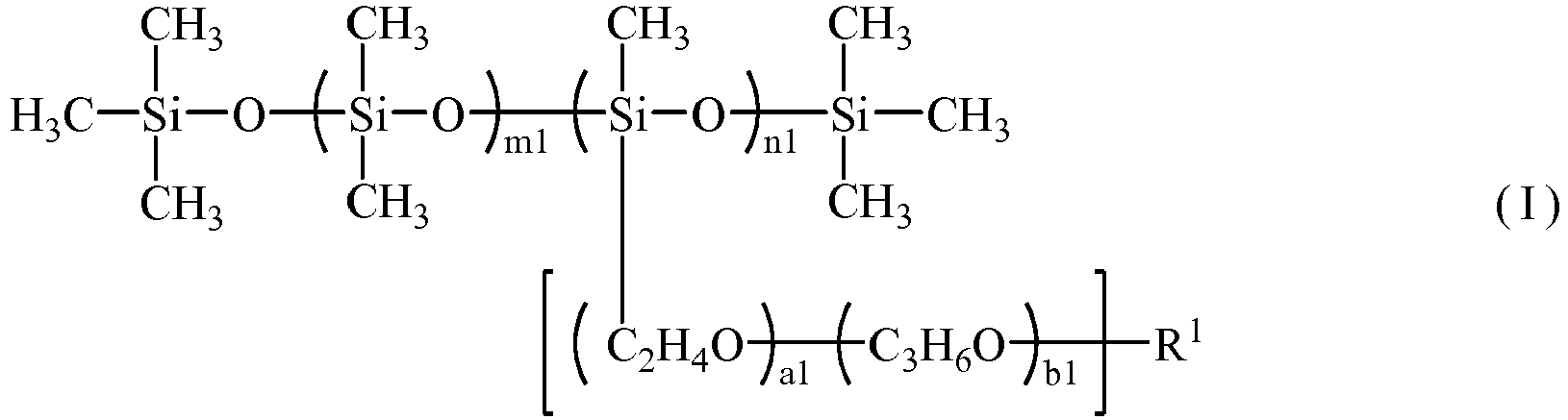
wherein R1 is hydrogen, alkyl group of 1 to 4 carbon atoms or acetyl group, m1 is an integer of 0 or more, n1 is an integer of at least 1, m1+n1 is an integer of 1 to 6, a1×n1 is an integer of 2 to 20, b1×n1 is an integer of 0 to 100, and units (a1) and (b1) may be arranged randomly or blockwise,
said polyether-modified silicone (B) having the average compositional formula (II):
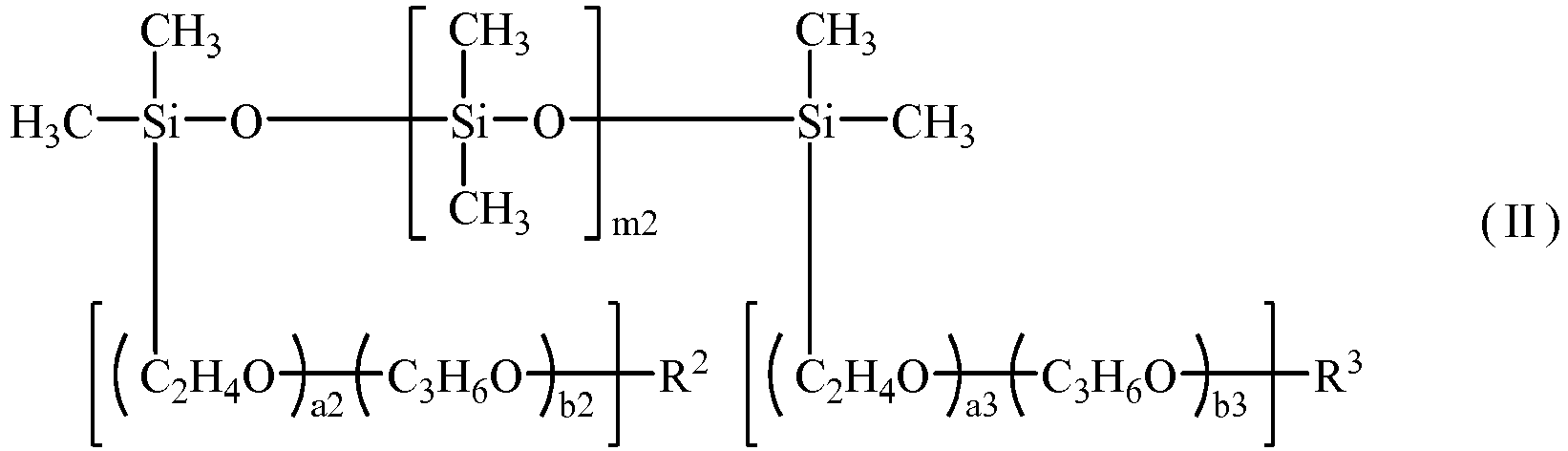
wherein R2 and R3 are independently hydrogen, alkyl group of 1 to 4 carbon atoms or acetyl group, m2 is an integer of 10 to 40, a2+a3 is an integer of 5 to 100, b2+b3 is an integer of 0 to 100, units (a2) and (b2) may be arranged randomly or blockwise, and so may units (a3) and (b3).
said polyether-modified silicone (A) having the average compositional formula (I):
wherein R1 is hydrogen, alkyl group of 1 to 4 carbon atoms or acetyl group, m1 is an integer of 0 or more, n1 is an integer of at least 1, m1+n1 is an integer of 1 to 6, a1×n1 is an integer of 2 to 20, b1×n1 is an integer of 0 to 100, and units (a1) and (b1) may be arranged randomly or blockwise,
said polyether-modified silicone (B) having the average compositional formula (II):
wherein R2 and R3 are independently hydrogen, alkyl group of 1 to 4 carbon atoms or acetyl group, m2 is an integer of 10 to 40, a2+a3 is an integer of 5 to 100, b2+b3 is an integer of 0 to 100, units (a2) and (b2) may be arranged randomly or blockwise, and so may units (a3) and (b3).
2. Ink composition of claim 1 in which polyether-modified silicone (A) is contained at
0.05 to 3% by weight, based on 100% by weight of the ink composition.
3. Ink composition of claim 1 or 2 in which polyether-modified silicone (B) is contained
at 0.05 to 3% by weight, based on 100% by weight of the ink composition.
4. Ink composition of any one of the preceding claims in which in formula (I) R1 is hydrogen, methyl group or acetyl group and in formula (II) R2 and R3 are hydrogen, methyl group or acetyl group.
5. Ink composition of any one of the preceding claims in which in formula (I) a1 is from
5 to 10.
6. Ink composition of any one of the preceding claims in which in formula (I) b1 is greater
than 0.
7. Ink composition of any one of the preceding claims in which in formula (II) each of
a2 and a3 is from 2 to 50.
8. Ink composition of any one of the preceding claims in which in formula (II) the value
of b2+b3 is an integer greater than 0.
9. Ink composition of any one of the preceding claims containing from 5 to 95% water
by weight.
10. Ink composition of claim 9 containing from 50 to 90% water by weight.
11. Ink composition of claim 1 in which polyether-modified silicone (A) is contained at
0.05 to 3% by weight, polyether-modified silicone (B) is contained at 0.05 to 3% by
weight, water is contained at from 50 to 90% by weight and the colorant is at 2 to
10% by weight, said weights % being based on the ink composition as 100%.
12. Ink composition of any one of the preceding claims containing from 1 to 50% by weight
of the water-soluble organic solvent.
13. Ink composition of any one of the preceding claims in which the water-soluble organic
solvent is selected from glycols, alkyl alcohols of 1 to 4 carbon atoms, formamide,
acetamide, dimethyl sulfoxide, sorbitol, sorbitan, acetin, diacetin, triacetin, sulfolane,
polyols, urea, 2-pyrrolidone, N-methyl-2-pyrrolidone, diethylene glycol monomethyl
ether, diethylene glycol monoethyl ether, diethylene glycol monopropyl ether, diethylene
glycol monobutyl ether, ethylene glycol monomethyl ether, ethylene glycol monoethyl
ether, ethylene glycol monopropyl ether and ethylene glycol monobutyl ether, used
alone or in a mixture.
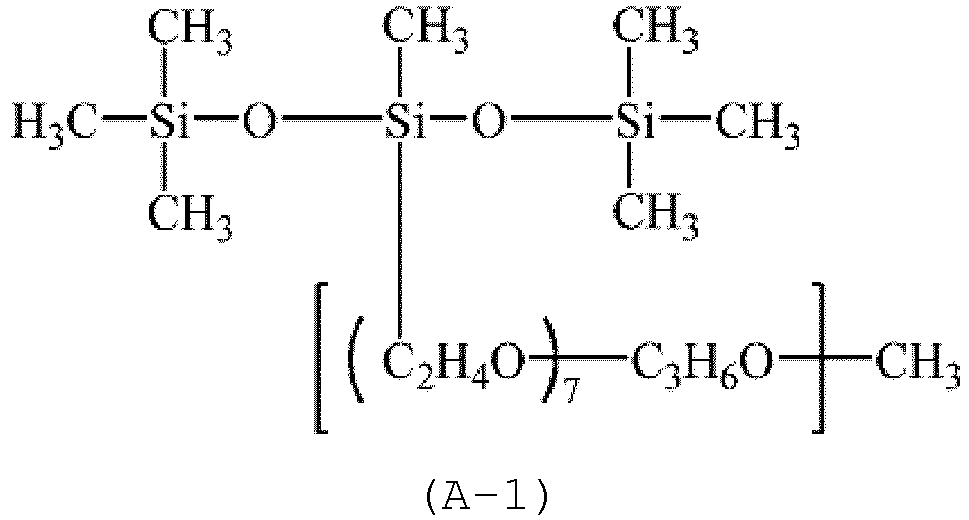
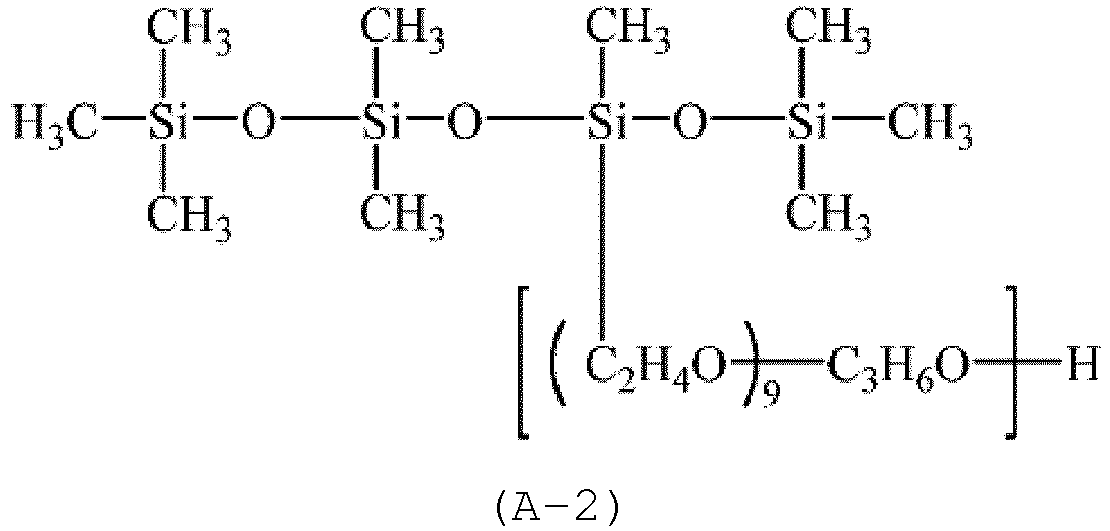
14. Ink composition of claim 1 in which polyether-modified silicone (A) is selected from
the following (A-1) to (A-3) and polyether-modified silicone (B) is selected from
the following (B-1) to (B-3):
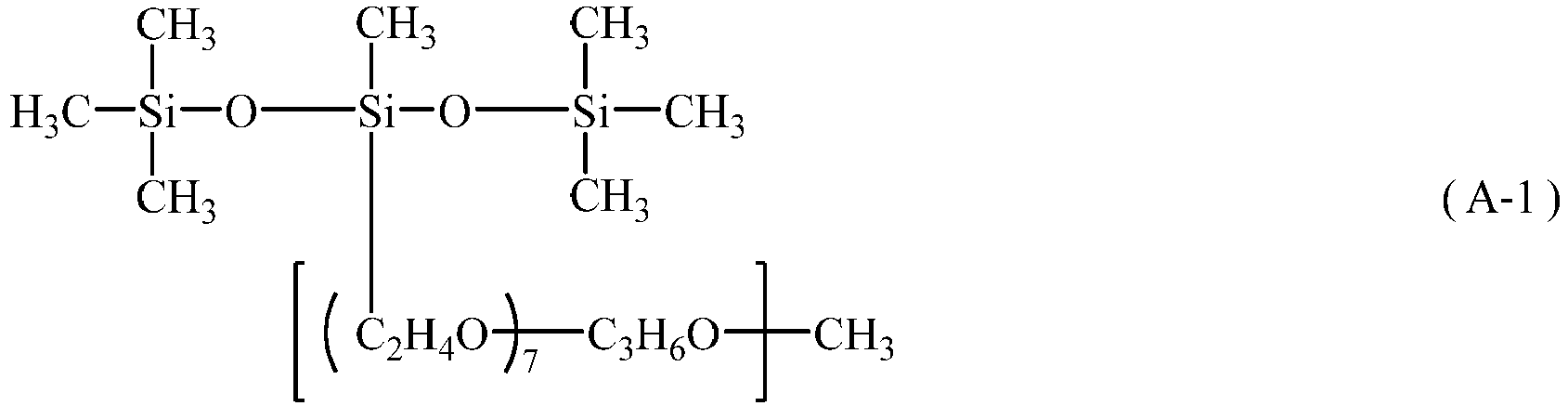
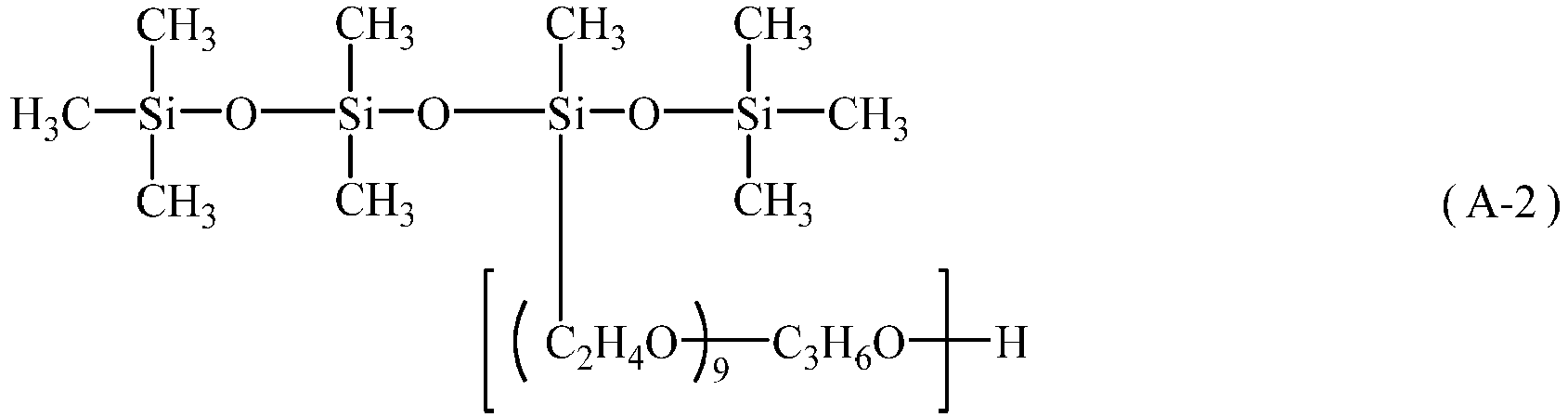
15. An inkjet ink comprising an ink composition of any one of claims 1 to 14.
16. Use of an ink composition of any one of claims 1 to 14 as or in an inkjet ink.
1. Tintenzusammensetzung, die (A) 0,01 bis 5 Gew.-% eines polyethermodifizierten Silikons
der durchschnittlichen Zusammensetzungsformel (I), (B) 0,01 bis 5 Gew.-% eines polyethermodifizierten
Silikons der durchschnittlichen Zusammensetzungsformel (II), Wasser, wasserlösliches
organisches Lösungsmittel und Farbmittel umfasst,
wobei das polyethermodifizierte Silikon (A) die durchschnittliche Zusammensetzungsformel (I) aufweist:
worin R1 Wasserstoff, eine Alkylgruppe mit 1 bis 4 Kohlenstoffatomen oder eine Acetylgruppe ist, m1 eine ganze Zahl von 0 oder mehr ist, n1 eine ganze Zahl von zumindest 1 ist, m1 + n1 eine ganze Zahl von 1 bis 6 ist, a1 x n1 eine ganze Zahl von 2 bis 20 ist, b1 x n1 eine ganze Zahl von 0 bis 100 ist und die Einheiten (a1) und (b1) statistisch oder blockweise angeordnet sein können,
wobei das polyethermodifizierte Silikon (B) die durchschnittliche Zusammensetzungsformel (II) aufweist:
worin R2 und R3 jeweils unabhängig Wasserstoff, eine Alkylgruppe mit 1 bis 4 Kohlenstoffatomen oder eine Acetylgruppe sind, m2 eine ganze Zahl von 10 bis 40 ist, a2 + a3 eine ganze Zahl von 5 bis 100 ist, b2 + b3 eine ganze Zahl von 0 bis 100 ist, die Einheiten (a2) und (b2), ebenso wie die Einheiten (a3) und (b3), statistisch oder blockweise angeordnet sein können.
wobei das polyethermodifizierte Silikon (A) die durchschnittliche Zusammensetzungsformel (I) aufweist:
worin R1 Wasserstoff, eine Alkylgruppe mit 1 bis 4 Kohlenstoffatomen oder eine Acetylgruppe ist, m1 eine ganze Zahl von 0 oder mehr ist, n1 eine ganze Zahl von zumindest 1 ist, m1 + n1 eine ganze Zahl von 1 bis 6 ist, a1 x n1 eine ganze Zahl von 2 bis 20 ist, b1 x n1 eine ganze Zahl von 0 bis 100 ist und die Einheiten (a1) und (b1) statistisch oder blockweise angeordnet sein können,
wobei das polyethermodifizierte Silikon (B) die durchschnittliche Zusammensetzungsformel (II) aufweist:
worin R2 und R3 jeweils unabhängig Wasserstoff, eine Alkylgruppe mit 1 bis 4 Kohlenstoffatomen oder eine Acetylgruppe sind, m2 eine ganze Zahl von 10 bis 40 ist, a2 + a3 eine ganze Zahl von 5 bis 100 ist, b2 + b3 eine ganze Zahl von 0 bis 100 ist, die Einheiten (a2) und (b2), ebenso wie die Einheiten (a3) und (b3), statistisch oder blockweise angeordnet sein können.
2. Tintenzusammensetzung nach Anspruch 1, worin 0,05 bis 3 Gew.-% polyethermodifiziertes
Silikon (A), bezogen auf 100 Gew.-% der Tintenzusammensetzung, enthalten sind.
3. Tintenzusammensetzung nach Anspruch 1 oder 2, worin 0,05 bis 3 Gew.-% polyethermodifiziertes
Silikon (B), bezogen auf 100 Gew.-% der Tintenzusammensetzung, enthalten sind.
4. Tintenzusammensetzung nach einem der vorangegangenen Ansprüche, wobei in Formel (I)
R1 Wasserstoff, eine Methylgruppe oder eine Acetylgruppe ist und in Formel (II) R2 und R3 Wasserstoff, Methylgruppen oder Acetylgruppen sind.
5. Tintenzusammensetzung nach einem der vorangegangenen Ansprüche, wobei in Formel (I)
a1 = 5 bis 10 ist.
6. Tintenzusammensetzung nach einem der vorangegangenen Ansprüche, wobei in Formel (I)
b1 > 0 ist.
7. Tintenzusammensetzung nach einem der vorangegangenen Ansprüche, wobei in Formel (II)
a2 und a3 jeweils 2 bis 50 sind.
8. Tintenzusammensetzung nach einem der vorangegangenen Ansprüche, wobei in Formel (II)
der Wert von b2 + b3 eine ganze Zahl > 0 ist.
9. Tintenzusammensetzung nach einem der vorangegangenen Ansprüche, die 5 bis 95 Gew.-%
Wasser enthält.
10. Tintenzusammensetzung nach Anspruch 9, die 50 bis 90 Gew.-% Wasser enthält.
11. Tintenzusammensetzung nach Anspruch 1, worin 0,05 bis 3 Gew.-% polyethermodifiziertes
Silikon (A) enthalten sind, 0,05 bis 3 Gew.-% polyethermodifiziertes Silikon (B) enthalten
sind, 50 bis 90 Gew.-% Wasser enthalten sind und 2 bis 10 Gew.-% Farbmittel enthalten
sind, wobei die Gew.-% auf die Tintenzusammensetzung als 100 % bezogen sind.
12. Tintenzusammensetzung nach einem der vorangegangenen Ansprüche, die 1 bis 50 Gew.-%
wasserlösliches organisches Lösungsmittel enthält.
13. Tintenzusammensetzung nach einem der vorangegangenen Ansprüche, worin das wasserlösliche
organische Lösungsmittel aus Glykol, Alkylalkoholen mit 1 bis 4 Kohlenstoffatomen,
Formamid, Acetamid, Dimethylsulfoxid, Sorbit, Sorbitan, Acetin, Diacetin, Triacetin,
Sulfolan, Polyol, Harnstoff, 2-Pyrrolidon, N-Methyl-2-pyrrolidon, Diethylenglykolmonomethylether,
Diethylenglykolmonoethylether, Diethylenglykolmonopropylether, Diethylenglykolmonobutylether,
Ethylenglykolmonomethylether, Ethylenglykolmonoethylether, Ethylenglykolmonopropylether
und Ethylenglykolmonobutylether, alleine oder in einem Gemisch, ausgewählt ist.
14. Tintenzusammensetzung nach Anspruch 1, worin polyethermodifiziertes Silikon (A) aus
den folgenden Formeln (A-1) bis (A-3) ausgewählt ist und polyethermodifiziertes Silikon
(B) aus den folgenden Formeln (B-1) bis (B-3) ausgewählt ist:
15. Tintenstrahltinte, die eine Tintenzusammensetzung nach einem der Ansprüche 1 bis 14
umfasst.
16. Verwendung einer Tintenzusammensetzung nach einem der Ansprüche 1 bis 14 als oder
in einer Tintenstrahltinte.
1. Composition d'encre comprenant (A) 0,01 à 5 % en poids de silicone modifiée par un
polyéther répondant à la formule de composition moyenne (I), (B) 0,01 à 5 % en poids
de silicone modifiée par un polyéther répondant à la formule de composition moyenne
(II), de l'eau, un solvant organique soluble dans l'eau, et un colorant,
ladite silicone modifiée par un polyéther (A) répondant à la formule de composition moyenne (I) :
dans laquelle R1 est l'hydrogène, un groupe alkyle de 1 à 4 atomes de carbone ou un groupe acétyle, m1 est un entier valant 0 ou plus, n1 est un entier valant au moins 1, la somme m1+n1 est un entier de 1 à 6, le produit a1xn1 est un entier de 2 à 20, le produit b1×n1 est un entier de 0 à 100, et les motifs (a1) et (b1) peuvent être arrangés de façon statistique ou séquencée,
ladite silicone modifiée par un polyéther (B) répondant à la formule de composition moyenne (II) :
dans laquelle R2 et R3 sont indépendamment l'hydrogène, un groupe alkyle de 1 à 4 atomes de carbone ou un groupe acétyle, m2 est un entier de 10 à 40, la somme a2+a3 est un entier de 5 à 100, la somme b2+b3 est un entier de 0 à 100, les motifs (a2) et (b2) peuvent être arrangés de façon statistique ou séquencée, tout comme les motifs (a3) et (b3).
ladite silicone modifiée par un polyéther (A) répondant à la formule de composition moyenne (I) :
dans laquelle R1 est l'hydrogène, un groupe alkyle de 1 à 4 atomes de carbone ou un groupe acétyle, m1 est un entier valant 0 ou plus, n1 est un entier valant au moins 1, la somme m1+n1 est un entier de 1 à 6, le produit a1xn1 est un entier de 2 à 20, le produit b1×n1 est un entier de 0 à 100, et les motifs (a1) et (b1) peuvent être arrangés de façon statistique ou séquencée,
ladite silicone modifiée par un polyéther (B) répondant à la formule de composition moyenne (II) :
dans laquelle R2 et R3 sont indépendamment l'hydrogène, un groupe alkyle de 1 à 4 atomes de carbone ou un groupe acétyle, m2 est un entier de 10 à 40, la somme a2+a3 est un entier de 5 à 100, la somme b2+b3 est un entier de 0 à 100, les motifs (a2) et (b2) peuvent être arrangés de façon statistique ou séquencée, tout comme les motifs (a3) et (b3).
2. Composition d'encre selon la revendication 1, dans laquelle la silicone modifiée par
un polyéther (A) est contenue à raison de 0,05 à 3 % en poids pour 100 % en poids
de la composition d'encre.
3. Composition d'encre selon la revendication 1 ou 2, dans laquelle la silicone modifiée
par un polyéther (B) est contenue à raison de 0,05 à 3 % en poids pour 100 % en poids
de la composition d'encre.
4. Composition d'encre selon l'une quelconque des revendications précédentes, dans laquelle,
dans la formule (I), R1 est l'hydrogène, un groupe méthyle ou un groupe acétyle et, dans la formule (II),
R2 et R3 sont l'hydrogène, un groupe méthyle ou un groupe acétyle.
5. Composition d'encre selon l'une quelconque des revendications précédentes, dans laquelle,
dans la formule (I), a1 vaut de 5 à 10.
6. Composition d'encre selon l'une quelconque des revendications précédentes, dans laquelle,
dans la formule (I), b1 est supérieur à 0.
7. Composition d'encre selon l'une quelconque des revendications précédentes, dans laquelle,
dans la formule (II), chacun de a2 et a3 vaut de 2 à 50.
8. Composition d'encre selon l'une quelconque des revendications précédentes, dans laquelle,
dans la formule (II), la valeur de la somme b2+b3 est un entier supérieur à 0.
9. Composition d'encre selon l'une quelconque des revendications précédentes, contenant
de 5 à 95 % en poids d'eau.
10. Composition d'encre selon la revendication 9, contenant de 50 à 90 % en poids d'eau.
11. Composition d'encre selon la revendication 1, dans laquelle la silicone modifiée par
un polyéther (A) est contenue à raison de 0,05 à 3 % en poids, la silicone modifiée
par un polyéther (B) est contenue à raison de 0,05 à 3 % en poids, l'eau est contenue
à raison de 50 à 90 % en poids et le colorant est contenu à raison de 2 à 10 % en
poids, lesdits pourcentages en poids étant basés sur la composition d'encre qui est
de 100 %.
12. Composition d'encre selon l'une quelconque des revendications précédentes, contenant
de 1 à 50 % en poids du solvant organique soluble dans l'eau.
13. Composition d'encre selon l'une quelconque des revendications précédentes, dans laquelle
le solvant organique soluble dans l'eau est choisi parmi les glycols, les alcools
alkyliques de 1 à 4 atomes de carbone, le formamide, l'acétamide, le diméthylsulfoxyde,
le sorbitol, le sorbitan, l'acétine, la diacétine, la triacétine, le sulfolane, les
polyols, l'urée, la 2-pyrrolidone, la N-méthyl-2-pyrrolidone, l'éther monométhylique
de diéthylèneglycol, l'éther monoéthylique de diéthylèneglycol, l'éther monopropylique
de diéthylèneglycol, l'éther monobutylique de diéthylèneglycol, l'éther monométhylique
d'éthylèneglycol, l'éther monoéthylique d'éthylèneglycol, l'éther monopropylique d'éthylèneglycol
et l'éther monobutylique d'éthylèneglycol, utilisés seuls ou en mélange.
14. Composition d'encre selon la revendication 1, dans laquelle la silicone modifiée par
un polyéther (A) est choisie parmi les formules (A-1) à (A-3) suivantes et la silicone
modifiée par un polyéther (B) est choisie parmi les formules (B-1) à (B-3) suivantes
:
15. Encre pour jet d'encre comprenant une composition d'encre selon l'une quelconque des
revendications 1 à 14.
16. Utilisation d'une composition d'encre selon l'une quelconque des revendications 1
à 14 en tant que ou dans une encre pour jet d'encre.
REFERENCES CITED IN THE DESCRIPTION
This list of references cited by the applicant is for the reader's convenience only. It does not form part of the European patent document. Even though great care has been taken in compiling the references, errors or omissions cannot be excluded and the EPO disclaims all liability in this regard.
Patent documents cited in the description
- JP2003253166A [0006]
- EP1234859A [0006]
- US7201795B [0006]
- JP2007154021A [0006]
- JP2011046035A [0006]
- JP2013203910A [0006]
- US8646891B [0006]
- JP2008208292A [0006]
- JP2012167161A [0006]
- JP2005120181A [0006]
- JP2014107927A [0054]