|
(11) | EP 0 000 544 A1 |

| (12) | EUROPEAN PATENT APPLICATION |
|
|
|
|
|||||||||||||||||||||||||||
| (54) | Heat stabilized thermoplastic resins containing compounds with phosphorus to phosphorus bonds |
| (57) This invention relates to thermoplastic resin compositions containing an organo-phosphorus
compound. The organo-phosphorus compound has one of the formulas wherein a is independently 0 or 1, n is 3 to 6, X is oxygen or sulfur, R1; R2 and R3 are independently dialkylamino, alkoxy, aryloxy, alkyl, aryi, alkaryl, aralkyl, or R1 and R2 taken with the phosphorus atom represent a cyclic structure having only carbon, phasphorus and oxygen atoms in the cyclic structure. The thermoplastic resin compositions of this invention are resistant to discoloration. |
[0001] It has been found that compounds having a phosphorus to phosphorus bond are useful to stabilize thermoplastic polymers or resins from the effects of heat and/or oxygen during the molding of a blend containing the polymers and a compound having one or more phosphorus to phosphorus bonds.
[0002] The invention is directed to a composition comprising a thermoplastic polymer and a stabilizing amount of an organo-phosphorus compound having one of the formulas
wherein a is independently 0 or 1, n is 3 to 6, X is oxygen or sulfur, R1, R2 and R3 are independently dialkylamino, alkoxy, aryloxy, alkyl, aryl, alkaryl, aralkyl, R1 and R2 taken with the P atom represent a cyclic structure having only carbon, phosphorus and oxygen atoms in the cyclic structure.
[0003] A preferred species of the invention is a the mole tic polycarbonate resin containing a compound ` of the formula
[0004] The blends or compositions of this invention are thus useful to make molded parts as in the injection molding of diverse articles such as, for example, cups, glasses, valve fittings and appliance covers.
[0005] The thermoplastic resins or polymers which can be used in the compositions of this invention are illustrated by polyalkylenes such as polyethylene, polypropylene and related copolymers; polyvinyl chloride; vinyl polymers such as polystyrene and related copolymers such as styrene-butadiene-acrylonitrile copolymers; acrylic polymers such as polyacrylonitriles and poly(methyl- methacrylates) and related copolymers; polyesters such as poly(ethylene terephthalates); and aromatic polycarbonates such as bisphenol A polycarbonate and copolycarbonates with diverse dihydroxy phenols.
[0006] The compounds having at least one phosphorus--to-phosphorus bond which can be used in the invention are illustrated by, and not limited to, the following:
wherein Ph signifies the phenyl group,
Me signifies the methyl group,
Et signifies the ethyl group, and
i-Pr signifies the isopropyl group.
[0007] For the purposes of this invention a stabilizing amount of the compounds is defined as a range from about 0.01 to about 1.0 percent by weight and preferably about 0.05 to about 0.25 based on the total weight of the polymer.
[0008] The compositions of this invention may also be blended with other conventional additives such as ultra violet light stabilizers, antioxidants, dyes and pigments.
EXAMPLES 1 THROUGH 4 AND
COMPARATIVE RUNS A THROUGH D
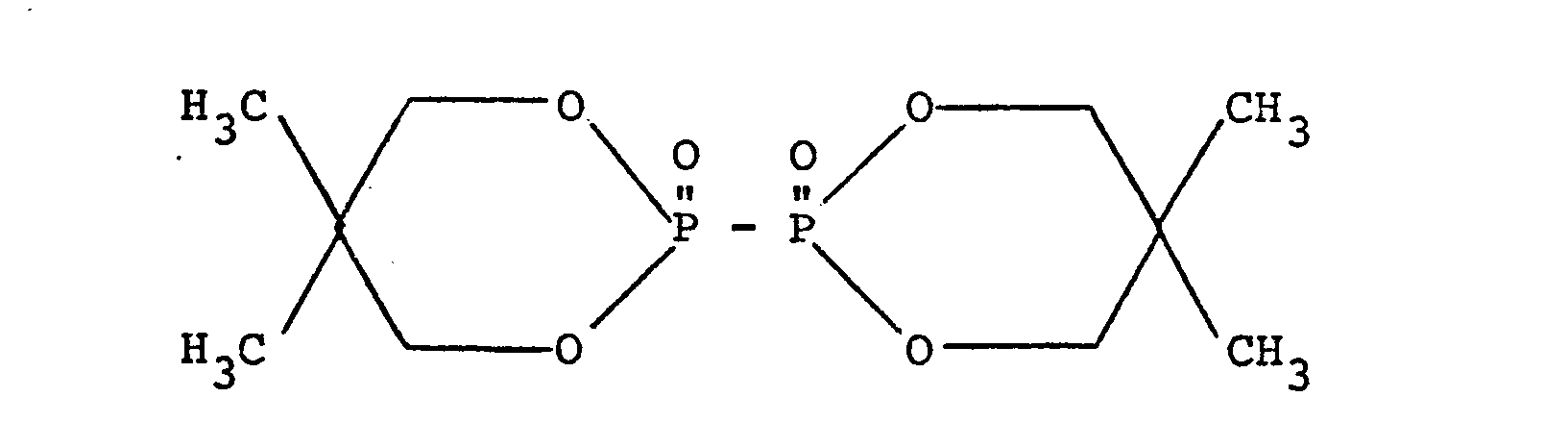
[0009] Stabilizer A, bis(5,5-dimethyl-2-oxo-l,3,2--dioxaphosphorinanyl), was prepared as follows. Into a flask fitted with stirrer, nitrogen purge, feeding funnel, thermometer, and reflux condenser were charged 50 ml of dry benzene and 4.6 grams (0.1 mole) sodium:paraffin 50:50 dispersion. The mixture was stirred about 30 minutes at room temperature with a slow nitrogen purge and then a solution containing 15 grams, (0.1 mole) of 2-hydroxy-5,5-dimethyl-1,3,2-dioxaphosphorinan dissolved in 50 ml of dry benzene was fed in at such a rate that the temperature was kept below 30°C. The contents were stirred for 15 minutes at 25°C and then a solution of 12.0 grams (0.066 mole) of 2-chloro-2-oxo-5,5-dimethyl--1,3,2-dioxaphosphorinan dissolved in benzene (50 ml) was fed dropwise at 5 to 7°C. The reaction temperature was controlled by rate of addition and an ice acetone--water bath. After the feed was in, the reactants were stirred and digested at 25°C for three hours. The contents were again cooled to 5°C by an external source at which time 100 ml of an aqueous 5 percent NaHCO3 solution was added and stirred for a few minutes. The contents were transferred to a separating funnel and allowed to phase out. At the interface a solid forms. The solid was filtered off then dried. It had a melting point of 222°C. The crude product was recrystallized using CHCl3:ethyl acetate (2:1), filtered then washed with water, filtered again then dried. The white needle crystals weighed 5.15 grams and had a melting point of 255°C. The product was identified by phosphorus-31 Nuclear Magnetic Resonance; Infrared; and Mass Spectroscopy as having the formula:
[0010] Stabilizer B was prepared as follows. Into a flask equipped with stirrer, nitrogen purge, thermometer, and reflux condenser were charged'175 ml of benzene. The flask was purged with nitrogen to remove the air and then 25 ml of benzene was distilled off to remove any trace of water. The contents were cooled to 25°C and then with stirring 35.8 grams (0.2 mole) of dichlorophenyl phosphine was added, all at once, followed by the addition in the same manner 49.6 grams (0.4 mole) of trimethyl phosphite. The mixture was refluxed for three hours, cooled, and transferred to a Rinco flask where the benzene was remcved by distillation using high vacuum and 90°C temperature. The resulting product was a colorless liquid, having a weight of 53 grams, and upon standing overnight began to crystallize. The product was identified by Phosphorus 31 Nuclear Magnetic Resonance to be the compound having the formula:
[0011] Stabilizer C was prepared'as follows. 33 grams (0.15 mole) of chlorodiphenylphosphine and 18.6 grams (0.15 mole) of trimethyl phosphite was fed into a flask equipped with stirrer, thermometer, feeding funnel, nitrogen purge, and reflux condenser containing 150 ml of dry benzene. The reaction mixture was refluxed for three hours under a very slow nitrogen purge. The reactants were cooled, transferred to a rotary evaporator where the benzene was removed by distillation under vacuum. 42 grams of a slightly yellowish syrup was recovered. After standing for several days, the syrup crystallized into a composition having a paste-like consistency. After examination by phosphorus-31 NMR, the product was identified as a mixture of 20 percent of (C6H5)2-P(O)-P-(OCH3)2 and about 40 percent of (C6H5)2-P-P(C6H5)2.
[0012]
was prepared as follows. 1.2 grams
of magnesium was weighed into a 125 ml flask
stirrer, thermometer, feeding
r2 purge and reflux condenser. After purging with N2 50 ml of tetrahydrofuran was added to the magnesium. The contents were stirred while phenol dichloro- phosphine 8.9 grams (0.05 mole) was fed in dropwise with occasional external cooling with a water bath to maintain a reaction temperature of 50° to 60°C. After phosphine addition was completed the contents were stirred at 50°C for four hours. The reaction mixture was cooled to room temperature (25°C), transferred to a separating funnel and washed with 30 ml of water. The water was removed and the oil layer was allowed to evaporate in air to about 50 percent of the original volume. Then a second addition of 30 ml of water precipitated-2.1 grams of a white solid which, when recrystallized from acetonitrile, gave a product with a melting point of 150°C, consistent with reported literature results. The structure of the compound was determined to be as follows:
[0013] A copolycarbonate of phenolphthalein and Bisphenol A, hereinafter known as Polycarbonate E, was prepared by condensing 112.5 pounds (51.0 kg) of Bisphenol A and 37.5 pounds (17.0 kg) of phenolphthalein with 68 pounds (31 kg) of phosgene. The reaction was carried out in a solution of 1200 pounds (544 kg) of methylene chloride and 162.5 pounds (73.7 kg) pyridine in a 200 gallon (757 liters) glass-lined Pfaudler reactor. Para tertiary butyl phenol (2.10 pounds) (0.95 kg) was added is a terminater to control molecular weight.
[0014] After polymerization, the pyridine hydrochloride formed in the reaction and any excess pyridine was remozed by contacting the polymer solution with a solution of 76 pounds (34 kg) of 12N HC1 in 30 gallons (114 liters) of distilled water. An aliquot of the polymer solution in methylene chlorie was removed and washed two additional times with 30 volume percent distilled water. The water was separated and removed after each wash. Final traces of water were removed by contacting the solution with silica gel. The polymer solution was then filtered, the polymer precipitated with hexane, and air dried.
[0015] The copolycarbonate was 25 weight percent phenolphthalein and had a molecular weigh of 33,000 weight average molecular weight by gel permeation chromatography.
[0016] Stabilizers A, B, C and D prepared as above were blended with Polycarbonate E using ethanol as the solvent.
[0017] Comparative Runs A, B, C and D were made employing no stabilizers and two commercially available stabilizers. Stabilizer F was tetrakis(2,4-di-t-butylphenyl)-4,4'-bis- -(phenylyldiphosphonite) available as Sandostab P-EPQ®. Stabilizer G has 3,9-(di(octadecyloxy)-2,4,8,10-tetraoxa--3,9-diphosphaspiro-5,5-undecane available as Weston 618®. In Examples 1 through 4 and Comparative Runs C and D, the stabilizer level was 1000 parts per million.
[0018] The compositions were then air dried followed by vacuum drying at 110°C for four hours. One gram of each composition was weighed into a separate 13 by 100 mm test tube and purged with nitrogen. The test tubes were inserted into a 1-3/4 inch (4.4 cm) deep hole in an aluminum block with the temperature being controlled at 350°C. The heat cycle time was 30 minutes. A nitrogen pad (a pressure of.about 3.7 mm of mercury) was maintained on the samples during the heat cycle.
[0019] After the heat cycle, the sample was cooled. The test tube was broken and the composition was dissolved in methylene chloride. The glass particles were removed by filtration and the filtrate was diluted with more methylene chloride to make up a 100 ml solution. The color was determined on the solution by using a "Spec- tronic" Bausch and Lomb Photometer at 350 mµ and reported in Table I as percent transmittance.
EXAMPLE 5 AND COMPARATIVE RUN E
[0020] 15 pounds (6.8 kg) of high density polyethylene having a melt index of 5.0 and a density of 9.962 was dry blended with 0.12 ounces (3.4 grams) of Stabilizer A. The mixture was then double-pass extruded at 149°C on a 1-1/4 inch (3.2 cm) extruder with a nitrogen purge on the feed hopper of the extruder. After blending and extruding, the melt index of the polyethylene composition containing 500 parts per million of Stabilizer A was determined using ASTM Procedure D-1238.
[0021] The polyethylene composition was next subjected to a multiextrusion test employing the same extruder
above, but with the temperature at 260°C. Aften each pass through the extruder, the
extruded composition was determined. A decrease in the melt index signified a breaking down and crosslinking of the polymer. The best stabilizer would result in the smallest change in the melt index. in Comparative Run E, the same polyethylene as in Example 5 was extruded twice at 260°C, the polyethylene in the comparative run net containing any stabilizer.
EXAMPLE 6 AND COMPARATIVE RUN F
[0024] 300 grams of Polycarbonate E was slurried with approximately 2 liters of distilled water in a Waring Blendor. While the water-polymer slurry was vigorously agitated, a solution of 1.5 grams of Stabilizer G in 15 milliliters of methylene chloride was slowly added. The polycarbonate powder was then collected on a filter and air dried.
[0025] This
procedure was repeated adding 1.5 grams of Stabilizer A to 300 grams of Polycarbonate E to give a composition containing 5000 parts per million of Stabili-
A.
1. A composition comprising a thermoplastic polymer and a stabilizing amount of an
argano-
compound having one of the formulas



wherein a is independently 0 or l, n is 3 to 6, X is oxygen or sulfur, R1, R2 and R3 are independently dialkylamino, alkoxy, aryloxy, alkyl, aryl, alkaryl, aralkyl, or R1 and R2 taken with the phosphorus atom represent a cyclic structure having only carbon, phosphorus and oxygen atoms in the cyclic structure.
compound having one of the formulas
wherein a is independently 0 or l, n is 3 to 6, X is oxygen or sulfur, R1, R2 and R3 are independently dialkylamino, alkoxy, aryloxy, alkyl, aryl, alkaryl, aralkyl, or R1 and R2 taken with the phosphorus atom represent a cyclic structure having only carbon, phosphorus and oxygen atoms in the cyclic structure.
2. The composition as in Claim 1 wherein the organo-phosphorus compound has the formula
3. The composition as in Claim 1 wherein the thermoplastic polymer is a polycarbonate.
4. The composition as in Claim 1 wherein the organo-phosphorus compound is present
from 0.01 to 1.0 percent by weight based on the total weight of the polymer.