|
(11) | EP 0 002 379 A1 |

| (12) | EUROPEAN PATENT APPLICATION |
|
|
|
|
|||||||||||||||||||||||||||
| (54) | A reversing mechanism for a reciprocating combustion engine |
| (57) A reversing mechanism for a reciprocating combustion engine comprises a lost-motion
coupling having two coupling parts (3, 16) connected to the engine's control or cam
shaft (1) aid its crankshaft, respectively, and at least one reversing crank (7) for
turning the coupling parts through an angle relative to one another. The reversing
crank is driven by a hydraulic, osciilating-piston motor (4, 18) built into one of
the coupling parts. In order to ensure proper lubrication of plain bearings (9, 39),
which support the crank in either coupling part, ducts are provided in the crank and
in the hydraulic motor through which the high-pressure chamber of the hydraulic motor
communicates with the bearings. The ducts may ba formed by drilled bcres (31, 32,
34, 35) in the crank and by annular slots defined between the main journal ein (8,
30) cf the crank and barrier rings (29) secured in the cylinder of the hydraulic motor.
(Fig. 2). |
[0001] The present invention relates to a reversing mechanism for a reciprocating combustion engine, such as a ship's engine, having a control shaft to which there are secured cams for controlling the fuel injection and/ or valves in the engine cylinders, said reversing mechanism comprising a lost-motion coupling connecting the control shaft to the crankshaft of the engine and including a first coupling part in the form of a driving wheel connected to the crankshaft, a second coupling part in the form of a driver rigidly connected to the control shaft and at least one oscillating-piston hydraulic motor mounted in one of the coupling parts with its axis of oscillation offset from the axis of the control shaft, the piston of said hydraulic motor being rigidly connected with the main journal pin of a reversing crank, the eccentric crank pin of which is rotatably journalled in a shoe slidingly displaceable within a guideway in the other coupling part, the reversing crank being supported by plain bearings in both coupling parts.
[0002] A reversing mechanism of this kind is disclosed in British Patent Specification No. 1 408 325. When the combustion engine is to be reversed one chamber of each hydraulic motor is connected to a source of hydraulic liquid at high pressure, e.g. 30 to 40 bar, and when the or each reversing crank is consequently turned from one end position to its other end position, the two coupling parts are turned relative to one another through an angle. Consequently, the angular position of the control shaft and the cams secured thereto relative to the crankshaft of the combustion engine is changed according to the desired change of the direction of rotation of the crankshaft.
[0003] In the reversing mechanism disclosed in British Specification No. 1 408 325 the plain bearings in which reversing cranks are supported may give rise to a rather considerable bearing friction and a correspondingly high resistance against the turning of the cranks during the reversing operation. In some cases this can result in that the reversing cannot be completed because the available working pressure of the hydraulic liquid is insufficient to overcome the resistance. It has therefore been proposed to support the reversing cranks by roller or needle bearings, as disclosed in Danish Specification No. P33 169 whereby the bearing friction becomes so low that this problem is eliminated. There may, however, then occur a different problem in that the supporting surfaces of the bearing races can be permanently deformed due to the high specific contact pressure prevailing between these surfaces and the rolling elements of the bearings during normal operation of the combustion engine when no rotation takes place between the bearings parts which at the same time have to transfer the entire driving torque from the crankshaft of the engine to the control shaft.
[0004] According to the present invention all the problems mentioned above have been solved by the provision - in a reversing mechanism of the kind referred to initially - of ducts in the hydraulic motor and in the reversing crank, which ducts - during a reversing operation - connect the bearings of the reversing crank with that working chamber of the hydraulic motor in which a high hydraulic pressure prevails.
[0005] Due to the flow path created between the high-pressure chamber of the or each- hydraulic motor and the bearings of the or each reversing crank the bearings will be lubricated, during the reversing operation, by oil at a pressure which substantially exceeds the normal pressure of the oil for lubricating the control shaft and the further component parts of the reversing mechanism (generally about 1.5 to 2 bar), and it has been found that in this way the friction within the bearings is reduced so much that notwithstanding the somewhat higher consumption of high-pressure oil the reversing proceeds smoothly and without any risk that the turning of the reversing crank or cranks stops before the operation has been terminated. At the same time the advantages obtained by the relatively high contact area of the plain bearings and the correspondingly low specific contact pressure during normal operation of the combustion engine, when the reversing crank does not move relative to the coupling parts, are retained:
[0006] In a particularly simple embodiment of the invention said ducts are formed by annular slots between the cylinder of the hydraulic motor and the main journal pin of the reversing crank and by bores drilled through the crank and connecting a chamber located between one bearing of the main journal pin and the adjacent annular slot with the bearings supporting the crank in the sliding shoe. The permanent communication between the working chambers and the bearings ensures that also during normal operation of the combustion engine, when the working chambers are connected to the usual lubricating oil system, a sufficient lubricating film will be maintained between the relatively stationary bearing surfaces. With a suitable dimensioning of the annular slots and the drilled bores it is possible to restrict the leakage of oil from the high-pressure chamber of the motor to the low-pressure chamber thereof to a value which is sufficiently low not to jeopardize the completion of the reversing operation.
[0007] Each annular slot may be formed between the surface of the main journal pin and a barrier ring secured in the cylinder of the hydraulic motor. Since the barrier rings can be made of a different material than the cylinder and the main journal pin of the hydraulic motor, which generally are both made of steel, the risk of direct contact between the cylinder and the journal pin, due to elastic deformations in the reversing mechanism, and the concomitant risk of seizure is avoided.
[0008] The invention will be described in more detail below with reference to the accompanying, somewhat schema- - tic drawings in which
Fig.l is an axial section through a reversing mechanism embodying the present invention,
Fig. 2 is a corresponding section on a larger scale through the hydraulic motor of the mechanism,
Fig. 3 is a section along line A-A in Fig. 2, and
Fig. 4 is a section along line B-B in Fig. 2.
[0009] As illustrated in the drawings, a reversing mechanism for a combustion engine (not shown in detail) includes a shaft 1 which in the embodiment shown is relatively short and formed, at its ends, with flanges 2 by means of which the shaft can be secured to the two halves of the control shaft (not further shown) to which there are secured cams for controlling fuel injection pumps and exhaust valves. It is contemplated that the combustion engine is a directly reversible two stroke engine in which the same cams are operative at both directions of rotation, but with different angular positions relative to the crankshaft of the engine.
[0010] To shaft 1 there is secured a driver 3 with a bore extending parallel to the shaft and eccentric relative thereto. In this bore a hydraulic cylinder 4 is secured by means of bolts 5 passing through the end cover 6 of the cylinder and a subjacent flange of the cylinder. A reversing crank 7 includes a main journal pin 8 which is supported in the bottom wall of cylinder 4 and in end cover 6 by means of two plain bearings 9 and 39, respectively. Crank 7 also comprises a crank pin 10 offset from pin 8 and connected to this pin by means of an arm 11. By means of two bearing sleeves 12 and 13 secured to pin 10, this pin is supported in a sliding shoe 14, which is radially displaceable within a guide 15 in a sprocket wheel 16. By means of two roller bearings 17 sprocket 16 is rotatably supported on shaft 1 laterally offset from driver 3. Through one or more chains (not shown) sprocket 16 is drivingly connected to the crankshaft (not shown) of the combustion engine.
[0011] To the main journal pin 8 there is secured a radially extending vane or piston 18 which together with a filler piece 19 secured within cylinder 4 defines two working chambers within the cylinder. In the periphery of filler piece 19 and vane piston 18 there are mounted sealing strips 20 and 21, respectively, for sealing the working chambers from one another.
[0012] As shown and described in more detail in the two patent specifications referred to above, each of the two working chambers within cylinder 4 can be connected to a hydraulic source and sink, respectively, through bores 22 and 23 in the wall of the cylinder and alined bores in the driver 3, external oil pipes (not shown), annular distributor grooves 24 and 25 in the boss of driver 3, two coaxial ducts 26 and 27 in shaft 1 and a stuffing box 28. Further details concerning the lost-motion coupling and the system for supplying and returning hydraulic liquid in order to carry out a reversing operation, will appear from said two patent specifications.
[0013] At either side of the piston 18 there is provided a barrier ring 29 secured in the cylinder 4 and the end cover 6, respectively, which ring surrounds the main journal pin 8 and the extension 30 thereof, which is - supported in cover 6, respectively, with a relatively narrow clearance. In connection with a main journal pin having a diameter of 220 mm the clearance may be about 0.07 to 0.15 mm. Ecah of two radial bores 31 and 32 in pin 8 opens at one end thereof in an annular chamber 33 between the bearing sleeve 9 and the adjacent barrier ring 29 while the opposite end of each bore opens into an axial bore 34 in the pin. The bore 34 is closed at its end adjacent extension 30 and the opposite end thereof merges into an inclined bore 35 which passes through arm 11 and opens in the surface of crank pin 10 between the two bearing sleeves 12 and 13.
[0014] When hydraulic oil at high pressure is supplied, through the control system (not shown) of the hydraulic motor, to one of the two working chambers defined between piston 18 and filler piece 19 within cylinder 4, the piston and hence the reversing crank 7 is rotated, as described in the two aforesaid patent specifications, from one end position thereof to the opposite end position, and due to the slots formed by the barrier rings 29 oil at said high pressure can-flow to the two plain bearings 9 and 39 and lubricate these bearings at an increased pressure. From chamber 33 oil may further flow through bores 31, 32, 34, and 35 for lubricating the two bearing sleeves of crank pin 10. When the reversing operation has been completed, the pressure in the operative working chamber of the hydraulic motor is reduced to the usual lubricating oil pressure and said annular slots and bores ensure that also during the periods of operation of the combustion engine between successive reversing operations the bearings will be supplied with lubricating oil.
1. Reversing mechanism for a reciprocating combustion engine, such as a ship's engine,
having a control shaft to which there are secured cams for controlling the fuel injection
and/or valves in the engine cylinders, said eversing mechanism comprising a. lost-motion
coupling connecting the control shaft to the crankshaft of the
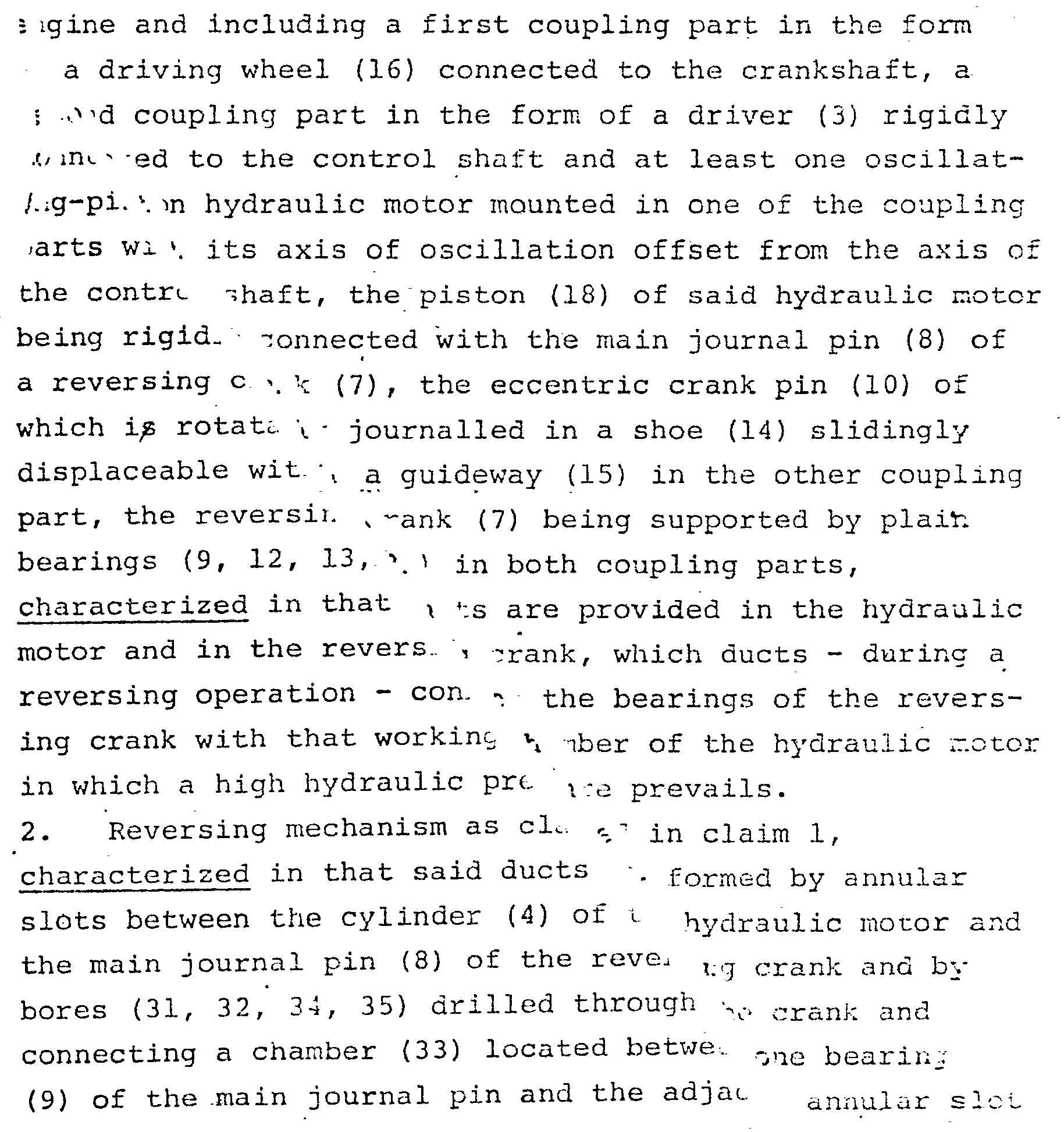
2. Reversing mechanism as cla gl in claim 1, characterized in that said ducts formed
by annular slots between the cylinder (4) of t hydraulic motor and the main journal pin (8) of the revet tg crank and by bores
(31, 32, 34, 35) drilled through to crank and connecting a chamber (33) located betwen one bearing
(9) of the main journal pin and the adjad annular slow with the bearings supporting
the crank in the sliding shoe (14).
3. Reversing mechanism as claimed in claim 2, characterized in that each annular slot
is formed between the surface of the main journal pin (8, 30) and a barrier ring (29)
secured in the cylinder of the hydraulic motor.