|
(11) | EP 0 003 246 B1 |

| (12) | EUROPEAN PATENT SPECIFICATION |
|
|
| (54) |
Polyamides and their use Polyamide und ihre Verwendung Polyamides et leur utilisation |
|
|
|||||||||||||||||||||||
| Note: Within nine months from the publication of the mention of the grant of the European patent, any person may give notice to the European Patent Office of opposition to the European patent granted. Notice of opposition shall be filed in a written reasoned statement. It shall not be deemed to have been filed until the opposition fee has been paid. (Art. 99(1) European Patent Convention). |
[0001] This invention relates to polyamides and their use. More in particular the invention relates to polyamides substantially based on polycarboxylic acid and polyamine. Polyamines include hereinbelow, triamines etc. and polycarboxylic acids include inter alia dimeric, trimeric and higher oligomeric fatty acids. Polyamides of this general type are known in the art and have been used for various purposes.
[0002] British Specification 1,349,816 (Inventa) discloses polyamides based on dicarboxylic acids which are by-product of the oxidation of cycloalkanols/alkanones, in particular cyclo- hexanol/cyclohexanone, i.e. mixtures of C4-C6 mono- and dicarboxylic acids, and on polyamines, inter alia of the formula H(NH A)nNH2, in which A is lower alkylene, n is 2 to 6 and the n radicals A are the same or different. Of this group of polyamines only diethylene triamine (DETA), triethylene tetramine (TETA) and bis-(3-aminopropyl)-imine (page 4, lines 9-10 and examples 1-9) are specifically mentioned. Amines in which the n radicals A are different are not specifically mentioned, nor are polymerized fatty acids. The polyamides are used in epoxide resins.
[0003] British Specification 1,108,558 (Swan) discloses polyamides based on polymerized fatty acids and polyamines of the formula H2N (R-NH)x-R-NH2, in which x = 1-4 and R = C2-C4 alkylene. There is no mention that the x groups R could be different and the polyamines mentioned specifically (DETA, TETA, TEPA and PEHA) all show identical groups R. The polyamides are used in epoxide resins.
[0004] Reactive polyamides, i.e. polyamides containing appreciable amounts of free amine or free carboxyl groups, as evidenced by their amine value and acid value have, particularly, been used as curing agents for resins. Polyamides with amine values of 5-250 and even higher have in particular been used as curing agent for epoxide resins as they impart certain desirable properties, such as improved impact resistance and flexural strength, to the resin.
[0005] One of the problems encountered in compounding polyamide-epoxide resins is that the reactive polyamide resins employed are usually semi-liquid, highly viscous polymers and therefore difficult to handle. Attempts have therefore been made to lower the pour point and to reduce the viscosity of these polyamides. Thus it has been proposed to improve the rheological properties of polyamides based on polymeric fatty acids and excess polyamine such as ethylenediamine (EDA), diethylenetriamine (DETA), triethylenetetramine (TETA), and similar higher polyamines with recurring ethylene imine fragments by heating these polyamides during or after their preparation to reaction temperatures exceeding 250°C for prolonged periods, so as to effect the formation of imidazoline rings. Formation of imidazoline rings reduces the viscosity, but at the same time also the reactivity towards the epoxy resin is reduced. It has been found difficult in practice to reach a satisfactory compromise between viscosity and reactivity with these imidazoline-containing products.
[0006] It has now been found that certain novel polyamides possess relatively low viscosities combined with a high reactivity. These polyamides are substantially based on a polycarboxylic acid constituent comprising polymeric fatty acids and on a polyamine constituent comprising a polyalkylene polyamine in which at least two of the n recurring alkylene groups are different. These polyamines possess alkylene groups containing 1-5, preferably 2 or 3 carbon atoms and 2-6, preferably 2 or 3 recurring alkylene gorups in the molecule. In these polyamines two or more different alkylene imine groups occur in a regular or irregular, preferably alternating sequence. The polyalkylene polyamines on which the polyamides according to the invention are based having the general formula
in which n = 2-6, and in which the n recurring groups R comprise at least two different C,-C5, preferably C2-C3 alkylene groups. The groups R may be present in any regular or irregular pattern but an alternating sequence is preferable. Very suitable polyamines are e.g. 3-(2-amino ethyl) amino propylamine (3-azahexane-1,6-diamine), N,N'-bis(3-amino propyl)ethylenediamine (4,7-diazadecane-1,10-diamine) N,N'-bis(2-amino ethyl) 1,3-propylenediamine (3,7-diazanonane-1,9-diamine), and 4,7,11-triaza-tetradecane-1,14-diamine, but other similar polyamines may equally be used. Mixtures of polyalkylene polyamines of this type can be used and they may also be combined with up to 50, preferably less than 25 mol. per cent of polyamines of a different type, such as e.g. those with identical recurring alkylene imine groups or other aliphatic, cycloaliphatic and aromatic polyamines, such as trimethylhexamethylene diamine, isophoron diamine and piperazine. The polyamine constituent of the polyamide then comprises two different polyamines, viz. one satisfying the general formula given above and a different aliphatic, cycloaliphatic or aromatic polyamine. The polycarboxylic acid constituent on which the polyamides according to the present invention are substantially based comprises polymerized fatty acids, e.g. polymerized C12-C22 monocarboxylic acids, more in particular polymerized CIs-fatty acids such as stearic acid, oleic acid, linoleic acid and linolenic acid. Customarily unsaturated fatty acids are polymerized, which polymerized acids are separated into a monomeric and a polymeric fraction and the polymeric fraction may be subjected to further treatments like hydrogenation, bleaching and separation into fractions. Technical grades of these polymerized fatty acids substantially consists of monocarboxylic acid (Monomer), dicarboxylic acid (Dimer) and tricarboxylic acid (Trimer) in varying amounts. E.g., products with the following compositions can be used with advantage: T:D:M 20:80:1 (Empol® 1022), 80:25:0 (Empol 1040) and 5:90:0 (Empol 1010). Instead of polytlmines and polymerized fatty acids also their functional derivatives may be used to prepare polyamides. Other dicarboxylic acids can also be included, even up to 80 mol.%, in particular C4-C24 dicarboxylic acids e.g. adipic acid, azelaic acid, sebacic acid, terephthalic acid, etc. @Empol is a registered trademark of Emery Ind. Inc. USA and Unilever-Emery N.V. at Gouda, Netherlands. To obtain special effects other compounds may be built into the polyamide by incorporating them into the reaction mixture. Such ingredients are e.g. polymeric fatty acid amines, lactams, and chain stoppers such as monoamines and C2-C20 monocarboxylic acids. Especially monocarboxylic acids C8C18 straight or branched chain are useful chain stoppers. The amount of chain stopper present is suitably from 0 to 40 mol percent. Dependent on the reactivity desired in the eventual polyamide, usually an excess amount of amine, expressed in equivalents, is used, but excess carboxylic acids may also be applied.
[0007] The polyamides according to the invention can be prepared by methods known in the art, by heating the reaction components, the polycarboxylic acid constituent comprising the polymeric fatty acid or its lower alkyl ester and the polyamine constituent, to temperatures of 150-325°C, in particular 200-270°C, for several hours, preferably under conditions which allow water of reaction to escape. Addition of an entrailment agent to the reaction mixture and/or blanketing under an inert gas is often advantageous. Polyamides according to the invention prepared at the lower range of reaction temperatures indicated above show low viscosities and pour points as compared with the corresponding polyamides based on e.g. diethylenetriamine. For instance certain polyamides based on 3-+2-amino ethyl aminopropyl)amine and N,N'-bis-(-3-amino propyl)ethylenediamine and homologues thereof prepared at reaction temperatures of 200°-250°C show pour points and viscosities which can be attained only with TETA-based polyamides containing appreciable amounts of imidazoline (5-membered) rings. The viscosity of the polyamides according to the present invention can be even further reduced by heating to temperatures above 250°C, possibly leading to some formation of 6-membered ring structures, which however hardly affects the reactivity. The polyamides according to the invention are light- to amber-coloured liquids having viscosities of 0.05-25, preferably 0.1-3.0 Pa s at 75°C and amine values from 5-600, preferably 100-500, combined with acid values below' 2, preferably below 1. However also polyamides with acid values of 5-300 and low amine values are provided.
[0008] These novel polyamides can be advantageously used in accordance with the invention as curing agents for resins, in particular for epoxy resins. Epoxy resins are complex polymeric reaction product of polyfunctional phenols with polyfunctional halogenohydrins such as resorcinol and/or other bisphenols with epichlorohydrin and/or glycerol dichlorohydrin. Usually halogenohydrin is reacted in excess with respect to phenol and the reaction is carried out in an alkaline medium. Several of these epoxy resins which contain 2 or more epoxy groups in the molecule are commercially available, e.g. Epikotes ex Shell Oil Co.
[0009] The polyamides according to the present invention can be reacted with the epoxy resin by simple mixing, obviating the use of a solvent. Curing may take place with or without heating. The reactivity of the polyamide is expressed by its gel time, which was either determined at 20°C by mixing 50 parts by weight of polyamide with 100 parts by weight of Epikote 828 or at 60°C by mixing these ingredients in equivalent amounts.
[0010] The relative quantities of polyamide and epoxy resin combined depend, inter alia, on the reactivity of the two resins, i.e. on amine value and epoxide equivalent number and may differ widely. Equivalent amounts are often used, however 10-100 equivalent per cent of reactive polyamide per epoxy equivalent can be used in general; in practice 10-50 per cent by weight of polyamide per 90-50 per cent by weight of epoxy resin is used. The polyamide/epoxy resin combinations are useful for many purposes, especially for coating casting resins, laminating and impregnating compositions. The epoxy resins thus cured showed an excellent colour stability and impact resistance. The invention also provides articles wholly or partially consisting of epoxy resins which have been cured employing a polyamide according to the invention.
[0011] The invention will now be illustrated by the following Examples:
In these Examples the ratio polymeric carboxylic acid/monocarboxylic acid expressed in equivalents was kept constant. The quantities indicated in the Tables below are weight quantities indicated in grams.
Examples 1-5
[0012] A series of polyamides was prepared from ingredients and at reaction conditions indicated in Table I, where the quantities indicated are weight quantities expressed in grams. The properties of the polyamides are also indicated and for comparison purposes polyamides known in the art are given.
Example 6
[0014] The resin showed an amine value of 418, an acid value of 0.2 and a viscosity at 75°C of 1.3 Pa s.
[0015] For comparison purposes a similar polyamide was prepared using triethylene tetraamine (TETA) in an amount of 447 g and 855 g trimeric acid, which showed an amine value of 417, an acid value of 0.1 and a viscosity at 75°C of 4.6 Pa s.
Example 7
[0017] The pale resin showed an amine value of 350, an acid value of 0.1 and a viscosity at 25°C of 5.5 Pa s.
Examples 8 and 9
Example 10
[0020] The resulting polyamide showed an amine value of 294, an acid value of 0.2 and a viscosity of 0.50 Pa s at 75°C, the gel time was 16 minutes (equivalents amounts mixed at 60°C).
[0021] For comparison purposes a similar polyamide was prepared now using 363 g tetraethylene pentamine (TEPA) as the sole amine component. This polyamide showed an amine value of 306, an acid value of 0.1, an imidazoline content of about 60%, a viscosity of 0.75 Pa s at 75°C and the gel time was 30 minutes (equivalent amounts mixed at 60°C).
Example 11
[0023] The resulting polyamide showed an amine value of 385, an acid value < 0.1, a viscosity of 3.0 Pa s at 25°C and a gel time of 12 minutes (equivalent amounts admixed at 60°C).
Example 12
1. A polyamide based on a polycarboxylic acid constituent comprising a polymerized
fatty acid and a polyamine constituent comprising a polyamine with the general formula:
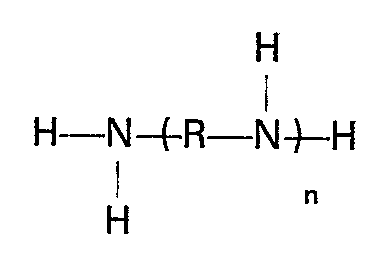
characterized in that n = 2-6 and in that the n recurring groups R comprise at least two different C,-Cs alkylene groups.
characterized in that n = 2-6 and in that the n recurring groups R comprise at least two different C,-Cs alkylene groups.
2. A polyamide according to claim 1, characterized in that the n recurring groups
R are present in the form of an alternating sequence.
3. A polyamide according to claims 1 and 2, characterized in that the polycarboxylic
acid constituent comprises a polymerized fatty acid and 0 to 80 mol. per cent of a
C4-C24 dicarboxylic acid.
4. A polyamide according to claim 1, 2 or 3, characterized in that the polyamine constituent
comprises 0 to 50 mol. per cent of a different aliphatic, cyclo-aliphatic or aromatic
polyamine.
5. A polyamide according to claim 1, characterized in that 0-40 mol. per cent of a
chain stopper is present.
6. A process for curing epoxy resins, characterized in that a polyepoxy compound is
reacted with 10-100 equivalent per cent of a polyamide as defined in claim 1.
7. Articles wholly or partially consisting of cured epoxy resin, characterized in
that they are obtained according to claim 6.
1. Ein Polyamid auf der Basis eines eine polymerisierte Fettsäure umfassenden Polycarbonsäurebestandteils
und eines ein Polyamin der allgemeinen Formel
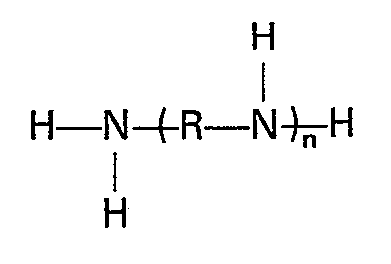
umfassenden Polyaminbestandteils, dadurch gekennzeichnet, daß in der vorstehenden Formel n eine Zahl von 2 bis 6 ist und daß die n x sich wiederholenden Gruppen R wenigstens zwei verschiedene C1- bis Cs-Alkylengruppen umfassen.
umfassenden Polyaminbestandteils, dadurch gekennzeichnet, daß in der vorstehenden Formel n eine Zahl von 2 bis 6 ist und daß die n x sich wiederholenden Gruppen R wenigstens zwei verschiedene C1- bis Cs-Alkylengruppen umfassen.
2. Polyamid nach Anspruch 1, dadurch gekennzeichnet, daß die n x sich wiederholenden
Gruppen R in Form einer alternierenden Reihenfolge vorhanden sind.
3. Polyamid nach Anspruch 1 oder 2, dadurch gekennzeichnet, daß der Polycarbonsäurebestandteil
eine polymerisierte Fettsäure und 0 bis 80 Mol-% einer C4- bis C24-Dicarbonsäure umfaßt.
4. Polyamid nach Anspruch 1, 2 oder 3, dadurch gekennzeichnet, daß der Polyaminbestandteil
0 bis 50 Mol-% eines verschiedenen aliphatischen, cycloaliphatischen oder aromatischen
Polyamins umfaßt.
5. Polyamid nach Anspruch 1, dadurch gekennzeichnet, daß 0 bis 40 Molgew.-% eines
Kettenunterbrechungsmittels vorhanden sind.
6. Verfahren zum Härten von Epoxyharzen, dadurch gekennzeichnet, daß eine Polyepoxyverbindung
mit 10 bis 100 Äquivalent-% eines Polyamides gemäß Anspruch 1 umgesetzt wird.
7. Gegenstände vollständig oder teilweise, bestehend aus einem gehärteten Epoxyharz,
dadurch gekennzeichnet, daß sie nach dem Verfahren gemäß Anspruch 6 erhalten werden.
1. Polyamide à base d'un constituant acide polycarboxylique comprenant un acide gras
polymérisé et d'un constituant polyamine comprenant une polyamine ayant la formule
générale:
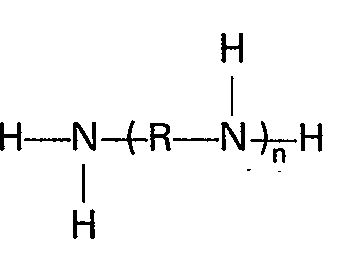
caractérisé par le fait que n = 2 à 6 et que les n groupes R de récurrence comprennent au moins deux groupes alkylène en C1-CS différents.
caractérisé par le fait que n = 2 à 6 et que les n groupes R de récurrence comprennent au moins deux groupes alkylène en C1-CS différents.
2. Polyamide selon la revendication 1, caractérisée par le fait que les n groupes
R de récurrence sont présents sous la forme d'un ordre alterné.
3. Polyamide selon les revendications 1 et 2, caractérisée par le fait que le constituant
acide polycarboxylique comprend un acide gras polymérisé et 0 à 80% en mole d'un acide
dicarboxylique en C4-C24·
4. Polyamide selon l'une quelconque des revendications 1, 2 ou 3, caractérisée par
le fait que le constituant polyamine comprend 0 à 50% en mole d'une polyamine aliphatique,
cycloaliphatique ou aromatique, différente.
5. Polyamide selon la revendication 1, caractérisée par le fait que 0 à 40 % en mole
en poids d'un arrêteur de chaînes est présent.
6. Procédé pour le durcissement des résines époxy, caractérisé par le fait que l'on
fait réagir un composé polyépoxy avec 10 à 100% en équivalents d'une polyamide telle
que définie dans la revendication 1.
7. Articles consistant en totalité ou en partie d'une résine époxy durcie, caractérisés
par le fait qu'ils sont obtenus selon la revendication 6.