| (19) |
 |
|
(11) |
EP 0 003 256 B1 |
| (12) |
EUROPEAN PATENT SPECIFICATION |
| (45) |
Mention of the grant of the patent: |
|
09.09.1981 Bulletin 1981/36 |
| (22) |
Date of filing: 07.12.1978 |
|
|
| (54) |
Flexible tubular container and method of making it
Flexibler schlauchförmiger Behälter und Verfahren zur Herstellung eines solchen Behälters
Récipient tubulaire flexible et son procédé de fabrication
|
| (84) |
Designated Contracting States: |
|
BE CH DE FR SE |
| (30) |
Priority: |
30.01.1978 GB 368778
|
| (43) |
Date of publication of application: |
|
08.08.1979 Bulletin 1979/16 |
| (71) |
Applicant: IMPERIAL CHEMICAL INDUSTRIES PLC |
|
London SW1P 3JF (GB) |
|
| (72) |
Inventor: |
|
- Wright, Arthur Stephen
Stevenston
Ayrshire KA20 3LN (GB)
|
| (74) |
Representative: Reid, Thomas James et al |
|
ICI Group Patents Services Dept.
PO Box 6
Shire Park
Bessemer Road
Welwyn Garden City
Herts, AL7 1HD
Welwyn Garden City
Herts, AL7 1HD (GB) |
|
| |
|
| Note: Within nine months from the publication of the mention of the grant of the European
patent, any person may give notice to the European Patent Office of opposition to
the European patent
granted. Notice of opposition shall be filed in a written reasoned statement. It shall
not be deemed to
have been filed until the opposition fee has been paid. (Art. 99(1) European Patent
Convention).
|
[0001] This invention relates to a flexible tubular container which is sealed at one end
by a compression closure embracing the gathered tube end and to a method of making
the said container. Such containers are generally made by dividing a continuous length
of stock tubular material, usually plastics material and often in the form known as
'lay-flat' seamless tube. The closures are often applied to a filled continuous length
of tube before the tube is cut transversely to separate the individual sealed containers.
[0002] In known flexible tubular containers, for example, those containing liquid or gelatinous
materials such as slurry explosive compositions or grouting resin for anchor bolts
used in mines, the tube ends are usually closed by self-sustaining metal or plastic
clips. These clips are rather expensive and difficult to apply. The metal clips constitute
a hazard in blasting operations in mines as they may give rise to sparks which could
ignite firedamp. Also during application to the tube and in blasting the clips can
be projected at high velocity and thus be a danger to personnel. The plastic clips
tend to expand when the containers are stored under pressure with consequent leakage
or exposure of the contents.
[0003] It is known from United States Patent Specification No. 3,785,406 (Delmar) to form
containers from continuous flexible tube by binding a constricted portion of tube
with two separate wires held in position by tying the wire ends and cutting the tube
transversely between the wire closures. Also in United States Patent Specification
No. 3,620,774 (Ford et al) it is proposed to close one end of a flexible tubular container
with a ligature helically wound around a gathered neck of the container and maintained
in position by adhesive material. Neither of these forms of end-closure have been
proposed for closing containers for explosive material.
[0004] It is an object of this invention to provide an improved flexible tubular container,
which is reliab!e and suitable for explosive for use in coal mines. and a method of
making such a container.
[0005] In accordance with this invention a flexible tubular container having at least one
of its ends closed by a length of filamentary material tightly wound in a generally
helical manner along a gathered and constricted portion of said end and held in position
by adhesive material, is characterised in that the container end and the filamentary
material are coterminous and substantially the whole of the end turn of filamentary
material lies in the same plane as the container end.
[0006] Preferably the filamentary material is bonded both to itself and to the tubular container
by a mutually compatible adhesive material.
[0007] Convenient filamentary materials include flexible tying materials such as cord, tape,
string and textile yarn. The adhesive material is advantageously a fast acting adhesive
such as cyanoacrylate adhesive or a hot-melt adhesive comprising a mixture of thermoplastics
resin and tackifying resin such as a mixture of ethylene/vinyl acetate copolymer and
rosin ester.
[0008] The container is advantageously made from a continuous length of flexible tube by
a method which comprises gathering and constricting a portion of the flexible tube,
binding the constricted portion with a length of filamentary material tightly wound
in a generally helical manner along the constricted portion of the tube and applying
adhesive material to the filamentary material to fix said filamentary material in
position on the constricted tube portion, and is characterised in that the constricted
portion of the tube and length of filamentary material are cut transversely to define
two closed container ends on adjacent portions of the flexible tube with each closed
end and substantially the whole of the turn of filamentary material adjacent thereto
lying in the same piane. In a preferred method oi making a container sealed with similar
closures at both ends a continuous length of flexible tube is gathered and constricted
at each of two spaced apart positions, a length of filamentary material is tightly
wound in a generally helical manner along each constricted tube portion and fixed
thereon with adhesive material and the filamentary material and constricted tube portions
are cut transversely at each position to separate a tubular container closed at both
ends from the adjacent closed portions of the flexible tube. It will be understood
that the tube may be constricted, bound and cut at the two positions consecutively,
simultaneously or, in any order which is convenient. Thus the tube may be cut at one
end of the container either before or after the filamentary material is applied around
the tube at the position defining the other end of the tube.
[0009] Tubes of smaller diameter, for example, 5 cm diameter or less, can advantageously
be gathered and constricted by the application of the filamentary material but with
large diameter tubes or tubes containing highly viscous filling material it may be
desirable to pre-waist the tube at the positions where the filamentary material is
to be wound.
[0010] The adhesive may be applied to the filamentary material as it is being wound around
the tuoe or it may be applied in a preliminary operation, the filamentary material
serving as a carrier for the adhesive.
[0011] Advantageously the tubular container may contain the filling material which is to
be packaged in the container. The filling may be a continuous length of deformable
material which is displaced from the constricted portion of tube during the gathering
and constriction of the tube, or it may be spaced apart discrete portions of rigid
or dimensionally stable material, the filamentary material being applied around the
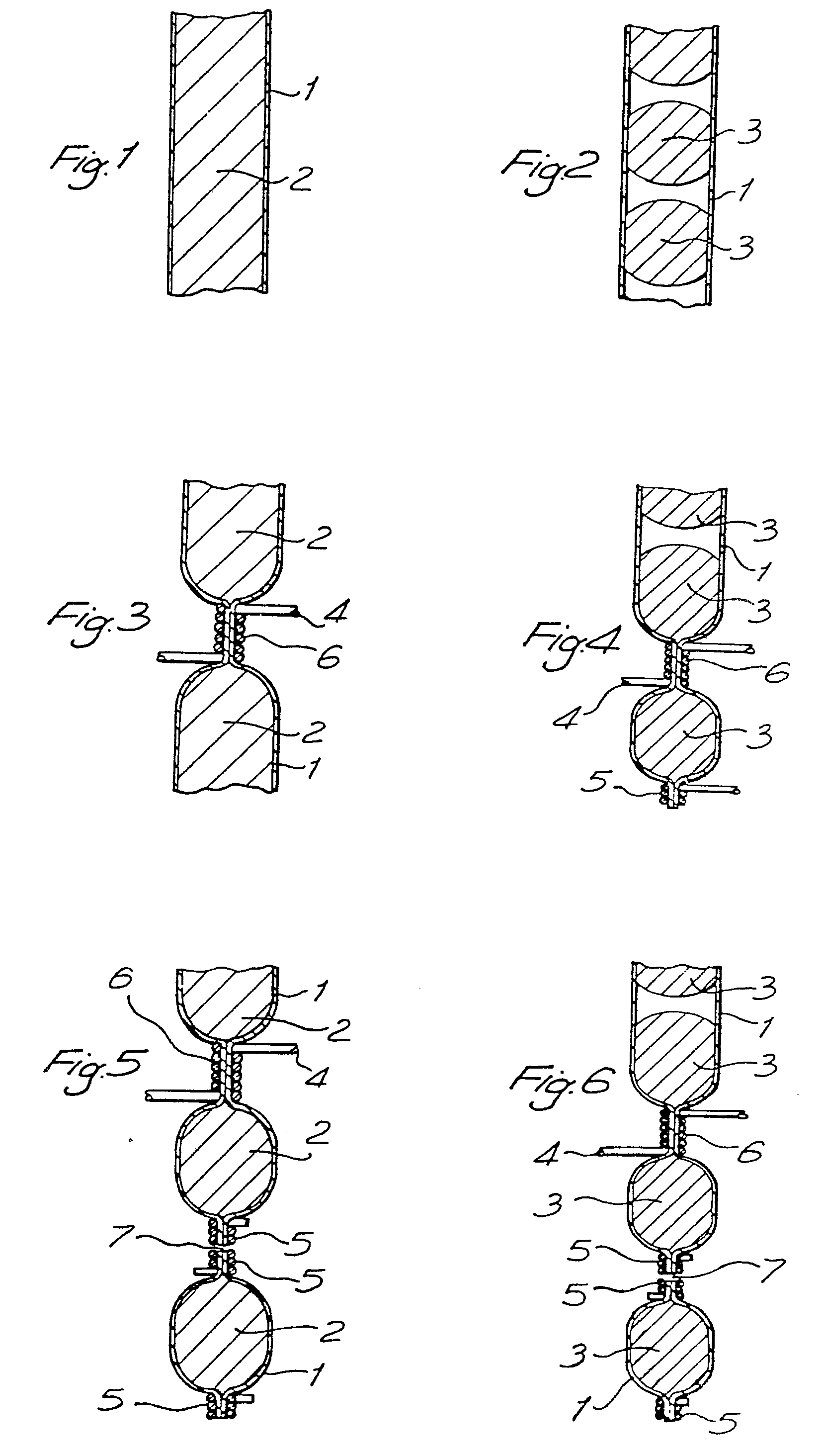
tube at positions between these portions. The invention is further illustrated by
the method of forming containers of the invention which is hereinafter particularly
described, by way of example only, with reference to the accompanying drawings wherein
Fig. 1 is a diagrammatic fragmentary side view of a plastics tube filled with a continuous
deformable material;
Fig. 2 is a diagrammatic fragmentary side view of a plastics tube containing preformed
discrete portions of a filling material;
Fig. 3 shows diagrammatically the tube of Fig. 1 with a cord wound as a ligature around
the tube and constricting a portion of the tube;
Fig. 4 shows diagrammatically the tube of Fig. 2 with a cord wound around and constricting
portions of the tube intermediate discrete portions of filling material;
Fig. 5 shows diagrammatically the constricted tube of Fig. 3 with two adjacent constricted portions cut transversely to separate a sealed filled
container from the adjacent tube portions;
Fig. 6 shows diagrammatically the constricted tube of Fig. 4 with two adjacent constricted
portions cut transversely to separate a sealed container containing a preformed portion
of filling material from the adjacent tube portions. The same numeral is used to denote
like elements in all Figs.
[0012] Referring to Figs. 1, 3 and 5, the flexible tube 1 is filled with a continuous deformable
material 2 and lengths of cord 4 (Fig. 3) are wound tightly in helical manner around
longitudinally spaced portions 6 of the tube 1 whereby the portions 6 are gathered
together and tube 1 is closed. Adhesive material is applied to the cord lengths 4
whereby the cord lengths 4 are maintained tightly bound in position on the tube portions
6. The tube is then cut transversely at the positions 7, whereby the closed portions
6 and the surrounding cord lengths are divided into two parts 5, each part 5 forming
a sealed closure on the tube, the portions of the tube between the adjacent cuts at
positions 7 forming individual sealed containers.
[0013] The filling material in the plastics tube 1 of Fig. 2 is in preformed portions 3
and, in forming the individual sealed containers, the tube 1 is closed by cord lengths
4 wound around portions 6 and cut at positions 7 as described for Figs. 1, 3 and 5,
the portion 6 in this case being intermediate the filling portions 3.
[0014] In putting the invention into practice the plastics tube 1 may conveniently be a
thin tube of polyethylene, polypropylene or polyvinyl chloride which may be preformed
or continuously formed from sheet material during the filling process. The tube may
be filled, for example, by continuously pumping or extruding fluent material, or loading
discrete portions of filling material into the tube. The filled tube is fed past a
closure applying position where, at appropriate intervals, a length of cord is helically
wound around the tube to close tube portions 6. Adhesive material is applied to the
cord 4 or alternatively to the tube 1, to hold the cord 4 firmly in position. The
portion 6 is then cut transversely to divide the two closed portions 6 into two portions
5 and separate a sealed container from the following portion of filled tube 1, each
portion 5 sealing an end of a container.
[0015] The cord 4 may conveniently be cotton, jute or synthetic plastics string such as
is used for conventional parcel binding.
[0016] An especially effective and preferred adhesive is cyanoacrylate adhesive, which may
be obtained from Loctite (UK) Limited as Loctite (Registered Trade Mark) superfast
cyanoacrylate adhesive I.S.--415 or I.S.-495 although, as previously mentioned, hot-meit
adhesives are also advantageous. When the adhesives are applied to the cord, this
may be done before or after the cord is wound on the tube 1. Alternatively, the tube
1 may be precoated with adhesive before the cord 4 is wound around it. In any case
the adhesive will advantageously bond the cord to itself and to the tube 1.
1. A flexible tubular container having at least one of its ends closed by a length
of filamentary material (4) tightly wound in a generally helical manner along a gathered
and constricted portion (6) of said end and held in position by adhesive material,
characterised in that the container end and the filamentar, material (6) are coterminous
and substantially the whole of the end turn of filamentary material lies in the same
plane (7) as the container end.
2. A flexible tubular container formed from a continuous length of flexible tube (1)
by gathering and constricting said length of tube at 'intervals along its length and
binding each constricted portion (6) with a length of filamentary material (4) tightly
wound in a generally helical manner along the constricted portion and held in position
by adhesive material, characterised in that each constricted tube (6) and length of
filamentary material (4) are cut transversely to provide a closed end on each of two
containers formed from adjacent portions of the flexible tube (1) with each closed
end and substantially the whole of the turn of filamentary material adjacent thereto
lying in the same plane (7).
3. A container as claimed in Claim 1 having both its ends closed by a length of filamentary
material (4) as specified in Claim 1.
4. A container as claimed in any one of Claims 1 to 3 inclusive characterised in that
the filamentary material (4) is adhered both to ílseif and to the container by an adhesive material which is compatible with the filamentary
material and the container.
5. A container as claimed in any one of Claims 1 to 4 inclusive characterised in that
the filamentary material (4) comprises cord, tape, string or textile yarn.
6. A container as claimed in any one of Claims 1 to 5 inclusive characterised in that
the adhesive material is fast acting.
7. A container as claimed in Claim 6 characterised in that the adhesive material comprises
cyanoacrylate adhesive or a hot-melt adhesive.
8. A container as claimed in claim 7 characterised in that the adhesive material comprises
a mixture of thermoplastics resin and tackifying resin.
9. A container as claimed in Claim 8 characterised in that the hot-melt adhesive material
comprises a mixture of ethylene/vinyl acetate copolymer and rosin ester.
10. A method of making a flexible tubular container from a length of flexible tube
(1) which method comprises gathering and constricting a portion (6) of the flexible
tube, binding the constricted portion (6) with a length of filamentary material (4)
tightly wound in a generally helical manner along the constricted portion of the tube
and applying adhesive material to the filamentary material (4) to fix said filamentary
material in position on the constricted tube portion, characterised in that the constricted
portion (6) of the tube and length of filamentary material (4) are cut transversely
to define two closed container ends on adjacent portions of the flexible tube with
each closed end and substantially the whole of the turn of filamentary material adjacent
thereto lying in the same plane (7).
11. A method as claimed in Claim 10 characterised in that a continuous length of flexible
tube (1) is gathered and constricted at each of two spaced apart positions (6), a
length of filamentary material is tightly wound in a generally helical manner along
each constricted tube portion (6) and fixed thereon with adhesive material and the
filamentary material (4) and constricted tube portions (6) are cut transversely at
each position to separate a tubular container closed at both ends from the adjacent
closed portions of the flexible tube.
12. A method as claimed in Claim 10 or Claim 11 characterised in that the filamentary
material (4) is bonded both to itself and to the tubular container.
13. A method as claimed in any one of Claims 10 to 12 inclusive characterised in that
the flexible tube (1) is gathered and constricted by the application of the filamentary
material (4).
14. A method as claimed in any one of Claims 10 to 13 inclusive characterised in that
the adhesive material is applied to the filamentary material (4) as the material is
being wound around the tube (1).
15. A method as claimed in any one of Claims 10 to 14 inclusive characterised in that
the adhesive material is applied to the filamentary material (4) before the filamentary
material is wound around the tube (1).
16. A method as claimed in any one of Claims 10 to 15 inclusive characterised in that
the continuous length of flexible tube (1) contains a continuous length of deformable
material (2) which is displaced from the constricted portion (6) of the tube during
the gathering and constricting of the tube.
17. A method as claimed in any one of Claims 10 to 16 inclusive characterised in that
the flexible tube (1) contains discrete portions (3) of rigid or dimensionally stable
material and the filamentary material (4) is applied around the tube at positions
(6) between these portions.
18. A method as claimed in any one of Claims 10 to 17 inclusive wherein the adhesive
material comprises cyanoacrylate adhesive or a hot-melt adhesive.
1. Récipient tubulaire flexible dont au moins une des extrémités est fermée par une
longueur de matière filamentaire (4) enroulée étroitement d'une manière générale en
hélice le long d'une partie froncée et étranglée (6) de la dite extrémité et maintenue
en place par de la matière adhésive, caractérisé en ce que son extrémité ainsi que
la matière filamentaire (6) se terminent au même niveau et en substance la totalité
de la spire d'extrémité de la matière filamentaire est disposée dans le même plan
(7) que l'extrémité du récipient.
2. Récipient tubulaire flexible fait d'une longueur continue de boyau flexible (1)
par fronçage et étranglement de cette longueur de boyau à des intervalles longitudinaux
et par liage de chaque partie étranglée (6) au moyen d'une longueur de matière filamentaire
(4) enroulée étroitement d'une manière générale en hélice le long de la partie étranglée
et maintenue en place par de la matière adhésive, caractérisé en ce que chaque partie
étranglée (6) du boyau ainsi que la longueur de matière filamentaire (4) sont sectionnées
transversalement pour former une extrémité fermée sur chacun de deux récipients faits
de parties adjacentes du boyau flexible (1 chaque extrémité fermée ainsi qu'en substance
la totalité de la spire de matière filamentaire qui y est adjacente se trouvant dans
le même plan (7).
3. Récipient suivant la revendication 1, caractérisé en ce que ses deux extrémités
sont fermées par une longueur de matière filamentaire (4) comme spécifié dans la revendication
1.
4. Récipient suivant l'une quelconque des revendications 1 à 3 incluse, caractérisé
en ce que la matière filamentaire 4 est collée à elle-même et au récipient par une
matière adhesive qui est compatible avec la matière filamentaire et le récipient.
5. Récipient suivant l'une quelconque des revendications 1 à 4 incluse, caractérisé
en ce que la matière filamentaire (4) comprend de la corde, du ruban, de la ficelle
ou du fil textile.
6. Récipient suivant l'une quelconque des revendications 1 à 5 incluse, caractérisé
en ce que la matière adhesive est à action rapide.
7. Récipient suivant la revendication 6, caractérisé en ce que la matière adhésive
comprend un adhésif cyanoacrylique ou un adhésif fondant à chaud.
8. Récipient suivant la revendication 7, caractérisé en ce que la matière adhésive
comprend un mélange de résine thermoplastique et de résine conférant de l'adhésivité.
9. Récipient suivant la revendication 8, caractérisé en ce que la matière adhésive
fondant à chaud comprend un mélange d'un copolymère d'éthylène/acétate de vinyle et
d'un ester de colophane.
10. Procédé pour fabriquer un récipient tubulaire flexible à partir d'une longueur
de boyau flexible (1), suivant lequel on fronce et on étrangle une partie (6) du boyau
flexible, on lie la partie étranglée (6) au moyen d'une longueur de matière filamentaire
(4) enroulée étroitement d'une manière générale en hélice le long de la partie étranglée
du boyau et on applique une matière adhésive sur la matière filamentaire (4) pour
fixer la matière filamentaire en place sur la partie étranglée du boyau, caractérisé
en ce qu'on sectionne la partie étranglée (6) du boyau et la longueur de matière filamentaire
(4) transversalement pour former deux extrémités de récipients fermées sur des parties
adjacentes du boyau flexible, chaque extrémité fermée ainsi qu'en substance la totalité
de la spire de matière filamentaire qui y est adjacente étant situées dans le même
plan (7).
11. Procédé suivant la revendication 10, caractérisé en ce qu'on fronce et on étrangle
une longueur continue de boyau flexible (1) à chacun de deux endroits (6) espacés,
on enroule étroitement une longueur de matière filamentaire d'une manière générale
en hélice le long de chaque partie étranglée (6) du boyau et on l'y fixe au moyen
d'une matière adhésive, puis on sectionne la matière filamentaire (4) et les parties
étranglées (6) du boyau transversalement à chacun de ces endroits pour séparer un
récipient tubulaire fermé aux deux extrémités des parties fermées adjacentes du boyau
flexible.
12. Procédé suivant la revendication 10 ou 11, caractérisé en ce que la matière filamentaire
(4) est collée à elle-même et au récipient tubulaire.
13. Procédé suivant l'une quelconque des revendications 10 à 12 incluse, caractérisé
en ce que le boyau flexible (1) est froncé et étranglé par application de la matière
filamentaire (4).
14. Procédé suivant l'une quelconque des revendications 10 à 13 incluse, caractérisé
en ce que la matière adhésive est appliquée sur la matière filamentaire (4) lorsque
cette matière filamentaire est enroulée autour du boyau (1).
15. Procédé suivant l'une quelconque des revendications 10 à 14 incluse, cractérisé
en ce que la matière adhésive est appliquée sur la matière filamentaire (4) avant
que cette matière filamentaire soit enroulée autour du boyau (1).
16. Procédé suivant l'une quelconque des revendications 10 à 15 incluse, caractérisé
en ce que la longueur continue de boyau flexible (1) contient une longueur continue
de matière déformable (2) qui est refoulée de la partie étranglée (6) du boyau pendant
le fronçage et l'étranglement du boyau.
17. Procédé suivant l'une quelconque des revendications 10 à 16 incluse, caractérisé
en ce que le boyau flexible (1) contient des portions distinctes (3) de matière rigide
ou de dimensions stables et la matière filamentaire (4) est appliquée autour du boyau
aux endroits (6) situés entre ces portions.
18. Procédé suivant l'une quelconque des revendications 10 à 17 incluse, caractérisé
en ce que la matière adhésive comprend un adhésif cyanoarcylique ou un adhésif fondant
à chaud.
1. Biegsamer, röhren- oder schlauchförmiger Behälter, bei dem mindestens eines seiner
Enden durch ein Stück eines fadenförmigen Materials (4), das im allgemeinen spiralförmig
längs eines zusammengenommenen und zusammengeschnürten oder verengten Anteils (6)
des Endes fest aufgewickelt ist und durch ein Klebstoffmaterial an Ort und Stelle
gehalten wird, geschlossen ist, dadurch gekennzeichnet. daß das Ende des Behälters
und das fadenförmige Material (6) aneinander angrenzen und daß im wesentlichen die
ganze Endwindunq des fadenförmigen Materials in der gleichen Ebene (7) wie das Ende
des Behälters liegt.
2. Biegsamer, röhren- oder schlauchförmiger Behälter, der aus einem kontinuierlichen
oder zusammenhängenden Stück eines biegsamen Rohrs oder Schlauchs (1) gebildet wird,
indem man das Stück des Rohrs oder Schlauchs in Abständen entlang seiner Länge zusammennimmt
und zusammenschnürt oder verengt und jeden zusammengeschnürten oder verengten Anteil
(6) mit einem Stück eines fadenförmigen Materials (4), das im allgemeinen spiralförmig
längs des zusammengeschnürten oder ver-engten Anteils fest aufgewickelt ist und durch
ein Klebstoffmaterial an Ort und Stelle gehalten wird, einfaßt, dadurch gekennzeichnet,
d3S jeder zusammengeschnürte oder verengte Anteil (6) des Rohrs oder Schlauchs und
jedes Stück des fadenförmigen Materials (4) transversal bzw. schräg durchschnitten
werden wodurch an den beiden Behältern, die aus benachbarten Anteilen des biegsamen
Rohrs oder Schlauchs (1! gebildet werden, jeweils ein geschlossenes Ende erhalten
wird wobei iedes geschlossenes Ende und im wesentlicher die gesamte an das geschlossene
Ende angrenzende Windung des fadenförmigen Materials in der gleichen Ebene (7) liegen.
3. Behälter nach Ansprüch 1, bei dem beide Enden in der in Anspruch 1 angegebenen
Weise durch ein Stück eines fadenförmigen Materials (4) geschlossen sind.
4. Behälter nach einem der Ansprüche 1 bis 3, dadurch gekennzeichnet, daß das fadenförmige
Material (4) durch eine mit dem fadenförmigen Material und dem Behälter verträgliches
Klebstoffmaterial mit sich selbst verklebt und an den Behälter angeklebt ist.
5. Behälter nach einem der Ansprüche 1 bis 4, dadurch gekennzeichnet, daß es sich
bei dem fadenförmigen Material (4) um eine Schnur, einen Bindfaden, einen Strick,
eine Saite, ein Band, einen Streifen oder ein Textilgarn handelt.
6. Behälter nach einem der Ansprüche 1 bis 5, dadurch gekennzeichnet, daß das Klebstoffmaterial
schnellwirkend ist.
7. Behälter nach Anspruch 6, dadurch gekennzeichnet, daß das Klebstoffmaterial ein
Cyanacrylat-Klebstoff oder ein Heiß- bzw. Schmelzklebstoff ist.
8. Behälter nach Anspruch 7, dadurch gekennzeichnet. daß es sich bei dem Klebstoffmaterial
um eine Mischung aus einem thermoplastischen Harz und einem klebrigmachenden Harz
handelt.
9. Behälter nach Anspruch 8, dadurch gekennzeichnet, daß das Heiß- bzw. Schmelzklebstoffmaterial
eine Mischung aus einem AthylenNinylacetat-Copolymerisat und Harzester bzw. Estergummi
ist.
10. Verfahren zur Herstellung eines biegsamen, röhren- oder schlauchförmigen Behälters
aus einem Stück eines biegsamen Rohrs oder Schlauchs (1), bei dem eine Anteil (6)
des biegsamen Rohrs oder Schlauchs zusammengenommen und zusammengeschnürt oder verengt
wird und bei dem man den zusammengeschnürten oder verengten Anteil (6) mit einem Stück
eines fadenförmigen Materials (4), das im allgemeinen spiralförmig längs des zusammengeschnürten
oder verengten Anteils des Rohrs oder Schlauchs fest aufgewickelt ist, einfaßt und
auf das fadenförmige Material (4) ein Klebstc,ffmaterial aufbringt, um das fadenförmige
Material auf dem zusammengeschnürten oder verengten Anteil des Rohrs oder Schlauchs
in seiner Lage festzuhalten oder zu befestigen, dadurch gekennzeichnet, daß man den
zusammengeschnürten oder verengten Anteil (6) des Rohrs oder Schlauchs und das Stück
des fadenförmigen Materials (4) transversal bzw. schräg durchschneidet, wodurch auf
benachbarten Anteilen des biegsamen Rohrs oder Schlauchs zwei geschlossene Behälterenden
festgelegt werden, wobei jedes geschlossene Behälterende und im wesentlichen die gesamte
an das geschlossene Behälterende angrenzende Windung des fadenförmigen Materials in
der gleichen Ebene (7) liegen.
11. Verfahren nach Anspruch 10. dadurch gekennzeichnet, daß man ein zusammenhängendes
bzw. kontinuierliches Stück eines biegsamen Rohrs oder Schlauchs (1) an jeder von
zwei Stellen (6), die sich in einem Abstand voneinander befinden, zusammennimmt und
zusammenschnürt oder verengt, daß man längs eines jeden zusammengeschnürten oder verengten
Anteils (6) des Rohrs oder Schlauchs ein Stück eines fadenförmigen Materials im allgemeinen
spiralförmig fest aufwickelt und mit einem Klebstoffmaterial auf dem zusammengeschnürten
oder verengten Anteil (6) befestigt und daß man das fadenförmige Material (4) und
die zusammengeschnürten oder verengten Anteile (6) des Rohrs oder Schlauchs an beiden
Stellen transversal bzw. schräg durchschneidet und von den benachbarten, geschlossenen
Anteilen des biegsamen Rohrs oder Schlauchs einen röhren- oder schlauchförmigen Behälter
abtrennt, der an beiden Enden geschlossen ist.
12. Verfahren nach Anspruch 10 oder 11, dadurch gekennzeichnet, daß das fadenförmige
Material (4) mit sich selbst und mit dem röhren-oder schlauchförmigen Behälter verbunden
bzw. verklebt wird.
13. Verfahren nach einem der Ansprüche 10 bis 12, dadurch gekennzeichnet, daß man
das biegsame Rohr bzw. den biegsamen Schlauch (1) durch das Aufbringen bzw. unter
4nwendung des fandenförmigen Materials (4) zusammennimmt und zusammenschnürt bzw.
verengt.
14. Verfahren nach einem der Ansprüche 10 bis 13, dadurch gekennzeichnet, daß das
Klebstoffmaterial auf das fadenförmige Material (4) aufgebracht wird, während das
fadenförmige Material um das Rohr bzw. den Schlauch (1) herumgewickelt wird.
15. Verfahren nach einem der Ansprüche 10 bis 14, dadurch Gekennzeichnet, daß man
das Klebstoffmaterial auf das fadenförmige Material (4) aufbringt, bevor das fadenförmige
Material um das Rohr bzw. den Schlauch (1) herumgewickelt wird.
16. Verfahren nach einem der Ansprüche 10 bis 15, dadurch gekennzeichnet, daß das
kontinuierliche bzw. zusammenhängende Stück des biegsamen Rohrs oder Schlauchs (1)
ein kontinuierliches bzw. zusammenhängendes Stück eines verformbaren Materials (2)
enthält, das aus dem zusammengeschnürten oder verengten Anteil (6) des Rohrs oder
Schlauchs verdrängt wird, während das Rohr oder der Schlauch zusammengenommen und
zusammengeschnürt oder verengt wird.
17. Verfahren nach einem der Ansprüche 10 bis 16, dadurch gekennzeichnet, daß das
biegsame Rohr bzw. der biegsame Schlauch (1) getrennte Anteile (3) eines starren bzw.
steifen oder dimensionsstabilen Materials enthält und daß man das fadenförmige Material
(4) an Stellen (6), die sich zwischen den Anteilen (3) befinden, um das Rohr bzw.
den Schlauch herum anbringt.
18. Verfahren nach einem der Ansprüche 10 bis 17, dadurch gekennzeichnet, daß man
als Klebstoffmaterial einen Cyanacrylat-Klebstoff oder einen Heiß- bzw. Schmelzklebstoff
einsetzt.