|
(11) | EP 0 003 876 B1 |

| (12) | EUROPEAN PATENT SPECIFICATION |
|
|
| (54) |
Process for the hydrocarbonylation of methanol to ethanol in the presence of added oxygen-containing organic compounds Verfahren zur Hydrocarbonylierung von Methanol zu Äthanol in Gegenwart von zugesetzten, Sauerstoff enthaltenden organischen Verbindungen Procédé pour l'hydrocarbonylation de méthanol en éthanol en présence de compositions organiques ajoutées contenant de l'oxygène |
|
|
|||||||||||||||||||||||
| Note: Within nine months from the publication of the mention of the grant of the European patent, any person may give notice to the European Patent Office of opposition to the European patent granted. Notice of opposition shall be filed in a written reasoned statement. It shall not be deemed to have been filed until the opposition fee has been paid. (Art. 99(1) European Patent Convention). |
[0001] The present invention relates to the production of ethanol from methanol and synthesis gas (mixtures of carbon monoxide and hydrogen) in the presence of a cobalt-containing catalyst.
[0002] Ethanol is a valuable industrial product which is generally manufactured either by fermentation of natural products, e.g. molasses or by hydration of ethylene in the presence of an acid catalyst, such as phosphoric acid. The rapidly dwindling reserves of crude oil from which ethylene is derived and the associated need to utilise fully the remaining natural resources such as coal and the vast amounts of gases, e.g. the methane potentially available from the exploitation of North Sea oilfields, has stimulated researchers to investigate other routes to ethanol utilising these materials as feedstocks. Both coal and methane gas can be converted into synthesis gas (CO + H2), which in turn can be reacted to form methanol, which can be further reacted with carbon monoxide and hydrogen under appropriate conditions to form ethanol.
[0003] It has long been known that methanol can be hydrocarbonylated with hydrogen and carbon monoxide to ethanol in the presence of a water soluble cobalt catalyst at high temperatures and pressures. The course of this reaction can be represented by the following equation:
Thus in a paper published in Science 113, 206 (1951) Wender, Friedel and Orchin reported that methanol was reacted with synthesis gas (1 H2:1 CO) in the presence of dicobalt octacarbonyl as catalyst to produce methyl formate (2%), methyl acetate (9.0%), ethyl alcohol (38.3%), ethyl acetate (6.3%), propyl alcohol (4.7%), butyl alcohol (.09%), methane (8.5%), propyl acetate (0.1 1%) and a small amount of unidentified product, the total conversion of methanol being 76.4% over a reaction period of eight hours. The problem with this and the majority of prior art processes is that they produce large amounts of by-products such as esters, and acids in addition to ethanol.
[0004] French Patent Publication No. 2314166 describes a process for the production of ethanol by reacting methanol with carbon monoxide and hydrogen in the presence of a cobalt-containing catalyst and a solvent wherein the selectivity to ethanol is increased by carrying out the reaction in the presence of a halogen promoter, a tertiary phosphine and a hydrocarbon solvent.
[0005] We have now found that the total realisable yield and selectivity to ethanol, as hereinafter defined, can also be increased by the addition of alcohols, aldehydes, ketones and ethers which are miscible, under normal conditions of temperature and pressure with methanol containing up to 20% w/w water. In the context of the present specification a miscible alcohol, aldehyde, ketone or ether is one which is not capable of forming a separate phase in the presence of methanol containing up to 20% w/w water under normal conditions of temperature and pressure.
[0006] By total realisable yield of ethanol within the context of the present specification is meant the yield of free ethanol plus the yield of ethanol realisable by the hydrolysis of ethanol-yielding esters (e.g. ethyl acetate). In the same way, by the total methanol fed or in the product is meant the free methanol in the feed or in the product plus the methanol realisable by the hydrolysis of methanol-yielding ester (e.g. methyl acetate).
By the yield of realisable acetic acid is meant the yield of free acetic acid plus the yield of acetic acid realisable by the hydrolysis of acetic acid-yielding esters (e.g. methyl acetate). In calculating the yield it is assumed that all the acetic acid is derived from methanol and synthesis gas and no account is taken of acetic acid derived from cobalt acetate, when this is added as catalyst.
[0007] Thus the present invention provides a process for the production of ethanol by reacting, at elevated temperature and pressure, methanol with hydrogen and carbon monoxide in the presence of a soluble cobalt catalyst optionally promoted with iodine or bromine as the sole promoter and optionally also in the presence of a non polar solvent characterised in that there is added to the reactants an oxygen-containing organic compound miscible, under normal conditions of temperature and pressure, with methanol containing up to 20% w/w water comprising either an aldehyde, a ketone, an alcohol other than methanol or an ether or a mixture of two or more such compounds.
[0008] Methanol is a readily available industrial product. It is generally manufactured on an industrial scale from synthesis gas. Whilst it is preferred that the methanol be substantially pure, the presence of small amounts of certain impurities, in addition to aldehydes, ketones, alcohols and ethers can be tolerated. The methanol may however contain up to 50% by weight of water.
[0009] Mixtures of the gases hydrogen and carbon monoxide are abundantly available in the form of synthesis gas. Methods for preparing synthesis gas are well-known in the art and usually involve the partial oxidation of a carbonaceous substance, e.g. coal. Alternatively synthesis gas may be prepared, for example, by catalytic steam reforming of methane. Although it is preferred to use substantially pure synthesis gas the presence of such impurities as carbon dioxide and nitrogen can be tolerated. On the other hand impurities having a deleterious effect on the reaction should be avoided. Thus it may be necessary in a continuously operated process to employ a gas purge to prevent the build-up of deleterious impurities.
[0010] The cobalt-containing catalyst may be added directly, e.g. in the form of dicobalt octacarbonyl, which may be prepared by heating an anhydrous cobalt compound in a non-aqueous solvent at a temperature greater than 100°C and in a superatmosphere of carbon monoxide and hydrogen. Alternatively the cobalt-containing catalyst may be formed "in situ" under the prevailing reaction conditions by simply adding a source of cobalt to the initial reaction mixture. Any source of cobalt which will react with carbon monoxide and hydrogen to yield a cobalt carbonyl or cobalt carbonyl/hydride complex under the prevailing reaction conditions may be employed. Cobalt is preferably employed in the ionic form but the use of cobalt metal to react in situ to form ionic cobalt which then further reacts to form the desired cobalt complex is within the scope of the present invention. Typical sources of cobalt are, for example compounds such as cobalt acetate, cobalt formate, cobalt propionate and the like, which under the reaction conditions form carbonyl or carbonyl/hydride complexes. The amount of cobalt catalyst present may suitably be sufficient to provide a cobalt to methanol molar ratio in the range 1:10 to 1:1000, preferably 1:40 to 1:800.
[0011] In addition to the catalyst an iodine or bromine promoter may optionally be incorporated in the reaction mixture. The iodine or bromine may be added either in ionic form, e.g. as cobalt iodide or cobalt bromide, or as molecular iodine (12) or bromine (BrZ). Furthermore the iodine or bromine may be added as an alkyl or aryl iodide or bromide, preferably methyl iodide. However the iodine or bromine may also be added in ionic form utilising cations which are inert with regard to the hydrocarbonlyation reaction. Typical of the inert form is potassium iodide or bromide, sodium iodide or bromide and lithium iodide or bromide. The molar ratio of cobalt to iodine or bromine may suitably be in the range 1:3 to 10:1, preferably 1:1 to 5:1.
[0012] Whilst it is appreciated that oxygen-containing organic compounds comprising aldehydes, ketones, alcohols and ethers may be formed as by-products during the course of the hydrocarbonylation reaction the invention resides in the addition of such a compound or a mixture thereof to the reaction mixture. It is found that by so-doing the amount of unwanted side reaction is reduced, with the attendant consequence that the total selectivity to ethanol is increased. Preferably the compound is one which exists mainly in the form of a liquid under the reaction conditions chosen. Certain of the compounds falling within the scope of the present invention may be reduced or hydrolysed under the reaction conditions employed. For example, certain aldehydes may be reduced to alcohols and certain ethers hydrolysed to alcohols. Whilst such compounds may be used in the process of the invention it is preferred to add compounds which are not so affected. The alcohol added is preferably an aliphatic alcohol. Suitable aliphatic alcohols include n-propanol and n-butanol. The ketone added is preferably an aliphatic ketone. Suitable aliphatic ketones include acetone. The aldehyde added is preferably an aliphatic aldehyde. Suitable aliphatic aldehydes include acetaldehyde. Preferably the added compound is an aliphatic, alicyclic or aromatic ether. Suitable ethers include 1,4-dioxane, tetrahydrofuran, di-n-propyl ether and diphenyl ether. Preferably the ether is 1,4-dioxane. The compounds or mixtures of compounds may be added in an amount such that the molar ratio of methanol to the compound or mixture of compounds contacted with the catalyst is in the range from 20:1 to 1:3, preferably from 10:1 to 1:1. It is thought that the added oxygen-containing organic compounds are effective because they are capable of forming a co-ordinate linkage between the lone pair of electrons on the oxygen atom and the incomplete electron shell of the cobalt atom thereby directing the reaction mechanism, in some manner, towards the formation of ethanol but we do not intend to be bound in any way by any particular theory.
[0013] In addition to the oxygen-containing organic compound essential to the invention there may also be added non polar solvents such as alkanes, benzene and alkyl-substituted benzenes, as disclosed in French Patent Publication No. 2314166.
[0014] Furthermore there may also be added one or more acids and derivatives thereof having the formula:
wherein the substituent R is a hydrocarbyl group or an oxygen-containing hydrocarbyl group and the substituent X is the group OR' in which R' is independently a hydrogen atom, a hydrocarbyl group or an oxygen-containing hydrocarbyl group or X is the group -0-CO-R2 wherein R2 is independently a hydrocarbyl group or an oxygen-containing hydrocarbyl group. Preferred compounds having the formula (I) are acetic acid and methyl acetate. The compound of formula (I) may be added in an amount such that the molar ratio of the compound to free methanol in the reaction mixture can be as high as 1.5:1, but is normally in the range 0.1:1 to 0.7:1.
[0015] Inert liquids may be used as supplemental additives in the process of the present invention. The inert liquid may be, for example, an aryl halide, a thiophene, or a silicone oil. Preferably the inert liquid is chlorobenzene, a polydimethyl-silicone fluid or a methyl phenyl silicone fluid. The molar ratio of methanol to the inert liquid can be varied within wide limits, e.g. from 30:1 to 1:10, preferably from 25:1 to 1:2. In the case of silicone oils for which the molecular weight is not known with any degree of certainty the ratio of the volume added to the volume of methanol fed may be in the range from 0.05:1 to 50:1, preferably from 0.1:1 to 5:1.
[0016] The mixture of synthesis gas and methanol is suitably contacted with the catalyst at an elevated temperature in the range of from 150 to 250°C, preferably from 175 to 230°C and at an elevated pressure greater than 100, preferably 140 to 300 bar. At temperatures in excess of 200°C and/or at low pressures it may be necessary to use a catalyst stabilizer. Stabilizers which may be used. for example, include those disclosed in US Patent 3,931,332 to Chevron Research Company.
[0017] The molar ratio of methanol to synthesis gas fed may be in the range of from 10:1 to 1:20, preferably from 2:1 to 1:5. The molar ratio of carbon monoxide to hydrogen in the synthesis gas fed may suitably be in the range 2:1 to 1:3, preferably in the range 3:2 to 2:3, even more preferably 1:1. Methods for adjusting the molar ratio of carbon monoxide to hydrogen are well-known in the art.
[0018] The process may be carried out batchwise or continuously, continuous operation being preferred. The process may be carried out continuously for example by feeding methanol and synthesis gas to a reactor containing the catalyst and the added compound, removing from the reactor a liquid product containing ethanol, oxygen-containing organic compounds, by-products, unchanged methanol, catalyst and unreacted synthesis gas, separating the synthesis gas which may be recycled to the reactor, removing light ends, separating the product containing ethanol and by-products from the catalyst and thereafter recovering ethanol from the by-products, there being recycled to the reactor the catalyst, methanol and oxygen-containing organic compounds. Other reaction by-products particularly those which can act as precursors for the formation of ethanol such as acetaldehyde and 1,1-dimethoxyethane may also be recycled to the reactor with advantage. It may be necessary to feed from time to time further catalyst.
[0019] The residence time may suitably be up to 8 hours, but is preferably in the range of from 10 to 180 minutes. Within the context of the specification the residence time for batchwise operation is that time during which the reactor is at the specified reaction temperature. When the process is operated continuously the residence time is calculated as follows:
Example 1
[0021] A stainless steel, magnetically stirred autoclave equipped for pressurised reactions was charged with methanol (6.0 moles) containing cobalt acetate tetrahydrate (75 x 10-3 moles). To this mixture was further added 1,4-dioxane (0.9 moles). The system was purged with nitrogen and then pressurised to 200 bars with a mixture of carbon monoxide and hydrogen (1:1 molar). The reactor temperature was then raised to 185°C and maintained at this value for 2 hours. When heating was commenced the pressure in the reactor rose above 200 bars and then began to decrease as the reaction started. During the course of the reaction, whenever the pressure in the autoclave fell to 140 bars a fresh charge of carbon monoxide and hydrogen (1:1 molar mixture) was added thereby increasing the reactor pressure to 200 bars. After two hours at 185°C the autoclave was allowed to cool and the reaction product was analysed. The amounts of reactants are given in Table 1A and the results are given in Table 1B.
Comparison Test A
[0022] The procedure described in Example 1 was followed using the reactants in the concentrations shown in Table 1A and with the results shown in Table 1 B.
[0023] This is not an example according to the invention because no oxygen-containing organic solvent was added.
Example 2
[0024] The procedure described in Example 1 was followed except that the amount of 1,4-dioxane added was increased to 1.35 moles, the amount of catalyst was reduced to 56.3 x 10⁻³ moles and the amount of methanol was reduced to 4.5 moles.
[0025] The amounts of reactants are shown in Table 1A and the results obtained are given in Table 1 B.
Example 3
[0026] The procedure described in Example 1 was followed except that tetrahydrofuran (0.9 moles) was added in place of 1,4-dioxane (0.9 moles).
[0027] The amounts of reactants are shown in Table 1A and the results obtained are given in Table 1 B.
Example 4
[0028] The procedure of Example 1 was followed except that tetrahydrofuran (1.5 moles) was added in place of 1,4-dioxane (0.9 moles), the amount of catalyst was reduced to 62.5 x 10⁻³ moles and the amount of methanol was reduced to 5.0 moles.
[0029] The amounts of reactants are shown in Table 1A and the results obtained are given in Table 1 B.
Example 5
[0030] The procedure of Example 1 was followed except that tetrahydrofuran (2.7 moles) was added in place of 1,4-dioxane (0.9 moles), the amount of catalyst was reduced to 33.8 x 10⁻³ moles and the amount of methanol was reduced to 2.7 moles.
[0031] The amounts of reactants are shown in Table 1A and the results obtained are given in Table 1 B.
Example 6
[0032] The procedure of Example 1 was followed except that di-n-propyl ether (0.65 moles) was added in place of 1,4-dioxane (0.9 moles), the amount of catalyst was reduced to 53.8 x 10⁻³ moles and the amount of methanol was reduced to 4.3 moles.
[0033] The amounts of reactants are shown in Table 1A and the results obtained are given in Table 1 B.
Example 7
[0034] The procedure of Example 1 was followed except that diphenyl ether (0.675 moles) was added in place of 1,4-dioxane (0.9 moles), the amount of catalyst was reduced to 56.3 x 10⁻³ moles and the amount of methanol was reduced to 4.5 moles.
[0035] The amount of reactants are shown in Table 1A and the results obtained are given in Table 1 B.
[0036] Examination of Table 1 B shows that the addition of an oxygen-containing organic compound in the form of an ether to the unpromoted cobalt-catalysed reaction significantly increases the % molar selectivity and yield to realisable ethanol without substantially affecting the % methanol conversion (Examples 1 to 7).
Example 8
[0037] The procedure of Example 1 was followed except that diphenyl ether (0.675 moles) was added in place of 1,4-dioxane (0,9 moles) and the amount of methanol was reduced to 4.5 moles. Furthermore only 56.3 x 10⁻³ moles cobalt acetate tetrahydrate was added and a promoter, iodine was added in an amount of 28.1 x 10⁻³ moles.
[0038] The amounts of reactants are shown in Table 2A and the results obtained are given in Table 2B.
Example 9
[0039] Example 8 was repeated except that diphenyl ether (0.675 moles) was replaced by 1,4-dioxane (1.35 moles).
[0040] The amounts of reactants are shown in Table 2A and the results obtained are given in Table 2B.
Example 10
[0041] Example 9 was repeated except that an acid derivative, methyl acetate, (1.0 moles) was added in addition to 1,4-dioxane (1.2 moles). Otherwise the amounts of reactants are as given in Table 2A. The results obtained are given in Table 2B.
Comparison Test B
[0042] Example 8 was repeated using the reactants in the concentrations shown in Table 2A and with the results shown in Table 2B.
[0043] This is not an example according to the invention because no oxygen-containing organic solvent was added.
[0044] Examination of Table 2 shows that the addition of an oxygen-containing organic compound in the form of an ether to the reaction promoted by iodine not only increases the % molar selectivity and yield to realisable ethanol but also increases significantly the % methanol conversion.
Example 11
[0045] The procedure of Example 1 was followed except that acetone (0.9 moles) was added in place of 1,4-dioxane (0.9 moles).
[0046] The amounts of reactants are given in Table 3A and the results obtained are given in Table 3B.
Example 12
[0047] The procedure of Example 1 was followed except that acetone (1.5 moles) was added in place of 1,4-dioxane (0.9 moles), the amount of catalyst was reduced to 62.5 x 10⁻³ moles and the amount of methanol was reduced to 5 moles.
[0048] The amounts of reactants are given in Table 3A and the results obtained are given in Table 3B.
Example 13
[0049] The procedure of Example 1 was followed except that n-propanol (0.9 moles) was added in place of 1,4-dioxane (0.9 moles).
[0050] The amounts of reactants are given in Table 3A and the results obtained are given in Table 3B.
Example 14
[0051] The procedure of Example 1 was followed except that n-butanol (2.7 moles) was added in place of 1,4-dioxane (0.9 moles), the amount of catalyst was reduced to 33.8 x 10⁻³ moles and the amount of methanol was reduced to 2.7 moles.
[0052] The amounts of reactants are given in Table 3A and the results obtained are given in Table 3B.
Comparison Test C
[0053] The procedure of Example 1 was followed except that no oxygen-containing organic solvent was added, the amount of catalyst was reduced to 43.8 x 10⁻³ moles and the amount of methanol was reduced to 3.5 moles. However, a solvent, octane (1.17 moles), was added.
[0054] The amounts of reactants are given in Table 3A and the results obtained are given in Table 3B.
1. A process for the production of ethanol by reacting, at elevated temperature and
pressure, methanol with hydrogen and carbon monoxide in the presence of a soluble
cobalt catalyst optionally promoted with iodine or bromine as the sole promoter and
optionally also in the presence of a non-polar solvent characterised in that there
is added to the reactants an oxygen-containing organic compound miscible, under normal
conditions of temperature and pressure, with methanol containing up to 20% w/w water
comprising either an aldehyde, a ketone, an alcohol other than methanol or an ether
or a mixture of two or more such compounds.
2. A process according to claim 1 wherein the oxygen-containing organic compound is
an aliphatic alcohol, an aliphatic ketone or an aliphatic aldehyde.
3. A process according to claim 2 wherein the compound is n-propanol, n-butanol, acetone
or acetaldehyde.
4. A process according to claim 1 wherein the oxygen-containing organic compound is
an . aliphatic, alicyclic or aromatic ether.
5. A process according to claim 4 wherein the compound is 1,4-dioxane, tetrahydrofuran,
di-n-propyl ether or diphenyl ether.
6. A process according to any one of the preceding claims wherein in addition to the
oxygen-containing organic compound there is also added one or more acids or derivatives
thereof having the formula:
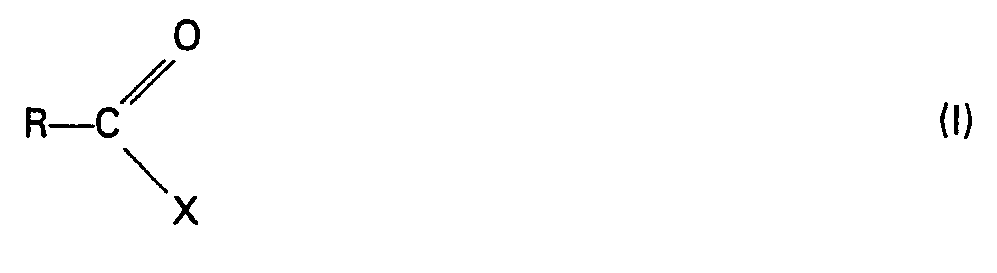
wherein the substituent R is a hydrocarbyl group or an oxygen-containing hydrocarbyl group and the substituent X is the group -OR' in which r' is independently a hydrogen atom, a hydrocarbyl group or an oxygen-containing hydrocarbyl group or X is the group -0-CO-RZ wherein R2 is independently a hydrocarbyl group or an oxygen-containing hydrocarbyl group, the acid or derivative thereof of formula (I) being added in an amount such that the molar ratio of the acid or derivative thereof to methanol in the reaction mixture is up to 1.5-1.
wherein the substituent R is a hydrocarbyl group or an oxygen-containing hydrocarbyl group and the substituent X is the group -OR' in which r' is independently a hydrogen atom, a hydrocarbyl group or an oxygen-containing hydrocarbyl group or X is the group -0-CO-RZ wherein R2 is independently a hydrocarbyl group or an oxygen-containing hydrocarbyl group, the acid or derivative thereof of formula (I) being added in an amount such that the molar ratio of the acid or derivative thereof to methanol in the reaction mixture is up to 1.5-1.
7. A process according to claim 6 wherein the acid or derivative thereof is acetic
acid or methyl acetate.
8. A process according to any one of the preceding claims wherein there is also added
an inert liquid which is either an aryl halide, a thiophene or a silicone oil, the
molar ratio of methanol to the added inert liquid being in the range from 30:1 to
1:10.
9. A process according to claim 8 wherein the inert liquid is chlorobenzene, a polydimethylsiloxane
fluid or a methyl phenyl silicone fluid.
10. A process according to any one of the preceding claims wherein the oxygen-containing
organic compound or mixture thereof is added in an amount such that the molar ratio
of methanol to the compound or mixture of compounds is in the range from 20:1 to 1:3.
1. Procédé de production de l'éthanol par la réaction, à température et pression élevées,
du méthanol avec de l'hydrogène et du monoxyde de carbone en présence d'un catalyseur
à base de cobalt soluble comportant éventuellement de l'iode ou du brome comme seul
promoteur et éventuellement aussi en présence d'un solvant non polaire, procédé caractérisé
en ce qu'on ajoute aux corps destinés a réagir un composé organique contenant de l'oxygène
et qui est miscible, dans les conditions normales de température et de pression, avec
du méthanol contenant jusqu'à 20 % en poids/poids d'eau, ce composé comprenant un
aldéhyde, une cétone, un alcool autre que le méthanol ou un éther-oxyde ou étant un
mélange de deux ou plusieurs de ces composés.
2. Procédé selon la revendication 1, caractérisé en ce que le composé organique contenant
de l'oxygène est un alcool aliphatique, une cétone aliphatique ou un aldéhyde aliphatique.
3. Procédé selon la revendication 2, caractérisé en ce que le composé est le n-propanol,
le n-butanol, l'acétone ou l'acétaldéhyde.
4. Procédé selon la revendication 1, caractérisé en ce que le composé organique contenant
de l'oxygène est un éther-oxyde aliphatique, alicyclique ou aromatique.
5. Procédé selon la revendication 4, caractérisé en ce que le composé est le 1,4-dioxanne,
le tétra- hydrofuranne, l'éther-oxyde de di-n-propyle ou l'éther-oxyde de diphényl.
-
6. Procédé selon l'une quelconque des revendications précédentes, caractérisé en ce
que, en plus du composé organique contenant de l'oxygène, on ajoute également un ou
plusieurs acides ou de leurs dérivés, répondant à la formule:
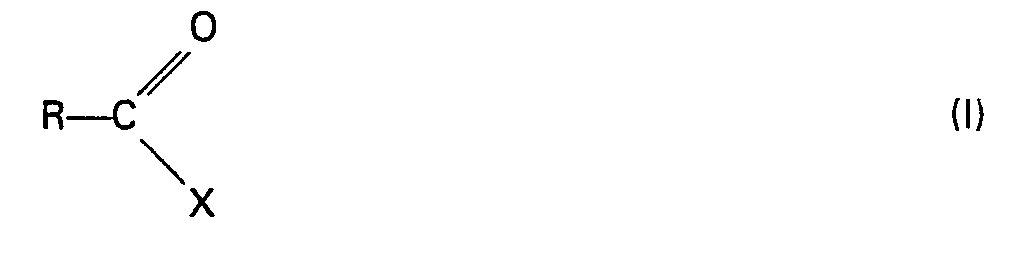
dans laquelle le substituant R est un groupe hydrocarbyle ou un groupe hydrocarbyle contenant de l'oxygène et le substituant X est le groupe -OR', dans lequel RI est, indépendamment, un atome d'hydrogène, un groupe hydrocarbyle ou un groupe hydrocarbyle contenant de l'oxygène, ou bien X est le groupe -0-CO-R2, dans lequel R2 est, indépendamment, un groupe hydrocarbyle ou un groupe hydrocarbyle contenant de l'oxygène, l'acide ou son dérivé de formule (I) étant ajouté en une quantité telle que le rapport molaire entre l'acide ou son dérivé et le méthanol dans le mélange réactionnel peut aller jusqu'à 1,5:1.
dans laquelle le substituant R est un groupe hydrocarbyle ou un groupe hydrocarbyle contenant de l'oxygène et le substituant X est le groupe -OR', dans lequel RI est, indépendamment, un atome d'hydrogène, un groupe hydrocarbyle ou un groupe hydrocarbyle contenant de l'oxygène, ou bien X est le groupe -0-CO-R2, dans lequel R2 est, indépendamment, un groupe hydrocarbyle ou un groupe hydrocarbyle contenant de l'oxygène, l'acide ou son dérivé de formule (I) étant ajouté en une quantité telle que le rapport molaire entre l'acide ou son dérivé et le méthanol dans le mélange réactionnel peut aller jusqu'à 1,5:1.
7. Procédé selon la revendication 6, caractérisé en ce que l'acide ou son dérivé est
l'acide acétique ou l'acétate de méthyle.
8. Procédé selon l'une quelconque des revendications précédentes, caractérisé en ce
qu'on ajoute également un liquide inerte qui est un halogénure d'aryle, un thiophène
ou une huile de silicone, le rapport molaire entre le méthanol et le liquide inerte
ajouté se situant entre 30:1 et 1:10.
9. Procédé selon la revendication 8, caractérisé en ce que le liquide inerte est le
chlorobenzene, un fluide du type polydiméthylsiloxanne ou un fluide de type méthyl-phényl-silicone.
10. Procédé selon l'une quelconque des revendications précédentes, caractérisé en
ce qu'on ajoute le composé organique contenant de l'oxygène, ou un mélange de tels
composés, en une quantité telle que le rapport molaire entre le méthanol et le composé
ou le mélange des composes se situe entre 20:1 et 1:3.
1. Verfahren zur Herstellung von Äthanol durch Umsetzung von Methanol mit Wasserstoff
und Kohlenmonoxid in Anwesenheit eines löslichen Kobalt katalysators, gegebenenfalls
aktiviert mit Jod oder Brom als einzigem Promotor und gegebenenfalls auch in Anwesenheit
eines nicht polaren Lösungsmittels bei erhöhter Temperatur und erhöhtem Druck, dadurch
gekennzeichnet, daß zu den Reaktanten eine sauerstoffhaltige organische Verbindung
zugesetzt wird, die unter normalen Temperatur- und Druckbedingungen mischbar ist mit
Methanol, welches bis zu 20 Gew-% Wasser enthält und aus entweder einem Aldehyd, einem
Keton, einem anderen Alkohol als Methanol oder einem Äther oder einer Mischung von
2 oder mehreren solchen Verbindungen besteht.
2. Ein Verfahren gemäß Anspruch 1, worin die Sauerstoff enthaltende organische Verbindung
ein aliphatischer Alkohol, ein aliphatisches Keton oder ein aliphatischer Aldehyd
ist.
3. Ein Verfahren gemäß Anspruch 2, worin die Verbindung n-Propanol, n-Butanol, Aceton
oder Acetaldehyd ist.
4. Ein Verfahren gemäß Anspruch 1, worin die Sauerstoff enthaltende organische Verbindung
ein aliphatischer, alizyklischer oder aromatischer Äther ist.
5. Ein Verfahren gemäß Anspruch 4, worin die Verbindung 1,4-Dioxan, Tetrahydrofuran,
Di-n-propyläther oder Diphenyläther ist.
6. Ein Verfahren gemäß einem der vorgehenden Ansprüche, worin zusätzlich zu der Sauerstoff
enthaltenden organischen Verbindung weiterhin eine oder mehrere Säuren oder Säurederivate
der Formel
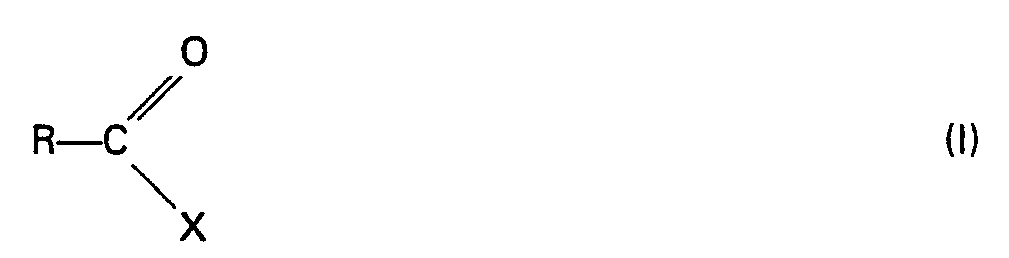
worin der Substituent R eine Hydrocarbylgruppe oder eine Sauerstoff enthaltende Hydrocarbylgruppe und der Substituent X die Gruppe -oR1 darstellen, worin R1 unabhängig ein Wasserstoffatom, eine Hydrocarbylgruppe oder eine Sauerstoff enthaltende Hydrocarbylgruppe bedeutet oder X die Gruppe -0-CO-R2 darstellt, worin R2 unabhängig eine Hydrocarbylgruppe oder eine Sauerstoff enthaltende Hydrocarbylgruppe bedeutet, zugesetzt wird in einer solchen Menge, daß das molare Verhältnis von Säure oder Säurederivat zu Methanol in der Reaktionsmischung bis zu 1,5:1 liegt.
worin der Substituent R eine Hydrocarbylgruppe oder eine Sauerstoff enthaltende Hydrocarbylgruppe und der Substituent X die Gruppe -oR1 darstellen, worin R1 unabhängig ein Wasserstoffatom, eine Hydrocarbylgruppe oder eine Sauerstoff enthaltende Hydrocarbylgruppe bedeutet oder X die Gruppe -0-CO-R2 darstellt, worin R2 unabhängig eine Hydrocarbylgruppe oder eine Sauerstoff enthaltende Hydrocarbylgruppe bedeutet, zugesetzt wird in einer solchen Menge, daß das molare Verhältnis von Säure oder Säurederivat zu Methanol in der Reaktionsmischung bis zu 1,5:1 liegt.
7. Ein Verfahren gemäß Anspruch 6, worin die Säure oder das Säurederivat Essigsäure
oder Methylacetat ist.
8. Ein Verfahren gemäß einem der vorgehenden Ansprüche, worin ferner eine inerte Flüssigkeit
zugesetzt wird, die entweder ein Arylhalogenid, ein Thiophen oder ein Silikonöl ist,
wobei das molare Verhältnis von Methanol zu der zugesetzten inerten Flüssigkeit im
Bereich von 30:1 zu 1:10 liegt.
9. Ein Verfahren gemäß Anspruch 8, worin die inerte Flüssigkeit Chlorbenzol, ein Polydimethylsiloxan
oder ein Methylphenylsilikon ist.
10. Ein Verfahren gemäß einem der vorgehenden Ansprüche worin die Sauerstoff enthaltende
organische Verbindung oder Mischung solcher Verbindungen in einer solchen Menge zugesetzt
wird, daß das molare Verhältnis von Methanol zu der Verbindung oder der Mischung von
Verbindungen im Bereich von 20:1 bis 1:3 liegt.