|
(11) | EP 0 004 107 A1 |

| (12) | EUROPEAN PATENT APPLICATION |
|
|
|
|
|||||||||||||||||||||||||||
| (54) | 3-Azabicyclo(3.1.0)hexane derivatives, a process for their preparation, biologically active compositions containing them and herbicidal method using them |
| (57) Novel compounds of the general formula:
wherein R represents a hydrogen atom or an alkoxycarbonyl, alkyl or cycloalkyl group which may be unsubstituted or substituted by one or more of the same or different substituents selected from halogen atoms, alkoxy groups and aryl groups; R' represents a hydrogen atom or an alkyl orcyc- loalkyl group which may be unsubstituted or substituted by one or more of the same or different substituents selected from halogen atoms and alkoxy groups; and each of R2, R', R4, R5, R6 and R7 independently represents a hydrogen or halogen atom or an alkyl, cycloalkyl, alkenyl, aryl, alkaryl or aralkyl group which may be unsubstituted or substituted by one or more of the same or different substituents selected from halogen atoms and alkoxy groups, or each of R2, R3, R6, and R7 independently has one of the above meanings and R4 and R'together represent an alkylene group or each of R2, R3, R4 and R5 has one of the above meanings and R6 and R7 together represent an alkylene group; or an acid addition salt thereof. |
[0001] The invention relates to 3-azabicyclo[3.1.0]hexane derivatives, a process for their preparation, biologically active compositions containing them and herbicidal method using them. The compounds according to the invention exhibit herbicidal properties, and are useful intermediates in the preparation of 2-carboxy-3-aza- picyclo [3.1.0] hexane and derivatives thereof.
[0002] The present invention provides a compound of the general formula:
wherein R represents a hydrogen atom or an alkoxycarbonyl, alkyl or cycloalkyl group which may be unsubstituted or substituted by one or more of the same or different substituents selected from halogen atoms, alkoxy groups and aryl groups; R represents a hydrogen atom or an alkyl or cycloalkyl group which may be unsubstituted or substituted by one or more of the same or different substituents selected from halogen atom and alkoxy groups; and each of R2, R3, R4, R5, R6 and R independently represents a hydrogen or halogen atom or an alkyl, cycloalkyl, alkenyl, aryl, alkaryl or aralkyl group which may be unsubstituted or substituted by one or more of the same or different substituents selected from halogen atoms and alkoxy groups, or each of R2, R3, R and R7 independently has one of these meanings and R4 and R5 together represent an alkylene group, or each of R2, R3, R4 and R5 independently has one of these meanings and R6 and R7 together represent an alkylene group; or an acid addition salt thereof.
[0003] Unless otherwise stated, any halogen atom present in a compound according to the invention is preferably a chlorine or fluorine atom. Any alkyl, alkenyl, or alkoxy group preferably has up to 6, especially up to 3, carbon atoms. Any aryl moiety is preferably a phenyl moiety, and any alkaryl or aralkyl group preferably has 7 or 8 carbon atoms.
[0004] R may for example represent a hydrogen atom or an alkyl group which may be unsubstituted or substituted by one or mere of the same or different substituents selected from halogen atoms, alkoxy groups and aryl groups. If R represents an alkoxycarbonyl group, this group is preferably unsubstituted and preferably has up to 6 carbon atoms. R may for example represent an ethoxycarbonyl group. Preferably, R represents a hydrogen atom, an alkyl group having up to 6 carbon atoms which may be unsubstituted or substituted by up to 3 halogen atoms, an alkoxycarbonyl group having up to 6 carbon atoms, a cycloalkyl group, or a benzyl group which may be unsubstituted or substituted in the ring by up to 3 halogen atoms. More preferably, R represents a hydrogen atom or an alkyl group having up to 4 carbon atoms. Most preferably, R represents a methyl group or, especially, a hydrogen atom.
[0005] Preferably, R represents a hydrogen atom or an alkyl group having up to 6 carbon atoms which may be unsubstituted or substituted by up to 3 halogen atoms. More preferably, R represents a hydrogen atom or an alkyl group having up to 4 carbon atoms. Most preferably, R represents a methyl group or, especially, a hydrogen atom.
[0006] Preferably, each of R2, R3, R4, R5, R and R7 independently represents a hydrogen or halogen atom, an alkyl or alkenyl group having up to 6 carbon atoms which may be unsubstituted or substituted by up to 3 halogen atoms, or an aryl, aralkyl or alkaryl group having up to 10 carbon atoms which may be unsubstituted or substituted by up to 3 halogen atoms, or each of R2, R3, R6 and R7 independently has one of these meanings and R4 and R5 together represent an alkylene group having up to 6 carbon atoms, or each of R2, R3, R4, and R5 independently has one of these meanings and R6 and R7 together represent an alkylene group having up to 6 carbon atoms. More preferably, each of R2, R3, R4, R5, R6 and R7 independently represents a hydrogen, fluorine, chlorine or bromine atom or an alkyl or alkenyl group having up to 4 carbon atoms which may be unsubstituted or substituted by up to 3 fluorine, chlorine or bromine atoms, for example a methyl, isobutenyl, difluorovinyl or dichlorovinyl group, or each of R2, R3, R6 and R7 independently has one of these meanings and R4 and R5 together represent an alkylene group having 4 or 5 carbon atoms, or each of R , R3, R and R has one of these 'meanings and R6 and R7 together represent an alkylene group having 4 or 5 carbon atoms. Most preferably, each of R2, R3, R4 and R5 represents a hydrogen atom.
[0007] An especially preferred compound according to the invention is 2-cyano-3-azabicyclo[3.1.0] hexane.
[0008] The compounds of the general formula I form acid addition salts with organic and inorganic acids. Suitable salts include salts with mineral acids, for example hydrohalide, especially hydrochloride, salts. Acid addition salts should, of course, be prepared under conditions which do not hydrolyze the 2-cyano group.
[0009] The invention also provides a process for the preparation of a compound of the general formula I, characterized in that a compound of the general formula:
in which R1, R2, R3, R4 and R5 have the meanings given for the general formula I, X repres.ents an oxygen or sulphur atom, and R represents a hydrogen atom or an alkyl, cycloalkyl, aryl, alkaryl or aralkyl group which may be unsubstituted or substituted by one or more of the same or different substituents selected from halogen atoms, alkoxy groups and aryl groups, is reacted with a trialkyl oxoniumfluoroborate, and at least part of the resulting product is reacted with a suitable reducing agent; and if desired, converting the resulting compound of the general formula I into another compound of the general formula I.
[0010] The reaction of the compound of the general formula II with a trialkyloxonium tetrafluoroborate produces a fluoroborate complex, which may be isolated, for example by crystallization, or used in situ for the subsequent reduction. Suitably the reaction is carried out at a temperature in the range of from 0 to 30°C, for example at room temperature. The reaction may conveniently be carried out in the presence of a suitable solvent, for example a liquid alkane or halogenated alkane, for example pentane, hexane, methylene chloride, chloroform or carbon tetrachloride. Mixtures of solvents may be suitable.'
[0011] The trialkyloxonium tetrafluoroborate may, for example, be trimethyloxonium tetrafluoroborate, triethyloxonium tetrafluoroborate, or a mixed lower alkyl oxonium tetrafluoroborate.
[0012] The subsequent reduction step is carried out using a mild reducing agent, for example a simple or complex alkali metal hydride, for example sodium hydride, lithium hydride, lithium borohydride or, especially, sodium borohydride. Preferably, the reduction is carried out at ambient temperature. The reducing agent may be added directly to the reaction mixture obtained in the previous step, or it may be reacted with the tetrafluoroborate complex which has been isolated and dissolved or suspended in a suitable solvent, such as methanol or ethanol. The reaction mixture may be worked up by conventional procedures.
[0013] The product of the reduction is a compound of the general formula I in which each of R and R represents a hydrogen atom, and R represents a group other than an alkoxycarbonyl group. This resulting compound can be converted into a compound in which R5 and/or R7 represents a substituent other than a hydrogen atom by methods analogous to those known in the art, if necessary temporarily blocking other reactive sites in the molecule. Compounds in which R represents an optionally-substituted alkoxycarbonyl group can be prepared by reacting a resulting compound of formula I in which R represents a hydrogen atom with a haloformate of the general formula:
in which Hal represents a chlorine or bromine atom and R9 represents an alkyl group which may be unsubstituted or substituted by one or more of the same or different substituents selected from halogen atoms, alkoxy groups and aryl groups. This reaction is suitably carried out at a temperature in the range of from -20°C to +20°C, in the presence of a suitable solvent, for example water. Suitably, the hydrogen halide produced during the reactbn is neutralized using a base, for example potassium carbonate.
[0014] The compounds of the general formula II are described in U.K. Patent Application No. 8066/78.
[0015] They may be prepared by a process in which a compound of the general formula:
in which R , R2, R3, R and R have the meanings given for the general formula I, each of X and Y independently represents an oxygen or sulphur atom, R represents an optionally substituted alkyl group, an alkali metal ion, an ammonium ion, optionally substituted by one or more alkyl groups, or one equivalent of an alkaline earth metal ion, and the groups -COR and -CXYR° are in cis-relationship to each other, is reacted with a cyanide in the presence of a compound of the general formula:
in which R8 has the meaning given for the general formula II.
[0016] The compounds according to the invention exist in the form of geometric and optical isomers, the number of isomers depending on the meanings of the various substituents in the molecule. For example, the -CN group in the 2-position of the molecule may be cis or trans to the -CR4R5 group, and each of these isomers exists as a pair of optical isomers. The invention should be understood to include individual isomers and mixtures thereof.
[0017] If a mixture of isomers of the compound of formula II is used as starting material, the process according to the invention generally leads to a mixture of isomers of the compound of formula I, which may, if desired, be separated into individual isomers or groups of isomers by conventional methods. For example, cis and trans isomers may be separated by fractional crystallization or layer or column chromatography. However, depending on the iscmer desired it may be advantageous to start from a particular isomer of a compound of the formula II. Especially preferred compounds according to the invention are those in which the -CN group is cis to the -CR4R5 group, for example cis (d,l) 2-cyano-3-azabicyclo[3.1.0]hexane itself, which may for example be obtained from cis (d,l) 2-cyano-3-azabicyclo[3.1.0]hexan-4-one.
[0018] Preparation of compounds of the general formula I in which R represents an optionally substituted alkoxycarbonyl group, provides a useful method of preparing single geometric isomers of compounds of the general formula I and derivatives thereof, since mixtures of isomers of these N-alkoxycarbonyl compounds can be separated into single isomers by fractional distillation. An especially useful process comprises reacting a mixture of the cis and trans isomers of 2-cyano-3-azabicyclo[3.1.0]hexane with a suitable ester of the general formula V, preferably ethyl chloroformate, and separating the resulting cis and trans isomers by fractional distillation. Hydrolysis of each of these isomers leads to the separate cis and trans isomers of 2-carboxy-3-azabicyclo [3.1.0]hexane.
[0019] The compounds of the general formula I are useful intermediate compounds in the preparation of 2-carboxy-3-azabicyclo-[3.1.0]hexane and certain of its derivatives. These compounds, for example those described in German Offenlegungsschrift No. 2,641,295, exhibit interesting pollen suppressant and plant growth regulating activity. For example, 2-cyano-3-azabicyclo[3.1.0]-hexane can be converted into the corresponding acid by hydrolysis, using for example a mineral acid, or into an ester, by reaction with an alcohol. Particular isomers of 2-carboxy-3-azabicyclo- [3.1.0]hexane and its derivatives may be obtained. For example, trans (d,l) 2-cyano-3-azabicyclo[3.1.0] hexane can be converted into trans (d,l) 2-carboxy-3-azabicyclo;3.1.0ihexane by acid hydrolysis or into trans (d,l) 2-ethoxycarbonyl-3-azabicyclo-[3.1.0]hexane by reaction with ethanol. The compounds according to the present invention can also be converted into the corresponding thioamides by reaction with hydrogen sulphide or a mono- or dialkyl sulphide in the presence of a tertiary amine.
[0020] The compounds of the general formula I exhibit herbicidal activity. The present invention, therefore, also provides a herbicidal composition comprising a carrier and/or surface-active agent, characterized in that it contains as active ingredient at least one compound of the general formula I. The invention also provides a method of controlling undesired plant growth at a locus, characterized in that there is applied to the locus a herbicidally effective amount of a compound or a composition according to the invention.
[0021] Any of the carrier materials or surface-active agents usually applied in formulating pesticides may be used in the compositions according to the present invention. Examples of such carriers and surface-active agents are given in British Patent Specification No. 1,293,546.
EXAMPLE 1 - Preparation of 2-cyanc-3-azabicyclo[3.1.0]hexan-4-one
[0023] A 250 ml flask was charged with 21.3 g cis 1-ethoxycarbonyl-2-formylcyclopropane (0.15 mol.), absolute ethanol (50 ml) and 4 drops of piperidine. The reaction contents were cooled to 0°C. Then 6 ml hydrogen cyanide (4.2 g; 0.155 mol.) were added and the reaction mixture was saturated with anhydrous ammonia and allowed to attain room temperature. After the addition of further ammonia the temperature rose slowly and the mixture was kept at 70-75°C for 45 minutes. After removal of the volatile components in a film evaporator under reduced pressure, the remaining mixture was saturated with ethanol while cooling in an ice-bath, then filtered and recrystallized from 30 ml ethanol.
[0024] 5.2 g of product, m.p. 135-136°C were obtained. This product was characterized by proton and C nuclear magnetic resonance spectroscopy as the pure cis compound.
[0026] From the mother liquor a further amount of 10.6 g 2-cyano-3-azabicyclo[3.1.0]hexan-4-one was obtained using chromatography over silica gel (methylene dichloride as eluent) as a cis/trans mixture. An analytical pure sample of the trans isomer (m.p. 89-90°C) was cbtained using liquid-liquid chromatography. The compound was characterized by nuclear magnetic resonance spectrcscopy. The total yield of products was 86%.
[0027] Similar results were obtained when the reaction was carried out using 0.675 mol. of cis 1-ethoxycarbonyl-2-formylcyclopropane as starting material (66% of cis/trans product isolated).
EXAMPLE 2 - Preparation of cis-2-cyano-3-azabicyclo[3.1 0]hexane and the corresponding acid from cis 2-cyano-3-azabicyclo 3.1.0] hexan-4-one
[0028] Cis 2-cyano-3-azabicyclo[3.1.0]hexan-4-one prepared as in Example 1 (10 g, 0.08 mole) was dissolved in dry methylene dichloride (50 ml) and treated with triethyloxonium tetrafluoroborate (19 g, 0.1 mole) while stirring at 10-15°C. The stirring was continued for 18 hours during which time a crystalline solid separated. The reaction mixture was evaporated to dryness under reduced pressure and redissolved in dry ethanol (60 ml), cooled to between 5 and 10°C and treated portion-wise over 10 minutes with sodium borohydride (4.0 g, 0.105 mole). The mixture was then stirred for 20 hours at ambient temperature and then evaporated to dryness. Water (150 ml) was added and the solution obtained extracted several times with diethyl ether (total volume 250 ml). The solution was dried over magnesium sulphate and then evaporated to give 6.7 g of the crude nitrile.
[0029] This product was dissolved in 6 N HC1 (80 ml) and refluxed for 4 hours. Having evaporated the solution down to a volume of about 20 ml, it was poured down a DOWEX 50 W-X8 (trade mark) column and washed until free of chloride ions. The product was eluted with 2N NH4OH, collecting a total volume of 3 litres. After evaporation a syrupy residue remained which was heated with ethanol (100 ml) to deposit ammonium chloride. After evaporation of the solvent 2.5 g of a pale yellow oil were obtained which solidified under reduced pressure (1 mm). The N.M.R. and I.R. spectra of the product were identical to those of the natural product cis 3-azabicyclo [3.1.0] hexane-2-carboxylic acid. The cis content of the product was more than 90%.
[0030] In a similar experiment, starting from 4.5 g cis 2-cyano- 3-azabicyclo[3.1.0]hexan-4-one a semi-solid residue was obtained to which benzene was added. Evaporation of the benzene solution left a yellow oil which gave on distillation 1.2 g of cis 2-cyano-3-azabicyclo[3.1.0]hexane (b.p. 80-86°C at a pressure of'1 mm Hg). EXAMPLE 3 - Preparation of cis and trans 2-cyano-3-azabicyclo-[3.1.0]hexane from a mixture of cis and trans 2-cyano-3-azaoicyclo[3.1.0]hexan-4-one
[0031] A mixture of 45% cis and 55% trans 2-cyano-3-azabicyclo-[3.1.0]hexan-4-one (18 g, 0.148 mole) was stirred in dry methylene dichloride (250 ml) and treated portion-wise with pure triethyloxonium tetrafluoroborate (32 g, 0.168 mole). Cooling was not required. After stirring for 30 minutes a heavy oil began to separate and the mixture was stirred at ambient temperature for 15 hours.
[0032] After evaporating the mixture to dryness under reduced pressure a yellow oil remained which was redissolved in dry ethanol (120 ml). The solution was stirred and cooled to 0°C and treated portion-wise with sodium borohydride (12.8 g, 0.336 mole). The mixture was stirred. overnight, evaporated to a low volume and treated with water (100 ml). Repeated extractions of the solution with diethyl ether (total volume 600 ml) followed by evaporation of the extracts left a viscous yellow oil. The oil was redissolved in benzene, dried over magnesium sulphate and evaporated to dryness leaving a viscous oil which was distilled under reduced pressure and from which 7.1 g (44%) product (b.p. 56-60°C at a pressure of 0.3 mm Hg) was obtained.
Analysis:
[0033]
From the N.M.R. spectroscopy carried out in hexadeutero- benzene it appeared that the product contained 91% of the trans and 9% of the cis isomer.
EXAMPLE 4 - Isolation of trans 2-cyano-3-azabicyclo[3.1.0]hexane
[0034] 7.0 g of the cis/trans mixture obtained via the procedure described in the previous Example were treated with a cold isopropyl alcohol/petroleum ether mixture from which the trans isomer crystallized in the form of white needles, m.p. 39-40°C. Yield 6.0 g (85%).
EXAMPLE 5 - Preparation of cis and trans 2-cyano-3-ethoxycarbonyl-3-azabicyclo[3.1.0]hexane
[0035] A solution of mixed 2-cyano-3-azabicyclo[3.1.0]hexane (142 g, 1.32 mol. cis/trans ratio 45/55) in water (140 ml) was cooled to 0° and treated with ethyl chloroformate (145 g, 1.33 mol.) over 30 minutes. The temperature.was held at 0-2°C by isopropanol/dry ice cooling. A solution of potassium carbonate (181 g, 1.31 mol.) in water (220 ml) was then added dropwise over 30 minutes with the temperature maintained at 0° to -5°C. Reaction was quite exothermic at this stage. The mixture was warmed to 15° over 45 minutes. The layers were separated and the aqueous phase extracted 3 times with diethyl ether (200 ml portions). After washing the combined extracts with water (3 x 200 ml) to pH 7 the ether was removed on a rotary evaporator to give 232 g of crude product.
[0036] This material was subjected to vacuum fractionation using a column packed with 15 cm of multi-turn helices. The first fraction obtained was identified using NMR spectroscopy as trans 2-cyano-3-ethoxycarbonyl-3-azabicyclo[3.1.0]hexane. The final fraction obtained was the cis isomer.
EXAMPLE 6 - 2-cyano-6-chloro-3-azabicyclo[3.1.0]hexane
[0037] Similarly, 2-cyano-6-chloro-3-azabicyclo[3.1.0]hexane was prepared. The single isomer in which the chlorine atom is in the exo position and the cyano group is trans to the CHCl group, was isolated as a yellow liquid which crystallised on standing to give a solid, m.p. 85-87°C.
Analysis:
EXAMPLE 7 - Demonstration of herbicidal activity
[0039] To evaluate their herbicidal activity the compounds of the invention were tested using as a representative range of plants: maize, Zea mays (MZ); barnyard grass, Echinochloa crusgalli (BG); oat, Avena sativa (0); mustard, Sinapis alba (M); sugar beet Beta vulgaris (SB); and scya bean, Glycine max (S).
[0040] The tests involved were post-emergence tests, involved foliar spray tests in which seedling plants of the above species were sprayed with a liquid formulation containing a compound of the invention.
[0041] The soil used in the tests was a steam-sterilized, modified John Innes Compost mixture in which half the peat, by loose bulk, had been replaced by vermiculite.
[0042] The formulations used in the tests were prepared by preparing a solution of the compounds in acetone containing 0.4% by weight of an alkylphenyl/ethylene oxide condensate available under the trade name TRITON X-155. The acetone solution was diluted with an equal volume of water and the resulting formulation applied at a dosage level corresponding to 5 kilograms of active material per hectare in a volume equivalent to 400 litres per hectare.
[0043] The herbicidal effects of the compounds were assessed visually seven days after spraying the foliage and eleven days after spraying the soil, and were recorded on a 0-9 scale. A rating 0 indicates no effect on the treated plants, a rating 2 indicates a reduction in growth of the plants of approximately 25%, a rating 5 indicates a reduction cf approximately 55%, a rating 9 indicates a reduction of 95%.
1. A compound of the general formula:
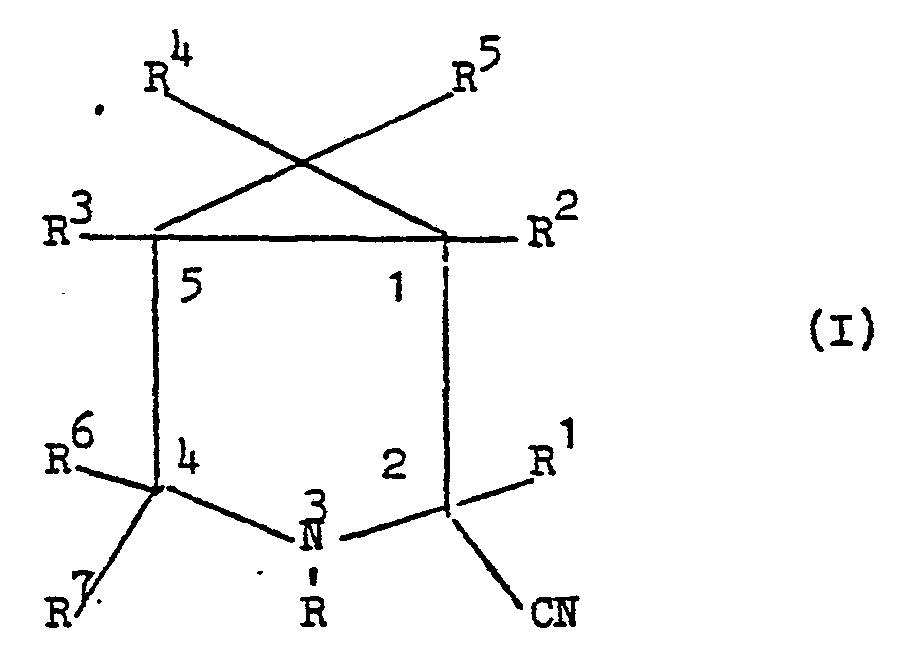
wherein R represents a hydrogen atom or an alkoxycarbonyl, alkyl or cycloalkyl group which may be unsubstituted or substituted by one or more of the same or different substituents selected from halogen atoms, alkoxy groups and aryl groups; R represents a hydrogen atom or an alkyl or cycloalkyl group which may be unsubstituted or substituted by one or more of the same or different substituents selected from halogen atoms and alkoxy groups; and each of R2, R3, R4, R5, R and R independently represents a hydrogen or halogen atom or an alkyl, cycloalkyl, alkenyl, aryl, alkaryl or aralkyl group which may be unsubstituted or substituted by one or more of the same or different substituents selected from halogen atoms and alkoxy groups, or each of R2, R3, R6 and R7 independently has one of the above meanings and R4 and R5 together represent an alkylene group or each of R2, R3, R4 and R5 has one of the above meanings and R6 and R7 together represent an alkylene group; or an acid addition salt thereof.
wherein R represents a hydrogen atom or an alkoxycarbonyl, alkyl or cycloalkyl group which may be unsubstituted or substituted by one or more of the same or different substituents selected from halogen atoms, alkoxy groups and aryl groups; R represents a hydrogen atom or an alkyl or cycloalkyl group which may be unsubstituted or substituted by one or more of the same or different substituents selected from halogen atoms and alkoxy groups; and each of R2, R3, R4, R5, R and R independently represents a hydrogen or halogen atom or an alkyl, cycloalkyl, alkenyl, aryl, alkaryl or aralkyl group which may be unsubstituted or substituted by one or more of the same or different substituents selected from halogen atoms and alkoxy groups, or each of R2, R3, R6 and R7 independently has one of the above meanings and R4 and R5 together represent an alkylene group or each of R2, R3, R4 and R5 has one of the above meanings and R6 and R7 together represent an alkylene group; or an acid addition salt thereof.
2. A compound as claimed in claim 1, in which R represents a hydrogen atom, an alkyl
group having up to 6 carbon atoms which may be unsubstituted or substituted by up
to 3 halogen atoms, an alkoxycarbonyl group having up to 6 carbon atoms, a cycloalkyl
group, or a benzyl group which may be unsubstituted or substituted in the ring by
up to 3 halogen atoms.
3. A compound as claimed in either claim 1 or claim 2, in which R represents a hydrogen
atom or an alkyl group having up to 6 carbon atoms which may be unsubstituted or substituted
by up to 3 halogen atoms.
4. A compound as claimed in any one of claims 1 to 3, in which each of R2, R3, R4, R5, R6 and R independently represents a hydrogen, fluorine, chlorine or bromine atom or
an alkyl or alkenyl group having up to 4 carbon atoms which may be unsubstituted or
substituted by up to 3 fluorine, chlorine or bromine atoms, or each of R2, R3, R and R7 independently has one of these meanings and R4 and R5 together represent an alkylene group having 4 or 5 carbon atoms, or each of R2, R3, R4 and R5 independently has one of these meanings and R6 and R7 together represent an alkylene group having 4 or 5 carbon atoms.
5. 2-Cyano-3-azabicyclo[3.1.0]hexane or 2-cyano-3-ethoxycarbonyl-3-azabicyclo[3.1.0]hexane,
or an acid addition salt thereof.
6. A process for the preparation of a compound as claimed in any one of claims 1 to
5, characterized in that a compound of the general formula:
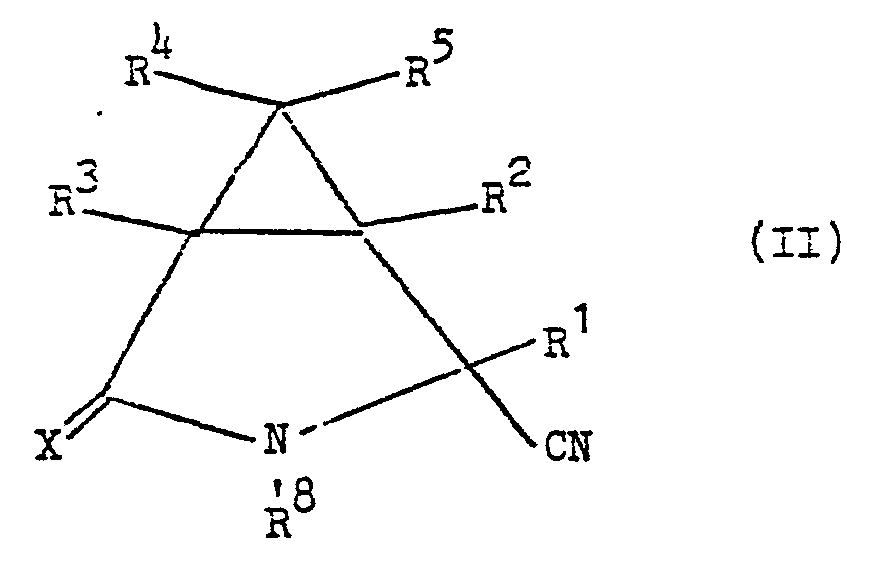
in which R1, R2, R3, R4 and R have the meanings given for the general formula I, X represents an oxygen or sulphur atom, and R represents a hydrogen atom or an alkyl, cycloalkyl, aryl, alkaryl or aralkyl group which may be unsubstituted or substituted by one or more of the same or different substituents selected from halogen atoms, alkoxy groups and aryl groups, is reacted with a trialkyl oxoniumfluoroborate, and at least part of the resulting product is reacted with a suitable reducing agent; and if desired, converting the resulting compound of the general formula I into another compound of the general formula I.
in which R1, R2, R3, R4 and R have the meanings given for the general formula I, X represents an oxygen or sulphur atom, and R represents a hydrogen atom or an alkyl, cycloalkyl, aryl, alkaryl or aralkyl group which may be unsubstituted or substituted by one or more of the same or different substituents selected from halogen atoms, alkoxy groups and aryl groups, is reacted with a trialkyl oxoniumfluoroborate, and at least part of the resulting product is reacted with a suitable reducing agent; and if desired, converting the resulting compound of the general formula I into another compound of the general formula I.
7. A process as claimed in claim 6, characterized in that the reaction of the compound
of the general formula II with the trialkyloxonium fluoroborate is carried out at
a temperature in the range of from 0 to 300C.
8. A process as claimed in either claim 6 or claim 7, characterized in that the trialkyloxonium
fluoroborate is trimethyloxonium fluoroborate or triethyloxonium fluoroborate.
9. A process as claimed in any one of claims 6 to 8, characterized in that the reduction
step is carried out using sodium hydride, lithium hydride, lithium borohydride or
sodium borohydride.
10. A process as claimed in any one of claims 6 to 9, characterized in that there
is prepared a compound of the general formula I in which R represents a hydrogen atom,
and that said compound is reacted with a compound of the general formula:

in which Hal represents a chlorine or bromine atom and R9 represents an alkyl group which may be unsubstituted or substituted by one or more of the same or different substituents selected from halogen atoms, alkoxy groups and aryl groups, to produce a compound of the general formula I, in which R represents an alkoxycarbonyl group of formula -C02R9.
in which Hal represents a chlorine or bromine atom and R9 represents an alkyl group which may be unsubstituted or substituted by one or more of the same or different substituents selected from halogen atoms, alkoxy groups and aryl groups, to produce a compound of the general formula I, in which R represents an alkoxycarbonyl group of formula -C02R9.
11. A herbicidal composition which comprises a carrier and/or a surface-active agent,
characterized in that it contains as active ingredient at least one compound as claimed
in any one of claims 1 to 5.
12. A method of controlling undesired plant growth at a locus, characterized in that
there is applied to the locus a herbicidally effective amount of a compound as claimed
in any one of claims 1 to 5 or a herbicidal composition as claimed in claim 11.