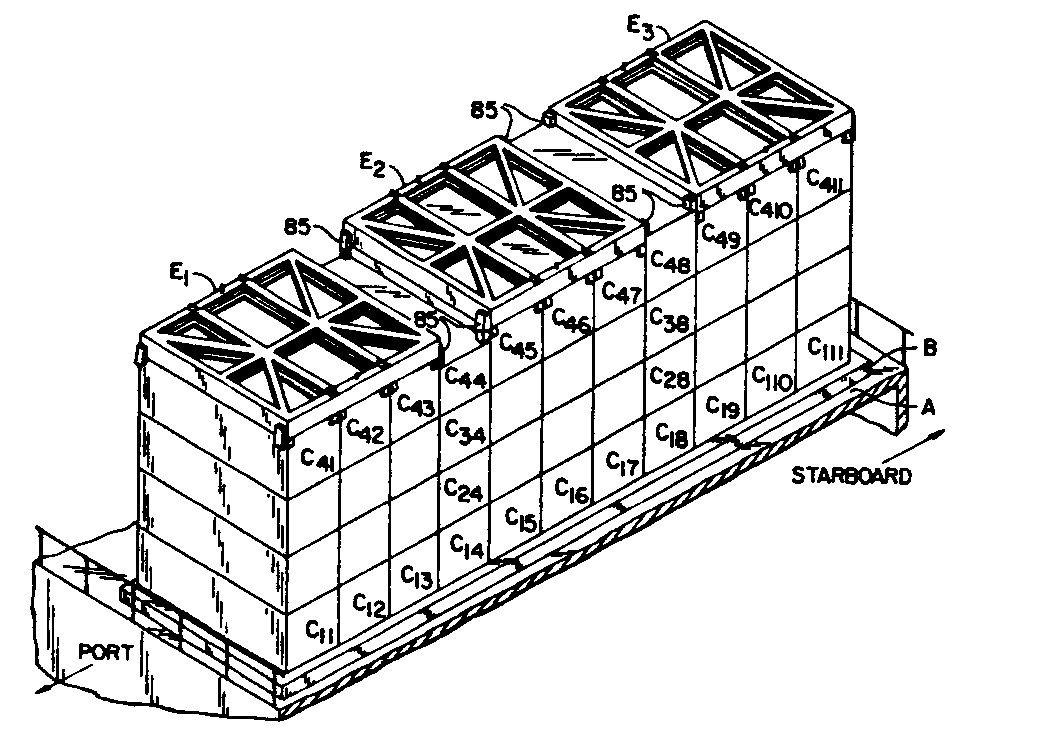
(57) A deck container restraint system is disclosed which utilizes discrete containers
against vertical movement in modules of three-wide, typically four-high stacks or
columns to prevent overboard loss due to static and dynamic load conditions experienced
at sea. A three-wide, one-high bottom tier of containers is secured against side to
side and vertical movement by deck cones having locking devices. The overlying three-wide
second tier is secured against side to side and vertical movement by cones having
locking devices at the top of the first tier. Finally the three-wide, two-high top
third and fourth tiers of containers are loaded, first by being tied vertically together
by cones having locking devices and second, by being lifted in vertically tied pairs
onto stacking fittings at the second-third tier interface. The stacking fittings restrain
side to side movement at the second-third tier interface only. Upon completion of
placement of the third and fourth tier, an equalizing spreader fits over the top of
the three-wide, four-high container columns or stacks, restraining relative vertical
and horizontal movement between the corners of adjacent containers. By providing for
remote fastening of the equalizer to the top of the three-wide, four-high module,
container restraint against dynamic loadings commonly experienced at sea can occur
without conventional horizontal or vertical ties. Provision is made to expand the
module to container columns on either side of additional equalizer spreaders are used.
|
|
