|
(11) | EP 0 004 942 A1 |

| (12) | EUROPEAN PATENT APPLICATION |
|
|
|
|
|||||||||||||||||||||||||||
| (54) | Process for the manufacture of alkylene carbonates |
| (57) A new process is disclosed for the synthesis of alkylene carbonates having from 2
to 4 carbon atoms in the chain, starting from a corresponding halohydrin having the
formula:
wherein R., Rb, Rc and Rd are independently hydrogen or alkyl, aryl, alkylaryl or arylalkyl radicals and where X is a halogen, characterized in that said halohydrin is reacted with a bicarbonate of a quaternary -onium compound, where "-onium" means ammonium, phosphonium, arsonium or stibonium, preferably using an organic solvent as diluent and operating in the presence of carbon dioxide. |
[0001] This invention relates to a process for the manufacture of alkylene carbonates and particularly of alkylene carbonates having 2 to 4 carbon atoms in the alkylene chain. Such alkylene carbonates, and in particular ethylene carbonate and propylene carbonate, have great utility for instance as solvents of organic polymers, as electrochemical solvents, and as synthesis intermediates.
[0002] Processes for manufacturing alkylene carbonates are already well known. One such method involves the reaction of an epoxide with carbon dioxide in the presence of proper catalysts. Another method is based on the reaction between vicinal glycols and phosgene. Still another method is based on the reaction between vicinal halohydrins and sodium bicarbonate in the presence of carbon dioxide.
[0003] Such methods, however, have the drawback of involving, respectively, rather high working temperatures and pressures, or the use of toxic reagents (phosgene), or of leading to the collateral formation of undesired by-products that are difficult to separate (glycols).
[0004] From the U.S. Patent No. 3 923 842 it is also known to prepare alkylene carbonates by reacting vicinal halohydrins with carbon dioxide in a solvent and in the presence of amines according to the reaction scheme:
in which R, Ra, Rb, Rc, and Rdt which can be similar or dissimilar to each other, are hydrogen or alkyl, aryl, alkylaryl or arylalkyl radicals, and X is a halogen. This process, although offering considerable advantages over the above-cited methods, does not seem fully satisfactory because the reaction proceeds rather slowly even at high temperatures (70 to 100°C) and requires the use of high carbon dioxide pressures to obtain appreciable results from an industrial viewpoint.
[0005] Thus it is an object of the present invention to provide a methcd for synthesizing alkylene carbonates substantially more quickly in comparison to the methods of the art, and which permits the operation at room temperatures and pressures with excellent yields in very short times. Still further objects and advantages will appear from the following description.
[0006] In its broadest aspect, the invention relates to a process for the manufacture of alkylene carbonates, and particularly alkylene carbonates having from 2 to 4 carbon atoms in the alkylene chain, starting from a corresponding vicinal halohydrin, such process being characterized in that the halohydrin is reacted with the bicarbonate of a quaternary -onium compound, where "-onium" means ammonium, phosphonium, arsonium or stibonium, preferably in the presence of an organic diluent and of carbon dioxide.
[0007] More particularly, high yields may be obtained without any appreciable formation of glycols in very short times and at room temperatures and pressures by using bicarbonates of quaternary ammonium cations, such as, for example, tetramethyl-ammonium bicarbonate, tetraethylammonium bicarbonate, tetra-n-butyl-ammonium bicarbonate, benzyl-trimethyl-ammonium bicarbonate. Similar results have been achieved by using strongly basic anionic resins having quaternary ammonium terminals or end groups (in the form of hydroxyls), carbonated with C02 before the synthesis. Examples of the latter are the products commercially known as KASTEL A 300, KASTEL A 300 P, KASTEL A 500, KASTEL A 500 P, AMBERLITE IRA-400-OH, KASTEL A 501 D, KASTEL A 510, and the like. Weakly basic resins having a ternary terminal group (-NR2), such as KASTEL A 101 in Examples 9 and 10 below, lead to far less satisfying results.
[0008] The terminal or end groups of strongly basic quaternary resins to be used according to this invention may be, for instance, of the type
The term "halohydrins" means in particular chlorohydrins, bromohydrins and iodohydrins. Examples are the following halohydrins: ethylene chlorohydrin, ethylene bromohydrin, ethylene iodohydrin, 2-chloro-propanol-1, 1-chloro-propanol-2, 2-bromo-propanol-1, 1-bromo-propanol-2, 2-iodo-propanol-1, 2-chloro-butanol-1, 2-bromo-butanol-1, 2-iodo-butanol-1, erythro-3-bromo-butanol-2, threo-3-bromo-butanol-2, and mixtures thereof.
[0009] Various solvents may be employed for the synthesis according to this invention, such as for example methanol, n-butanol, acetone, dioxane, acetonitrile, dimethylformamide, benzene, toluene, xylols, dimethylsulphoxide, and the like. In tests carried out by the present inventors acetonitrile has been used with excellent results.
[0010] When bicarbonates of resins are used as carbonating agents for the halohydrins, aqueous-organic mixtures, such as water-dioxane, water-acetonitrile, and the like, may also be employed as solvent. In some particular cases even water alone may be used.
[0011] The amount of ammonium compound, expressed as NR4+ groups, must be equivalent to or slightly in excess - in molar terms -'with respect to the amount of halohydrin employed.
[0012] At the conclusion of the reaction the ammonium compound is present in the form of a halide, according to the reaction scheme:
wherein the symbols have the meanings specified above.
[0013] The tetralkylammonium halide or the resin halide may be easily separated from the reaction mixture by filtration and recovered nearly quantitatively. The filtrate can be fractionated to give the required alkylene carbonate.
[0014] As an alternative, when using an anion exchange resin, the resin is regenerated "in situ" after conclusion of the reaction, for which it may be advisable to work with two or more reactors in parallel, preferably of the suspended bed type, running alternately. While one reactor works, the other is shut down and the resin is regenerated, for instance by means of dilute aqueous NaOH or NH4OH solutions and successive carbonation with C02.
[0015] The synthesis temperature may vary over a wide range. Although excellent results are obtained at room temperature or even as low as 0°C, a temperature increase may be useful in some cases for substantially reducing the reaction period. Of course, the reaction temperature must not exceed either the boiling point of the solvent or the degradation point of the exchange resin.
[0016] The influence exerted by the carbon dioxide pressure is not critical. Nevertheless, when operating at higher temperatures than room temperature, an increase of the C02 pressure is particularly advantageous. In principle, it is useful to operate between room pressure and 10000 Kilopascal (Kpa), and preferably between room pressure and 3000 Kpa.
[0017] The following examples are given for the purpose of still better illustrating the present invention, but withoa being a limitation thereof.
Example 1
[0018] 46 g of a methanol solution of 24% by weight of tetramethylammonium hydroxide (about 0.12 moles) were diluted with 50 cm3 of methanol, and the dilute solution was carbonated with carbon dioxide for 40 minutes. Methanol was then distilled off under a slight vacuum, and the residue was diluted again with 250 cm3 of acetonitrile and kept in a carbon dioxide atmosphere for about 10 minutes until gas absorption was no longer noticed.
[0019] To le remaining solution of tetramethyl-ammonium bicarbonate in acetonitrile there was added 0.1 mole of ; ethylene bromo-hydrin, and the suspension was kept at 20°C with stirring and in a C02 atmosphere for about 10 minutes. The tetramethyl-ammonium bromide so obtained was separated by filtration at 20°C together with small amounts of tetramethyl-ammonium bicarbonate, corresponding to the excess of the ammonium reagent. The filter cake was washed twice with each 40 cm3 of acetonitrile, the washing liquid was added to the filtrate, and the whole was distilled under a slight vacuum to recover the solvent. To the residual liquid acetone was added and the last traces of salt which precipitated were separated; by filtration. Acetone was then evaporated, so obtaining 9.63 g of an oil that solidified at room temperature.
[0020] 8.45 g of solid ethylene carbonate were obtained by distillation under vacuum (73°-75°C/0.4-0.5 mm Hg). The yield was about 96% based upon the bromohydrin.
Example 2
[0021] 0.1 mole of 98% propylene iodohydrin was added to a solution of tetramethyl-ammonium bicarbonate in acetonitrile, prepared according to Example 1, and the sus- pension was stirred at 20°C in a C02 atmosphere for about 10 minutes. Tetramethyl-ammonium iodide was separated by filtration at 20°C together with small amounts of tetramethyl-ammonium bicarbonate.
[0022] The filter cake was washed with 50 cm3 of acetonitrile, the acetonitrile washings were then added to the filtered solution, and the whole was distilled under vacuum to recover the solvent. The residual liquid was diluted with acetone and 1.5 g of salt still contained therein were separated by filtration. The acetone was evaporated, and the oil contained therein was distilled under vacuum (10.1 g).
[0023] 9.40 g of propylene carbonate of 98.6% purity (gas-liquid chromatographic analysis) were obtained by distillation (59°-60°C/0.5 mm Hg). This corresponded to a yield of about 91% based upon the iodohydrin.
Example 3
[0024] To an acetonitrile suspension of tetramethyl-ammonium bicarbonate, prepared as described in Example 1, there was added 0.1 mole of erythro-3-bromo-butanol-2, whereupon the procedure was as specified above. The reaction time was 20 minutes. By operating according to Example 1, 11.14 g of an oil were obtained, which solidified at room temperature.
[0025] By distillation under vacuum (58°C/0.05 mm Hg) 10.8 g of trans-1,2-dimethyl-ethylene carbonate were obtained. The yield was about 93%.
Example 4
[0026] Example 3 was repeated using threo-3-bromo-butanol-2 as reagent. The reaction time was 60 minutes.
[0027] By distillation under vacuum (70°-74°C/0.1 mm Hg), 11.3 g of cis-1,2-dimethylethylene carbonate of 97.85% purity were obtained. The yield was about 95.3%.
Example 5
[0028] Example 3 was repeated using 2-bromo-1-phenyl-ethanol as reagent and adjusting the reaction time to about 15 minutes. 16.57 g of a yellowish residual oil were obtained, which solidified at room temperature.
[0029] By distillation under vacuum (115°C/0.1 mm Hg) 15.35 g of phenylethylene carbonate were obtained, which promptly solidified. The yield was about 93.6%.
Example 6
[0030] Example 3 was repeated using butylene bromohydrin as reagent and adjusting the reaction time to about 15 minutes. 12.6 g of a residual oil were obtained, which, after distillation under vacuum (68°-70°C/ 0.4-0.5 mm Hg), provided 11.2 g of butylene carbonate (at 99% purity) in the form of a colorless oil with a yield of about 96.4%.
Example 7
Example 8
[0033] 43 g of a wet, strongly basic anion exchange resin in the hydroxyl form (AMBERLITE IRA - 400 - OH) were suspended in 100 cm3 of methanol and carbonated with C02 for about 30 minutes. The carbonated resin was filtered, washed with acetonitrile to remove the residual methanol and suspended in 100 cm3 of acetonitrile. The suspension was then kept under stirring in a carbon dioxide atmosphere for 10 minutes. Then 0.05 moles of propylene iodohydrin were added to the suspension, whereupon the f suspension was maintained under stirring at room temperature and in a carbon dioxide atmosphere for 2 hours. Finally it was filtered, and the resin was washed with acetonitrile.
[0034] From the filtrate were obtained 4.7 g of propylene carbonate (gas-liquid chromatographic analysis), corresponding to a yield of 92%, and 0.46 g of unconverted iodohydrin.
Example 9 (Comparative Example)
[0035] Example 8 was repeated contacting 0.01 mole of propylene iodohydrin with 7.5 g of a weakly basic anion exchange resin, commercially known as KASTEL A-101, suspended in 16 cm3 of a mixture containing water and dioxane in equal parts. The suspension was maintained under stirring at room temperature and in a carbon dioxide atmosphere for 4 hours, thereby obtaining 0.41 g of propylene carbonate (gas-liquid chromatographic analysis), corresponding to a yield of 40%.
Example 10 (Comparative Example)
[0036] Example 9 was repeated contacting in anautoclave and under stirring 0.04 moles of propylene iodohydrin with 30 g of a weakly basic resin (KASTEL A-101), suspended in 64 cm of a mixture containing water and dioxane in equal parts.
[0037] The whole was heated to 60°C under a carbon dioxide pressure of 3000 Kpa for 4 hours, thereby obtaining 3 g of propylene carbonate (gas-liquid chromatographic analysis), corresponding to a yield of about 73.5%.
[0038] The results of Examples 2, 7, 8, 9 and 10 are recorded in the following Table I for comparative purposes.
Example 11
[0040] 0.01 mole of butylene chlorohydrin was added to a suspension of 0.012 moles of tetramethylammonium bicarbonate in 25 cm3 of acetonitrile, whereupon the procedure of Example 6 was repeated.
[0041] 1.13 g of butylene carbonate were thus obtained. The yield was about 97% (gas-liquid chromatographic analysis).
Example 12
[0042] 43 g of a wet; strongly basic anion exchange resin in the hydroxyl form (AMBERLITE IRA-400-0H) were charged into an oscillating autoclave at room temperature under C02 pressure (3000 Kpa) for 30 minutes. The autoclave was opened, the carbonated resin was filtered, washed with acetonitrile, and suspended again in the autoclave with 100 cm3 of acetonitrile. The resin was kept under C02 pressure (3000 Kpa) for a further 10 minutes, then it was degasified, a vacuum was created in the autoclave, and 0.05 moles of propylene chlorohydrin were introduced by suction. After charging CO2 to a pressure of 200C Kpa it was heated to 60°C. The C02 pressure increased to 3000 Kpa. The mixture was kept under these conditions for 1 hour. The autoclave was cooled, degasified, and the resin filtered and washed with acetonitrile.
[0043] From the filtrate were obtained 4.12 g of propylene carbonate, corresponding to a yield of 80%, and about 1 g of unconverted chlorohydrin (gas-liquid chromatographic analysis).
Example 13
[0044] Example 12 was repeated using propylene iodohydrin. The mixture was maintained at 600C under C02 pressure (3000 Kpa) for 30 minutes. The conversion of the iouohydrin to propylene carbonate was practically complete.
Example 14
[0045] Example 12 was repeated using, as a strongly basic resin, KASTEL A-300 in the hydroxylated form. ;
[0046] The resin in question was one having quaternary terminal groups of the type
on a matrix obtained by copolymerizing styrene and divinylbenzene.
[0047] 3.56 g of propylene carbonate, corresponding to a yield of about 70%,and 0.988 g of the unconverted chlorohydrin were thus obtained (gas-liquid chromatographic analysis).
Example 15
1.- Process for the manufacture of alkylene carbonates, starting from a corresponding
vicinal halohydrin having the general formula:
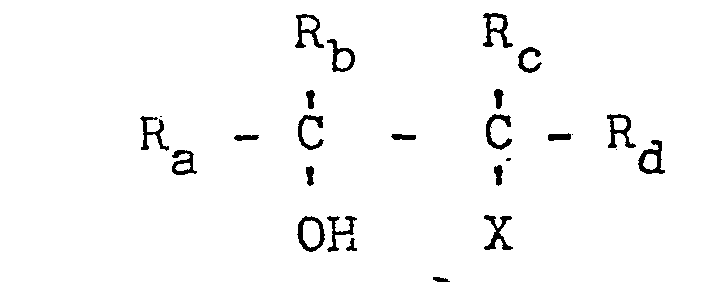
in which Ra, Rb, Rc, and Rd, which can be similar or dissimilar to each other, are hydrogen or alkyl, aryl, alkylaryl oder arylalkyl radicals, and X is a halogen, characterized in that said halohydrin is reacted with the bicarhonate of a Quaternary -onium compound of the group of ammonium, phosphonium, arsonium or stibonium.
in which Ra, Rb, Rc, and Rd, which can be similar or dissimilar to each other, are hydrogen or alkyl, aryl, alkylaryl oder arylalkyl radicals, and X is a halogen, characterized in that said halohydrin is reacted with the bicarhonate of a Quaternary -onium compound of the group of ammonium, phosphonium, arsonium or stibonium.
Process according to claim 1, characterized in that an organic solvent is employed
as diluent and operating in the presence of carbon dioxide.
3.- Process according to claim 1, characterized in that an alkylene carbonate having
2 to 4 carbon atoms in the alkylene chain is prepared.
4.- Frocess according to claim 1, characterized in that said halohydrin is a chlorohydrin,
a bromohydrin or an iodohydrin.
5.- Process according to claim 1, characterized in that said bicarbonate is the bicarbonate
of a quaternary ammonium cation, preferably the bicarbonate of tetramethyl ammonium
or of benzyl trimethyl ammonium.
6.- Process according to claim 1, characterized in that said bicarbonate is the bicarbonate
of a strongly basic anion exchange resin having quaternary ammonium end groups and
which is preferably suspended.in the reaction liquid.
7.- Process according to claim 6, characterized in that said resin is regenerated
after the synthesis, preferably by means of dilute aqueous NaOH or NH4OH and successive carbonation with C02.
8.- Process according to claims 6 and 7, characterized in that the synthesis is carried
out in two or more parallel reactors operating alternately.
9.- Process according to claims1 1 and/or 5 to 8, characterized in that for the synthesis
of propylene carbonate propylene chlorohydrin, bromohydrin or iodohydrin is used as
starting material in the presence of an organic solvent as diluent and, if desired,
in the presence of carbon dioxide.
10.- Process according to claim 9, characterized in that said organic solvent is acetonitrile.
11.- Process according to claim 9, characterized in that the synthesis temperature
ranges from 0 to 100°C.
12.- Process according to claim 9, characterized in that the synthesis temperature
ranges from 20°C to the boiling temperature of the organic solvent.
13.- Process according to claim 9, characterized in that the carbon dioxide pressure
is between 0 and 10 000 Kpa, preferably between 0 and 3000 Kpa.