[0001] The formation of formic acid by the hydrolysis of alkyl formates is well-known in
the art. The major drawback of such processes from the commercial standpoint is that
the chemical equilibrium of the hydrolysis reaction does not favor the rapid formation
of substantial amounts of formic acid. Even with mineral acid catalyst and high temperatures,
the extended residence time necessary to reach equilibrium makes the process very
complicated and expensive.. Examples of such processes are shown in U.S. Patent 2,160,064
and British Patent 628,656. Though the use of the mineral acid catalyst did reduce
reaction time, it created problems because of its tendency to promote the decomposition
of the formic acid to carbon monoxide and water.
[0002] In recent years, the trend has been to perform the hydrolysis by using formic acid
itself as the catalyst. While this overcame certain of the decompose ition problems
caused by the use of a strong mineral acid, the formic acid is less effective in accelerating
the reaction.
[0003] To overcome this problem, U.S. Patent 3,907,884 proposed the use of a solvent system
to reduce the reaction equilibrium time at temperatures from 25 to 150°C. This process,
however, while it serves to increase the reaction rate, is not fully effective because
the reactants during purification tend to undergo a reverse reaction, that is, the
formic acid and the methyl alcohol present in high concentrations though no formic
acid is added, thezmethyl formate is partially hydrolyzed to form sufficient formic
acid to catalyze the main hydrolysis step. The partially hydrolyzed product from this
preliminary step is combined with the recycled methyl formate and water so that the
total feed to the main hydrolysis contains a molar excess of the methyl formate.
[0004] As already indicated, the present invention relates to the preparation of formic
acid by the hydrolysis of the methyl formate in the presence of a formic acid catalyst.
More specifically, the invention relates to a high pressure-high temperature continuous
reaction autocatalyzed by formic acid, whereby the reaction product is processed so
as to substantially eliminate the reesterification of the reaction products during
purification. Reesterification is further suppressed by using a molar excess of methyl
formate in the hydrolysis.
[0005] The formic acid catalyst required for the main hydrolysis can be added to the reaction
zone, as by recycling product formic acid in a continuous process, but preferably
is formed in a preliminary hydrolysis zone wherein methyl formate and a mixture of
steam and water are introduced into a high temperature-high pressure zone. The main
hydrolysis step of the instant invention is performed at a temperature 90 to 140 C.
at pressures from 5 to 18 atmospheres, in the liquid phase at a methyl formate-water
molar ratio of from 1.5:1 to 10:1, preferably from 2:1 to 4:1. Under these conditions
the reactants are in a single phase. This eliminates the necessity of employing a
solvent system as the system. In the flashing step a substantial amount of the unreacted
methyl formate is vaporized and separated, i.e., at least 25%, preferably at least
50% of the total leaving the main hydrolyzer. The-bottom from the distillation zone
i.e. primarily water and formic acid may be further distilled for the removal of water
and to obtain high purity, e.g. 85%, formic acid.
[0006] In the embodiment of the invention wherein the formic acid catalyst is generated
in situ, prior to the main hydrolysis a portion of the methyl formate and a steam-water
mixture is fed to a preliminary hydrolysis reactor maintained at elevated temperatures
and pressure. This reactor is operated at similar conditions to the main hydrolyzer,
namely, at temperatures of from 90 to 140°C. and pressures from 5 to 18 atmospheres.
Generally lower pressures may be used because of the lower volatility of the reactants.
The methyl formate-water molar ratio is from 0.5:1 to 3:1. Though no formic acid is
added to the preliminary hydrolyzer, sufficient hydrolysis takes place to form sufficient
formic acid to catalyse the main hydrolysis reaction. In this latter reaction zone,
the contents from the preliminary reactor are combined with the methyl formate and
water recycled from the distillation zone. This embodiment is of significant economic
advantage because it eliminates the need for recycling purified formic acid or the
addition of extraneous formic acid to the process. Since the preliminary hydrolyzer
is an inexpensive addition to the overall process, this technique of forming
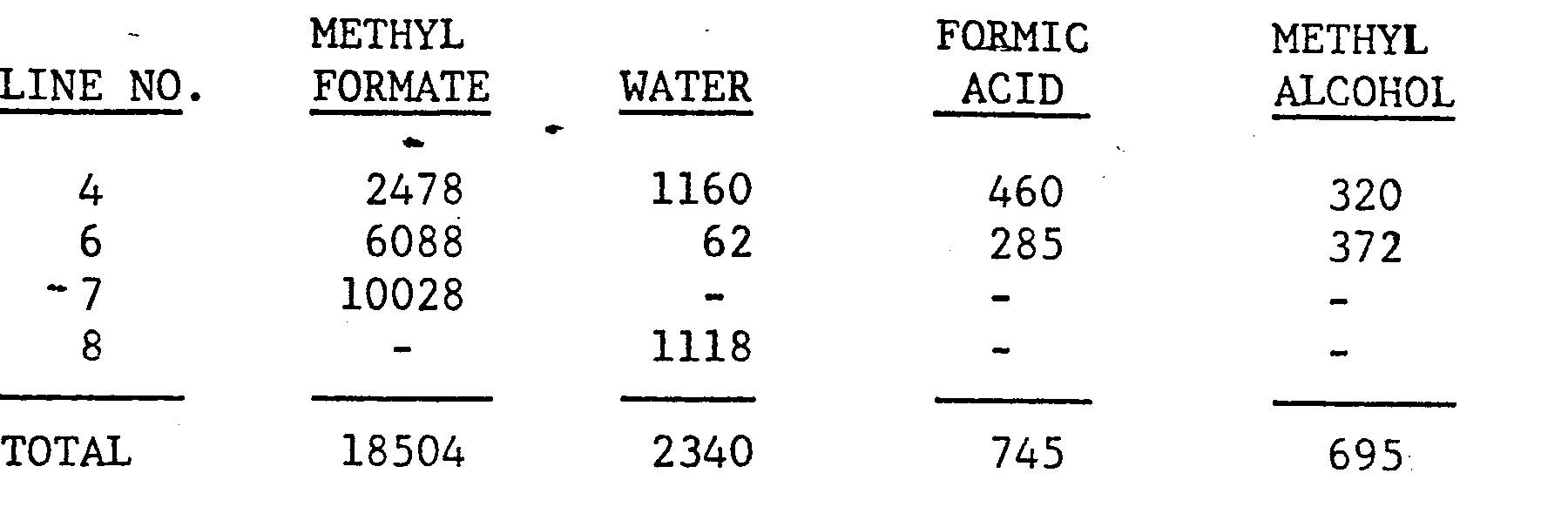
[0007] The total feed to the main hydrolyzer 5.has a methyl formate/water mol ratio of 2.4:1.
This reactor is maintained at a temperature of 120°C. and a pressure of about 9 atm.
As will be understood by those skilled in the art, the formic acid formed in the preliminary
hydrolyzer 1 serves as a catalyst for the reaction in the main hydrolyzer 5. Because
of the severe conditions of temperature and pressure the hydrolysis reaction achieves
95% equilibrium in approximately 20 seconds.
[0008] The reaction product from the main hydrolyzer 5 contains 2645 parts of formic acid,
2013 parts of methyl alcohol, 16,116 parts of methyl formate and 1597 parts of water,
and passes via line 9 to flash vessel 10. The latter is maintained at atmospheric
pressure. In the flash vessel 10 a substantial portion of the unreacted methyl formate,
namely 6088 parts, flashes off via line 6 rapidly cooling the remaining liquid. The
vapor is recycled to the main hydrolyzer 5. The liquid passes via line 11 to a first
distillation column 12, a glass-lined steel column packed with woven glass mats containing
only sufficient volume to minimize liquids hold-up. The distillation column 12 is
maintained at 400 mm Hg. distillate temperature of 131°C. is maintained. The overhead
stream, consisting essentially of water, is recycled via line 8 to the main hydrolyzer
5. The residue is removed via line 18, and consists of 2360 parts of formic acid and
417 parts of water, i.e., 85% formic acid.
90 to 140°C., the molar ratie of methyl formate and water in said preliminary hydrolyzer
being from 0.5:1 to 3:1; partially hydrolyzing the methyl formate to form catalytic
quantities of formic acid; passing the effluent directly to a main hydrolyzer; adding
to said main hydrolyzer additional methyl formate and water so that the methyl formate-water
molar ratio to the main hydrolyzer is from 1.5:1 to 10:1; maintaining said second
reaction zone at a pressure of from 5 to 18 atms. and a temperature of from 90 to
1400C.; further hydrolyzing said methyl formate until equilibrium conditions are approached;
separating the formic acid, methyl alcohol, unreacted methyl formate and water from
said second reaction zone; and recycling of the separated unreacted methyl formate
and water to said preliminary hydrolyzer.
5. A process according to Claim 4, wherein the effluent from the second reaction zone
is passed to a low pressure zone. wherein a substantial amount of the unreacted methyl
formate is vaporized overhead and the remaining liquid is thereby quickly cooled and
wherein the liquid from said low pressure zone is subject to distillation to separate
the residual methyl formate, the methyl alcohol and the product formic acid.
6. A process according to Claim 5, wherein the low pressure zone is maintained at
about atmospheric pressure.
7. A process according to Claim 5 or Claim 6, wherein said distillation is effected
in a vacuum distillation column.
