| (19) |
 |
|
(11) |
EP 0 006 768 B1 |
| (12) |
EUROPEAN PATENT SPECIFICATION |
| (45) |
Mention of the grant of the patent: |
|
27.01.1982 Bulletin 1982/04 |
| (22) |
Date of filing: 02.07.1979 |
|
| (51) |
International Patent Classification (IPC)3: G01V 1/04 |
|
| (54) |
Methods and apparatus for the generation and transmission of signals for echo location
and geophysical and other signalling purposes
Verfahren und Vorrichtung zur Erzeugung und Übertragung von Signalen für die Echolokalisierung
und für geophysikalische und andere Signalierungszwecke
Méthodes et dispositif pour la génération et la transmission de signaux pour la localisation
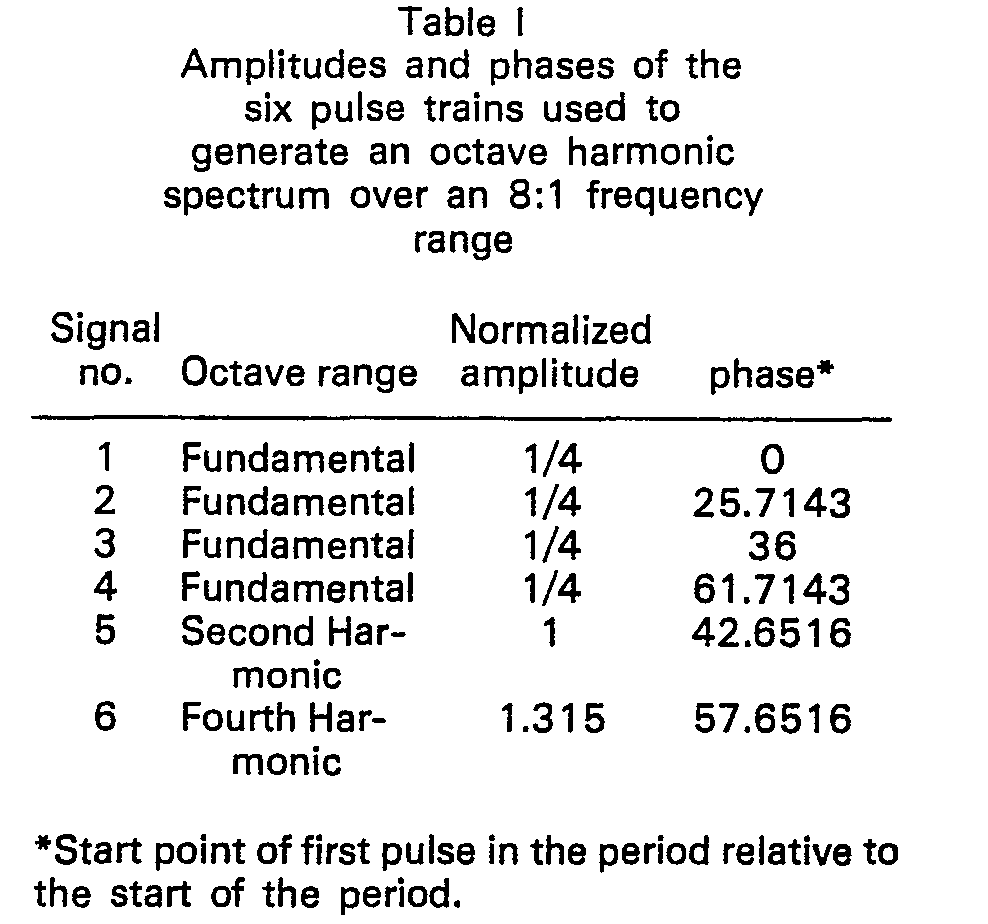
par écho, la géophysique et à d'autres fins de signalisation
|
| (84) |
Designated Contracting States: |
|
DE FR GB IT NL SE |
| (30) |
Priority: |
03.07.1978 US 921405
|
| (43) |
Date of publication of application: |
|
09.01.1980 Bulletin 1980/01 |
| (71) |
Applicant: Hydroacoustics Inc. |
|
Rochester, N.Y. 14692 (US) |
|
| (72) |
Inventor: |
|
- Nelson, David Elmer
Rochester, New York 14615 (US)
|
| (74) |
Representative: Godsill, John Kenneth et al |
|
Haseltine Lake & Co.,
Imperial House,
15-19 Kingsway
London WC2B 6UD
London WC2B 6UD (GB) |
|
| |
|
| Note: Within nine months from the publication of the mention of the grant of the European
patent, any person may give notice to the European Patent Office of opposition to
the European patent
granted. Notice of opposition shall be filed in a written reasoned statement. It shall
not be deemed to
have been filed until the opposition fee has been paid. (Art. 99(1) European Patent
Convention).
|
[0001] In seismic exploration, it is known to inject periodic vibratory signals into the
subsurface of the earth. Such signals may be monotonic or they may be chirp signals.
One such known technique is disclosed in U.S. Patent No. 3,106,982. The patent discloses
the mechanical structure of a vibrator mechanism as well as a vehicle for transporting
the apparatus. The Patent is primarily directed towards a means for anchoring a base
plate to a solid medium such as the earth, so that sinusoidal signals may be injected
into the earth. Known devices, such as that disclosed in the above patent, inherently
generate harmonics of the fundamental frequency. Such undesired harmonics seriously
contaminate the desired signal.
[0002] The present invention relates to methods of and apparatus for generating and transmitting
signals in accordance with a predetermined format or code such that a sequence of
signals or signal elements exhibits a given, preferably relatively smooth, power spectrum
extending over a broad frequency band useful for echo location and other signalling
purposes.
[0003] The invention is especially adapted to and suitable for generation of seismic signals
for use in geophysical exploration and enables such signals to be transmitted, in
the form of rectangular waves with high energy, efficiently into a transmission medium,
either in marine environments or on land.
[0004] According to one aspect of the invention, there is provided a method of generating
and transmitting a signal, which method comprises the step of generating one signal
having a waveform constituted by successive signal elements each with at least two
levels, characterised in that the method comprises:
carrying out the generating step so that said at least two levels in each signal element
have time durations that are in selected unequal proportions so as to reduce predetermined
spectral harmonics of the signal; and
changing the time durations of the levels of the signal elements during transmission,
but not allowing the ratio of the time durations of the longest and the shortest signal
elements to exceed 2 to 1, so that the repetition frequency of said one signal sweeps
over an octave.
[0005] According to another aspect of the invention, there is provided apparatus for carrying
out the above method, comprising means for generating one signal having a waveform
constituted by successive signal elements each with at least two levels, characterised
in that:
the generating means is constructed so that, when operating, it gives time durations
for the levels of each signal element that are in selected unequal proportions so
as to reduce the predetermined spectral harmonics of the signal; and
the apparatus comprises means constructed so that, when operating, it changes the
time duration of the levels of said signal elements during transmission with the ratio
of the time duration of the longest to the shortest signal element not exceeding a
factor of 2 to 1, such that the repetition frequency of said one signal sweeps over
an octave.
[0006] It is thus possible to provide methods of and apparatus for producing repetitive
signals whose spectral line amplitudes have desired amplitude relationships.
[0007] It is also possible to provide methods and apparatus for generating and transmitting
signals having a substantially flat power spectrum through the use of rectangular
wave forms, such as have at least two levels and may be pulses, which may be efficiently
generated with high power.
[0008] An embodiment is disclosed for obtaining a transmission having an autocorrelation
function with low side lobe levels using sequences of pulses properly timed with respect
to each other and with the amplitude of the pulses in certain relationship.
[0009] The methods and apparatus disclosed hereinafter produce an octave harmonic spectrum
wherein the non-octave harmonics are reduced or eliminated over a frequency range
of more than an octave. An octave harmonic is one whose frequency is 2N times the
frequency of the fundamental repetition frequency, where N is an integer. The shape
of the signal is adjusted to reduce or eliminate many of the non-octave harmonics.
In a preferred embodiment, signals consisting of rectangular or square waves having
at least two levels are used. The term "wave" or "wave form" is here used to mean
"a disturbance which is propagated through the body of a medium, without involving
net movement of the material". The portion of the wave having one of the two levels
is referred to herein as a pulse. The duration of the pulse is selected so that certain
non-harmonic octaves of the spectrum are reduced or eliminated. Specifically, where
the pulse duration is one-third the period of the repetition frequency of a sequence
of pulses or a pulse train, non-octave harmonics are reduced or eliminated. By selecting
time displacement of pulses in a plurality of pulse trains, other non-octave harmonic
components of the spectrum may be eliminated and octave harmonic components augmented
in amplitude. The repetition frequencies of these pulse trains are swept over one
octave. A substantially flat power spectrum can result, viz., a spectrum with substantially
constant spectral energy extending smoothly over a range exceeding the fundamental
octave of the sweep. This spectrum provides the autocorrelation function desired for
use in seismic exploration and other echo location and signalling system.
[0010] French Patent 1,583,239 teaches the method of enhancing seismic signals by cross-
correlating a transmitted signal with a received signal. The transmitted signal consists
of a series of constant-amplitude, discrete, random pulses so chosen that the autocorrelation
side lobes are minimal.
[0011] For a better understanding of the invention and to show how the same may be carried
into effect, reference will now be made, by way of example, to the accompanying drawings,
in which:
Fig. 1 is several diagrams illustrating the spectrum of pulse signals having different
characteristics;
Fig. 2 are waveform and vector diagrams of the signals resulting from two pulse trains
which are generated and transmitted in accordance with the invention;
Fig. 3 are waveform and vector diagrams of a fundamental and second harmonic pulse
trains generated in accordance with the invention;
Fig. 4 is a waveform of a composite signal resulting from the summation of several
pulse trains which are generated in accordance with the invention;
Fig. 5 is a block diagram of a system for generating pulse trains in accordance with
the invention;
Fig. 6 is a sectional view diagrammatically illustrating a seismic source which is
controlled by signals generated in accordance with the invention for transmitting
seismic signals corresponding thereto;
Fig. 7 is a section view of another seismic source which may be used for transmitting
signals generated by the system illustrated in Fig. 5;
Fig. 8 is a block diagram of a system for controlling the duration of the pulses so
as to compensate for distortion;
Fig. 9 is a plot of the spectrum of one of the pulse trains showing the operation
of the system of Fig. 8 in compensating for distortion;
Fig. 10 is a waveform diagram of the fundamental period of a composite signal which
may be generated in accordance with the invention; and
Fig. 11 is a waveform diagram similar to Fig. 10 which is quantized into 16 levels.
[0012] Referring first to Fig. 1, it will be seen that a signal element consisting of two
levels, such as a rectangular pulse waveform may be shaped to eliminate or reduce
the amplitude of an undesired line of its energy spectrum, and thus form a signal
element or building block of a repetitive signal having a shaped spectrum.
[0013] In Fig. 1 (a) there is illustrated the spectrum which results from a periodic repetition
of a pulse with a very short duration in relation to the period of its repetition
frequency. In the limit the pulse is an "impulse" or Dirac delta function (viz., the
duration of the pulse approaches zero while the pulse area is held constant). The
line spectrum associated with a train of such pulses consists of a series of equal
amplitude, equally spaced spectral lines having a spacing equal to the repetition
frequency, as shown in Fig. 1 (a).
[0014] Fig. 1 (b) illustrates the spectrum of a rectangular pulse waveform with a pulse
width or duration one-third of the period of the pulse train of Fig. 1 (a). In other
words, the waveform of this pulse has at least two levels which divide the duration
thereof in a proportion of 1 to 2. From Fourier transform theory, it is known that
the spectrum of such a pulse is defined by the function Sin X/X where X is ω T
o/2, where ω is the angular frequency of the spectral component of the pulse waveform
and To is the pulse duration. Such a pulse displays spectral nulls where X takes on
values of π, 2π, 3π, etc. These nulls correspond to frequencies whose periods equal
the pulse width or which subdivide the pulse width into equal parts. Such frequencies
are shown in the spectrum of Fig. 1 (b) as being 3 times and 6 times a frequency whose
period is the pulse period.
[0015] Fig. 1 (c) illustrates the spectrum obtained for a pulse train made up of repetitions
of pulses whose time widths or durations are one-third the period of the repetition
frequency. The spectral nulls correspond with the nulls of the single pulse shown
in Fig. 1 (b). The spectral lines at harmonic numbers 3n, where n is an integer, are
eliminated. These are the third and sixth harmonics as shown in Fig. 1(c). Amplitudes
of the other harmonics are altered and follow the amplitude envelope of the spectrum
of the individual pulse as shown in Fig. 1 (b).
[0016] A spectrum containing only the octave harmonics in proper proportion for creating
a. flat power spectrum is illustrated in Fig. 1 (d).
[0017] When the repetition frequency of the signals making up the spectrum is swept monotonically
at a constant rate over an octave, all frequencies in the power spectrum are generated
with equal amplitude and the autocorrelation function has a narrow main lobe and very
low side lobe level.
[0018] Fig. 1 (e) illustrates the ideal spectrum obtained by sweeping the octave harmonic
spectrum of Fig. 1 (d) over an octave of the fundamental repetition frequency. The
spectrum level of the second harmonic panel P2 is of the same amplitude as the first
harmonic panel P1. This amplitude relationship is true for all higher harmonic panels,
such as panel P3. Since the harmonic line amplitude is augmented by the square root
of n, where n is the harmonic number, as shown in Fig. 1 (d), the power is increased
to offset the spectral loss due to the increasing sweep rate. This is because the
sweep rate for each harmonic is directly proportional to the harmonic number, which
reduces the spectral power level in accordance with the square of that number.
[0019] Fig. 1 (f) illustrates the spectrum obtained by changing the duration or period of
the pulses whose spectrum is shown in Fig. 1 (c) so that the train of these pulses
sweeps monotonically at a constant rate over an octave. Inasmuch as the 3n (third
and sixth) harmonics are eliminated, the panels P1, P2 and P3 are flat over a range
equal to five times the lowest frequency of the lowest octave. However, the harmonic
panels are not equal in amplitude, reflecting that the octave harmonics of the pulse
train do not have the amplitude value equal to the square root of n. Moreover the
fifth harmonic and the seventh harmonic are present causing the spectrum to undulate,
beginning at the fifth harmonic and changing again at the seventh harmonic. By utilizing
the steps illustrated in Figs. 2 and 3, the substantially flat spectrum can be obtained.
[0020] Fig. 2 shows two pulse trains S1 and S2 which are displaced in time but otherwise
identical. The displacement is one-tenth the fundamental repetition period (1/10 T
fo) or 36°. The sum of these trains is shown as a composite signal S1+S2. The two pulse
trains, because of their displacement in time, cause the fifth harmonic to cancel.
The time displacement is the product of 1/5, 180°/360° and T
f°. In other words the displacement is one-tenth of the fundamental period. The vector
diagrams show the relationship between the fundamental components of the S1 and S2
pulse trains and further show that the - fifth harmonic components S1 H5 and S2H5
cancel, since they are'180° out of phase.
[0021] By a similar method, using a time displacement of one-fourteenth the fundamental
repetition period the seventh harmonic components can be made to cancel.
[0022] Fig. 3 shows the use of a fundamental and a second harmonic pulse train both of one-third
duration and at a specific time displacement to augment the magnitude of the second
harmonic of the sum signal to the value (the square root of 2 or 1.414) required to
obtain the flat octave harmonic spectrum through the second harmonic panel. The pulse
train S1 operates at the fundamental repetition frequency and the pulse train S2 at
the second harmonic of this repetition frequency. The sum or composite signal S1+S2
results from these trains. Both trains are swept slowly, the first (S1) over the fundamental
octave and the second (S2) over the octave of the second harmonic of S1. The pulse
trains are displaced in time 20.7° referenced to the fundamental period. As shown
in the vector diagram in Fig. 3, this corresponds to a phase displacement of 41.4°
at the second harmonic of the fundamental repetition frequency. The fundamental component
of each pulse train has the normalized value of 1.0; the amplitudes of the pulses
being equal. The second harmonic component of the fundamental pulse train S 1 H2 has
a normalized amplitude of 0.5. The sum of the second harmonic component of the fundamental
pulse. train, S 1 H2, and the fundamental component of the second harmonic train,
S2H1, is the square root of 2, as shown in the vector diagram in Fig. 3. A similar
method can be used to augment the fourth harmonic component and to establish for this
fourth harmonic a level of 2.
[0023] Fig. 4 shows the time waveform for one period of a transmission made up of pulse
trains S1 to S6 listed in Table I below. An octave harmonic spectrum is generated
by these pulse trains when the repetition frequency is monotonically swept in frequency
over one octave of the fundamental repetition frequency. This power spectrum is flat
over a frequency range of 8 to 1 beginning at the lowest repetition frequency.
[0024] In generating the six pulse trains the following steps are followed:
1. The fundamental pulse train S1 is chosen for the lowest octave in the frequency
range. The pulse width or duration is one-third of the fundamental period. All of
the other signals have the same one-third period duration and the third and sixth
harmonic spectral lines are nulled.
2. Three more fundamental pulse trains S2, S3 and S4 are generated. These trains are
grouped in pairs (S1 and S2 constituting a first pair and S3 and S4 constituting a
second pair). The signals S1 and S2 are displaced in time and the signals S3 and S4
are similarly displaced in time (by 25.7143°) so as to null the seventh harmonic,
as was explained in connection with Fig. 2. The two pairs are then displaced with
respect to each other by 36° to null the fifth harmonic, again as was explained in
connection with Fig. 2.
3. The fifth pulse train S5, at the second harmonic of the fundamental repetition
frequency, augments the second harmonic to the proper amplitude (the square root of
2) as was explained in connection with Fig. 3.
4. A sixth pulse train S6 at the fourth harmonic augments the fourth harmonic to the
proper value (the square root of four or 2) as was explained also in connection with
Fig. 3.
[0025] A system for generating the six pulse trains S1 to S6 is illustrated in Fig. 5. The
repetition frequency is determined by a voltage controlled oscillator 101. The pulse
trains are then coherent with each other. This frequency is swept over an octave by
a ramp generated by a ramp generator 102. The duration of this ramp is equal to the
duration of the transmission. The amplitude of the ramp is adjusted so that the frequency
of the VCO 101 sweeps a ratio of 2 to 1, or one octave. The output of the VCO 101
is a pulse signal which triggers a one-third period generator 104. This generator
is made up of two flip-flops 201 and 202, which constitute a binary divider which
counts to 2 and returns, since it is reset by an AND gate 203. The signal from the
Q output of flip-flop 202 is the S6 pulse train at the fourth harmonic. The pulses
have a period of one-third the repetition period of the pulses provided by the VCO
101.
[0026] Another flip-flop 500 divides the VCO frequency by 2. Another flip-flop 600 which
is connected to the output of the flip-flop 500 further divides the VCO frequency
by 2 or a total of 4 to 1. The second harmonic pulse train of one-third duration pulses
is generated by a one-third period generator 300 and a variable time delay one-shot
301. The output of the ramp generator 102 is amplified in an amplifier 302 having
the gain necessary to set the time displacement, in terms of the duration of the output
pulse from the variable time delay one-shot 301 so that it is the same proportion
of a period in each repetition or period of the pulses in the S5 train. In other words
the S5 train will only be 42.6516° displaced from the S1 train over the entire sweep
(see Table I). The four signals S1 to S4 at the fundamental repetition frequencies
are generated in response to the pulses from the flip-flop 600 by one-third period
generators 400, 700, 800 and 900. The time displacements of these fundamental signals
are obtained by variable time delay one-shots 401, 701, 801, and 901. Amplifiers 402,
702, 802 and 902 each having different gains G1 to G5 control the time displacements
so that they are in the same proportion of a period in each repetiton or period of
the signals S 1 to S4 occurring during the transmission. Again, these time displacements
correspond to the phase shifts shown in Table I.
[0027] Six seismic sources such as illustrated in Fig. 6 may be used to transmit seismic
signals corresponding to the signals S1 to S6.
[0028] Each source consists of a housing 10 in which a coupling piston 12 is reciprocally
mounted. The piston forms an interface with the medium into which the seismic signals
are to be injected which in the illustrative case is water in a marine environment.
A cavity 15 behind the piston 12 is filled with pressurized gas such as air from a
source indicated as P to a pressure P at least equal to the pressure P
A exerted on the piston 12 by the surrounding medium. A drive piston 24 is connected
by a shaft 13 to the coupling piston 12. This piston presents two drive areas A, and
A
2 to cavities 17 and 18 in the housing 10. These cavities are supplied with pressurized
hydraulic fluid through passages 19 and 20. The fluid is switched between supply and
return pressures P and P
R from a hydraulic power supply by means of a four-way electrohydraulic valve 16. The
signals are applied as the input control signal E
IN to the valve 16. Accumulators 21 and 22 are closely coupled to the valve so as to
minimize fluctuation in the pressures P and P
A. When the pulse signal is positive, hydraulic fluid in the cavity 17 is switched
from return to supply pressure while the fluid in the cavity 18 is switched to return
pressure. A positive force is then applied to the piston 12 for the duration of the
signal. This force is transmitted as a compressive force into the medium. When the
other level (for two- thirds of the duration of the signal) is present supply pressure
is switched by the valve to the cavity 18 and return pressure is switched to the cavity
17. A tensile or negative force is then applied to the medium. Since the hydraulic
fluid is switched between supply and return pressures a pulse train with a bi-level
waveform is transmitted into the medium. This pulse train is transmitted with high
efficiency, since the pressures are switched and losses due to throttling of fluid
in the ports of the valve are minimized. The sources of the type shown in Fig. 6 may
have different drive areas so as to obtain the relationship of signal amplitudes shown
in Table I.
[0029] A N-level force generator as illustrated in Fig. 7 may be used to transmit the composite
signal by summing all of the individual signals S1 to S6. The composite signal is
a signal of the waveform shown in Fig. 4. The source shown in Fig. 7 is the subject
matter also of the concurrently filed application No. 79301286.5 (publication No.
0006767). In the source two pistons 502 and 504 are mounted by coaxial extensions
520 and 521 so as to slide on a shaft 503. The pistons are in back-to-back relationship
and define a cavity 505 in a cylinder 515 in which they are also slidable along their
outer peripheries which are sealed by means of "O" rings. The cavity 505 is pressurized
from a source of pressurized gas indicated at P
G to a pressure P
e which is higher than the pressure P of the surrounding medium (water in the marine
environment). Housings 501 and 501' are symmetrically disposed with respect to the
pistons 502 and 504 and are attached at the ends of the shaft 503. Struts 516 and
516' connect the outer cylinder 515 to the housings 501 and 501' so that the housings
and cylinder are fixed while the pistons 502 and 504 move toward and away from each
other. The coaxial extensions 520 and 521 of the pistons and the inner periphery of
bores in the housing 501 and 501' are formed with steps to define cavities 508, 508',
518, 518' and 528, 528'. The steps on the coaxial extensions form drive areas A
D1, A
D2, A
D3, A
D1',. A
D2', and A
D3'. These six drive areas may all be different. By increasing the drive areas or decreasing
them the amplitude of the signal may be adjusted. In this manner amplitude control
as is required for the signals shown in Table I is obtained. Separate pairs of three-way
electrohydraulic valves 560, 560', 561, 561' and 562, 562' are in communication with
the cavities 508, 508', 518, 518', and 528, 528'. The signals are applied to the valves
and the pressures in the cavity are switched between supply and return pressures,
generating forces of duration corresponding to durations of the pulses in each repetition
period to the pistons 502 and 504. The forces sum and the composite signal is generated
by the pistons 502 and 504. The number of levels, N, which can be produced by an N-level
source, is 2
v, where V is the number of valves. The number of valves, V, may be chosen equal to
the number of signals, in which case a single source can provide the exact octave
harmonic spectrum developed by this number of signals. For instance, the waveform
of Fig. 4 requires 6 signals, which could be produced by a source with 6 cavities
and will provide a flat, undulation-free spectrum through the eighth harmonic.
[0030] It-may be possible to approximate the octave harmonic spectrum by omitting the fifth
and seventh harmonic cancellations. In this case, signals S1 through S4 in Table I,
are combined into a single signal of amplitude 1 and common phase 39.7143 (22° displaced
from the second harmonic source, S5, as shown in Fig. 3). In this case, 3 cavities
and 8 levels are required for the approximate signal, which will be flat, but v some
undulation, through the eighth harmor
[0031] If a spectrum flat through only the second harmonic panel is desired, the higher
frequency source, S6, may be deleted entirely, leaving only 2 signals. In this case,
a two cavity source will suffice.
[0032] When each drive area is used individually to produce a desired signal, the reaction
forces on the housing 501, 501' are not necessarily balanced, and the housing may
be subjected to dynamic accelerations requiring care in its mounting. Alternatively,
the opposing pistons 502, 504 may be driven in a balanced mode where pairs of areas
on opposing sides are matched, and the corresponding valves are driven in synchronism.
In this case, reaction forces on the housing are minimized or eliminated. In order
to achieve such balanced drive, the number of independent signals that can be transmitted
is halved. This is achieved in the 3 cavity, 8 level case considered above when applied
to Fig. 7 where six cavities would be used to produce 3 independent signals in balanced
position. The waveform of Fig. 10 then results.
[0033] In the configurations just discussed the cavity sizes are chosen to provide a specific
force level, each exactly and independently defining a two- level signal. The source
is actually several sources compressed into one, wherein each cavity provides one
of the signals.
[0034] There is still another approach to using the N-level source. The N-levels may be
redefined into equal quantum steps and each level defined by a binary code. Then,
each of the levels of Figs. 4 or 8 may be replaced by the nearest quantum step, and
the cavities pressurized in accordance with the binary code associated with each of
the levels. This additional approximation-that-of replacing an exact level with the
nearest quantum step-causes a further degradation of the octave harmonic spectrum.
However, it has been found that if four cavities, with 16 quantum steps, are employed,
the waveform of Fig. 11 can be produced, and provides a flat, undulation-free spectrum
through the eighth harmonic. Such a source is less specialized, since the cavity sizes
progress in exact powers of two, and could be used to transmit any waveform within
the limits of sampling rate (i.e., valve switching speed) and quantizing accuracy.
[0035] In the event that the waveform of the two- level pulse is distorted the spectral
nulls may be shifted with the result that the desired spectrum of the transmission
is not obtained. Such distortion may be compensated by adjusting the width of the
pulse.
[0036] The effect of the distortion is illustrated in Fig. 9. The undistorted waveform and
the spectrum corresponding thereto are designated by (a). Distortion as exemplified
by a half cosine pulse added to the undistorted pulse and the shift in the spectral
null away from the third harmonic is shown by the lines made up of long and short
dashes and designated by (b). The adjusted pulse of increase width and the resulting
spectrum which again has a null at the third harmonic is shown by the lines made up
of short dashes and designated by (c).
[0037] In order to vary the duration of the pulse the signal generating system of Fig. 5
may be modified as shown in Fig. 8. A transducer 1001 in the medium (either in the
water or ground near the source or sources of the signals) detects the signals. The
third harmonic is selected from the transducer signals by a filter 1002. The third
harmonic of the S1 signal from the 1/3 period generator 900 is also selected by another
filter 1003 after these S1 signals are processed in a variable time delay one-shot
(VTDOS) 1004. The width of the pulse from the 1/3 period generator 900 is varied in
the VTDOS 1004 in response to the difference in amplitude of the third harmonic components
in the medium and in the S1 signal by a comparator 1005 which may be a differential
amplifier. The third harmonic is nulled by controlling the pulse width of the S1 signal
in response to the error signal from the comparator 1005. This error signal is applied
to other VTDOSs, one for each of the S2 to S5 signals which similarly adjusts their
duration. From the foregoing description it will be apparent that there has been provided
improved methods and apparatus for the generation and transmission of signals having
spectra which are substantially flat over a broad frequency range. Variations and
modifications of the herein-described methods and apparatus within the scope of the
invention will undoubtedly suggest themselves to those skilled in the art. Accordingly,
the foregoing description should be taken as illustrative and not in a limiting sense.
1. A method of generating and transmitting a signal, which method comprises the step
of generating one signal having a waveform constituted by successive signal elements
each with at least two levels, characterised in that the method comprises:
carrying out the generating step so that said at least two levels in each signal element
have time durations that are in selected unequal proportions so as to reduce predetermined
spectral harmonics of the signal; and
changing the time durations of the levels of the signal elements during transmission,
but not allowing the ratio of the time durations of the longest and the shortest signal
elements to exceed 2 to 1, so that the repetition frequency of said one signal sweeps
over an octave.
2. A method according to claim 1, wherein said signal elements have two levels in
the proportion of 1 to 2 so that spectral harmonics having harmonic numbers 3n, where
n is an integer, are reduced.
3. A method according to claim 1 or 2, wherein said signal is a seismic signal transmitted
into a medium, said levels corresponding to forces applied to said medium, said generating
step being carried out such that the level of shorter time duration corresponds to
a compressive or positive force on said medium and said level of longer duration corresponds
to a tensile or negative force on said medium.
4. A method according to claim 1,2 or 3, and comprising transmitting signals having
a spectrum extending over a frequency range of more than one octave, generating at
least a second signal and said one signal each according to claim 1 to provide at
least one pair of signals with said signals having the same signal element duration
and dividing said signal element duration in the same selected unequal proportions,
the method comprising the step of changing said durations of the signal elements of
said pair as the signal elements are repeated during said transmission to sweep the
repetition frequencies thereof over an octave, displacing the signal elements in said
pair in time, one signal with respect to the other, by the same portion of said duration
in each repetition of the signal elements of said pair during said transmission.
5. A method according to claim 4, wherein said signal elements have two levels in
the proportion of 1 to 2 and said portion of said duration is 1/10 so that spectral
harmonics having harmonic numbers 3n, where n is an integer, and 5, are reduced.
6. A method according to claim 4, wherein said method comprises the steps of generating
at least another pair of said signals with the signal elements in said other pair
being of said duration and dividing said duration in said selected unequal proportions,
changing the signal element durations of said signals in said other pair as the elements
are repeated during said transmission to sweep the repetition frequencies thereof
over said octave, displacing the signal elements in said other pair in time, one signal
with respect to the other, by said same portion of said duration in each repetition
during said transmission, and displacing said other pair of signals in time with respect
to said one pair by a second portion of said duration which remains the same in each
repetition.
7. A method according to claim 6, wherein said signal elements have two levels in
the proportion of 1 to 2 and said first named portion is 1/10 and said second portion
is 1/14, so that spectral harmonics having harmonic numbers 3n, wherein n is an integer,
5 and 7 are reduced.
8. A method according to claim 1, 2 or 3, wherein said method provides substantially
constant spectral energy extending smoothly over said range, said method comprising
generating at least one other signal having the same waveform as said one signal and
a signal element duration which divides the duration of each repetition of the signal
elements into parts of number 2" where n is an integer, n being 1 for said one other
signal, changing the signal element duration of said other signal as the signal element
is repeated during said transmission also to sweep the repetition frequency of said
other signal over an octave, displacing said other signal in time with respect to
said one signal by a certain portion of said duration which remains the same in each
signal element repetition such that the vector sum of the second harmonic amplitude
of said one signal and the fundamental amplitudes of said other signal, where n is
1, is approximately equal to the square root of 2 times the amplitude of the fundamental
of said one signal.
9. A method as claimed in claim 8, wherein the step of generating said other signal
is carried out by generating a plurality of said other signals each of which divides
said duration into 2" parts where n is an integer different for each signal of said
plurality of other signals, starting at 1 for said one other signal and increasing
in direct relationship to the order of said other signals.
10. Apparatus for carrying out the method of claim 1, comprising means (900) for generating
one signal having a waveform constituted by successive signal elements each with at
least two levels, characterised in that:
the generating means is constructed so that, when operating, it gives time durations
for the levels of each signal element that are in selected unequal proportions so
as to reduce predetermined spectral harmonics of the signal; and
the apparatus comprises means (102) constructed so that, when operating, it changes
the time duration of the levels of said signal elements during transmission with the
ratio of the time duration of the longest to the shortest signal element not exceeding
a factor of 2 to 1, such that the repetition frequency of said one signal sweeps over
an octave.
11. Apparatus according to claim 10, wherein said signal elements have two levels
in the proportion of 1 to 2 so that spectral harmonics having harmonic numbers 3n,
where n is an integer, are reduced.
12. Apparatus according to claim 10 or 11, wherein said signal is a seismic signal
for transmitting into a medium, said levels corresponding to forces applied to said
medium, said generating means providing a compressive or positive force on said medium
corresponding to the level of shorter duration and a tensile or negative force on
said medium corresponding to the level of longer duration.
1-3. Apparatus according to claim 10, 11 or 12, wherein the generating means (900,
800) are operable to generate at least a second signal (S2) and said one signal (S1)
each comprising successive signal elements having at least two levels, to provide
at least one pair of signals with said signals having the same signal element duration
and dividing said signal element duration in the same selected unequal proportions,
the apparatus comprising means (102) for changing said durations of the signal elements
of said pair as the signal elements are repeated during transmission to sweep the
repetition frequencies thereof over an octave, and means (901, 801) for displacing
said signal elements in said pair in time, one signal with respect to the other, by
the same portion of said duration in each signal element repetition of said pair during
said transmission.
14. Apparatus according to claim 13, wherein said elements have two levels in the
proportion of 1 to 2 and said portion of said duration is 1/10 so that spectral harmonics
having harmonic numbers 3n, where n is an integer, and 5, are reduced.
15. Apparatus according to claim 13, wherein said apparatus comprises means (700,
400) for generating at least another pair of said signals with the signal elements
in said other pair being of said duration and dividing said duration in said proportion,
there being means (102) for changing the signal element durations of said signals
in said other pair as the elements are repeated during said transmission to sweep
the repetition frequencies thereof over said octave, and means (701,401) for displacing
the signal elements in said other pair in time, one signal with respect to the other,
by said same portion of said duration in each repetition during said transmission
and for displacing said other pair of signals in time with respect to said one pair
by a second portion of said duration which remains the same in each repetition.
16. Apparatus according to claim 15, wherein signal elements have two levels in the
proportion of 1 to 2 and said first named portion is 1/10 and said second portion
is 1/14, so that spectral harmonics having harmonic numbers 3n, where n is an integer,
5 and 7 are reduced.
17. Apparatus according to claim 10 for providing substantially constant spectral
energy extending smoothly over said range, said apparatus comprising means (800) for
generating at least one other signal having the same waveform as said one signal and
a signal element duration which divides the duration of each repetition of the signal
elements into parts of number 2" where n is an integer, n being 1 for said one other
signal, means (102) for changing the signal element duration of said other signal
as it is repeated during said transmission also to sweep the repetition frequency
of said other signal over an octave, and means (901, 801) for displacing said other
signal in time with respect to said one signal by a certain portion of said duration
which remains the same in each repetition such that the vector sum of the second harmonic
amplitude of said one signal and the fundamental amplitude of said other signal, where
n is 1, is approximately equal to the square root of 2 times the amplitude of the
fundamental of said one signal.
18. Apparatus according to claim 17, wherein said means for generating said other
signal includes means for generating a plurality of said other signals each of which
divides said duration into 2" parts where n is an integer different for each signal
of said plurality of other signals, starting at 1 for said one other signal and increasing
in direct relationship to the order of said other signals.
1. Verfahren zum Erzeugen und Übertragen eines Signals, das einen Arbeitsschritt umfaßt,
der dazu dient, ein Signal zu erzeugen, das eine Wellenform aufweist, die durch aufeinander
folgende Signalelemente gebildet wird, von denen jedes mindestens zwei Pegel aufweist,
dadurch gekennzeichnet, daß der Arbeitsschritt zum Erzeugen des einen Signals in der
Weise durchgeführt wird, daß die beiden bei jedem Signalelement mindestens vorhandenen
Pegel jeweils eine zeitliche Dauer aufweisen, zwischen denen gewählte ungleiche Verhältnisse
bestehen, um vorbestimmte spektrale Harmonische des Signals zu verringern, und daß
die zeitliche Dauer der Pegel der Signalelemente während der Übertragung geändert
wird, wobei jedoch nicht zugelassen wird, daß das Verhältnis zwischen der zeitlichen
Dauer der längsten und der zeitlichen Dauer der kürzesten Signalelemente den Wert
2:1 überschreitet, so daß die Folgefrequenz des genannten einen Signals eine Oktave
überstreicht.
2. Verfahren nach Anspruch 1, dadurch gekennzeichnet, daß die Signalelemente zwei
Pegel im Verhältnis von 1:2 aufweisen, so daß die spektralen Harmonischen, denen harmonische
Zahlen 3n zugehören, wobei n eine ganze Zahl bezeichnet, verringert werden.
3. Verfahren nach Anspruch 1 oder 2, dadurch gekennzeichnet, daß es sich bei dem.
Signal um ein seismisches Signal handelt, das in ein Medium hinein übertragen wird,
daß die genannten Pegel auf das Medium aufgebrachten Kräften entsprechen und daß der
Arbeitsschritt zum Erzeugen des Signals in der Weise durchgeführt wird, daß der Pegel
mit der kürzeren zeitlichen Dauer einer auf das Medium wirkenden Druckkraft oder einer
positiven Kraft entspricht und daß der Pegel mit der längeren Dauer einer auf das
Medium aufgebrachten Zugkraft oder einer negativen Kraft entspricht.
4. Verfahren nach einem der Ansprüche 1 bis 3, das Maßnahmen umfaßt, um Signale zu
übertragen, deren Spektrum sich über einen Frequenzbereich von mehr als einer Oktave
erstreckt, um mindestens ein zweites Signal und das genannte eine Signal jeweils gemäß
Anspruch 1 zu erzeugen, so daß man mindestens ein Paar von Signalen erhält, wobei
bei den ge-' nannten Signalen die Signalelemente die gleiche zeitliche Länge haben,
und um die Dauer der Signalelemente in die gleichen gewählten ungleichen Teile zu
unterteilen, dadurch gekennzeichnet, daß die zeitliche Länge der Signalelemente des
genannten Paars von Signalen geändert wird, während die Signalelemente während der
Übertragung wiederholt werden, damit ihre Folgefrequenzen eine Oktave überstreichen,
und daß die Signalelemente bei dem genannten Paar von Signalen gegeneinander zeitlich
um den gleichen Anteil der zeitlichen Länge bei jeder Wiederholung der Signalelemente
des genannten Paars während der Übertragung versetzt werden.
5. Verfahren nach Anspruch 4, dadurch gekennzeichnet, daß die genannten Signalelemente
zwei Pegel im Verhältnis von 1:2 haben und daß der genannte Teil der zeitlichen Länge
1/10 beträgt, so daß spektrale Harmonische, denen harmonische Zahlen 3n zugehören,
wobei n eine ganze Zahl sowie die Zahl 5 bezeichnet, verringert werden.
6. Verfahren nach Anspruch 4, dadurch gekennzeichnet, daß das Verfahren Arbeitsschritte
umfaßt, um mindestens ein weiteres Paar der genannten Signale zu erzeugen, wobei die
Signalelemente bei dem genannten weiteren Paar die genannte zeitliche Länge haben,
und um die genannte zeitliche Länge in die genannten gewählten ungleichen Teile zu
unterteilen, um die zeitliche Länge der Signalelemente der genannten Signale bei dem
genannten weiteren Paar zu ändern, während die Elemente während der Übertragung wiederholt
werden, damit ihre Folgefrequenz die genannte Oktave überstreicht, um die Signalelemente
des genannten weiteren Paars gegeneinander zeitlich um den gleichen Teil der genannten
zeitlichen Dauer bei jeder Wiederholung während der Übertragung zu versetzen und um
das genannte weitere Paar von Signalen zeitlich gegenüber dem genannten einen Paar
um einein zweiten Teil der genannten zeitlichen Dauer zu versetzen, der bei jeder
Wiederholung der gleiche bleibt.
7. Verfahren nach Anspruch 6, dadurch gekennzeichnet, daß die Signalelemente zwei
Pegel im Verhältnis 1:2 haben, daß der zuerst genannte Teil 1/10 beträgt und daß der
genannte zweite Teil 1/14 beträgt, so daß spektrale Harmonische, denen harmonische
Zahlen 3n zugehören, wobei n eine ganze Zahl sowie 5 und 7 bezeichnet, verringert
werden.
8. Verfahren nach einem der Ansprüche 1 bis 3, bei dem das Verfahren eine im wesentlichen
konstante spektrale Energie liefert, die sich zügig über den genannten Bereich erstreckt,
dadurch gekennzeichnet, daß mindestens ein weiteres Signal erzeugt wird, das die gleiche
Wellenform hat wie das genannte eine Signal sowie eine zeitliche Länge der Signalelemente,
welche die zeitliche Länge jeder Wiederholung der Signalelemente in Teile mit der
Anzahl 2" unterteilt, wobei n eine ganze Zahl bezeichnet, wobei n bei dem genannten
anderen Signal gleich 1 ist, daß die zeitliche Länge der Signalelemente des genannten
anderen Signals geändert wird, während das Signalelement während der Übertragung wiederholt
wird, so daß ebenfalls die Folgefrequenz des anderen Signals eine Oktave überstreicht,
und daß das genannte andere Signal zeitlich gegenüber dem genannten einen Signal um
einen bestimmten Teil der zeitlichen Länge versetzt wird, welcher bei jeder Signalelementwiederholung
der gleiche bleibt, so daß die Vektorsumme der zweiten harmonischen Amplitude des
genannten einen Signals und der Grundamplituden des anderen Signals dann, wenn n gleich
1 ist, annähernd gleich dem Produkt der Quadratwurzel des Zweifachen der Amplitude
der Grundschwingung des genannten einen Signals ist.
9. Verfahren nach Anspruch 8, dadurch gekennzeichnet, daß der Arbeitsschritt zum Erzeugen
des genannten anderen Signals in der Weise durchgeführt wird, daß mehrere der genannten
anderen Signale erzeugt werden, von denen jedes die genannte zeitliche Dauer in 2"
Teile unterteilt, wobei n für jedes Signal der genannten mehreren Signale eine andere
ganze Zahl bezeichnet, bei der für das genannte eine andere Signal mit 1 begonnen
wird und die in einer direkten Beziehung zur Ordnung der genannten anderen Signale
zunimmt.
10. Vorrichtung zum Durchführen des Verfahrens nach Anspruch 1 mit einer Einrichtung
zum Erzeugen eines Signals, dessen Wellenform durch aufeinanderfolgende Signalelemente
gebildet wird, von denen jedes mindestens zwei Pegel aufweist, dadurch gekennzeichnet,
daß die genannte Einrichtung (900) so ausgebildet ist, daß sie während ihres Betriebs
zeitliche Längen für die Pegel jedes Signalelements liefert, für die gewählte ungleiche
Verhältnisse gelten, um vorbestimmte spektrale Harmonische des Signals zu verringern,
und daß die Vorrichtung eine Einrichtung (102) aufweist, die so ausgebildet ist, daß
sie während des Betriebs die zeitliche Länge der Pegel der Signalelemente während
der Übertragung verändert, wobei das Verhältnis zwischen der zeitlichen Länge des
längsten Signalelements und derjenigen des kürzesten Signalelements den Faktor 2:1
nicht überschreitet, so daß die Folgefrequenz des genannten einen Signals eine Oktave
überstreicht.
11. Vorrichtung nach Anspruch 1, dadurch gekennzeichnet, daß die Signalelemente zwei
Pegel im Verhältnis von 1:2 haben, so daß spektrale Harmonische, denen harmonische
Zahlen 3n zugeordnet sind, wobei n eine ganze Zahl bezeichnet, verringert werden.
12. Vorrichtung nach Anspruch 10 oder 11, dadurch gekennzeichnet, daß das genannte
Signal ein seismisches Signal ist, das in ein Medium hinein übertragen werden soll,
daß die genannten Pegel auf das Medium aufgebrachten Kräften entsprechen und daß die
genannte Signalerzeugungseinrichtung (900) auf das Medium eine Druckkraft bzw. eine
positive Kraft aufbringt, die dem Pegel mit der kürzeren zeitlichen Länge entspricht,
sowie eine Zugkraft bzw. eine negative Kraft, die dem Pegel mit der größeren zeitlichen
Länge entspricht.
13. Vorrichtung nach einem der Ansprüche 10 bis 12, dadurch gekennzeichnet, daß die
Signalerzeugungseinrichtung (900, 800) geeignet ist, mindestens ein zweites Signal
(S2) und das genannte eine Signal (S1) zu erzeugen, von denen jedes aufeinanderfolgende
Signalelemente enthält, die mindestens zwei Pegel aufweisen, um mindestens ein Paar
von Signalen zu erzeugen, deren Signalelemente die gleiche zeitliche Länge haben,
und um die zeitliche Länge der Signalelement in die gleichen gewählten ungleichen
Teile zu unterteilen, wobei die Vorrichtung eine Einrichtung (102) aufweist, die geeignet
ist, die zeitliche Länge der Signalelemente des genannten Paars zu verändern, während
die Signalelemente währen der Übertragung wiederholt werden, damit ihre Folgefrequenzen
eine Oktave überstreichen, und daß Einrichtungen (901, 801) vorhanden sind, die geeignet
sind, die Signalelemente bei dem genannten Paar gegeneinander zeitlich um den gleichen
Teil der zeitlichen Länge bei jeder Signalelementwiederholung des genannten Paars
während der Übertragung zu verlagern.
14. Vorrichtung nach Anspruch 13, dadurch gekennzeichnet, daß die genannten Signalelemente
zwei Pegel im Verhältnis von 1:2 aufweisen und daß der genannte Teil der zeitlichen
Länge 1/10 beträgt, so daß spektrale Harmonische, denen harmonische Zahlen 3n zugehören,
wobei n eine ganze Zahl sowie 5 bezeichnet, verringert werden.
15. Vorrichtung nach Anspruch 13, gekennzeichnet durch Einrichtungen (700, 400) zum
Erzeugen mindestens eines weiteren Paars der genannten Signale, wobei die Signalelemente
dieses weiteren Paars die genannte zeitliche Länge haben, und zum Unterteilen der
zeitlichen Länge entsprechend dem genannten Verhältnis, wobei eine Einrichtung (102)
vorhanden ist, die geeignet ist, die zeitliche Länge der Elemente der Signale des
genannten anderen Paars zu ändern, während die Elemente während der Übertragung wiederholt
werden, damit ihre Folgefrequenzen die genannte Oktave überstreichen, und daß Einrichtungen
(701, 401) vorhanden sind, die geeignet sind, die Signalelemente des genannten anderen
Paars zeitlich gegeneinander um den gleichen Teil der genannten zeitlichen Länge bei
jeder Wiederholung während der Übertragung zu versetzen und das genannte andere Paar
von Signalen zeitlich gegenüber dem genannten einen Paar um einen zweiten Teil der
zeitlichen Länge zu versetzen, welcher bei jeder Wiederholung der gleiche bleibt.
16. Vorrichtung nach Anspruch 15, dadurch gekennzeichnet, daß die Signalelemente zwei
Pegel im Verhältnis von 1:2 aufweisen und daß der zuerst genannte Teil 1/10 und der
zweite Teil 1/14 entspricht, so daß spektrale Harmonische, denen harmonische Zahlen
3n zugehören, wobei n eine ganze Zahl sowie 5 und 7 bezeichnet, verringert werden.
17. Vorrichtung nach Anspruch 10 zum Erzeugen im wesentlichen konstanter spektraler
Energie, die sich gleichmäßig über den genannten Bereich erstreckt, gekennzeichnet
durch eine Einrichtung (800) zum Erzeugen mindestens eines weiteren Signals, das die
gleiche Wellenform hat wie das genannte eine Signal sowie eine zeitliche Länge der
Signalelemente, welche die zeitliche Länge jeder Wiederholung der Signalelemente in
2" Teile unterteilt, wobei n eine ganze Zahl bezeichnet, wobei n für das genannte
andere Signal gleich 1 ist, ferner eine Einrichtung (102) zum Ändern der zeitlichen
Länge der Elemente des genannten anderen Signals, während dieses während der Übertragung
wiederholt wird, um auch in diesem Fall zu bewirken, daß die Folgefrequenz des genannten
anderen Signals eine Oktave überstreicht, sowie durch Einrichtungen (901, 801) zum
zeitlichen Versetzen des genannten anderen Signals gegenüber dem genannten einen Signal
um einen bestimmten Teil der zeitlichen Länge, der bei jeder Wiederholung der gleiche
bleibt, so daß die Vektorsumme der zweiten harmonischen Amplitude des einen Signals
und der Grundamplitude des anderen Signals dann, wenn n gleich 1 ist, annähernd gleich
der Quadratwurzel des Zweifachen der Amplitude der Grundfrequenz des einen Signals
ist.
18. Vorrichtung nach Anspruch 17, dadurch gekennzeichnet, daß zu der Einrichtung zum
Erzeugen des anderen Signals eine Einrichtung gehört, die geeignet ist, mehrere weitere
Signale zu erzeugen, von denen jedes die genannte zeitliche Länge in 2" Teile unterteilt,
wobei n eine ganze Zahl bezeichnet, die für jedes Signal der verschiedenen anderen
Signale unterschielich ist, wobei für das genannte eine andere Signal mit 1 begonnen
wird und wobei eine Erhöhung in einer direkten Beziehung zur Ordnung der anderen Signale
erfolgt.
1. Procédé de génération et de transmission d'un signal, ce procédé comprenant la
phase de génération d'un signal ayant une forme d'onde constituée par des éléments
successifs de signal ayant chacun au moins deux niveaux, procédé caractérisé en ce
que la phase de génération est effectuée de manière qu'au moins les deux niveaux de
chaque élément de signal aient des durées qui sont dans des proportions inégales sélectionnées
de façon à réduire des harmoniques spectrales prédéterminées du signal et en ce qu'on
change les durées de niveau des éléments de signal en cours de transmission, mais
sans permettre au rapport des durées du plus long élément de signal et du plus court
élément de signal de dépasser la valeur 2/1, de manière que la fréquence de répétition
dudit signal couvre une octave.
2. Procédé selon la revendication 1, caractérisé en ce que lesdits éléments de signal
comportent deux niveaux dans la proportion de 1/2 de façon à réduire des harmoniques
spectrales comportant des numéros d'harmoniques correspondant à 3n, où n est un nombre
entier.
3. Procédé selon la revendication 1 ou 2, caractérisé en ce que ledit signal est un
signal cyclique transmis dans un milieu, en ce que lesdits niveaux correspondent à
des forces appliquées audit milieu, en ce que ladite phase de génération est effectuée
de manière que le niveau de la durée temporelle la plus courte corresponde à une force
de compression ou positive s'exerçant sur le milieu et que le niveau de durée temporelle
plus longue corresponde à une force de tension ou négative s'exerçant sur le milieu.
4. Procédé selon la revendication 1, 2 ou 3, caractérisé en ce qu'il consiste à transmettre
des signaux ayant un spectre couvrant une gamme de fréquence supérieure à une octave,
à engendrer au moins un second signal ainsi qu'un premier signal conformément à la
revendication 1 en vue de produire au moins une paire de signaux qui ont la même durée
d'éléments de signal et à diviser ladite durée d'élément de signal dans les mêmes
proportions inégales sélectionnées, le procédé consistant en outre à modifier lesdites
durées des éléments des signaux de ladite paire lorsque les éléments de signaux sont
répétés pendant la transmission afin de produire un balayage de leurs fréquence de
répétition sur une octave, à déplacer temporellement les éléments de signaux de ladite
paire, à savoir un signal par rapport à l'autre, de la même portion de ladite durée
dans chaque répétition des éléments de signal de ladite paire pendant ladite transmission.
5. Procédé selon la revendication 4, caractérisé en ce que lesdits éléments de signal
comportent deux niveaux se trouvant dans la proportion de 1/2 et en ce que ladite
portion de ladite durée est de 1/10 de façon à réduire des harmoniques spectrales
ayant des numéros correspondant à 3n, où n est un nombre entier pouvant avoir la valeur
5.
6. Procédé selon la revendication 4, caractérisé en ce qu'il consiste à engendrer
au moins une autre paire desdits signaux, les éléments de signal de ladite autre paire
ayant ladite durée, à diviser ladite durée dans lesdites proportions inégales sélectionnées,
à changer les durées des éléments desdits signaux de ladite autre pair lorsque les
éléments sont répétés pendant ladite transmission afin que leur fréquence de répétition
couvre ladite octave, à déplacer temporellement les éléments des signaux de ladite
autre paire, à savoir un signal par rapport à l'autre, de la même portion de ladite
durée dans chaque répétition pendant ladite transmission, et à déplacer temporellement
les signaux de l'autre paire par rapport à la première paire d'une seconde portion
de ladite durée qui reste la même dans chaque répétition.
7. Procédé selon la revendication 6, caractérisé en ce que lesdits éléments de signal
comportent deux niveaux qui sont dans la proportion de 1/2 et en ce que la portion
citée en premier est égale à 1/10, tandis que la seconde portion est de 1/14, de manière
à réduire des harmoniques spectrales correspondant à des numéros de 3n, où n est un
nombre entier pouvant avoir les valeurs 5 et 7.
8. Procédé selon la revendication 1, 2 ou 3, consistant à faire couvrir uniformément
ladite gamme par une énergie spectrale essentiellement constante, procédé caractérisé
en ce qu'il consiste à engendrer au moins un autre signal ayant la même forme d'onde
que le premier signal et à diviser la durée de chaque répétition des éléments de signal
en parts correspondant au nombre 2", où n est un nombre entier qui est égal à I pour
ledit autre signal, à changer la durée de l'élément dudit autre signal quand cet élément
de signal est répété au cours de la transmission en vue de produire également un balayage
de la fréquence de répétition dudit autre signal sur une octave, à déplacer temporellement
ledit autre signal par rapport au premier signal d'une certaine portion de ladite
durée qui reste la même dans chaque répétition d'élément de signal de façon que la
somme vectorielle de l'amplitude de seconde harmonique du premier signal et des amplitudes
fondamentales dudit autre signal, lorsque n est égal à 1, soit approximativement égale
à la racine carrée de 2 multipliée par l'amplitide de la fondamentale dudit premier
signal.
9. Procédé selon la revendication 8, caractérisé en ce que la phase de génération
dudit autre signal est effectuée en engendrant une pluralité desdits autres signaux
qui divisent chacun ladite durée en 2" parts, n étant un nombre entier qui est différent
pour chaque signal de ladite pluralité d'autres signaux, en commençant par 1 pour
ledit premier autre signal, et en progressant en relation directe avec l'ordre desdits
autres signaux.
10. Appareil pour la mise en oeuvre du procédé selon la revendication 1, comprenant
un dispositif (900) de génération d'un signal ayant une forme d'onde constituée par
des éléments successifs de signal comportant chacun au moins deux niveaux caractérisé
en ce que
le dispositif de génération (900) est agencé de manière que, en fonctionnement, il
établisse pour les niveaux de chaque élément de signal des durées qui sont dans des
proportions inégales sélectionnées afin de réduire les harmoniques spectrales prédéterminées
du signal, et
l'appareil comprend un moyen (102) agencé de façon que, en fonctionnement, il change
la durée des niveaux desdits éléments de signal en cours de transmission avec un rapport
entre les durées du plus long élément de signal et du plus court élément de signal
qui ne dépasse pas un facteur de 2/1, de telle sorte que la fréquence de répétition
dudit signal couvre une octave.
11. Appareil selon la revendication 10, caractérisé en ce que lesdits éléments de
signal comportent deux niveaux dans la proportion de 1/2 de façon à réduire des harmoniques
spectrales comportant des numéros d'harmoniques correspondant à 3n, où n est un nombre
entier.
12. Appareil selon la revendication 10 ou 11, caractérisé en ce que ledit signal est
un signal cyclique transmis dans un milieu, en ce que lesdits niveaux correspondent
à des forces appliquées audit milieu, en ce que ladite phase de génération est effectuée
de manière que le niveau de la durée temporelle la plus courte corresponde à une force
de compression ou positive s'exerçant sur le milieu et que le niveau de durée temporelle
plus longue corresponde à une force de tension ou négative s'exerçant sur le milieu.
13. Appareil selon la revendication 10, 11 ou 12, caractérisé en ce que les dispositifs
de génération (900, 800) agissent de manière à engendrer au moins un second signal
(S2) et ledit premier signal (S1) comprenant chacun des éléments successifs de signal
présentant au moins deux niveaux, de façon à produire au moins une paire de signaux
ayant la même durée d'élément de signal et à diviser ladite durée d'élément de signal
dans les mêmes proportions inégales sélectionnées, l'appareil comprenant en outre
un moyen (102) pour modifier lesdites durées des éléments de signaux de ladite paire
quand ces éléments sont répétés au cours de la transmission en vue de produire un
balayage de leur fréquence de répétition sur une octave, ainsi que des moyens (901,
801) pour déplacer temporellement lesdits éléments de signaux de ladite paire, à savoir
un signal par rapport à l'autre, de la même portion de ladite durée de répétition
des éléments de signaux de ladite paire au cours de ladite transmission.
14. Appareil selon la revendication 13, caractérisé en ce que lesdits éléments de
signal comportent deux niveaux se trouvant dans la proportion de 1/2 et en ce que
ladite portion de ladite durée est de 1/10 de façon à réduire des harmoniques spectrales
ayant des numéros correspondant à 3n, où n est un nombre entier pouvant avoir la valeur
de 5.
15. Appareil selon la revendication 13, caractérisé en ce qu'il comprend des dispositifs
(700, 400) pour engendrer au moins une autre paire desdits signaux, les éléments des
signaux de ladite autre paire ayant ladite durée et pour diviser ladite durée dans
ladite proportion, en ce qu'il est prévu un moyen (102) pour modifier les durées des
éléments desdits signaux de ladite autre paire lorsque les éléments sont répétés pendant
ladite transmission pour produire un balayage de leur fréquence de répétition sur
ladite octave, ainsi que des moyens (701, 401) pour faire déplacer temporellement
les éléments des signaux de ladite autre paire, à savoir un signal par rapport à l'autre,
de la même portion de ladite durée dans chaque répétition au cours de la transmission
et pour faire déplacer temporellement ladite autre paire de signaux par rapport à
la première paire d'une seconde portion de ladite durée qui reste la même dans chaque
répétition.
16. Appareil selon la revendicaton 15, caractérisé en ce que lesdits éléments de signal
comportent deux niveaux qui sont dans la proportion de 1/2 et en ce que la portion
citée en premier est égale à 1/10, tandis que la seconde portion est de 1/14, de manière
à réduire des harmoniques spectrales correspondant à des numéros de 3n, où n est un
nombre entier pouvant avoir les valeurs 5 et 7.
17. Appareil selon la revendication 10, servant à produire une énergie spectrale essentiellement
constante qui couvre uniformément ladite gamme, caractérisé en ce qu'il comprend un
dispositif (800) pour engendrer au moins un autre signal ayant la même forme d'onde
que le premier signal et une durée d'élément de signal qui divise la durée de chaque
répétition des éléments de signaux en parts correspondant à un nombre 2", où n est
un nombre entier qui est égal à 1 pour ledit premier autre signal, un dispositif (102)
pour changer la durée des éléments dudit autre signal quand il est répété au cours
de ladite transmission également pour produire un balayage de la fréquence de répétition
dudit autre signal sur une octave, et des moyens (901, 801) pour faire déplacer temporellement
ledit autre signal par rapport au premier signal d'une certaine portion de ladite
durée qui reste la même dans chaque répétition, de telle sorte que la somme vectorielle
de l'amplitude de seconde harmonique dudit premier signal et l'amplitude de fondamentale
dudit autre signal, lorsque n est égal à 1, soit approximativement égale à la racine
carrée de 2 multipliée par l'amplitude de la fondamentale dudit premier signal.
18. Appareil selon la revendication 17, caractérisé en ce que ledit dispositif de
génération dudit autre signal comprend des moyens pour engendrer une pluralité desdits
autres signaux qui divisent chacun ladite durée en 2" parts, où n est un nombre entier
différent pour chaque signal de ladite pluralité d'autres signaux, en commençant par
1 pour- ledit premier autre signal, et en progressant en relation directe avec l'ordre
desdits autres signaux.