|
(11) | EP 0 008 916 A1 |

| (12) | EUROPEAN PATENT APPLICATION |
|
|
|
|
|||||||||||||||||||||||||||
| (54) | Compositions for treating used rubber and their use in a recycling process |
| (57) Used rubber is treated for recycling by placing it in a mixture containing one or
more optionally substituted benzenes (e.g. toluene or xylene) until it is brittle,
followed preferably by removal from the mixture and pulverizing it. The mixture can
contain also one or more C4 to Clo alkanes or alkenes and/or optionally substituted pyrrolidones. Preferred inclusive
ranges by weight are: optionally substituted benzenes 40 - 80%, alkanes or alkenes
1 - 20%, and optionally substituted pyrrolidones 0 - 40%. A typical composition for
use in the treatment is, by weight, 88% toluene, 6% xylene, 3% methylpyrrolidone and
3% iso-octane. |
[0001] This invention relates to the treatment of rubber for the purpose of recycling. In one aspect this invention relates to a method of treating rubber and in another aspect the invention relates to a composition which can be used for treating rubber.
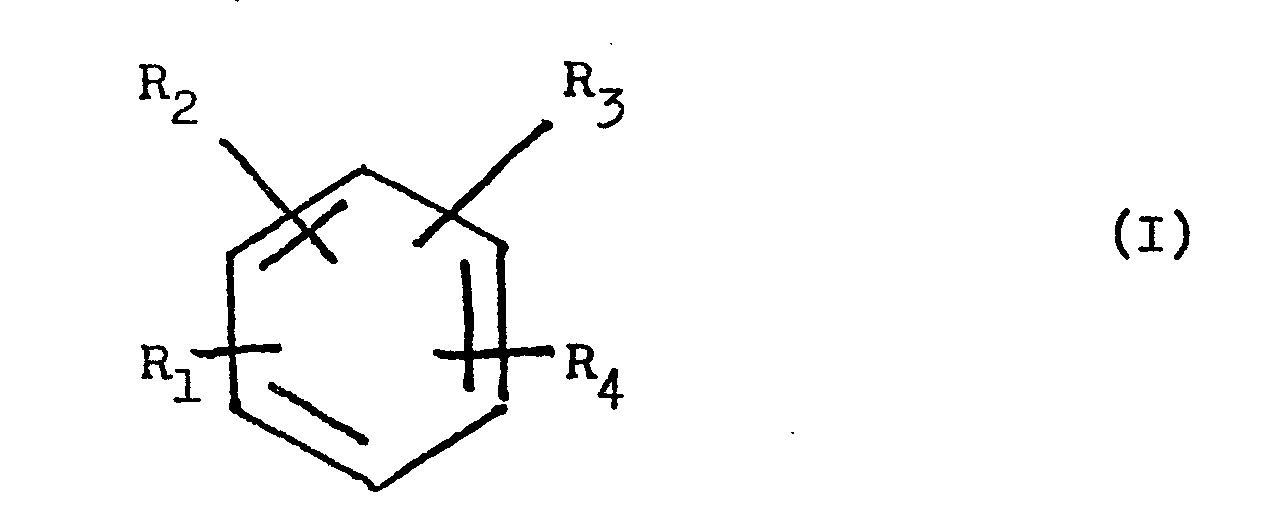
[0002] The present invention provides a method of treating used rubber for the purpose of recycling which comprises forming a mixture comprising at least one compound of the general formula I:
wherein Rl, R2, R3 and R4, which may be the same or different, are selected from the group consisting of methyl, ethyl, n-propyl, iso-propyl, chlorine, bromine and hydrogen and placing said used rubber in said mixture until it becomes brittle. Subsequently the method may include removing said rubber from said mixture and pulverizing same into a powder form.
[0003] The at least one compound of formula I is preferably present in said composition as 40-80% inclusive by weight thereof.
[0004] Said composition may additionally contain one or more aliphatic compounds, preferably of sage form, and preferably of formula II:
where n is an integer of from 4 to 10 inclusive and x is an integer of from -2 to +2 inclusive and including zero.
[0006] The one or more compound of formula II is preferably present as from 1 to 20% inclusive of said composition.
[0007] Particularly preferred are compositions which contain aliphatic (sage) compound, methyl, dimethyl, trimethyl or tetramethyl or benzolia or tetramethyl benzene and normal or iso alkanes or normal or iso alkenes containing from 5 to 10 carbon atoms inclusive. Said composition may include at least one compound of formula III:
wherein R1, R2 and R3, which may be the same or different, are selected from the group consisting of hydrogen, methyl, -CH2Hal or -C2H3.
[0008] Said at least one compound of formula III is preferably present in said composition as from 0-40% by weight thereof.
[0009] Exemplary compositions in accordance with this invention will now be described with reference to the following Examples in which all percentages are by weight:-
Example I
88% alkylbenzol with (e.g. SHELLSOL E .(C7 H8))
6% xylene
3% methylpyrrolidone
3% iso-octane 1,2,3,4, trimethyl pentane
Example II
88% toluene
6% xylene
3% iso-octane 1,2,3,4, trimethylpentane
Example III
88% xylene
1-3% iso-octane
Example IV
100% xylene
[0011] The composition is effective in forming mixtures from which material can be obtained which can be reformed into rubber for further use and without wishing to be limited by any theory we believe that the composition breaks molecular bonds in rubber molecules. In practice, a powder can be obtained which is capable of being processed and re-used as rubber.
[0012] The compositions are effective in treating rubber which might otherwise be thought to be waste. In this respect the compositions have been effective in treating worn out motor car tyres to the extent of even recovering rubber adhering to wire beads and linen casings.
Example V
[0013] A composition was prepared in accordance with this invention, for example that of Example I, and waste tyres were steeped therein. The liquid obtained was withdrawn and linen of the casing and wire of the beads of the tyres were removed. Thereafter the tyre could be ground down to a powder which can be reprocessed as rubber.
[0014] In all the aforementioned Examples the effect was to produce a brittle rubber substance from the original used rubber, which substance could readily be ground or pulverized to provide a powder. The length of time in the composition depended upon the thickness and . type of rubber and it should be noted that after removal from the composition conversion of the rubber substance to powder should be effected within a limited time, otherwise the rubber substance returns to its original untreated state. The time limit for conversion to powder also depends on the thickness and type of rubber as well as on ambient temperature conditions.
[0015] As examples of-compounds of formula (I) there can be mentioned benzene, toluene, o-, m- and p- xylenes, ethylbenzene, cumene, chlorobenzene, o- and R-dichlorobenzenes, bromobenzene, hemimellitene, durene, pseudocumene, mesitylene,and the like, and mixtures of two or more thereof.
[0016] As examples of compounds of formula (II) there can be mentioned n-pentane, iso-octane, n-heptane, n-hexane, 2-methylpentane, 2-methylhexane, 3-ethylpentane, hexene-1, heptene-1, and the like, and mixtures of two or more thereof including light petroleum fractions of suitable boiling point.
[0017] In Examples I, II and III alternative forms of . iso-octane are 2-methylheptane and 2,2,4-trimethylpentane.
[0018] As examples of compounds of formula (III) there can be mentioned N-methylpyrrolidone, 3- and 5-methyl- pyrrolid-2-ones, 1,3,5-trimethylpyrrolid-2-one, N-chloromethylpyrrolidone, 3- and 5-chloromethylpyrrolid-2-ones, N-vinylpyrrolidone, and the like.
1. A method of treating used rubber for the purpose of recycling which comprises forming
a mixture comprising at least one compound of the general formula I:

wherein R1, R2, R3 and R4, which may be the same or different, are selected from the group consisting of methyl, ethyl, n-propyl, iso-propyl, chlorine, bromine and hydrogen and placing said used rubber in said mixture until it becomes brittle.
wherein R1, R2, R3 and R4, which may be the same or different, are selected from the group consisting of methyl, ethyl, n-propyl, iso-propyl, chlorine, bromine and hydrogen and placing said used rubber in said mixture until it becomes brittle.
2. A method as claimed in claim 1, wherein the compound of formula I is present in
said composition as 40-80% by weight.
3. A method as claimed in claim 1 or claim 2, wherein said composition additionally
contains one or more compounds of formula II:

where n is an integer of from 4 to 10 inclusive and x is an integer of from -2 to +2 inclusive and including zero.
where n is an integer of from 4 to 10 inclusive and x is an integer of from -2 to +2 inclusive and including zero.
4. A method as claimed in claim 3, wherein the one or more compound of formula II
is present as 1-20% of said composition.
5. A method as claimed in any preceding claim, wherein said composition additionally
contains at least one compound of formula III:
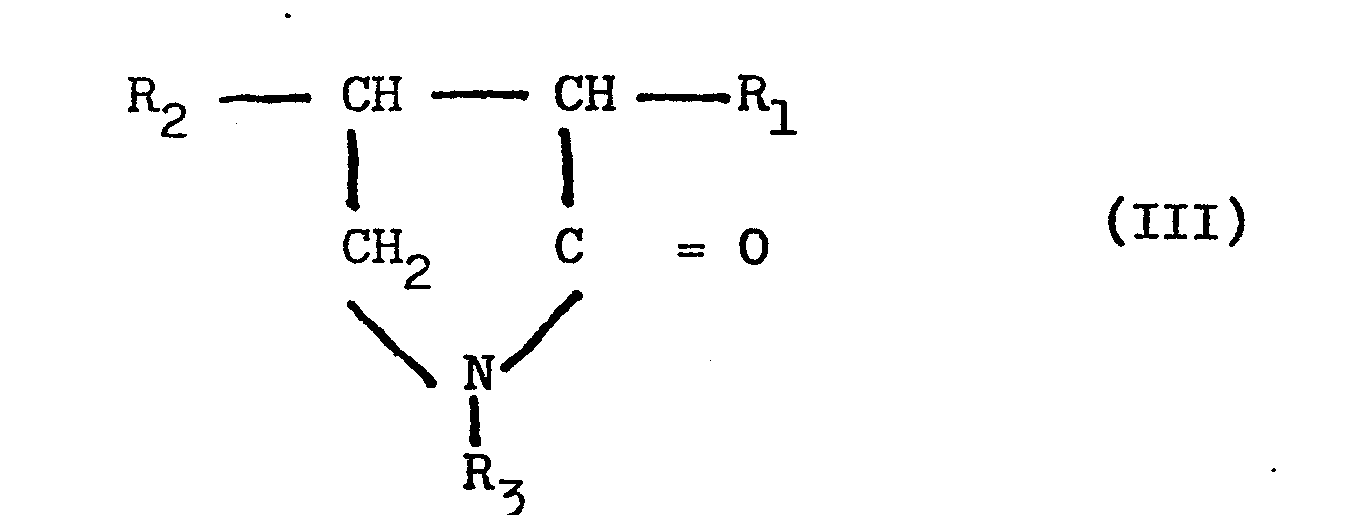
wherein Rl, R2 and R3 which may be the same or different, are selected from the group consisting of hydrogen, methyl, -CH2 Hal or -C2H3.
wherein Rl, R2 and R3 which may be the same or different, are selected from the group consisting of hydrogen, methyl, -CH2 Hal or -C2H3.
6. A method as claimed in claim 5, wherein said at least one compound of formula III
is present in said composition as 0-40% thereof.
7. A method as claimed in any preceding claim, including evaporating said composition
to obtain a rubber derivative capable of being reprocessed as rubber.
8. A composition comprising 40 - 80% of a method of at least one compound of the general
formula I:
wherein R19 R2, R3 and R4, which may be the same or different, are selected from the group consisting of methyl, ethyl, n-propyl, iso-propyl, chlorine, bromine and hydrogen, 1-20% of at least one compound of formula II:

where n is an integer of from 4 to 10 inclusive and x is an integer of from -2 to +2 inclusive and including zero and 0-40% of at least one compound of formula III:
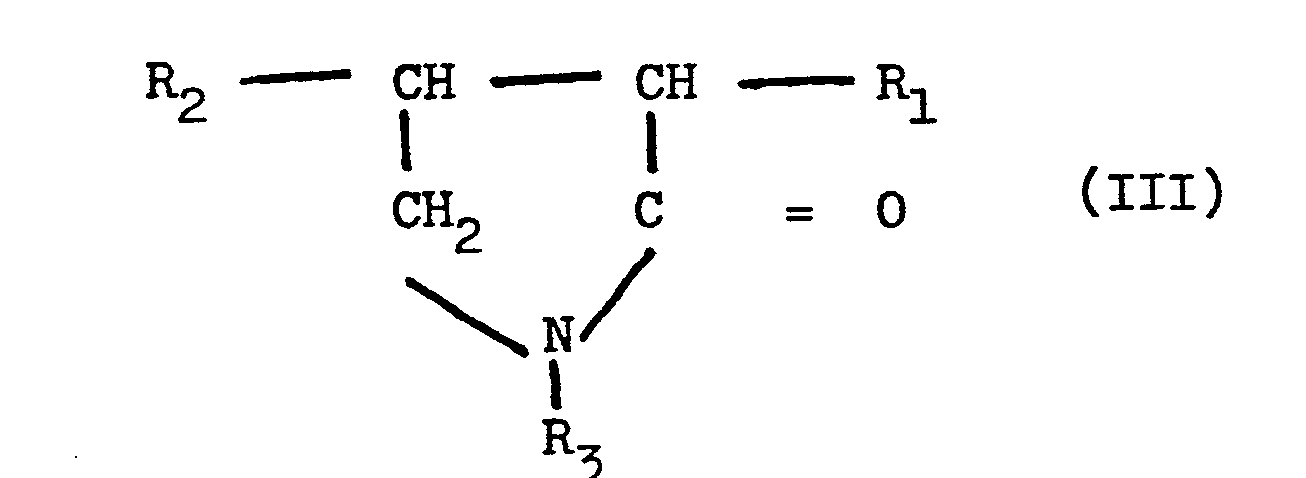
where Rl, R2 and R31 which may be the same or different, are selected from the group consisting of hydrogen, methyl, -CH2 Hal or -C2H3.
wherein R19 R2, R3 and R4, which may be the same or different, are selected from the group consisting of methyl, ethyl, n-propyl, iso-propyl, chlorine, bromine and hydrogen, 1-20% of at least one compound of formula II:
where n is an integer of from 4 to 10 inclusive and x is an integer of from -2 to +2 inclusive and including zero and 0-40% of at least one compound of formula III:
where Rl, R2 and R31 which may be the same or different, are selected from the group consisting of hydrogen, methyl, -CH2 Hal or -C2H3.
9. A method as defined in claim 1 wherein said rubber is removed from said mixture
and pulverized into a powder form.
10. A method of treating rubber substantially as hereinbefore described.
11. A composition substantially as hereinbefore described.