| (19) |
 |
|
(11) |
EP 0 009 032 B1 |
| (12) |
EUROPEAN PATENT SPECIFICATION |
| (45) |
Mention of the grant of the patent: |
|
16.06.1982 Bulletin 1982/24 |
| (22) |
Date of filing: 27.12.1978 |
|
| (51) |
International Patent Classification (IPC)3: B65G 9/00
// A47H15/00, E05D13/02 |
| (86) |
International application number: |
|
PCT/US7800/247 |
| (87) |
International publication number: |
|
WO 7900/662 (06.09.1979 Gazette 1979/18) |
|
| (54) |
Carrier having two wheels inclined towards one another
Gutträger mit zwei zueinander geneigt umgeordneten Laufrollen
Transporteur a deux roues inclinées l'une par rapport a l'autre
|
| (84) |
Designated Contracting States: |
|
CH DE FR GB SE |
| (30) |
Priority: |
27.02.1978 US 881394
|
| (43) |
Date of publication of application: |
|
19.03.1980 Bulletin 1980/06 |
| (71) |
Applicant: TODER, Ellis, I. |
|
Fort Washington, PA 19034 (US) |
|
| (72) |
Inventor: |
|
- TODER, Ellis, I.
Fort Washington, PA 19034 (US)
|
| (74) |
Representative: Warren, Stanley Francis et al |
|
Baron & Warren
18 South End
Kensington
London W8 5BU
London W8 5BU (GB) |
|
| |
|
| Note: Within nine months from the publication of the mention of the grant of the European
patent, any person may give notice to the European Patent Office of opposition to
the European patent
granted. Notice of opposition shall be filed in a written reasoned statement. It shall
not be deemed to
have been filed until the opposition fee has been paid. (Art. 99(1) European Patent
Convention).
|
Technical Field
[0001] This invention relates to carriers of objects suspended from track systems for moving
such objects along the track, and more specifically relates to curtain carriers for
a privacy curtain system such as is used in hospitals and other facilities requiring
privacy cubicles.
Background Art
[0002] Carriers involving more than one wheel are well known. DE-A-2,616,495 discloses a
dual wheel carrier for use in conjunction with a carrier track consisting of a pair
of parallel longitudinally extending spaced apart tracks, said carrier having an axle
support from which extend diverging upwards a pair of axles, and from which depends
means for attaching an item to be carried, and a wheel mounted on each of said axles
for rotation, the lowest points of said wheels being spaced apart so that each wheel
is seatable on an rideable along a different one of the spaced-apart tracks of the
said carrier track, said wheels converging towards one another at their upper edges.
US-A-1,364,592 shows at Figure 3 the use of roller bearings for each of a pair of
wheels running in a track, while FR-A-1,214,606 shows at Figure 3 a wheel having an
aperture of frusto-conical shape with a smaller base at the outer face of the wheel
and the larger base at the inner face of the wheel.
Disclosure of Invention
[0003] The present invention has for its object to improve on the arrangements described
in the above specifications by providing a track and dual wheel carrier combination
in which the carrier can move in a straight line along the direction of pull without
crab walking and in which the possibility of jamming is substantially reduced.
[0004] Accordingly the present invention consists in a dual wheel carrier in combination
with a carrier track consisting of a pair of parallel longitudinally extending spaced
apart horizontal tracks, said carrier comprising an axles support from which extend
divergingly upward a pair of axles, and from which depends means for attaching an
item to be carried, said axles being each inclined at an angle of forty-five degrees
to the horizontal, and a wheel mounted on each of said axles for rotation, the lowest
points of said wheels being spaced apart the proper distance so that each wheel is
seatable on and rideable along a different one of the spaced apart horizontal tracks
of the aforesaid carrier track, said wheels converging toward one another at their
upper edges, and characterised in that each wheel is mounted on its associated axle
at an angle of 45° to the underlying track upon which it is seatable.
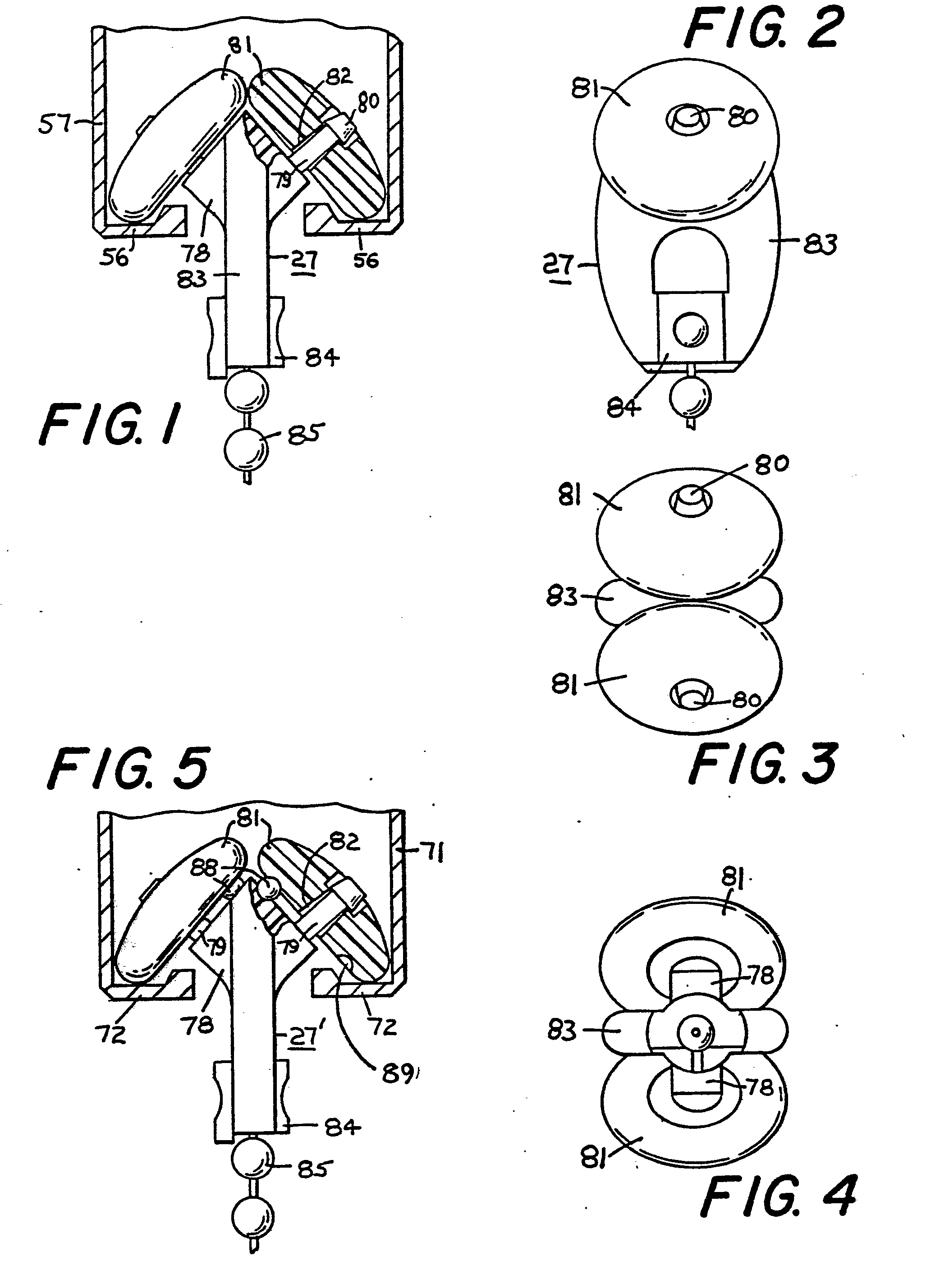
[0005] In order that the invention may be more readily understood, reference will now be
mac to the accompanying drawings, in which:-
Figure 1 is a vertical sectional view through portion of a track section within which
is seate a dual canted wheel curtain carrier according t one embodiment of the invention,
one wheel ( the carrier being also sectioned;
Figures 2, 3 and 4 are respectively side, to and bottom views of the carrier shown
in en elevation and partial section in Figure 1; and
Figure 5 is a view similar to that of Figure 1 but showing a modified form of dual
cante wheel curtain carrier.
[0006] Turning now to Figure 1, there is shown track structure or section comprising a pair
c parallel, longitudinally extending spaced apart horizontal tracks 56 provided with
side wall 57. Supported by and rideable along the track 56 is a carrier which includes
a carrier block 7F from which divergingly upwardly extend in common plane a pair of
axles 79 which latte terminate in a frusto-conical end formation 8( having the larger
conical base closest to the carrier block 78 and of larger diameter than the axles
79. The axles 79 are orthogonal to each other and oriented forty-five degrees to the
horizontal and vertical directions. Wheels 81 are mounted on the axles 79 with the
axle receiving bores 82 being of frustoconical cross- section with the opening closest
to the carriei block 78 being of larger cross-sectional area than the axles 79 and
converging to the size ol the axle just inward of the frusto-conical axle end formations
80.
[0007] The wheels 81 are forced onto the axles 79 by pressing them inward past the end formations
80, which latter then restrain the wheels 81 from moving outward on the axles 79.
The thickness of the wheels 81 is such that when mounted upon the shaft 79 there is
a clearance between the carrier block 78 and the inner surface of the wheel 81. Additionally,
the wheels 81 engage one another in the region of their uppermost points or edges
so that as one wheel rotates in a given direction its frictional engagement with the
other wheel drives the other wheel in the same direction. Accordingly, each of the
wheels drives the other which prevents twisting or cocking of the carrier 27 within
the track.
[0008] The outer surfaces of the lowermost points of the wheels 81 are spaced slightly away
from the inside surfaces of the track walls 57, and the inside surfaces of the wheels
81 do not engage the inner edges of the tracks 56. As a consequence of this construction,
the wheels 81 ride on the horizontal surfaces of the track 56 with freedom to move
slightly laterally, and therefore never laterally bind within the track structure.
Depending from the carrier block 78 is a stem 83 which terminates at its lower end
in a chain holder 84 within which is replaceably secured a support chain 85. Figures
2, 3 and 4 are respectively side, top and bottom views of the carrier shown in partial
section in Figure 1.
[0009] A slightly modified carrier 27' is illustrated in Figure 5, the parts being identical
to those of carrier 27 except for two differences. In the showing of Figure 5, the
upper bearing for the carrier wheels 81 is not provided by having the wheels engage
one another, but is provided by having the inside surface of each wheel bear against
a ball-bearing 88 seated in a socket formed in the carrier block 78 proximate to its
upper edge. The ball bearings 88 engage the inside surfaces of the wheels 81 and ride
within a circular groove 89 formed on the wheel inside surfaces. In both cases, the
double bearing supports for the wheels 81 provide a mechanically strong and stable
structure.
[0010] While the axles 79 are shown in Figures 1 and 5 as being orthogonat to one another,
it is not absolutely mandatory that the angle between the axles be precisely ninety
degrees. Other angles could be used if desired. However, significantly smaller angles
increase the bearings loads and widen the track with no apparent offsetting benefit,
while significantly larger angles can increase the required track height and decrease
the upper bearings loads which in extreme cases could cause the wheels in the embodiment
of Figure 1 to slip relatively to one another.
1. A dual wheel carrier in combination with a carrier track consisting of a pair of
parallel longitudinally extending spaced apart horizontal tracks (56), said carrier
comprising an axles support (78) from which extend divergingly upward a pair of axles
(79), and from which depends means for attaching an item to be carried, said axles
being each inclined at an angle of forty-five degrees to the horizontal, and a wheel
(81) mounted on each of said axles for rotation, the lowest points of said wheels
being spaced apart the proper distance so that each wheel (81) is seatable-,on and
rideable along a different one of the spaced apart horizontal tracks (56) of the aforesaid
carrier track, said wheels converging toward one another at their upper edges, and
characterised in that each wheel (81) is mounted on its associated axle at an angle
of 45° to the underlying track upon which it is seatable.
2. A combination as claimed in claim 1, further including a rolling bearing for each
said wheel (81), said bearings being positioned at locations closer to each other
than are the locations of the bearings of the wheels on the axles and than are the
contacts of the wheels with the underlying tracks.
3. A combination as claimed in claim 2, wherein said wheels (81) are of such diameter
that, when mounted on said axles (79), they converge into engagement with one another
in the region of their uppermost points, said engagement constituting said rolling
bearing.
4. A combination as claimed in claim 2, wherein said rolling bearing comprises a ball
bearing (88) journalled in said axles support and engaged with the wheel face closest
to said axles support.
5. A combination as claimed in claim 4, wherein said wheel face is circularly annularly
grooved (89) to receive therein a portion of said ball bearing surface.
6. A combination as claimed in any preceding claim, wherein said axles (79) are non-
rotatably fixed to said axles support (78) and said wheels (81) are centrally apertured
to receive said axles (79) therethrough, said central wheel apertures (82) being of
frusto- conical shape with the smaller base being of substantially the same diameter
as said axle and located proximate to the outer face of the wheel farthest from the
axles support while said wheel aperture larger base is larger than the axle diameter
and located at the wheel face closest to the axles support.
7. A combination as claimed in any preceding claim, wherein each said axle (79) is
provided on its outer end with a resiliently deformable wheel retainer formation of
larger diameter than the axle, and each said wheel (81) is forced onto said axle (79)
until said wheel retainer passes the outer end of the axle- receiving central aperture
in the wheel.
8. A combination as claimed in any preceding claim, wherein said axles (79) are coplanar.
1. Double porte-galets en combinaison avec une voie portante ayant une paire de paliers
(56) horizontaux et parallèles s'étendant espacés longitudinalement, le dit porte-galets
comprenant un porte-pivots (78), une paire de pivots (79) s'étendant vers le haut
en divergence du dit porte-pivots duquel pendent des moyens pour attacher un élément
à porter, chacun des dits pivots étant incliné à une pente de quarantecinq degrés
de la horizontale, et un galet (81) étant monté à rotation sur chacun des dits pivots,
les points les plus bas des bits pivots étant séparés d'une distance propre pour que
chaque galet (81) pourra être porté et entrainé sur et le long d'un différent palier
des paliers (56) horizontaux et espacés de la susdite voie portante, les dits galets
convergeant l'un vers l'autre à leurs bords supérieurs, et caractérisé par le fait
que chaque galet (81) est monté sur son pivot respectif à une inclinaison de 45° par
rapport au palier sousjacent sur lequel il peut être posé.
2. Combinaison suivant revendication 1, comprenant encore un palier à roulement pour
chaque galet (81) lesdits paliers étant placés aux endroits plus proches l'un de l'autre
que les endroits des coussinets des galets sur les pivots et que les points de contact
des galets sur les paliers sousjacents.
3. Combinaison suivant revendication 2, dans laquelle lesdits galets (81) ont un diamètre
tel que lorsque ils sont montés sur lesdits pivots (79) ils vont convergeant jusqu'à
venir en contact mutuel dans la région de leurs points les plus hauts, le dit contact
constituant le dit palier à roulement.
4. Combinaison suivant revendication 2, dans laquelle ledit palier à roulement comprend
un roulement comprend un roulement à billes (88) tourillonné dans le dit porte-pivots
et en prise avec les côtés des galets les plus proches dudit porte-pivots.
5. Combinaison suivant revendication 4, dans laquelle ledit côté des galets est rainuré
(89) annulairement en cercle pour y recevoir une partie de la surface de la dite bille
de roulement.
6. Combinaison selon l'une quelconque des revendications précédentes, dans laquelle
les dits pivots (79) sont attachés à demeure audit porte-pivots (78) et les dits galets
(81) sont perforés centralement pour recevoir lesdits pivots (79) à travers les dits
perforations, les dites perforations centrales (82) des galets étant de form frustoconique
dont la base la plus petite a essentiellement le même diamètre que ledit pivot, et
située près de la face extérieure du galet la plus lointaine du porte-pivots, la plus
grande base de la dite perforation de galet étant plus grande que le diamètre du pivot
et étant située au côté du galet le plus proche du porte-pivots.
7. Combinaison selon l'une quelconque des revendications précédentes, dans laquelle
chacun des dits pivots (79) est pourvu à son extrémitée externe avec un moyen déformable
élastiquement pour retenir un galet et ayant un diamètre plus grande que celui du
pivot, chacun des dits galets (81) étant forcé sur un dit pivot (79) jusqu'à ce que
le dit moyen de retenue d'un galet dépasse par l'extrémité extérieure de la perforation
centrale dans le galet recevant le pivot.
8. Combinaison selon l'une quelconque des revendications précédentes, dans laquelle
les dits pivots (79) sont coplanaires.
1. Doppelrad-Läufer in Kombination mit einer Trag-Schiene aus zwei parallelen, sich
in Längsrichtung erstreckenden, voneinander beanstandeten, horizontalen Schienen (56),
welcher einen Achsen-Träger (78) umfaßt, von dem eine der Befestigungseinrichtung
für einen zu tragenden Gegenstand herabhängt und von dem zwei Achsen (79) divergierend
nach oben wegstehen, welche unter einem Winkel von 45 Grad gegenüber der Horizontalen
geneigt sind und auf welchen jeweils ein Rad (81) drehbar gelagert ist, wobei die
untersten Punkte der Räder einen gegenseitigen geeigneten Abstand derart haben, daß
jedes Rad (81) auf eine unterschiedliche horizontale Schiene (56) aufsetzbar und längs
dieser abrollbar ist, und wobei sich die Räder an ihren Oberkanten einander annähern,
dadurch gekennzeichnet, daß jedes Rad (81) auf seiner zugeordneten Achse unter einem
Winkel von 45 Grad gegenüber der darunter liegenden Schiene, auf welche es aufsetzbar
ist, gelagert ist.
2. Kombination nach Anspruch 1, bei welcher für jedes Rad (81) ein Rollager vorgesehen
ist und die Rollager an Stellen angeordnet sind, die einander näher liegen als die
Stellen der Lager der Räder auf den Achsen und als die Berührungspunkte der Räder
mit den darunter liegenden Schienen.
3. Kombination nach Anspruch 2, bei welcher die Räder (81) einen solchen Durchmesser
haben, daß sie, sich auf ihren Achsen (79) befindend, einander bis zur gegenseitigen
Berührung im Bereich ihrer obersten Punkte angenähert sind, wobei die Berührung das
Rollager bildet.
4. Kombination nach Anspruch 2, bei welcher das Rollager ein Kugellager (88) umfaßt,
das in dem Achsen-Träger aufgenommen ist und mit der Radseite zusammenwirkt, die dem
Achsen-Träger am nächsten ist.
5. Kombination nach Anspruch 4, bei welcher die Radseite eine kreisförmige Ringnut
(89) zur Aufnahme eines Teils der Kugellager-Oberfläche aufweist.
6. Kombination nach einem der vorhergehenden Ansprüche, bei welcher die Achsen (79)
am Achsen-Träger (78) nicht-drehbar befestigt sind und die Räder (81) eine zentrale
Öffnung zur Aufnahme der Achsen (79) aufweisen, wobei die zentralen Rad-Öffnungen
(82) eine kegelstumpfförmige Gestalt haben, bei welcher das schmalere Ende im wesentlichen
den gleichen Durchmesser wie die Achse hat und sich an der vom Achsen-Träger am weitesten
entfernten Aussenseite des Rades befindet, während das größere Ende der Rad- Öffnung
großer als der Achsendurchmesser ist und sich an der Radseite befindet, die dem Achsen-Träger
am nächsten ist.
7. Kombination nach einem der vorhergehenden Ansprüche, bei welcher jede Achse (79)
am äußeren Ende mit einem elastisch verformbaren, zum Festhalten des Rades dienenden
Formstück versehen ist, dessen Durchmesser größer als der der Achse ist, wobei jedes
Rad (81) auf die Achse (79) gedrückt wird, bis das Formstück durch das äußere Ende
der zentralen, die Achse aufnehmenden Öffnung im Rad hindurchgetreten ist.
8. Kombination nach einem der vorhergehenden Ansprüche, bei weicher die Achsen (79)
koplanar sind.