|
(11) | EP 0 009 338 A1 |

| (12) | EUROPEAN PATENT APPLICATION |
|
|
|
|
|||||||||||||||||||||||||||
| (54) | Glass composition |
| (57) A subcutaneous glass implant for supplying one or more trace elements to an animal.
The implant is made e.g. from a zinc oxide based glass which is prepared in rod form,
a short section of the rod being implanted under the skin of an animal. Typically
the glass may contain selenium dioxide for supplying small quantities of selenium
to the animal. |
[0001] This invention relates to glass composition and in particular to water soluble glasses for the supply of trace elements to animals.
[0002] One of the problems involved in the husbandry of domesticated animals, e.g. cattle and sheep, is the provision of an adequate supply of trace elements. For example it has been found that, for the healthy growth of such animals, it is necessary that they ingest between 1 and 5 parts per million of selenium based on body weight. In some pastures such a level of selenium occurs naturally but in other areas, e.g. in areas of high rainfall, the natural selenium level is insufficient and must therefore be supplemented either in the form of medication or as an additive to the animal foodstuff. In practice however, because the required quantities of trace e'lements are so small, it is difficult to achieve the required dosage rate. Furthermore at levels above the required dose trace elements are in general dangerous poisons.
[0004] According to one aspect of the invention there is provided a subcutaneous implant for supplying one or more trace elements to the bloodstream or body fluid of an animal, characterised in that the implant comprises a partially or wholly water soluble glass body, and that said body incorporates the one or more trace elements in oxide form.
[0005] According to another aspect of the invention there is provided a water soluble glass composition adapted to release selenium into aqueous solution, characterised in that the composition comprises a fused mixture of 40 to 60 mol % selenium dioxide (Se02) and 60 to 35 mol % zinc oxide (ZnO) metal or non metal oxides.
[0006] According to a further aspect of the invention there is provided a subcutaneous implant for an animal and adapted to supply one or more trace elements into the bloodstream of the animal, characterised in that the implant comprises a body of a glass material at least the major proportion which includes one or more oxides of said one or more trace elements together with zinc oxide.
[0007] A glass employed as a subcutaneous implant for an animal must be non-toxic, non-irritant and must dissolve at a suitable rate so as to supply an adequate level of one or more trace elements into the body fluids of an animal in which the glass is implanted. We have found that glasses based on zinc oxide, which acts as a glass modifying oxide, may be used for this purpose.
[0008] The term "glass modifying oxide" is understood to mean an oxide which, whilst it does not of itself form a glass, is capable of forming glass compositions in conjunction with others, generally oxide, glass forming materials. In the glass compositions described herein the trace element or elements may be present in the form of glass forming oxides or as additives together with one or more biologically inert or active glass forming oxides. The components of the glass composition are fused and thoroughly mixed and the melt is then cast e.g. into a rod. A portion of such a glass rod may then be inserted beneath the skin of an animal where the glass constituents slowly dissolve into the animals bloodstream.
[0009] In particular, glass compositions suitable for supplying controlled quantities of selenium e.g. to an animal, may be prepared from selenium dioxide (Se02) and zinc oxide (Zn0) as the major constituents together with oxides of other metals or non metals as minor constituents. These latter minor constituents may be employed to determine the water solubility, and hence the selenium release rate, of the glass composition. The technique of solubility adjustment is more fully described in our published specification No. 1,512,637 (C.F. Drake - 49). It has been found in general that the upper limit for the molecular percentage of selenium dioxide in such glass composition is 60 mol % above which the glass composition devitrifies. Also, at selenium concentrations below 40 mol % the glass is hygroscopic and thus unsuitable for controlled selenium release. Small quantities of metal oxides, e.g. alkali metal oxides, may be incorporated in the glass composition to adjust the softening point, ensure freedom from devitrification, and to control the rate of solution. Thus, for example, for glasses of the molar composition xM2O : (50-x) ZnO : 50 SeO2 where M20 is an alkali metal oxide or a mixture of alkali metal oxides, those glasses wherein x < 5 are effectively insoluble whilst those wherein x > 18 disintegrate rapidly in water. Therefore, to obtain a useful composition, x should lie within the range 5 to 18.
[0010] The glass is prepared by mixing the constituent oxides, i.e. zinc oxide, selenium oxide and optionally other metal and/or non metal oxides, in dry powder form. The mixture is fused into a homogeneous material at a temperature of 500° to 700° for 10 Min. to 1 hr. in an air atmosphere. Conveniently the glass may be fused in a platinum crucible. The melt may then be cast and cooled. Advantageously the glass composition is formed as a small smooth body, e.g. by drawing into a rod which is then subdivided into short lengths, which may be implanted beneath the skin of an animal so as to release selenium directly into the animal's body fluids.
[0011] It will be clear to those skilled in the art that the carbonate, hydroxide, nitrate etc. of one or more constituent metals may be used in place of the metal oxide as those components decompose to form the respective oxide during the fusion process.
Example 1
[0013] 0.67 g anhydrous sodium carbonate, 1.28 g potassium nitrate, 5.6 g selenium dioxide and 4.0 g basic zinc carbonate were fused for 15 Mins. in a platinum crucible at a temperature of 600°C and in an air atmosphere. The total weight loss on fusion was 2.38 g, this loss being attributed to the evolution of C02, N021 02, H20 and some Se02. The final composition of the clear yellow glass was:-
[0014] A 3 mm rod drawn from this melt was immersed in new-born calf serum at a temperature of 38°C and was found to dissolve at a rate of 0.53 mg/day.
Example 2
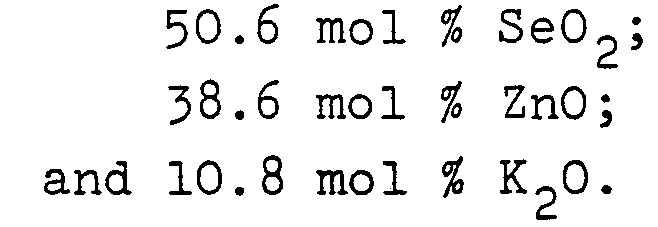
[0015] A glass composition was prepared containing 50.6 mol % selenium dioxide; 38.6 mol % zinc oxide and 10.8 mol % potassium oxide (K20).
[0016] The glass was cast, allowed to cool and was then crushed. A weighed portion of the glass was immersed in new-born calf serum at a temperature of 38°C. The dissolution rate of the glass under these conditions was found to be 25 µg/cm2/hr.
[0017] The glass compositions and the techniques described herein are particularly applicable to the treatment of mineral deficiency of sheep, cattle or other animals in regions of mineral deficient soils. Such mineral deficient regions are far more extensive than is generally realised, the deficiency often being accentuated in areas of high rainfall. The glass implant technique provides a simple and very effective method of overcoming such deficiencies without the risk of excessive or insufficient dosing of the animals.
1. A subcutaneous implant for supplying one or more trace elements to the bloodstream
or body fluid of an animal, characterised in that the implant comprises partially
or wholly water soluble glass body, and that said body incorporates the one or more
trace elements in oxide form.
2. A water soluble glass composition adapted to release selenium into aqueous solution,
characterised in that the composition comprises a fused mixture of 40 to 60 mol %
selenium dioxide (Se02) and 60 to 35 mol % zinc oxide (Zn0), the balance if any comprising one or more metal
or non metal oxides.
3. A glass composition as claimed in claim 2, characterised in that said metal oxides
comprise one or more alkali metal oxides.
4. A glass composition as claimed in claim 3, characterised in that the molar concentration
of such alkali metal oxides is not greater than 13.1 %.
5. A water soluble glass composition adapted to release selenium into aqueous solution
and having the molar composition xM20 : (50-x) ZnO : 50 Se02, wherein M20 is an alkali metal oxide or a mixture of alkali metal oxides, and wherein 18 > x
> 5.
6. A water soluble glass composition comprising:-

7. A water soluble glass composition comprising:-
8. A water soluble glass composition substantially as described herein with reference
to the Examples.
9. A subcutaneous implant for an animal and comprising a glass composition as claimed
in any one of the preceding claims.
10. A subcutaneous implant for an animal and adapted to supply one or more trace elements
into the bloodstream of the animal, characterised in that the implant comprises a
body of a glass material at least the major proportion of which includes one or more
oxides of said one or more trace elements together with zinc oxide.
11. A subcutaneous implant as claimed in claim 10, characterised in that said one
or more trace elements includes selenium.
12. A subcutaneous animal implant substantially as described herein with reference
to the Examples.