|
(11) | EP 0 009 839 B2 |

| (12) | NEW EUROPEAN PATENT SPECIFICATION |
|
|
| (54) |
Alkaline aqueous hydrogen peroxide solutions stabilised against decomposition Alkalische-wässrige Wasserstoffperoxidlösungen, die gegen Zersetzung stabilisiert sind Solutions aqueuses alcalines de peroxyde d'hydrogène stabilisées contre la décomposition |
|
|
|||||||||||||||||||||||||||||||
[0001] This invention relates to the stabilisation of aqueous hydrogen peroxide solutions under alkaline conditions. The invention also relates to the preparation of storage-stable alkaline hydrogen peroxide solutions which can be used as a base for liquid bleach products.
[0002] Hydrogen peroxide decomposes to water and oxygen and cannot be kept for long unless it is properly stabilised.
[0003] Decomposition of hydrogen peroxide occurs mainly in a catalysed reaction, of which the active catalysts are trace amounts of indigenous transition metal ions, such as copper, iron, cobalt and manganese ions, and as such can in principle be reduced by adding suitable metal complexing agents. Indeed many stabilisers for hydrogen peroxide known in the art are complexing agents and just as many stabilisers have been suggested and used for solving, at least partially, the decomposition problem of hydrogen peroxide solutions.
[0004] While the stabilisation of hydrogen peroxide is relatively easy in acid solution, i.e. at pH «7, where the concentration of reactive H02- ions - the active form of hydrogen peroxide - is minimal, it has heretofore been considered as practically impossible to achieve a satisfactory stabilisation of hydrogen peroxide under alkaline conditions. The term "alkaline" as used here is meant to indicate alkaline pH values of between 8 and 14.
[0005] Indeed many complexing agents developed heretofore as stabilisers for use with hydrogen peroxide solutions and which give satisfactory stabilisation of hydrogen peroxide under acid conditions, are poor stabilisers and hence unsuitable when used with hydrogen peroxide under alkaline conditions, particularly at pH above 8.
[0006] For this reason hydrogen peroxide is presented commercially as product concentrates having a pH lying generally within the range of 2-5, mostly between 2 and 3. Acid hydrogen peroxide is, however, unsuitable for use as a bleach due to the low concentration of H02 ions, the active form of hydrogen peroxide. For effective bleaching an alkaline pH is a necessary requirement, the higher the pH the higher the HOz* ion-concentration to provide for more effective bleaching. The selection of pH used will generally depend upon the substrate which is to be bleached. For textile bleaching a suitable pH is within the range of 8-12.5, preferably between 9 and 11.5, as higher pH's will tend to cause excessive fabric damage.
[0007] When said commercial acid hydrogen peroxide solution is made alkaline, e.g. with sodium hydroxide, to a suitable bleaching pH with or without dilution with water to any desired concentration, it becomes unstable and cannot be stored without quickly losing its activity.
[0008] Stabilisers which have been suggested for use with hydrogen peroxide solutions include dipicolinic acid (DPA) as described in US Patent Specification 2,624,655; ethylenediamine tetra acetic acid compounds (EDTA) as described in British Patent Specification 1,285,151; amino tri-(lower alkylidene phosphonic acid) compounds, e.g. sodium nitrilo tri-(methylene phosphonate) as described in British Patent Specification 1,119,221; alkylidene-diphosphonic acid derivatives, e.g. ethane-1-hydroxy-1,1-diphosphonate (EHDP) as described in British Patent Specification 925,373; and ethylenediamine tetra methylene phosphonic acid) as described in US Patent Specification 3,701,825.
[0009] Most of these known stabilisers, though having some ability to inhibit decomposition of hydrogen peroxide under acid conditions, are however poor stabilisers for alkaline hydrogen peroxide solutions, and are therefore less suitable or even unsuitable for producing satisfactory storage-stable alkaline hydrogen peroxide solutions.
[0010] It is therefore an object of the invention to improve the stability of hydrogen peroxide solutions, under alkaline conditions.
[0011] It is another object of the invention to provide a stabiliser for hydrogen peroxide which is much better than the hitherto known stabilisers for use with alkaline hydrogen peroxide solutions.
[0012] Still another object of the invention is to provide alkaline hydrogen peroxide solutions which are sufficiently stable on storage to achieve an acceptable shelf-life.
[0013] It has now been found that these and other objects which will be apparent hereinafter can be achieved if the hydrogen peroxide solution includes a stabilising phosphonate compound of the following general formula:
wherein n = 1-2; and X = H or a water-soluble cation. The various X groups may be the same or different. Typical examples of useful cations are alkali metals, and alkaline earth metals, such as calcium and magnesium.
[0014] The invention therefore provides an alkaline aqueous hydrogen peroxide solution free of ammonia and monoethanolamine of a concentration of 5-20% by weight and having a pH of 8-14, characterized in that it contains a phosphonate compound of the following general formula:
wherein n = 1-2; and X is H or a water-soluble cation, selected from the group consisting of alkali metals, and alkaline earth metals in an amount of from 0.1 to 10% by weight (calculated as acid), of the hydrogen peroxide in solution.
[0016] The preferred amount of the stabilising phosphonate compound depends upon the pH of the hydrogen peroxide solution and the anticipated amount of impurities that may enter the hydrogen peroxide solution to be stabilised.
[0017] The amount of stabilising phosphonate compound used will be from 0.1-10% by weight, more preferably from 0.2-5.0% by weight for stabilising the alkaline hydrogen peroxide solution, the percentages being of the weight of the hydrogen peroxide in the aqueous hydrogen peroxide solution.
[0018] The maximum amount of the stabilising phosphonate compound that can be present in the hydrogen peroxide solution is limited only by practical and economic considerations in that concentrations beyond the above upper levels, although functional, impart little or no advantage over lower percentages. Higher levels of the stabilising compound would also tend to give a reduced bleaching due to interaction between the bleaching species and the stabilising compound.
[0019] A preferred pratice of the invention is to stabilise hydrogen peroxide solutions having a concentration of from 5 to 20% by weight and alkalinity of from pH 8 to pH 12.5. The further preferred concentration of the stabilised hydrogen peroxide solution is from 5-1a% by weight, the preferred pH of the stabilised hydrogen peroxide is between 9 and 11.5.
Examples
[0020] Stability studies were carried out on 5% w/v H202 solutions at pH of around 10 and a temperature of 40°C. At the 5% level the H202 has a similar oxidising capacity to (a) 10% NaOCI used in liquid chlorine bleach, or (b) 25% sodium perborate used in fabric washing powders. The comparatively high temperature of 40°C was chosen deliberately to accelerate the test. The 5% w/v H202 test solution was made by diluting a 28% w/v H202 solution sample (ex Hopkins and Williams) with deionised water. As received the 28% w/v H202-solution had a pH -2 and for test purposes this was raised to about 10 with NaOH. The residual H202 in the test solution was monitored periodically during storage at 40°C using the iodine/thiosulphate method. From the plot of % residual H202 vs. time the half decomposition time of the solution was found. The experiments were carried out with two members of the stabilising phosphonate compound of formula 1 within the invention (Runs 19 and 20) and compared with a variety of other known stabilisers and metal ion complexing agents (Runs 2-18), added in most cases at a level of 0.03% by weight of the solution.
1. Alkaline aqueous hydrogen peroxide solution free of ammonia and monoethanolamine
of a concentration of 5-20% by weight and having a pH of 8-14, characterized in that
it contains a phosphonate compound of the following formula:
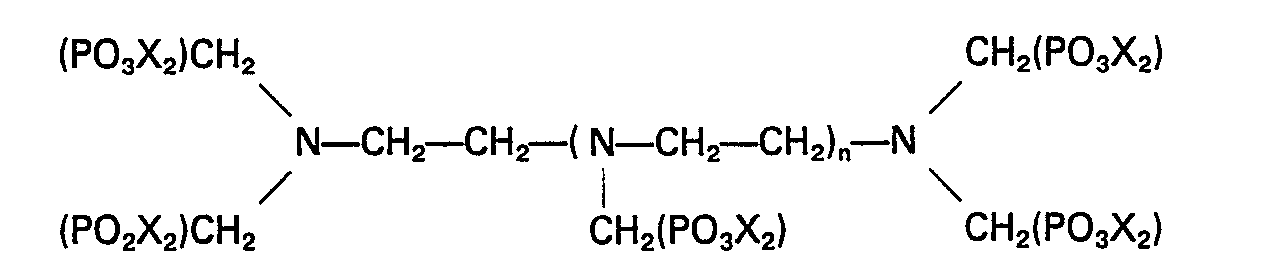
wherein n = 1-2; and X is H or a water-soluble cation, selected from the group consisting of alkalimetals, and alkaline earth metals, in an amount of from 0.1 to 10% by weight (calculated as acid), of the hydrogen peroxide in the solution.
wherein n = 1-2; and X is H or a water-soluble cation, selected from the group consisting of alkalimetals, and alkaline earth metals, in an amount of from 0.1 to 10% by weight (calculated as acid), of the hydrogen peroxide in the solution.
2. Alkaline hydrogen peroxide solution according to claim 1, characterized in that
the amount of phosphonate compound is between 0.2 and 5% by weight of the hydrogen
peroxide in the solution.
3. Alkaline hydrogen peroxide solution according to claim 1 or 2, characterized in
that the pH is from 8 to 12.5.
4. Alkaline hydrogen peroxide solution according to claim 3, characterized in that
the hydrogen peroxide concentration is from 5 to 10% by weight and the pH is between
9 and 11.5.
1. Alkalische wäßrige Wasserstoffperoxidlösung frei von Ammoniak und Monoethanolamin
mit einer Konzentration von 5-20 Gew.-% und einem pH-Wert von 8-14, dadurch gekennzeichnet,
daß sie eine Phosphonatverbindung der folgenden Formel
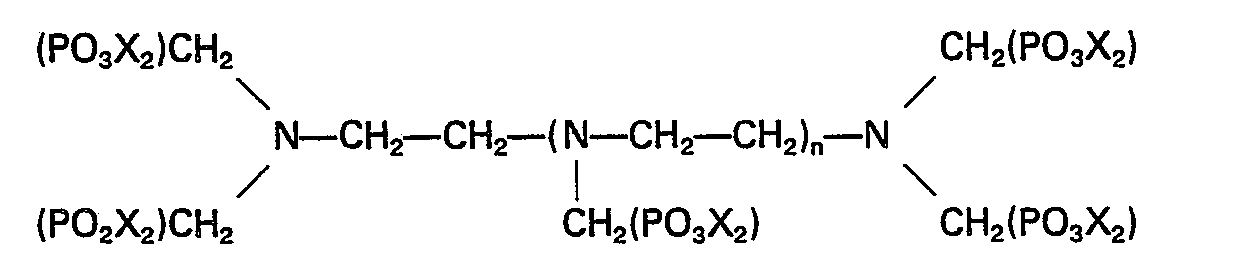
enthält, worin n = 1-2 und X = H oder ein wasserlösliches Kation ausgewählt aus der Gruppe bestehend aus Alkalimetallen und Erdalkalimetallen bedeuten, in einer Menge von 0,1 bis 10 Gew.-% (berechnet als Säure) des Wasserstoffperoxids in der Lösung.
enthält, worin n = 1-2 und X = H oder ein wasserlösliches Kation ausgewählt aus der Gruppe bestehend aus Alkalimetallen und Erdalkalimetallen bedeuten, in einer Menge von 0,1 bis 10 Gew.-% (berechnet als Säure) des Wasserstoffperoxids in der Lösung.
2. Alkalische Wasserstoffperoxidlösung gemäß Anspruch 1, dadurch gekennzeichnet, daß
die Menge der Phosphonatverbindung 0,2 bis 5 Gew.-% des Wasserstoffperoxids in der
Lösung beträgt.
3. Alkalische Wasserstoffperoxidlösung gemäß Anspruch 1 oder 2, dadurch gekennzeichnet,
daß der pH-Wert 8 bis 12,5 beträgt.
4. Alkalische Wasserstoffperoxidlösung gemäß Anspruch 3, dadurch gekennzeichnet, daß
die Wasserstoffperoxidkonzentration 5 bis 10 Gew.-% beträgt und der pH-Wert zwischen
9 und 11,5 liegt.
1. Solution aqueuse alcaline de peroxyde d'hydrogène exempte d'ammoniac et de monoéthanolamine
d'une concentration comprise entre 5 et 20% en poids et ayant un pH compris entre
5 et 14, caractérisée en ce que la solution contient un phosphonate de la formule
générale:
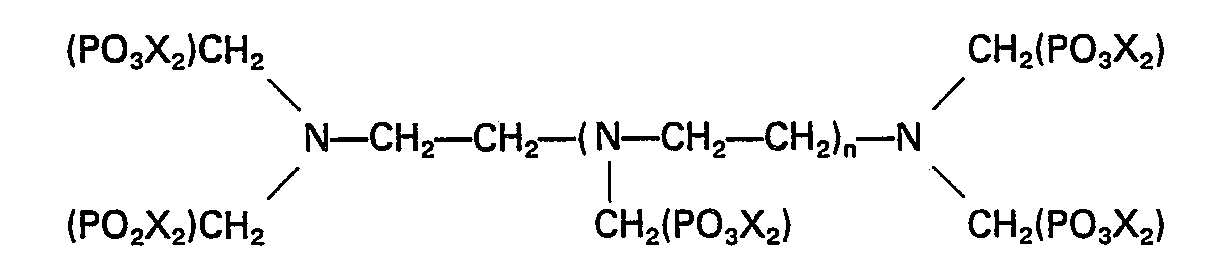
dans laquelle n est un nombre de 1 à 2 et X est H ou un cation soluble dans l'eau, choisi parmi ceux de métaux alcalins, et de métaux alcalino-terreux, selon une quantité comprise entre 0,1 et 10% en poids (calculé en tant qu'acide) par rapport au peroxyde d'hydrogène dans la solution.
dans laquelle n est un nombre de 1 à 2 et X est H ou un cation soluble dans l'eau, choisi parmi ceux de métaux alcalins, et de métaux alcalino-terreux, selon une quantité comprise entre 0,1 et 10% en poids (calculé en tant qu'acide) par rapport au peroxyde d'hydrogène dans la solution.
2. Solution aqueuse alcaline de peroxyde d'hydrogène selon la revendication 1, caractérisée
en ce que la quantité de phosphonate est comprise entre 0,2 et 5% en poids par rapport
au peroxyde d'hydrogène dans la solution.
3. Solution aqueuse de peroxyde d'hydrogène selon l'une des revendications 1 et 2,
caractérisée en ce que le pH est compris entre 8 et 12,5.
4. Solution aqueuse de peroxyde d'hydrogène selon la revendication 3, caractérisée
en ce que la teneur en H202 est comprise entre 5 et 10% en poids et le pH est compris entre 9 et 11,5.