| (19) |
 |
|
(11) |
EP 0 010 290 B1 |
| (12) |
EUROPEAN PATENT SPECIFICATION |
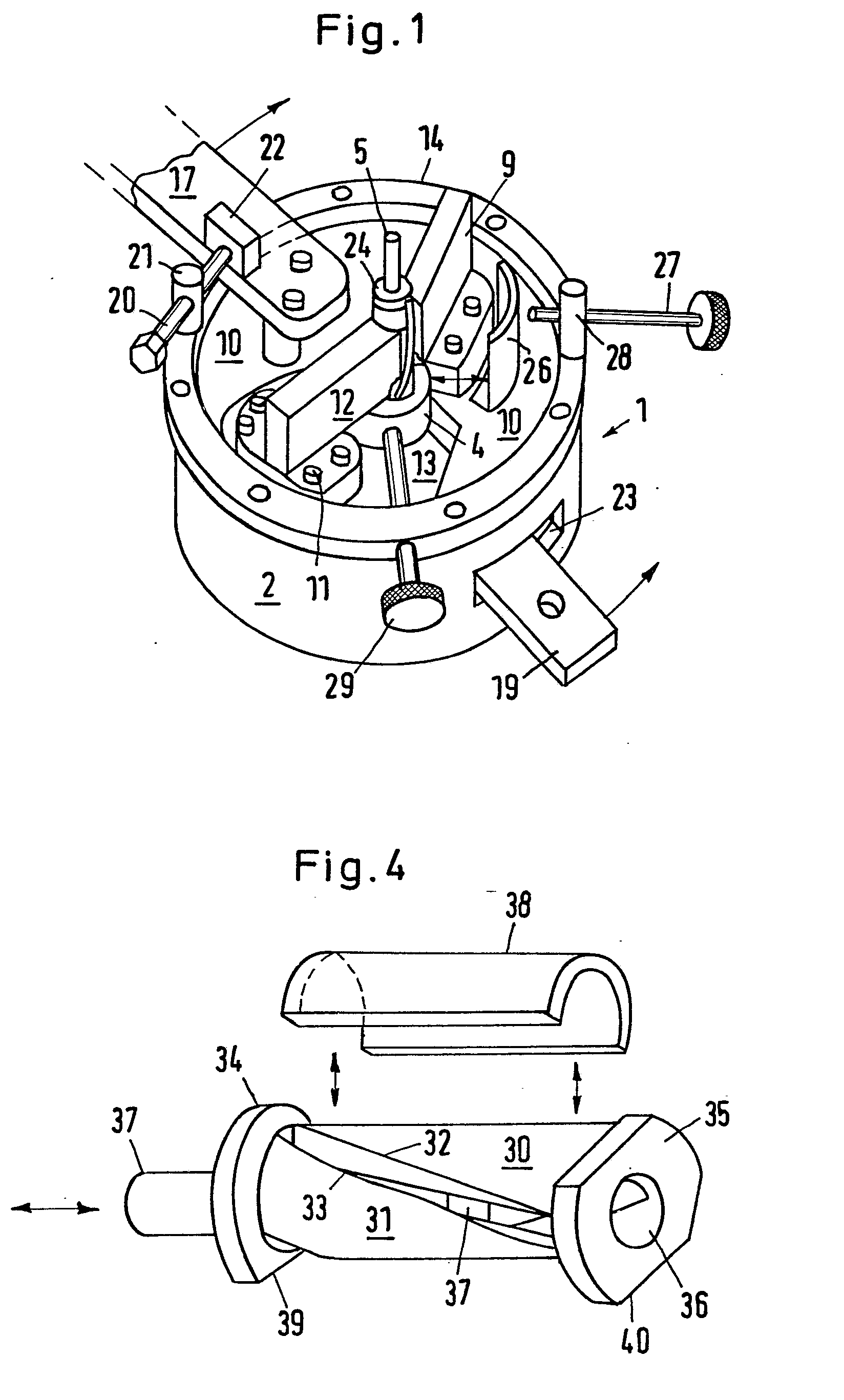
| (45) |
Mention of the grant of the patent: |
|
27.04.1983 Bulletin 1983/17 |
| (22) |
Date of filing: 16.10.1979 |
|
|
| (54) |
A press for forming particulate tungsten carbide into a blank for cutting tool bit
insert and a sinter fixture for compensating shrinkage distortion during sintering
Presse zum Überführen pulverförmigen Wolframkarbids in ein Bestückungsteil für ein
Schneidewerkzeug und Halter, um der während des Sinterns auftretenden Schwindungsverformung
entgegen zu wirken
Presse pour mettre une poudre de carbure de tungstène sous forme d'une ébauche pour
une plaquette d'un outil de coupe et support de frittage devant obvier à la déformation
résultant du retrait lors du frittage
|
| (84) |
Designated Contracting States: |
|
CH FR GB IT SE |
| (30) |
Priority: |
20.10.1978 AU 6483/78
|
| (43) |
Date of publication of application: |
|
30.04.1980 Bulletin 1980/09 |
| (71) |
Applicant: AUSTUNG PROPRIETARY LIMITED |
|
South Yarra
Victoria 3141 (AU) |
|
| (72) |
Inventor: |
|
- Springborn Karl Siegfried
Wheeler's Hill
Victoria, 3170 (AU)
|
| (74) |
Representative: Andrejewski, Walter et al |
|
Patentanwälte
Andrejewski, Honke & Partner
Postfach 10 02 54
D-45002 Essen
D-45002 Essen (DE) |
|
| |
|
|
|
Remarks: |
|
The file contains technical information submitted after the application was filed
and not included in this specification |
|
| Note: Within nine months from the publication of the mention of the grant of the European
patent, any person may give notice to the European Patent Office of opposition to
the European patent
granted. Notice of opposition shall be filed in a written reasoned statement. It shall
not be deemed to
have been filed until the opposition fee has been paid. (Art. 99(1) European Patent
Convention).
|
[0001] The invention relates to a press with contra- rotating jaws and forming cavity closure
members for cold pressure-forming of particulate, tungsten carbine into helically-shaped
blanks for fitting to a cutting tool bit as inserts; a separate sinter piece has components
of similar configuration and function to those of the press and has means built in
for continually maintaining correct angular and radial dimensions of the pressed insert
blank to compensate for shrinkage and prevent distortion during sintering.
[0002] Sintered tungsten carbide cutting tool bit insert blanks used as cutting edges fixed
to high-speed cutting tools such as augers with helical cutting edges are made by
pressing tungsten carbide, sometimes mixed with cobalt, under pressure into slabs
or ingots from which special shapes are then cut or pressed directly into blanks of
desired shape or size. Blanks are then semi-sintered in a non-oxidizing atmosphere
at temperatures below 800°C (1472°F) and further formed by machining. Final sintering
is then carried out but the sintered carbide so obtained is so hard that the sintered
shape can only be corrected by diamond cutter grinding. Uncontrolled shrinkage of
the carbide blanks occurs with distortion of shape in existing methods in which carbide
powder is brushed onto a spiral or helical cutting tool edge and the carbide is partially
sintered on the tool. This requires reheating and bending the tool. Again a strip
of pre-sintered or partially sintered carbide is placed along or beside the spiral
cutting contour of the cutting tool and fused onto the tool by sintering at a higher
temperature than the first-stage temperature. Uncontrolled shrinkage and distortion
of the pressed blank occurs during existing sintering processes.
[0003] This causes irregularities in the sintered insert and loss of edge and shoulder sharpness
or definition.
[0004] The invention as claimed is intended to remedy the above problem of shrinkage distortion
of a sintered blank by controlling or confining those surfaces and edges which are
critically affected during shrinkage caused by sintering and namely the whole diameter
or radial height and the angular thickness or the thickness of the insert blank in
the pitch circle direction of the insert when it is in mounted position on a spiral
cutting bit. The whole diameter of the insert is that distance between the root diameter
or base of the insert on the cutter bit face and the radial distance from the base
to the top of the insert or the outer diameter of the cutter.
[0005] The advantages of the invention are mainly that the correct configuration of a spiral
insert blank is obtained by press forming and then maintained during sintering and
shrinking of the blank by a sinter piece having distortion-correcting design features
built in which continually correct or maintain correct configuration of an insert
blank of tungsten carbide during sintering.
[0006] One way of carrying out the invention is described in detail below with reference
to drawings which illustrate several specific embodiments, in which:-
Figure 1 is a perspective view of a forming press in accordance with the invention
with a top pressure member removed, and side cavity sealing plate loosened.
Figure 2 is a plan view of the press with side cavity-sealing plate closed up.
Figure 3 is a vertical section taken along line A-A of figure 2.
Figure 4 is a partially exploded view of the shrinkage-compensating, sintering fixture
for pressed and formed cutter bit insert blanks for cutting tools.
[0007] The figures 1 to 3 show a cold-forming press for making pre-sinter blanks of tungsten
carbide for tool cutter bit inserts or tips for milling machine cutters, augers and
other such devices and which comprises a bowl shaped body 1 with a recessed base 2,
a side wall 3 and a central column 4 supporting a centre forming pin 5. The column
4 is bolted to the base of the body by a socket screw 6 the head of which clamps a
securing collar 7 into the recess 8 under the body. There is mounted around the centre
pin 5 a compression jaw 9 the base of which is fixed on a compression plate 10 by
socket screws 11. An ejection jaw 12 is similarly fixed to an ejection plate 13 beneath
the compression plate, both plates 10, 13 being designed for limited, angular reciprocating
movement about the column 4 and centre pin 5. The plates 10, 13 are retained within
the body by the plate-retaining collar 14. The jaws 9, 12 are formed as two matching
split segments of a cylindrically curved sleeve split into two segments along blank-shaped
cuts which are matching helical or spiral separation cut or cuts forming a helical
or spiral forming cavity on one side of the centre pin 5 and an identical jaw-separation
slot on the diametrically opposite side of the pin 5. By an angular movement of the
compression jaw 9 or of the ejection jaw 12 the complementary, helically-shaped mating
surfaces 15 and 16 of the split-shell segments, i.e. the circumferentially facing
areas of the forming cavity move towards each other whereas at the same time the two
helical surfaces of the jaw-separation slot on the opposite side of the pin 5 move
away from each other, and vice versa. To compress a charge by - applying sufficient
pressure of the order of 100 pounds, a closing and opening movement of the compression
jaw 9 and compression plate 10 is caused by a reciprocating angular movement of the
compression lever 17 which is powered by suitable means such as a pneumatic ram 18.
The movement of the ejection jaw 12 and ejection plate 13 facilitating removal and
causing ejection of the compressed blank is effected by the ejection lever 19 actuated
by a pneumatic ram. The extent of angular travel of the compression lever 17, plate
10 and jaw 9 is limited by the limit stop screw 20 mounted on the threaded post 21
and the screw is adapted to bear against the stop block 22. The extent of the angular
travel of the ejection lever 19, plate 13 and jaw 12 is limited by the confining edges
of the angular slot 23. The forming cavity is sealed against loss of particulate carbide
charge material by means of the separate top cavity sealing collar 24 sealed under
pressure by vertically reciprocating means 25, the separate cavity side sealing plate
26 clamped in place by upper threaded press bolt 27 mounted on the post 28 and the
lower threaded press bolt 29 mounted through the plate-retaining, ring 14.
[0008] Referring to figure 4, there is shown a sintering fixture for sintering press-formed,
helically-shaped, tungsten carbide cutting tool bit inserts which although is a separate
assembly from the press assembly nevertheless has components of the same shape and
function and comprises four components of graphite in the form of a spool-shaped body
on a centre pin and which is longitudinally split into two sleeve-like segments along
helical separation cuts 32 and 33 which divide the segments 30 and 31. The segments
30 and 31 have flanged partially circular ends 34 and 35 and a longitudinal or axial
bore 36 which is adapted to receive a removable, rod-like pin 37. The round surface
of the pin is, when the pin is inserted into the bore, adapted to maintain contact
with the bottom surface of a pressed blank and the helical edge walls defining the
two sleeve segments are adapted to maintain contact of the sides of a pressed blank.
A cover piece 38 of complementary curvature to the spool or sleeve segments is adapted
to bear against the top edge of a pressed blank. The flanged ends each have a flattened
portion 39 and 40, respectively. When the assembled fixture containing a pressed blank
is placed upon the flat surface in a sinter furnace, the flattened rim portions 39
and 40, which are each off-set with respect to each other in an angular direction
about the longitudinal axis of the sintering fixture, produce a torque or twisting
action of each segment of the shell towards each other so that the edge surfaces 32
and 33 close up or bear against a helical blank to counteract angular shrinkage distortion
in the direction of the pitch circle of the sintered blank insert installed on or
against the cutting edge profile of a cutting tool bit when the blank is sintered
at 1500° to 1600°C, depending on the composition of the sinter mix.
1. Press for cold forming a charge of particulate tungsten carbide into a sinter blank
for cutting tool insert bit, characterised by a bowl- shaped body (1) with a cylindrical
centre pin (5), a compression jaw (9) fixed to a compression plate (10) horizontally
reciprocatable through a limited arc about the centre pin (5) by a compression lever
arm (17), a pressed blank ejection jaw (12) fixed on a horizontally reciprocatable
ejection plate (13) moved through a limited arc about the centre pin (5) by an ejection
lever (19) in contra-reciprocation to the compression plate (10), the jaws (9, 12)
being formed as two matching split segments of a cylindrical sleeve mating along surfaces
of separation cuts defining helical blank-forming surfaces (15 and 16), one of the
cuts on the sleeve segment at one side of the centre pin (5) defining a forming die
for the side walls of a blank by forming compression surfaces (15, 16), the other
cut defining a jaw separation slot on the diametrically opposite side of the centre
pin (5) to the compression surfaces (15, 16), the die charging cavity being formed
collectively by the cylindrically curved surface of the centre pin (5), by the flat
top surface of a column (4) at the base of the centre pin (5), by the compression
surfaces (15, 16) of the split segment sleeves, by a curved side-sealing plate (26)
with a helically curved sealing surface, and by the flat undersurface of a vertically
reciprocatable sealing collar (24) which is closed after the charge has been introduced
into the die cavity, separate clamping means (27 and 29) being provided for the side-sealing
plate (26) and clamping or pressure application means being provided for the sealing
collar (24) which seals the top of the die forming cavity.
2. A sinter fixture for counteracting shrinkage shape distortion during sintering
of shaped cutting tool bit insert blanks cold pressed from particulate, tungsten carbide
in the press claimed in claim 1, characterised in that it is constructed as a generally
spool-shaped, hollow shell with a central cylindrical section (30, 31) and flanged
ends (34 and 35), the central cylindrical section being split into two equal segments
(30 and 31) by longitudinal, helical separation cuts (32 and 33) which form mating
edges, the segments (30 and 31) forming a cylindrical shaped bore (36) a removable
centre pin (37) being removably located in the bore, a separate curved cover (38)
being provided to fit over the cylindrical section of each shell segment (30, 31)
when assembled on the centre pin (37) and in contact with the top or outer surface
of a pressed blank to press the blank against the centre pin (37), each flanged end
(34, 35) of the shell segments (30, 31) having a flattened rim portion (39 and 40)
mutually off-set about the longitudinal axis of the shell such that when the fixture
is assembled with the centre pin (37) inserted in the bore (36) of the shell segments
(30, 31), and a pressed blank placed in the gap between the helical separation cuts
(32, 33) and against the centre pin (37) and cover 38 and the sinter fixture is placed
on the flat surface of a sinter furnace or on the flat surface of a carrier member
in a sinter furnace, the surfaces along the edge of the separation cuts (32, 33) are
constrained to bear against the side walls of the blank by a torque produced by gravitational
reaction of the mutually off-set flattened rim portions (39, 40) on the flat surface
of the sinter furnace or carrier.
3. A sinter fixture as claimed in claim 2, characterised in that all the components
are constructed of graphite.
1. Presse zum Kaltumformen einer aus pulverförmigem Wolframkarbid bestehenden Beschickung
in einen Sinterpreßling für ein Schneidwerkzeugbestückungsteil, gekennzeichnet durch
einen napfförmigen Körper (1) mit zylindrischem Mittelzapfen (15), eine Druckbacke
(9), welche an einer mit Hilfe eines Druckhebelarmes (17) auf einem begrenzten Bogen
um den Mittelzapfen (5) horizontal hin- und herbewegbaren Druckplatte (10) befestigt
ist, und eine Preßlingauswerferbacke (12), welche an einer horizontal hin- und herbewegbaren,
mit Hilfe eines Auswerferhebels (19) auf einem begrenzten Bogen in einer zur Druckplatte
(10) gegenläufigen Hin- und Herbewegung um den Mittelzapfen (5) bewegten Auswerferplatte
(13) befestigt ist, wobei die Backen (9, 12) als zwei zueinander passende Spaltsegmente
einer zylindrischen Hülse ausgebildet sind, welche längs schraubenlinienförmige Preßlingsformflächen
(15 und 16) bildender Oberflächen von Trennschnitten aneinander angepaßt sind, von
denen der eine am Hülsensegment auf einer Seite des Mittelzapfens (5) durch Bildung
von Druckflächen (15, 16) ein Formwerkzeug für die Seitenwandungen eines Preßlings
und der andere auf der den Druckflächen (15, 16) gegenüberliegenden Seite des Mittelzapfens
(5) einen Backentrennschlitz darstellt, wobei der zu beschickende Werkzeughohlraum
insgesamt von der zylindrisch gekrümmten Fläche des Mittelzapfens (5), der ebenen
Oberseite einer am Fuß des Mittelzapfens (5) vorgesehenen Säule (4), den Druckflächen
(15, 16) der Spaltsegmenthülsen, einer gekrümmten Seitendichtplatte (26) mit schraubenlinienförmig
gekrümmter Dichtfläche und der ebenen Unterseite eines vertikal hin- und herverstellbaren,
nach Einbringen der Beschickung in den Werkzeughohlraum in Schließstellung bewegten
Dichtkragens (24) gebildet ist und wobei für die Seitendichtplatte (26) getrennte
Klemmittel (27 und 29) und für den Werkzeughohlraum nach oben hin abdichtenden Dichtkragen
(24) Klemm- oder Druckbeaufschlagungsmittel vorgesehen sind.
2. Sinterhalter zum Entgegenwirken einer Schwindungsverformung beim Sintern von aus
pulverförmigem Wolframkarbid in der Presse nach Anspruch 1 gepreßten Preßlingen für
Schneidwerkzeugbestückungsteile, dadurch gekennzeichnet, daß er als ein im allgemeinen
spulenförmiges hohles Rundgehäuse mit einem mittleren zylindrischen Abschnitt (30,
31) und Flanschenden (34 und 35) aufgebaut ist, daß der mittlere zylindrische Abschnitt
durch Passungsränder bildende schraubenlinienförmige Längstrennschnitte (32 und 33)
in zwei gleiche Segmente (30 und 31) aufgeteilt ist, welche eine zylindrisch gestaltete
Längsbohrung (36), in der ein Zentraldorn (37) entfernbar angeordnet ist, bilden,
daß eine getrennte gekrümmte Abdeckung (38) vorgesehen ist, welche auf den zylindrischen
Abschnitt jedes Rundgehäusesegmentes (30, 31) nach Zusammenbau auf dem Zentraldorn
(37) und in Berührung mit der Ober- oder Außenfläche eines Preßlings zum Anpressen
desselben an den Zentraldorn (37) aufsetzbar ist, und daß jedes Flanschende (34, 35)
der Rundgehäusesegmente (30, 31) einen abgeflachten Randabschnitt (39 und 40) aufweist,
die gegenseitig um die Längsachse des Rundgehäuses derart versetzt sind, daß dann,
wenn der Halter unter Einführen des Zentraldornes (37) in die Längsbohrung (36) der
Rundgehäusesegmente (30, 31) zusammengebaut, der Preßling in den Spalt zwischen den
schraubenlinienförmigen Trennschnitten (32, 33) und gegen den Zentraldorn (37) sowie
die Abdeckung (38) gesetzt und der Sinterhalter auf die ebene Oberfläche eines Sinterofens
oder auf die ebene Oberfläche eines Trägerelementes in einem Sinterofen gelegt worden
ist, die Oberflächen längs des Randes der Trennschnitte (32, 33) durch ein mit Hilfe
einer Gravitationsreaktion der gegenseitig versetzten abgeflachten Randabschnitte
(39, 40) auf die ebene Oberfläche des Sinterofens oder Trägers ausgeübtes Drehmoment
zu einem Druck gegen die Seitenwandungen des Preßlings gezwungen sind.
3. Sinterhalter nach Anspruch 2, dadurch gekennzeichnet, daß alle seine Bauteile aus
Graphit hergestellt sind.
1. Presse pour le façonnage à froid d'une charge de carbure de tungstène en particules
en une ébauche frittée de pièce rapportée de mèche d'outil de coupe, caractérisée
en ce qu'elle comprend un corps en forme de cuvette (1), avec une broche centrale
cylindrique (5), une mâchoire de compression (9) fixée à une plaque de compression
(10) pouvant effectuer un mouvement horizontal de va-et-vient sur un arc limité autour
de la broche centrale (5) sous l'action d'un levier de compression (17), une mâchoire
d'éjection d'ébauche pressée (12) fixée sur une plaque d'éjection (13) animée d'un
mouvement horizontal de va-et-vient sur un arc limité autour de la broche centrale
(5) par un levier d'éjection (19) dans une direction opposée à celle de la plaque
de compression (10), les mâchoires (9, 12) étant constituées de deux segments séparés
correspondants d'un manchon cylindrique appariés le long des surfaces de découpes
de séparation définissant des surfaces de façonnage d'ébauches hélicoïdales (15 et
16), une des découpes du segment de manchon situé d'un côté de la broche centrale
(5) définissant une matrice de formage pour les parois latérales d'une ébauche en
définissant des surfaces de compression (15, 16), tandis que l'autre découpe définit
une rainure de séparation des mâchoires sur le côté de la broche centrale (5) qui
est diamétralement opposé aux surfaces de compression (15, 16), la cavité de chargement
de matrice étant formé conjointement par la surface à courbure cylindrique de la broche
centrale (5), par la surface supérieure plane d'une colonne (4) à la base de la broche
centrale (5), par les surfaces de compression (15, 16) des manchons en deux segments
séparés, par une plaque courbe d'étanchéité latérale (26) comportant une surface d'étanchéité
à courbure hélicoïdale, ainsi que par la surface inférieure plane d'un collier d'étanchéité
à mouvement vertical de va-et-vient (24) qui est fermé après introduction de la charge
dans la cavité de matrice, des éléments de serrage séparés (27 et 29) étant prévus
pour la plaque d'étanchéité latérale (26), tandis qu'un élément de serrage ou d'application
de pression est prévu pour le collier (24) qui étanchéifie le sommet de la cavité
de formage de la matrice.
2. Support de frittage destiné à contrecarrer la déformation due au retrait lors du
frittage d'ébauches de pièces rapportées de mèches d'outils de coupe profilées pressées
à froid à partir de carbure de tungstène en particules dans la presse suivant la revendication
1, caractérisé en ce qu'il est constitué d'une coquille creuse généralement en forme
de bobine avec une section cylindrique centrale (30, 31) et des extrémités à rebords
(34 et 35), la section cylindrique centrale étant divisée en deux segments égaux (30
et 31) par des découpes de séparation longitudinales hélicoïdales (32 et 33) qui forment
des bords d'appariement, les segments (30 et 31 ) définissant un alésage cylindrique
(36) une broche centrale amovible (37) étant disposée de façon amovible dans l'alésage,
un couvercle courbe séparé (38) étant prévu pour s'adapter pardessus la section cylindrique
de chaque segment de coquille (30, 31) lors de l'assemblage sur la broche centrale
(37), tout en entrant en contact avec le dessus ou la surface extérieure d'une ébauche
pressée afin de presser cette dernière contre la broche centrale (37), chaque extrémité
à rebord (34, 35) des segments de coquille (30, 31) comportant un rebord aplati (39
et 40) mutuellement décalé autour de l'axe longitudinal de la coquille de sorte que
lorsque le support de frittage est assemblé avec la broche centrale (37) introduite
dans l'alésage (36) des segments de coquille (30, 31), et une ébauche pressée étant
placée dans l'espace vide compris entre les découpes de séparation hélicoïdales (32,
33) et contre la broche centrale (37) et le couvercle (38) et le support de frittage
est placé sur la surface, plane d'un four de frittage ou sur la surface plane d'un
organe support prévu dans ce dernier, les surfaces s'étendant le long du bord des
découpes de séparation (32, 33) sont contraintes de venir appuyer contre les parois
latérales de l'ébauche par un couple engendré par une réaction de gravitation des
rebords aplatis mutuellement décalés (39, 40) sur la surface plane du four de frittage
ou de l'organe support de ce dernier.
3. Support de frittage suivant la revendication 2, caractérise en ce que tous les
éléments sont réalisés en graphite.