|
(11) | EP 0 010 466 A1 |

| (12) | EUROPEAN PATENT APPLICATION |
|
|
|
|
|||||||||||||||||||||||||||
| (54) | Polymer bound phase transfer catalyst and process for its preparation |
| (57) An improved process for converting 3-thenylbromide, by reaction with an alkali metal
cyanide, to 3-thienylacetonitrile. New catalysts of the type termed triphase, that
is a polymer bound phase transfer catalyst, are provided, said catalysts being represented
as
wherein R is a member of the group diethyl-n-butylamino, tripropylamino, tributylamino, trialkylphosphino and triarylphosphino; X is chlorine or bromine; and n is from 600 to 2,000,000. |
[0001] This invention deals with an improved process for converting 3-thenylbromide to 3-thienylacetonitrile by reaction of the ,first of these compounds with an alkali metal cyanide and in the presence of triphase reaction catalysts. Further, new catalyst compositions are provided.
[0002] A significant and recurring problem in organic synthesis stems from the use, or desired use, of a water-soluble reagent in chemically altering a water-insoluble organic substrate. If the reaction is conducted as a heterogeneous process (e.g., organic phase-aqueous phase reaction) observed reaction rates are normally very slow owing to the low concentration of at least one of the reac-- tants in each phase. Techniques currently available to circumvent this problem rely on the use of rapid stirring, cosolvent, and phase-transfer methods. If chemical reaction takes place at a liquid-liquid phase-boundary, rapid stirring may have an accelerating effect by increasing interfacial contact. Alternatively, the addition of a cosolvent can bring about a homogeneous state and thereby completely eliminate phase separation. Although this latter approach is often useful, product mixtures are necessarily made more complex and the resulting workup made more difficult. In addition, with aqueous phase-organic phase reactions, use of a cosolvent not only renders the organic substrate accessible to the reagent, but also increases the substrate's contact with water and can promote competing hydrolytic pathways. Recently, a third technique has been developed which appears to have considerable potential; this method has been referred to as phase-transfer catalysis. In brief, an organic-soluble, partially water-soluble catalyst (most commonly a tetraalkylammonium or tetraalkylphosphonium salt) accelerates an aqueous phase-organic phase reaction, presumably, by extracting a given ionic reagent out of water and into the bulk organic phase where reaction can ensue. Based on enhanced reaction rates, high yields of products, and the convenience found with this method, it seems likely that many industrial applications will be forthcoming. One practical limitation to the phase-transfer method, however, is that many of the catalysts used promote the formation of stable emulsions.
[0003] More recently, a new type of heterogeneous catalysis termed "triphase catalysis" has been introduced. The underlying feature which distinguishes this from other forms of heterogeneous catalysis is that the catalyst and each one of a pair of reactants are located in separate phases. This principle has been successfully applied to certain aqueous phase-organic phase reactions employing a solid phase catalyst. S. L. Regen, J. Am. Chem. Soc., 97, 5956 (1975). The present invention relates to a novel catalyst for use in such reactions.
[0004] Previously, such triphase catalysts have been used to catalyze aqueous phase-organic phase reactions in which homogeneous phase transfer catalysts have produced stable emulsions, greatly reducing the usefulness of homogeneous phase transfer catalysts. Triphase catalysts have been used in cyanide displacement. halogen exchange, dichlorocarbene addition, dichlorocarbene chlorination, alkoxide and phenoxide displacement, dehalogenation of vic-dibromides and oxidation of alcohols. S. L. Regen. J. Org. Chem. Soc., Vol. 42, No. 5, 1977. In general, the triphase catalyst emply chloromethylated polystrene beads, subsequently reacted with dimethylbutylamine or trimethylamine. Di- methyloctylamine, dodecylamine, tetradecylamine, triethylamine, dimethyltoluoylamine and hydroxyethylamine have also been employed to produce triphase catalysts. S. L. Regen, J.Am. Chem. Soc., 98, 6270 (1976). While such catalysts are known, it is always desirable to find cheaper and more effective materials to produce triphase catalysts. Accordingly, the present invention has as its object the provision of new triphase or polymer bound phase transfer catalysts, and the provision of an improved process to convert 3-thenylbromide to 3-thienylacetonitrile.
[0005] The catalysts now provided are represented as
is employed, wherein R, in the above formula, is selected from diethyl-n-butylamino, tripropylamino, tributylamino, trialkylphosphino and triarylphosphino; X is chlorine or bromine; and n can range from 600 to 2,000,000.
[0006] Such catalyst compositions can be prepared by establishing a mixture of chloromethylated styrene polymer in a solvent capable of swelling the polymer, maintaining the mixture until the polymer is swollen, reacting the swollen polymer with an amine or phosphine and recovering the resultant catalyst composi.tion from the reaction mixture.
[0007] Such catalyst compositions, as indicated above, have been found to be less expensive and more efficient in the synthesis of nitriles, for example, producing 3-thienylacetonitrile from 3-thenylbromide by reacting in an organic solvent with aqueous alkali metal cyanide.
[0008] As indicated, the catalyst composition contains a polymer. It has been found that polystyrene is an excellent polymer substrate for preparation of triphase or polymer bound phase transfer catalysts. Commercially available polystyrenes can be employed. Reference is made to the article entitled "Styrene Plastics", Encyclopedia of Chemical Technology 2nd Ed., 19, 85-134, Interscience Publishers, New York (1969). Preferably, the polystyrene is crosslinked with from 1-10% of divinylbenzene. Further, the polystyrene is chloromethylated, according to known procedures, so that each of the styrene groups on the polymer contains a chloromethane group. Such chlormethylated polystyrene crosslinked with varying amounts of divinylbenzene is available in bead form from Bio-Rad Laboratories, Richmond, California, designated as "Bio-Beads S-X1", Catalog No. 154-1342.
[0009] The chloromethylated polystyrene beads can be reacted with diethyl-n-butylamine, tripropylamine, tributylamine or trialkyl- or triarylphosphines to produce quaternary ammonium and phosphonium groups on the polystyrene resin. As used herein, the term "alkyl" means lower alkyl having from 1 to about 4 carbon atoms such as methyl, ethyl, propyl and butyl; and the term "aryl" means mononuclear aromatic groups having from 6 to 10 carbon atoms and being optionally substituted with alkyl groups, defined hereinbefore. In order to effect such a reaction, the polymer is first swelled in a suitable solvent such as aromatic hydrocarbon solvents, for example, benzene, toluene and xylene, or heterocyclic ethers, such as tetrahydrofuran. Preferably, tetrahydrofuran is employed. The swelling can be accomplished by mixing the chloromethylated polystyrene beads with a suitable amount of tetrahydrofuran and allowing the mixture to stand for 10 to 30 hours. The swelled polymer is then separated from the suspension, washed with tetrahydrofuran and air dried for subsequent reaction with an amine or phosphine. This drying step is optional and the swollen polymer beads can be directly reacted with a suitable amine or phosphine after swelling, but on many occasions an amount of swollen beads are prepared for subsequent reaction so that drying is advantageous to maintain the swollen polymer beads in readiness for such subsequent reaction.
[0010] The dried, swollen polymer beads can be easily reacted with a suitable amine or phosphine, such as, tri-n-butylamine or tri-n-butylphosphine, triphenylphosphine or tripropylamine, in a suitable solvent by reacting, under reflux, with the resin under a nitrogen atmosphere for 12-36 hours. After reflux, the reaction mixture is filtered and washed with a mixture of water and tetrahydrofuran and vacuum dried.
[0011] The catalyst can be employed to convert bromides to nitriles by reaction in a three-phase system having an organo bromide in an organic solvent and an alkali metal cyanide in an aqueous system. For example, 3-thenylbromide can be converted into 3-thienylacetonitrile by reacting in the presence of a suitable triphase or polymer bound phase transfer catalyst of this invention. Also, 1-bromooctane can be converted into 1-cyanooctane by reaction with a catalyst of this invention. The preparation of triphase catalyst compositions and their use in converting bromides to nitriles is more particularly illustrated in the following examples.
EXAMPLE 1 - Comparative
[0012] into a 200 ml beaker was placed 10 grams of chloromethylated polystyrene beads crosslinked with 1% by weight of divinylbenzene purchased from Bio-Rad Laboratories, Richmond, California and designated as "Bio-Beads S-X1", Catalog No. 154-1342. To the beaker was added 50 ml of dry, distilled tetrahydrofuran and the polymer was "swelled" for 20 hours. The polymer-tetrahydrofuran suspension was then filtered, washed with two fresh, 50 ml portions of tetrahydrofuran and the polymer was air dried for 5minutes.
[0013] The dried, swollen polymer beads were placed into a 300 ml round bottom flask together with 50 ml of tetrahydrofuran and 10 ml of N,N-dimethylbutylamine. The mixture was refluxed under a nitrogen atmosphere for 24 hours. After reflux the reaction mixture was filtered and the solid catalyst was washed with a mixture of 20 ml water and 20 ml tetrahydrofuran and finally with another 20 ml of tetrahydrofuran. The catalyst was vacuum dired.
EXAMPLE 2
[0014] In a procedure similar to Example 1, except that 10 ml of N,N-dimethylbutylamine was replaced by 10 ml of tri-n-butylamine, there was produced a polystyrene/tri-n-butylammonium chloride catalyst.
EXAMPLE 3
[0015] In a procedure similar to Example 1, except that 10 ml of N,N-dimethylbutylamine was replaced by 10 ml of tri-n-butylphosphine, there was produced a polystyrene/tri- n-butylphosphonium chloride catalyst.
EXAMPLE 4
[0016] In a procedure similar to Example 1, except that 10 ml of N,N-dimethylbutylamine was replaced by 10 ml of triphenylphosphine, there was produced a polystyrene/tri- phenylphosphonium chloride catalyst.
EXAMPLE 5
[0017] In a procedure simlar to Example 1, except that 10 ml of N,N-dimethylbutylamine was replaced by 10 ml of tripropylamine, there was produced a polystyrene/tripropyl- ammonium chloride catalyst.
EXAMPLE 6
[0018] In a procedure similar to Example 1 except that 10 ml of N,N-dimethylbutylamine was replaced by 10 ml of N,N-diethyl-n-butylamine, there was produced a polystyrene/ diethyl-n-butylammonium chloride catalyst.
EXAMPLE 7
[0019] The catalysts of Examples 1 and 2 were compared with similar homogeneous phase transfer catalyst in their ability to cyanate 3-thenylbromide. Into a suitable reactor were placed 150 mmoles of 3-thenylbromide in 200 ml of carbon tetrachloride, 14.7 g (300 mmoles) of sodium cyanide in 50 ml of water was added and the particular phase transfer catalyst shown in Table 1 below was added. All reactions were run at 50° C. except the polymer bound phase transfer catalyst was duplicated at 75° C. in Runs 5 and 6. Samples were taken and analyzed on vapor phase chromatograph at 0.5, 1 and 2 hours for a comparison of the amounts of the percent of 3-thienylacetonitrile present as shown by VPC (see Table 1 below). Run 1 contained tetra-n-butylammonium bromide, Run 2 was methyl-tri-n-butylammonium chloride, Runs 3 and 5 used the catalyst prepared in Example 1 and Runs 4 and 6 used the catalyst prepared in Example 2. Runs 7 and 8 employed the catalyst prepared in Example 6.
[0020] The reaction of Run 1 turned dark red-brown immediately upon combination of all reactants. An emulsion appeared to be forming also immediately upon combination of reactants. Following the reaction, the solution was extremely difficult to filter, even though a filter aid such as Celite 545 was used after two hours. At the end of the reaction, the reaction mixture was so dark that the phase interface could not be distinguished. The same comments apply to Run 2 having immediate red-brown color formation upon combination, formation of emulsion, extremely difficult filtration and indistinguishable interface. In Run 3, a pale yellow color developed after two hours. No emulsion formed. The solution filtered rapidly without the use of a filter aid and the aqueous and inorganic phases could be easily distinguished. In Run 4, the same comments apply as for Run 3 but the color was fainter. The higher temperature runs, Runs 5 and 6, turned dark brown at the end of two hours' reaction. However, no emulsion was formed and the mixtures filtered rapidly without the use of a filter aid. In addition, the phases could be easily distinguished. Thus, it is clear that the higher temperature runs caused little problem with handling the reaction mass and achieved yields as good as or better than the homogeneous catalyst.
EXAMPLE 8
[0022] Although the catalysts produced good reaction yields and were easily separated from the reaction mixture in Example 7, it was desired to determine whether or not the catalysts could be recycled for the obvious economic reasons. Therefore, the catalysts from Runs 5 and 6 of.Example 7 were filtered from the reaction mixture as indicated and an additional 1.77 g (0.01 moles) of 3-thenylbromide, 30 ml 3 of carbon tetrachloride, 0.98 g of sodium cyanide, 4 ml of water and 1 g of each catalyst were placed in a reaction vessel. The temperature in each reaction vessel was increased to 72° and samples were taken over a 2-hour period. At the end of one hours, the catalyst from Run 5 of Example 7 had 86.5% yield and the catalyst from Run 6 had 85.3% yield. After 2 hours, the catalyst from Run 5 had 98.2% yield and catalyst from Run 6 had 96.7% yield of 3-thienylacetonitrile, respectively. Thus, both catalysts in accord with Examples 1 and 2 can be recycled and reused without a decrease in yield.
EXAMPLE 9
[0023] The polymer bound phase transfer catalyst of Examples 3, 4, 5 and 6 were compared with the catalyst of Example 1. In their ability to synthesize 1-cyanooctane from l-bromooctane, each catalyst was placed in a 25 ml round bottom flask with 1.93 g (0.01 moles) of 1-bromooctane, 3 ml of chloroform, 0.49 g (0.01 mole) of sodium cyanide, 1 ml of water and 0.3 g of the particular catalyst. The catalysts were heated at 80° C. in an oil bath for brief periods and samples were taken and analyzed by vapor phase chromatography. The results of these runs are given in Table 2 below:
[0024] Thus, each of the catalysts appear to promote a synthesis of 1-cyanooctane. However, while the catalysts of Examples 3 and 4 appear to be less effective than the catalyst of Example 1 over the short time period, catalyst of Example 5 appears to be almost as effective as the catalyst of Example 1.
EXAMPLE 10
[0025] This example will show the amount of catalyst needed, compared to the amount of a homogeneous phase transfer catalyst. In this example, three separate runs were made using the catalyst of Example 2, in which 1.77 g (0.01 mole) of 3-thenylbromide, 8 ml of carbon tetrachloride, 0.98 g (0.02 mole) of sodium cyanide, 2 ml of water and from 10 to 3.3 weight percent of the catalyst of Example 2 were mixed together in a suitable reactor. The mixture was heated at 75° C. for 2 hours and the yield of 3-thienylacetonitrile was determined by vapor phase chromatography. The result of these runs are shown in Table 3 can be compared with the 90% yield of 3-thenylbromide to 3-thienylacetonitrile after one hour at 55° C. with 7% mehtyl tri-n-butylammonium chloride.
[0026] Note that the 10% and 7% catalyst concentrations appear to be about equal in ability to convert 3 -thenylbromide to 3-thienylacetonitrile. The 7% concentration appears to take, however, twice as long to make the conversion than does the equivalent amount of homogeneous phase transfer catalyst.
1. A triphase catalyst composition comprising'a compound of the formula

in which R is selected from diethyl-n-butylamino, tripropylamino, tributylamino, trialkylphosphino and triarylphosphino; X is chlorine or bromine; and n is from 600 to 2,000,000.
in which R is selected from diethyl-n-butylamino, tripropylamino, tributylamino, trialkylphosphino and triarylphosphino; X is chlorine or bromine; and n is from 600 to 2,000,000.
2. A catalyst according to claim 1 wherein R is tripropylamino and X is chlorine.
3. A catalyst according to claim 1 whereon R is tributylamino and X is chlorine.
4. A catalyst according to claim 1 wherein R is tri- butylphosphino and X is chlorine.
5. A catalyst according to claim 1 wherein R is tri- phenylphosphino and X is chlorine.
6. A process for preparing a triphase catalyst composition of the formula

in which R is selected from diethyl-n-butylamino, tripropylamino, tributylamino, trialkylphosphino and triarylphosphino; X is selected from chlorine and bromine; and n is from 600 to 2,000,000, said process comprising establishing a mixture of chloromethylated styrene polymer in a solvent capable of swelling said styrene polymer, maintaining said mixture for a period sufficient to swell the polymer, reacting the swelled polymer with an amine or phosphine and recovering the resultant triphasic catalyst composition from the reaction mixture.
in which R is selected from diethyl-n-butylamino, tripropylamino, tributylamino, trialkylphosphino and triarylphosphino; X is selected from chlorine and bromine; and n is from 600 to 2,000,000, said process comprising establishing a mixture of chloromethylated styrene polymer in a solvent capable of swelling said styrene polymer, maintaining said mixture for a period sufficient to swell the polymer, reacting the swelled polymer with an amine or phosphine and recovering the resultant triphasic catalyst composition from the reaction mixture.
7. The process of claim 6 in which said solvent is tetrahydrofuran.
8. The process of claim 6 in which said swelled polymer is reacted with an amine selected
from tributylamine and tripropylamine.
9. The process of claim 6 in which said swelled polymer is reacted with a phosphine
selected from tributylphosphine and triphenylphosphine.
10. The process of any of claims 6 to 9 in which the swelled polymer is reacted with
said amine or said phosphine until from about 1 to about 20 percent of the polymer
has amino or phosphino groups attached to said polymer and recovering the triphasic
catalyst produced.
11. The process of claim 6 in which said chloromethylstyrene polymer is employed in
the form of beads which are swelled in tetrahydrofuran for 10 to 30 hours, reacted
with tri-n-butylamine at reflux for 24 hours to produce a triphasic catalyst and then
recovering the triphasic catalyst produced.
12. In a process for converting 3-thenylbromide to 3-thienylacetonitrile by reacting
3-thenylbromide in an organic solvent with aqueous alkali metal cyanide, the improvement
comprising conducting said process in the presence of a catalyst being a solid triphase
catalyst, as a separate phase intermediate the aqueous and organic phases, having
the formula
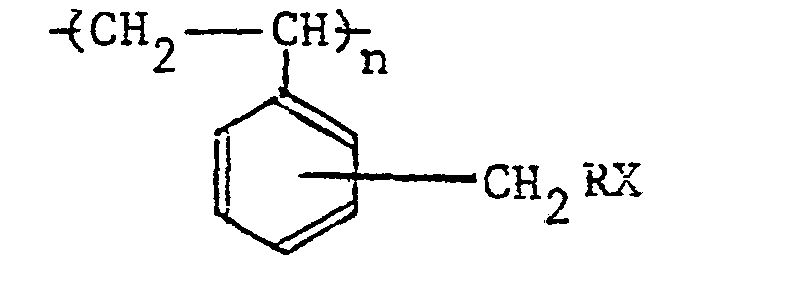
in which R is selected from dimethyl-n-butylamino, diethyl-n-butylamino, tripropylamino, tributylamino, trialkylphosphino and triarylphosphino; X is selected from chlorine and bromine, and n is from 600 to 2,000,000.
in which R is selected from dimethyl-n-butylamino, diethyl-n-butylamino, tripropylamino, tributylamino, trialkylphosphino and triarylphosphino; X is selected from chlorine and bromine, and n is from 600 to 2,000,000.
13. The process of claim 12 in which R is tripropylamino and X is chlorine.
14. The process of claim 12 in which R is tributylamino and X is chlorine.
15. The process of claim 12 in which R is tributyl- phosphino and X is chlorine.
16. The process of claim 12 in which R is triphenyl- phosphino and X is chlorine.