|
(11) | EP 0 010 523 A1 |

| (12) | EUROPEAN PATENT APPLICATION |
|
|
|
|
|||||||||||||||||||||||
| (54) | Perfluoroalkylalkylenemercapto group containing non-ionic surfactants, process for their manufacture and their use |
| (57) Fluorochemical surfactants of the formula
wherein Rf is perfluoroalkyl of 4 to 20 carbon atoms or perf- luoroalkoxyperfluoroalkyl of 4 to 20 carbon atoms, A is straight or branched chain alkylene of 1 to 10 carbon atoms which is unsubstituted or substituted by halogen, n is 1 to 50, R1 is hydrogen or alkyl of 1 to 4 carbon atoms and R2 is hydrogen or alkyl of 1 to 4 carbon atoms. The new surfactants are useful in aqueous and non-aqueous systems. |
[0001] The instant invention relates to novel fluorinated non-ionic surfactants of the general formula
wherein Rf is perfluoroalkyl of 4 to 20 carbon atoms, or perfluoro- alkoxyperfluoroalkyl of 4 to 20 carbon atoms, A is straight or branched chain alkyl of 1 to 10 carbon atoms which is unsubstituted or is substituted by halogen, preferably by chloro or fluoro, n is 1 to 50, R1 is hydrogen or alkyl of 1 to 4 carbon atoms and R2 is hydrogen or alkyl of 1 to 4 carbon atoms.
[0002] Preferably, Rf is perfluoroalkyl of 4 to 16, preferably 4 to 14 carbon atoms or said perfluoroalkyl substituted by perfluoroalkoxy of 2 to 4 carbon atoms, A is unsubstituted alkylene of 1 to 4 carbon atoms, preferably ethylene, n is 5 to 25, R1 is hydrogen or methyl, R2 is hydrogen or alkyl of 1 to 4 carbon atoms, most preferably methyl and n is 5 to 50.
[0003] Where n is less than 5, the resulting compounds have little water solubility. However, such compounds are useful as surfactants in non-aqueous systems, as mold release agents in the plastics and silicone industry, as well as grease and oil repellants for paper. Those compounds wherein R1-is predominately lower alkyl are likewise characterized by their limited water solubility and likewise possess utility as surfactants in non aqueous systems, as mold release agents and as grease and oil repellants for paper and the like.
[0004] Preferred compounds are those wherein R1 is at least predominately hydrogen, R2 is alkyl of 1 to 4 carbon atoms, and n is 5 to 50, preferably 5 to 25. Such compounds are essentially water soluble.
[0005] Such water soluble compounds are valuable aqueous surfactants and are useful industrial wetting agents. Thus, they are useful wetting agents for biocides, cleaning compositions and detergents, as rinse- aids for cars, dishes and the like, as emulsifiers, and as levelling agents in the dye and pigmant industry.
[0007] The compounds can be prepared conveniently by reacting an alkoxylated compound of the formula
with epichlorohydrin in bulk or in a common dry and aprotic solvent, including ketones, such as acetone or methyl ethyl ketone; ethers, such as diethylether, ethyloneglycol-dimethylether or tetrahydrofuran; esters such as ethyl acetate or methyl ethyleneglycol acetate; and amides, such as dinghyloftamide or N-methyl pyrrolidone. A Lewis acid catalyst, such as boron trifluoride (usually in the form of the diethyl ether complex thereof) or aluminium chloride, is used to promote the formation of the halohydrin intermediate. If the reaction is run in the absence of a solvent, it is advantageously run at a temperature above the melting point of the alkoxylated compound with boron trifluoride-etherate. The reaction is ordinarily exothermic. It is generally not necessary to isolate the halohydrin intermediate, and the next reaction can be carried out in the same vessel. The halohydrin intermediate has the formula
[0008] In the second step, the perfluoroalkylalkylene mercaptan (R -A-SH) (US-Patent Specification 3,172,910) is added to the halohydrin intermediate, followed by the addition of an equivalent amount of base as an acid acceptor. This step may advantageously be carried out in bulk or in the presence of aprotic or protic solvents. As apotic solvents, there may be used those recited above for the first step. Suitable protic solvents include water, and alcohols such as methanol, ethanol, isopropanol, tert. butyl alcohol, hexyleneglycol, ethyleneglycol and ethyleneglycol monoethylether. Suitable bases include sodium hydroxide, potassium hydroxide, pyridine, lutidine and triethylamine. Conveniently, a solvent is selected which dissolves the reactants and desired product, but not the by-product salt, so that the salt will precipitate out as the reaction proceeds and can then be removed by convential techniques, such as filtration. The fluorochemical surfactant product may be left in solution or evaporated to remove the solvent. The reaction is preferably carried out between about 30 and 80°C, under a nitrogen atmosphere, with stirring. There is generally an exotherm as the base is added to the reaction mixture.
[0009] Alternatively, the surfactants of the instant invention may be prepared by first reacting equimolar amounts of perfluoroalkylalkylene mercaptan, Rf-A-SH, and epichlorohydrin by placing them in a reaction vessel and stirring the reactants in the presence of an inert solvent, such as methyl ethyleneglycol acetate. Then a stoichiometric amount of a base, such as 50% aqueous sodium hydroxide, is slowly added to the reaction mixture. The resulting reaction is exothermic and the reaction temperature is advantageously maintained between about 20 to 60°C with stirring for 1 to 3 hours. The resulting epoxide intermediate has the formula
[0010]
is removed from the epoxide intermediate and any residual water is removed by vacuum distillation.
[0011] The epoxide intermediate is then reacted with an equimolar amount, or a slight excess, of an alkoxylated compound of the formula (2), which preferably is a (poly)ethyleneglycol (R2=R1=H)' a (poly)-propyleneglycol (R1=CH3, R2=H) or an ethoxylated (propoxylated) lower alcohol (R2= alkyl of 1 to 4 carbon atoms). These compounds are well known in the art.
[0012] This reaction is advantageously conducted under substantially anhydrous conditions in the presence of a catalyst, such as BF38 etherate, at a temperature of about 30 to 60°C in the presence or absence of an inert solvent, such as methyl ethyleneglycol acetate. In one technique, the catalyst is dispersed in a mixture of the alkoxylated compounu and the solvent, and slowly added to the epoxide intermediate with stirring. Preferably, this reaction is carried out under a nitrogen blanket.
[0013] The product fluorochemical surfactant may be left in solution and used as such, or may be evaporated or distilled under vacuum to remove the solvent.
[0014] The fluorochemical surfactants of this invention are distinguished by their increased surface active properties vis-a-vis their related hydrocarbon surfactant analogs. As a result, they improve or impart properties such as wetting, penetration, spreading, leveling, foam stability, flow properties, dispersion properties and oil and water repellency.
[0016] Example l: 32.56 g (0.3520 moles) of epichlorohydrin was slowly added to a mixture of 140.0 g (0.4000 moles) Carbowax 350 (methoxy- polyethoxy ethanol, MW≅350) and 1.60 g BF3·diethyl etherate (47%BF3) at a rate which maintained the exothermic reaction at 50 to 60°C. After stirring for an additional 1/2 hour at 50 to 60°C, 355.4 g of anhydrous isopropyl alcohol and 148.8 g (0.3200 moles) of perfluoroalkylethyl-mercaptan *(RfCH2CH2SA, MW≅465) were added to the reaction vessel and stirred at~50°C. Then 28.67 g (0.3584 moles) of 50% aq. sodium hydroxide was slowly added to the reaction mixture at a rate which maintained the exothermic reaction at 50 to 60°C. A white precipitate formed (sodium chloride by-product) during the addition. The system was stirred for an additional 1 hour at 50 to 55°C. After cooli~ng to~25°C, the resulting product mixture was filtered to remove the NaCl. 647 g of an amber solution were collected (at 94.3% yield of solution), containing the compound with the structure:
*Rf=0.9% C4F9 , 32.9% C6F13 , 37.5% C8 F17 , 22.9% C10F21 , 5.3% C12F15
[0017] This product was slightly soluble in water and soluble in toluene. A portion of the solution was evaporated to solids (43.5% solids found) leaving an amber oil. 33.0% F found (32.1% F calc.)
[0018] Example 2: In the same manner as Example 1, 24.42 g (0.2640 moles) of epichlorohydrin, 225.0 g (0.3000 moles) of Carbowax 750 (methoxy- polyethoxy ethanol, MW≅750), 1.60 g BF3·diethyl etherate, 412.2 g anhydrous isopropyl alcohol, 111.6 g (0.2400 moles) of perfluoroalkylethyl mercaptan (same Rf-distribution as in Example 1), and 21.50 g (0.2688 moles) of 50% aq. sodium hydroxide were utilized to prepare 742 g (95.0% yield) of a solution containing the compound:
[0019] The product was an amber solution (43.2% solids found) which was soluble in water and toluene. 21.3% F found in solids (21.1% F calc.).
[0021] Examples 3 to 8: Using the procedure of Example 1, compounds of the general structure
were prepared from the hydroxy compounds listed below, where "n" and "R" are defined in the table, and Rf≅1.7% C4F9, 32.9% C6F13' 36.4% C8F17, 21.8% C10F21' 5.4% C12F25' 0.6% C14F29.
[0022] Example 9: By the process of Example 1, 4.1 g (0.044 moles) of epichlorohydrin, 95.0 g (0.05 moles) of Carbowax 2000 (methoxypoly- ethylene glycol, MW≅ 1900), 0.3 g BF3·ether complex, 146.3 g anhydrous isopropyl alcohol, 23.6 g (0.04 moles) of perfluoroalkylethyl mercaptan (MW≅588.8, see Rf-distribution below), and 3.6 g (0.0448 moles) of 50% sodium hydroxide were used to prepare the compound:
where Rf = 0.5% C6F13, 24.1% C8F17, 48.1% C10F21' 21.7% C12F25, 2.8% C14F29'
[0023] 234.6 g of a thick white suspension (at room temperature) were obtained at 42.9% solids, found. The solids were a white hard wax.
[0025] Example 10: Also by the process described in Example 1, 6.48 g (0.07 moles) of epichlorohydrin, 5.33 g (0.07 moles) of 2-methoxyethanol, 0.1 g of BF 3. ether complex, 5.6 g of anhydrous isopropyl alcohol, 33.72 g (0.07 moles) of perfluorooctylethyl mercaptan (C8F17CH2CH2SH), and 5.60 g of 50% sodium hydroxide were used to prepare 37.4 g of isolated solids (87% yield) of the following compound:
calculated: 31.38% C 2.80% H 52.74% F found: 30.43% C 2.51% H 52.99% F
[0026] Example 11: By the process of Example 1, 2.31 g (0.025 moles) epichlorohydrin, 18.75 g (0.025 moles) of Carbowax MPEG 750 (Union Carbide Corp.), 0.1 g BF3*ether complex, 35.22 g anhydrous isopropyl alcohol, 8.65 g (0.025 moles) of (CF3)3CFOCF2CF2CH2CH2SH, and 2.00 g (0.25 moles) of 50% sodium hydroxide were used to prepare the compound:
The product (evaporated to solids) was a yellow wax.
[0027] Surface Tension = 18.0 dynes/cm at 0.1% in deionized water Calculated: 45.3% C 6.87% H 18.4% F Found: 45.5% C 7.1% H 15.6% F
1. A fluorochemical surfactant of the formula
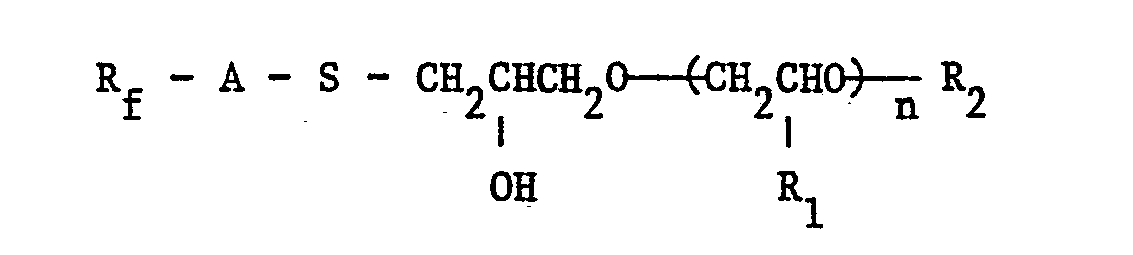
wherein Rf is perfluoroalkyl of 4 to 20 carbon atoms or perfluoroalkoxy- perfluoroalkyl of 4 to 20 carbon atoms, A is straight or branched chain alkylene of 1 to 10 carbon atoms which is unsubstituted or substituted by halogen, n is 1 to 50, R1 is hydrogen or alkyl of 1 to 4 carbon atoms, and R2 is hydrogen or alkyl of 1 to 4 carbon atoms.
wherein Rf is perfluoroalkyl of 4 to 20 carbon atoms or perfluoroalkoxy- perfluoroalkyl of 4 to 20 carbon atoms, A is straight or branched chain alkylene of 1 to 10 carbon atoms which is unsubstituted or substituted by halogen, n is 1 to 50, R1 is hydrogen or alkyl of 1 to 4 carbon atoms, and R2 is hydrogen or alkyl of 1 to 4 carbon atoms.
2. A fluorochemical surfactant according to claim 1, wherein Rf is perfluoroalkyl of 4 to 16 carbon atoms, or said perfluoroalkyl substituted by
perfluoroalkoxy of 2 to 4 carbon atoms, A is unsubstituted alkylene of 1 to 4 carbon
atoms, n is 5 to 50, R1 is hydrogen or methyl, and R2 is hydrogen or alkyl of 1 to 4 carbon atoms.
3. A fluorochemical surfactant according to claim 2, wherein R is hydrogen and R2 is alkyl of 1 to 4 carbon atoms.
4. A fluorochemical surfactant according to claim 3, wherein n is 5 to 25.
5. A fluorochemical surfactant according to claim 2, wherein R2 is alkyl of 1 to 4 carbon atoms and A is ethylene.
6. A fluorochemical surfactant according to claim 5, wherein R2 is methyl and A is ethylene.
7. A fluorochemical surfactant according to claim 2, wherein R2 is methyl and R1 is hydrogen.
wherein R1 is hydrogen or alkyl of 1 to 4 carbon atoms, R2 is hydrogen or alkyl of 1 to 4 carbon atoms and n is 1 to 50, with epichlorohydrin in bulk or in a dry and aprotic solvent in the presence of a lewis acid, and then reacting this intermediate with a perfluoroalkylalkylalkylens mercaptan of the formula
wherein Rf is perfluoroalkyl of 4 to 20 carbon atoms or perfluoroalkoxy- perfluoroalkyl of 4 to 20 carbon atoms and A is a straight or branched chain alkylene of 1 to 10 carbon atoms which is unsubstituted or substituted by halogen, in the presence of a base as acid acceptor.
9. Process for the manufacture of the compounds according to claim 1 which comprises
reacting a perfluoroalkylalkylene mercaptan of the formula
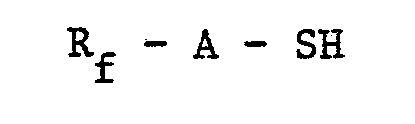
wherein Rf is perfluoroalkyl of 4 to 20 carbon atoms or perfluoroalkoxy- perfluoroalkyl of 4 to 20 carbon atoms and A is a straight or branched chain alkylene of 1 to 10 carbon atoms which is unsubstituted or substituted by halogen, with epichlorohydrin in an inert solvent and in the presence of a base, and then reacting the obtained epoxide intermediate with an alkoxylated compound of the formula
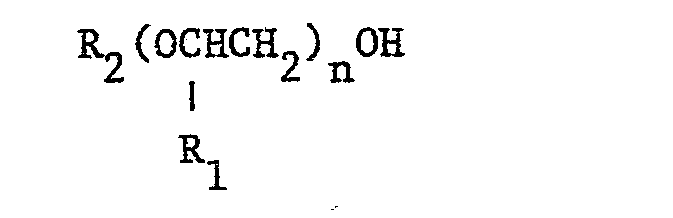
wherein R is hydrogen or alkyl of 1 to 4 carbon atoms, R2 is hydroger or alkyl of 1 to 4 carbon atins and n is 1 to 50, mder anti

anhydrous conditions in the presence or absence of an inert solvent and in the presence of a Lewis acid.
wherein Rf is perfluoroalkyl of 4 to 20 carbon atoms or perfluoroalkoxy- perfluoroalkyl of 4 to 20 carbon atoms and A is a straight or branched chain alkylene of 1 to 10 carbon atoms which is unsubstituted or substituted by halogen, with epichlorohydrin in an inert solvent and in the presence of a base, and then reacting the obtained epoxide intermediate with an alkoxylated compound of the formula
wherein R is hydrogen or alkyl of 1 to 4 carbon atoms, R2 is hydroger or alkyl of 1 to 4 carbon atins and n is 1 to 50, mder anti
anhydrous conditions in the presence or absence of an inert solvent and in the presence of a Lewis acid.
10. Use of the compounds according to claim 1 as emulsifiers or wetting and levelling
agents.