|
(11) | EP 0 011 311 B1 |

| (12) | EUROPEAN PATENT SPECIFICATION |
|
|
| (54) |
Alkyl glyceryl ether sulfate salts, process for their preparation and composition of matter containing them Salze von Alkylglyceryläthersulfaten und sie enthaltende Zusammensetzungen Sels de sulfates d'éthers alcoyle-glycéryle et compositions les contenant |
|
|
|||||||||||||||||||||||||||||||||||
| Note: Within nine months from the publication of the mention of the grant of the European patent, any person may give notice to the European Patent Office of opposition to the European patent granted. Notice of opposition shall be filed in a written reasoned statement. It shall not be deemed to have been filed until the opposition fee has been paid. (Art. 99(1) European Patent Convention). |
[0001] The present invention relates to anionic surfactants useful in formulating detergent compositions, and more particularly to novel sulfate salts of C10―C20 linear alkyl glyceryl ether alcohols containing 1-3 glyceryl units according to the formula
as well as to a process for producing the same and to composition of matter containing them.
[0002] In recent years the detergent industry has been increasing its usage of anionic surfactants, particularly the biodegradable aliphatic and/or alicyclic ether sulfonate and sulfate salts.
[0003] Alkyl ether sulfonate salts according to the above formula and their preparation are known from USA patent specification 3,024,273 wherein is described the preparation of CS-C22 alkyl chloropropylene ethers having 1-4 C3 units, i.e. compounds according to the above formula wherein X is chlorine, by reacting a stoichiometric excess of epichlorohydrin with high molecular weight fatty alcohols in the presence of a catalyst (polymerization, when occurring, being primarily via the oxygen on the middle carbon of the glyceryl unit). The sulfonate salts, i.e. compounds according to the above formula wherein at least part of the groups X are -S03M, M being sodium or potassium, are prepared therefrom by reacting at least one chlorine atom in the molecule with sodium or potassium sulfite. Sulfonation of chlorinated compounds, however, generally requires rather harsh conditions, particularly in terms of energy and equipment. Moreover, sulfonate salts such as the above-mentioned ones seem to be rather harsh to the human skin.
[0004] USA patent specification 3,431,265, disclosing the preparation of quaternary ammonium salts, mentions the existance of straight-chain alkyl mono-glyceryl ether sulfates according to the formula
wherein R is an alkyl group having from 8 to 22 carbon atoms and M is a cation, as being "well-known anionic surfactants". This implies the use of compound mixtures in which R may have various meanings, but in all those compounds the alkyl group is connected by an oxygen atom to position no. 1 of the C3 core and the sulfate group to position no. 3, and any molecule has got only one Ca-unit. This formula excludes position isomers such as 2 - alkoxy - 3 - hydroxypropyl - 1 - sulfates and 1 - alkoxy - 3 - hydroxypropyl - 2 - sulfates, and a fortiori molecules having two or three C3-units. The preparation of such 1 - alkoxy - 2 - hydroxypropyl - 3 - sulfates necessitates a cumbersome separation from the position isomers which makes such compositions uneconomic for actual use.
[0005] The patent literature also discloses the preparation of sulfate salts by reacting the primary hydroxyl group of branched C8―C20 alkyl ethers of ethylene glycol (formed by reactions involving ethylene glycol or ethylene oxide) with a sulfating agent and neutralization of the sulfuric acid ester with a base. The branching occurs at the α carbon atom, which is substituted with two alkyl groups.
[0006] Additionally the literature describes the preparation of the sulfate salts of similarly branched alkyl ether alcohols containing 1-3 ethylene-oxide units, and in particular the reaction of glycerol and dodecene-1 to produce a mixture of branched alkyl ether alcohols. The sulfate salts of the branched alkyl ethers of the type disclosed in this literature are less readily biodegraded than the analogous sulfate salts of the unbranched n-alkyl ethers.
[0007] Other sulfate salts derived from alkyl glyceryl ethers and processes for their preparation are known from German patent specification 757,749, which discloses the preparation of 1,3-dialkyl ethers of glycerol. Sulfate salts are prepared therefrom in a fashion similar to that. described above. These salts are said to be applied advantageously as textile finishing agents.
[0008] The present invention provides a novel anionic detergent product based on a mixture of alkyl mono- and poly-glyceryl ether alcohols according to the general formula
wherein R is a linear alkyl group having from 10 to 20 carbon atoms, n is an integer from 1 to 3, and wherein now X is either a hydroxyl or a sulfate group at least one X in each molecule being a sulfate group or position isomers thereof, and wherein at least 50% by weight of said mixture consists of compounds wherein n = 1, the balance of said mixture consisting essentially of compounds wherein n = 2 or 3, and for a major proportion of compounds wherein n = 2.
[0009] The cations of these sulfate salts may be sodium, potassium, ammonium and alkylol-substituted ammonium in which the alkylol group contains 2 or 3 carbon atoms, or a mixture of such cations.
[0010] The invention also comprises a process for preparing an anionic detergent product based on a mixture of alkyl mono- and poly-glyceryl ether alcohols, wherein said mixture of ether alcohols is converted into an anionic detergent containing per molecule one or more SOaH groups, which is recovered as a salt.
[0011] The starting material, the mixture of alkyl mono- and poly-glyceryl alcohols containing 1 to 3 glyceryl units per molecule, is obtained by reacting a C10-C20 linear alkyl alcohol with glycidol in the presence of a solvent and an acid catalyst and recovering a mixture of ether alcohols from the reaction mixture. This is the subject of the divisional patent application originating from the present one, and is not discussed in detail here.
[0012] For preparing the product of the invention said mixture of linear alkyl mono- and poly-glyceryl ether alcohols is reacted with a sulfating agent under the condition that the molecular ratio of the intermediate mixture of ether alcohols to the sulfating agent is within the range of from 1:1 to 1:1.15, and the reaction temperature is within the range of from -15° and 75°C.
[0013] When the mixture of ether alcohols from the glycidol/alkyl alcohol reaction is sulfated and neutralized directly, without separating or concentrating any particular component or components, the resulting sulfate salt mixture contains a major proportion, i.e. more than 50%, of such sulfates wherein n = 1, the balance of said mixture consisting essentially of compounds wherein n is 2 and 3. Generally said mixture contains at least 80% of such sulfated ether alcohols wherein n is 1.
[0014] In carrying out the sulfation reaction, the alkyl glyceryl ether alcohol reactant is contacted and reacted with a sulfating agent. Any of the known sulfating agents, such as chlorosulfonic acid, sulfur trioxide, pyrosulfate, oleum and sulfuric acid can be used in the process of the invention, the preferred sulfating agents being chlorosulfonic acid and sulfur trioxide.
[0015] Generally, molecular ratios of alkyl glyceryl ether alcohol to sulfating agent within the range of from 1:1 to 1:1.15 respectively are satisfactory in carrying out the sulfation reaction. When chlorosulfonic acid or sulfur trioxide is employed as the sulfating agent, the preferred molecular ratio of ether alcohol reactant to sulfating agent is within the range of from 1:1.01 to 1:1.05 respectively.
[0016] Such molecular ratios provide a product containing at least about one sulfate group per molecule. When stoichiometric ratios are employed, there is on the order of one sulfate group per molecule, primarily on an end carbon of the glyceryl unit. When a stoichiometric excess of sulfating agent (within the above range) is employed, up to 1.0% by weight of the product may comprise compounds having more than one sulfate group per molecule.
[0017] Preferably the ether alcohol reactant is predissolved in an inert diluent prior to being contacted with the sulfating agent. This procedure minimizes localized overheating in the reaction mass which may occur during admixture of the reactants. Such overheating can cause undesirable side reactions and decomposition of the alkyl chain, resulting in decreased yields and discoloration of the product.
[0018] Suitable inert diluents for predissolving the ether alcohol include organic solvents as the chlorinated methanes or ethanes, and 1,4-dioxane and the like. The preferred diluent is methylene chloride since it provides relatively concentrated solutions of the alkyl glyceryl ether alcohol reactant, for example, on the order of 30 weight percent, which allow for more rapid and complete sulfation than less concentrated solutions. Further, the relatively low boiling point of this diluent permits it to function as a built-in heat sink for controlling the reaction temperature, and permits its ready removal from the product upon completion of the reaction.
[0019] The concentration of alkyl glyceryl ether alcohol reactant in the selected diluent may vary, although as stated above, relatively concentrated solutions are preferred. Concentrations within the range of from 10 weight percent to 80 weight percent may be employed, the preferred range being from 25 weight percent to 50 weight percent.
[0020] When sulfur trioxide is employed as the sulfating agent it is additionally preferred to employ a diluent for this reactant. Such procedure minimizes product decomposition which might result from high concentrations of sulfur trioxide in the reaction mass. The diluent for sulfur trioxide should be inert to the materials in the reaction mass at the conditions employed, and is admixed with the sulfur trioxide prior to being contacted with the ether alcohol reactant.
[0021] Suitable diluents for the sulfur trioxide include for example nitrogen, air and sulfur dioxide, the amount of diluent being preferably sufficient to prevent or minimize said product decomposition.
[0022] Means are provided for maintaining the reaction mass in an agitated condition throughout the sulfation reaction period to facilitate contact between the reactants and to minimize or prevent localized overheating in the reaction mass during admixture of the reactants.
[0023] The temperature at which the sulfation reaction is carried out will generally vary from -15 to 75°C. When chlorosulfonic acid is employed as the sulfating agent, the reaction temperature is preferably within the range of 30 to 40°C. When sulfur trioxide is employed as the sulfating agent, the reaction temperature is preferably within the range of -10 to 20°C. The reaction time for preparing the products of the invention is primarily a function of reaction temperature, the particular diluent, and the sulfating agent. Generally, reaction times are on the order of minutes. When, for example, methylene chloride is employed as the diluent, and chlorosulfonic acid as the sulfating agent, reaction times between 5-10 minutes are generally sufficient at reaction temperatures within the preferred range for this sulfating agent.
[0024] When chlorosulfonic acid is employed as the sulfating agent, it is preferable, after completion of the reaction, to maintain the reaction mass at the reaction temperature for an additional time sufficient to drive off any remaining hydrogen chloride formed during the reaction period. Such additional time is typically 2 minutes.
[0025] After completion of the sulfation reaction and any further heating to remove hydrogen chloride, the sulfate product is recovered upon removal from the reaction mass (generally by distillation at reduced pressure) of any diluents employed.
[0026] In neutralizing the sulfate product to produce the linear alkyl glyceryl ether sulfate salts of the invention, sufficient water is added to dissolve at least some and preferably all of the sulfate product. The resulting solution (or slurry) is contacted with a base selected from the group consisting of sodium hydroxide, potassium hydroxide, ammonia, ammonium hydroxide, tetra-alkyl ammonium hydroxide, and alkylol- substituted ammonia in which the alkylol contains a whole number of carbon atoms from 2 to 3, the amount of base being sufficient to raise the pH of the solution to a value within the range of from 6.5 to 8.5.
[0027] The linear alkyl glyceryl ether sulfate salts of the invention are recovered upon drying the resulting solution or slurry.
Example I
[0029] This example demonstrates the production of essentially pure lauryl mono-glyceryl ether sulfate, potassium salt, that is, monomer ether sulfate, potassium salt.
[0030] Forty-one and six-tenths grams (0.16 moles) of lauryl mono-glyceryl ether alcohol prepared and isolated as described as in Example I of the divisional application and 150 ml of methylene chloride were charged to a 500 ml 3-necked round-bottom glass reaction flask equipped with a thermometer, TeflonTM paddle stirrer, condenser and dropping funnel. The ether alcohol readily dissolved in the methylene chloride and the solution was heated to 35°C. Nineteen and twelve-hundredths grams (0.168 moles) of chlorosulfonic acid sulfating agent were added to the contents of the flask over a 5- minute period. Evolution of hydrogen chloride from the resulting reaction mass began immediately upon addition of the sulfating agent. The reaction was initially exothermic, the temperature rising to 40°C. After about one- half of the sulfating agent was added, external heat was applied to maintain the reaction temperature at 40°C (reflux temperature). The reaction mass was refluxed for an additional 2 minutes after addition of the sulfating agent was completed. The methylene chloride solvent was then stripped from the reaction mass at reduced pressure (3333 Pa), leaving a colorless, waxy solid residue in the reaction flask. One hundred and fifty ml of water were added to the residue in the flask. The resulting mixture, which had a pH of 1.3, was neutralized to a pH of 8.0 by addition of 25% potassium hydroxide. A thick slurry was obtained which upon drying produced 60.6 grams of a white free-flowing solid. This solid assayed as 99% pure lauryl mono-glyceryl ether sulfate, potassium salt, which corresponds to a 99.2% yield based on starting lauryl mono-glyceryl ether alcohol.
Example II
[0031] This example demonstrates the production of essentially pure lauryl mono-glyceryl ether sulfate, sodium salt, that is, monomer ether sulfate, sodium salt.
[0032] The chemicals, procedure and equipment employed in this example are the same as in Example I, except that neutralization was effected with 25% sodium hydroxide. Upon drying of the resultant slurry, 58.5 grams of a thick free-flowing solid were obtained. This solid assayed as 98% pure lauryl mono-glyceryl ether sulfate, sodium salt, which corresponds to a 99.0% yield based on starting lauryl mono-glyceryl ether alcohol.
Example III
[0033] This example demonstrates the production of essentially pure lauryl mono-glyceryl ether sulfate, sodium salt, that is, monomer ether sulfate, ammonium salt.
[0034] The chemicals, procedure and equipment employed in this example are the same as in Example I, except that neturalization was effected with 20% ammonium hydroxide. Upon drying of the resultant slurry, 57.7 grams of a thick, wax-like solid were obtained. This solid assayed as 98% pure lauryl mono-glyceryl ether sulfate, ammonium salt, which corresponds to a 99.0% yield based on starting lauryl mono-glyceryl ether alcohol.
Example IV
[0035] This example demonstrates the production of lauryl di-glyceryl ether sulfate, potassium salt, that is, dimer ether sulfate, potassium salt, together with a small amount of the corresponding trimer sulfate salt.
[0036] The chemicals, procedure and equipment employed in this example were the same as in Example I, except that the glyceryl ether alcohol reactant was lauryl di-glyceryl ether alcohol (containing about 2% by weight lauryl tri-. glyceryl ether alcohol) obtained by a further distillation of the residue from the organic phase produced as described in Example I of the divisional application. Ten and two hundredths grams (0.03 moles) of such ether alcohol reactant were sulfated in 50 ml methylene chloride with 3.63 grams (0.0312 moles) of chlorosulfonic acid. After completion of the reaction, the methylene chloride solvent was stripped from the reaction mass and 25 ml water added to the residue as described in Example VI. Neutralization to a pH of 8 was effected by addition of 25% potassium hydroxide. Upon drying the resulting slurry, 13.8 grams of a white free-flowing solid were obtained. This solid assayed as 97.6% dimer and trimer lauryl glyceryl ether sulfates, potassium salts, (the trimer being present in only a few percent) which corresponds to a 99.3% yield based on starting lauryl di-glyceryl ether alcohol reactant.
Example V
[0037] This example demonstrates the production of a mixture of lauryl mono-, di- and tri-glyceryl ether sulfates, potassium salts, that is, monomer, dimer and trimer glyceryl sulfates, potassium salts.
[0038] A mixture of lauryl glyceryl ether alcohols comprising approximately 90 weight% monomer, 10 weight% dimer, and 0.1 weight% trimer ether alcohols was prepared following the procedure described in Example I of the division application. The equipment and procedure employed in preparing the ether sulfates, potassium salts, in this example were the same as in Example I. 45.3 grams (.16 moles) of the ether alcohol mixture dissolved in 150 ml of methylene chloride were reacted with 20.15 grams (.1729 moles) of chlorosulfonic acid sulfating agent. After completion of the reaction, the methylene chloride diluent was stripped from the reaction mass and 175 ml water added to the residue as described in Example I. Neutralization to a pH of 8.1 was effected by addition of 25% potassium hydroxide. Upon drying of the resultant slurry, 64.3 grams of a white free-flowing solid were obtained. This solid assayed as 99% monomer, dimer and trimer lauryl glyceryl ether sulfates, potassium salts, which corresponds to a 99.2% yield based on the starting lauryl glyceryl ether alcohol mixture.
Example VI
[0039] This example is intended to demonstrate the detersive properties of the glyceryl ether sulfate salts of the invention.
[0040] Surface tension, foam height and foam half-life measurements were made on the glyceryl ether sulfate salts obtained from Examples I, II, III, IV and V. The same measurements were made using lauryl sulfate sodium salt, which is used by the industry as a standard for comparing the detersive properties of anionic sulfate surfactants.
[0041] The surface tension measurements were made using a Fisher Surface Tensiometer and are reported in Table I as dynes/cm at 23.5°C. Low values for this measurement are indicative of good detersive action. As can be seen from the table, values for the compounds of the invention are on the order of 40% lower than the value for the standard, lauryl sulfate, sodium salt.
[0042] The foam height and foam half-life measurements were made following the Ross Miles Test (ASTM Method D 1173-53). Values for these. measurements are given in Table I. High values are desired as they are indicative of good foam stability. As can be seen from the table, foam height (initial and after five minutes) and foam half-life values for the compounds of the invention are in all instances appreciably greater than the corresponding values for the standard, lauryl sulfate, sodium salt.
1. An anionic detergent product based on a mixture of alkyl mono- and poly-glyceryl
ether alcohol according to the general formula
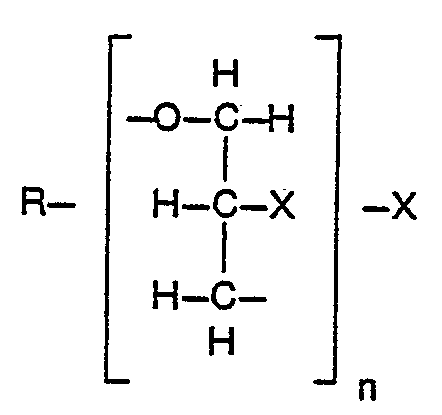
wherein R is a linear alkyl group having from 10 to 20 carbon atoms, n is an integer from 1 to 3, characterized in that X is either a hydroxy or a sulfate group, at least one X in each molecule being a sulfate group and position isomers thereof, and in that at least 50% by weight of said mixture consists of compounds wherein n = 1, the balance of said mixture consisting essentially of compounds wherein n = 2 or 3 and for a major proportion of compounds wherein n = 2.
wherein R is a linear alkyl group having from 10 to 20 carbon atoms, n is an integer from 1 to 3, characterized in that X is either a hydroxy or a sulfate group, at least one X in each molecule being a sulfate group and position isomers thereof, and in that at least 50% by weight of said mixture consists of compounds wherein n = 1, the balance of said mixture consisting essentially of compounds wherein n = 2 or 3 and for a major proportion of compounds wherein n = 2.
2. A product according to claim 1, characterized in that in said formula R is a linear
alkyl group having from 12 to 16 carbon atoms.
3. A product according to 2, characterized in that in said formula R is a lauryl group.
4. A product according to any of the preceding claims, characterized in that the cations
of the sulfate groups are sodium, potassium, ammonium and/or alkylol-substituted ammonium,
in which the alkylol group contains 2 or 3 carbon atoms.
5. A process for preparing an anionic detergent product based on a mixture of alkyl
mono-and poly-glyceryl ether alcohols containing 1 to 3 glyceryl units per molecule,
wherein a C10―C20 linear alkyl alcohol is reacted with glycidol in the presence of a solvent and an
acid catalyst, a mixture of linear alkyl glyceryl ether alcohols is recovered from
the reaction mixture and by contacting with a sulfating agent is converted into an
anionic detergent product containing per molecule one or more SOaH groups, which is recovered as a salt, characterized in that said alcohol and glycidol
are brought together in a molecular ratio of from 1.5:1 to 8:1 and in that the solvent
is hexylacetate in which the glycidol is predissolved, in that the molecular ratio
of the intermediate mixture of ether alcohols to the sulfating agent is within the
range of from 1:1 and 1:1.15, the reaction temperature being within the range of from
25° to 125° during the reaction of the alcohol with the glycidol and within the range
of from - 15 to 75° during the sulfation of the ether alcohols.
6. A process according to claim 5, characterized in that the linear alkyl alcohol
is one having from 12 to 16 carbon atoms.
7. A process according to claim 6, characterized in that the linear alkyl alcohol
is lauryl alcohol.
8. A process according to any of the claims 6, 7, or 8, characterized in that the
sulfating agent is chlorosulfonic acid.
9. A process according to any of the claims 6, 7, 8 or 9, characterized in that prior
to the sulfation the ether alcohol is dissolved in methylenechloride.
1. Produit détergent anionique basé sur un mélange d'éther alcools alkyle mono-et
polyglycéryliques répondant à la formule générale:
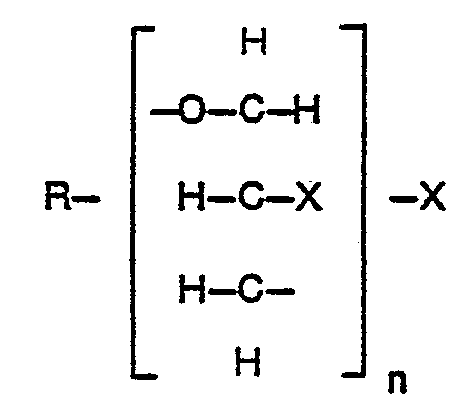
dans laquelle R est un groupe alkyle linéaire ayant 10 à 20 atomes de carbone, n est un entier de 1 à 3, caractérisé en ce que X est soit un groupe hydroxy, soit un groupe sulfate, au moins un X de chaque molécule étant un groupe sulfate et des isomères de position de celui-ci, et en ce qu'au moins 50% en poids de ce mélange consistent en composés dans lesquels n = 1, le reste de ce mélange étant essentiellement constitué de composés dans lesquels n = 2 ou 3, et pour une proportion prédominante de composés dans lesquels n=2.
dans laquelle R est un groupe alkyle linéaire ayant 10 à 20 atomes de carbone, n est un entier de 1 à 3, caractérisé en ce que X est soit un groupe hydroxy, soit un groupe sulfate, au moins un X de chaque molécule étant un groupe sulfate et des isomères de position de celui-ci, et en ce qu'au moins 50% en poids de ce mélange consistent en composés dans lesquels n = 1, le reste de ce mélange étant essentiellement constitué de composés dans lesquels n = 2 ou 3, et pour une proportion prédominante de composés dans lesquels n=2.
2. Produit suivant la revendication 1, caractérisé en ce que dans cette formule, R
est un groupe alkyle linéaire ayant de 12 à 16 atomes de carbone.
3. Produit suivant la revendication 2, caractérisé en ce que dans cette formule, R
est un groupe lauryle.
4. Produit suivant l'une quelconque des revendications précédentes, caractérisé en
ce que les cations des groupes sulfate sont le sodium, le potassium, l'ammonium et/ou
l'ammonium alkylolsubstitué, dans lequel le groupe alkylol contient 2 ou 3 atomes
de carbone.
5. Procédé de préparation d'un produit détergent anionique basé sur un mélange d'éther
alcool alkyl mono- et polyglycéryliques contenant 1 à 3 motifs glycéryle par molécule,
dans lequel un alcool alkylique linéaire en C10 à C20 est mis à réagir avec du glycidol en présence d'un solvant et d'un catalyseur acide,
un mélange d'éther alcools alkyl glycéryliques linéaires est récupéré du mélange réactionnel
et, par contact avec un agent de sulfatation, est transformé en un produit détergent
anionique contenant par molécule un ou plusieurs groupes S03H, qui est récupéré sous forme de sel, caractérisé en ce que cet alcool et ce glycidol
sont unis dans un rapport moléculaire de 1,5:1 à 8:1 et en ce que le solvant est l'acétate
d'hexyle dans lequel le glycidol est prédissous, en ce que le rapport moléculaire
du mélange intermédiaire d'éther alcools à l'agent de sulfatation est dans l'intervalle
de 1:1 et 1 :1,15, la température de réaction étant dans l'intervalle de 25 à 125°
pendant la réaction de l'alcool avec le glycidol et dans l'intervalle de -15° à 75°
pendant la sulfatation des éther alcools.
6. Procédé suivant la revendication 5, caractérisé en ce que l'alcool alkylique linéaire
est un alcool ayant de 12 à 16 atomes de carbone.
7. Procédé suivant la revendication 6, caractérisé en ce que l'acool alkylique linéaire
est l'alcool laurique.
8. Procédé suivant l'une quelconque des revendications 6, 7 ou 8, caractérisé en ce
que l'agent de sulfatation est l'acide chlorosul- fonique.
9. Procédé suivant l'une quelconque des revendications 6, 7, 8 ou 9, caractérisé en
ce qu'avant la sulfatation, l'éther alcool est dissous dans du chlorure de méthylene.
1. Ein anionisches Waschmittel auf ein Gemisch aus Alkylmono- und Polyglycerylätheralkoholen
nach der allgemeinen Formel
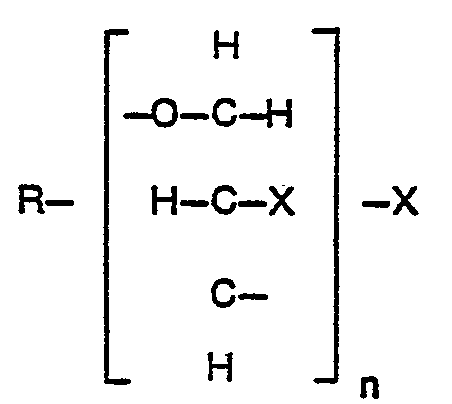
basiert, in welcher Formel R eine lineäre Alkylgruppe mit 10-20 Kohlenstoffatomen ist, n eine ganze Zahl von 1-3 ist, dadurch gekennzeichnet, dass X entweder eine Hydroxy- oder eine Sulfatgruppe ist wobei am mindesten eins X in jedem Molekül eine Sulfatgruppe ist, und Stellungsisomere davon, und dadurch dass mindestens 50 Gew.% des Gemisches aus Verbindungen besteht in welchen n = 1, wobei der Rest des Gemisches wesentlich aus Verbindungen in denen n = 2 oder 3 und grösstenteils aus Verbindungen in denen n = 2 besteht.
basiert, in welcher Formel R eine lineäre Alkylgruppe mit 10-20 Kohlenstoffatomen ist, n eine ganze Zahl von 1-3 ist, dadurch gekennzeichnet, dass X entweder eine Hydroxy- oder eine Sulfatgruppe ist wobei am mindesten eins X in jedem Molekül eine Sulfatgruppe ist, und Stellungsisomere davon, und dadurch dass mindestens 50 Gew.% des Gemisches aus Verbindungen besteht in welchen n = 1, wobei der Rest des Gemisches wesentlich aus Verbindungen in denen n = 2 oder 3 und grösstenteils aus Verbindungen in denen n = 2 besteht.
2. Ein Produkt nach Anspruch 1, dadurch gekennzeichnet dass in der genannten Formel
R eine lineäre Alkylgruppe mit 12-16 Kohlenstoffatomen ist.
3. Ein Produkt nach Anspruch 2, dadurch gekennzeichnet, dass in der genannten Formel
R eine Laurylgruppe ist.
4. Ein Produkt nach einem der vorhergehenden Ansprüche, dadurch gekennzeichnet, dass
die Kationen der Sulfatgruppen Natrium, Kalium, Ammonium und/oder Alkylol-substituiertes
Ammonium sind, wobei die Alkylolgruppe 2 oder 3 Kohlenstoffatome enthält.
5. Ein Verfahren zurt Herstellung eines anionischen Waschmittels auf ein Gemisch aus
Alkylmono- und Polyglycerylätheralkolen die 1-3 Glyceryleinheiten pro Molekül enthälten
basiert, wobei ein lineäres Alkylalkohol mit 10-20 Kohlenstoffatomen mit Glycidol
reagiert wird in Gegenwart eines Lösungsmittels und eines säuren Katalysators, ein
Gemisch lineären Alkylglycerylätheralkohole aus dem Reaktionsgemisch gewonnen wird
und mittels Berührung mit einem Sulfatierungsmittel in ein anionisches Waschmittelprodukt
umgesetzt wird, das pro Molekül eine oder mehrere S03H-Gruppen enthält, und das als ein Salz gewonnen wird, dadurch gekennzeichnet, dass
das genannte Alkohol und das Glycidol in einem molekülaren Verhältnis von 1,5:1 zu
8:1 zusammengebracht werden und dass das Lösungsmittel Hexylacetat ist, worin das
glycidol vorgelöst ist, wobei das molekülare Verhältnis des intermediären Gemisches
aus Ätheralkoholen zu dem Sulfutiertungsmittel innerhalb des Bereich von 1:1 und 1:1,15
ist, wobei die Reaktionstemperatur während der Reaktion des Alkohols mit dem Glycidol
innerhalb dem Bereich von 25° zu 125° und innerhalb dem Bereich von -15°C zu 75° während
der Sulfatierung der Ätheralkohole ist.
6. Ein Verfahren nach Anspruch 5, dadurchgekennzeichnet, dass das lineäre Alkylalkohol
ein alkohol mit 12-16 Kohlenstoffatomen ist.
7. Ein Verfahren nach Anspruch 6, dadurch gekennzeichnet dass das lineäre Alkylalkohol
Laurylalkohol ist.
8. Ein Verfahren nach irgendeinem der Ansprüche 6, 7 oder 8 ist, dadurch gekennzeichnet
dass das Sulfatierungsmittel Chlorsulfonsäure ist.
9. Ein Verfahren nach irgendeinem der Ansprüche 6, 7, 8 oder 9 ist, dadurch gekennzeichnet
dass vor der Sulfatierung das Ätheralkol in Methylenchlorid gelöst wird.