|
(11) | EP 0 011 389 A1 |

| (12) | EUROPEAN PATENT APPLICATION |
|
|
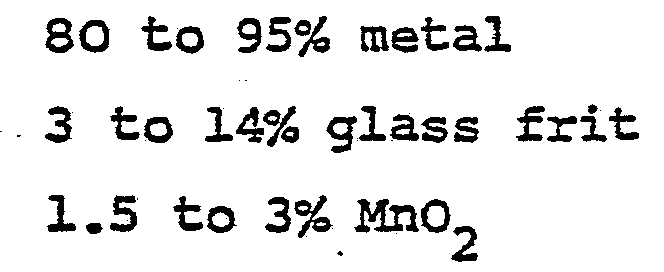
|
|
|||||||||||||||||||||||||||
| (54) | Ceramic capacitor having co-fired base metal end terminations, and paste or ink for producing said end terminations |
| (57) A ceramic body containing embedded metal electrodes is provided with end termination
configurations using a paste or ink containing base metal (nickel or copper) particles,
glass frit (barium borosilicate or barium aluminosilicate glasss) and MnO2 in an organic vehicle, such as ethyl cellulose in butyl cellosolve. The body and
end terminations are co-fired to provide a ceramic capacitor. |
[0001] The present invention relates to monolithic multi-electrode ceramic capacitors having base metal end terminations, and to a paste or ink for producing the end terminations.
[0002] Monolithic ceramic capacitors are known to the art, for example, see U.S. patents 3,612,963 (1971), 3 , 815 , 187 (1974), 4,055,850 (1977) and 3,902,102 (1975) and comprise a ceramic body, e.g., of barium titanate, a plurality of metal film electrodes embedded in the ceramic body and end terminations of silver or a base metal contacting exposed end portions of alternate electrodes and adhering to end portions of the ceramic body.
[0003] While noble metals such as silver and silver alloys are conventionally used as electrode materials, it has been proposed to use less expensive nickel and copper as electrode materials in conjunction with nickel and/ or copper base metal end terminations. A particular technique of this type is disclosed in U.S. patent 3,902, 102 (1975) whereby the base metal terminations are provided on a pre-fired (about 1300 - 1400 C) ceramic body by applying and subsequently firing at a lower temperature a nickel or copper base metal paste which contains barium borate glass frit. This practice, while providing advantages, does not permit the more economical practice of co-firing the ceramic body and base metal paste since the higher temperatures required in co-firing (at least as high as the ceramic firing temperature of 1300 - 1400 C) lead to oxidation reaction of the base metal and glass constituents of the termination and detrimentally affect the properties of the capacitor resulting in lower capacitance,higher dissipation factor, lower insulation resistance, and lower adhesion characteristics.
[0004] These problems of the prior art are overcome in the present invention by means of a paste or ink for forming metal end terminations which can effectively be co-fired with the ceramic body of the capacitor.
[0005] According to the present invention there is provided a paste or ink for providing end terminations on a ceramic capacitor consisting essentially of a mixture, in an organic vehicle, of a finely divided metal selected from nickel and copper; glass frit, the glass being selected from barium borosilicate glass and barium aluminosilicate glass; and MnO2 ; the proportions by weight of the metal, glass frit and MnO2 being from about
[0006] The invention will now be described in more detail making reference to the accompanying drawings, in which:
Figure 1 illustrates an unfired ceramic capacitor body
Figure 2 shows the body of Figure 1 after co-firing with base metal end terminations on a fired ceramic body, and
Figure 3 is a scanning electron microscope microphotograph (500X) of a portion of an end termination in accordance with the present invention.
[0007] One aspect of the present invention is a base metal paste or ink consisting essentially of an organic vehicle containing a mixture of finely-divided metal powders, nickel or copper, a barium borosilicate or barium aluminosilicate glass frit, and MnO2. The metal powder is suitably sized from about O.5 to 10 microns and is about 80 to 95% by weight of the inorganic constituents of the paste e.g. metal, glass, Mn02. The glass frit, suitable sized 0.5µ to 2µ is about 1.5 to 3% by weight of the inorganic constituents of the paste. The organic vehicle is suitably from about 20 to 40% of the weight of the inorganic constituents and is suitably ethyl cellulose dissolved in butyl cellosolve or other resin formulations used in pastes and known to the art.
[0008] In the practice of the present invention, thin slips of a green, dried, ceramic, unfired conventional formulation, e.g. barium titanate containing up to about
EXAMPLE I
[0011] An end termination paste was prepared by mixing in a resin the inorganic constituents in proportions as follows: 91% by weight nickel powder sized 1-5µ, 6% by weight of glass frit sized 0.5µ to 2.0µ (barium- aluminum silicate) with 3% by weight of MnO2 sized 1-5µ, and the organic vehicle was ethyl cellulose (8% by weight) dissolved in butyl cellosolve and contained 2% by weight of surfactant (Raybo 56-Trademark of Raybo Chemical) . The vehicle was 31% of the weight of the inorganic constituents. The resulting paste was three- roll milled to achieve optimum dispersion of the metal powder.
EXAMPLE II
[0012] Finely divided powder containing about 85-90% barium titanate balance, calcium zirconate, barium carbonate and manganese dioxide, was mixed with about 8% by weight pasticized polyvinyl alcohol and slip cast and dried to provide green ceramic tape about 2 mils thick.
[0013] Rectangular electrode patterns (0.566 cm X 0.569 cm X 0.008 cm). were screen printed using an ink containing nickel particles on the green ceramic tape using a 325 mesh (U.S. Series) stainless steel screen. The printed green ceramic tape was cut into strips and stacked in a capacitor configuration as shown in Figure 1. The capacitor configuration was arranged to have 18 printed electrodes i.e. 17 active dielectric layers. A paste of the composition of Example 1 was applied as end terminations to the unfired ceramic body, and the body was subsequently fired in an argon gas atmosphere at 1350oC for about 5 hours. Leads were attached by solder dipping and measured properties of twenty capacitors were as follows:
COMPARATIVE EXAMPLE
[0014] The procedure of Example II was followed except that the paste used for the end terminations did not contain MnO2. The measured properties of twenty capar- citors were as follows:
[0015] As can be seen by comparing the above results with Example II, the capacitors of Example II, in which MnO2 was used in the end termination paste, in accordance with the present invention, have improved properties. This is believed to be due to the presence of manganese intermediately adjacent to glass particle in the metal phase of the end termination which inhibits oxidation of the metal phase in the firing step of forming capacitors.
1. A paste or ink for providing end terminations on a ceramic capacitor consisting
essentially of a mixture, in an organic vehicle, of a finely divided metal. selected
from nickel and copper; glass frit, the glass being selected from barium borosilicate
glass and barium aluminosilicate glass; and MnO2; the proportions by weight of the metal, glass frit and MnO2 being from about
2. A paste or ink according to Claim 1 in which the metal powder is sized from about
0.5 to 10 microns.
3. A paste or ink according to Claim 1 or 2 in which the glass frit is sized from
0.5 to 2µ.
4. A paste or ink according to Claim 1,2 or 3 in which the MnO2 is sized from 0.5 to 20µ
5. A paste or ink according to any one of Claims 1 to 4 in which the organic vehicle
is from about 20 to 40% by weight of the inorganic constituents.
6. A paste or ink according to any one of Claims 1 to 5 in which the organic vehicle
is ethyl cellulose dissolved in butyl cellosolve.
7. A ceramic capacitor formed by firing a green ceramic body containing a plurality
of embedded electrodes and having end portions coated with a paste or ink according
to any one of Claims 1 to 6.