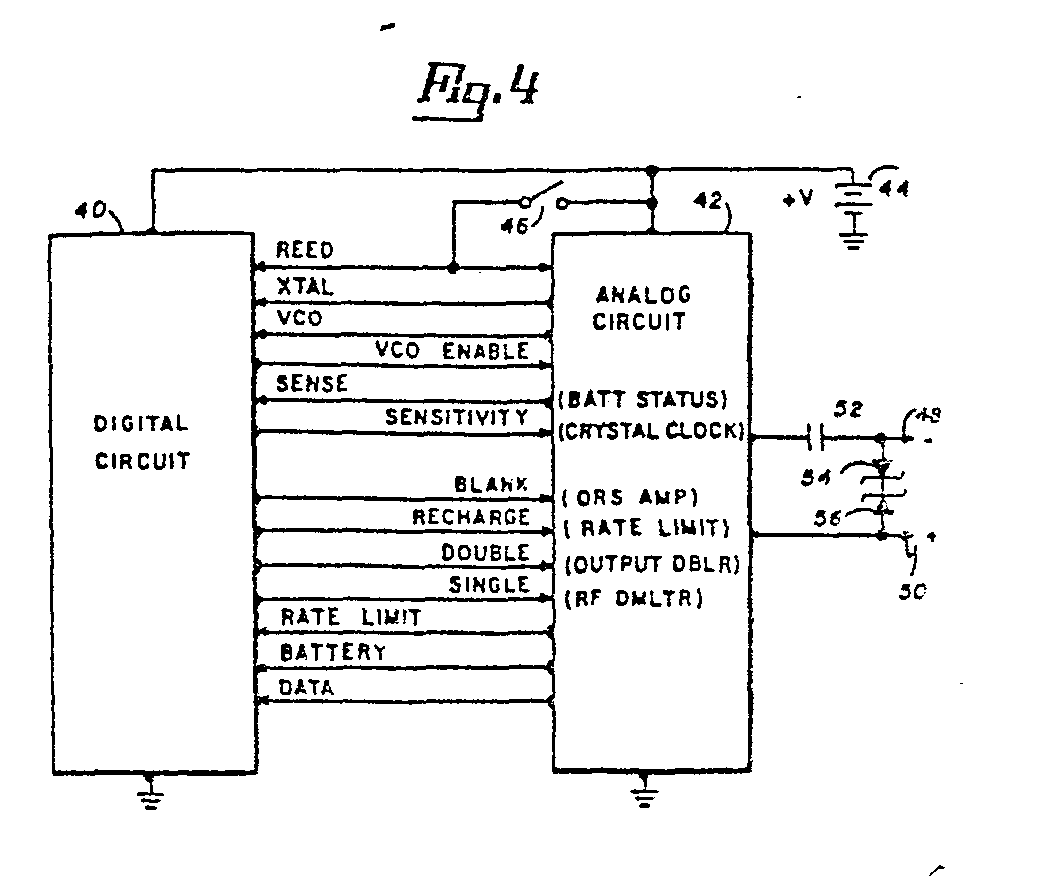
(57) A programmable medical device, e.g. a cardiac pacemaker, utilizes digital circuitry
40 for controlling circuitry 42 for providing clocks, an output circuit and heart
activity sensing. Digital circuit 40 includes a memory in which may be programmed
on a permanent or temporary basis from an external programmer control information
relating to rate, pulse width, pulse amplitude, refractory period, sense amp- lifiersensitivity
and the mode of operation desired. In addition the output can be inhibited or a threshold
margin test can be performed in which a reduced energy output pulse is provided to
check if heart capture is lost. The pacemaker can operate in a hysteresis mode and
provides a high rate limit which can however be exceeded by programming. The pacemaker
further includes means for signalling the acceptance of a programming signal and means
to reset the program acceptance circuit if extraneous signals are detected as programming
signals. The acceptance circuit checks for the receipt of the proper number of signals
within a given time, for an access code and correct parity. Timing is by means of
a crystal oscillator and a voltage controlled oscillator controls pulse width to obtain
energy compensation with varying battery voltage.
|
|
