|
(11) | EP 0 012 395 B1 |

| (12) | EUROPEAN PATENT SPECIFICATION |
|
|
| (54) |
Method for synthesis of penicillin Verfahren zur Herstellung von Penicillin Méthode de synthèse de la pénicilline |
|
|
|||||||||||||||||||||||||||||||
|
||||||||||||||||||||||||||||||||
| Note: Within nine months from the publication of the mention of the grant of the European patent, any person may give notice to the European Patent Office of opposition to the European patent granted. Notice of opposition shall be filed in a written reasoned statement. It shall not be deemed to have been filed until the opposition fee has been paid. (Art. 99(1) European Patent Convention). |
[0001] This invention relates to a method for synthesizing a penicillin by reacting a silylate of 6-aminopenicillanic acid and a carboxylic acid halide; more particularly it relates to such a penicillin synthesizing method featuring the use of a weakly basic resin as acid coupling agent.
Description of the Prior Art:
[0002] It is known that various kinds of penicillin compositions can be synthesized from 6-aminopenicillanic acid and carboxylic acid halides. The reaction therefor is usually accomplished by first silylating 6-aminopenicillanic acid and then reacting the resultant silylate with a carboxylic acid halide. Since a hydrohalic acid is produced in this reaction, it is necessary to carry out the reaction in the presence of an acid coupling agent. Heretofore, amines such as. dimethyl amine, pyridine, quinoline, picoline, etc., have been commonly used as an acid coupling agent in said reaction. However, the use of such amines involves some serious problems: it is hard to separate such amines from the produced penicillin, and even if an elaborate separating operation is used, a trace of amine may still be present in the penicillin produced., Presence of even a trace of amine in the product results in various adverse effects such as headache, nausea, drowsiness, etc., because of the toxicity of amines.
[0003] In GB - A - 1 212 551 a method for preparing a semi-synthetic penicillin is described which comprises reacting 6-aminopenicillanic acid' adsorbed on an anion-exchange resin with an acylating agent to produce the desired penicillin.
[0004] As a result of further research into the penicillin synthesizing method without the use of any amine, the present inventors found that . the above-mentioned problems can be solved by using as acid coupling agent an insoluble weakly basic resin having a three-dimensional structure and they thus succeeded in formulating the present invention.
[0005] It is an object of the present invention to provide a penicillin free of amines such as dimethylamine, pyridine, quinoline, picoline, etc. This problem is solved by the invention, where a penicillin is synthesized by reacting a silylate of 6-aminopenicillanic acid and a carboxylic acid halide in the presence of an insoluble weakly basic resin having a three-dimensional structure.
[0006] According to this invention, a silylate of 6-aminopenicillanic acid and a carboxylic acid halide are reacted in a proper inert solvent in the presence of an insoluble weakly basic resin having a three-dimensional structure and a dissociation constant from 10-8 to 10-11, and after removal of the resin from the reaction mixture by filtration, centrifugation or other means, the object penicillin is separated from the filtrate and refined according to a known process, thereby obtaining a penicillin which is free of impurities and has no side effects.
[0007] A silylate of 6-aminopenicillanic acid, which is one of the reaction materials in the process of this invention, can easily be obtained by silylating 6-aminopenicillanic acid with a silylating agent such as trimethylchlorosilane, triethylchlorosilane, triethylbromosilane, etc., in a suitable solvent such as benzene, toluene, methylene chloride, tetrahydrofuran, etc., and in the presence of a base such as triethylamine, diethylamine, ethylamine, etc., according to a known method.
[0008] The carboxylic acid halide to be reacted with said silylate of 6-aminopenicillanic acid may be suitably selected according to the type of the penicillin to be produced; an acid halide of a-amino acid is preferred. In this case it is necessary to protect the amino group of the acid halide with a suitable protective agent such as, for example, a hydrohalic acid. Among the acid halides of a-amino acid, the phenylglycine derivatives represented by the following general formula (I)
. wherein R is hydrogen, a hydroxyl group or a protected hydroxyl group and X is a halogen are most preferred.
[0009] The insoluble weakly basic resin having a three-dimensional structure and a dissociation constant of from 10-8 to 10-11 which is used in the reaction of this invention, may be selected from the copolymers of weakly basic polymerizable amines such as vinylpyridine, vinylquinoline, vinylpicoline, N,N-dimethylvinylaniline, etc., and polyfunctional monomers copolymerizable therewith. As polyfunctional monomer a trifunctional monomer may be used such as trimethylolpropane trimethacrylate or other polyfunctional monomers of higher orders; preferred is a difunctional monomer such as divinylbenzene, divinyltoluene, divinylnaphthalene, ethylene glycol dimethacrylate, divinyl adipate or the like. It is also possible to use a condensate of an amine such as dimethylaniline, N,N,N',N'-tetramethyl-m-phenylenediamine, etc. and an aldehyde such as formalin or glutaraldehyde.
[0010] As regards the physical structure of the resin .used in this invention, it is possible to use both the so-called gel-structured type and the macro porous type having a large specific surface area. The particle size of the resin used in this invention is preferably within the range of 20 to 400 meshes (0.833-0.037 mm width of mesh).
[0011] The reaction of a silylate of 6-aminopenicillanic acid with a carboxylic acid halide in the process of this invention can be accomplished in a generally known way, except for use of said weakly basic resin instead of pyridine as acid coupling agent. Said reaction may be performed, for example, by adding a silylate of 6-aminopenicillanic acid, a substantially equimolecular amount of a carboxylic acid halide and at least equimolecular amount, preferably more than two equivalents of said dry, weakly basic resin in an inert solvent such as benzene, toluene, methylene chloride, ethylene chloride, tetrahydrofuran, ethyl ether, dimethylformamide, methylisobutyl ketone or the like. After the reaction is finished, the resin is removed by filtration, centrifugation or other means. To the reaction solution is then added water, alcohol or similar to eliminate the silyl groups to produce a penicillin. Separation of the penicillin from the reaction solution and purification thereof can be accomplished according to a usual method which is suitably selected depending on the type of the penicillin to be produced. For instance, in the case of Ampicillin or Amoxycillin, the product can be precipitated in the form of crystals by adding caustic soda to the reaction solution to adjust the pH of the reaction solution to the isoelectric point.
[0012] Since the penicillin obtained according to this invention is free of amines such as pyridine, its use is not accompanied by any side effects.
[0013] The invention is described in further detail by way of the examples and referential examples, but it is to be understood that the invention is not limited by these examples but may be embodied in other forms within the gist of the invention.
[0014] In the following referential examples, resin drying was effected at 80°C under 1 mmHg for 8 hours.
[0015] The hydrochloric acid adsorptivity of the resin was determined in the following way: 3 g of the resin deprived of deposited mositure was added to 250 ml of a 1/5N HCI solution, and after shaking the solution for 18 hours the hydrochloric acid concentration of the supernatant liquid was measured to determine the amount of reduction from which the hydrochloric acid adsorptivity of the resin was calculated.
[0016] The dissociation constant of the resin was determined according to the method shown in F. Helfferich: "Ion Exchange" (McGraw-Hill, pub. in 1962) p. 84. Thus, the dissociation constant of resin in this invention is the apparent dissociation constant.
Referential Example 1
(Synthesis of gel-type 4-vinylpyridine resin)
[0017] 1,800 ml of desalted water, 72 g of common salt, 12 g of polivinyl alcohol and 12 g of carboxymethyl cellulose were dissolved in a 3- litre four-necked flask provided with a cooling pipe, stirring rod and a nitrogen supply pipe, and after replacing the atmosphere in the flask with nitrogen, to the mixture was further added 4.26 g of industrial divinylbenzene (purity: 56.5%), 115.56 g of 4-vinylpyridine and 1.2 g of azobisisobutyronitrile. In the nitrogen atmosphere and under stirring, the mixture was heated at 80°C for 4 hours and then at 90°C for an additional 4 hours to effect polymerization. After completion of the polymerization, the obtained resin was washed well with water. Then the resin was packed in a column and washed with 50 litres of methanol and then with 10 litres of water. This was followed by further washing with 50 litres of 1 N hydrochloric acid, 10 litres of desalted water, 50 litres of 1N caustic soda and 30 litres of desalted water, successively in that order. The hydrochloric acid adsorptivity of the obtained resin was 2.99 meq/ml (wet resin) and 9.11 meq/g (dry resin), and the moisture content was 50%. The dissociation constant of this resin at 20°C was 9.7 x 10⁻¹⁰ and the particle size was 100-200 meshes (0.147-0.074 mm width of mesh).
Referential Example 2
(Synthesis of highly porous type 4-vinylpyridine resin)
[0018] 1,500 ml of desalted water, 90 g of common salt and 2 g of polyvinyl alcohol were dissolved in a 3-litre four-necked flask provided with a cooling pipe, a stirring rod and a nitrogen supply pipe, and after replacing the atmosphere in the flask with nitrogen, 53.1 g of industrial divinylbenzene (purity: 56.5%), 66.9 g of 4-vinylpyridine, 12 g of benzoyl peroxide and 48 g of isooctane were further added. The mixture was heated at 80°C for 4 hours and then at 90°C for an additional 4 hours in the nitrogen atmosphere under stirring to effect polymerization. Upon completion of the polymerization, the resulting resin was washed in the same way as in Referential Example 1. The hydrochloric acid adsorptivity of the thus obtained resin was 1.19 meq/ml (wet resin) and 6.22 meq/g (dry resin) and the moisture content was 67.9%. The dissociation constant of this resin at 20°C was 8.4 x 10⁻¹⁰ and the particle size was 50-100 meshes (0.294-0.147 mm width of mesh).
Example 1
[0019] 43.2 g (0.20 moles) of 6-aminopenicillanic acid and 40.5 g (0.40 moles) of triethylamine were added to 500 ml of methylene chloride, and the mixture was stirred at room temperature for 45 minutes. Then, after adjusting the temperature to 15°C, 43.4 g (0.040 moles) of trimethylchlorosilane was further added to the mixture over a period of 7 minutes and then stirred at 40°C for 60 minutes to complete silylation. The reaction mixture was cooled to -25°C, 87.8 g (0.8 equivalents) of the dry resin produced in Referential Example 1 were added and then further 43.3 g (0.20 moles) of D(-)-a-phenylglycylchloride hydrochloride (purity: 95%) were further added dropwise over a period of 60 mintues. After this dropwise addition the temperature was raised to -5°C and the mixture was stirred at this temperature for 90 minutes. The resin was filtered off and washed with 200 ml of cold methylene chloride, and the wash liquid was combined with the filtrate. The combined methylene chloride solutions were evaporated at 0°C under reduced pressure until the liquid quantity reached 400 ml, and then the filtrate was poured into 400 ml of cold water and stirred for 10 minutes. The mixed solution was allowed to stand to separate into two layers, and the methylene chloride layer was reextracted with 50 ml of cold water. This was combined with the aqueous layer and 280 ml of methylisobutyl ketone were added. After adjusting the pH to 4.5 with 20% caustic soda solution, the mixture was stirred at 10°C for one hour. The precipitated crystals were filtered off, washed twice with 75 ml of water and three times with 125 ml of acetone, and then dried at 35°C under reduced pressure. The resulting Ampicillin trihydrate had a purity of approximately 90% (purity according to microbial activity) and the yield was 57%.
Example 2
[0020] The 6-aminopenicillanic acid silylation reaction mixture obtained in the same way as described in Example 1 was cooled to -25°C, then 128.6 g (0.80 equivalents) of the resin produced in Referential Example 2 were added and 55.5 g (0.20 moles) of D(-)-a-(p-hydroxyphenyl) glycinechloride hydrochloride (purity: 80%) were dropwise added over a period of 60 minutes. Upon completion of this dropwise addition, the temperature was raised to -5°C and the mixture was stirred at this temperature for 90 minutes to complete the reaction. This was followed by the same treatment as in Example 1, except that the pH was adjusted to 5.3 at the time of precipitation. Consequently Amoxycillin trihydrate with a purity of 88% was obtained.
Referential Example 3
(Synthesis of gel type 2-vinylpyridine resin)
[0021] 1,800 ml of desalted water, 150 g of common salt, 2 g of polyvinyl alcohol, 8.9 g of divinylbenzene (purity: 56.5%), 243.1 g of 2-vinylpyridine and 2.5 g of azobisisobutyronitrile were introduced into a 3-litre four-necked flask equipped with a cooling pipe, a stirring rod and a nitrogen supply pipe, and the mixture was heated at 65°C for 4 hours and then at 80°C for 5 hours in the nitrogen atmosphere under stirring to perform polymerization. After completion of the polymerization, the resulting resin was washed in the same way as in Referential Example 1. The resultant resin had a hydrochloric acid adsorptivity of 3.32 meq/ml (wet) and 8.78 meq/g (dry) and a moisture content of 45.3%. The dissociation constant of this resin at 20°C was 5.0 x 10⁻¹¹ and the particle size was 100-200 meshes (0.147-0.074 mm width of mesh).
Referential Example 4
(Synthesis of highly porous 2-vinylpyridine resin)
[0022] 1,500 ml of desalted water, 126 g of common salt and 1.6 g of polyvinyl alcohol were dissolved in a 3-litre four-necked flask furnished with a cooling pipe, a stirring rod and a nitrogen inlet pipe, and after replacing the interior of the flask with nitrogen, 111 g of divinylbenzene (purity: 56.5%), 99 g of 2-vinylpyridine, 210 g of toluene, 42 g of polystyrene and 2.1 g of azobisisobutyronitrile were also added. The mixture was heated at 65°C for 4 hours and then at 80°C for an additional 5 hours in the nitrogen atmosphere under stirring to accomplish polymerization. After completion of the polymerization, the resin was filtered off and stirred in 1 litre of toluene for 3 hours, and after extracting the polystyrene portion the resin was further filtered off. The same extraction operation was repeated, and the resultant resin was washed in exactly the same way as in Referential Example 1. The resulting resin had a hydrochloric acid adsorptivity of 1.37 meq/ml (wet resin) and 4.30 ml/g (dry resin) and a moisture content of 54.0%. The dissociation constant of this resin was 3.9 x 10⁻¹¹ and the particle size was 20-100 meshes (0.833-0.147 mm width of mesh). The specific surface area and pore volume of this resin were 37 m2/g-resin and 0.548 ml/g-resin, respectively.
Referential Example 5
[0023] 100 g of macro porous chloromethylated crosslinked polystyrene with a chlorine content of 11.2%, specific surface area of 102 m2/g and pore volume of 1.24 ml/g was immersed in 400 g of dioxane, and after standing 30 minutes at room temperature, to the solution were further added 28.6 g of a 30% caustic soda solution and 66.2 g of imidazole and stirred at 90°C for 8 hours to effect the reaction. Upon completion of the reaction, the resulting resin was washed in exactly the same way as in Referential Example 1.. The resultant resin had a hydrochloric acid adsorptivity of 0.622 meq/ml (wet resin) and 2.28 meq/g (dry resin) and a moisture content of 59.4%. The dissociation constant of this resin was 1.95 x 10⁻⁹ and the particle size was 20-100 meshes (0.833-0.147 mm width of mesh). Also, the specific surface area and pore volume of this resin were 51.5 m2/g and 1.18 ml/g, respectively.
Example 3
[0024] 10.8 g of 6-aminopenicillanic acid, 10.1 g of triethylamine and 6.26 g of the dry resin produced in Referential Example 3 were added to 100 ml of dichloromethane, and the mixture was stirred at room temperature for 30 minutes. After adjusting the temperature to 15°C, to the mixture was further added 10.85 g of trimethylchlorosilane at 15°C over a period of 5 minutes and stirred at 40°C for 2 hours to complete silylation.
[0025] The reaction mixture was cooled to -15°C and to it was added dropwise 10.33 g of D(-)-a-phenylglycylchloride hydrochloride for a period of 10 minutes. Thereafter, the mixture was stirred at -15°C for 1.5 hours and then, after heating to 15°C, further stirred at this temperature for 1.5 hours. Upon completion of the reaction, resin and solids were filtered off and the filtered material was washed with 50 ml of cold dichloromethane. The wash liquid was combined with the filtrate.
[0026] To these combined solutions were added 100 ml of cold water at 0°C and stirred for 15 minutes. It was then allowed to stand to separate into two layers. After filtering off the solids of the water layer, the pH of the water layer was adjusted to 4.5 by adding 27% ammonia water and the mixed solution was stirred at 10°C for one hour. The precipitated crystals were filtered off, washed with 20 ml of cold water (0°C) and then with 50 ml of acetone and thereafter dried at 30°C under reduced pressure for 10 hours. As a result an Ampicillin trihydrate in a yield of 56% with a purity (according to microbial activity) of 91.7% was obtained.
Example 4
[0027] Ampicillin trihydrate was synthesized by following exactly the same procedure as in Example 3, except for the use of 12.8 g of the dry resin produced in Referential Example 4 instead of the resin produced in Referential Example 3. The yield of said Ampicillin trihydrate was 60% and the purity according to microbial activity was 94.6%.
Example 5
[0028] Ampicillin trihydrate was synthesized in exactly the same way as in Example 4 except for the use of 24.1 g of the dry resin produced in Referential Example 5 instead of the resin produced in Referential Example 3. The yield of said Ampicillin trihydrate was 51% and the purity according to microbial activity was 93.4%.
1. A penicillin synthesizing method characterized by reacting in an-inert solvent
a silylate of 6-aminopenicillanic acid and a carboxylic acid halide in the presence
of an insoluble weakly basic resin having a three-dimensional structure and a dissociation
constant of from 10-8 to 10-11.
2. A penicillin synthesizing method according to Claim 1, wherein the carboxylic acid
halide is a halide of a-amino acid having its amino group protected.
3. A penicillin synthesizing method according to Claim 1, wherein the carboxylic acid
halide is a phenylglycine derivative represented by the following general formula:
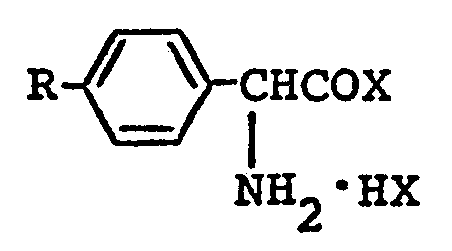
wherein R is hydrogen, a hydroxyl group or a protected hydroxyl group, and X is a halogen.
wherein R is hydrogen, a hydroxyl group or a protected hydroxyl group, and X is a halogen.
1. Procédé pour la synthèse d'une pénicilline, caractérisé en ce que l'on fait réagir
dans un solvant inerte un silylate de l'acide 6-aminopénicillanique et un halogénure
d'acide carboxylique en présence d'une résine insoluble faiblement basique à structure
tridimensionnelle et présentant une constante de dissociation de 10-8 à 10-".
2. Procédé pour la synthèse d'une pénicilline selon la revendication 1, dans lequel
l'halogénure d'acide carboxylique est un halogénure d'alpha-aminoacide dont le groupe
amino est protégé.
3. Procédé pour la synthèse d'une pénicilline selon la revendication 1, dans lequel
l'halogénure d'acide carboxylique est un dérivé de la phénylglycine répondant à la
formule générale suivante:
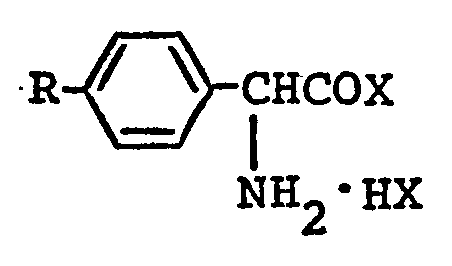
dans laquelle R représente l'hydrogène, un groupe hydroxy ou un groupe hydroxy protégé et X est un halogène.
dans laquelle R représente l'hydrogène, un groupe hydroxy ou un groupe hydroxy protégé et X est un halogène.
1. Synthetisches Verfarhen zur Herstellung von Penicillin dadurch gekennzeichnet,
daß man einen 6-Aminopenicillan-säuresilylester in einem inerten Lösungsmittel mit
einem Carbonsäurehalogenid in Gegenwart eines unlöslichen schwach basischen Harzes
von 3-dimensionaler Struktur und mit einer Dissoziationskonstante von 10-8 bis 10-11 zur Umsetzung bringt.
2. Synthetisches Verfahren zur Herstellung von Penicillin nach Anspruch 1, dadurch
gekennzeichnet, daß man als Carbonsäurehalogenid ein a-Aminosäurehalogenid verwendet,
dessen Aminogruppe geschützt ist.
3. Synthetisches Verfahren zur Herstellung von Penicillin nach Anspruch 1, dadurch
gekennzeichnet, daß man als Carbonsäurehalogenid ein Phenylglycinderivat der allgemeinen
Formel
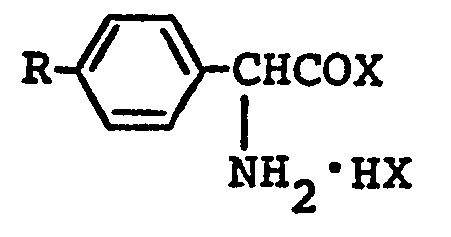
verwendet, in der R ein Wasserstoffatom, eine Hydroxylgruppe oder eine geschützte Hydroxylgruppe und X eine Halogenatom bedeuten.
verwendet, in der R ein Wasserstoffatom, eine Hydroxylgruppe oder eine geschützte Hydroxylgruppe und X eine Halogenatom bedeuten.