|
(11) | EP 0 012 516 A1 |

| (12) | EUROPEAN PATENT APPLICATION |
|
|
|
|
|||||||||||||||||||||||||||
| (54) | Electroconductive polymer compositions for use in the manufacture of electrographic papers and containing a fluorinated alkylphosphate ester |
| (57) An electroconductive polymer composition contains from 90 to 99.5% by weight of a
water-soluble electroconductive polymer; sufficient amounts of a stabilizer to adjust
the pH to 8.0 or more; and from 0.5 to 10% by weight of the polymer composition of
a (mono or)bis-(fluorinated alkyl)-phosphate ester of the formula:
where m is an integer between 4 and 10, n is an integer between 1 and 11, y is 1 or 2 and M is a water-solubilizing cation; or of an ammonium bis-(N-ethyl-2-perfluoralkyl- sulfonamide ethyl) phosphate containing not more than 15% ammonium mono(N-ethyl-2-perfluoroalkylsulfonamido ethyl) phosphate in which the alkyl group is more than 95% Ce, the fluorine content is 50.2% to 52.8% as determined on a solids basis. |
[0001] This invention relates to electroconductive polymer compositions of the type that may be applied to surface-sized and non-surfaced-sized paper raw stock. The present invention is based on the discovery that, by incorporating into a conductive polymer an effective quantity of certain fluorosurfactants and a stabilizer, the solvent holdout and tack properties can be improved, so that paper coated with the compositions will have solvent holdout, conductivity and tack properties that are acceptable as electroconductive base stocks for electrographic and electrophotographic papers.
[0002] In general, electroconductive base sheets for use in the manufacture of electrographic and electrophotographic reproduction papers are prepared by applying to one or both surfaces of a suitable paper substrate (a publication grade paper of basis weight in the range of 30 to 45.pounds per 3,000 square feet, i.e. 0.049 to 0.074 kg/m2) a resinous conductive layer to render the paper electroconductive. Commonly the conductive layer comprises an electroconductive polymer either alone or more usually, formulated with a binder (nornally a water-soluble, non-conductive, film-forming polymer such as a protein, starch, styrene-butadiene latices, a modified or converted starch, casein, polyvinylacetate, polyvinylalcohol, copolymer of ethylene and vinylacetate, and the like) and with a pigment (such as calcium carbonate, kaolin clay, titanium dioxide, alumina or a combination ; of these materials). In the electrostatic paper industry, such formulations including a conductive agent, a binder and a pigment are commonly referred to as coating formulations or compositions.
[0003] The binders in conventional conductive coating formulations serve to make the paper less porous and more uniform, to improve the adherence of the conductive layer to the base paper and, importantly, to impart to the conductive layer the properties of a holdout or barrier coating to prevent solvents used in the later applied photosensitive or dielectric layers from penetrating into the conductivized paper. A separate non-conductive solvent holdout layer comprising one or a mixture of conventional binders is applied to the paper prior to the application of the conductive layer in order to assist in achieving a solvent holdout effect. Solvent holdout to toluene and, in some cases, paraffinic solvents is essential because the top side of a conductive base paper comes into contact with toluene during the subsequent application of the photo-sensitive or dielectric coating which comprises dye-sensitized zinc oxide or dielectric resin dispersed in toluene and a binder. In some cases, the back of the zinc oxide or dielectric coated base stock (now referred to as finished Electrofax or dielectric paper) comes into contact with kerosene during the copying process inside copy machines that use "vet" toners which are composed of carbon particles suspended in a solution of kerosene and binders. The usual type of electroconductive polymer in combination with the usual type of coating additives, such as the binders and pigments mentioned above, will not give acceptable solvent holdout when applied at commercially feasable coatweights of from 1 to 4 pounds of coating per 3,000 square feet per paper surface where attempts are made to prepare the conductive base sheet in an obviously desirable one-pass process without pretreatment of the paper raw stock with a separate solvent holdout layer.
[0004] The present invention is based upon the discovery that the temperature stability and solvent holdout properties of conventional electroconductive polymers commonly used in such formulations can be markedly enhanced by incorporating into such polymers an effective quantity of a stabilizer, such as caustic soda, and a fluorosurfactant of the type hereinafter described. The improved polymer composition of this invention will give to the conductive base sheet conductivity, zinc oxide and dielectric resin topcoatability, rebrokability of broke and enhanced solvent holdout properties and low tack that are commercially acceptable for the manufacture of electrographic and electro- . photographic papers according to current industry standards and practices when applied to a non- surface sized raw stock (a raw stock that has no surface treatment of starch, alginate or other surface sizing material), as well as barrier coated raw stock. The improved polymer composition of this invention, therefore, not only posesses temperature stability and provides enhanced solvent holdout and reduced tack properties, but makes possible the application of the electroconductive layer to the base sheet in a one-pass operation thus eliminating any necessity for the application of separate solvent holdout layers. The conductivity, zinc oxide and dielectric topcoatabiltiy, rebrokability and solvent holdout properties obtained through the use of the improved polymer composition of this invention have been confirmed employing standard laboratory techniques. It is contemplated, therefore, that suitable coatweights of the improved polymer composition of this invention will be employed in the manufacture of electroconductive base sheets suitable for the preparation of electrophotographic and electrographic papers.
[0005] The nature of the electroconductive polymer component of the improved polymer composition of this invention is not critical. Any of a variety of electroconductive polymers, both cationic and anionic, may be employed provided that the conductive polymer selected has a Brookfield Viscosity at 25°C. of less than about 1500 and is capable of imparting adequate conductivity to the base raw stock (industry requirements for conductivity in base sheets are 108 to 10 10 [ohms per square] decade at 15% relative humidity). As cationic electroconductive polymers, there may be employed any water-soluble cationic polymer containing quaternary ammonium functional groups. Included in such cationic polymers are those of the formula:
wherein:
R stands for hydrogen or lower alkyl;
R1 represents a member of the class composed of:
R2 stands for:
wherein, in turn, A represents a lower alkylene, an hydroxy-lower alkylene or lower-
alkylsubstituted lower alkylene group, and R3 stands for a lower alkyl group.
[0006] These polymers include those wherein the quaternary ammonium functional group is carried as a pendant group to the principal polymer chain, such as, for example, polyvinyl benzyl trimethyl ammonium chloride, poly-[alpha-(methylene trimethyl ammonium chloride) ethylene oxide] and poly(methacryloloxyethyl trimethyl ammonium chloride). Also useful are those polymers wherein the quaternary ammonium functional group is incorporated in a cyclic structure which comprises a portion of the polymer backbone, such as, for example, polymers containing repeating units of the formula:
where R is an alkyl group of 1 to 18 carbon atoms and R1 is R or β-propionamido and A is an anion. A preferred polymer of this class is poly-(dimethyl- diallyl ammonium chloride); and those wherein the quaternary ammonium functional group forms a part of the polymer chain, such cationic polymers being commonly designated as, "ionenes".
[0007] Included in this group, for example, are ionene polymers prepared from halo alkyl dialkyl amine monomer units, such as 3-ionene(poly-dimethyl propyl)-ammonium chloride), prepared by the polymerization of 3-chloropropyl dimethyl amine, and ionene polymers prepared from di-tertiaryamines and dihalides, such as 3,4-ionene which is prepared from 1,3-bis-dimethyl- amino propane and 1,4-dichlorobutene. Other ionene polymers, of course, which are prepared similarly, may be employed as the electroconductive component of of the polymer composition of this invention.
[0008] In addition to the cationic electroconductive polymers mentioned above, water-soluble cationic phosphonium and sulfonium polymers also may be employed as the electroconductive component in the polymer composition of this invention. Included among these are polymers, such as, for example, poly-(2-acryloxyethyldimethyl sulfonium chloride) and poly-(glycidyltributyl phosphonium chloride) and the like.
[0009] Water-soluble anionic polymers useful in the preparation of the polymer composition of this invention typically are polymeric acids and alkali metal and alkaline earth metal salts. Included among such anionic polymers are, for example, poly-(sulfostyrene), poly(allyl sulfonic) acid, sulfonated urea-formaldehyde resin, sulfonated polymethyl- olacrylamide and the like.
[0010] It should be noted that the typical cationic and anionic polymers mentioned above may contain one or more other mer units. For example, copolymers such as the copolymer of dimethyl diallyl ammonium chloride and diacetone acrylamide or the copolymer of styrene and maleic anhydride also can be used as the electroconductive component of the polymer composition of this invention. The ratio of mer units in such copolymers will be determined by the quantity of cationic or anionic necessary to impart the desired surface resistivity to the base sheet.
[0011] Although any of the electroconductive polymers noted above or other electroconductive polymer capable of imparting the necessary degree of surface resistivity to the base sheet may be employed as the electroconductive component in the improved polymer composition of this invention, the preferred electroconductive polymers are the cationic polymers and copolymers and especially cationic quaternary ammonium polymers and copolymers. Of these, the most preferred polymers are poly-(dimethyldiallyl- ammonium chloride), copolymers of dimethyl diallyl ammonium chloride and diacetone acrylamide containing from 70 to 98% diallyl monomer, polyvinylbenzyl trimethyl ammonium chloride, poly-methacryloxyethyl trimethyl ammonium chloride, poly- methacryloloxytrimethylammonium methosulfate, polyepichloro- hydrin 80 to 100% quaternized with trimethylamine, copolymers of acrylamide and methacryloloxyethyl trimethyl ammonium chloride containing from 90 to 99.5% methacryloloxyethy1 monomer and poly-(methacryloloxyethyl dimethyl hydroxyethyl ammonium chloride).
[0012] The fluorosurfactant component of the improved electroconductive polymer composition of this invention is essential to achieving the enhanced solvent holdout properties displayed by the improved polymer composition. The present invention provides an electroconductive polymer composition containing from 90 to 99.5% by weight of a water-soluble electroconductive polymer; sufficient amounts of a stabilizer to adjust the pH to 8.0 or more; and from 0.5 to 10% by weight of the polymer composition of a (mono or)bis-(fluorinated alkyl)-phosphate ester of the formula :
or an ammonium bis(N-ethyl-2-perfluoroalkylsulfonamide ethyl) phosphate containing not more than 15% ammonium mono(N-ethyl-2-perfluorealkylsulfonamido ethyl) phosphate, in which the alkyl group is more than 95% C8 and the salts have a fluorine content of 50.2°/ to 52.8% as determined on a solids basis. Materials of this type are sold by 3M Co., Inc., under the Trademark Scotchban. In the formula, m is an integer between 4 and 10, n is an integer between 1 and 11, y is 1 or 2 and M is a water-solubilizing cation, for example, an alkali metal (Li, K or Na), ammonium or substituted ammonium including methylamine, dimethylamine, diethylamine, monoethanolamine, diethanolamine, triethanolamine and morpholine. Preferred salts generally are the diethanolamine salts. Desirably, Cm and Cn, taken together, constitute a straight chain of at least 8 carbon atoms. Such perfluoroalkyl phosphate esters are well known materials and are available commercially or readily prepared by methods fully described in the literature. Particularly preferred is the perfluoroalkyl phosphate ester manufactured by E. I. du Pont de Nemours Company, Inc., Wilmington, Delaware, under the Trademark Zonyl RP and Zonyl FSE, which contain diethanolamine salts of mono- and bis-fluorinated alkyl) phosphates in which the alkyl group is even-numbered in the range C8-C18 and the salts have a fluorine content of 52.4 to 54.4% as determined on a solids basis.
[0013] Suitable stabilizers such as caustic soda, potassium hydroxide and ammonium hydroxide are added to the polymer composition to control the pH of the polymer and impart temperature stability thereto. The composition of the instant invention is stable at a pH of 8.0 or more.
[0014] The weight percent of the several components of the novel polymer composition of this invention may vary greatly. In general, they contain from 90 to 99.5% by weight electroconductive polymer, 0.5 to 10% by weight fluorosurfactant and sufficient stabilizer to adjust the pH to 8.0 or more.
[0015] The weight percent (dry coating) of the components in the coating formulations using the polymer composition of this invention may vary widely. In general, the electroconductive polymer composition of this invention will constitute from 0.5 to 95% by weight of the formulation; the binder will constitute from 5 to 80% by weight of the formulation. If desirable, the formulation may also contain from 5 to 95% by weight of a pigment. Such formulations are typical of the coating formulations typically employed in the manufacture of electroconductive base sheets.
[0016] The results set forth in the following tables illustrate the benefits of the stabilizer of the instant invention.
[0017] Although the invention has been described above in terms of the use of certain specified (mono and bis)-fluorinated. alkyl)phosphates as the essential component of the improved polymer composition of this invention, many obvious modifications will suggest themselves from a consideration of the foregoing specification. It will be obvious, for example, that fluorocarbons other than the fluorinated alkyl phosphates disclosed above could be substituted in the practice of the invention. Included among such fluorocarbons, for example, are long-chain polyfluoro aliphatic fluorocarbons substituted with polar functions such as carboxyl, carbamate, carboxamide, sulfonamide, sulfonate, amino or quaternary amine groups.
1. An electroconductive polymer composition containing from 90 to 99.5% by weight
of a water-soluble electroconductive polymer; sufficient amounts of a stabilizer to
adjust the pH to 8.0 or more; and from 0.5 to 10% by weight of the polymer composition
of a (mono or)bis-(fluorinated alkyl)phosphate ester of the formula :
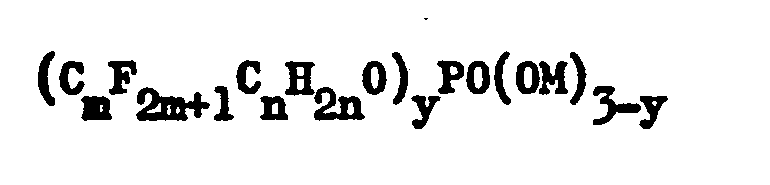
where m is an integer between 4 and 10, n is an integer between 1 and 11, y is 1 or 2 and M is a water-solubilizing cation; or of an ammonium bis-(N-ethyl-2-perfluoroalkylsulfonamide ethyl) phosphate containing not more than 15% ammonium mono(N-ethyl-2- perfluoroalkylsulfonamido ethyl) phosphate in which the alkyl group is more than 95% C8, the fluorine content is 50.2% to 52.8% as determined on a solids basis.
where m is an integer between 4 and 10, n is an integer between 1 and 11, y is 1 or 2 and M is a water-solubilizing cation; or of an ammonium bis-(N-ethyl-2-perfluoroalkylsulfonamide ethyl) phosphate containing not more than 15% ammonium mono(N-ethyl-2- perfluoroalkylsulfonamido ethyl) phosphate in which the alkyl group is more than 95% C8, the fluorine content is 50.2% to 52.8% as determined on a solids basis.
2. A composition as claimed in Claim 1 in which the stabilizer is potassium hydroxide,
sodium hydroxide or ammonium hydroxide.
3. A composition as claimed in Claim 1 or 2 in which the water-solubilizing cation
is diethanolamine and Cm and Cn, taken together, constitute a straight chain of at least eight carbon atoms.
4. An electroconductive polymer composition as claimed in Claim 3 in which the fluorocarbon
is a diethanolamine salt of a (mono or bis)-(fluorinated alkyl)phosphate having the
formula set forth in Claim 1 in which the alkyl group is even-numbered in the range
C8-C18, the fluorine content is 52.4 to 54.4% as determined on a solids basis, and M is
an alkali metal, ammonium or substituted ammonium cation.
5. A composition as claimed in any preceding claim in which the electroconductive
polymer is a cation-quaternary ammonium polymer.
6. A composition as claimed in Claim 5 in which the cationic-quaternary ammonium polymer
is poly(dimethyl diallyl ammonium chloride), a copolymer of dimethyl diallyl ammonium
chloride and diacetone acrylamide containing from 70 to 98% of diallyl monomer units,
polyvinylbenzyl trimethylammonium chloride, polymethacryloloxyethyl trimethyl ammonium
chloride, polymethacryloloxyethyl trimethyl ammonium methosulfate, polyepi- chlorohydrin
80 to 100% quaternized with trimethylamine, a copolymer of acrylamide and methacryloloxyethyl
trimethyl ammonium chloride containing from 90 to 99.5% methacryloloxyethyl monomer,
or poly-(methacryloloxyethyl dimethylhydroxyethyl ammonium chloride).