|
(11) | EP 0 012 572 A1 |

| (12) | EUROPEAN PATENT APPLICATION |
|
|
|
|
|||||||||||||||||||||||||||
| (54) | Improved method of preparing crystalline zeolite ZSM-20 |
| (57) An improved method of preparing substantially pure crystalline zeolite ZSM-20, a
low silica, large pore zeolite from a reaction mixture containing a source of an alkali
metal oxide, an oxide of a tetraethylammonium compound, an oxide of aluminum, an oxide
of silicon wherein tetraalkylorthosilicates are the source of silica and water, under
controlled concentration of the hydroxyl, alkali metal, and tetraethylammonium ions |
[0001] This invention relates generally to an improved method of preparing a crystalline zeolite material and particularly to an improved method of making substantially pure zeolite ZSM-20.
[0002] Zeolitic materials, both natural and synthetic, have been demonstrated in the past to have catalytic properties for various types of hydrocarbon conversions. Certain zeolitic materials are ordered, porous crystalline aluminosilicates having a definite crystalline structure within which there are a large number of channels. These cavities and channels are precisely uniform in size. Since the dimensions of these pores are such as to accept for adsorption molecules of certain dimensions while rejecting those of larger dimensions, these materials have come to be known as "molecular sieves" and are utilized in a variety of ways to take advantage of these properties.
[0003] Such molecular sieves, both natural and synthetic, include a wide variety of positive ion-containing crystalline aluminosilicates. These aluminosilicates can be described as a rigid three-dimensional framework of Si04 and A104 in which the tetrahedra are cross-linked by the sharing of oxygen atoms whereby the ratio of the total aluminum and silicon atoms to oxygen is 1:2. The electrovalence of the tetrahedra containing aluminum is balanced by the inclusion in the crystal of a cation, for example, an alkali metal or an alkaline earth metal cation. This can be expressed wherein the ratio of aluminum to the number of various cations, such as Ca/2, Sr/2, Na, K or Li is equal to unity. One type of cation may be exchanged either entirely or partially by another type of cation utilizing ion exchange techniques in a conventional manner. By means of such cation exchange, ; it has been possible to vary the properties of a given aluminosilicate by suitable selection of the cation. The spaces between the tetrahedra are occupied by molecules of water prior to dehydration.
[0004] Prior art techniques have resulted in the formation of a great variety of synthetic aluminosilicates. These aluminosilicates have come to be designated by letter or other convenient symbols, as illustrated by zeolite A (U.S. Patent 2,882,243), zeolite X (U.S. Patent 2,882,244), zeolite Y (U.S. Patent 3,130,007), zeolite ZK-5 (U.S. Patent 3,247,195), zeolite ZK-4 (U.S. Patent 3,314,752) zeolite ZSM-5 (U.S. Patent 3,702,886), zeolite ZSM-11 (U.S. Patent 3,709,979), zeolite ZSM-12 (U.S. Patent 3,832,449) and zeolite ZSM-20 (U.S. Patent 3,972,983), merely to name a few.
[0005] A crystalline aluminosilicate zeolite well known in the art is faujasite. The ZSM-20 zeolite made by the present invention resembles faujasite in certain aspects of structure, but has a notably higher silica/alumina ratio than faujasite.
[0006] The present invention relates to an improved method of preparing synthetic crystalline aluminosilicate, designated as "zeolite ZSM-20" or simply "ZSM-20". The ZSM-20 composition has a characteristic X-ray diffraction pattern, the values of which are set forth in Table 1, of U.S. Patent 3,972,983.
[0007] In the as synthesized form, the zeolite has a formula, in terms of mole ratios of oxides and in the anhydrous state, as follows: (0.3-0.6)R2O : (C.4-0.7)M20 : Al2O3 : (7-10) Si02 wherein R is a tetraethylammonium cation and M is an alkali metal cation, especially sodium.
[0008] Also, the zeolite ZST2-20 crystal structure is comprised of relatively uniform rigid three-dimensional pore networks characterized by uniform pores of between 7 and 8 Angstrom units in diameter.
[0009] While synthetic ZSM-20 zeolites or the thermally treated products thereof may be used in a wide variety of hydrocarbon conversion reactions, they are notably useful in the processes of polymerization, aromatization, cracking and hydrocracking. Other hydrocarbon conversion processes for which ZSM-20 or the thermally treated product thereof may be utilized in one or more of its active forms include, for example, alkylation and converting light aliphatics to aromatics such as in U.S. Patent 3,760,024.
[0010] Zeolite ZSM-20 in accord with the invention is prepared from a solution containing sources of an alkali metal oxide, preferably sodium oxide, an oxide of tetraethylammonium, an oxide of aluminum, an oxide of silicon, wherein tetraalkylorthosilicates, e.g. ethyl, propyl etc., are the source of silica and water under controlled concentration of the hydroxyl, alkali metal, and tetraethylammonium ions, and having a composition, in terms of mole ratios of oxides., falling within the following ranges:
wherein R is a tetraethylammonium cation and M is an alkali metal cation, and maintaining the mixture until crystals of the zeolite are formed. Thereafter, the crystals are separated from the liquid and recovered. Typical reaction conditions consist of heating the foregoing reaction mixture to a temperature of from about 90°C for a period of time of from about 2 weeks to about 6 weeks. A more preferred temperature range is from about 100°C to about 120°C with the amount of time at a temperature in such range being from.about 1 week to about 1 month.
[0011] The digestion of the gel particles is carried out until crystals form. The solid product is separated from the reaction medium, as by cooling the whole to room temperature, filtering and water washing.
[0012] The crystalline product is dried, e.g. at 230oF, for from about 8 to 24 hours. Of course, milder conditions may be employed, if desired, e.g. room temperature under vacuum.
[0013] The composition for the synthesis of synthetic ZSM-20 can be prepared utilizing materials which can supply the appropriate oxide. Such compositions include aluminates, alumina, silicates, as specified above, and hydroxides.
[0014] Crystal size and crystallization time of the ZSM-20 composition will vary with the nature of the reaction mixture employed.
[0015] ZSM-20, another TEA zeolite, crystallizes in competition with zeolite Beta and dense phases such as zeolite P. Water, sodium, and hydroxide levels control that competition. Tetraethylorthosilicate (Et4SiO4) is a superior silica source for the rapid and efficient synthesis of ZSM-20 compared with the use of other soluble forms of silica such as Q-brand sodium silicate, silica sol, or the previously employed tetramethylorthosilicate (Me4SiO4).
[0016] U.S. Patents 3,972,983 and 4,021,331 describe the preparations of ZSM-20 with Me4Si04 over a relatively narrow Si02/A1203 range at 100oC, static, in 19-42 days. It has now been found that ZSM-20 can be more reproducibly crystallized in shorter times at optimum OH- levels and similar Si02/A1203 range and temperature, if Et4Si04 is used as the silica source. Further, the ethanol by-product is also less toxic than methanol from-Me4SiO4. Higher tetraalkylorthosilicates (i.e. propyl, butyl, etc) would be expected to be as effective, if not superior, silica sources. Not only must the Na+ content of the reaction mixture be minimized, as with zeolite Beta synthesis, but also in ZSM-20 synthesis the water level must be minimized for the rapid and efficient crystallization of ZSM-20. It has also been found that a low-temperature aging period is not required prior to crystallization, but time is an important variable, for, as the reaction mixture becomes more siliceous during crystallization, Beta phase begins to form.
[0017] In order to more fully illustrate the nature of the invention and the manner of practicing same, the following examples are presented. These examples are not to be considered limiting, as would be realized by one of ordinary skill in the art.
EXAMPLES 1-11 and 12-18
[0018] The following examples whose reaction mixtures and results are tabulated in Tables I (Example 1-11) and Table II (Examples 12-21) below demonstrate the critical importance of the variables stated above. The products were prepared in the general manner as described in Example 19.
[0019] Looking at the results of Table I it can be seen from Examples 6, 7, 8 and 9 that by rigid control of the OH, Na and TEA factors that 100% ZSM-20 was obtained. With respect to the results of Table II, it would appear that ZSM-20 can be synthesized at SiO2/Al2O3=10, however, the crystallization rates were much less than at Si02/A1203=30 (Table I).
EXAMPLE'f9
[0020] Illustrating the preparation of ZSM-20, a solution comprising 759.4 grams H20 and 67.5 grams NaAlO2 (40% A1203; 33% Na20) was prepared. The solution was stirred until all the NaAl02 was dissolved. Added to this stirred solution was 1770 ml. of freshly prepared 3.95 N tetraethylammonium hydroxide solution (density 1.03). A 1665.2 gram quantity of tetraethyorthosilicate was added to the above solution and mixed thoroughly. The slurry so formed was placed in a 100°C steam chest. Crystallization at 100°C over 12 days produced 162 grams of ZSM-20 crystals.
1. A method for preparing zeolite ZSM-20 which comprises forming a reaction mixture
containing sources of an alkali metal oxide, alumina, silica, a tetraalkylammonium
oxide and water characterized in that the source of the silica is a C2-C4 tetraalkylorthosilicate and that the reaction mixture has the composition (in terms
of mole ratios):
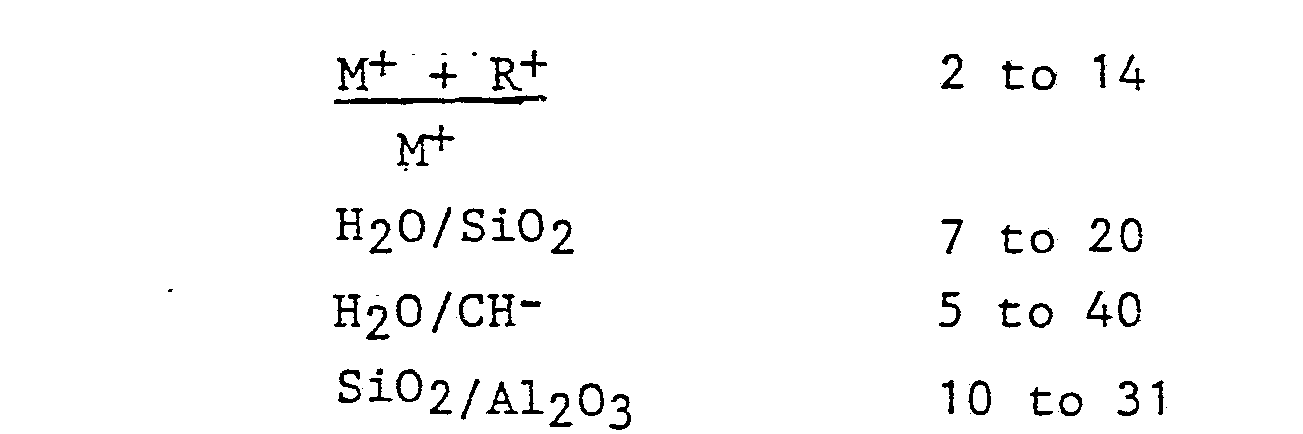
wherein R is tetraalkylammonium and M is alkali metal, said mixture being maintained at least 90°C until crystals of the zeolite are formed.
wherein R is tetraalkylammonium and M is alkali metal, said mixture being maintained at least 90°C until crystals of the zeolite are formed.
2. The method of Claim 1 wherein the mixture has a composition, in terms of mole ratios
of oxides, falling within the following ranges:
3. The method according to Claim 1 wherein the temperature is maintained between from
about 90°C to about 150°C.
4. The method according to Claim 2 wherein the temperature is maintained between from
about 90°C to about 120°C.
5. A method according to any of Claims 1 to 4 wherein said tetraalkylorthosilicate
is selected from tetraethylorthosilicate, tetrapropylsilicate, and tetrabutylsilicate.
6. A method according to any of Claims 1 to 4 wherein said tetraalkylorthosilicate
is tetraethylorthosilicate and the mole ratios of H20/OH-and R+ + M+ are about 11 and 10.7 respectively. M+