|
(11) | EP 0 013 060 B1 |

| (12) | EUROPEAN PATENT SPECIFICATION |
|
|
| (54) |
Carene-modified petroleum resins and their production Caren-modifizierte Kohlenwasserstoffharze und ihre Herstellung Résines de pétrole modifiées par le carène et leur production |
|
|
|||||||||||||||||||||||||||||||
|
||||||||||||||||||||||||||||||||
| Note: Within nine months from the publication of the mention of the grant of the European patent, any person may give notice to the European Patent Office of opposition to the European patent granted. Notice of opposition shall be filed in a written reasoned statement. It shall not be deemed to have been filed until the opposition fee has been paid. (Art. 99(1) European Patent Convention). |
[0001] The present invention relates to new improved petroleum resins and a process for their production. In particular the invention relates to resins suitable as tackifier for elastomers and useful in hot melt formulations.
[0002] Petroleum resins obtained by the polymerisation of C5 dienes such as pentadiene 1,3 and/or isoprene are well known as is their use as tackifiers for elastomers and as components in hot melt formulations.
[0003] It is known that SIS block copolymers (block styrene-isoprene copolymers such as Shell Cariflex (Registered Trade Mark) TR 1107) can be tackified by petroleum resins of narrow molecular weight distribution produced by controlling the polymerisation conditions with branched reactive olefins, substituted aromatics or tertiary alkyl halides, see for example our GB Patents 1538057 and 1537852. These previously described petroleum resins of narrow molecular weight distribution tackify oil extended random SBR (styrene-butadiene) copolymers and provide very good tackifying properties for the SIS block copolymers. However, they also have a low cohesive strength in pressure sensitive adhesives based on natural rubber. They do not however tackify oil free SBR elastomers of either random or block thermoplastic nature (e.g. SBS block copolymers).
[0004] Other petroleum feed additives, for example dicyclopentadiene, methyl cyclopentadiene dimers or thermal polymers obtained from cyclodiene dimer rich streams as described in our prior patent GB 11486211 are known as a means of making resins of high softening point. However the resins produced in this way have degradated resin Gardner colour and wax compatibility. Moreover, even if they increase the cohesive strength of pressure sensitive adhesives based on natural rubbers and slightly tackify SIS block copolymers they do not tackify other SBR copolymers.
[0005] One disadvantage of these earlier techniques is that the presence of the molecular weight controlling additive tends to reduce the softening point of the resin thus rendering it unsuitable for certain pressure sensitive adhesives particularly those where cohesive strength (shear adhesion) is important. It has been proposed to overcome this problem by carrying out the polymerisation in a paraffinic solvent which is not entirely satisfactory and increases costs and reduces plant capacity. It has also been proposed in Japanese Patent Application 7430489 to include a-pinene for copolymerisation with petroleum resin feeds and French Patent 2368504 suggests the inclusion of vinyl-norbornene or tetrahydroindene.
[0006] We have now found that these disadvantages may be largely overcome if carene is copolymerised with the petroleum resin feed.
[0007] The present invention therefore provides a modified petroleum resin comprising a copolymer of (i) a petroleum resin feed obtained from cracking petroleum feedstock and comprising C5 olefines and diolefines, C6 olefines and diolefines or a mixture of C5 and C6 olefines and diolefines, and (ii) a non-aromatic unsaturated cyclic compound characterised in that the non-aromatic unsaturated cyclic compound is carene.
[0008] The present invention further provides a process for the production of modified petroleum resins comprising copolymerising using a Friedel Crafts catalyst a mixture of (i) a petroleum resin feed comprising Cs olefines and diolefines C6 olefines and diolefines or a mixture of C5 and C6 olefines and diolefines, said feed being obtained from the cracking of petroleum feedstock and (ii) a non-aromatic unsaturated cyclic compound characterised in that the non-aromatic unsaturated cyclic compound is carene.
[0009] The C5 or C6 diolefine and olefine containing feed used in our process may be obtained from the cracking of petroleum feedstock: Such feedstocks include naphthas, kerosene, gas oil and vacuum gas oil. These feedstocks usually boil in a range of from 20°C to 450°C.
[0010] The petroleum feedstock is cracked, preferably in the presence of steam, and the recommended cracking temperature is between 500° and 870°C. The product which contains unsaturated hydrocarbons usually boiling in the range of 20° to 240°C, preferably 20° to 130°C, usually is thereafter subjected to fractionation to remove Cz to C4 light ends. The feedstock may thereafter be subjected to thermal soaking at a temperature between 100°C and 160°C, preferably 120° to 140°C, e.g. at about 130°C. The thermal soaking preferably takes 0.5 to 6 hours, e.g. 0.5 to 1 hour. Low temperatures are preferred in order to limit the cyclic diene (Cyclopentadiene and Methylcyclopentadiene (co-dimerisation with Cs linear conjugated dienes (isoprene and pentadienes 1,3 cis- and trans-). After fractionation and, if carried out, thermal soaking, the feedstock is preferably subjected to distillation to remove cyclic conjugated diolefines which are gel precursors (cyclopentadiene and methylcyclopentadiene being removed as dimers).
[0011] After distillation one obtains an overhead naphtha which usually boils in the range from 25 to 110°C, e.g., 25 to 80°C, the best results being achieved with a 25-70°C cut. This overhead naphtha comprises mainly C5 diolefins such as isoprene and 1,3 cis- and trans- pentadienes, C5 to C6 monoolefins and aromatics for example benzene. In general the overhead naphthas have the following compositions:
the exact composition depending on the nature of the petroleum feedstock which is subjected to steam cracking. Cyclopentene contents are generally below 3.0 wt.%.
[0012] The feed could be significantly isoprene free provided this compound is previously recovered through any conventional extraction process such as extractive distillation or azeotropic distillation. In such cases the properties of the resin produced are better than those obtained with isoprene-containing feeds. In this case the feed may be a narrow fraction pentadiene 1,3 concentrate. A typical such composition contains less than 1.5 wt.% isoprene, from 50 to 80 wt.% pentadiene 1,3 (cis and trans isomer), the balance being generally cyclopentene typically 15 to 20 wt.%. Other C5 and Ce olefines, diolefins and paraffins making up the remainders. Moreover, depending on the final boiling point of the feed cut the feedstock could be substantially free of benzene. Cyclopentene contents are generally below 3.0 wt.%.
[0013] If thermal soaking has been carried out the cyclodiene dimers which are produced are generally not included in the feed to be polymerized, because they are detrimental to the specific properties of the resins. However, if required for special applications they can be left in the resin feed, the distillation step previously mentioned being carried out before the thermal soaking step.
[0014] From 10 wt.% to 90 wt.%, preferably for 20 wt.% to 70 wt.% of carene based on the combined weight of petroleum resin feed and carene should be used generally from 10 wt.% to 40 wt.% is used as carene is expensive and concentrations above 40 wt.% lead to too low a molecular weight. The carene used may be any of the carene isomers, it may be delta-2-carene, delta-3-carene or a mixture of the two compounds. Alternatively and as is preferred, the carene may be a concentrate obtained from gum or crude turpentine and we particularly prefer to use a delta-3-carene concentrate obtained by rectification of crude turpentine which generally contains from 50% to about 95 wt.% of carene. A sample of a typical such materials was found to contain:
[0015] We found that the use of carene surprisingly narrows the molecular weight distribution of the resin at the same time increasing the softening point of the resin.
[0016] Other unsaturated cyclic monomers may also be included in the copolymerisation. For example one or more of norbornene, vinyl-norbornene, dicyclopentadiene, methyl cyclopentadiene, vinyl cyclohexane, tetrahydroindene and other terpenes such as pinene may be included.
[0017] The techniques of the present invention are equally applicable to resin production process which employ other agents to narrow the molecular weight distribution such as the branched chain reactive aliphatic olefines of our GB patent 1538057 to achieve extremely narrow distribution without reduction of softening point. Similarly the carene may be incorporated into systems which uses a solvent to keep up softening points or the need for the solvent may be obviated by the use of the carene. The ratios of the amount of carene and petroleum resin feed to the amount of branched olefine used may be varied to obtain resins of any desired softening point within the range 60°C to 140°C. Where branched olefines are used a broad (e.g. C5-C8) fraction of our U.K. patent 1538057 may be used. The preferred branched chain reactive aliphatic olefines are oligomers of propylene and butylenes obtained with phosphoric acid catalysts or from a Fluid Catalytic Cracker.
[0018] Other chain transfer agens such as the alkyl halides of our GB Patent 1537852 may also be used.
[0019] Similarly oxygenated transfer agents may be used such as mono-, di- or tri-substituted phenols the substituent being a C1 to C30 or preferable C1 to C6 straight chain or branched chain hydrocarbyl group e.g. methyl, ethyl, propyl, butyl, amyl or their secondary or tertiary isomers, (e.g. 2,6 ditertiary- butyl-4-methyl phenol), alcohols, esters, dialkyl ethers, alkaryl ethers, the alkyl group in the ether being C1 to C3o, preferably C1 to C6 straight or branched chain hydrocarbyl group e.g. methyl, ethyl, amyl or their secondary or tertiary isomers, (e.g. anisole), organic acids or anhydrides (e.g. maleic anhydride). When used the oxygenated transfer agent should preferably have a boiling point lower than 300°C. If low boiling point compounds e.g. diethyl ether, are used the polymerisation temperature and pressure should be carefully chosen so as to maintain them in the liquid state.
[0020] The most efficient compounds in the presence of AICI3 are dialkyl ethers or an alkaryl ether, such as anisole since they act as solvents for the catalysts. Since the polymerisation is usually carried out between 30 to 80°C, any such additive should be of adequate boiling point in order to maintain it in the liquid phase.
[0021] The amount of oxygenated compound used as transfer agent can vary from 0.1 to 5 wt.%, preferably 0.5 to 2 wt.%, based on the weight of petroleum resin feed. They are generally less attractive than branched chain reactive aliphatic olefines previously described.
[0022] Cs to Clo unsaturated aromatic compounds may be included with the petroleum feed and carene optionally containing the olefine as described in the GB Patent 1538057 and/or the oxygenated transfer agent described above. Examples of suitable aromatics include styrene, a-methyl styrene, vinyl toluene, indene and methyl indene and their chlorinated and oxygenated derivatives. When used, the concentration should preferably vary from 10 to 400% by weight, particularly 10 to 50% by weight, based on the weight of the petroleum resin feed.
[0023] The resin feed and the carene are mixed and polymerized using a Friedel Crafts catalyst, for example aluminium chloride, aluminium bromide or a liquid aluminium chloride/hydrochloric acid alkyl substituted aromatic hydrocarbon complex, the aromatic hydrocarbon being for example o-xylene, mesitylene, ethyl benzene, isopropyl benzene and other short or long chain alkyl benzenes. The alkyl chain can be linear or branched and can vary from 1 to 30 carbon atoms.
[0024] Acid liquid AICI3 sludges obtained as by-products during the alkylation of benzene or any other substituted aromatics (e.g. toluene or xylenes) with branched chain olefins can be directly used as catalyst for the above described polymerisation process. The branched chain olefins which are for example, produced via the boron trifluoride oligomerisation of propylene and fractionation, e.g. C,2 olefins or C24 olefins, can be alkylated with aromatics producing in situ sludge. As an example the acidic sludge available from a dodecylbenzene plant provided similar results to the preformed o-xylene AICIJHClliquid complex sludges from other substituted branched or straight chain aromatic production for example, meta and/or para diisopropyl benzenes and para-tertiary butyl benzene may also be used.
[0025] These liquid complexes are slightly more efficient that AICI3 powder at equivalent concentration and provide slightly higher resin yields and lower resin molecular weight. Therefore, the amount of carene required for narrowing the resin molecular weight is significantly reduced. Moreover when byproduct sludges are available in plant site, the catalyst cost is reduced and such a process is particularly attractive although powdered AICI3 results in resin having better Gardner colour.
[0026] In the polymerisation process the amount of catalyst may vary from 0.25 to 3.0 wt.% preferably 0.5 to 1.5 wt.% based on the weight of the mixture to be polymerized. The optimum concentration depends on the nature of the solvent which affects the solubility of the catalyst as well as on the stirring efficiency inside the polymerisation reactor. High catalyst concentration reduces the resin molecular weight distribution and therefore limits the amount of carene required for controling the resin molecular weight.
[0027] Other Friedel Crafts catalysts like titanium tri- or tetrachloride, tin tetrachloride, boron trifluoride, boron trifluoride complexes with organic ethers, phenols or acids can also be used but they lead to rather low resin yields and large quantities of liquid oligomers of low value are obtained. Even though these oily oligomers can be upgraded as reactive plasticizer or liquid plasticizer such catalysts are not recommended. Other possible catalysts can be acidic clays.
[0028] Usual polymerisation temperatures are between -20°C and 100°C, preferably between 30° and 80°C.
[0029] After polymerisation the residual catalyst may be removed by for example washing with aqueous solution of alkali, ammonia or sodium carbonate, or by the addition of an alcohol such as methanol and subsequent filtration.
[0030] The final resin may be stripped of unreacted hydrocarbons ("raffinate" rich in benzene and/or paraffins/unreactive olefins) and low molecular weight oil oligomers by stream stripping or vacuum distillation. The finished product is a substantially non-aromatic unsaturated thermoplastic hydrocarbon resin. It usually has a softening point of from 60°C to 140°C, preferably 70° to 130°C.
[0031] The resins obtained can be used in many applications which require low viscosity, good flexibility and elongation before or especially after chemical modification with polar compounds such as phenols, unsaturated anhydrides such as maleic anhydride or unsaturated acids (e.g. fumaric acid). These resins are designed for a wide range of end uses and applications. They can be applied to paper, metal, thermoplastic films (Cellophane (Registered Trade Mark) polyesters, PVC, woven or non woven fabrics, glass etc. and for bonding such materials together). Typical application are hot melts, carpet backing, coating with drying oil formulations, book binding, paper sizing or in any applications involving natural or synthetic resins and/or rubbers such as caulks, sealants or rubber tackification. More especially they may be used as tackifiers with natural rubber or synthetic rubbers such as polyisoprene, EPDM, butyl, chlorobutyl, bromobutyl, neoprene and block copolymers for example styrene/isoprene rubber (Shell Cariflex (Registered Trade Mark) TR 1107) mixtures of such rubbers. Even though these resins are significantly non-aromatic they provide outstanding tackiness with such elastomers and high/rubber ratio can be used to reducing the adhesive formulation cost (the resin being significantly cheaper than the block sytrene/isoprene rubber).
[0032] Other applications involving such resin properties are pressure sensitive adhesives, hot melt adhesives, low temperature adhesives, label adhesives, latex adhesives, surgical tapes and masking tapes where they may be blended with polymers such as ethylene/vinyl acetate copolymers optionally blended with wax.
[0033] Thus, hot melt adhesives and latex adhesives can be prepared from styrene-isoprene block copolymers and a tackifying resin. The low softening point aliphatic petroleum resins are a replacement for aromatic resins or rosin and terpene derivatives.
[0034] The present invention is illustrated but in no way limited by reference to the following examples.
Example 1
[0035] The carene rich stream containing
Pinene 1.75 wt.%
Carene 83.90 wt.%
Terpinene 0.45 wt.%
Cymene 1.68 wt.%
Limonene 7.38 wt.%
Terpinolene 0.57 wt.%
Unidentified 4.27 wt.%
a piperylene rich stream comprising:
Pentadiene 1:3 Trans 48.5 wt.%
Pentadiene 1:3 Cis 23.6 wt.%
Cyclopentene 17.5 wt.%
Cyclopentane 8.1 wt.%
Others (Paraffins/olefins etc) 2.3 wt.%
and a fluid catalytic cracker olefine stream of Final Boiling Point 100°C containing:
33.90 wt.% Paraffins
0.33 wt.% diolefines
58.40 wt.% olefins
0.11 wt.% aromatics
Total C4's 17.15 wt.%
were fed to a 2 litre glass reactor in the ratios given in Table 1 below. The reactor was fitted with a mechanical stirrer, a cooler and catalyst injection device. 1 wt.% of powdered AICI3 as catalyst based on the total weight of the feed was injected into the reactor which was then held at 50°C for 90 minutes.
[0036] The solvent used contained:
99.44 wt.% paraffins
0.50 wt.% aromatics
0.06 wt.% unknown
and contained 10 parts per million of sulphur.
Example 2
[0038] The effect of the presence of carene on the softening point and the molecular weight distribution with and without the paraffinic solvent was assessed using the reactor used in Example 1. The pentadiene 1:3 feed consisted of:
and the polymerisation conditions were as in Example 1. The results are shown in the following Table 2, together with the properties of the products obtained (some test methods as in Example 1).
1. A modified petroleum resin comprising a copolymer of (i) a petroleum resin feed
obtained from cracking petroleum feedstock and comprising C5 olefines and diolefines, C6 olefines and diolefines or a mixture of C5 and C6 olefines and diolefines, and (ii) a non-aromatic unsaturated cyclic compound characterised
in that the non-aromatic unsaturated cyclic compound is carene.
2. A modified petroleum resin according to claim 1 containing from 10 to 90 wt.% carene.
3. A modified petroleum resin according to claim 1 or claim 2 in which the petroleum
resin feed comprises
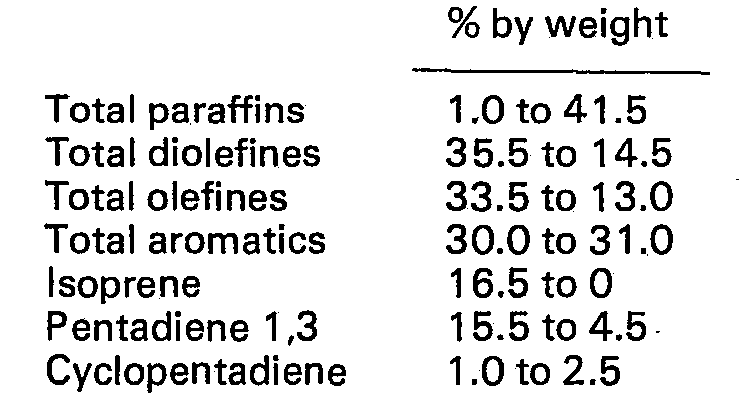
4. A modified petroleum resin according to claims 1 or 2, wherein the petroleum feed
comprises a narrow fraction pentadiene 1,3 concentrate containing less than 1.5 wt.%
isoprene and from 50 to 80 wt.% pentadiene 1,3.
5. A modified petroleum resin according to any of claims 1 to 4 containing a copolymerised
branched chain reactive aliphatic olefine.
6. A modified petroleum resin according to any of the claims 1 to 5 having a softening
point (ASTM E-28) from 60°C―140°C.
7. A process for the production of modified petroleum resins comprising copolymerising
using a Friedel Crafts catalyst a mixture of (i) a petroleum resin feed comprising
C5 olefines and diolefines, C6 olefines and diolefines or a mixture of C5 and C6 olefines and diolefines, said feed being obtained from the cracking of petroleum
feedstock and (ii) a non-aromatic unsaturated cyclic compound characterised in that
the non-aromatic unsaturated cyclic compound is carene.
8. A process according to claim 7 characterised in that the mixture contains from
10 wt.% to 90 wt.% of carene based on the weight of the mixture.
9. A process according to claim 7 or 8 characterised in that the carene is delta-3-carene
concentrate obtained by rectification of crude turpentine.
10. A process according to any of claims 7 to 9 characterised in that a branched chain
reactive aliphatic olefine is also copolymerised with the petroleum resin feed and
the carene.
11. A process according to any of claims 7 to 10 characterised in that the petroleum
resin feed comprises:
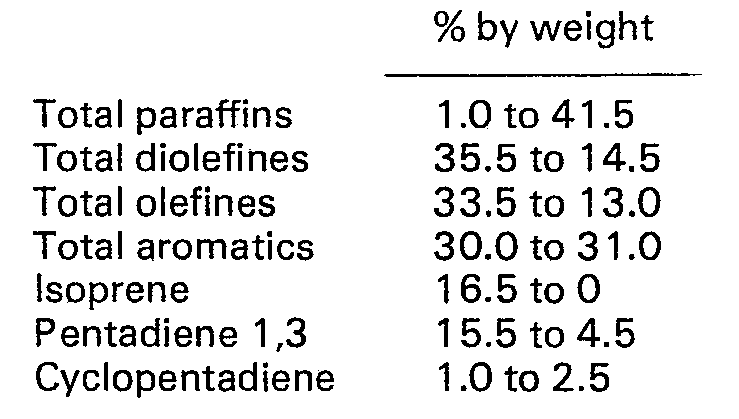
12. A process according to any of claims 7 to 10 characterised in that the petroleum
feed comprises a narrow fraction pentadiene 1,3 concentrate containing less than 1.5
wt.% isoprene and from 50 to 80 wt.% pentadiene 1,3.
1. Modifiziertes Petroleumharz, das ein Copolymer aus (i) einem Petrolharzeinsatzprodukt,
das durch Cracken eines Erdöleinsatzproduktes erhalten worden ist und C5-Olefine und -Di-olefine, C6-Olefine und -Diolefine oder eine Mischung aus Cs- und Ce-Olefinen und -Diolefinen enthält, und (ii) einer nicht aromatischen ungesättigten
cyclischen Verbindung, dadurch gekennzeichnet, daß die nicht aromatische ungesättigte
cyclische Verbindung Caren ist.
2. Modifiziertes Petrolharz nach Anspruch 1, dadurch gekennzeichnet, daß es 10 bis
90 Gew.% Caren enthält.
3. Modifiziertes Petrolharz nach Anspruch 1 oder 2, dadurch gekennzeichnet, daß das
Petrolharzeinsatzorodukt enthält:
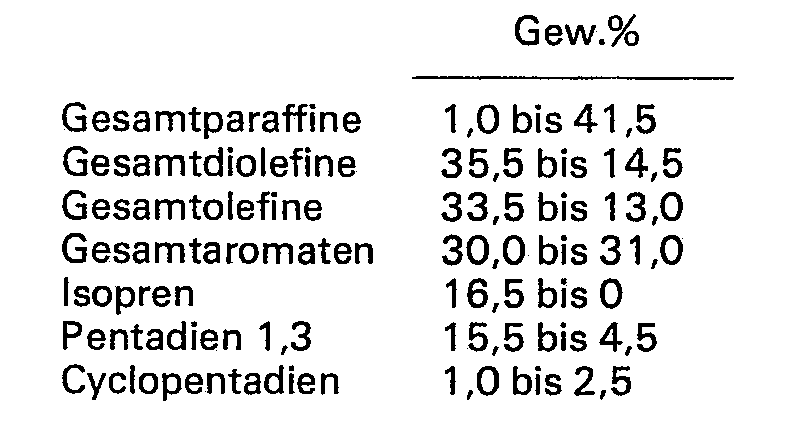
4. Modifiziertes Petrolharz nach Anspruch 1 oder 2, dadurch gekennzeichnet, daß das
Petrolharzeinsatzprodukt ein Konzentrat aus'einer engen Pentadien-1,3-fraktion enthält,
so daß es weniger als 1,5 Gew.% Isopren und 50 bis 80 Gew.% Pentadien-1,3 enthält.
5. Modifiziertes Petrolharz nach einem der Ansprüche 1 bis 4, dadurch gekennzeichnet,
daß es ein copolymerisiertes verzweigtkettiges reaktives aliphatisches Olefin enthält.
6. Modifiziertes Petrolharz nach einem der Ansprüche 1 bis 5, dadurch gekennzeichnet,
daß es einen Erweichungspunkt (ASTM E-28) von 60 bis 140°C besitzt.
7. Verfahren zur Herstellung von modifizierten Petrolharzen, bei dem unter Verwendung
eines Friedel-Crafts-Katalysators eine Mischung aus (i) einem Petrolharzeinsatzprodukt,
das Cs-Olefine und -Diolefine, C6-Olefine und -Diolefine oder eine Mischung aus C5- und Ce-Olefinen und -Diolefinen enthält und durch Cracken eines Erdöleinsatzprodukts
erhalten worden ist, und (ii) einer nichtaromatischen ungesättigten cyclischen Verbindung
copolymerisiert wird, dadurch gekennzeichnet, daß die nichtaromatische ungesättige
cyclische Verbindung Caren ist.
8. Verfahren nach Anspruch 7, dadurch gekennzeichnet, daß die Mischung bezogen auf
das Gewicht der Mischung 10 bis 90 Gew.% Caren enthält.
9. Verfahren nach Anspruch 7 oder 8, dadurch gekennzeichnet, daß das Caren delta-3-Caren-Konzentrat
ist, das durch Rektifikation von Rohterpentin erhalten worden ist.
10. Verfahren nach einem der Ansprüche 7 bis 9, dadurch gekennzeichnet, daß mit dem
Petrolharzeinsatzprodukt und dem Caren außerdem ein verzweigtkettiges reaktives aliphatisches
Olefin copolymermisiert wird.
11. Verfahren nach einem der Ansprüche 7 bis 10, dadurch gekennzeichnet, daß das Petrolharzeinsatzprodukt
enthält:
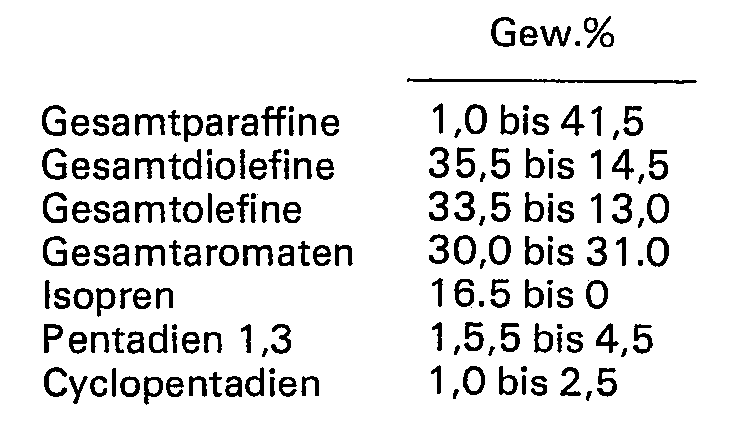
12. Verfahren nach einem der Ansprüche 7 bis 10, dadurch gekennzeichnet, daß das Petrolharzeinsatzprodukt
ein Konzentrat einer engen Pentadien-1,3-Fraktion enthält, so daß es weniger als 1,5
Gew.% Isopren und 50 bis 80 Gew.% Pentadien-1,3 enthält.
1. Résine de pétrole modifiée comprenant un copolymère (i) d'une charge de résine
de pétrole obtenue par craquage d'une charge de pétrole et comprenant des oléfines
et des dioléfines en C5, des oléfines et des dioléfines en C6 ou un mélange d'oléfines et de dioléfines en C5 et C6 et (ii) d'un composé cyclique insaturé non aromatique, caractérisée en ce que le
composé cyclique insaturé non aromatique est un carène.
2. Résine de pétole modifiée suivant la revendication 1, contenant 10 à 90% en poids
de carène.
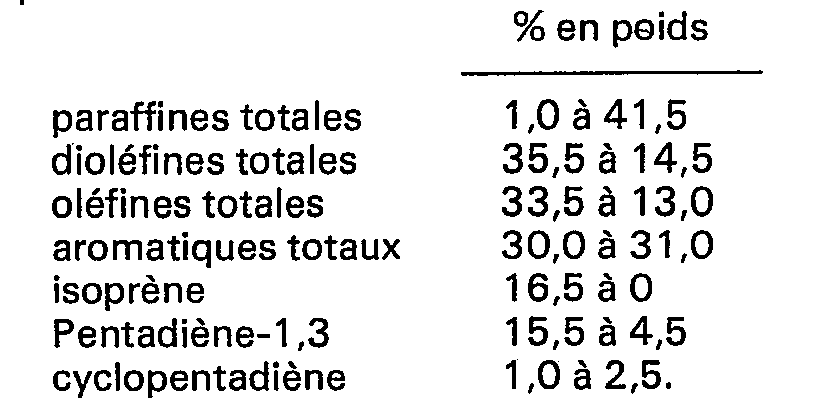
3. Résine de pétrole modifiée suivant la revendication 1 ou la revendication 2, dans
laquelle la charae de résine de pétrole comprend:
4. Résine de pétrole modifiée suivant la revendication 1 ou 2, dans laquelle la charge
de pétrole comprend un concentré de pentadiène-1,3 à fraction étroite contenant moins
de 1,5% en poids d'isoprène et 50 à 80% en poids de pentadiène-1,3.
5. Résine de pétrole modifiée suivant l'une quelconque des revendications 1 à 4, contenant
une oléfine aliphatique réactive à chaîne ramifiée copolymérisée.
6. Résine de pétrole modifiée suivant l'une quelconque des revendications 1 à 5, ayant
un point de ramollissement (ASTM E-28) de 60 à 140°C.
7. Procédé de production de résines de pèrole modifiées, consistant à copolymériser,
en utilisant un catalyseur de Friedel-Crafts, un mélange (i) d'une charge de résine
de pétrole comprenant des oléfines et dioléfines en C5, des oléfines et dioléfines en C6 ou un mélange d'oléfines et dioléfines en Cs et Ce, ladite charge étant obtenue par craquage d'une charge de pétrole, et (ii)
d'un composé cyclique insaturé non aromatique, caractérisé en ce que le composé cyclique
insaturé non aromatique est un carène.
8. Procédé suivant la revendication 7, caractérisé en ce que le mélange contient 10
à 90% en poids de carène sur la base du poids du mélange.
9. Procédé suivant la revendication 7 ou 8, caractérisé en ce que le carène est une
concentré de delta-3-carène obtenu par rectification d'une térébenthine brute.
10. Procédé suivant l'une quelconque des revendications 7 à 9, caractérisé en ce qu'une
oléfine aliphatique réactive à chaîne ramifiée est également copolymérisée avec la
charge de résine de pètrole et le carène.
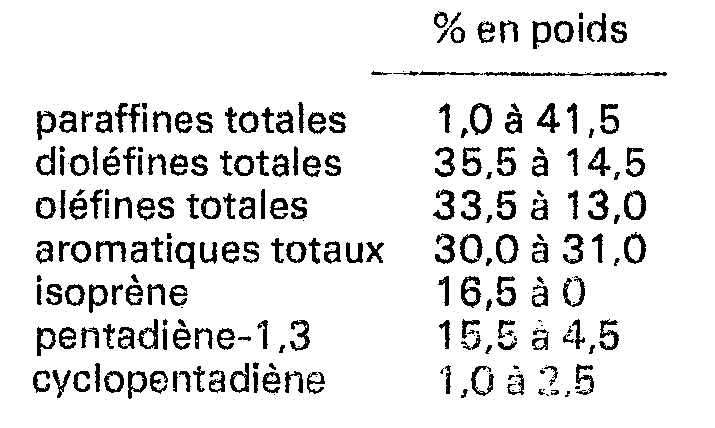
11. Procédé suivant l'une quelconque des revendications 7 à 10, caractérisé en ce
que la charge de résine de pétrole comprend:
12. Procédé suivant l'une quelconque des revendications 7 à 10, caractérisé en ce
que la charge de pétrole comprend un concentré de pentadiène-1,3 à fraction étroite
renfsrmartt moins de 1.6% en poids d'isoprène et 50 à 80% en poids de pentadiène-1
,3.