[0001] Isoflurane or l-chloro-2,2,2-trifluoroethyl difluoromethyl ether is an inhalation
anesthetic. See U.S. Patents 3,535,388 and 3,535,425. Although the metabolic pathways
of isoflurane are not well defined, it is known that the compound is metabolized in
the body to release inorganic halides into the blood. See Greestein, et al. Anesthesiology
42, 420-424 (1975) and
Mazze, et al. J. Pharmacol. Exptl.Therap.190, 523-529 (1974). Clinical studies in both
laboratory animals and man indicate that the presence of inorganic fluoride in the
blood caused by the metabolism of anesthetics containing fluorine is related to renal
failure. Therefore, it is desirable to retard the metabolism of anesthetics containing
fluorine, such as isoflurane, to minimize the release of inorganic fluoride into the
blood.
[0002] The present invention is directed to the novel deuterated analogue of isoflurane
which essentially is CF
3CDClOCF
2H, or 1-chloro-1-deutero-2,2,2-trifluoxoethyl difluoromethyl ether.
[0003] The present invention is also directed to the use of the deuterated analog of isoflurane
as an anesthetic in animals, preferably a mammal.
[0004] The use of the deuterated analog of isoflurane as an anesthetic comprises all technical
operations and processes which allow its applications in appropriate amounts and under
suitable conditions for displaying the anesthetic action in an animal without undesired
and disadvantageous side-effects, Operations and processes connected with said use
are, for instance, those applied in providing suitable compositions and mode of administration
to exploit the anesthetic effect of the compound in the animals. As used herein the
term "animal" refers to an inhalation anesthetic susceptible animal,
[0005] The present invention is also directed to an anesthetic composition which comprises
the minimum alveolar concentration of the deuterated analog of isoflurane in combination
with an innocuous gas vaporization medium and/or in combination with other anesthetics
such as, for example, nitrous oxide. In anesthetizing an animal using the subject
compound and methods described herein, the compound is usually administered by vaporizing
the compound in the presence of an innocuous gas vaporization medium such as, for
example, helium, nitrogen, oxygen or various mixtures thereof. As used herein, the
term "minimum alveolar concentration" refers to the effective concentration of the
anesthetic to anesthetize the animal. The particular minimum alveolar concentration
depends on factors well known in the art such as the animal to be anesthetized.
[0006] The following examples further illustrate the present invention:
Example 1: Preparation of Deuterated Isoflurane Deuterated Isoflurane was prepared
by charging 100 ml (5.0 moles) of deuterated water, 0.1 mole sodium hydroxide, 0.54
moles of l-chloro-2,2,2-trifluoroethyl dilfuoro- methyl ether (CHF2OCHClCF3) and 0.003 moles of tetrabutylammonium hydrogen sulfate into the reaction vessel
and heating the mixture at reflux with agitation for six hours. The mixture was allowed
to cool to room temperature.
[0007] The ether layer was separated, washed with water, dried over calcium chloride and
distilled.
[0008] The fraction boiling between 48-49 C (~ 52 g) was collected. Gas liquid chromatography
showed a single large peak (99.95%) and one trace impurity (< 0.05%).
[0009] Mass spectral analysis showed the material to be CF
2H-OCHClCF
3 with 94 percent of the hydrogen of the -OCHCl-, and 11 percent of the hydrogen of
the CHF
2- group having been replaced by deuterium.
[0010] Example 2: Metabolism studies for the presence of inorganic fluorides following the
use of deuterated isoflurane and isoflurane were carried out as follows:
A closed circuit exposure chamber was used to anesthetize the test animals. The animals
were placed in a 30 liter glass chamber. The air was circulated from the chamber through
an ascarite tower by a pump with a capacity of 20 liters per minute. The system was
under positive pressure and a 2 liter neoprene bag was used as a reservoir. As oxygen
was consumed it was noted by a decrease in the volume of the bag. Pure oxygen was
added to the system to maintain it in equilibrium. The temperature in the chamber
was monitored and did not exceed 240C. The anesthetic concentration was monitored by gas chromatography, and the concentration
was adjusted by adding liquid through a septum to the air being circulated,
[0011] Groups of 6 male Fischer 344 rats (6 months of age, 200-250 grams) were exposed to
2.5% (v/v) isoflurane or 2.5% (v/v) deuterated isoflurane for 2 hours. After exposure,
the animals were removed immediately. All animals were maintained in individual metabolism
cages for 48 hours after exposure. Urine was collected during each of two 24 hour
intervals after exposure. No differences were noted between the anesthetic properties
of isoflurane and deuterated isoflurane.
[0012] The test animals exposed to isoflurane and the deuterated analog were deeply anesthetized.
Two animals treated with isoflurane died during exposure while one of the animals
treated with the deuterated analog died. Urinary volume for each surviving animal
was recorded and the urine samples were assayed for inorganic fluoride using an Orion
fluoride electrode.
[0013] A comparison of the amount of total inorganic fluoride in the urine of the control
and test animals is shown in Table I below:
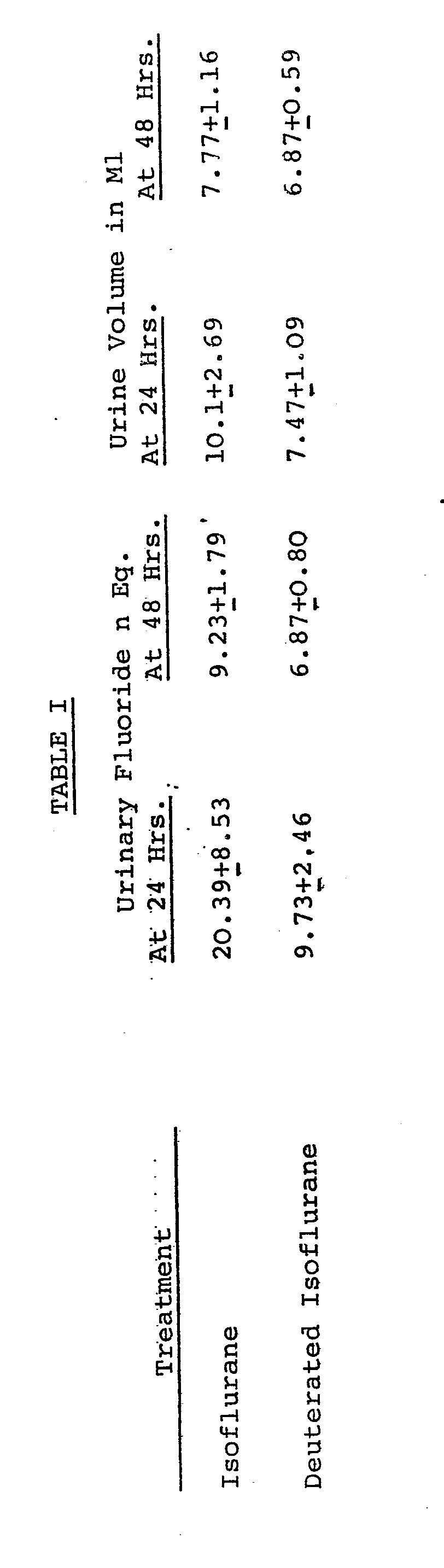
The data indicate the deuterated analog produces only about 48% as much fluoride
as isoflurane during the first 24 hour interval and about 75% as much during the second
24 hour interval. This indicates a significant reduction in the metabolism of the
anesthetic molecule to inorganic fluoride when the deuterated analog is used instead
of the undeuterated isoflurane..
1) A deuterated analog of isoflurane which essentially is l-chloro-l-deutero-2,2,2-trifluoroethyl
difluoromethyl ether.
2) The compound of the formula CF3CDC10CF2H.
3) Use of the deuterated analog of isoflurane of claim 1 as an anesthetic.
4) The use of claim 3 wherein the compound is administered to the animal in the presence
of an innocuous gas vaporization medium.
5) The use of claim 3 wherein the compound is administered in the presence of oxygen.
6) An anesthetic composition comprising the compound 1-chloro-1-deutero-2,2,2-trifluoroethyl
difluoromethyl ether and an innocuous gas vaporization medium.
7) The anesthetic composition of claim 6 wherein the innocuous gas vaporization medium
is oxygen.
8) The anesthetic composition of claims 6 or 7 further including another anesthetic.
